Monday, October 19, 2026

Types Of Collectivism

I recently came across this piece on Substack which I found intriguing and provocative.  From Tibor Rutar of the University of Maribor in Slovenia it is on the differences between Americans and Chinese on collectivism and individualism.  I've linked to it here and it's also worth reading the comments as they add layers of 

Isn’t it the case that Americans (and Westerners more generally) are selfish, asocial individualists while the Chinese (and Easterners or people from the Global South) are altruistic, prosocial collectivists?

Rutar points out that most discussions of this subject confuse two things.  The first is "warm fuzzy collectivism" which he describes as having four elements:

Feeling warm emotions about other people

Expressing positive emotions and identifying with other people

Rejecting self-interest, competition and negative feelings about other people

Extending this positivity to everyone, without sharply distinguishing between close and distant relationships 

He then posits that "the described warm and fuzzy collectivism strongly clashes with another cultural dimension that many thought would go together with it. That one is called “responsibilism,” and it’s also one form of collectivism. It has to do with how much a culture emphasizes the responsibilities people have to those close to them . . . responsibilism simply refers to how strongly people feel that they have non-shirkable duties and responsibilities for those they’re in close relationship with, like their parents or the extended family."

Rutar goes on to assert:

In Asia (including East Asia!) and Africa, responsibilism tends to be very high. In the West, it tends to be low or very low.

What's this all mean?

The key thing you need to wrap your head around is that “individualist” Western countries exhibit higher levels of prosociality or generalized cooperation. In non-Western, “collectivist” societies, the reverse is true. This sounds weird and paradoxical at first, because individualism is stereotypically associated with selfishness, competitiveness, and asociality, while collectivism seems to represent altruism, helping behavior, and cooperation with the whole of society. 

The professor goes on to use several examples to illustrate his proposition.  What caught my attention is that his observations generally reflect my experiences with both societies.  I'm going to spend more time with the comments and thinking this through. 

Sunday, October 18, 2026

Groesbeek Heights

Heading north from Eindhoven, we entered the area of the 82nd Airborne, driving across the John S Thompson Bridge spanning the Maas River.  The bridge was captured on the first day of Market Garden by 82nd Lt. John Thompson who led 16 men in an attack on the span.  In 2004 the bridge was renamed in honor of Thompson at a ceremony attended by his widow.

Though mis-dropped and understrength, Thompson decided to attack the bridge with his 16 man platoon rather than wait for additional troops. The bridge was defended by German forces supplemented by two 20 mm flak guns. Thompson's platoon destroyed "electrical equipment and cables that they expected were hooked up to demolitions", and their bazooka team destroyed the one of the flak guns, permitting the establishment of a roadblock on the bridge while waiting for reinforcements to arrive. 

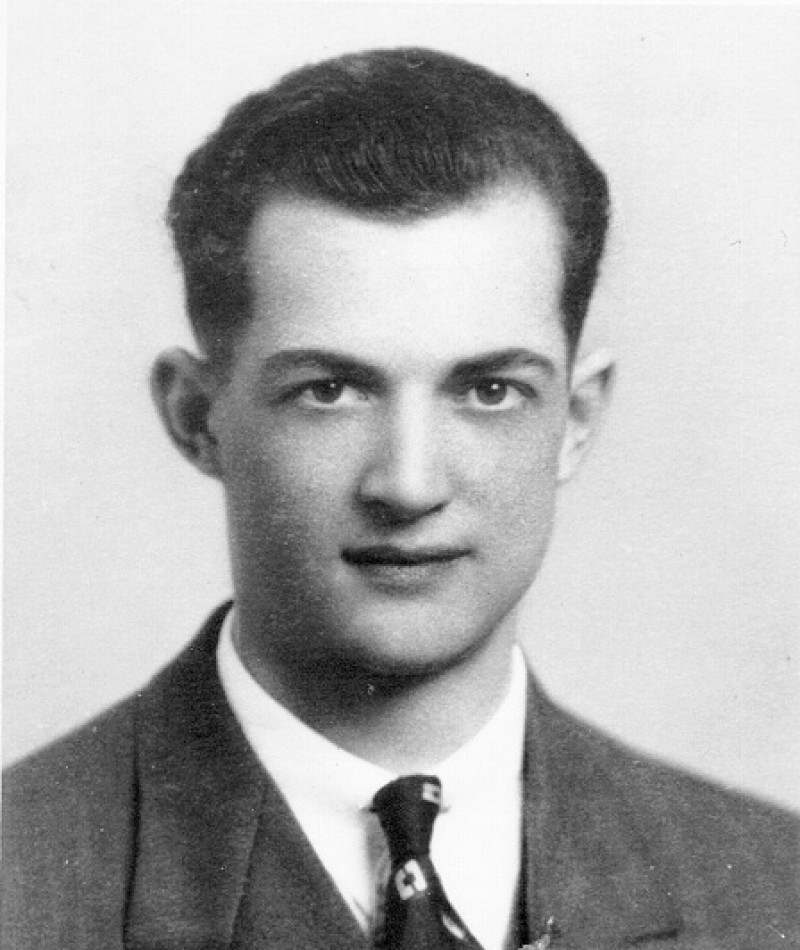
Thompson also fought at the Bulge, was wounded twice, and a recipient of the Bronze and Silver Stars.  "Jocko"Thompson was also a pitcher for the Philadelphia Phillies from 1948 to 1951.  Thompson, a native of Beverly, MA started his professional career in the Boston Red Sox farm system in 1940 after graduating from Northeastern University. Volunteering immediately after Pearl Harbor, Thompson missed four seasons while in the military and did not make his major league debut until he was 31.

The 82nd landing zones were south of Nijmegen and the division's initial objectives were to seize the high ground of the Groesbeek Heights, southwest of the city, in order to block any German counterattack, and then seize the bridge across the wide Waal River on the north side of Nijmegen.

Groesbeek Heights contains the Freedom Museum, commemorating Market Garden, the Dutch Resistance, and the story of Nijmegen during the war as well as many memorials and markers. Below is the memorial to the 82nd and its commander, General James Gavin.


Notice the wreath and photo atop the memorial.  Here's what it looks like up close.

Placed there by the grand children of PFC Kenneth R Holden.  Turns out it was placed there only two weeks before our visit.  On the 82nd anniversary of the landings, September 17, 2026, American and Dutch speakers gathered at a Groesbeek church to honor and commemorate those events.  One of the speakers was Chief Warrant Officer Ken Holden, one of the grand children.
 
This is another memorial a couple of miles away, commemorating the American defense of a small town against German counterattacks. 

The Freedom Museum contained this striking piece showing the dead paratroopers who liberated Nijmegen emerging from their graves to reminisce.

The Highway

The start point for Operation Market Garden is less than a two hour drive from the northern part of the Battle of the Bulge.  The plan for Market Garden (Sept 17-25, 1944) was for three airborne landings - 101st in the area of Eindhoven to seize bridges over rivers and canals in the area; 82nd near Nijmegen to seize bridges over the Meuse and Waal, and for the British 1st Airborne to take the Rhine bridge at Arnhem.  British XXX Corps was to drive up the highway from Lommel on the Belgian/Dutch border to reinforce the lightly armed paratroopers.  Once the Rhine bridge was secure the Allies would have outflanked the Siegfried Line/Westwall and could race into Germany.

We retraced the XXX Corps route from its start, stopping at markers and memorials along the way.  As in the Bulge battle area, local citizens and towns have erected and maintained these along the entire route.  I wanted to highlight two.

 
This is the memorial to Medal of Honor recipient Private First Class Joe Eugene Mann, located on a path near the Wilhelmina Canal near Best, north of Eindhoven.  The drop zones for the 101st were in the Best area and one of their goals were to seize the bridges over the canal.  After landing on Sept. 17, the following day Joe Mann knocked out a German 88 mm gun and an ammo dump.  His MOH citation goes on to read:

Completely disregarding the great danger involved, he remained in his exposed position, and, with his M1 rifle, killed the enemy one by one until he was wounded four times. Taken to a covered position, he insisted on returning to a forward position to stand guard during the night.

The wounds to his arms required they be strapped to his torso, making them unusable.  The following morning he was in a crater with several other wounded when the Germans counterattacked and a grenade landed in the crater.  Unable to use his arms to toss it away, Joe called "grenade!" and fell on it, saving his fellow troopers.  He received the MOH posthumously.  Joe Mann was 22 years old.  As you can see in the photo, the marker is well maintained and surrounded by fresh flowers and American flags.

Medal of Honor Recipient Joe E. Mann (Joe Mann)

This is a memorial at St Anthony's Mill in the town of Eerde, north of Best.  Much of the Eindhoven and Nijmegen areas seized by the Americans was under constant German counterattack for a week.  St Anthony's Mill, an actual windmill, was the site of prolonged fighting.  This memorial, which today sits next to a modest neighborhood of small well-kept homes, is maintained locally.  A few feet away is another memorial with the names of 75 men from the 101st who perished in the area around the mill. 

Highly recommended for a visit in this area is the Wings of Liberation Museum in Best.  It can be a little difficult to find, located within what is primarily a children's park.  The museum is directly adjacent to the 101st landing zones which, for the most part, remain open fields, and boasts an excellent collection of military equipment and an accompanying audio tour that highlights the bravery of the Dutch resistance.

Thursday, October 15, 2026

Summer Soft

It's been a while since we've featured Stevie Wonder.  Time to remedy that.  Summer Soft is from his 1976 double album Songs In The Key of Life, the capstone of the remarkable five album run Stevie had in the 1970s; Music Of My Mind and Talking Book (1972), Innervisions (1973), and Fulfillingness' First Finale (1974), containing tunes like Superstition, You Are The Sunshine of My Life, I Believe (When I Fall in Love It Will be Forever, Living For The City, Higher Ground, Don't You Worry 'Bout a Thing, Boogie On Raggae Woman, and You Haven't Done Nothin', being the predecessors.  Songs In The Key of Life also contained Sir Duke, Isn't She Lovely, I Wish, and Pastime Paradise.

Summer Soft, one of the album's lesser known songs is simply amazing.  From the gorgeous piano opening, multiple and complex chord, key, and rhythmic changes, layered intricate instrumentation, topped by one of Stevie's finest vocal performances (which is really saying something!), this is a masterpiece.  And from what I could find out that's Stevie on piano, synthesizer, bass, and drums.

Wednesday, October 14, 2026

Nuts

Bastogne is surrounded by monuments, memorials, and museums. of which we visited two.  The Bastogne War Rooms museum was disappointing.  Located in the downtown barracks that served as General McAuliffe's HQ it seemed rather thin on materials.  However, the Bastogne War Museum, located just outside the town was well worth a visit.  Artifacts, displays, and explanatory materials were all outstanding.  The audiophones also present a coherent and well-designed explanation of the events from four perspectives; American and German soldiers, a young schoolteacher who is part of the Resistance, and a young boy of 10 sent by his family in a small village to find shelter in Bastogne.

North of the town we visited Bois Jacques and the village of Foy, scene of two memorable episodes in Band of Brothers.  The Bois Jacques is where Easy Company was stationed for three weeks.  You can still see the foxholes in the forest.  Foy was the village just downhill from the forest attacked by Easy on January 13, 1945.  You can see the village from the edge of Easy's position.

Bois Jacques


 Foy from the edge of Easy Company position.

Memorials at the church in Foy.  The church was repaired after the war but still bares scars from the battle.  First photo is of church after the Americans took Foy.


This last photo tells the story of the return of treasured church artifacts returned by American soldiers many years after the war.
 

Tuesday, October 13, 2026

Grand Slam

It was Oct 13, 2013.  Things were looking grim for the Red Sox in their playoff series against the Detroit Tigers.  They'd lost 1-0 at Fenway the night before and tonight they were down 5-1 entering the bottom of the 8th.  If they lost, the Sox would be going to Detroit to play three games down 2-0 in a best of 7 series.

LDC and I had been in the Fenway bleachers the week before to see the Sox beat the Rays on their way to a 3-1 series win and I was watching the game that night and not feeling good about it. 

Detroit starter Max Scherzer was overpowering holding the Sox to two hits and one run while striking out 13 in seven innings but took himself out of the game at that point.

Jose Veras started the 8th for the Tigers, getting the first batter out on a grounder but Will Middlebrooks doubled to left.  Drew Smyly replaced Veras and walked Jacoby Ellsbury on a 3-2 count and was immediately replaced by Al Alburquerque who struck out Shane Victorino.  Two down!  But then Dustin Pedrioa singled, loading the bases.

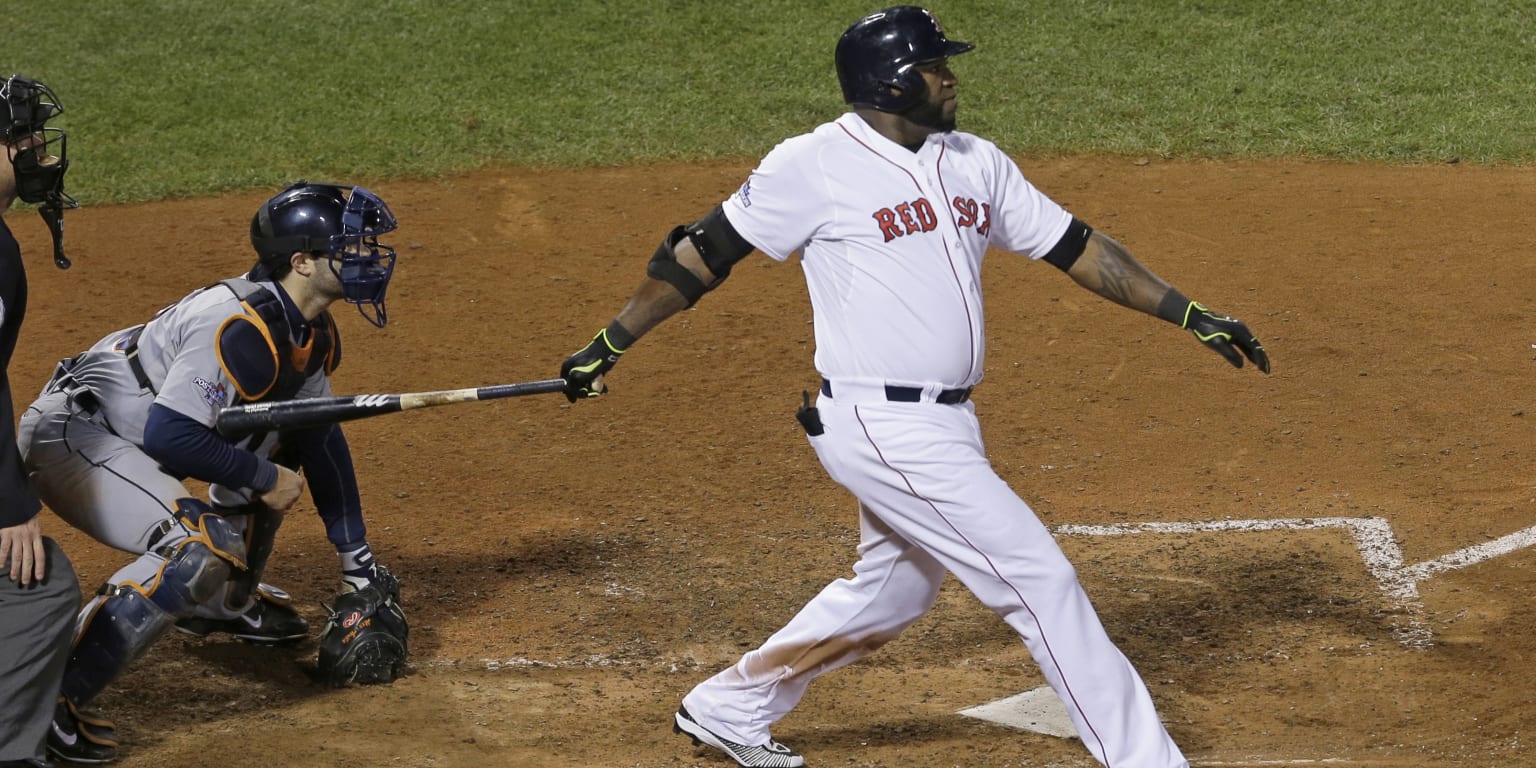
Joaquin Benoit, the Tigers' closer, came in to face David Ortiz.  Big Papi had not had a good series so far going 0 for 6 with four strikeouts.  Scherzer had faced him three times that night, getting him to K twice while walking the slugger once.  Benoit's first pitch was a changeup which Ortiz hit on a line into the Red Sox bullpen giving us the immortal photo of Tiger center fielder Torii Hunter's legs after he plunged over the low wall in pursuit and behind him the upraised arms of a Boston policeman who was stationed in the bullpen.  The grand slam tied the game.  

 David Ortiz clutch grand slam 2013 ALCS Big Papi's swing against Benoit.

David Ortiz, Red Sox take dramatic win over Tigers - The Boston Globe 

The deflated Tigers went on to lose in the bottom of the 9th when the Sox pushed across the winning run.  Ortiz only went 1-15 in the next four games, one of his worst playoff performances, but he came through when it most counted and the Sox took 2 of 3 in Detroit and then won game 6 in Fenway, going on to beat the St Louis Cardinals in the World Series.  Big Papi hit .688 in the World Series and was on base 19 times in 24 plate appearances.  LDC and I were in the bleachers for the final game and experienced the Red Sox winning the World Series at Fenway for the first time since 1918.

I came across this interview with Torii Hunter in which he drops a few nuggets, most startingly that he and Ortiz had dinner the night before the game and Big Papi told him that Benoit was tipping his pitches so he knew what was coming. Hunter said Benoit was dismissive when he told him of Ortiz's claim, responding that he always got him out.  I checked and as of the playoff series, Big Papi was 6 for 22 off of Benoit, but had only 3 hits in his last 15 at bats, and he'd never had an extra base hit against Benoit.

Torii also talks about the longer term effects from hitting his head when falling into the bullpen. And, though not said directly, Hunter implies he did not like Scherzer's decision to take himself out of the game.  Torii Hunter had a distinguished career and was an outstanding outfielder and is in the Almost Good Enough, But Not Quite, To Get Into the Hall of Fame category.  

Monday, October 12, 2026

Luxembourg

My first time in this tiny country.  The northern part is very hilly and heavily forested, the central area more open with rolling countryside.  Quickly overrun by the Germans at the start of both world wars.

Clervaux, the small town where we stayed for the night, sits at the bottom of a bowl, surrounded by steep wooded  hillsides, with only narrow, twisting and steep roads providing access.  Within the town is a small hill upon which sits a castle, today the site of the history museum filled with artifacts of the Battle of the Bulge.

The town's significance is that on December 16 it sat about five miles from the German front lines and it is only 20 miles from Clervaux to Bastogne via a direct road.  The German timetable called for the attack to begin at dawn on the 16th, quickly seize Clervaux, and take Bastogne by noon on the 17th.  The importance of Bastogne lay in the road network centered on the town and it was to be the path for the German army to advance upon Brussels, protecting the flank of the main effort toward Antwerp.

Instead the last remnants of the 110th Infantry Regiment, 28th Division held out at Clervaux until the morning of the 19th, while Combat Commands from the 9th and 10th Armoured Divisions sacrificed themselves to slow down the Germans on the road to Bastogne.  The Germans did not approach Bastogne until the afternoon of the 19th, only beginning their attacks on the town on the 20th, by which time the 101st Airborne had arrived.

Near the gate to the castle is the restored Sherman tank which defended the castle during the German assault until it was damaged.  


Clervaux was rebuilt after the war and today is a quiet vacation town.


 From Clervaux we drove 45 minutes south to Dierkirch, another Luxembourg town occupied by the Germans, which houses the country's National Military Museum containing an impressive array of equipment and artifacts.
 

On the 45 minute drive to Bastogne we stopped at the Schummanseck Memorial Path just before entering Belgium, site of the deadliest concentrated fighting of the battle.  Patton's Third Army reached Bastogne on December 26, breaking the siege, but only had a narrow corridor open to supply the town, which remained mostly surrounded by the Germans.  Patton proposed attacking the Germans from both north and south at the base of the salient created by the Bulge attack, believing the enemy would be unable to defend at strength and forcing a withdrawal.  However, he was overruled by Eisenhower, Montgomery, and Bradley, who ordered an attack from the south closer to Bastogne, only ten miles east.
 
The result was Patton's attack in the area of the Schumannseck, resulting in a grueling and bloody fight that lasted for the first three weeks of January, with thousands of casualties on both sides.  The Memorial Path is in a forested area taking you past foxholes and outposts used by Germans and Americans who fought at close quarters.  The eerie part is that life-sized portrayals of Germans and American soldiers are placed along the trail.


Sunday, October 11, 2026

The Bulge: The Northern Shoulder

We continued our travels through the northern sector of the battle driving through the twin villages of Rocherath and Krinkelt which saw house to house fighting as the 99th and 2nd Divisions delayed the 12th SS Panzer Division, allowing American reinforcements to reach the Elsenborn Ridge where they withstood further German attacks over the next week.  Much of the Elsenborn Ridge is today a training area for the Belgian Army and inaccessible to tourists.  A narrow one-lane road goes up the ridge where there is only one small monument marking this critical point in the American defense line.

From there we went about 10 miles southeast to the tiny village of Lanzareth only a couple of miles from the German border.  With the aid of Google maps we were able to find a small gravel road leading up a hill where we found a monument dedicated to the Intelligence & Recon Platoon, 394th Infantry Regiment, 99th Division.  On the morning of December 16, the 22 man platoon, commanded by 2nd Lt Lyle Bouck Jr, who would turn 21 the following day, found itself confronting a 500 man German battalion.  The German timetable called for the battalion to quickly seize the village and open a path for the Panzers to exploit the breakthrough.  Instead, Bouck's platoon, with the assistance of four forward artillery observers, held off the Germans for eighteen hours before surrendering after running out of ammo, completely disrupting the attack plan and delaying the advance of the panzers by a critical day.  

Because Bouck and his platoon were POWs for the rest of the war, the actions by the platoon were little known and not recognized for decorations until 1981.  Once a full review was made of the I&R Platoon's heroic conduct, it became the most decorated American platoon of the war.  The unit received a Presidential Unit Citation, Bouck and three others received the Distinguished Service Cross, five members received Silver Stars, with nine receiving Bronze Stars with V device for Heroism.  The four soldiers of the 371st Forward Artillery Observation Team (one of whom was killed on Dec. 16) each received the Distinguished Service Cross.

The photos show the position of the memorial.  Lanzareth is at the bottom of the hill.  The hills in the distance are in Germany.  The other photos show the memorial and the information on its panels. Standing on that hillside and imaging what those soldiers went through that day was a powerful moment.


Saturday, October 10, 2026

The Straight Story


David Lynch made some bizarre and strange movies, but he was not a cynic.  A cynic could not have made The Straight Story, the G-rated movie Lynch directed for Disney, which was released in 1999.  I saw it when it was in theaters and recently watched it again.

The movie is based on the story of Alvin Straight.  In 1994, the 73 year old Straight, living in western Iowa, learned that his brother Lyle, across the Mississippi in the hill country of Wisconsin, 240 miles away, had suffered a stroke.  Alvin had been estranged from his brother for a decade, during which they had no contact, but decided he needed to see him.  As he says "It's a hard swallow on my pride to do this trip.  I just hope I'm not too late". Not having a driver's license and refusing to travel by bus or have someone drive him, Alvin decided to ride a lawn mower the entire way - a journey which took five weeks.  The movie is about that journey.

It's a calm, reflective tale that Lynch spins.  The movie was filmed along the same route Alvin rode and captures the land and people of the region and its small towns. And Lynch clearly adores and admires the movie's characters.  There is no antagonist in the film, you saddle up and, with a bit of patience, enjoy the ride and Alvin's encounters along the way, including with a runaway pregnant teenager, a revealing conversation with a fellow WW2 veteran in a Wisconsin bar, and the legendary grabber scene. 

There are a couple moments of Lynch's patented weirdness, most notably with Alvin's encounter with a woman motorist who has just hit a deer and goes off on an extended and very odd lament about hitting several deer over the prior two weeks on her commute to work. 

The cast is impeccable.  Richard Farnsworth plays Alvin with quiet, restrained dignity, a role for which he was nominated for an Academy Award as Best Actor.  What Farnsworth kept secret from Lynch and the rest of the cast was he was terminally ill with prostate cancer.  The canes you see Alvin use in the film for support were actually needed by Farnsworth at the time, but he made up an excuse as to why he needed them.  Farnsworth died a year after the film was released.  Farnsworth's manner of speaking and attitude reminded me of my late father in law who was born in Nebraska and lived his adult life in Iowa, adding additional poignancy as I watched.

Sissy Spacek plays Alvin's daughter.  Her back story, involving her children, is one of the few purely fictional aspects of the screenplay.  Harry Dean Stanton plays Alvin's brother and their reunion scene at the film's end is perfect.  There are also many smaller roles cast perfectly but one deserving highlighting is James Cada as Danny Riordan who helps Alvin when his lawn mower breaks down and develops a relationship with him.  Cada conveys that Midwestern decency and straight forwardness that I've seen over the years, having spent a lot of time in Iowa and Wisconsin.

The score by Angelo Badalamenti is subtle, lovely, and underlines the movie's mood. 


The Bulge

In September 2024 my friend Joe and I spent a week along the French-Belgian border visiting WW1 sites, primarily Ypres, the Somme, Verdun, and Meuse-Argonne, a trip about which I did three posts, Left Behind, Lochnagar Crater, and Butte de Vauquios.

This year we traveled to Belgium, Luxembourg, and the Netherlands spending three days each on the Battle of the Bulge and Operation Market Garden.  We also spent an afternoon in Amsterdam which I didn't care for being overrun by tourists, somewhat shabby, and reeking of weed everywhere.  The rest of the trip was memorable.

 I'm writing of the Bulge and Market Garden separately but something we were impressed with in both areas was the extent to which these battles are still remembered today and the Allied participants honored.  We saw many American flags, not only at museums and major combat sites, but in small towns and the countryside where small American units fought.  These include memorials to individual soldiers and units, maintained by local volunteer groups or municipalities eight decades after the events.  And the same can be said for the way British and Polish airborne are honored in the Arnhem area.

The Ardennes, the forested and hilly area of Belgium and Luxembourg, is beautiful country filled with small towns and villages, narrow scenic roads, narrow valleys and rolling countryside.  At the same time you see constant reminders of the terrible events that occurred between December 16, 1944 and January 28, 1945, in which 80,000 Americans were killed, wounded, missing, or captured. 

Growing up most of what I knew about the Battle of the Bulge was centered around Bastogne, the 101st Airborne and its acting commander, General Anthony McAuliffe, responding "Nuts" to the German demand he surrender his forces.  The prominence of Bastogne and the 101st has been heightened further by the popular series Band of Brothers which includes several episodes on Easy Company of the 101st at Bastogne.  

In recent years as I've done more reading and listening to the 8-part series on the battle on the We Have Ways of Making You Talk podcast, I've come to a better understanding of the battle and we designed our tour to reflect this.  We only spent the last of our three days in the Bastogne area, instead focusing on the northern sector where the Germans planned their breakthrough only to be thwarted by outnumbered and outgunned American forces and the central front where the 28th Infantry Division and Combat Commands from the 9th and 10th Armored Divisions fought desperately and successfully to delay the German timetable enough for the 101st to reach Bastogne.  The four American infantry divisions on the front line on December 16 (south to north: 4th, 28th, 106th, and 99th) were outnumbered 5-1 in infantry and 10-1 in tanks.

Our first day we initially traced in reverse the route taken by Kampfgruppe Peiper which broke through American lines until finally stopped at the village of La Gleize in the town of Stoumont.  We then traveled through Stavelot and Malmedy (the site of the notorious massacre of American prisoners by the SS troops under Peiper's command, and on towards the German border.  We then visited St Vith, Lanzereth, and the Elsenborn Ridge where the green 99th Infantry Division, quickly reinforced by other American units, stopped the main German thrust towards Antwerp.

Our second day was primarily in Luxembourg where we stayed in Clervaux, HQ of the 110th Regiment of the 28th Division, the unit which bore the brunt of the German attack in the center, losing 85% of its strength, but gaining precious time by disrupting the German timetable.  Clervaux today is a lovely little town set in a bowl and surrounded by forests.  In 1944 it gained the nickname of Alamo in the Ardennes.  We also visited the country's National Military Museum in Diekirch, a town initially captured by the Germans in the offensive.  Finally, we visited the Schumannseck Memorial Path, where Patton's troops fought the Germans for three weeks in early January.

At the December '44 Museum in La Gleize, the little village where a collection of American units, including the 82nd American (Joe served in the 82nd during the 1980s) stopped Peiper.  That's me in front of a German Tiger Tank abandoned by Peiper's attack group.  The museum contains a large collection of artifacts, most of which were left behind by the Germans.  Also below is a memorial to the 82nd in the nearby town of Werbomont.


Stavelot. This little town saw fierce fighting with the Germans occupying parts of the town for over three weeks.  Peiper's SS Panzer troops executed more than 130 Belgian civilians during the occupation.  Photos below are from the Memorial Park along the River.  Second photo is memorial to the civilians murdered.  It took us a couple of minutes to realize what we were looking at in the picture in the third photo.  It shows a German tank and if you look beyond the picture you will see that still standing today is the building in front of which the tank was emplaced.


The next town was Malmedy, today a very pleasant market town.  A little over two miles outside town is a field where, on December 17, Peiper's SS troops killed 84 American prisoners from the 285th Field Artillery Observation Battalion.  The prisoners were machine gunned and then German soldiers shot any survivors.  However, in the chaos a number of Americans were able to escape and reached American lines.  Peiper's unit had murdered other American POWs earlier that day but this remained unknown for some time but with the Malmedy survivors carrying the news within hours, the military publicized the event and it was quickly picked up by newspapers.  News of Malmedy helped stiffen American resistance and created a desire for revenge.  For the remainder of the war German SS troops would find it difficult to surrender to Americans and survive. Investigations after the war concluded that between 300 and 700 American soldiers were executed by Peiper's column.
 
The photos below are from the Memorial.  Many American family members of those killed have placed photos and other remembrances at the memorial and the names of each of those killed is engraved on the wall.  An American flag flies over it.  


Friday, September 4, 2026

If You Know You Know

 By all accounts an accurate portrayal of the Churchill-De Gaulle relationship.

Sunday, August 30, 2026

Grandma's Hands

Bill Withers, live in 1974 on the BBC.  The final line of the song is in the pantheon of finest last lines in music.

Saturday, August 29, 2026

Those Were The Days


Friday, August 28, 2026

I Gotta A Right To Sing The Blues

Composed in 1932 by Harold Arlen (music) and Ted Koehler (lyrics).  Arlen and Koehler also together wrote Get Happy, I've Got The World on a String, and Stormy Weather.  With other lyricists, Arlen wrote the music for Over The Rainbow (as well as the other songs featured in The Wizard of Oz), The Man That Got Away, That Old Black Magic, It's Only A Paper Moon, and One For My Baby (And One More For The Road).  Louis Armstrong puts his unique stamp on this version with his horn and voice.

Wednesday, August 26, 2026

Train Train

Like everyone else I liked and admired Dolly Parton and featured her in four posts over the years.

This is Train Train from her bluegrass period backed by the great pickers at Union Station with Allison Krauss singing backup.  You can also hear her transform Stairway to Heaven into a gospel hymn with her adding lyrics at the end, and perform a lovely version of Neil Young's After The Gold Rush with Emmylou Harris and Linda Ronstadt. 

Another Travesty

Today I learned that in 2020 the University of Texas School of Journalism and Media established the Dan Rather Medals for News and Guts.  What a travesty and what a disgrace for journalism.  Read Promoting Disinformation to find out why.

Tuesday, August 25, 2026

Let's Play Two!

As Ernie Banks would say.  So let's do two baseball posts today.

Just realized Albert Belle turns 60 today.  Was reminded coming across this video (below) titled "Albert Belle Was The Most Un-Hinged Baseball Player of All-Time" by sportswriter Jeff Pearlman.  While a reminder of the craziness of Albert at times (just watch his assault on second baseman Fernando Vina), the title and language are somewhat overhyped as everything seems to be in recent years.  It's worth a watch and has an unexpected and relatively happy ending.  Turns out Albert and his family are neighbors of ours in Scottsdale.

Belle was an incredible hitter.  He only played ten full seasons (1991-2000), retiring just after turning 34, but he could pound the ball.  Over those ten years he averaged per season 38 doubles, 37 home runs, 120 rbi, with a .297 batting average.  At the time he retired Albert had the 10th highest career slugging percentage in major league history.

He was capable of prolonged hot streaks, over the last 90 games of the strike-shortened 1994 season hitting .367, with a OBP of .447, while slugging .757 with 67 extra base hits and 90 rbi.  During the 1995 season, Belle had 103 XBH.  During the final 87 games of the 1998 season his splits were .389/.461/.799, including 63 XBH and 93 rbi. I remember how intimidating he could look at the plate.

As far as being the "most un-hinged" ballplayer, Albert has a lot of competition.  Take Ty Cobb for example.  In my review of Charles Leersehn's revisionist biography, Ty Cobb: A Terrible Beauty, I noted:

As Grantland Rice, a friend and admirer, wrote years later:

When I first met Cobb I found him to be an extremely peculiar soul, brooding and bubbling with violence, combative all the way, a streak, incidentally, he never lost.    
Throughout his career, though much less after he retired, he reacted quickly to any perceived insult.  In commenting on his penchant for fighting Leerhsen writes:
. . . he provided such a dizzying array of examples to choose from - fights with complete strangers, fights with teammates, fights with rival players, fights with hotel employees, shopkeepers, and rowdy cranks [fans] . . .
The author goes on to provide an account of his behavior over a short period during the 1916 season; fighting with Buck Herzog of the Giants both on and off the field; an incident in Comiskey Park when, angered by a called third strike, he threw his bat into the stands; flinging a handful of dirt into the face of a Senators pitcher; and being pulled out of stands in St Louis by teammates and police before he could pummel a heckler.

I also quoted Bill Veeck:

"Wake up the echoes at the Hall of Fame and you will find that baseball's immortals were a rowdy and raucous group of men who would climb down off their plaques and go rampaging through Cooperstown, taking spoils, like the Third Army bustling through Germany". 


The Black Sox

I read Eliot Asinoff's Eight Men Out many years ago and enjoyed John Sayles 1988 movie based on the book.  Over the years, I've become aware of the many inaccuracies in both.  Asinoff and Sayles were both sympathetic to the plight of the eight Chicago White Sox players who threw the 1919 World Series to the Cincinnati Reds, becoming known as the infamous Black Sox. In their telling, Charles Comiskey, the Sox owner, was the bad guy who drove the players to take payoffs from gamblers.

Several years ago, the Society for American Baseball Research (SABR) published Eight Myths about the Black Sox, along with an exhaustive appendix of the significant, and not so significant, errors and omissions in the book and movie. 

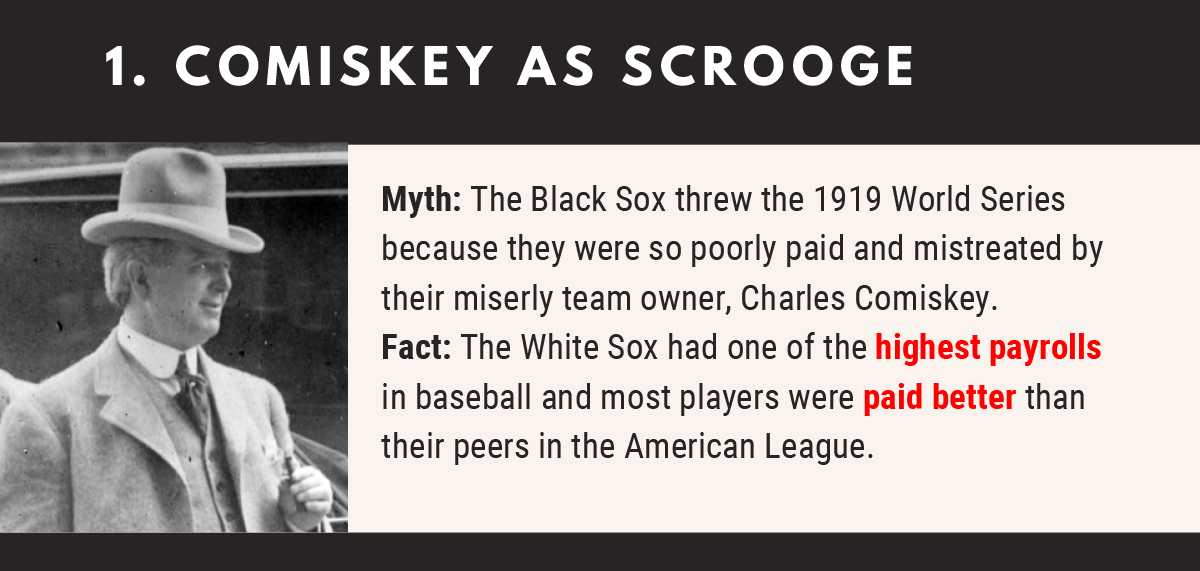
To give you a flavor this is the first of the myths:

This is the central thesis of Eight Men Out: Charles Comiskey’s “ballplayers were the best and were paid as poorly as the worst,” as Eliot Asinof wrote. That couldn’t be further from the truth. We can’t climb into the heads of the Black Sox to know exactly why they threw the World Series. But the players themselves rarely claimed, as Asinof did, that it was because of Comiskey’s low salaries or poor treatment — and we now have accurate salary information to back that up. Newly available organizational contract cards at the National Baseball Hall of Fame show that the White Sox’s Opening Day payroll of $88,461 was more than $11,500 higher than that of the National League champion Reds, and several of the Black Sox players were among the highest-paid at their positions. If they did feel resentment at their salaries under the reserve-clause system, so did players from 15 other major-league teams. The scandal was much more complex than disgruntled players trying to get back at the big, bad boss. 

You can find the 8 Myths here and the detailed appendix here. 

With the proliferation of sports gambling sites and their active promotion during the broadast of sporting events I fear we will eventually have another huge scandal like the Black Sox. 

Monday, August 24, 2026

Rolling Down A River

In late December of 1831, Alexis de Tocqueville, the young Frenchman who would become famous for writing Democracy in America, was on a steamboat traveling down the Mississippi River to New Orleans.  On December 27 Sam Houston and two Cherokee boarded the boat in Arkansas, soon meeting de Tocqueville, who was well aware of Houston's notoriety and recorded their conversation.

Houston is the most emblematic figure of that period in American history between the War of 1812 and the Civil War, as recounted previously, representing a constellation of beliefs that don't neatly fit into any of today's categories. The French traveler was meeting Sam at a low point in his life. In early 1829 he'd been the newly elected governor of Tennessee and was also newly married to Eliza Allen, when she suddenly left the governor's house in the middle of the night, and refusing Houston's entreaties to return.  The distraught Houston resigned and fled to the Indian Territory (now Oklahoma) to join his Cherokee friends, with whom he'd already lived with for three years as a teenager.

Marrying Tiana Rogers, a Cherokee widow, Houston embarked on an epic drinking spree, earning the nickname "Big Drunk".  Tocqueville met him when Sam was part of a Cherokee lobbying delegation off to Washington DC, where Houston had served in Congress and was a friend of President Andrew Jackson who'd been his political mentor.

Tocqueville wrote of Houston, “His figure is athletic; everything about him indicates physical and moral energy,” and after writing of his downfall , “Since then, he has lived in the midst of the wilderness, half European, half savage.”  He then recorded much of their conversation in a Q&A format:

Q: Have the Indians a religion?

A: Some of them have no belief in the immortality of the soul. But generally the Indians believe in a God who punishes or rewards the deeds of this life in the other world.

Q: Have they any form of worship?

A: The Osages, who live on the frontier of Mexico, pray every morning to the rising sun. The Creeks have no worship. It is only in times of great calamity, or before undertaking some great enterprise, that they devote themselves to some public manifestations of worship.

Q: What sort of government have the Indians?

A: Generally a patriarchal government. Birth makes the chiefs. Among the tribes which contact with Europeans has made more enlightened, they are elected.

Q: What is the status of women among the Indians?

A: Complete servitude. The women have to do all the unpleasant tasks, and live in great degradation.

In response to a question about the intelligence of Indians and blacks, Houston replied, according to this History Net article:

. . . that he believed both Indians and black people were as intelligent as whites, and he suggested that freedom spawns intelligence while slavery thwarts it. “The Indian is born free; he makes use of this freedom from his first steps in life,” Houston told Tocqueville. “Surrounded by dangers, pressed by necessities, and unable to count on anyone, his mind must be ever active to find means to ward off troubles and to maintain his existence. This necessity imposed on the Indian gives his intelligence a degree of development and ingenuity which are often wonderful.” Meanwhile, Houston added, the black man’s native intelligence is crippled by slavery: “The first notions of existence which he receives make him understand that he is the property of another, that care for his own future is no concern of his, and that the very power of thought is for him a useless gift of providence.” 

As I've written elsewhere, Sam Houston was the greatest political defender of Indian rights in the pre-Civil War United States.  While he was not an abolitionist, and owning slaves, he opposed the extension of slavery, and later secession.  Sam was forced to resign as governor of Texas in 1861 when he refused to take an oath to the Confederacy, and freed his slaves when learning of the Emancipation Proclamation.

Sunday, August 23, 2026

Lifes Rich Pageant

My favorite R.E.M. album, Lifes Rich Pageant(1), was released 40 years ago this summer, though my favorite song remains Driver 8 from their prior album, Fables of the Reconstruction.  The band hailed from the same place as the B-52s, Athens, Georgia.  Over its long recording career, R.E.M. had two distinct styles; songs on which you could not understand Michael Stipe's lyrics and those on which you could (Losing My Religion and Everybody Hurts are good examples of the latter).  THC much preferred the former earlier style.  R.E.M. were at their best when they featured jangling guitars,  strong melodies, and Stipe's mumbling vocals buried into the mix. I find a lot of later REM either dreary or just too much.

Burying the vocals in the mix dominated the early R.E.M. records in the 1980s.  It didn't mean that the listener couldn't make out any words in the murk.  Indeed, words and even phrases could be interpreted but there were always passages when you simply could not make out what they were saying.  And, back then, there was no internet to quickly search out the lyrics.  It also ensured that you often had no idea what the song was about, which in some cases may have been for the better.  Lifes Rich Pageant is a transitional record in which Stipe's vocals occasionally emerge above the mix.

Here's one of the best cuts from the album, These Days, and you should also listen to Fall On Me, Cuyahoga, Hyena, and Swan Swan H. 


-------------------------

(1)  Yes, I know it should be Life's but that how it appears on the cover of the album. 

High Performance Driver Education

Came across this 2022 article from Car and Driver, "Why Attending A High Performance Driving School Is Worth It", in which their editors attended driving schools with BMW, Lexus, and Porsche and giving all the experiences a thumbs up.

It reminded me of my own experience with High Performance Driver Education (HPDE) in 2005, when my good friend and I took our Nissan 350Z's to Lime Rock Park in Lakeville, CT.  Lime Rock is a 1.5 mile long track which hosts competitive racing as well as education and training for drivers.  The track is not an oval, rather a curving, up and down cross-country path, with a 1/4 mile straight away at the end of each lap.  Except during the straight away most of the track is only two cars wide.  The Paul Newman straight is named after the actor, a Connecticut residence, who frequently raced on the track.

https://photos.smugmug.com/Website-Photos/n-qFxFdp/Low-res/Maps/i-CDK35j3/0/028f5a7b/X5/TrackMap-classiclayout_PLNstraight-01-X5.jpg 

From what I can tell from the current Lime Rock website, our version of HPDE was a little looser than what is on offer now.  My friend and I had been talking about going there for a while so our wives got together and purchased seats, giving them to us for our birthdays, which were two weeks apart.  They also informed us that they had increased the amounts on our life insurance policies.

I can't remember which outfit ran the HPDE but they warned us before the training day not to count on any insurance coverage if our vehicles were damaged.  We assumed all the risk.

It was a cold, early November morning when I set out, driving my black, 2003 Z the hour to get to Lime Rock.  We started out with about an hour of classroom instruction, learning about driving the Apex and other techniques.  The instructors emphasized that our cars were capable of much more than we realized or had the opportunity to explore in our usual driving mode.  There were about 15 of us in the class, driving a variety of cars.

(2003 Nissan 350Z)

2003 Nissan 350Z | GR Auto Gallery 

During the course of the day we had four driving sessions, the first 2 being twenty minutes and the last 2, twenty five.  In between each we had about an hour for more instruction or recovering from the experience.

All the cars started together.  We had an experienced driver with each of us.  We wore helmets that had speakers and mics so we could get active directions from our instructors.  My instructor was a retired bank executive who drove a Corvette with a 729hp engine when he raced.

I was instructed not to look at the dashboard, except to be aware that when my tachometer hit red I should shift.  Your entire focus was looking at what was in front of you through the windshield.  This was an experience where you can do absolutely nothing but concentrate on your single task.  You do not let your mind wander. 

Because it was cold that morning, when we started tires were pretty hard and had limited traction until we were underway for a little bit.  We started at the bottom left of the track map heading through the Big Bend.  As we got to the second turn (Lefthander) the car in front of me failed to negotiate the turn and went off the track (it was not damaged).  This was to happen a couple of other times that day. 

I was nervous during that first session.  There were cars all around me, but my instructor was quite good, calmly coaching me to slowly add pressure to the gas pedal, head towards a point at the side of a straight stretch, then tap the brake and turn the steering wheel 90 degrees to negotiate the turn.

By my third time out I was driving much faster, feeling okay going 90+ only a few feet off another car's bumper, and being sharp on my turns. Between my third and fourth sessions, my instructor asked if I would like to go out with him driving on the track.  He borrowed a Corvette from a friend (who quietly told me my instructor's car had a blown engine that cost 30K to replace).  We strapped in and took off.  Other, more experienced, drivers were on the track at the same time. 

It was like being in a rocket ship.  A few minutes in we were coming up to the West Bend, my instructor made the sharp turn to the right at the point where the track began to slope downhill so sharply that we could not see further until hitting the crest.  But right on the crest was another car which had spun three quarters around, squarely across both lanes, and not moving.  I saw the driver staring at us with his mouth and eyes wide open while at the same time I heard in my speaker my driver go "oh, shit".  The instructor managed to react quickly enough to miss the other car by inches; I still can't believe he do so. As we sped downhill we saw a Porsche that went out of control after passing the stranded car, had spun around and crashed into a fence.  Immediately, loud horns were going off and the track closed down, while the Porsche and the stranded car were towed off.  Thankfully, no one was hurt.

It was during my third session I had my best driving moment.  The most difficult section of the track for me was at the end of the long straight away (the Sam Posey Straight), where there was a sharp turn, requiring a double shift while you were among other cars on the curve. I was often missing up the turn and coordinating changing gears with using my brake pedal.  The end of Sam Posey was where you were driving the fastest on the course.  While, at the time, I never looked at my speedometer, I was later able to calculate that I hit 130-135 mph just before the curve.  Towards the end of the third session however, I was not only able to smoothly negotiate the curve, but passed another car on the inside while in the curve.  It felt exhilarating.

Towards the end of the final session, I could feel myself tiring and my concentration fading which led to making a couple of sloppy turns so I brought my car in a couple of minutes before the session ended. 

I was physically and mentally drained at the end of the day, a drove home very slowly. My car had a layer of tire particles over it.  Running my fingers over the hood you could feel and see it. My friend had to replace all his tires after the session.

It was a wonderful day.  I came away a much better driver and it made even my commute to work on the Merritt Parkway more fun.  It was also one of those rare experiences when you are totally concentrated on one thing, which I enjoyed.

I also came away with a much greater appreciation for professional race car drivers.  I'd been on the track for a total of 90 minutes during the day and came away completely exhausted.  I was not a follower of competitive race car driving and had no comprehension of the amount of physical and mental concentration needed to be maintained by race drivers for hours on end.  They are true athletes. Hats off to them.

Saturday, August 15, 2026

Streaks

In Game, I pondered the recent success of the Red Sox.  I need not have been concerned as they've now lost six of their last seven games.  Observing the Sox who won 32 of 37 but who've taken 85 games to win another 33, I naturally thought of the 1916 New York Giants and took a look at the details of their season of extremes. The '16 Giants started off losing 13 of 15, then embarked on a long road trip winning their next 17.  Following a long period of post-streak mediocrity, the Giants then won a major league record 26 in a row, all on a home stand, before losing 4 of their last five.  They went 43-0 during the two streaks and 43-66 the rest of the season.  The Giants finished in 4th place with an 86-66 record.

If the Giants had merely played .500 ball apart from their two winning streaks, they'd have won the pennant.  Looking at it from the opposite perspective, apart from their season opening and ending 3-17 record, the team won 83 and only lost 49.  

Operation Pedestal

On this date in 1942, the SS Ohio, an American built oil tanker requisitioned by the British Navy the month before, and loaded with 13,000 tons of aviation fuel, reached the Grand Harbor at Malta.  The rudderless tanker, a gaping hole in its stern and its decks awash, had to be towed in.  The Ohio was one of 5 ships of the original convoy of fourteen that had survived repeated German attacks to reach the island.  The fuel carried by the ship would save Malta.

The story of WW2 is dominated by great battles and campaigns, but lesser known events proved just as critical.  The arrival of the Ohio is one of those.

The Mediterranean island of Malta was the object of one of the two great sieges of the war, lasting from June 1940 to November 1942, the other being Leningrad which lasted from September 1941 to January 1944 (1).

Malta had been a British possession since 1800, its position between Italy to the north and North Africa to the south, and midway between Gibraltar to the west and Alexandria and the Suez Canal to the east, making it of immense strategic importance and a major base for the British Navy.

The events of June 1940 were to make its importance even more critical.  With the surrender of France, that country's possessions in Tunisia, Algeria, and Morocco were now under the control of Vichy, the French government collaborating with the Nazis and hostile to Britain.  That same month Mussolini declared war on Britain and France, making Libya, Italy's North African colony, a threat to Egypt and the Suez.  That same month, Italy began undertaking aerial bombing of Malta, which proved ineffective.

Over the next two years, Axis efforts against the island waxed and waned, going through various levels of effectiveness.  For the British it was critical to maintaining the supply lines to its forces in the Middle East where the 8th Army was fighting the Italians, and beginning in early 1941, the Germans under Rommel, as well as interfering with German and Italian efforts to supply their forces in North Africa.  For the Germans and Italians, neutralizing Malta would enable support for Rommel and cripple British defenses in the Middle East.

At times, the Luftwaffe deployed a large part of its fighter and bomber fleet against the island, but the failure of Germany to ever launch an invasion of the isolated island was a major strategic failure on its part.

Malta had multiple vulnerabilities. It required constant supply of food for its population,  In addition, the British garrison, particularly the air force and navy required large amounts of fuel oil.  This necessitated the need for supply convoys to undertake the dangerous passage through the Med.  In early 1942, the Germans and Italians began their fiercest campaign to cut off the island and by mid-summer Malta was in desperate conditions, the food supply nearly gone and the aviation fuel essential to its defense almost gone.  An effort to send two supply convoys in June was a costly failure and by the beginning of August, rationing on Malta reached a critical point; adult male workers got 1,690 calories a day, while women and children received 1,500 calories daily.

As a last chance gamble to keep Malta going, the British launched Operation Pedestal on August 3, 1942.  The convoy, consisting of fourteen merchant ships of which the Ohio was the most important, left Britain on that date.  On the night of August 9/10, the convoy passed Gibraltar and it was at that point that the German and Italian navies and air forces pounced.  To protect the convoy the British deployed at various times, four aircraft carriers, two battleships, seven cruisers, thirty two destroyers, four minesweepers, and eleven submarines.  The Axis deployed six cruisers, twelve destroyers, twenty one submarines, and nearly 600 fighters and bombers.

Axis attacks began on August 11, with the sinking of the carrier Eagle.  The following day the cargo vessel Deucalion was badly damaged and forced to leave the convoy, and another carrier and a destroyer also badly damaged.  That night the cruisers Nigeria and Cairo were sunk and the Ohio suffered a hit, blowing a 23x26 foot hole in the hull, blowing the steering gear apart, and starting a fire which its crew was able to extinguish. The deck was blown open so one could look down into the ship. Later in the night of August 12/13 several of the cargo ships were sunk or damaged.  

(First hit on the Ohio)


On the morning of the 14th, the cargo ship Waimarama, carrying ammunition and high octane fuel, was hit and disintegrated but on the 13th and 14th four cargo ships reached Malta.  Right after the Waimarama exploded a damaged German plane crashed into the deck of the Ohio, causing more damage. Bombs hit the boiler room and the stern.  The crew abandoned ship but Captain Dudley Mason, looking at his burning ship, decided to return with a volunteer crew and got the ship underway again.

(Dudley Mason)


The destroyers Penn and Braham lashed themselves to the sides of the Ohio, running cables under the ship to hold it together as they towed it toward Malta.  Later that day, Ohio was hit by another bomb which broke its keel.  Captain Mason once again ordered the ship abandoned and then, once again, decided to reboard and restart. The following afternoon, the Ohio finally made it to Malta, still towed by the destroyers lashed to its sides, with a minesweeper acting as a stabiliser at its stern, even as it was attacked by twenty bombers that hit the ship several more times, destroying its rudder.  We'll let Wikipedia describe its entrance into the harbor:

Ohio was towed into Grand Harbour at 09:30 on 15 August, to cheering crowds and a band playing Rule Britannia. The crowd fell silent as the ships entered harbour, men removed their hats, women crossed themselves and a bugle sounded Still.  The tanker discharged oil into two tankers and water was pumped in at the same time, to reduce the chance of structural failure. Ohio settled on the bottom just as the last of the fuel was emptied.

(Ohio entering Malta Harbor)
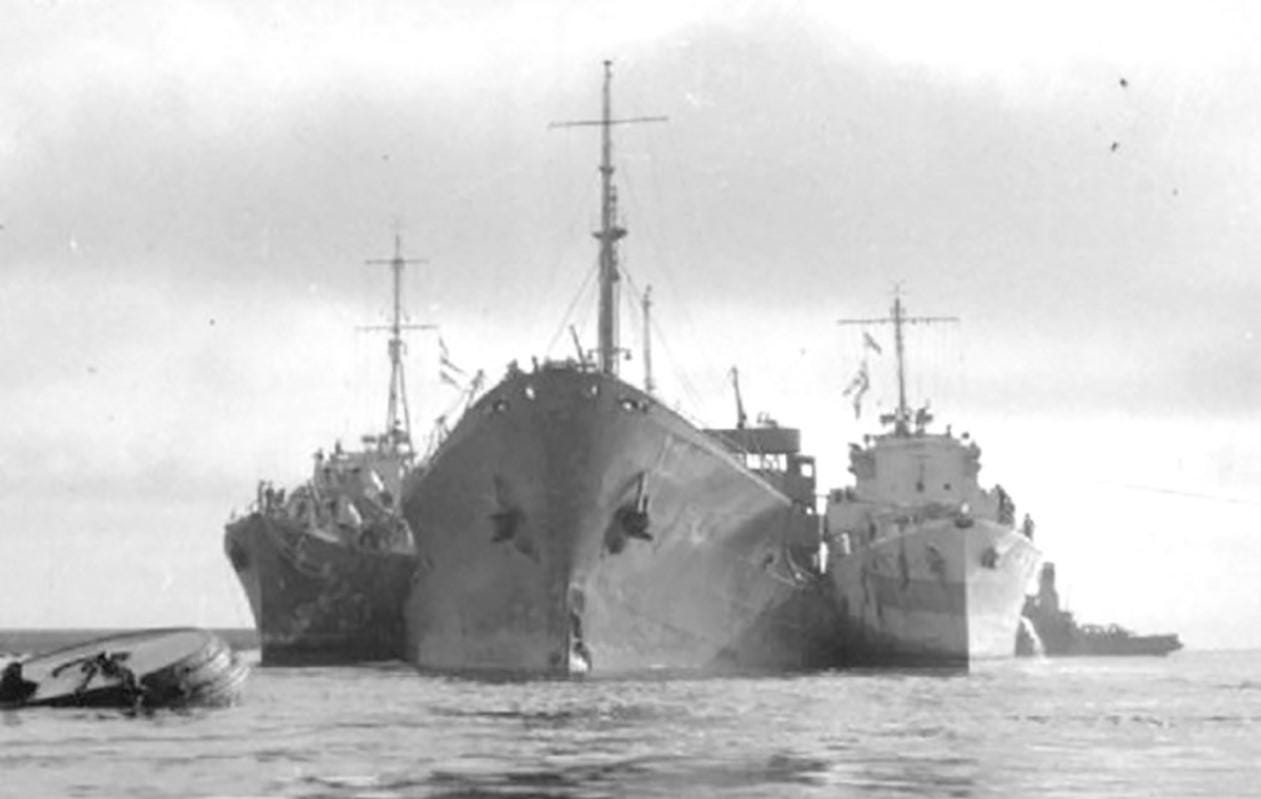
 

(Another view of Ohio entering the harbor.  You can see how low it is in the water.)


Captain Mason stood at salute as the welcoming band played. Mason and his chief engineer were both badly burned and flown back to Britain for treatment. For his actions, Mason, a member of the British Merchant Navy, was awarded the George Cross, the highest British award for non-operational gallantry or gallantry not in the presence of an enemy and is considered the equivalent of the Victoria Cross, the highest military valour award.  In addition, the crew of the Ohio received a Distinguished Service Order, five Distinguished Service Crosses, and seven Distinguished Service Medals.  This is the text of Mason's award, after which he was granted a private audience with King George.

The KING has been graciously pleased to award the GEORGE CROSS to Captain Dudley William Mason, Master, SS Ohio. During the passage to Malta of an important convoy Captain Mason's ship suffered most violent onslaught. She was a focus of attack throughout and was torpedoed early one night. Although gravely damaged, her engines were kept going and the Master made a magnificent passage by hand-steering and without a compass. The ship's gunners helped to bring down one of the attacking aircraft. The vessel was hit again before morning, but though she did not sink, her engine room was wrecked. She was then towed. The unwieldy condition of the vessel and persistent enemy attacks made progress slow, and it was uncertain whether she would remain afloat. All next day progress somehow continued and the ship reached Malta after a further night at sea. The violence of the enemy could not deter the Master from his purpose. Throughout he showed skill and courage of the highest order and it was due to his determination that, in spite of the most persistent enemy opposition, the vessel, with her valuable cargo, eventually reached Malta and was safely berthed. (The award is dated 4th September, 1942.) 

Along with the nine cargo ships, Britain lost one carrier and another damaged, two cruisers and one destroyer sunk and two cruisers damaged, along with 500 dead, but Malta was saved. In November the Allies landed in North Africa and the tide of the war in Europe changed.

 -----------

(1) Leningrad was, by far, a more deadly siege with more than a third of the city's prewar population of more than 3 million perishing, most by starvation.