On this date in 1943, several hundred Jewish prisoners at Treblinka, the Nazi death camp in Poland, rose in revolt and attempted escape. About three hundred avoided the gunfire from camp guards and made it to the surrounding woods. Somewhere between 50 and 70 were still alive at the end of the war in May 1945.
Treblinka was one of three major death camps, the others being Sobibor and Belzec, along with some smaller sites, built by the Nazis for the extermination of Jews living in the Government General of Poland, the area of that former country not absorbed into the Reich.
Unlike concentration camps like Dachau and Buchenwald, where prisoners were housed under horrible conditions, starved, used as forced labor, and subject to arbitrary violence, dying at terrible rates, the death camps were designed to receive and quickly kill as many people as possible, keeping alive only the bare minimum to help keep the camp running. In most cases, those arriving by train transport were dead within one to two hours of arriving. During just over a year in operation, approximately 800-850,000 were murdered at Treblinka, 450,000 at Belzec (with only two known survivors), and 170,000 at Sobibor (which had several dozen survivors after an uprising in September 1943).
Auschwitz was a mixed camp with an industrial side using forced labor, opened in 1940, as well as an area constructed in 1942 for the the murder of Jews. About 1.1 million Jews died at Auschwitz, along with more than 100,000 Poles, Gypsies, and Russian prisoners of war.
At Treblinka, in addition to Polish Jews, about 8,000 Jews from the former Czechoslovakia and 11,000 from Thrace and Macedonia, along with 2,000 Romani were also killed.
In addition to the German commanders and German and East European guards, each death camp also had a contingent of Jewish prisoners who were spared immediate death in order to keep the camp running. At Treblinka this amounted to between 600 and 1,000 men divided into three groups. The first to manage the unloading of those arriving on the train transports, including the undressing process before they were herded into the "showers". The second sorted through belongings left behind so they could be collected and sent to Germany for civilian use. The final group removed the dead from the gas chambers, burying them, and later, in 1943, digging up the corpses so they could be incinerated. Every few weeks those in the three groups, with a few exceptions needed for continuity, would be murdered and replaced by new prisoners.
In 1943 as the number of arrivals dwindled and the digging up and incineration of the dead accelerated the workers were aware that the day of their termination was approaching, leading to the planning for the breakout. They were also inspired by the news of the Warsaw Ghetto Uprising in April. Under very difficult circumstances planning proceeded and a key to the German arsenal was forged, allowing the group to access guns and grenades.
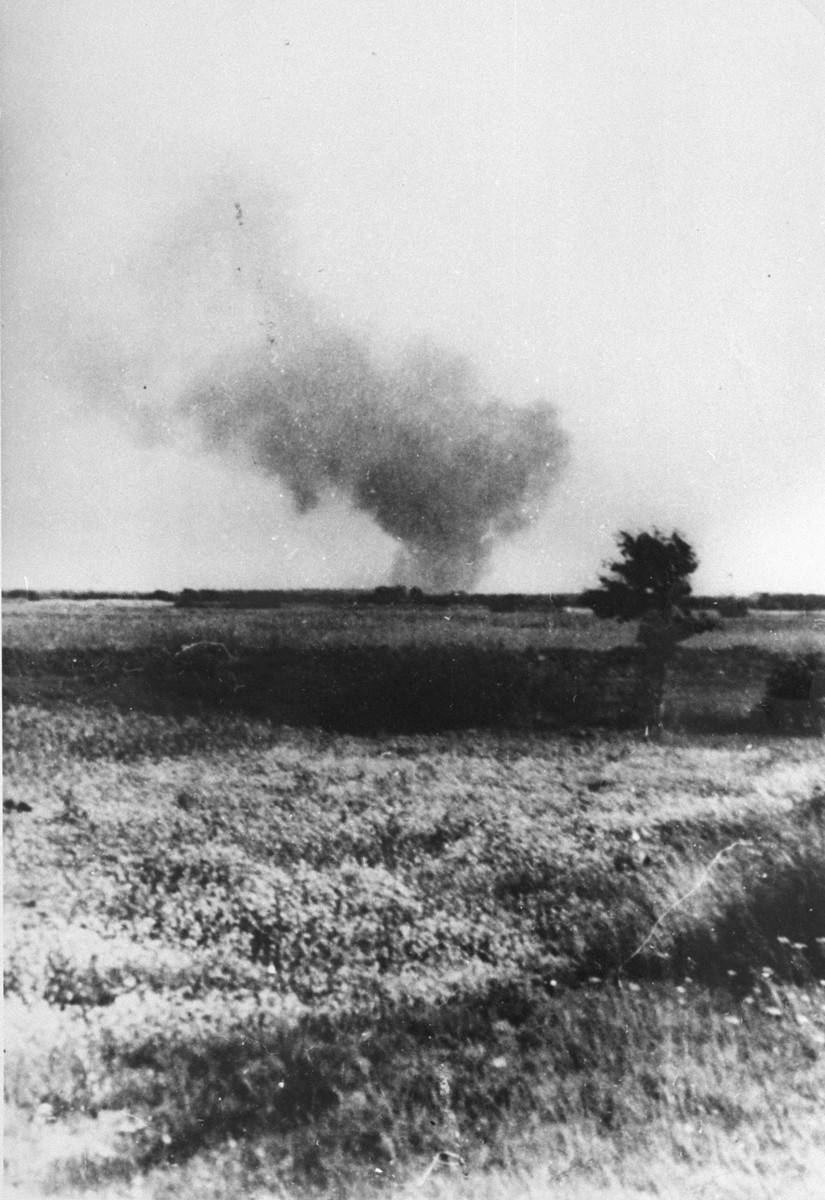
During the August 2 breakout, several guards were killed and the main gate and fences destroyed allowing about 300 to cross the antitank obstacles and ditches to reach the forest. Though many were hunted down by the Germans or died under other circumstances a few dozen were to survive and bear witness.
Fire set during the breakout. Photo by railway worker.
Treblinka was finally closed in September 1943.
Names of Some of the Survivors

No comments:
Post a Comment