A reworked and slightly expanded version of a post from 2015 . . .and particularly timely given the theme of government bureaucracies acting to cover up their mistakes.
I was in 7th grade and our teacher was absent when class was scheduled to
start after lunch. At first we sat quietly, patiently waiting, but as the
minutes passed we began speculating about what was going on. Our
teacher finally walked into the room crying, telling us that President Kennedy had
been shot (I can't remember whether she said he was dead) and
that school was dismissed.
After walking across the school athletic fields to our house I found the front door ajar and no one home. Upon hearing the news my mother, a
Democratic party official, had gone to the nearby
home of our former Democratic Congressman where many local party
officials were gathering.
Vivid memories remain of watching TV that November afternoon; hearing of the death of Dallas Police
Officer JD Tippit, and the arrest of
Lee Harvey Oswald. In the evening we saw Air Force One land at Andrews Air Force Base, disgorging the coffin and watching
Jackie Kennedy
disembark, wearing the same clothes she had on earlier in the day when her husband was murdered. On Sunday morning a friend came over and we, along with my
sister, took a break from the constant TV watching to go to my room and
play a game. Suddenly
we heard my parents shouting, prompting us to run to the living room
where we learned that Oswald had just been shot. And then came the
funeral on Monday.
John F Kennedy is the first president I distinctly remember. In
1960, at the age of nine, I was a member of Youth For Kennedy (and
still have a clipping from the local paper with a picture of me as part
of the group), and saw him speak at the train station in Bridgeport, CT
on November 6, 1960, two days before the election (Connecticut was still
a crucial swing state in those days).
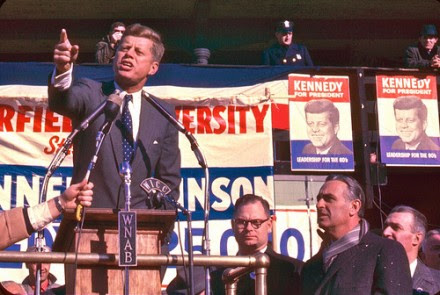
(
JFK in Bridgeport with Governor Abe Ribicoff second to the right from onlyinbridgeport)
Because of my mom's position in the state Democratic party we were able
to stand next to the platform from which the candidate spoke, below and
just to the right of JFK in this picture. It was a bright sunny day and
I remember him pointing just as he is in the picture. The area around
the station was packed with an enthusiastic crowd and there were teenage
girls jumping up and down screaming, just as they would for The Beatles only ten weeks after JFK's death.
JFK's assassination changed things. After his death came the Vietnam
War, riots in American cities, and a general sense that things were out
of control. It bred a more conspiratorial and, at times, paranoid
mindset, a mindset that has stayed in place over the decades.
Ironically, the academic view at the time was that the paranoia was from the
right-wing; the best example being liberal
Professor Richard J Hofstadter's influential November 1964 article in Harper's Magazine,
The Paranoid Style in American Politics, a screed against the rise of
Barry Goldwater,
but as I can attest being a politically active young Democrat, it was
JFK's death that set off an ever growing paranoid view of politics among
liberals. It became the conviction of large percentages of Americans
that there was a conspiracy masterminded by dark forces in our society,
thwarting a collective fantasy that, but for that event, we would have
moved into "
bright sunlit uplands", a viewpoint expressed in its most extreme form by the loony, but creative, director
Oliver Stone (for more on him see
Showtime's Agitprop) in the feverish conspiracy film, JFK, featuring the bizarre convoluted conspiracy theories of wacky New Orleans prosecutor
Jim Garrison.
Stone's film, made in the early 1990s, merely reflected widespread views
originating in the late 60s and early 70s. After a brief honeymoon of
public acceptance after its 1964 release, the credibility of the Warren
Commission report, with its conclusion that Oswald acted alone, quickly
eroded and by the mid-60s more than 50% of Americans thought there was a
conspiracy. By 1975, 81% believed in a conspiracy and Gallup Polling
over the years has always shown more than 70% supporting the conspiracy
hypothesis until its most recent survey, in 2013, showed a drop to a
still substantial 61%. JFK assassination conspiracy theories have even
become punch lines
in Hollywood movies.
I read some of the early books attacking the commission's work and claiming a government conspiracy by authors like
Mark Lane and, while living in the Boston area in the early and mid-1970s, knew people associated with the
Assassination Information Bureau (AIB), founded by the radical former president of Students for a Democratic Society (SDS)
Carl Oglesby.
The AIB became command central for those who propagated a variety of
assassination theories, all centered around a right-wing conspiracy,
usually involving
Lyndon Johnson and various combinations of the
CIA, FBI, Mafia, Cuban refugees, defense contractors, the Pentagon and
the Illuminati (just joking on the last one, I think). It was quite an
experience listening to them go on and on in an all-knowing way. For
some reason, they believed that a self-proclaimed Marxist and Communist,
who had defected to the Soviet Union and two months before the
assassination tried to get visas to go to the Soviet Union or Cuba, a
failure who felt he deserved to be a big shot and cultivated feelings of
resentment and anger, constantly taunted by his Russian born wife for
his inadequacies, a trained Marine rifleman who for several months had
been going to shooting ranges to brush up on his skills and, who in
April 1963 tried to murder the notorious right-winger,
Edwin Walker, who idolized
Fidel Castro and
was aware of Castro's threat to get the Kennedys if they didn't stop
trying to kill him and who may, while in Mexico City, have attended a
party where Cuban diplomats, spies and others made remarks about their
desire that John Kennedy die (for more on these last two see below),
apparently lacked the motive and means to kill the president on his own.
And, as I found out in doing research for this post, Hillary Clinton's long-time henchman and recent advisor on Libya,
Sid Blumenthal,
played a key role in the AIB, co-authoring the only book published by
the organization. By all accounts he remains as obsessively
conspiratorial minded.
---------------------------------------------------------------------------------------------
Today it is clear to me, based upon the availability of more
advanced computer based reconstructions of the timing and trajectory of
the President's vehicle and the rifle shots, more accurate knowledge of
his wounds, and thorough reexaminations of the evidence in several books
including those by Gerald Posner (
Case Closed) and Vincent Bugliosi (
Reclaiming History),
that all of the shots came from the rifle of
Oswald and were fired by him (for a more comprehensive discussion of the evidence
read this). There was no second gunman. There is
also no doubt there was not a conspiracy involving individually, or
any combination of, LBJ, the Mafia, Jack Ruby, American right-wingers
or the Russians. What now seems obvious to me, however, remains
controversial for many; just check out all the One-Star reviews for the
two books mentioned above on Amazon.
What remains as a very slight possibility is Cuban involvement in one of
two ways. The first, and more probable of these still unlikely
scenarios, involves Cuban intelligence, centered around Oswald's visits
to the Cuban and Soviet embassies in Mexico City during his five day
visit, September 27 through October 1, 1963 less than two months before
the assassination. Why might there be Cuban involvement? Because JFK
and
Robert Kennedy were continuing to run, via the CIA,
operations to kill Fidel Castro, despite the resolution of the Cuban
Missile Crisis the previous fall. Castro was well aware of these
repeated attempts on his life though the American public was not at the
time. The Associated Press published an article on September 8, 1963,
by a reporter who interviewed Castro and quoted him issuing a warning "
U.S. leaders should think that if they are aiding terrorist plans to eliminate Cuban leaders, they themselves will not be safe". The AP story was published in the
New Orleans Times-Picayune
that same week. Oswald, in New Orleans at the time, and publicly
demonstrating in support of Castro, was an avid reader of that paper
during his sojourn in the city. It was after New Orleans that Oswald
made his trip to Mexico City and the Cuban Embassy.
The second is the possible involvement of anti-Castro Cubans, incensed
by what they saw as JFK's betrayal at the Bay of Pigs, manipulating
Oswald into believing he was working on behalf of Castro in killing
Kennedy.
There are many reasons for doubting there was any conspiracy but here are two I found easy to grasp.
It was happenstance that gave Oswald the opportunity. While visiting with some of her neighbors
Marina Oswald
heard one of them mention that the Texas School Book Depository was
hiring. Desperate to get her unemployed husband a job, she asked the
other woman to inquire of her friend about a job for Lee. The
Depository was hiring at both its locations and Oswald was randomly
assigned to the one in Dealey Plaza. All this happened in mid-October
1963,
after his visit to Mexico City. While there had been a
public announcement of JFK's trip to Texas in late September, Dallas was
not added to the visit until November 9, and the motorcade route not
published until November 19; a route which had the president's limousine
not only pass directly in front of the Depository building, but
required a sharp left turn which slowed the vehicle down
making the president an easy target in the open back seat.

(
from McAdams,
though
the note referring to "Originally Planned" route is in error, the route
was always planned to take a right and then a left on to Elm St)
And what about
Jack Ruby shooting Oswald on November 24? The
shooting occurred as Oswald was being transferred from Dallas Police to
Federal custody. The planned transfer was delayed because, at the last
minute, a federal postal inspector requested he be allowed to ask Oswald
some questions, and then further delayed when Oswald asked he be allowed to go back to
his cell to put on a sweater before leaving. Meanwhile, Jack Ruby was
at the Western Union office across the street from police headquarters
waiting patiently in line to wire $25 requested by one of the strippers
at his night club, having left his beloved dog to wait in the car for
his return. Seeing the police activity when he left Western Union, Ruby
(well known to Dallas Police as a hanger-on and cop wannabe) walked
down the garage ramp and into history. If not for the delays in Oswald
leaving, Ruby never would have had the chance to shoot him, and Ruby's
actions that morning do not seem those of a man acting to some
predetermined plan, rather he was, as those who interviewed him in 1964
concluded, psychotic and delusional.
I'm also strongly influenced by my own experience in doing
investigations which has served to disabuse me of an easy acceptance of
conspiracy theories. Things that often look extremely suspicious at
first usually end up as surprising, bizarre and unplanned chains of
events leading to unfortunate incidents. Even after completing
investigations where those factors were clearly at play, I'm still
amazed it happened without some grand plan.
---------------------------------------------------------------------------------------------------
The turmoil of 1960s America, both domestic and foreign, reduced the
credibility of government. Amid that growing cynicism some of the
initial books questioning the commission seemed credible, contributing
to a growing lack of public confidence in its conclusions. Moreover, as
we learned after the fall of the Soviet Union in 1991, in early 1964
the KGB started a covert disinformation operation to spread a message
blaming the assassination on the American government, a theme initially
gaining traction in Western Europe and then spreading to America, prompted by a Kremlin worried that it would be blamed for JFK's death; a
campaign that fed right into the growing suspicion and disillusionment
over the Warren Commission.
It
is became evident over time that something went wrong within the
Warren Commission which fed the growth of conspiracy theories. Finding
out what went wrong is the subject of the 2013 book by long time New
York Times reporter,
Philip Shenon,
A Cruel And Shocking Act: The Secret History of the Kennedy Assassination. It is the best overview to help understand how the White House, CIA and FBI managed to damage the credibility of the Commision Report.
The book's title is drawn from the first line of the
Warren Commission's introduction to its report: "
The assassination of
John Fitzgerald Kennedy on November 22, 1963 was a cruel and shocking
act of violence, directed against a man, a family, a nation, and against
all mankind."
The book's subtitle "
The Secret History of the Kennedy Assassination" is
misleading; more accurately it should be, "
The Secret History
of the Warren Commission", because it is the investigation
undertaken by
that Commission which is the focus of the book. Shenon began his
research in 2008 and was able to interview a
number of the then still-living younger staff of the Warren
Commission. He also exhaustively reviewed the commission and various
government files, including the many documents declassified in the 1990s, as well as conducting interviews in Mexico City.
The author presents a fascinating intimate look at the operations of the
commission, giving us vivid portraits of the often-reluctant commission
members, particularly Chief Justice Earl Warren
and Senator Richard Russell,
both of whom were subjected to Lyndon Johnson's seductively persuasive
arm-twisting tactics before agreeing to serve, and of the in-fighting
among them from the time the commission began its work in December 1963
to the release of its report in September 1964. He walks us through
each step of the investigation, and introduces us to the young, and often relatively
inexperienced lawyers, who conducted much of it. I was struck by the
lack of seasoned investigators on the commission staff.
We learn about many of the key personalities, like the increasingly
erratic and untrustworthy Marina Oswald, along with smaller moments such
as
Lady Bird Johnson's testimony about coming face to face with
Jackie Kennedy, in her blood splattered clothes in that small hallway
at the hospital in Dallas, "
I think it was right outside the operating room. She
was quite alone. I don't think I ever saw anyone so much alone in my
life".
But it is the story of the suppression of evidence and why it occurred that is the backbone of the book.
Warren Commission Members
Earl Warren (Chairman) - Chief Justice of the Supreme Court (1953-69)
Hale Boggs (D-La) - House Minority Whip
John Sherman Cooper (R-Ky) - Senator
Allen Dulles - CIA Director (1953-61)
Appointed by Eisenhower, fired by Kennedy after the Bay of Pigs fiasco.
Gerald Ford (R-Michigan) - House Minority Leader.
According to Shenon, Ford was "perhaps the most
hardworking apart from Warren himself. . . [he] made a point of being
present to hear the testimony of almost all important witnesses. His
questions were consistently well thought-out and reflected his close
reading of the evidence". The most thorough reviewer and commenter on the draft report of the commission.
John McCloy
One
of the "Wise Men" who dominated the American foreign policy
establishment from the end of World War Two until the mid-1960s. McCloy
served as High Commissioner of Germany (1947-49), President of the
World Bank, Chairman of Chase Manhattan and Chairman of the Council on
Foreign Relations.
Richard Russell (D-Ga) Senator.
Perhaps
the most intelligent member of the commission, a friend of LBJ's
and his opponent in the fight over what became the 1964 Civil Rights Act
which was debated while the Warren Commission was underway.
Responsible for appointing the only woman investigator on the commission
staff. He and Warren despised each other.
-----------------------------------------------------------------------------------------------------

(
from wnd.com)
Philip Shenon's assessment:
The
commission made grievous errors. It failed to pursue important
evidence and witnesses because of limitations imposed on the
investigation by the man who ran it, Chief Justice Warren. Often,
Warren seemed more interested in protecting the legacy of his beloved
friend President Kennedy, and of the Kennedy family, than in getting to
the full facts about the president's murder.
. . . much
of the evidence about the president's murder was covered up or
destroyed - shredded, incinerated, or erased - before it could reach the
commission. Senior officials at both the CIA and the FBI hid
information from the panel, apparently in hopes of concealing just how
much they had known about Lee Harvey Oswald and the threat that he
posed.
Overriding
everything were the
suspicions of President Lyndon Johnson that the Soviets or Cubans may have been
behind the murder, even though he was not to learn the full extent of
JFK's attempts to kill Castro until 1967. If
true, Johnson believed public outrage would force the United States to respond in a way which could trigger
events leading to a possible nuclear war which
he desperately wanted to avoid at all costs. To avoid this outcome the
White House put limits on the investigation, pressuring it to wind up its
work as quickly as possible, declare Oswald the sole gunman, and calm public fears of a larger conspiracy.
In later
years, LBJ spoke openly of his views. In October 1968, after
announcing he would not run for reelection, Johnson gave an interview to
Howard K Smith
of ABC News. Off
camera, LBJ told Smith something he could not use for broadcast:
"I''ll tell you something that will rock you. Kennedy was trying to get to Castro, but Castro got to him first".
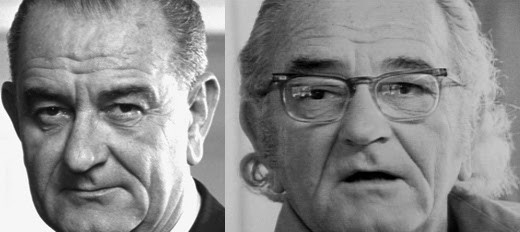
(
LBJ, 1964 & 1972)
The
July 1973 issue of
The Atlantic contained an article by Leo Janos, who
spent time with the retired president before his death in January.
Janos recounts one conversation:
"During coffee, the talk turned to President Kennedy, and Johnson
expressed his belief that the assassination in Dallas had been part of a
conspiracy. 'I never believed that Oswald acted alone, although I can
accept that he pulled the trigger.' Johnson said that when he had taken
office he found that 'we had been operating a damned Murder Inc. in the
Caribbean.' A year or so before Kennedy's death a CIA-backed
assassination team had been picked up in Havana. Johnson speculated that
Dallas had been a retaliation for this thwarted attempt, although he
couldn't prove it. " (from The Last Days Of The President, by Leo Janos, The Atlantic, July 1973)
LBJ
was not the only one with suspicions about a conspiracy; Robert
Kennedy also suspected it. Shenon writes of Kennedy's political
associates that
"They would admit years later that Kennedy had never stopped suspecting
that there had been a conspiracy to kill his brother . . . Kennedy
appeared worried, in particular, about the possibility that Castro or
the Mafia was behind the assassination."
This suspicion weighed heavily on Bobby Kennedy who felt guilt that his involvement
(RFK was the operational link between his brother and the CIA in the
plots) in the attempts to kill Castro, or his pursuit of the Mafia and Jimmy Hoffa, may have backfired and led to the death of
his brother, a worry that haunted him until his death in 1968, according
to some of his close associates. In a final twist on the relationship
between the Castro plots and the president's death, a CIA
Inspector General reviewing the history years later:
"would determine years later that on November 22, 1963 . . . a CIA
officer was meeting in Paris with a Cuban agent [who later turned out to
be a double agent for the Castro regime] to hand him a poison pen".
The IG concluded "it is likely that at the very moment President Kennedy
was shot, a CIA officer was meeting with a Cuban agent . . . and giving
him an assassination device for use against Castro."
In Congressional testimony during the 1970s Richard Helms, who
had personally approved the Castro plots and by then was CIA Director, said that since he had determined, in
his own mind, that the CIA's Castro plots had nothing to do with
Kennedy's assassination, therefore there was no reason to tell the
Commission about them, "
Besides, Helms asked later, why had it been his
responsibility to tell the commission about the Castro plots, since he
was certain that one of the commissioners - Dulles - knew all about
them, as had Robert Kennedy?"
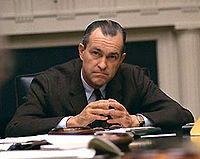
(
Helms, from wikipedia)
The
Kennedy family connection went on to taint the famous Church Committee
investigation of the CIA in the mid-1970s, which publicly exposed many of
its secrets, including the Castro plots. The portrait painted by the
committee's chairman,
Frank Church (D-Idaho) was of a "
rogue" agency and
played down the direct role of President Kennedy and Attorney
General Kennedy in the Castro matter. This framing may not have been
an innocent error, as Senator Church was a close friend of Senator Edward
Kennedy
, and the Kennedy family has been very protective of its legacy, being much more comfortable with the image of JFK as "
the civil rights
president" than as "
the cold war president".
Chief
Justice Warren had his own pressures. An admirer of John F
Kennedy and the family, he understandably wanted to spare his widow and
brother as much
pain as possible during the investigation process. One of his most
controversial decisions was to forbid the commission staff from seeing
the autopsy photos and x-rays of President Kennedy, because of the
horrible wounds suffered by the president and the risk they might
end up part of the
public record. The staff was forced to rely upon sketches of the wounds
made by doctors during the autopsy. When the photos and x-rays were
made available decades later it was realized that the sketches had major
errors in the placement of the entry and exit wounds (the photos can be
found on the internet; they are very disturbing). The
discrepancies in the erroneous sketches fueled conspiracy critics and help
kindle theories of more than one gunman being involved; whether the
fatal shot came from the back or front; and about the supposed
implausibility of the single bullet theory, all of which were debunked
once the photos and x-rays became available.
In addition to White House pressure to quickly complete the
commission's work, Warren may also have been asked to limit the look at
possible
Soviet or Cuban involvement. According to the staffers Shenon
interviewed, Warren was particularly reluctant to pursue questions around
Oswald's visit to Mexico City, in one instance refusing permission
for a staffer to interview
Silvia Duran, a young Mexican communist employed by
the Cuban embassy who, it was alleged, had been seen with Oswald on
several occasions, telling staffer David Slawson:
"You just can't believe a communist. We don't talk to communists. You
cannot trust a dedicated communist to tell us the truth, so what's the
point?"
Shenon reports:
"In light of what he later learned about the CIA,
Slawson suspected - but could not prove - that Warren had been asked by
the spy agency not to interview Duran."
Warren also
exhibited a surprising naivete about the operations of government. In
an early meeting of the commissioners, John McCloy asked:
"Had the chief justice or anyone else been in touch with the CIA to
determine what it knew about the assassination - and about Oswald and
his travels in Russia and Mexico?"
"No, I have not"
Warren replied, "for the simple reason that I have never been informed
that the CIA had any knowledge about this."
From the
beginning, Senator Russell had his own suspicions about the investigation, writing a note to himself after the first Commission
meeting in December "
Something strange is happening", referring to the
CIA and FBI investigation of Oswald's visit to Mexico, and it seemed
to him there was a rush to demonstrate that Oswald was the lone assassin aoubt which he
wrote "
This to me is an untenable conclusion."

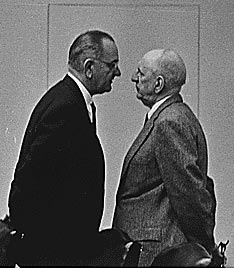
(
LBJ & Senator Russell, December 1963 from digital history)
Which
brings us to the final problem - the obstruction of the investigation
by the FBI and CIA. There were dual motives. The first was
avoiding bureaucratic embarrassment. Both agencies, the CIA through
its monitoring of the embassies in Mexico City, and the FBI, through its
access to some of that information, which was routinely forwarded to it
by the CIA, had good reason to be concerned about Oswald. Their failure
to act on that information may have cost the president's life. The
second was the likely directive from the White House to both agencies
to play down any possible Cuban or Soviet connection. Both motives
provided incentives to carefully manage the information flow to the
Warren Commission, and the presidential directive provided a convenient
excuse for the agencies to cover up their mistakes.
More mundane concerns also led to evidence destruction. On November 24,
1963, FBI Special Agent James Hosty (who handled the Oswald file prior
to the assassination - as a returned defector the FBI kept an eye on
him) was called to the office of Gordon Shanklin, his boss in Dallas.
Shanklin showed Hosty a note that Oswald had delivered personally to the
FBI office in early November complaining of FBI harassment, writing "
If you don't cease bothering my wife, I will take appropriate action" according to Hosty, who had contacted Marina Oswald in an attempt to interview her. Shanklin said "
Oswald is dead now, There can be no trial"
and told Hosty to get rid of the note which he shredded and flushed
down a toilet. Months later, a commission investigator decided to cross
check the FBI's typewritten summary of Oswald's address book, provided
to the commission as a courtesy since the agency said Oswald's
handwriting could be difficult to read, against the original address
book and was surprised to find that the FBI summary was missing Oswald's entry
of Agent James Hasty (an obvious misspelling of Hosty) which included
Hosty's office address, license plate number of his FBI car and was
dated November 1, 1963. Hosty later said that his name had been left
off the summary prepared by another agent in the Dallas office
in order to save him from Hoover's wrath.

(
Hosty)
From
the start, commission staff viewed J Edgar Hoover as uncooperative.
He blatantly tried to preempt the commission by producing his own
report on December 9, 1963, concluding Oswald was the lone
killer, which he then arranged to have selectively leaked to the press.
The report was shoddily done and the commission
members who read it thought it made no sense.
Hoover later testified to the commission under oath that "
There
was nothing up to the time of the assassination that gave any
indication that this man was a dangerous character who might do harm to
the president" but, as Shenon notes, "
Behind closed doors at the FBI,
however, Hoover's views, shared with his deputies, was precisely the
opposite. Within days of the assassination, he determined that the FBI
had, in fact, bungled its investigation of Oswald before the
assassination . . . "
Hoover went on to discipline 17 employees for "
shortcomings in
connection with the investigation of Oswald", including the decision not
to place Oswald on the FBI's internal Security Index, a roster that
would have been shared with the Secret Service ahead of Kennedy's visit
to Dallas, declaring the failure to do so "
could not have been more
stupid". The Commission was never informed of his actions nor that the
FBI knew of Oswald's visit to Mexico City and the embassies weeks before
the assassination.
And it is the events in Mexico City that are at the center of FBI
and CIA obstruction. Commission staffers knew Oswald visited
Mexico City for five days at the end of September and beginning of
October, entering the Cuban and Soviet embassies and unsuccessfully
trying to obtain visas. They had fragmentary reports about what Oswald
was up to and who he might have seen. They knew the CIA in Mexico City
had both embassies under surveillance but when interviewed, CIA station
chief Winston "Win" Scott insisted it had neither photographs nor any audiotapes of Oswald.

(
Win Scott from jfkfacts)
Perhaps one of the most intriguing leads was that Oswald had attended a party with Silvia Duran "
attended by
Cuban diplomats and spies, as well as Mexican supporters of Castro's
government" at which "
some of the guests had spoken openly of their hope
that someone would assassinate President John F Kennedy, if only to
ensure the survival of the revolution in Cuba that Kennedy had been so
desperate to crush". Win Scott poured cold water on these
allegations and went out of his way to discredit those making them, and
probably made efforts to avoid having some of the witnesses interviewed
by commission staffers.
While commission staff realized as early as December 1963 they were
being played by the FBI, their view of the CIA
was initially different, finally realizing in February that the agency was also withholding information, including on Oswald's
trip to Mexico City, which it justified by saying the commission "
did
not fully understand the implications of forcing the CIA to share
everything it had on Oswald". Yet it proved impossible for the
staff to penetrate the agency's layers of obfuscation and even then, as Shenon
reveals, many staffers were unaware of how badly they were misled until
the declassification of many documents in the 1990s or in some cases,
until Shenon in his interviews shared documents they had never seen.
Our ambassador in Mexico,
Thomas Mann
, was convinced early on
that Cuba had something to do with the assassination and urged a
thorough FBI and CIA investigation. The FBI bureau chief reported
Mann's conviction that the
Soviet Union was "
much too sophisticated" to be involved but that Castro
was "
stupid enough to have participated". After much resistance Hoover
sent an agent to investigate but, as that agent told Shenon "
he
came to understand years later that he had been part of a charade to
avoid discovering the full truth about Oswald in Mexico".
In 1977, Ambassador Mann was interviewed by investigators during the
House of Representatives investigation into the JFK, RFK and King
assassinations. In the interview, which remained classified for years,
Mann claimed he had been personally ordered by Secretary of State Dean
Rusk days after the assassination to shut down any investigation in
Mexico that would "
confirm or refute rumours of Cuban involvement in the
assassination" and he believed the same "
incredible" order was
given to Winston Scott and the embassy's FBI legal attache by their superiors.
Shenon also reveals the existence of a mystery letter that turned up in
the CIA files declassified in the 1990s. On June 17, 1964 Hoover
prepared a letter to the Warren Commission with explosive information.
It allegedly came directly from a conversation Fidel Castro had with a
U.S. Communist Party member and confidential FBI informant Jack Childs,
who was visiting Cuba. Along with his old brother Morris,
a senior official in the American Communist Party, Jack became an FBI
informant in the early 1950s. Because of their party connections, the
Childs brothers received unusual access to international party leaders
meeting with, among others, Nikita Khrushchev and Mao Tse-Tung. Their
information proved "
remarkably accurate" according to Shenon and in 1987 the brothers received the Presidential Medal Of Freedom from Ronald Reagan.
According to Hoover's letter, Castro was quoted as saying
"Oswald
stormed into the embassy, demanded the visa, and, when it was refused to
him, headed out saying, 'I'm going to kill Kennedy for this'". Castro
reportedly went on to say that Cuban diplomats did not take this seriously,
believing Oswald might be some type of CIA provocateur, and insisted
that the Cuban government had nothing to do with the assassination.
The
letter never reached the commission but a copy somehow ended up in the possession of the CIA.
In 1971 Win Scott died and CIA officials visited both his office and
home in Mexico City to remove files. Among his papers was a draft
memoir declassified in the 1990 which stated:
"Above all, Oswald's visits at both the Communist Cuban Embassy and the
Soviet Embassy in Mexico City during his brief five-day stay in
September-October 1963 are, together, with what is known of what took
place during these visits, sufficient to make him a suspect agent,
acting on behalf of the Soviets, in several things, possibly, including
the assassination of President Kennedy."
Despite his
insistence to the commission that the CIA had no surveillance photos of
Oswald, [Scott wrote that] the CIA had photos of him outside both embassies. He also said
that despite denials at the time, the CIA had audiotapes with Oswald's
voice in his phone calls to the embassies writing that "His
conversations with personnel of these embassies were studied in detail".
After the death of Hoover in 1972, his successors spent years cleaning
up the mess he left behind and attempting to restore the agency's
reputation. In 1975 reporters from the
Dallas Times Herald informed FBI Director Clarence Kelly they would be running a story about the letter from Oswald
that FBI Agent James Hosty destroyed two days after the assassination.
It was the first Kelly had heard of the incident and, after internal
inquiries, he told the paper the FBI had no objection to its running the
story because it was true.
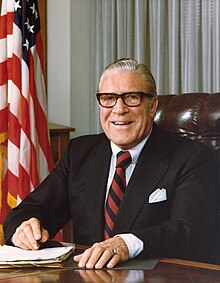
(
Director Kelly, wikipedia)
The incident prompted Kelly to undertake his own investigation of the
agency's action before and after the assassination and according to Shenon reached these conclusions:
He found
Hoover's undelivered June 1964 letter and other materials and became
very troubled about the entire Mexico City visit of Oswald and the
handling of evidence, including that one of the people he met with in
the Soviet embassy was Valeriy Kostikov, a KGB agent known to be a
specialist in assassinations.
Kelly concluded that in
Washington the FBI and CIA "had enough combined information on Oswald's
trek to Mexico City to put his name in lights on a presidential security
list of threats" but that Agent Hosty in Dallas was kept in the
dark.
Kelly found that the two missing memos of the Dallas file [dated October
18, 1963 about what the bureau knew of the CIA surveillance of Oswald
in Mexio City and dated November 19, 1963 about contents of a letter
written by Oswald to the Soviet embassy in Washington about his Mexico
City trip] were removed
days after the assassination in the hope Hosty had not yet read them.
Kelly believed the order to remove the memo came from the #3 man in the
FBI, William Sullivan, and that he appeared to be working on orders from
the White House which "seemingly considered the risk of a confrontation
with the Soviet Union over the Kennedy assassination as too great".
Kelly's final conclusion was that if the information had been given to
the Dallas office the President's death could have been easily
prevented.
Shenon also reports that while doing his research he went to Mexico City
and was able to interview Silvia Duran, several of her relatives, and
other people involved in the events of 1963 and is convinced that Oswald
was at the party mentioned above despite the CIA insistence otherwise.
Finally, and most startling, is something Shenon claims was not known before his research, that James Angleton
had inserted himself as the person at the CIA controlling the flow of
information to the Warren Commission. I don't know enough about the
literature around the assassination to judge whether Shenon is the first
to discover this but, if he is correct, Angleton's presence in the
middle of the investigation raises alarm bells.
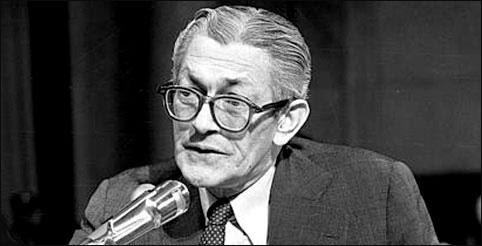
(
Angleton)
Forty years after being fired by CIA Director William Colby,
James Jesus Angleton remains the most controversial figure in the
agency's history. Born in 1917 to a U.S. cavalry officer father
and Mexican mother who met during General Pershing's 1916 expedition to
punish Pancho Villa, Angleton spent most of his childhood in Milan,
Italy. He attended Yale where, as an aspiring poet, he was editor of
the literary magazine
Furioso and, according to Wikipedia, corresponded extensively with Ezra Pound, EE Cummings, and TS Eliot.
Entering the American secret service during WWII, Angleton became friends with British intelligence agent Kim Philby
while
serving in London. Philby, a Soviet agent who did
immeasurable damage to American and British intelligence efforts in the
years immediately following the war, was constantly promoted by the British,
serving from 1949 to 1951 in Washington as British intelligence
liaison with the CIA, where he became even closer with Angleton.
Suspicions about Philby's activities forced the British to recall him in
1951, and though in 1955 Foreign Secretary Harold MacMillan told the
House of Commons there was no evidence Philby was a spy, in January 1963
he disappeared from Beirut, Lebanon, reappearing on July 30, 1963, when
the Soviets triumphantly announced his presence in Moscow where he
lived for the rest of his life.
Many believe that Philby's betrayal explains Angleton's own increasingly
mysterious, complex, conspiratorial, and suspicious attitude in his next
role as CIA's Chief of Counterintelligence from 1954 until he left the
agency twenty years later. Over those decades Angleton became
increasingly convinced the CIA had been penetrated by Soviet moles,
and though he was never able to conclusively identify anyone, he ruined
the careers of a number of CIA officers who became the target of his
suspicions. His ongoing investigations served to tie the agency up in
knots.
Informed opinions on Angleton differ widely which would probably please
him. CIA Director Helms held him in high regard, as does Edward Jay
Epstein, himself a highly regarded author on intelligence matters.
Other experienced intelligence professionals and authors regard him as
an incompetent alcoholic who paralyzed the agency and destroyed the
effectiveness of the CIA operations directorate, an opinion shared by
Director Colby, who forced him to retire.
Angleton's presence in the information stream to the commission adds yet
another layer of obfuscation, since it was his nature to complicate
things. Everyone who has written of their interactions with him speaks
about his obsession with nothing being as it seemed and of always seeing
complicated and well-planned deceptions piled upon deceptions. A conversation with him was like entering a hall of
mirrors. Shenon suspects it was Angleton who prevented Hoover's June
1964 letter (a copy of which ended up in CIA files) from reaching the
commission. If Angleton was the culprit, my guess is he thought
Castro's statement was disinformation designed to deflect blame from
Cuba, to which you might respond "
but isn't that what the White House wanted?" and the answer being yes, but that is not necessarily what Angleton wanted and he knew best in his own mind.
It was also James Angleton who personally visited Win Scott's office and
home in 1971 to collect his files, including the memoir declassified
two decades later. On top of a White House already interested in
minimizing information on Mexico City, who knows what additional
confusion and misdirection may have been sowed by Angelton's
involvement?
I'd tell you about Angleton and the battle around the bona fides of Soviet defectors
Golitysn and Nosenko, a battle which also bears on the assassination, but if we
enter that hall of mirrors we are likely never to find a way out.
------------------------------------------------------------------------------------------------------
What are we to make of all this?
The lack of access to the autopsy photos and x-rays led the commission
to botch the analysis of the president's wounds and raise unneeded
questions about the trajectory of the bullets. If Justice Warren had
allowed access it would have avoided errors and lessened the credibility
of conspiracy theorists.
The pressure to speed things along led to gaps and mistakes that became
an easy target for skeptics and should have been easily correctable with
a little more time and a more experienced staff.
The Mexico City aspect is trickier. The desire of the White House to
avoid a nuclear confrontation is certainly understandable. Perhaps the
right course of action depends on what you think really happened there.
It is certainly possible that Oswald attended the party with Silvia
Duran and heard comments about what a good thing it would be if
President Kennedy died. He may very well, as Castro supposedly
claimed, made threats about killing the president while at the Cuban
embassy but this does not implicate Cuban officials, though if the CIA
were aware of any of this, and failed to inform the FBI, it would have
been an enormous failure on its part.
Even Oswald's meeting with KGB "
wet work" specialist Kostikov at
the Soviet Embassy that so bothered FBI Director Kelly can be
explained. Kostikov also had regular consular duties as part of his
cover and, as the senior KGB man in the agency, it is understandable why
he might meet with a U.S. citizen, a former defector to the Soviet
Union seeking to return there. Moreover there was no clear
motive for the Soviet Union to kill the president in the wake of the
resolution of the Missile Crisis and the signing earlier in the year of
the Nuclear Test Ban Treaty and we know the reaction of Soviet leaders to the news
of his death was panic they would be blamed for the assassination.
Cuba is another matter. As information has dribbled out over the
decades we now know that the Castro demonstrated erratic personal
behavior during the 1962 crisis, including urging a first strike nuclear
attack on the U.S., and the Soviets took steps to limit his control of
their weapons in Cuba. He also had a motivation since we knew the Kennedy
brothers were trying to kill him which prompted his threat of retaliation,
and we can assume he was aware of the meeting scheduled in Paris on
November 22, 1963 between the CIA and the Cuban double agent. Yet there
is still no direct or even indirect link indicating that the Cubans
were willing to place the future of their country in the hands of the
unpredictable Lee Harvey Oswald who, at the time he was in Mexico City
seemed to have no realistic path to carrying out such a task. That's
why, while a Cuban role is possible, I still think it highly unlikely.

(
Castro, from jfkfacts)
However, Kelly was right about Kostikov and Mexico City on the most important aspect. In 1963 the process for a presidential visit involved the
local FBI office reviewing its files for potential security risks and
forwarding those to the Secret Service which would examine each
individual so identified. The CIA knew of Oswald's visits to the embassies and their
purpose. They may have had even more detailed and revealing
information on his activities and conversations. We know that some form
of that information reached the CIA and FBI in Washington, but did not
make it in usable form to the FBI Dallas Office (unless the still
unexplained October 18 memo was sufficient). If the local FBI knew
that there was a Dallas resident, a former Marine who defected to the
Soviet Union and returned to the U.S., engaged in pro-Castro activities
in New Orleans in September, and then visited the Soviet and Cuban
embassies seeking visas and meeting with a KGB assassination specialist,
Oswald would have been placed on the security list and simple
inquiries would have revealed he was working along the route of the
presidential motorcade. As Hoover concluded, the failure was "
stupid" and, as Kelly realized a decade later, proper handling of the information would have averted the tragedy.
Instead, geopolitical concerns provided a wonderful opportunity for both
agencies to cover their blunders. There is one constant about
bureaucracies both inside and outside government - their priority is to
protect themselves.
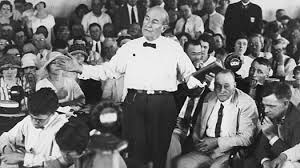 The
ACLU and Darrow differed on trial strategy. The ACLU considered
it a free speech case, but that was not Darrow’s interest. As a
militant atheist who did not believe in free will, he wanted to use the
trial as an opportunity to directly assault Christianity and its beliefs
about the creation of the universe and the human race. This discomfited
many ACLU supporters, but — through a complicated series of maneuvers — Darrow seized control of the defense strategy and was
cleverly able to lure Bryan to the stand, where he cross-examined him
viciously on Biblical inconsistencies. (Darrow might have been a
terrible person, but you’d want him defending you if you were on trial).
This prompted a Congregational Church official who supported the legal
challenge to send a note to the ACLU:
The
ACLU and Darrow differed on trial strategy. The ACLU considered
it a free speech case, but that was not Darrow’s interest. As a
militant atheist who did not believe in free will, he wanted to use the
trial as an opportunity to directly assault Christianity and its beliefs
about the creation of the universe and the human race. This discomfited
many ACLU supporters, but — through a complicated series of maneuvers — Darrow seized control of the defense strategy and was
cleverly able to lure Bryan to the stand, where he cross-examined him
viciously on Biblical inconsistencies. (Darrow might have been a
terrible person, but you’d want him defending you if you were on trial).
This prompted a Congregational Church official who supported the legal
challenge to send a note to the ACLU: