A live TV performance by Aretha Franklin in 1970. This lady is in full command. Full command vocally, on piano, and as a performer. She's a powerhouse. The song was written by Ahmet Ertegun and Betty Nelson and originally recorded by Ben E King in 1962. Ahmet was a famous record executive who discovered Ray Charles and years later signed the fledgling acts Led Zeppelin and Crosby, Stills, and Nash. He was the founder of Atlantic Records and the first chairman of the Rock n Roll Hall of Fame. Betty was the wife of Ben E King.
Friday, October 30, 2026

Thursday, October 22, 2026
And Your Bird Can Sing
Billy Strings makes this Beatles song from the Revolver album seem like it was actually written as a bluegrass tune.
Wednesday, October 21, 2026
The Last Bridge
Our final stops were in the Arnhem area. After driving across the John Frost Bridge, named for the lieutenant colonel commanding the parachute battalion that seized the north end of the Rhine Bridge but then became isolated from the rest of 1st Airborne and forced to surrender on Sept. 21, we headed west a few miles to Oosterbeek, the Arnhem suburb containing the British landing zones and where the last stand of the paratroopers took place. It's where the Hartenstein Airborne museum is located in the building that served as 1st Airborne HQ during the battle.

Outside the museum is this tribute from the British and Polish airborne to the Dutch people who came to their aid during the battle.

But for several decades after the battle relations between the British and Polish veterans was troubled. We learned some of the story at the Sosabowski exhibit but only learned the rest when we finished our visit at the small town of Driel on the south side of the Rhine, directly opposite Oosterbeek.
The Polish Parachute Brigade was organized with the intent that it would be eventually dropped into Warsaw to help with its liberation. Its soldiers would be the first Poles to return from exile. However, the British insisted that it be placed under their command and participate in Market Garden. Sosabowski was an abrasive and outspoken commander, a style that clashed with British military manners, and he was disliked for that reason. He also expressed doubts about the feasibility of Market Garden.
While Sosabowski parachuted in on the third day of the operation, most of his command did not arrive until Sept 21. The plan was to have the Poles seize the ferry at Driel and cross the river to help 1st Airborne. However, the ferry had been disabled the day before by the locals to prevent the Germans from using it, so only a couple of hundred Poles made it across on rubber boats. The rest of the brigade remained in Driel, eventually fighting its way out.
With the failure of Market Garden, the British military, specifically Field Marshall Montgomery and British Airborne Army Commander Browning sought to pin the blame on Sosabowski and the Poles (Perfidious Albion strikes once again). Though it was nonsense, they succeeded in forcing the Polish government-in-exile, dependent on British goodwill, to dismiss Sosabowski, who would spend the rest of his life trying to reclaim his reputation.
Because of the communist takeover of Poland, Sosabowski could not return, living in the UK until his death in 1967. His family was given permission to have him buried in Poland. In 1945 Sosabowski was reunited with his son Stanisek, who managed to flee Poland at war's end. Stanisek had been a member of the Home Army, led attacks on Germans, and fought in the Warsaw Uprising of 1944. Badly wounded he lost sight in his remaining eye (the other eye was lost in a childhood accident), leaving him blind. Saved by a nurse, who later became his wife, after coming to the UK he became a doctor.
Meanwhile, in Driel, a local woman Cora Baltussen, made it her life's mission to restore the reputation of the Poles, who were fondly remembered in the town. She discovered that plans for the Dutch Queen to award ten Poles medals for bravery were derailed by British objections. Over the years, and with the help of historians, the Poles began to be treated more fairly and in the 21st century the Dutch government awarded the medal and has held events honoring the parachute brigade. Today, the square in the center of Driel is filled with monuments and displays celebrating the Poles and Sosabowski, and the church on the square contains a large exhibit explaining their story and the efforts to rehabilitate their reputation.
Driel


Tuesday, October 20, 2026
Crossing The Waal

Depicted above is the Nijmegen Bridge, the target of the 82nd Airborne which had been scheduled to seize it the day of, or day after, the drop on Sept. 17. However, due to intense German counterattacks on the Groesbeek Heights and stubborn resistance on the southern approaches, the Germans still held the bridge on the morning of Sept. 20.
While XXX Corps had finally reached Nijmegen, the plight of the increasingly beleaguered British 1st Airborne at Arnhem, ten miles north of the Waal, required desperate measures by the 82nd. The 1st Airborne had failed to take the bridge at Arnhem and was being pushed back towards its landing zones several miles west of the town. Unless the 82nd and XXX Corps could reach them very soon Market Garden would fail.
It was decided the 82nd would attempt a crossing by boat about a mile downstream of the Nijmegen Bridge. After landing, the paratroopers would advance along the north shore of the river and take the bridge from that direction while XXX Corps attacked from the south. The plan called for the crossing to be attempted early in the morning of Sept. 20.
(Site of the boat crossing. The Nijmegen Bridge is the further of the two in the photo.)

Unfortunately, the boats were late in arriving. They were also made of canvas instead of wood or metal and thus very vulnerable to enemy fire. But the need to get to Arnhem as quickly as possible was paramount so the crossing began at 3PM on a sunny day under enemy fire. The crossing was a success and the bridge seized but 48 soldiers died in the crossing. Today a memorial stands on the north shore with the names of each of those who died.
The most moving part of our trip was centered on the Waal crossing. In 2013, the Dutch built a new bridge across the Waal to carry the circular road around the city. The bridge was in the very location where the 82nd crossed on canvas boats. The planners placed 48 pairs of lights on the structure, one for each American soldier who perished in the crossing with a stairway on the north end allowing pedestrians to walk down to the memorial.
In conjunction with the opening of the bridge, a volunteer group of Dutch military veterans began conducting sunset walks across the bridge every day of the week. On October 2 we joined the walkers at the south end of the bridge (my friend served in the 82nd during the 1980s). We set off promptly at sunset with about 15 walkers that evening, with us as the only Americans. The walk is made in complete silence. The veteran set off at a military marching pace and as he came to each pair of lights they would go on in perfect coordination with his pace. On the north side he led us down the steps to the memorial, said a few words about the sacrifice of those who died and then we stood in silence in remembrance and honor.
(Starting our walk, led by Dutch veteran)

(At the memorial, with the bridge in background)

(Plaque on bridge. Inscription reads "From this spot, paratroopers from the 3rd and 1st Battalion,504th Regiment of the 82nd Airborne Division, with the aid of C Co. 307th AEB and forward observers of the 376th PFAB, fearlessly crossed the Waal river in vulnerable boats on September 20, 1944. Many did not reach the other side. The survivors succeeded in securing the bridges on the north bank. Nijmegen could now be liberated. We salute their heroism.")

Earlier that day, while visiting the Freedom Museum, I became aware of two aspects of what happened at Nijmegen during the war that I had been unaware of.
Though the Nijmegen bridges were finally seized it was too late for the British at Arnhem. Fierce German resistance slowed down the Allied advance and finally stopped the British and Americans south of the Rhine, and most of the survivors of the 1st Airborne went into German captivity.
The result was the Nijmegen remained on the front lines until April 1945, subject to frequent German artillery fire which destroyed more of the city causing many civilian deaths and injuries. One of the stories told in the museum was of a young Jewish women who had successfully survived the German deportations by hiding in a Nijmegen attic, only to be killed by a German barrage after emerging when the occupation ended.
There is larger story about what the failure of Market Garden meant for the Dutch people as instead of the country being liberated it remained under German occupation until the end of the war seven months later. Nazi reprisals against those suspected of helping the Resistance during Market Garden were brutal and up to 250,000 Dutch may have starved to death that winter.
The other aspect was about the Dutch reaction to the Allies. On May 10, 1940 the Germans invaded the Netherlands. Dutch resistance continued until May 14 when the German air force launched a terror raid on downtown Rotterdam, killing 800 to 900 civilians and destroying the city center, an event still remembered with horror and a marker of German brutality by the populace. The Netherlands surrendered the following day.
At the Freedom Museum we learned of an event in February 1944, seven months before Market Garden and four months before D-Day. An American bombing raid into Germany was aborted because of bad weather. Our bombers had standing orders if this occurred to find other targets to drop bombs. However, bombing in the Netherlands was forbidden unless specific instructions to the contrary were given. For some reason, the returning bombers dropped their ordnance on Nijmegen, only a few miles from the German border, with its rail yards as the intended target. About 800 civilians were killed and much of the city destroyed.
The museum reports these events as part of Nijmegen's experience during the war, but there is no hint of censure or reproach for the American actions. There is no sense of intended moral equivalency with the Rotterdam raid or deployment of 21st century post-modern irony. The museum pays tribute to the people of Nijmegen and to its American liberators.
Monday, October 19, 2026
Types Of Collectivism
I recently came across this piece on Substack which I found intriguing and provocative. From Tibor Rutar of the University of Maribor in Slovenia it is on the differences between Americans and Chinese on collectivism and individualism. I've linked to it here and it's also worth reading the comments as they add layers of
Isn’t it the case that Americans (and Westerners more generally) are selfish, asocial individualists while the Chinese (and Easterners or people from the Global South) are altruistic, prosocial collectivists?
Rutar points out that most discussions of this subject confuse two things. The first is "warm fuzzy collectivism" which he describes as having four elements:
Feeling warm emotions about other people
Expressing positive emotions and identifying with other people
Rejecting self-interest, competition and negative feelings about other people
Extending this positivity to everyone, without sharply distinguishing between close and distant relationships
He then posits that "the described warm and fuzzy collectivism strongly clashes with another cultural dimension that many thought would go together with it. That one is called “responsibilism,” and it’s also one form of collectivism. It has to do with how much a culture emphasizes the responsibilities people have to those close to them . . . responsibilism simply refers to how strongly people feel that they have non-shirkable duties and responsibilities for those they’re in close relationship with, like their parents or the extended family."
Rutar goes on to assert:
In Asia (including East Asia!) and Africa, responsibilism tends to be very high. In the West, it tends to be low or very low.
What's this all mean?
The key thing you need to wrap your head around is that “individualist” Western countries exhibit higher levels of prosociality or generalized cooperation. In non-Western, “collectivist” societies, the reverse is true. This sounds weird and paradoxical at first, because individualism is stereotypically associated with selfishness, competitiveness, and asociality, while collectivism seems to represent altruism, helping behavior, and cooperation with the whole of society.
The professor goes on to use several examples to illustrate his proposition. What caught my attention is that his observations generally reflect my experiences with both societies. I'm going to spend more time with the comments and thinking this through.
Sunday, October 18, 2026
Groesbeek Heights
Heading north from Eindhoven, we entered the area of the 82nd Airborne, driving across the John S Thompson Bridge spanning the Maas River. The bridge was captured on the first day of Market Garden by 82nd Lt. John Thompson who led 16 men in an attack on the span. In 2004 the bridge was renamed in honor of Thompson at a ceremony attended by his widow.
Though mis-dropped and understrength, Thompson decided to attack the bridge with his 16 man platoon rather than wait for additional troops. The bridge was defended by German forces supplemented by two 20 mm flak guns. Thompson's platoon destroyed "electrical equipment and cables that they expected were hooked up to demolitions", and their bazooka team destroyed the one of the flak guns, permitting the establishment of a roadblock on the bridge while waiting for reinforcements to arrive.
Thompson also fought at the Bulge, was wounded twice, and a recipient of the Bronze and Silver Stars. "Jocko"Thompson was also a pitcher for the Philadelphia Phillies from 1948 to 1951. Thompson, a native of Beverly, MA started his professional career in the Boston Red Sox farm system in 1940 after graduating from Northeastern University. Volunteering immediately after Pearl Harbor, Thompson missed four seasons while in the military and did not make his major league debut until he was 31.
The 82nd landing zones were south of Nijmegen and the division's initial objectives were to seize the high ground of the Groesbeek Heights, southwest of the city, in order to block any German counterattack, and then seize the bridge across the wide Waal River on the north side of Nijmegen.
Groesbeek Heights contains the Freedom Museum, commemorating Market Garden, the Dutch Resistance, and the story of Nijmegen during the war as well as many memorials and markers. Below is the memorial to the 82nd and its commander, General James Gavin.

Notice the wreath and photo atop the memorial. Here's what it looks like up close.

Placed there by the grand children of PFC Kenneth R Holden. Turns out it was placed there only two weeks before our visit. On the 82nd anniversary of the landings, September 17, 2026, American and Dutch speakers gathered at a Groesbeek church to honor and commemorate those events. One of the speakers was Chief Warrant Officer Ken Holden, one of the grand children.
This is another memorial a couple of miles away, commemorating the American defense of a small town against German counterattacks. 

The Freedom Museum contained this striking piece showing the dead paratroopers who liberated Nijmegen emerging from their graves to reminisce.

The Highway
The start point for Operation Market Garden is less than a two hour drive from the northern part of the Battle of the Bulge. The plan for Market Garden (Sept 17-25, 1944) was for three airborne landings - 101st in the area of Eindhoven to seize bridges over rivers and canals in the area; 82nd near Nijmegen to seize bridges over the Meuse and Waal, and for the British 1st Airborne to take the Rhine bridge at Arnhem. British XXX Corps was to drive up the highway from Lommel on the Belgian/Dutch border to reinforce the lightly armed paratroopers. Once the Rhine bridge was secure the Allies would have outflanked the Siegfried Line/Westwall and could race into Germany.
We retraced the XXX Corps route from its start, stopping at markers and memorials along the way. As in the Bulge battle area, local citizens and towns have erected and maintained these along the entire route. I wanted to highlight two.

This is the memorial to Medal of Honor recipient Private First Class Joe Eugene Mann, located on a path near the Wilhelmina Canal near Best, north of Eindhoven. The drop zones for the 101st were in the Best area and one of their goals were to seize the bridges over the canal. After landing on Sept. 17, the following day Joe Mann knocked out a German 88 mm gun and an ammo dump. His MOH citation goes on to read:
Completely disregarding the great danger involved, he remained in his exposed position, and, with his M1 rifle, killed the enemy one by one until he was wounded four times. Taken to a covered position, he insisted on returning to a forward position to stand guard during the night.
The wounds to his arms required they be strapped to his torso, making them unusable. The following morning he was in a crater with several other wounded when the Germans counterattacked and a grenade landed in the crater. Unable to use his arms to toss it away, Joe called "grenade!" and fell on it, saving his fellow troopers. He received the MOH posthumously. Joe Mann was 22 years old. As you can see in the photo, the marker is well maintained and surrounded by fresh flowers and American flags.
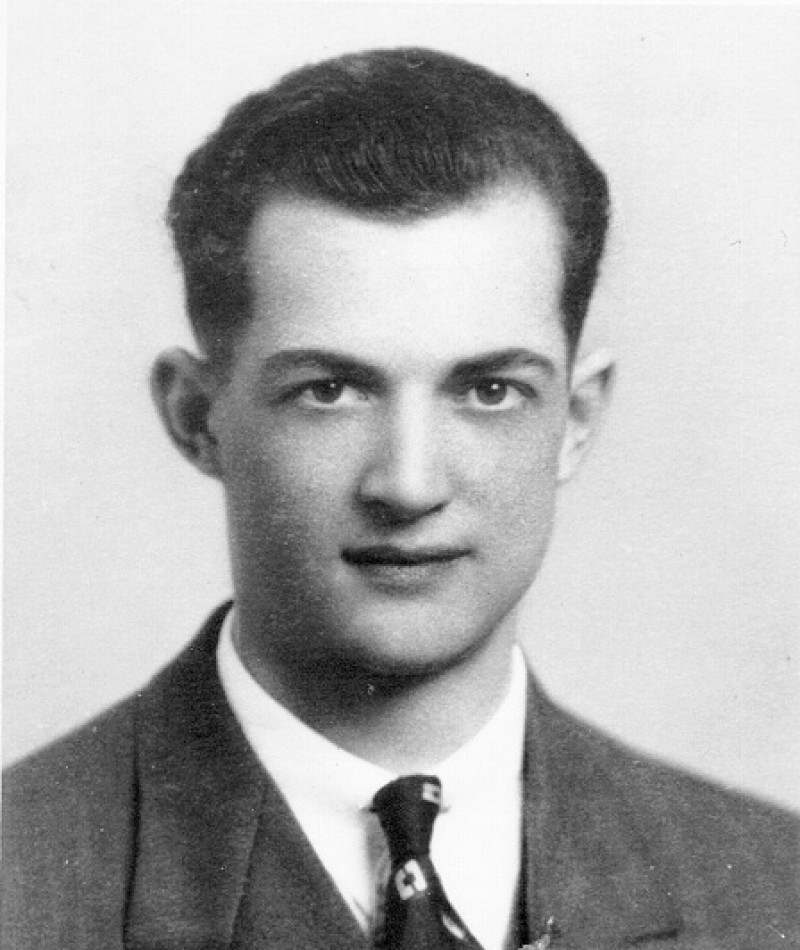 (Joe Mann)
This is a memorial at St Anthony's Mill in the town of Eerde, north of Best. Much of the Eindhoven and Nijmegen areas seized by the Americans was under constant German counterattack for a week. St Anthony's Mill, an actual windmill, was the site of prolonged fighting. This memorial, which today sits next to a modest neighborhood of small well-kept homes, is maintained locally. A few feet away is another memorial with the names of 75 men from the 101st who perished in the area around the mill.
 Highly recommended for a visit in this area is the Wings of Liberation Museum in Best. It can be a little difficult to find, located within what is primarily a children's park. The museum is directly adjacent to the 101st landing zones which, for the most part, remain open fields, and boasts an excellent collection of military equipment and an accompanying audio tour that highlights the bravery of the Dutch resistance.
Thursday, October 15, 2026
Summer Soft
It's been a while since we've featured Stevie Wonder. Time to remedy that. Summer Soft is from his 1976 double album Songs In The Key of Life, the capstone of the remarkable five album run Stevie had in the 1970s; Music Of My Mind and Talking Book (1972), Innervisions (1973), and Fulfillingness' First Finale (1974), containing tunes like Superstition, You Are The Sunshine of My Life, I Believe (When I Fall in Love It Will be Forever, Living For The City, Higher Ground, Don't You Worry 'Bout a Thing, Boogie On Raggae Woman, and You Haven't Done Nothin', being the predecessors. Songs In The Key of Life also contained Sir Duke, Isn't She Lovely, I Wish, and Pastime Paradise.
Summer Soft, one of the album's lesser known songs is simply amazing. From the gorgeous piano opening, multiple and complex chord, key, and rhythmic changes, layered intricate instrumentation, topped by one of Stevie's finest vocal performances (which is really saying something!), this is a masterpiece. And from what I could find out that's Stevie on piano, synthesizer, bass, and drums.
Wednesday, October 14, 2026
Nuts
Bastogne is surrounded by monuments, memorials, and museums. of which we visited two. The Bastogne War Rooms museum was disappointing. Located in the downtown barracks that served as General McAuliffe's HQ it seemed rather thin on materials. However, the Bastogne War Museum, located just outside the town was well worth a visit. Artifacts, displays, and explanatory materials were all outstanding. The audiophones also present a coherent and well-designed explanation of the events from four perspectives; American and German soldiers, a young schoolteacher who is part of the Resistance, and a young boy of 10 sent by his family in a small village to find shelter in Bastogne.
North of the town we visited Bois Jacques and the village of Foy, scene of two memorable episodes in Band of Brothers. The Bois Jacques is where Easy Company was stationed for three weeks. You can still see the foxholes in the forest. Foy was the village just downhill from the forest attacked by Easy on January 13, 1945. You can see the village from the edge of Easy's position.
Bois Jacques


Foy from the edge of Easy Company position.

Memorials at the church in Foy. The church was repaired after the war but still bares scars from the battle. First photo is of church after the Americans took Foy.


This last photo tells the story of the return of treasured church artifacts returned by American soldiers many years after the war.

Tuesday, October 13, 2026
Grand Slam
It was Oct 13, 2013. Things were looking grim for the Red Sox in their playoff series against the Detroit Tigers. They'd lost 1-0 at Fenway the night before and tonight they were down 5-1 entering the bottom of the 8th. If they lost, the Sox would be going to Detroit to play three games down 2-0 in a best of 7 series.
LDC and I had been in the Fenway bleachers the week before to see the Sox beat the Rays on their way to a 3-1 series win and I was watching the game that night and not feeling good about it.
Detroit starter Max Scherzer was overpowering holding the Sox to two hits and one run while striking out 13 in seven innings but took himself out of the game at that point.
Jose Veras started the 8th for the Tigers, getting the first batter out on a grounder but Will Middlebrooks doubled to left. Drew Smyly replaced Veras and walked Jacoby Ellsbury on a 3-2 count and was immediately replaced by Al Alburquerque who struck out Shane Victorino. Two down! But then Dustin Pedrioa singled, loading the bases.
Joaquin Benoit, the Tigers' closer, came in to face David Ortiz. Big Papi had not had a good series so far going 0 for 6 with four strikeouts. Scherzer had faced him three times that night, getting him to K twice while walking the slugger once. Benoit's first pitch was a changeup which Ortiz hit on a line into the Red Sox bullpen giving us the immortal photo of Tiger center fielder Torii Hunter's legs after he plunged over the low wall in pursuit and behind him the upraised arms of a Boston policeman who was stationed in the bullpen. The grand slam tied the game.
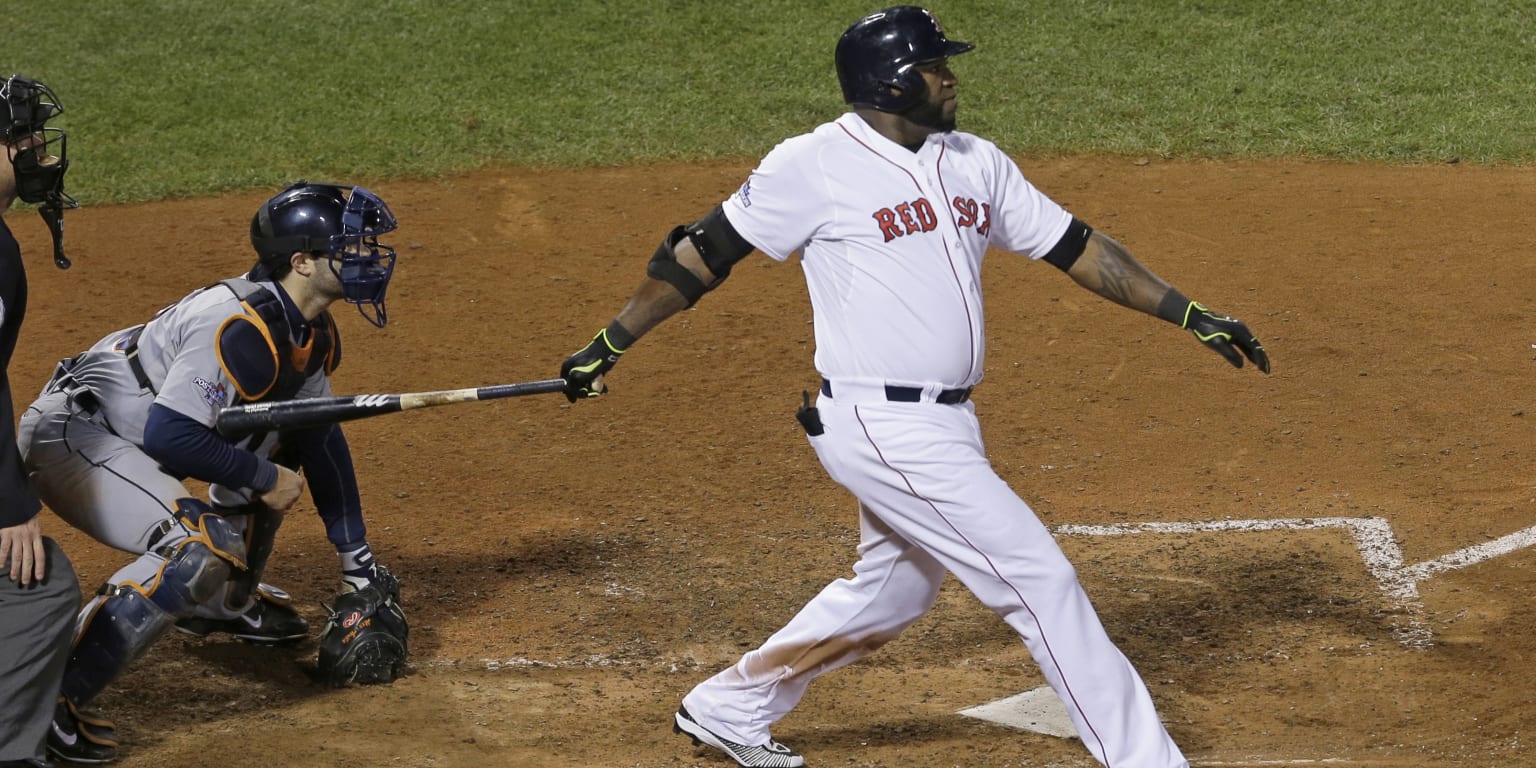 Big Papi's swing against Benoit.

The deflated Tigers went on to lose in the bottom of the 9th when the Sox pushed across the winning run. Ortiz only went 1-15 in the next four games, one of his worst playoff performances, but he came through when it most counted and the Sox took 2 of 3 in Detroit and then won game 6 in Fenway, going on to beat the St Louis Cardinals in the World Series. Big Papi hit .688 in the World Series and was on base 19 times in 24 plate appearances. LDC and I were in the bleachers for the final game and experienced the Red Sox winning the World Series at Fenway for the first time since 1918.
I came across this interview with Torii Hunter in which he drops a few nuggets, most startingly that he and Ortiz had dinner the night before the game and Big Papi told him that Benoit was tipping his pitches so he knew what was coming. Hunter said Benoit was dismissive when he told him of Ortiz's claim, responding that he always got him out. I checked and as of the playoff series, Big Papi was 6 for 22 off of Benoit, but had only 3 hits in his last 15 at bats, and he'd never had an extra base hit against Benoit.
Torii also talks about the longer term effects from hitting his head when falling into the bullpen. And, though not said directly, Hunter implies he did not like Scherzer's decision to take himself out of the game. Torii Hunter had a distinguished career and was an outstanding outfielder and is in the Almost Good Enough, But Not Quite, To Get Into the Hall of Fame category.
Monday, October 12, 2026
Luxembourg
My first time in this tiny country. The northern part is very hilly and heavily forested, the central area more open with rolling countryside. Quickly overrun by the Germans at the start of both world wars.
Clervaux, the small town where we stayed for the night, sits at the bottom of a bowl, surrounded by steep wooded hillsides, with only narrow, twisting and steep roads providing access. Within the town is a small hill upon which sits a castle, today the site of the history museum filled with artifacts of the Battle of the Bulge.
The town's significance is that on December 16 it sat about five miles from the German front lines and it is only 20 miles from Clervaux to Bastogne via a direct road. The German timetable called for the attack to begin at dawn on the 16th, quickly seize Clervaux, and take Bastogne by noon on the 17th. The importance of Bastogne lay in the road network centered on the town and it was to be the path for the German army to advance upon Brussels, protecting the flank of the main effort toward Antwerp.
Instead the last remnants of the 110th Infantry Regiment, 28th Division held out at Clervaux until the morning of the 19th, while Combat Commands from the 9th and 10th Armoured Divisions sacrificed themselves to slow down the Germans on the road to Bastogne. The Germans did not approach Bastogne until the afternoon of the 19th, only beginning their attacks on the town on the 20th, by which time the 101st Airborne had arrived.
Near the gate to the castle is the restored Sherman tank which defended the castle during the German assault until it was damaged.


Clervaux was rebuilt after the war and today is a quiet vacation town.


From Clervaux we drove 45 minutes south to Dierkirch, another Luxembourg town occupied by the Germans, which houses the country's National Military Museum containing an impressive array of equipment and artifacts.

 On the 45 minute drive to Bastogne we stopped at the Schummanseck Memorial Path just before entering Belgium, site of the deadliest concentrated fighting of the battle. Patton's Third Army reached Bastogne on December 26, breaking the siege, but only had a narrow corridor open to supply the town, which remained mostly surrounded by the Germans. Patton proposed attacking the Germans from both north and south at the base of the salient created by the Bulge attack, believing the enemy would be unable to defend at strength and forcing a withdrawal. However, he was overruled by Eisenhower, Montgomery, and Bradley, who ordered an attack from the south closer to Bastogne, only ten miles east.
The result was Patton's attack in the area of the Schumannseck, resulting in a grueling and bloody fight that lasted for the first three weeks of January, with thousands of casualties on both sides. The Memorial Path is in a forested area taking you past foxholes and outposts used by Germans and Americans who fought at close quarters. The eerie part is that life-sized portrayals of Germans and American soldiers are placed along the trail.


Sunday, October 11, 2026
The Bulge: The Northern Shoulder
We continued our travels through the northern sector of the battle driving through the twin villages of Rocherath and Krinkelt which saw house to house fighting as the 99th and 2nd Divisions delayed the 12th SS Panzer Division, allowing American reinforcements to reach the Elsenborn Ridge where they withstood further German attacks over the next week. Much of the Elsenborn Ridge is today a training area for the Belgian Army and inaccessible to tourists. A narrow one-lane road goes up the ridge where there is only one small monument marking this critical point in the American defense line.
From there we went about 10 miles southeast to the tiny village of Lanzareth only a couple of miles from the German border. With the aid of Google maps we were able to find a small gravel road leading up a hill where we found a monument dedicated to the Intelligence & Recon Platoon, 394th Infantry Regiment, 99th Division. On the morning of December 16, the 22 man platoon, commanded by 2nd Lt Lyle Bouck Jr, who would turn 21 the following day, found itself confronting a 500 man German battalion. The German timetable called for the battalion to quickly seize the village and open a path for the Panzers to exploit the breakthrough. Instead, Bouck's platoon, with the assistance of four forward artillery observers, held off the Germans for eighteen hours before surrendering after running out of ammo, completely disrupting the attack plan and delaying the advance of the panzers by a critical day.
Because Bouck and his platoon were POWs for the rest of the war, the actions by the platoon were little known and not recognized for decorations until 1981. Once a full review was made of the I&R Platoon's heroic conduct, it became the most decorated American platoon of the war. The unit received a Presidential Unit Citation, Bouck and three others received the Distinguished Service Cross, five members received Silver Stars, with nine receiving Bronze Stars with V device for Heroism. The four soldiers of the 371st Forward Artillery Observation Team (one of whom was killed on Dec. 16) each received the Distinguished Service Cross.
The photos show the position of the memorial. Lanzareth is at the bottom of the hill. The hills in the distance are in Germany. The other photos show the memorial and the information on its panels. Standing on that hillside and imaging what those soldiers went through that day was a powerful moment.


Saturday, October 10, 2026
The Straight Story
David Lynch made some bizarre and strange movies, but he was not a cynic. A cynic could not have made The Straight Story, the G-rated movie Lynch directed for Disney, which was released in 1999. I saw it when it was in theaters and recently watched it again.
The movie is based on the story of Alvin Straight. In 1994, the 73 year old Straight, living in western Iowa, learned that his brother Lyle, across the Mississippi in the hill country of Wisconsin, 240 miles away, had suffered a stroke. Alvin had been estranged from his brother for a decade, during which they had no contact, but decided he needed to see him. As he says "It's a hard swallow on my pride to do this trip. I just hope I'm not too late". Not having a driver's license and refusing to travel by bus or have someone drive him, Alvin decided to ride a lawn mower the entire way - a journey which took five weeks. The movie is about that journey.
It's a calm, reflective tale that Lynch spins. The movie was filmed along the same route Alvin rode and captures the land and people of the region and its small towns. And Lynch clearly adores and admires the movie's characters. There is no antagonist in the film, you saddle up and, with a bit of patience, enjoy the ride and Alvin's encounters along the way, including with a runaway pregnant teenager, a revealing conversation with a fellow WW2 veteran in a Wisconsin bar, and the legendary grabber scene.
There are a couple moments of Lynch's patented weirdness, most notably with Alvin's encounter with a woman motorist who has just hit a deer and goes off on an extended and very odd lament about hitting several deer over the prior two weeks on her commute to work.
The cast is impeccable. Richard Farnsworth plays Alvin with quiet, restrained dignity, a role for which he was nominated for an Academy Award as Best Actor. What Farnsworth kept secret from Lynch and the rest of the cast was he was terminally ill with prostate cancer. The canes you see Alvin use in the film for support were actually needed by Farnsworth at the time, but he made up an excuse as to why he needed them. Farnsworth died a year after the film was released. Farnsworth's manner of speaking and attitude reminded me of my late father in law who was born in Nebraska and lived his adult life in Iowa, adding additional poignancy as I watched.
Sissy Spacek plays Alvin's daughter. Her back story, involving her children, is one of the few purely fictional aspects of the screenplay. Harry Dean Stanton plays Alvin's brother and their reunion scene at the film's end is perfect. There are also many smaller roles cast perfectly but one deserving highlighting is James Cada as Danny Riordan who helps Alvin when his lawn mower breaks down and develops a relationship with him. Cada conveys that Midwestern decency and straight forwardness that I've seen over the years, having spent a lot of time in Iowa and Wisconsin.
The score by Angelo Badalamenti is subtle, lovely, and underlines the movie's mood.
The Bulge
In September 2024 my friend Joe and I spent a week along the French-Belgian border visiting WW1 sites, primarily Ypres, the Somme, Verdun, and Meuse-Argonne, a trip about which I did three posts, Left Behind, Lochnagar Crater, and Butte de Vauquios.
This year we traveled to Belgium, Luxembourg, and the Netherlands spending three days each on the Battle of the Bulge and Operation Market Garden. We also spent an afternoon in Amsterdam which I didn't care for being overrun by tourists, somewhat shabby, and reeking of weed everywhere. The rest of the trip was memorable.
I'm writing of the Bulge and Market Garden separately but something we were impressed with in both areas was the extent to which these battles are still remembered today and the Allied participants honored. We saw many American flags, not only at museums and major combat sites, but in small towns and the countryside where small American units fought. These include memorials to individual soldiers and units, maintained by local volunteer groups or municipalities eight decades after the events. And the same can be said for the way British and Polish airborne are honored in the Arnhem area.
The Ardennes, the forested and hilly area of Belgium and Luxembourg, is beautiful country filled with small towns and villages, narrow scenic roads, narrow valleys and rolling countryside. At the same time you see constant reminders of the terrible events that occurred between December 16, 1944 and January 28, 1945, in which 80,000 Americans were killed, wounded, missing, or captured.
Growing up most of what I knew about the Battle of the Bulge was centered around Bastogne, the 101st Airborne and its acting commander, General Anthony McAuliffe, responding "Nuts" to the German demand he surrender his forces. The prominence of Bastogne and the 101st has been heightened further by the popular series Band of Brothers which includes several episodes on Easy Company of the 101st at Bastogne.
In recent years as I've done more reading and listening to the 8-part series on the battle on the We Have Ways of Making You Talk podcast, I've come to a better understanding of the battle and we designed our tour to reflect this. We only spent the last of our three days in the Bastogne area, instead focusing on the northern sector where the Germans planned their breakthrough only to be thwarted by outnumbered and outgunned American forces and the central front where the 28th Infantry Division and Combat Commands from the 9th and 10th Armored Divisions fought desperately and successfully to delay the German timetable enough for the 101st to reach Bastogne. The four American infantry divisions on the front line on December 16 (south to north: 4th, 28th, 106th, and 99th) were outnumbered 5-1 in infantry and 10-1 in tanks.
Our first day we initially traced in reverse the route taken by Kampfgruppe Peiper which broke through American lines until finally stopped at the village of La Gleize in the town of Stoumont. We then traveled through Stavelot and Malmedy (the site of the notorious massacre of American prisoners by the SS troops under Peiper's command, and on towards the German border. We then visited St Vith, Lanzereth, and the Elsenborn Ridge where the green 99th Infantry Division, quickly reinforced by other American units, stopped the main German thrust towards Antwerp.
Our second day was primarily in Luxembourg where we stayed in Clervaux, HQ of the 110th Regiment of the 28th Division, the unit which bore the brunt of the German attack in the center, losing 85% of its strength, but gaining precious time by disrupting the German timetable. Clervaux today is a lovely little town set in a bowl and surrounded by forests. In 1944 it gained the nickname of Alamo in the Ardennes. We also visited the country's National Military Museum in Diekirch, a town initially captured by the Germans in the offensive. Finally, we visited the Schumannseck Memorial Path, where Patton's troops fought the Germans for three weeks in early January.
At the December '44 Museum in La Gleize, the little village where a collection of American units, including the 82nd American (Joe served in the 82nd during the 1980s) stopped Peiper. That's me in front of a German Tiger Tank abandoned by Peiper's attack group. The museum contains a large collection of artifacts, most of which were left behind by the Germans. Also below is a memorial to the 82nd in the nearby town of Werbomont.


Stavelot. This little town saw fierce fighting with the Germans occupying parts of the town for over three weeks. Peiper's SS Panzer troops executed more than 130 Belgian civilians during the occupation. Photos below are from the Memorial Park along the River. Second photo is memorial to the civilians murdered. It took us a couple of minutes to realize what we were looking at in the picture in the third photo. It shows a German tank and if you look beyond the picture you will see that still standing today is the building in front of which the tank was emplaced.


The next town was Malmedy, today a very pleasant market town. A little over two miles outside town is a field where, on December 17, Peiper's SS troops killed 84 American prisoners from the 285th Field Artillery Observation Battalion. The prisoners were machine gunned and then German soldiers shot any survivors. However, in the chaos a number of Americans were able to escape and reached American lines. Peiper's unit had murdered other American POWs earlier that day but this remained unknown for some time but with the Malmedy survivors carrying the news within hours, the military publicized the event and it was quickly picked up by newspapers. News of Malmedy helped stiffen American resistance and created a desire for revenge. For the remainder of the war German SS troops would find it difficult to surrender to Americans and survive. Investigations after the war concluded that between 300 and 700 American soldiers were executed by Peiper's column.
The photos below are from the Memorial. Many American family members of those killed have placed photos and other remembrances at the memorial and the names of each of those killed is engraved on the wall. An American flag flies over it.


Subscribe to:
Posts (Atom)