We've returned to our favorite spot in Europe for the first time since 2022, the little walled town of Domme in southwest France.
Some evening photos from around the place we are renting.
We've returned to our favorite spot in Europe for the first time since 2022, the little walled town of Domme in southwest France.
Some evening photos from around the place we are renting.
On April 15, the Washington Post posed this query:
"Rep. Eric Swalwell’s (D) fall left many asking how someone who was dogged by persistent rumors of inappropriate behavior toward women could have risen so high and so fast in a party that says it supports women’s rights."
Answer: Although many of his fellow Democratic politicians and many in the media knew about his behavior for years, they withheld information because of higher priorities - beating Republicans, especially Donald Trump. It was only when running against fellow Democrats for California's gubernatorial nomination, where the D nominee will win the general election, that Swalwell became expendable.
The Post wasn't actually serious when it posed the question. Reporters and editors already knew the answer. We have reporters from multiple publications acknowledging they knew the stories about Swalwell as long ago as 2013, but, for some reason, never got around to investigating. And obviously, the Democratic politicians knew, because one of his D opponents in the governor's race dropped the dime on him.
Swalwell first came to national prominence in 2017 and 2018 when he served on the House Intelligence Committee investigating Russian interference in the 2016 presidential election. Along with Rep. Adam Schiff he was a fixture on cable and network news promoting sensational tales of Russian interference and Trump malevolence, all of which proved false. After wading through more than 5,000 pages of testimony taken by the committee, I made this comment about Swalwell:
The leading Democrat questioners were Adam Schiff and Eric Swalwell. Schiff was a very skillful questioner. In contrast, Swalwell acted like he was always on the verge of asking the one question that would unravel the entire conspiracy and evidenced a very high opinion of his own abilities. I think Schiff realized fairly quickly the Democrats were drilling a dry hole in the search for a conspiracy but understood the political advantage of continuing the charade. Swalwell was dumb enough he may really have been a true believer.
The congressman further elevated himself with fellow Democrats by becoming a prominent critic of Brett Kavanaugh during his Supreme Court confirmation hearing, promoting the most outlandish (and false) accusations against the nominee.(1)
In the years since, he's continued on a path as a rising star in the Democratic constellation. This despite his dalliance with a Chinese spy while he served on the intelligence committee.
Like many politicians in both parties it is difficult to objectively look at Swalwell and conclude he's the kind of person you would want in high elected office, or any office, for that matter. Nonetheless, he received glowing press coverage. When, in September 2018, Swalwell's GOP opponent was the subject of an attempted stabbing and only saved by a malfunctioning jacknife, to the extent it was covered by the media it was limited to brief one-day stories. The next day, Swalwell was interviewed on CNN to talk about how horrible Trump was and received no questions regarding the incident, not even being asked to comment on it. No national conversation on political violence needed here!
The bottom line is that when the media breaks a story that, on its face, is damaging to Democrats, the question to be asked is not about the substance. Instead, ask why is this story being published now? Because, in almost every case, the substance was known for a long time. It is only the timing of the disclosure that matters.
Let's take two other examples to further illustrate how the system works.
The New York Times recently "broke" a story about Cesar Chavez, alleging a long time pattern of sexual abuse, inappropriate behavior, and general disrespect towards women. Chavez died in 1993, so why now? Much of the story was already known with biographies and other stories floating around for many years and, as with Swalwell, since the story broke many reporters have said they heard the stories years ago but had not reported on them because no one did the investigative work. The allegations of Dolores Huerta, now 96, are new and, indeed, terrible if true but even in her case she stated the 60 year old events had not been made public before because it would "hurt the movement".
Chavez's birthday is an official state holiday in California and celebrated in other states and cities. He had many schools, streets, and other public institutions named after him, and statues erected in many places. His work on behalf of farmworkers in covered in many educational textbooks. So why now?
Cesar Chavez was born in 1927. Next year is his 100th anniversary, a time when one would expect heightened attention and celebration of his life. However, in recent years as illegal immigration has become a fiercely debated subject, Chavez's very public and very vociferous opposition to illegal immigration has become more widely known. The very groups that have promoted his legend for decades are now unequivocally in favor of open borders and it would have been embarrassing and counterproductive to have Chavez remain a celebrated progressive hero next year. That's why he needed to be taken down now, so his legacy could not be used by opponents of today's progressive narrative. It's why the states and cities that celebrated Chavez over the decades have moved so quickly to take down monuments and rename things. It is important to erase as much as possible before the 100th anniversary.
Let's talk about Andrew Cuomo. In August 2021, Cuomo resigned as governor of New York after ten years in office. He'd been under constant political pressure since January of that year from the progressive wing of his party. Looking at his record, the casual observer would consider Cuomo to be a progressive, but because of his acerbic personality and willingness to only go 90% on the full progressive belief system he was anathema to that wing and they sought a way to get him out of office. But why 2021 after ten years in office?
The first effort to attack him was from ultra-progressive State Attorney General Letitia James. By ultra-progressive I mean she is a follower of Stalin's favorite secret policeman Lavrentiy Beria's adage, "show me the man, and I'll show you the crime". The lever was a report released by James on January 28, 2021 alleging that thousands of Covid-19 deaths in nursing homes were undercounted by Governor Cuomo, in an effort to support the effectiveness of the governor's actions to control Covid-19 in New York. Adding to this is Cuomo's decision to send Covid positive nursing home residents back to the nursing homes contributed to the toll in the early part of the pandemic.
But there was a problem for Cuomo's fellow Democrats when it came to timing. Although James and the stenographers at the New York Times pretended her report was a revelation, the undercounting and the deaths due to Cuomo's decision on sending Covid positive patients back into nursing homes was known in May and June of 2020. I was following Covid developments at the time and aware of the discrepancies between the state and CDC death counts and of sending the sick back into the homes. In October 2020 I wrote:
State politicians in some cases downplayed covid early on, in others sent infected patients back to nursing homes, in others delayed urging the use of masks, and in others completely overreacted in their dictates which have been kept in place well beyond reason. And not enough bad can be said about the ghoulish Governor Andrew Cuomo.
If you followed some knowledgeable conservative public health analysts you knew what was going in, but it was ignored by legacy media and Democrats.
Why? It's because Cuomo was being celebrated by Democrats and the media as the anti-Trump in 2020. The politician who was responsible, sober, intelligent, and, later that year was celebrated, particularly by himself, as the man who defeated covid.
In contrast to Trump's erratic press conferences which gave him ample opportunity to demonstrate his ignorance, Cuomo was calm, reassuring, and able to fake empathy, unlike Donald. For his party and the press to take down Cuomo for the nursing home massacre would have undermined the narrative they'd established. In fact, they went out of their way to hype Cuomo's "accomplishments".
The Governor received an Emmy Award for his press conferences, to promote his book he did a victory tour of late night talk shows, where he was received with adoration, and was bestowed the Edward M Kennedy Award for Inspired Leadership for his covid response.
Now, look at the timing of AG James' report, January 28, 2021, a week after Joe Biden was inaugurated and Trump gone. Once Trump was gone, the governor became expendable. That's why it was not allowed to become a story before then and only permissible to write about once Trump was gone. If Trump had been reelected in 2020, there would have been no AG report. James, the Democrats, and the press didn't give a damn about the thousands of deaths at the time they were occurring. It was, to borrow a phrase, an inconvenient truth at the time. But, rest assured, the Dems and the press were confident those who died and their families felt it was worth it because it allowed the Cuomo v Trump narrative to be sustained when most important politically.
However, the slaughter at the nursing home was not enough to get the job done, so the Dems and press turned to the tried and true tactic of sexual misbehavior, which was rolled out in February.(2) Strangely, if you looked closely at the allegations, many of them went back years. This was nothing new and, as with Swalwell, if you read closely you understood that it was common knowledge among party activists and some of the press, well before 2021.
I have a personal take on Cuomo's troubles with women. In the 1980s and 90s, I spent quite a bit of time in Washington DC on business. The company I worked for had a Washington office to do lobbying and I was often there. In the 90s, the head of the office was a guy who'd been a long time staffer on the Hill for a prominent Democratic congressman, beginning in the 1960s. I learned a lot from him about the transformation of Congress over the prior thirty years, including the increase in partisanship and the collapse of once frequent cross-party personal friendships.(3)
One day our discussion got on the topic of President Clinton's cabinet, and my friend started walking through each of them, giving his evaluation. Everyone was rated from excellent to okay from his perspective. Then he got to Andrew Cuomo, who was Secretary of Housing and Urban Development in the second Clinton administration, and began a rant about how horrible a guy Cuomo was and his problems with women. So, I wasn't surprised by the allegations more than two decades later.
The "revelation" story is never the story with institutional media. Ask "why am I reading this now?" to get to the real story.
---------------------------------------------------------------------------------
(1) With all these revelations about Democrats and political activists, a frequent press excuse is they weren't able to confirm allegations so withheld reporting. But none of those rules applied when it came to Kavanaugh in 2018. The press reported breathlessly on any rumor and allegation, regardless of the lack of confirmation. None of the allegations reported at the time, including those of participating in gang rape, were ever confirmed in any form. The individuals who Kavanaugh's primary accuser, Christine Blasey Ford, claimed would support her allegations both refused to do so. One of them, a long time friend and self-described political progressive, reported that her refusal to do so led to threats of ruination from other progressives. In fact, there is no evidence, outside Ford's allegation, that she and Kavanaugh ever met on any occasion.
That the press was using the allegations as a political weapon and simply did not care if they were true is shown by the lack of any followup investigation once Kavanaugh was confirmed. The national press didn't even give lip service to the idea the allegations were real. Hey, at least OJ said after he was acquitted he was going to find Nicole's real killer!
The real revelation from the Kavanaugh hearings was for moderate non-MAGA Republicans. Kavanaugh was about as mainstream non-MAGA moderate as you'll find in the GOP, yet the Democrats and press spared nothing in their efforts to not just deny him the confirmation, but to destroy him personally. Trump may be the flagbearer but anyone associated with the GOP today is a public enemy for the press and the institutions.
(2) The first rumblings about sexual allegations began in December 2020, after the election, but it wasn't until February that the story picked up steam, which is consistent with the Covid report not being a knock out punch.
(3) I learned from reading Robert Caro's third volume of his LBJ biography, Master of the Senate, that in the 1950s academic political scientists were very critical of the two parties because both consisted of what seemed to be ideological incompatible coalitions - for instance, the Democrats with conservative Southerners and urban liberals from the North. This was a bad thing in their view and the recommended remedy was a realignment along clear ideological grounds, something we have finally achieved in the 21st century. Do you think it is an improvement?
He was wakened around 1am on the morning of April 19, 1775 with news of British scouts in the area. John Parker had gone to bed early that night probably already suffering from symptoms of the tuberculosis that would kill him in September. There had been rumors the British would make an expedition into the countryside outside of Boston so the news was not a surprise.
Parker was 45 years old, married to Lydia Moore, with whom he had seven children from age 18 to 4. The Parker family had lived in Lexington since the 17th century and John had served in the French & Indian War (1). With his family background and military experience, he'd been elected as captain of the town's militia.
The 77 men of the Lexington militia mustered on the town green before dawn, formed into two lines. As dawn broke the 700 soldier British detachment approached. At the same time, two men crossed through the Lexington line, carrying a large chest. It was Paul Revere and an assistant with a chest containing important papers left behind by John Hancock in a house next to the town green. What happened next and who fired the first shot remains unknown, but the British initiated the first volley fire which shredded the Lexington ranks and Redcoats then advanced. Eight militia were killed and ten wounded. In a deposition given on April 25, Captain Parker wrote:
No 4. Lexington April 25th, 1775
I John Parker, of lawful Age, and Commander of the Militia in Lexington, do testify & declare that on the 19th Instant, in the morning, about one of the Clock, being informed that there were a Number of Regular Officers riding up and down the Road, Stopping and insulting People as they passed the Road, and also was informed that a Number of Regular Troops were on their March from Boston, in order to take the Province Stores at Concord, ordered our Militia to meet on the Common in said Lexington, to consult what to do, and concluded not to be discovered nor meddle or make with said Regular Troops (if they should approach) unless they should insult or molest us – and upon their sudden Approach I immediately ordered our Militia to disperse and not to fire – Immediately said Troops made their Appearance and rushed furiously, fired up-on and killed eight of our Party, without receiving any Provocation therefor from us.
The population of Lexington in 1775 was between 700 and 800. Members of the militia and their families were well known to each other and had often intermarried. The shock of losing good friends must have been considerable.
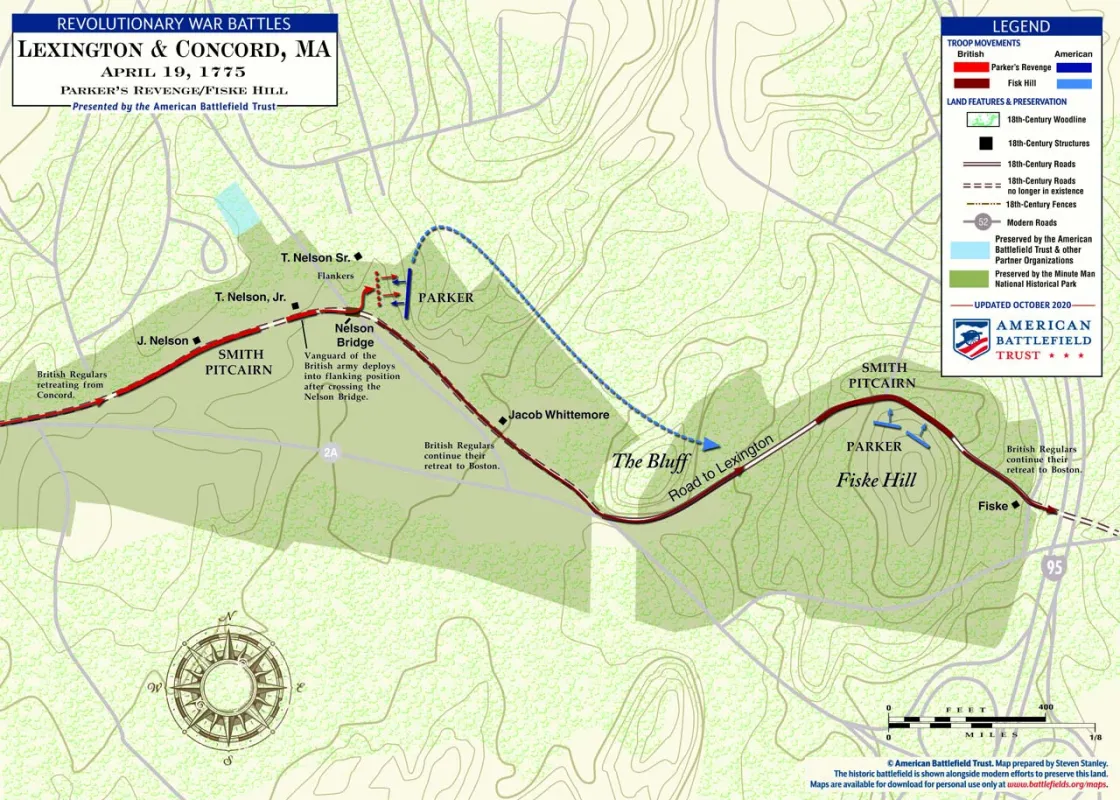
The British marched on to Concord but Parker and the militia were not done. At North Bridge, the Massachusetts men from several towns attacked and routed the British, who began an increasingly panicked retreat along the same road they'd taken early in the morning. As news filtered back to Lexington, Parker mustered his men once again, determined to confront the British. According to the recollections of Nathan Munroe of the militia:
"About the middle of the forenoon Captain Parker having collected part of his company, I being with them, determined to meet the regulars on their retreat from Concord. We met the regulars in the bounds of Lincoln. We fired on them and continued so to do until they met their reinforcement in Lexington.”
The exact location of Parker's encounter, referred to as "Parker's Revenge" has been the source of dispute for many years but excavations in recent years have identified the precise spot. The Lexington militia's initial volley inflicted several casualties on the British column and then continued to cause more damage as they followed the retreating British towards the Lexington green. The National Park Service describes the search for Parker's Revenge here, noting of the militia tactics:
Having left Lexington center before noon, Captain Parker and his militiamen had time to think about how to use the landscape to their advantage. Perhaps still questioning the decision to make a stand on the town green, Captain Parker was not going to be careless with the lives of his neighbors, relatives and friends. If the stand on the Green was meant as a show of resolve more than an invitation to battle, the fight on the town border in the afternoon was the real thing.
For more on Parker and his actions that day:
-------------------------------------------------------------
(1) There is some uncertainty over Parker's prior military experience, though all the secondary sources claim he served in the French & Indian War, including some stating he was at the Siege of Louisbourg in 1758 and at the Battle of Quebec on the Plains of Abraham the following year. My research was unable to confirm Parker's presence at either event. In what capacity he served during the war I could not ascertain.
Considered by some to be the first funk song, 1967's Cold Sweat by James Brown runs for seven minutes, with Part 1 as the A side single. Whether it is or not, it's a penetrating groove. You can find both parts here. At the beginning of Part 2 you can hear James call out "Maceo", a reference to tenor saxophonist Maceo Parker. Also featured on the track are Bernard Odum on bass and drummer Clyde Stubblefield.
With his performance against the Mets, Shohei Ohtani became the first major league player to have a 30+ game on base streak and 30+ scoreless innings at the same time. No one else in history has even 20 in both categories at the same time.
THC demonstrated his baseball knowledge and prognostication abilities back in 2018 when, after witnessing Shohei's first pitching and DH appearances in spring training, he felt confident the guy would never be a successful major league player.
From Neil Young in 1992. Background vocals on the recording by Linda Ronstadt. Bringing back beautiful dreamy memories. Think I can stay there for awhile.
Because I'm still in love with you
I want to see you dance again
Because I'm still in love with you
On this harvest moon
An introduction and appreciation of the gritty 1973 movie set in Boston starring Robert Mitchum from Turner Classic Movies. Watch the clip, watch the movie. And here's a link to NY Times critic AO Scott on the film. Eddie Coyle was the first novel of George V Higgins to be published, and he went on to write twenty more over the following two decades before dying in 1999. THC has read them all.
THC has written on the book and movie before in The Workingman's Eddie Coyle and Missing George V Higgins, along with his magnum opus on Higgins and his work, Eddie Coyle's Friend, which includes a description of the author's technique:
A Higgins novel relies on dialogue in which the characters converse about what had happened, or was about to happen, or about things that had nothing to do with what had or was going to happen, though sometimes it would dawn on you towards the end of the book that that thing, you know, which the guy talked about way back that didn't seem to have anything to do with the story, did.
That technique found its most exquisite execution in Bomber's Law:
Nominally, Bomber's Law is about Detective Sergeant Brennan of the Massachusetts State Police, who is following a mob enforcer, Short Joey Mossi, in an attempt to build a case against him. After tailing Mossi fruitlessly for years, Brennan is saddled by his boss, Brian Dennison, with a new partner, Harry Dell'Appa, an idealistic and impatient young state cop, who is puzzled why Brennan and Dennison's predecessor, the retired and now very dead Bomber Lawrence, have failed to get the goods on Short Joey after all these years. Most of the novel, which is 95% dialogue, consists of Brennan, Dell'Appa and Dennison telling each other lengthy, and occasionally deliberately distracting, yarns in the course of which we learn a lot about Short Joey and his younger, mentally disabled brother, and eventually the secret of Bomber's Law along with embarking upon many entertaining excursions which have nothing to do with the plot, that is, if there is, in fact, a plot. The story telling is wonderful but dazzlingly complex often requiring the reader to double back and make sure they understand just whom the speaker is referring to or who is actually speaking.
From Fresh, Sly and the Family Stone's 1973 album. That bass line is by Rustee Allen, who replaced long time band bassist Larry Graham (see Fat Bass). The group's final album would be released the following year as Sly descended into drug induced madness. The grove and Sly's vocal are so good I can listen to it ten times in a row.
Legislation involves compromise and compromise requires trust between the parties and institutional parity and safeguards. That is not present at the federal level for most issues.
Take immigration. My compromise is:
1. Deportation for all those who arrived illegally during the Biden Open Borders Party.
2. Deportation for the estimated 1 to 1.5 million illegals with final deportation orders.
3. Deportation for illegals with criminal records (beyond just the initial illegal entry).
- There will be some overlap between these three categories.
4. An end to sanctuary states and cities which privilege criminal illegals over law abiding citizens (including legal immigrants and those residing here legally).(1)
5. Anyone who arrived illegally before January 20, 2021 and (1) does not have a criminal record and (2) is not on public support, should be allowed to stay in the U.S.
However, I would oppose any legislation embodying this compromise because of a structural imbalance within the legislation and between the branches of government. Such legislation if enacted would not operate to effect the compromise. If Republicans agreed to such a compromise, they would look like fools the next time Democrats control the executive branch, because they would have already allowed the presence of millions of illegals, while the Democrats effectively neutered their side of the bargain.
My assessment is based on what has become clear with Democratic opposition to immigration enforcement under the Trump administration. Democrats are opposed to removal of any illegals under any conditions and support an open borders policy. When questioned many Democrats mumble about supporting "common sense" immigration reform but when pressed on details fail to provide any evidence of supporting practical steps to control the borders and deal with illegals currently in the country. Their vision is of the U.S. as a bus terminal not a real country.
If legislation is enacted containing the elements I outlined above, this is how it would work in the real world.
The legislation would specifically contain Point 5, allowing millions here illegally to stay in the U.S. If a subsequent administration tried to renege on that deal, their actions would be immediately (and properly) struck down by the courts (regardless of who appointed the judges) because of clear statutory language.
However, implementation of Points 1,2, and 3 reside with the executive branch. If a Democratic administration decided to use its enforcement discretion to "slow walk" deportations, no court is going to order the executive branch to change its process. The executive will be able to effectively undermine the compromise. We have proof on this topic. In 2024, we were told that an immigration reform bill was needed to control the border. That was phony, because the Biden administration decided to ignore most of its statutory authority to control the border, while in 2025 the Trump administration showed it could effectively control the border using the same existing laws. For more on the fake reform bill read No, No, No.
Although the Biden administration killed prospects for immigration reform with its open borders policy, it was President Obama who paved the way in undermining prospects for compromise with his DACA Executive Order. I wrote about it back in 2014 and also noted the Washington Post's editorial opposition to Obama's action. In a 2016 post, More Mush From The NY Times, I explained the damage to prospects for compromise on immigration.
The Times article fails to explore the real problem with the President's unilateral actions, and the approval it has generated from Progressive, leading Hillary Clinton to promise she will be even more aggressive in this respect - the undermining of prospects for compromise on any issue, which is ironic given President Obama's consistent invoking of the need for less partisanship. Or perhaps, more accurately, the President's reference to nonpartisanship is a reflection of Obama's cynicism, as it has become apparent over time he's our most cynical President since Richard Nixon.Under these conditions, the best course is to not change or reform immigration law.
Here's an example of how President Obama's approach discourages compromise. I'm in favor of immigration reform that would both provide some increase in legal immigration and improve border security. But, if he were in Congress today, I would never vote for such a bill or even negotiate with Democrats on it. The reason is that the essence of compromise, is the each side has to give up something to get something. In a world where President's push executive orders, informal rulemaking and arbitrary changing of statutory language, there is no assurance that a legislator would get the value of the deal they thought they made. If a Progressive President has provisions in a compromise immigration reform bill they do not like, they can simply order the agency not to enforce it, or issue an executive order directly overriding the bill, or arbitrarily have the enforcing agency issue an informal notice changing deadlines and announcing a regulatory interpretation that leads to the opposite result intended in the legislation. When Progressives control the Executive Branch, it means they can implement the sections they like and ignore or override what they don't like, leaving the other side feeling like chumps from Palookaville.
-----------------------------------------------------------------------------
(1) It is not an exaggeration to state that sanctuary jurisdictions privilege illegals over law abiding citizens. Every such jurisdiction has established at either the state attorney general or local district attorney level guidelines requiring prosecutors to take into account the risks to immigration status (that is, deportation) in charging decisions and plea deals. In other words, to favor decisions declining prosecution or making terms easier on plea deals in order to minimize chances of intervention by federal immigration enforcement. California (no surprise!) has actually enacted a statute requiring prosecutors to consider these factors in making charging and settlement decisions. The result is that an American citizen who has committed a crime will likely be prosecuted more harshly and face more several sentencing than an illegal committing the same crime.
If you want to know how insane sanctuary enforcement is, look no further than the despicable Soros-backed DA of Fairfax County, Virginia - Steven Descano. Descano's campaign pledge:
Wherever possible, Steve will make charging and plea decisions that limit or avoid immigration consequences. Following such a policy will keep our communities united and strong and demonstrate our Country's commitment to equal justice for all. If two people commit the same crime, but only one's punishment includes deportation, that's a perversion of justice and not a reflection of the values of Fairfax County.
It could not be any clearer. It ignores that the illegal has committed two crimes, one being entry into the U.S., and allows an American citizen to be prosecuted more harshly. This is not justice, it is privilege for criminals here illegally.
This wasn't just a campaign pledge by Descano. He's followed it in practice, releasing several violent illegals, and is now mired in controversy, as those released have committed further violent acts, including murder. Descano gives no indication of caring about the consequences of his actions for law abiding Americans. His sole concern is protecting those who have illegally entered this country.
This also points to another problem in arguments about illegal immigration; discussions about how to measure criminality of illegals and whether it is a problem. After looking at a number of these analyses it is evident there is a major methodological problem. Some studies combine legal and illegal immigrants in the analysis. Most do not distinguish among the origin countries for illegals, despite evidence that crime rates significantly differ depending on country of origin. There is also the data source problem because a careful review reveals that in many instances the data used in the analysis is not uniform, or missing key jurisdictions. Finally, the sanctuary jurisdictions preference for no charging, or reducing charges, and allowing pleas to lesser offenses, brings into question any analysis on this subject. The truth is we simply don't know about comparative crime rates between illegals and citizens and others lawfully residing here.
But that isn't the biggest problem. Looking at comparative rates is the wrong metric in this situation. There certainly are instances where comparative rates are the right metric, but in the case of illegal immigration every crime is one that would not have occurred but for the illegal entry. It is the additive absolute number, not comparative rate, that is relevant. For instance, there are about 20,000 homicides in the U.S. annually. There are a few jurisdictions that report crimes committed by illegals by category. A reasonable extrapolation of that data leads to the conclusion that somewhere between 1,000 and 2,000 homicides in the U.S. are committed annually by illegals. The illegal homicide rate is simply irrelevant, if you have any interest at all in preventing homicides by illegals.
On this date sixty years ago, The Beatles began recording Tomorrow Never Knows, the revolutionary and groundbreaking track from the album Revolver, released in August 1966. Though it was the last song on the second side of that album, it was the first song recorded in the sessions for the record, something I was surprised to discover decades later. At the time, we'd never heard anything remotely like this before, and thought its placement as the closing song was a signal that big musical changes were coming for The Beatles. As with A Hard Day's Night, the title is from an off hand remark by Ringo. Before settling on Tomorrow Never Knows was called The Void and Mark 1.
Tomorrow Never Knows is primarily a one-chord song with a droning tone, interspersed with weird, swirling snippets from something strange, and backwards guitar bits. Behind it is Ringo's drum pattern, which remains unchanging throughout. I've seen recent commentary from younger listeners thinking that because the drum pattern is so unerringly accurate Ringo must have played a small part that was then digitally repeated. However, the technology did not exist at the time and it really is Ringo from start to finish. George Harrison plays sitar or tamboura, depending on the analysis, on the track.
Topping it off are Lennon's lyrics, "turn off your mind, relax and float downstream/ All play the game
Existence to the end, of the beginning". John's instruction to George Martin was to make his voice sound like he was the Dalai Lama singing from a mountaintop, which, with some studio ingenuity, Martin accomplished by feeding the vocal through a revolving Leslie speaker inside a Hammond organ (the effect starts 87 seconds into the song).
The most innovative aspect was the use of tape loops This description is from The Beatles Recording Sessions: The Official Abbey Road Studio Session Notes by Mark Lewisohn (1988):
Perhaps the most striking sound on Tomorrow Never Knows is one of tape loops [the sound achieved by tape saturation, by removing the erase head of a machine and then recording over and over on the same piece of tape]. . . . The seagull-like noise on Tomorrow Never Knows is really a distorted guitar. (According to studio documentation, other loops used included the sounds of a speeded up guitar and a wine glass.) "We did a live mix of all the loops," says George Martin. "All over the studios we had people spooling them onto machines with pencils while Geoff [Emerick] did the balancing. There were many other hands controlling the panning." . . . "It was done totally off the cuff. The control room was as full of loops as it was people". "I laid all of the loops onto the multi-track and played the faders like a modern day synthesizer" says Emerick.
You can watch a video about the recording here which contains additional details and differs in some respects from the Lewisohn book. You can listen to the isolated tape loops here.
Mastering The Tides of the World told of the difficulty in knowing what courses of action are the right path to take, despite our best efforts to reason our way forward and predict outcomes.
We are at war once again, this time with Iran. Before it started I did not know what the right course of action was. Now that it has commenced I think it essential we achieve victory along the lines outlined by Secretary of State Rubio. This is a circumstance where, having started the task, failure to achieve these outcomes will have serious long-term negative consequences for the United States. I am aware of the sunk cost fallacy but, in this case, we need to continue. I'm also painfully aware of the potential for unforeseen consequences, a theme that has prompted a number of THC posts.
The Event At Sarajevo reflects on the unforeseen consequences of World War I and the lessons for future conflicts.
Japan's disastrous 1941 decision to attack the U.S. and other Western nations is the subject of Japan Decides On War.
Dereliction Of Duty discusses the U.S. decision for escalated involvement in Vietnam in 1964-65.
America's flawed decision to attack Iraq in 2003; Pausing At The Precipice.
In his Second Inaugural Address (March 4, 1865), President Lincoln spoke of the unpredictable nature of war:
Neither party expected for the war the magnitude or the duration which it has already attained. Neither anticipated that the cause of the conflict might cease with or even before the conflict itself should cease. Each looked for an easier triumph, and a result less fundamental and astounding.
We see that unpredictability in how the Cold War ended with the collapse of the Soviet Union, a resolution I had not thought possible nor, for that matter, had the legions of American experts on the Soviet Union. Perhaps Ronald Reagan was the only one with the foresight to predict that ending and he was considered delusional until it happened.
There is also a delusion that those opposed to the use of force can fall prey to. That inaction will allow things to continue unchanged on the same course. They don't. I wrote about this in the Iraq section of the essay Reflections On The Middle East Wars.
Nor does it mean that victory is an end to history. In his Finest Hour speech on June 18, 1940, Prime Minister Winston Churchill held out a vision of victory that would lead the world into "broad, sunlit uplands".
The whole fury and might of the enemy must very soon be turned on us. Hitler knows that he will have to break us in this Island or lose the war. If we can stand up to him, all Europe may be free and the life of the world may move forward into broad, sunlit uplands. But if we fail, then the whole world, including the United States, including all that we have known and cared for, will sink into the abyss of a new Dark Age made more sinister, and perhaps more protracted, by the lights of perverted science.
Yet only fifteen years later on March 1, 1955, merely a decade after victory over Hitler, the emergence of the Cold War and the threat of mutual annihilation by nuclear weapons led Churchill, only weeks before his resignation as Prime Minister, to address these words to Parliament:
The day may dawn when fair play, love for one’s fellow-men, respect for justice and freedom, will enable tormented generations to march forth serene and triumphant from the hideous epoch in which we have to dwell.
Of course, being Churchill, he closed his remarks with the stirring admonition: "Meanwhile, never flinch, never weary, never despair.”
ARTEMIS II AS SEEN BY THE OFFICIAL NASA CESSNA
— Chris Combs (iterative design enjoyer) (@DrChrisCombs) April 3, 2026
THIS IS THE BEST LAUNCH VIDEO AND IT ISN'T CLOSE pic.twitter.com/ikLxSYbHKW
It's good to see America returning to the moon with the launch of Artemis II, after an absence of more than a half-century. Though this mission only entails a fly around, future missions will be landing.
Twenty four Apollo astronauts flew around or landed on the moon between December 1968 and December 1972. Of the twelve who remained in the command module, only one still survives; Fred Haise (92). Of the twelve who walked on the moon, four are living; Buzz Aldrin (96), David Scott (93), John Young (87) and Harrison Schmitt (90).
The astronauts were selected in part, because of their good health, and it is reflected in their longevity. All were born between 1923 and 1936 and were in their 30s and 40s at the time. Even in a worst case assumption that all of five living moon astronauts die this year, the average age for the moon walkers would be 82.7 years and for the circumnavigators 82.3. Under the same assumptions the median age for moon walkers is 86 and for orbiters 89. Ten of the 24 made it to 90, with one more possible, and another five between 87 and 89.
Godspeed and may the mission be a success.
We'll close with The Byrds' tribute to Armstrong, Alden, and Collins; "The team below, that gave the go, they had God's helping hand"
"If we want things to stay as they are, things will have to change. Do you understand?"
- The young Tancredi to his uncle and guardian, the Prince of Salina, explaining why he is joining the rebels seeking to unite Italy in the 1860s. From The Leopard, the masterpiece by Giuseppe Tomasi di Lampedusa which I am currently reading for the second time. (1958)
The quote is well-known. What is less known are the passages just before and after Tancredi's remark:
Before:
"You're mad, my boy, to go with those people! They're all in the maffia, all troublemakers. A Falconeri should be with us for the King."
"The eyes began smiling again. 'For the King, yes, of course. But which King?'"
After:
"What a boy! Talking rubbish and contradicting it at the same time. . . . The Prince jumped up . . . and rummaged in a drawer. 'Tancredi, Tancredi, wait!'. He ran after his nephew, slipped a roll of gold pieces into his pocket, and squeezed his shoulders."
"On his way downstairs, he suddenly understood that remark of Tancredi's, 'If we want things to stay as they are . . .' Tancredi would go a long way: he had always thought so."
-----------------------------
There's nothing in the streets
Looks any different to me
And the slogans are replaced, by-the-bye
And the parting on the left
Is now parting on the right
And the beards have all grown longer overnightMeet the new boss
Same as the old boss
Hey, nineteen
That's 'Retha Franklin
She don't remember the Queen of Soul
It's hard times befallen
The soul survivors
She thinks I'm crazy
But I'm just growin' oldHey, nineteen
No, we got nothin' in common
No, we can't dance together
No, we can't talk at all