Showing posts with label American Revolution. Show all posts

Monday, June 8, 2026

Empire Of Liberty

Sad news today.  Gordon S Wood, the great historian of early America, died when hit by a car in the parking lot of a Shaw's supermarket in Rhode Island.  Though 92, Wood remained active, attending and speaking at conferences this year.

I've read his books Empire of Liberty, Power and Liberty, and Friends Divided: John Adams and Thomas Jefferson and have The Radicalism of the American Revolution on my reading list for this summer.  Empire of Liberty is the story of the democratization of the new republic in its first 4 decades to an extent unanticipated by the Founders, and probably unwanted as to at least some of them.

Wood trained at Harvard under the eminent historian Bernard Bailyn.  I've read several of Bailyn's books; The Barbarous Years: The Peopling of British North America (which I wrote about here), Atlantic History: Concepts and Contours, and Illuminating History: A Reflection of Seven Decades.  Another Bailyn book, The Ideological Origins of the American Revolution, is also on my summer reading list.

In 2019, when the New York Times published the ridiculously ahistorical 1619 Project, the World Socialist Web Site, a Trotskyite organization, published the first extensive critique of the project when it interviewed liberal, progressive, and socialist historians of early America, who unanimously panned the publication, including Wood who characterized it as "so wrong in so many ways" (his full interview is here).

Earlier this year, Wood published his thoughts on America's 250th anniversary in National Review, "The Five Greatest Words in the Declaration".  Some excerpts:

In the Declaration of Independence, the 250th anniversary of which we are celebrating this year, the Founders put down five significant words that came to define America’s culture — “all men are created equal.” No phrase could have been more radical, more momentous. Even the French Declaration of the Rights of Man and the Citizen in 1789, with its statement that “men are born and remain free and equal in rights,” does not have the same power and significance.

Equality was based on a new understanding of people’s capacity to transform themselves. Educated people in the late 18th century came to believe — it was the basic premise of all enlightened thinking — that people were not born to be what they might become. 

Many enlightened American slaveholders (but, alas, not Jefferson) assumed that at birth they were no different from their black slaves; they had all started with the same blank slate. William Byrd, a wealthy slaveholder and learned member of the Royal Society, was as much of an aristocrat as Virginia was ever to know, yet he sincerely believed that “the principal difference between one people and another proceeds only from the differing opportunities of improvement.” Lieutenant Governor Francis Fauquier of Virginia, Jefferson’s dining and music partner, made the point more bluntly: “White, Red, or Black, polished or unpolished,” he declared in 1760, “Men are Men.” James Boswell, Dr. Johnson’s great biographer, during his tour to the Hebrides in 1773, was surprised to find a black African servant in the north of Scotland whose manners were no different from those of a white servant from Bohemia. But then he realized that he had forgotten the modern presumption that culture was man-made. “A man is like a bottle,” he observed, “which you may fill with red wine or with white.”

Education, which had been important only to New England Puritans, suddenly became an American obsession.

And not just the education of elites but of all the people. The Northwest Ordinance of 1787 put it best, decreeing that “religion, morality and knowledge being necessary to good government and the happiness of mankind, schools and the means of education shall forever be encouraged.

Americans now began creating numerous learned academies and historical societies and flooded their society with printed matter designed to inform the new republican citizenry. Three-quarters of all the books and pamphlets published in America between 1637 and 1800 appeared in the last 35 years of the 18th century. Between 1786 and 1795, 28 learned and gentlemanly magazines were established, six more in these few years than in the entire colonial period. By 1810, Americans were buying more than 20 million copies of 376 newspapers annually — even though half the population was under the age of 16 and one-fifth was enslaved and generally prevented from reading. This was the largest aggregate circulation of newspapers of any country in the world.

But the most important humanitarian organizations of the revolution focused on slavery. Hereditary chattel slavery — one person owning the life and labor of another person and that person’s heirs — is virtually incomprehensible to those living in the West today, even though there may be millions of people in the world presently still enslaved.

Slavery existed in a multitude of cultures for thousands of years without substantial criticism — until the late 18th century and the American Revolution. Although many modern historians have called the Revolution’s inability to free all the slaves its greatest failure, they have committed the great sin of anachronism by assuming that everyone in the past must have known that slavery was an evil. These historians therefore have not fully appreciated that the Revolution defied a world that for millennia had taken slavery for granted. It was the Revolution that for the first time in history made slavery a problem, and it led to the first instance of states’ abolishing the practice. Not only did eight Northern states abolish slavery in the aftermath of the Declaration of Independence, but slaveholders in the Southern states were thrown on the defensive and, for the first time, had to justify an institution that they hitherto had taken for granted. They fell back on the alleged racial deficiencies of blacks. The antislavery movement that arose out of the Revolution inadvertently fostered an ideology of racism in America.

The meaning of these five words in the Declaration of Independence was expanded in the succeeding decades to the point where every white man felt he was equal to every other such American. Once invoked, the idea of equality could not be stopped, and it tore through American culture and society with awesome power. It became what Herman Melville in 1851 called “the great God absolute! The centre and circumference of all democracy!” The “Spirit of Equality” did not merely cull the “selectest champions from the kingly commons,” but it spread “one royal mantle of humanity” over all Americans and brought “democratic dignity” to even “the arm that wields a pick or drives a spike.”  

I came across this beautiful piece, The Things He'll Never Say, by former student C Bradley Thompson.  Wood was scheduled to come to Clemson on July 24, where Thompson would interview him.  At the end of the essay, Thompson lists some of the questions he had prepared.  Thompson also includes links to a number of videos featuring Wood.

Sunday, April 19, 2026

Remembering John Parker

He was wakened around 1am on the morning of April 19, 1775 with news of British scouts in the area.  John Parker had gone to bed early that night probably already suffering from symptoms of the tuberculosis that would kill him in September.   There had been rumors the British would make an expedition into the countryside outside of Boston so the news was not a surprise.

Parker was 45 years old, married to Lydia Moore, with whom he had seven children from age 18 to 4.  The Parker family had lived in Lexington since the 17th century and John had served in the French & Indian War (1).  With his family background and military experience, he'd been elected as captain of the town's militia.

The 77 men of the Lexington militia mustered on the town green before dawn, formed into two lines. As dawn broke the 700 soldier British detachment approached.  At the same time, two men crossed through the Lexington line, carrying a large chest.  It was Paul Revere and an assistant with a chest containing important papers left behind by John Hancock in a house next to the town green. What happened next and who fired the first shot remains unknown, but the British initiated the first volley fire which shredded the Lexington ranks and Redcoats then advanced.  Eight militia were killed and ten wounded.  In a deposition given on April 25, Captain Parker wrote:

No 4. Lexington April 25th, 1775                                  

I John Parker, of lawful Age, and Commander of the Militia in Lexington, do testify & declare that on the 19th Instant, in the morning, about one of the Clock, being informed that there were a Number of Regular Officers riding up and down the Road, Stopping and insulting People as they passed the Road, and also was informed that a Number of Regular Troops were on their March from Boston, in order to take the Province Stores at Concord, ordered our Militia to meet on the Common in said Lexington, to consult what to do, and concluded not to be discovered nor meddle or make with said Regular Troops (if they should approach) unless they should insult or molest us – and upon their sudden Approach I immediately ordered our Militia to disperse and not to fire – Immediately said Troops made their Appearance and rushed furiously, fired up-on and killed eight of our Party, without receiving any Provocation therefor from us.

The population of Lexington in 1775 was between 700 and 800.  Members of the militia and their families were well known to each other and had often intermarried.  The shock of losing good friends must have been considerable.
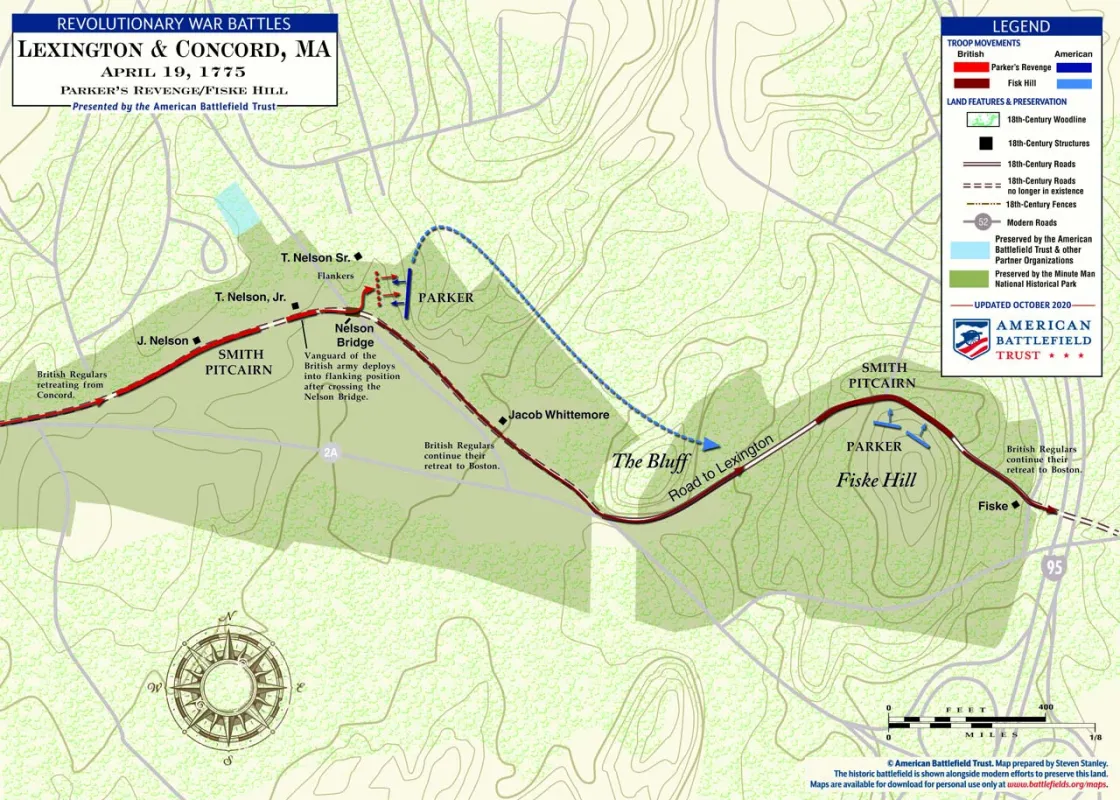
The British marched on to Concord but Parker and the militia were not done.  At North Bridge, the Massachusetts men from several towns attacked and routed the British, who began an increasingly panicked retreat along the same road they'd taken early in the morning.  As news filtered back to Lexington, Parker mustered his men once again, determined to confront the British.  According to the recollections of Nathan Munroe of the militia:

"About the middle of the forenoon Captain Parker having collected part of his company, I being with them, determined to meet the regulars on their retreat from Concord. We met the regulars in the bounds of Lincoln. We fired on them and continued so to do until they met their reinforcement in Lexington.” 

The exact location of Parker's encounter, referred to as "Parker's Revenge" has been the source of dispute for many years but excavations in recent years have identified the precise spot.  The Lexington militia's initial volley inflicted several casualties on the British column and then continued to cause more damage as they followed the retreating British towards the Lexington green.  The National Park Service describes the search for Parker's Revenge here, noting of the militia tactics: 

Having left Lexington center before noon, Captain Parker and his militiamen had time to think about how to use the landscape to their advantage. Perhaps still questioning the decision to make a stand on the town green, Captain Parker was not going to be careless with the lives of his neighbors, relatives and friends. If the stand on the Green was meant as a show of resolve more than an invitation to battle, the fight on the town border in the afternoon was the real thing. 

Lexington & Concord | Parker's Revenge/Fiske Hill | Apr 19, 1775 (October 2020) 

For more on Parker and his actions that day: 

-------------------------------------------------------------

(1) There is some uncertainty over Parker's prior military experience, though all the secondary sources claim he served in the French & Indian War, including some stating he was at the Siege of Louisbourg in 1758 and at the Battle of Quebec on the Plains of Abraham the following year.  My research was unable to confirm Parker's presence at either event.  In what capacity he served during the war I could not ascertain.

Monday, January 5, 2026

The Jason Russell House

On April 19, 1775, 49 Americans were killed in the fighting that began on the Lexington Green early that morning and continued at North Bridge in Concord.  For the rest of the day Americans from neighboring towns attacked the British as they retreated towards Boston.  Of the 49 deaths, twenty five occurred in Menotomy (now known as Arlington), the town southeast of Lexington and, of those, twelve were killed inside or on the property of the Jason Russell House which still exists.  The owner, Jason Russell, age 59, was killed, along with a number of men from Danvers who had rushed 16 to 18 miles that day to reach Arlington.

I recently came across the videos of Katie Turner Getty who has put together a series on the Revolutionary War in the Boston area.  They are very informative plus she has an authentic Boston accent!  This is her video on the events at the Jason Russell House and there is a lot more to watch on her YouTube channel and on her website.  She knows her stuff.

For more than a decade I worked less than two miles from the Jason Russell House and often passed it, but never went inside.  Wish I had. 

I wrote about April 19, 1775 in The Road Back, as well as Tough Guy, about another stalwart fighter in Menotomy that day, 78-year old Samuel Whittemore, who, after killing three British soldiers, was shot in the face, bayoneted somewhere between 6 and 13 times, clubbed in the head with a musket, and left for dead.  He lived another 18 years.

Saturday, April 19, 2025

The Road Back

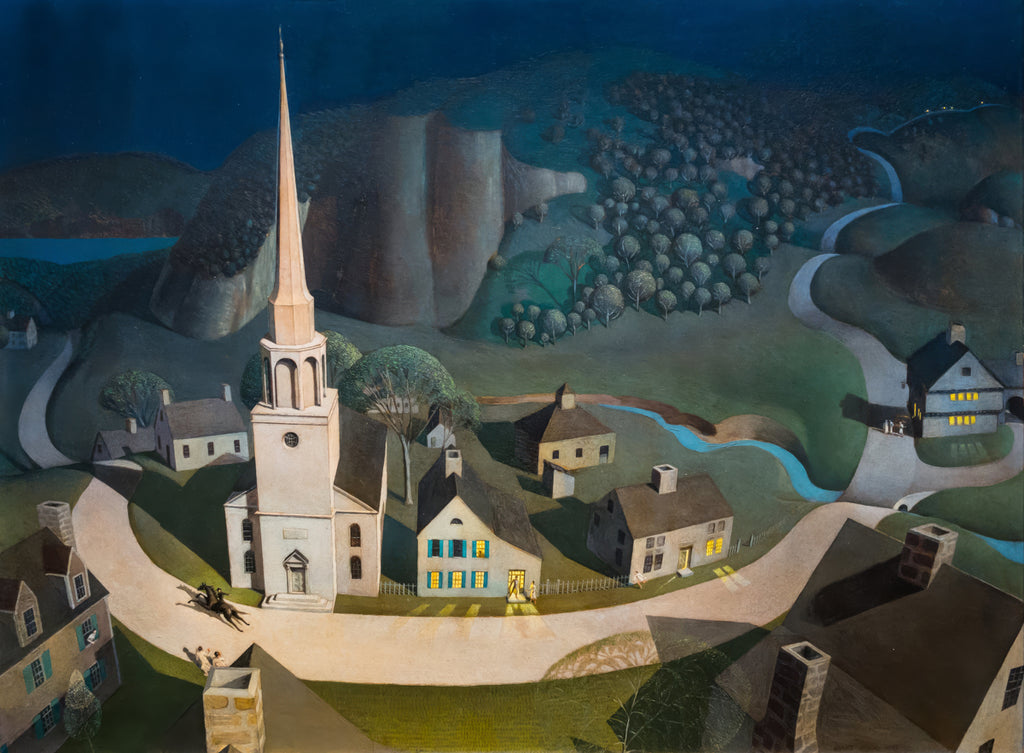
The Midnight Ride of Paul Revere, 1931 | McGaw Graphics

(The Midnight Ride of Paul Revere by Grant Wood, 1931)

Today is the 250th anniversary of Paul Revere's ride to warn of the British army advance into the countryside around Boston.  He set out late on the evening of April 18 to warn the countryside, was captured by the British, and released in time to appear on the Lexington Green the following morning. This is a repost from several years ago:


"During the whole affair, the rebels attacked us in a very scattered, irregular manner, but with perseverance and resolution, nor did they ever dare to form into any regular body.  Indeed they knew too well what was proper, to do so.  Whoever looks upon them as an irregular mob, will find himself very much mistaken.

"For my part, I never believed, I confess, that they would have attacked the king's troops, or have had the perseverance I found in them yesterday."

- Lord Percy, April 20, 1775

The quote is from Paul Revere's Ride by David Hackett Fischer, which I recently reread, and Lord Percy is referring to the final part of the British retreat from Lexington to Charlestown, along what is now known as Battle Road, on April 19, 1775.  Percy led a relief column out of Boston that morning to support the British force sent late the prior evening to seize Patriot arms stored in Concord.

When Lord Percy arrived in Lexington at mid-day he found a panicked British force hastening back from Concord in disarray, stunned by the resistance and the number of casualties inflicted upon them by the locals, whom, until that day, they held in contempt.  If Percy had not shown up it is doubtful any of the original British force would have made it back to Boston.  Under the direction of Lord Perc,y the combined force fought its way back with the most violent action of the day taking place in Menotomy (now Arlington).

Lord Percy's observation was perceptive.  For the most part he was not encountering local farmers spontaneously taking positions behind walls to shot at his soldiers.  These were regiments organized by local Massachusetts towns and under the direction of William Heath, a Roxbury farmer who had taught himself the rudiments of military strategy, and thought deeply in advance how to deal with British regulars.  The local regiments did not fight the British from fixed positions but rather formed a moving circle of skirmishers around the entire enemy column during this last phase of the British retreat.

Learning about the little-known Heath and the patriot military strategy is one of the joys of reading Fischer's book.  While it reclaims the legacy of Paul Revere it also tells the entire story of April 19 in great, and very readable detail.  Revere was much more than the man who made his famous ride.  He was instrumental in the years leading up to the events of April 19, becoming the key link between the artisans and tradesmen of Boston and the elite businessmen and lawyers like John Hancock, Joseph Warren, and Sam Adams.  He is seemingly everywhere, involved in every key event.

On the night of April 18-19 Revere was captured by the British on the road between Lexington and Concord.  Released later that evening he made his way to Lexington, where he had previously stopped to warn Hancock and Adams, who were staying at a house next to the Town Green, of the British expedition.  On his return he helped relocate the two patriot leaders to a more remote location and then learned they had left a large chest full of sensitive documents at a tavern on the Green!  Recruiting an assistant they removed the chest and carted it across the Green as dawn broke passing through the Lexington militiamen assembling there and seeing the approaching British troops.  As Revere reached the nearby woods he heard the first shots of the American Revolution.

Fischer is one of our great narrative historians and while Paul Revere's Ride is scholarly and full of fascinating footnotes at the end, it is also a rollicking and exciting tale as told by the author.  Washington's Crossing, about the darkest days of the Revolution in late 1776, is another narrative masterpiece by Fischer.  

In his introduction, Fischer explains his continued belief in the power of the narrative even as other approaches have come to dominate historical scholarship:

Pathbreaking scholarship in the 20th century has dealt mainly with social structures, intellectual systems, and material processes.  Much has been gained by this enlargement of the historian's task, but something important has been lost.  An entire generation of academic historiography has tended to lose sense of the causal power of particular actions and contingent events.  

An important key here is the idea of contingency - not in the sense of chance, but rather of 'something that may or may not happen' . . . An organizing assumption of this work is that contingency is central to any historical process, and vital to the success of our narrative strategies about the past.

To that end, this inquiry studies the coming of the American Revolution as a series of contingent happenings, shaped by the choices of individual actors with the context of large cultural processes.

Fischer's first book, originally his doctoral thesis, is Albion's Seed, the most important book ever written about the cultural differences between the British groups that settled America and their impact on the strands of American culture that powered this country throughout its history, at least until recent decades.

While modern academic theory has reduced all those of European origin into a faceless, indistinguishable blob of white supremacy, Albion's Seed reminds us of the strikingly different cultures from different geographical areas within England that settled in various parts of the New World - Puritans in New England, Quakers in the mid-Atlantic, Cavaliers in the South and the Scots-Irish in the backcountry.  Cultural and religious traditions in these groups varied tremendously and those differences carried over into America.

In the introduction to Paul Revere's Ride, Fischer speaks to the cultural traditions he identified in Albion's Seed writing:

Paul Revere's idea of liberty was not the same as our modern conception of individual autonomy and personal entitlement.  It was not a form of "classical Republicanism", or "English Opposition Ideology", or "Lockean Liberalism", or any of the learned anachronisms that scholars have invented to explain a way of thought that is alien to their own world.

He believed deeply in New England's inherited tradition of ordered freedom, which gave heavy weight to collective rights and individual responsibilities - more so than is given by our modern calculus of individual rights and collective responsibilities.

His genius was to promote collective action in the cause of freedom - a paradox that lies closer to the heart of the American experience than the legendary historical loners we love to celebrate.

And then there is Samuel Whittemore.  Read Tough Guy.

Friday, February 21, 2025

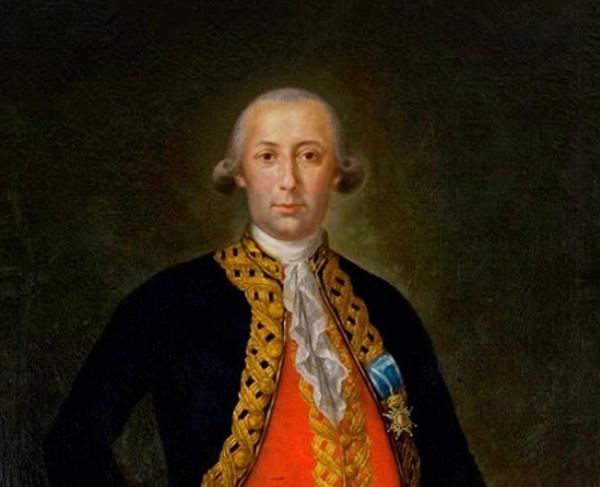
Galvez

Portrait of Bernardo de Galvez

On February 20, 1777, Bernardo de Galvez, was secretly instructed by the ministers of the King of Spain to sell American revolutionaries desperately needed supplies.

When we think of the American fight for independence against Britain, our memories are focused on the initial clashes in Massachusetts, dramatic incidents like the crossing of the Delaware, Cornwallis' surrender at Yorktown, and George Washington's leadership, but significant events occurred along the Mississippi River and the Gulf coast.  I refer, of course, to the Gulf of Mexico.  And Bernardo Vincente de Galvez y Madrid, governor of Spanish Louisiana during those times, was a critical player in ensuring American independence.

Born in Spain in 1746, by the age of 16 Galvez was a soldier, serving in the invasion of Portugal before coming to Mexico, part of New Spain, in 1769, where he led campaigns against the Apaches.  Returning to Spain, he was badly wounded in an attack on Algiers.  On January 1, 1777, Galvez became governor of Spanish Louisiana.  Spain had acquired the territory from France in 1762, and its largest town, New Orleans was dominated by French families.  Reportedly an outstanding administrator and charming man, Galvez quickly endeared himself to the top families in New Orleans by marrying the Creole daughter of a prominent citizen later that same year.

In April 1777, George Morgan, commander of the American garrison at Fort Pitt (modern Pittsburgh) sent a letter via the Ohio and Mississippi Rivers to Galvez offering American trade in exchange for aid to the revolutionaries.  Having already received instructions from Spain, which wanted to undermine Great Britain, Galvez responded in August 1777 by sending ammunition, arms, and provisions along with a letter informing Morgan that, "I will extend . . . whatever assistance I can but it must appear that I am ignorant of it all". 

For the next two years, Galvez ensured a flow of supplies.  Given the British blockade of much of the Atlantic Coast this became an important supply route for the Americans.  The Governor also worked with Oliver Pollock, the Continental Congress agent in New Orleans to supply George Roger Clark in his successful expedition to capture British forts in the Illinois country and support American raiders in West Florida.

In 1779, Spain joined France in its war against Britain and Galvez could now act openly.  Later that year he put together a force of several hundred men, an conglomeration of Spanish soldiers, German and French settlers, free Blacks, slaves, and Choctaw Indians to capture the British forts at Natchez and Baton Rouge, ensuring the Mississippi would stay open.  Galvez followed that up by seizing the British fort at Mobile in March 1780, after which he was promoted to Major General, and capturing Pensacola in May 1781, a triumph which eliminated the British presence in Florida.  With the Spanish fleet now in complete control of the Gulf, the French fleet was free to operate in the Atlantic, a campaign which culminated in its victory against the British navy at the Battle of the Chesapeake which, in turn, made the ultimate victory at Yorktown possible.

With the end of the war in 1783, the King made Galvez a Count, Governor of Cuba, and captain general of Louisiana and West Florida.  In 1785 he became the Viceroy of New Spain, the most powerful official in Spanish America.  Unfortunately, he became ill and died the next year, only forty years old.

Galveston, Texas is named after Bernardo de Galvez.  In 1976, the United States erected an equestrian statue of Galvez in Washington, and in 2014 Galvez became one of only eight persons to approved by Congress as an honorary American citizen.(1) 

------------------------------------------------

(1)  The remaining seven include two other figures from the Revolution, the Marquis de Lafayette and Casimir Pulaski.  The other five honorees are William and Hannah Penn, the founders of the Pennsylvania colony, Raoul Wallenberg, Mother Teresa and, the first recipient, Winston Churchill. 

Friday, April 19, 2024

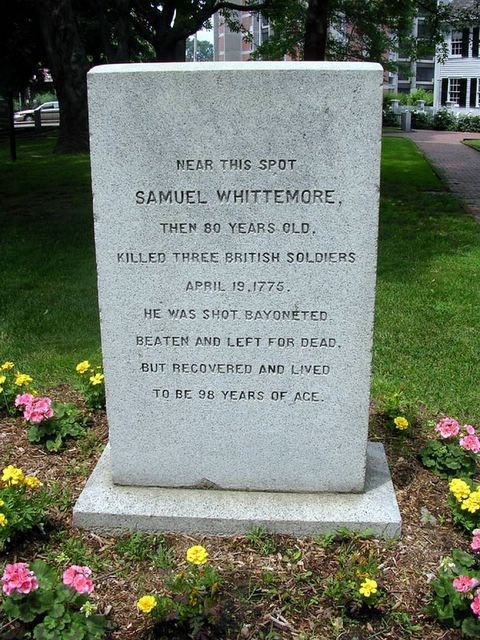
Tough Guy

Image

What were the 70 men gathered on the Lexington Green before dawn thinking as the sky began to brighten?  They knew the Regulars were coming - they weren't called the British because that word included those gathered on the Green.  They would have heard the approach of the Redcoat column coming up the road and then the voices of the officers.  Within a few minutes seven would be dead.  April 19, 1775.

The British moved on to Concord where they met disaster and then had to fight their way back to Boston.   Retracing their steps from Lincoln to Concord along what is now known as Battle Road and taking casualties all the way, they entered Arlington.  Nearing Arlington's border with Cambridge at Alewife Brook, the Redcoats encountered 78 year old Samuel Whittemore.  Whittemore was a farmer with extensive military experience, fighting in both King George's War (1744-48) and the Seven Years War (1756-63).  He was also quite prolific in his personal life having, by 1775, more than 180 direct descendants, most living in the same area.

Whittemore, with his home directly along the road of British retreat, decided he needed to do his part.  Taking his musket and pistols, he waited until the Redcoat column approached, rose up from behind his stone wall and fired his musket, killing a soldier.  As the British advanced on him, Whittemore drew his pistols and killed two more.  With that the British were upon him and he was shot in the face, bayoneted somewhere between 6 and 13 times, clubbed in the head with a musket, and left for dead.

Several hours later, neighbors noticed Samuel was still moving and brought him to the town doctor who proclaimed there was nothing to be done for him other than dressing his wounds and waiting for Whittemore to die.  They waited 18 years, as Samuel Whittemore died in 1793 at the age of 96.

The engraving on the marker in the picture is inaccurate as he was only 78 at the time.  The house seen to the right of the marker is Whittemore's home, which still stands.  For a decade I worked just on the other side of Alewife Brook on Whittemore Avenue in Cambridge.  You can read more about the British retreat from Concord in The Road Back.

Today is the 249th anniversary of the start of the American Revolution.  Next year will be the 250th and the year after that the 250th anniversary of the Declaration of Independence.  Time will tell if that nation, conceived in liberty, will continue to endure.

Wednesday, August 16, 2023

The Penobscot Expedition

On this date in 1779, a panicked American expeditionary force on Penobscot Bay in what was then Massachusetts, and is now Maine, burned its remaining boats, capping a disastrous campaign against the British.   The force originally consisted of 44 vessels, with 1,000 soldiers, and a 100 man artillery detachment commanded by Lt. Colonel Paul Revere.  Revere, the brave patriot of pre-war Boston and othe famed ride to Lexington and Concord, faced a court-martial in the wake of expedition's failure, and though acquitted, it marked the end of his military career.

It was the worst naval defeat in American history until Pearl Harbor.

The expedition was prompted by the landing, in June 1779, by British forces at the site of the present town of Castine, located on the northeast side of Penobscot Bay.   The British quickly constructed an earthworks fortification, named Fort George in honor of the King.  Their goal was to provide a base for protecting their valuable naval base in Nova Scotia.  Once news reached Boston, Massachusetts quickly put together an expedition to retake the area.

Under the command of Dudley Saltonstall, a powerful Massachusetts family from the time of John Winthrop in the 17th century until the mid-20th, the fleet arrived on July 24, but due to Saltonstall's timidity and various other mishaps the American force could not capture Fort George.  In early August a British relief fleet from New York City arrived and eventually the Americans fled up the Penobscot River, abandoning and destroying their fleet, the bedraggled survivors making their way through the woods of Maine as they returned to Massachusetts.

The British continued to occupy Fort George until they recognized American independence in the Treaty of Paris in 1783.


Sunday, July 2, 2023

You Need An Editor

. . . or, even better, multiple editors like John Adams and Ben Franklin.  The Continental Congress voted to declare independence on July 2, 1776 (which Adams mistakenly believed would become the great day of celebration) and then signed the edited version of the Declaration on July 4.

From Chicago Boyz:

How the Declaration of Independence evolved from its first draft by Thomas Jefferson (blue) to the revised draft by the Committee of Five (John Adams, Benjamin Franklin, Thomas Jefferson, Robert Livingston, and Roger Sherman (red) to the final changes made by the Continental Congress as a committee of the whole (bold black) (source):


A Declaration of the Representatives of the UNITED STATES OF AMERICA, in General Congress assembled. In Congress, July 4,1776. The unanimous Declaration of the thirteen United States of America.

When in the Course of human events, it becomes necessary for a People to advance from that Subordination, in which they have hitherto remained, one people to dissolve the political bands which have connected them with another and to assume among the Ppowers of the Eearth the equal and independant Station the separate and equal station to which the Laws of Nature and of Nature’s God entitle them, a decent Rrespect to the opinions of Mmankind requires that they should declare the Ccauses which impel them to the Change separation.
 
We hold these truths to be selfevident, that all men are created equal and independant, that from that equal creation they derive rights inherent and inalienable, that they are endowed by their Creator with certain unalienable rights, among which that among these are the Preservation of Life, and Liberty, and the Pursuit of Happiness. tThat to secure these Ends rights, Governments are instituted among men, deriving their just powers from the Cconsent of the governed; t.—That whenever any Form of gGovernment shall become becomes destructive of these ends, it is the Rright of the People to alter or to abolish it, and to institute new Government, laying its Ffoundation on such principles and organizing its powers in such form, as to them shall seem most likely to effect their Safety and Happiness. Prudence, indeed, will dictate that Governments long established should not be changed for light and transient Ccauses; and accordingly all Eexperience hath shown, that mankind are more disposed to Ssuffer, while Eevils are Ssufferable, than to right themselves by abolishing the forms to which they are accustomed. But when a long train of Aabuses and Uusurpations, begun at a distinguish’d Period and, pursuing invariably the same oObject, evinces a Ddesign to reduce them under absolute Power dDespotism, it is their Rright, it is their Dduty, to throw off such Government, and to provide new Guards for their future security. Such has been the patient Ssufferance of these Colonies; and such is now the Nnecessity which constrains them to expunge alter their former systems of government. The history of his present Majesty, the present king of Great Britain is a history of unremitting repeated injuries and usurpations, among which no one Fact stands Single or Solitary to contradict the uniform tenor of the rest, all of which have having in direct object the Eestablishment of an absolute Ttyranny over these Sstates. To prove this let Ffacts be Ssubmitted to a candid Wworld., for the Truth of which We pledge a Faith, as yet unsullied by falsehood.
 
He has refused his assent to laws the most wholesome and necessary for the public good.
 
He has forbidden his Governors to pass Laws of immediate and pressing importance, unless suspended in their operation till his assent should be obtained; and, when so suspended, he has neglected utterly to attend to them.
 
He has refused to pass other Laws for the accomodation of large Ddistricts of Ppeople unless those Ppeople would relinquish the right of Representation in the Legislature, a Rright inestimable to them, and formidable to Ttyrants only.
 
He has called together legislative bodies at places unusual, uncomfortable, and distant from the depository of their public rRecords, for the sole purpose of fatiguing them into compliance with his measures.
 
He has dissolved Representative Houses repeatedly and continually,for opposing with manly Ffirmness his Iinvasions on the Rrights of the Ppeople;
 
He has refused, for a long Space of Ttime after such Ddissolutions to cause others to be elected, whereby the lLegislative Ppowers, incapable of aAnnihilation have returned to the People at large for their Eexercise, the sState remaining, in the mean Ttime meantime, exposed to all the Ddangers of Iinvasion from without, and Convulsions within.
 
He has endeavoured to prevent the Ppopulation of these States; for that purpose obstructing the Laws for nNaturalization of fForeigners; refusing to pass others to encourage their Mmigrations hither, and raising the Cconditions of new Appropriations of Lands.
 
He has suffered obstructed the Administration of Justice totally to cease in some of these Colonies, by refusing his Assent to Laws for establishing Judiciary Powers.
 
He has made our Judges dependent on his Will alone, for the Ttenure of their offices, and the amount and payment of their Ssalaries.
 
He has created a Mmultitude of nNew oOffices by a Self-assumed Power, and sent hither swarms of oOfficers to harass our Ppeople, and eat out their Ssubstance.
 
He has kept among us, in Ttimes of Ppeace, Standing Armies and Ships of War without the cConsent of our legislatures..
 
He has affected to render the mMilitary independent of and Superiour superior to the cCivil Ppower.
 
He has combined with others to subject us to a Jjurisdiction foreign to our Cconstitution, and unacknowledged by our Llaws; giving his Assent to their pretended Acts of pretended Legislation:
 
fFor quartering large Bbodies of armed Ttroops among us:
 
fFor protecting them, by a Mmock Tryal Ttrial from Ppunishment for any Murders which they should commit on the Inhabitants of these States:
 
fFor cutting off our Ttrade with all Pparts of the Wworld;
 
fFor imposing Taxes on as without our Consent—fFor depriving Uus in many cases of the Bbenefits of Trial by Jjury;
 
fFor transporting us beyond Seas to be tried for pretended offences:
 
fFor abolishing the free sSystem of English Llaws in a neighbouring Province, establishing therein an aArbitrary government, and enlarging its Boundaries so as to render it at once an example and fit instrument for introducing the same absolute rule into these cColonies:
 
fFor taking away our Charters, abolishing our most valuable lLaws, and altering fundamentally the Forms of our Government:
 
fFor suspending our own Legislatures, and declaring themselves invested with Ppower to legislate for us in all Ccases whatsoever.
 
He has abdicated Government here withdrawing his Governors, and by declaring us out of his Allegiance and pProtection, and waging war against us.
 
He has plundered our Sseas, ravaged our Coasts, burnt our towns, and destroyed the Lives of our Ppeople.
 
He is at this Ttime transporting large Armies of foreign Mercenaries to complete compleat the Wworks of death, Ddesolation, andTtyranny, already begun with Ccircumstances of Ccruelty and Pperfidy scarcely paralleled in the most barbarous ages, and totally unworthy the Head of a civilized Nnation.
 
He has excited domestic insurrection among us, and has endeavoured to bring on the Iinhabitants of our Ffrontiers, the merciless Indian Savages, whose known Rrule of Wwarfare is an undistinguished Ddestruction of all Aages, Ssexes, and Cconditionsof existence.
 
He has incited treasonable Insurrections of our Fellow Citizens, with the allurement of Forfeiture and Confiscation of our Property.
 
He has constrained others our fellow citizens taken cCaptive on the high sSeas, to bear arms against their cCountry, to become the executioners of their friends and bBrethren, or to fall themselves by their hHands:
 
He has waged cruel War against human Nature itself, violating its most sacred Rights of Life and Liberty in the Persons of a distant People who never offended him, captivating and carrying them into Slavery in another Hemisphere, or to incur miserable Death, in their Transportation thither. This piratical Warfare, the opprobrium of infidel Powers, is the Warfare of the Christian King of Great Britain.
 
He has prostituted his Negative for Suppressing every legislative Attempt to prohibit or to restrain an execrable Commerce, determined to keep open a Market where Men should be bought and sold, and that this assemblage of Horrors might want no Fact of distinguished Die.
 
He is now exciting those very People to rise in Arms among us, and to purchase their Liberty of which he has deprived them, by murdering the People upon whom he also obtruded them: thus paying off, former Crimes committed against the Liberties of one People, with Crimes which he urges them to commit against the Lives of another.
 
In every stage of these oOppressions wWe have pPetitioned for rRedress, in the most humble tTerms: oOur repeated Petitions have been answered by repeated Iinjury.
 
A Prince whose Ccharacter is thus marked by every Aact which may define a Tyrant, is unfit to be the Rruler of a People who mean to be free people. future ages will scarce believe, that the Hardiness of one Man, adventured, within the Short Compass of twelve years only, on so many Acts of Tyranny, without a Mask, over a People, fostered and fixed in the Principles of Liberty.
 
Nor have wWe been wanting in Aattentions to our British Bbrethren. We have warned them from Ttime to Ttime of attempts of by their Llegislature to extend a an unwarranted Jjurisdiction over these our States us. We have reminded them of the Ccircumstances of our Eemigration and Ssettlement here no one of which could warrant so strange a Pretension. That these were effected at the expense of our own Blood and Treasure, unassisted by the Wealth or the Strength of Great Britain; that in constituting indeed, our Several Forms of Government, we had adopted one common King, thereby laying a Foundation for Perpetual League and Amity with them; but that Submission to their Parliament, was no Part of our Constitution, nor ever in Idea, if History may be credited; and wWe have appealed to their Nature, native Jjustice and Mmagnanimity and we have conjured them by as well as to the Tties of our common Kkindred to disavow these usurpations which were likely to would inevitably interrupt our Correspondence and Connection connection and correspondance. They too have been deaf to the Vvoice of Jjustice and of Cconsanguinity. and when occasions have been given them by the regular Course of their Laws of removing from their Councils, the Disturbers of our Harmony, they have by their free Election, re-established them in Power. At this very Time too, they are permitting their Chief Magistrate to send over not only soldiers of our common Blood, but Scotch and foreign Mercenaries, to invade and deluge us in Blood. These Facts have given the last Stab to agonizing affection, and manly Spirit bids us to renounce forever these unfeeling Brethren. We must endeavour to forget our former Love for them, and to hold them, as we hold the rest of Mankind, enemies in War, in Peace Friends. We might have been a free and a great People together but a Communication of Grandeur and of Freedom it seems is below their Dignity. Be it so, since they will have it: The Road to Happiness and to Glory is open to us too; we will climb it, apart from them We must therefore and acquiesce in the Nnecessity which denounces our eternal Sseparation and hold them, as we hold the rest of mankind, Enemies in War, in Peace Friends.
 
We, therefore, the Representatives of the United States of America, in General Congress aAssembled, appealing to the Supreme Judge of the world for the rectitude of our intentions, do, in the Name, and by the Authority of the good People of these States Colonies, reject and renounce all Allegiance and Subjection to the Kings of Great Britain, and all others, who may hereafter claim by, through, or under them; We utterly dissolve and break off, all political Connection which may have heretofore subsisted between us and the People or Parliament of Great Britain, and finally we do assert solemnly publish and declare, that these United Colonies are, and of Right ought to be fFree and iIndependent States; that they are Absolved from all allegiance to the British Crown, and that all political connection between them and the State of Great Britain, is and ought to be totally dissolved; and that as fFree and iIndependent States, they shall hereafter have full Power to levy War, conclude Peace, contract Alliances, establish Commerce, and to do all other Acts and Things which independent States may of Right do. And for the Ssupport of this Declaration, we mutually pledge to each other our Lives, our Fortunes, and our Sacred Honour Honor. 

Friday, April 21, 2023

Meaning Well

[He] means well for his Country, is always an honest Man, often a Wise One, but sometimes and in some things, absolutely out of his senses.

Benjamin Franklin on John Adams

On this date in 1789, John Adams was inaugurated as the first Vice President of the United States of America.  He would go on to serve another term as VP before becoming our second President.

Franklin's assessment, correct in all respects, was based upon his experience with Adams at the Second Continental Congress, where they served on the five man committee responsible for drafting the Declaration of Independence, and on their time then together in France during the war for independence.  Adams impatient and impolitic style contrasted greatly with Franklin's more subtle, and successful, approach to diplomacy aimed at securing the all important military and financial alliance with that country.

Adams was thin-skinned, voluble, with a temper that, on occasion, led him erupt with remarks that his enemies could use against him.  His books and essays seem turgid by modern standards and, even by those of his times, were not a source of memorable phrases.  As President, Adams could not control his own cabinet, and was responsible for the Alien & Sedition Acts, the greatest assault on free speech in peacetime in our history, until those of the current administration.

At the same time, John Adams was one of the leading proponents for resistance to the British attempts to interfere with the historical liberties of American colonials.  He successfully defended, at the urging of Samuel Adams and others, the British soldiers accused in the Boston Massacre of 1770.  As delegate to the Continental Congress from 1774 to 1777, he nominated George Washington to be commander in chief of the new army, was a leading and influential voice for independence, and served on the committee that drafted the Declaration.  In 1780 Adams drafted the Massachusetts Constitution, the oldest functioning written Constitution in the world.  During the war for independence, along with serving as Commissioner to France, he served as Minister to the Netherlands where he secured a critical loan for the American government and then, along with John Jay, was America's primary negotiator in securing the Treaty of Paris in which Britain recognized American independence and then becoming our first minister to Britain.

While his presidency was mostly unsuccessful due to, in addition to his own shortcomings, vicious anonymous press assaults (secretly promoted by his old friend Thomas Jefferson) and undermining by his rival Alexander Hamilton, Adams, for the good of the country, and at great personal political cost, avoided war with France.  When he lost his bid for reelection after brutal political campaign of 1800, Adams facilitated the first peaceful transition of power to another political party in Western history.

Adams is a difficult figure to relate to for 21st century Americans.  He could be stuffy and pretentious but his impulsive nature and reactions actually makes him more relatable than more remote figures like Washington, Jefferson, Madison, or Hamilton (though none can approach Franklin as a recognizable human figure to us).  We can see it in his correspondence after he and Jefferson reconciled in 1812 (after an earlier failed effort - see Abigail Writes Thomas).  For every letter Jefferson writes, Adams writes three.  He simply cannot contain himself, revealing much more about himself than the ever guarded Jefferson.

In the book I'm reading on Lafayette's tour of America in 1824-5, the Frenchman's secretary describes visiting the retired president, nearing his 89th birthday, at his modest home in Braintree, Massachusetts.

Our carriages stopped at the door of a very simple small house, built of wood and brick, and but one story high.  I was somewhat astonished to learn that this was the resident of an Ex-President of the United States. . . . He received and welcomed us with touching kindness: the sight of his ancient friend imparted a pleasure and satisfaction, which appeared to renew his youth.  During the whole of dinner time, he kept up the conversation with an ease and readiness of memory . . . 

At the moment of our visit, although he could not go out of his chamber, could scarcely raise himself from his chair, and his hands were unable to convey the food to his mouth without the pious assistance of his children or grand children, his heart and head felt not less ardour for every thing good.  The affairs of his country afforded him the most pleasant occupation. . . . We left him, filled with admiration at the courage with which he supported the pains and infirmities which the lapse of nearly a century had necessarily accumulated upon him.

Adams died on July 4, 1826, the same day as his old friend and rival, Thomas Jefferson.

Tuesday, April 19, 2022

The Experiment Begins

The Lexington Green is today surrounded by constant traffic, though many of the buildings bordering it were also there on the morning of April 19, 1775.  The immediate surroundings around North Bridge in Concord remain more bucolic; the reconstructed bridge over the peaceful river, the site where the British took their first casualties of the day, the adjoining meadows still intact.

This link takes you to my 22 previous posts on the war and the entire Revolutionary Era (1765-1789), the starting point for our grand national experiment.

Monday, April 19, 2021

The Road Back

"During the whole affair, the rebels attacked us in a very scattered, irregular manner, but with perseverance and resolution, nor did they ever dare to form into any regular body.  Indeed they knew too well what was proper, to do so.  Whoever looks upon them as an irregular mob, will find himself very much mistaken.

"For my part, I never believed, I confess, that they would have attacked the king's troops, or have had the perseverance I found in them yesterday."

- Lord Percy, April 20, 1775

The quote is from Paul Revere's Ride by David Hackett Fischer which I recently reread and Lord Percy is referring to the final part of the British retreat from Lexington to Charlestown, along what is now known as Battle Road, on April 19, 1775.  Percy led a relief column out of Boston that morning to support the British force sent late the prior evening to seize Patriot arms stored in Concord.

When Lord Percy arrived in Lexington at mid-day he found a panicked British force hastening back from Concord in disarray, stunned by the resistance of the local citizens and the number of casualties inflicted upon them by the locals, whom, until that day, they held in contempt.  If Percy had not shown up it is doubtful any of the original British force would have returned to Boston.  Under the direction of Lord Percy the combined force fought its way back with the most violent action of the day taking place in Menotomy (now Arlington).

Lord Percy's observation was perceptive.  For the most part he was not encountering local farmers spontaneously taking positions behind walls to shot at his soldiers.  These were regiments organized by local Massachusetts town and under the direction of William Heath, a Roxbury farmer who had taught himself the rudiments of military strategy and thought deeply in advance how to deal with British regulars.  The local regiments did not fight the British from fixed positions but rather formed a moving circle of skirmishers around the entire enemy column during this last phase of the British retreat.

Learning about the little-known Heath and the patriot military strategy is one of the joys of reading Fischer's book.  While it reclaims the legacy of Paul Revere it also tells the entire story of April 19 in great, and very readable detail.  Revere was much more than the man who made his famous ride.  He was instrumental in the years leading up to the events of April 19, becoming the key link between the artisans and tradesmen of Boston and the elite businessmen and lawyers like John Hancock, Joseph Warren and Sam Adams.  He is seemingly everywhere, involved in every key event.

On the night of April 18-19 Revere was captured by the British on the road between Lexington and Concord.  Released later that evening he made his way to Lexington, where he had previously stopped to warn Hancock and Adams, who were staying at a house next to the town Green, of the British expedition.  On his return he helped relocate the two patriot leaders to a more remote location and then learned they had left a large chest full of sensitive documents at a tavern on the Green!  Recruiting an assistant they removed the chest and carted it across the Green as dawn broke passing through the Lexington militiamen assembling there and seeing the approaching British troops.  As Revere reached the nearby woods he heard the first shots of the American Revolution.

Fischer is one of our great narrative historians and while Paul Revere's Ride is scholarly and full of fascinating footnotes at the end, it is also a rollicking and exciting tale as told by the author.  Washington's Crossing, about the darkest days of the Revolution in late 1776, is another narrative masterpiece by Fischer.  

In his introduction, Fischer explains his continued belief in the power of the narrative even as other approaches have come to dominate historical scholarship:

Pathbreaking scholarship in the 20th century has dealt mainly with social structures, intellectual systems, and material processes.  Much has been gained by this enlargement of the historian's task, but something important has been lost.  An entire generation of academic historiography has tended to lose sense of the causal power of particular actions and contingent events.  

An important key here is the idea of contingency - not in the sense of chance, but rather of 'something that may or may not happen' . . . An organizing assumption of this work is that contingency is central to any historical process, and vital to the success of our narrative strategies about the past.

To that end, this inquiry studies the coming of the American Revolution as a series of contingent happenings, shaped by the choices of individual actors with the context of large cultural processes.

Fischer's first book, originally his doctoral thesis, is Albion's Seed, the most important book ever written about the cultural differences between the British groups that settled America and their impact on the strands of American culture that powered this country throughout its history, at least until recent decades.

While modern academic theory has reduced all those of European origin into a faceless, indistinguishable blob of white supremacy, Albion's Seed reminds us of the strikingly different cultures from different geographical areas within England that settled in various parts of the New World - Puritans in New England, Quakers in the mid-Atlantic, Cavaliers in the South and the Scots-Irish in the backcountry.  Cultural and religious traditions in these groups varied tremendously and those differences carried over into America.

In the introduction to Paul Revere's Ride, Fischer speaks to the cultural traditions he identified in Albion's Seed writing:

Paul Revere's idea of liberty was not the same as our modern conception of individual autonomy and personal entitlement.  It was not a form of "classical Republicanism", or "English Opposition Ideology", or "Lockean Liberalism", or any of the learned anachronisms that scholars have invented to explain a way of thought that is alien to their own world.

He believed deeply in New England's inherited tradition of ordered freedom, which gave heavy weight to collective rights and individual responsibilities - more so than is given by our modern calculus of individual rights and collective responsibilities.

His genius was to promote collective action in the cause of freedom - a paradox that lies closer to the heart of the American experience than the legendary historical loners we love to celebrate.

Thursday, July 4, 2019

The 4th

Equality, rightly understood, as our Founding Fathers understood it, leads to liberty and to the emancipation of creative differences. Wrongly understood, as it has been so tragically in our time, it leads first to conformity and then to despotism. —Barry Goldwater

Saturday, March 3, 2018

How To Talk About What We Can't Talk About


The current atmosphere around discussions, or non-discussions on race, gender, and ethnicity, and the rise of social justice, microagression, intersectionality, and the other nonsense spawned by post-modernists prompted me to track down something I watched on C-Span several years ago.  It's a short talk and Q&A by Annette Gordon-Reed in connection with her then-new book The Hemingses of Monticello: An American Family.

I had not planned to read the book as I was sick of the battles over the alleged relationship between Sally Hemings and Thomas Jefferson.  It seemed that one group was intent on taking the relationship as 100% proven and then using it to trash Jefferson's reputation, while the other group steadfastly ignored any credible evidence supporting the possibility that such a relationship existed.

However, after watching Gordon-Reed I changed my mind, purchased her book and highly recommend it.  The author presents a plausible view of the relationship between Sally, and indeed the entire Hemings family, and Jefferson, and it's told with an understanding of the perspectives of everyone involved; Gordon-Reed treats everyone as a person, not as symbols or caricatures to make a point.  Along the way, I learned quite a bit about the history of slavery in Virginia and the evolving (or perhaps devolving) view of whites towards the institution during the late 18th and early 19th centuries.

The entire 33 minutes is worth viewing but it was a question at the end (asked at the 30:20 mark) that caused me to go back and watch it again.  The question goes to whether, or how, Jefferson reconciled his worst written racist utterances with his treatment of the Hemings family.  From Gordon-Reed's response:
[growing up in the South; Texas to be specific] . . . it is not uncommon for blacks and whites to have generalized racial views but see individual people differently.

. . . it is not unusual for people to have a set of intellectual beliefs that their emotional lives do not jibe with.

. . . some of the people who have been the most helpful to me in my life, if you were to sit down and talk to them, they would express sentiments that were racist sentiments but [they were not malicious] . . . there are malicious people who are non-racist and there are malicious people who are racist . . . and I don't see Jefferson as malicious. 
I'm not sure Gordon-Reed could get away with this thoughtful perspective today.  In our brave new world, anyone who carelessly utters what others see as the wrong words can be attacked, humiliated, and driven from public life, regardless of their actual actions.  It is a loss for our society and corrosive to our ability to function.  Having read and heard her in other contexts, it is clear Gordon-Reed and I tread different political paths but I think her approach to discussing these issues is the right one.

My own take on Hemings and Jefferson is that I think it highly likely they did have a relationship that lasted for 35+ years and that the author of the Declaration of Independence is the father of Sally's six children though it will never be proved to a certainty.  The DNA evidence only indicates that someone in the Jefferson family was the father of her children.  Defenders of Thomas have claimed the real father was his younger brother.  However, one of the other defenses, that Thomas Jefferson was not present at Monticello nine months prior to the birth of all of Sally's children has now been discredited, and it is accepted that the timing is now consistent with his paternity. 

In addition, there is a strong psychological element at play.  Jefferson, born in 1743, was only married once, in 1772, to Martha Wayles.  By all accounts, the introverted and aloof Jefferson was madly in love with Martha and she reciprocated.  When Martha died in 1782 he was distraught, isolating himself for weeks, leaving his family worried he might do harm to himself.

Sally Hemings was the half-sister of Martha Jefferson.  They shared the same father.  Sallie's mother was half white, so Sally was three quarters white (many of her descendents after being freed and moving to Ohio passed as white).   We have no pictures of Sally but according to those who knew her she looked strikingly like her half sister.  One can only surmise how Jefferson might have reacted when the teenage Sally showed up in Paris in the late 1780s, as escort to his daughter.  We also know that Jefferson treated the entire Hemings family much differently than the rest of the enslaved population of Monticello.

For a more complete and balanced analysis of the Hemings-Jefferson controversy read this piece by Professor Paul Rahe.

Thursday, December 21, 2017

The Important Question

We've written several times about contingency in history and the human inability to predict the course of events or the consequences of actions (see, for example Churchill & Tolkien).  We need to constantly remind ourselves when looking at the actions of historical figures that while we know how things turned out, they did not know when they made their decisions.

I was reminded of this recently watching Professor Joanne Freeman of Harvard on C-Span,  Professor Freeman is a scholar of Alexander Hamilton and a lively and thoughtful speaker.  She closed her talk on Hamilton by reading an excerpt from Federalist 1, noting that Alexander was a pessimist about the ability of the United States to survive in a hostile world but felt the proposed Constitution gave us the best possible chance.  Hamilton writes:
It has been frequently remarked that it seems to have been reserved to the people of this country, by their conduct and example, to decide the important question, whether societies of men are really capable or not of establishing good government from reflection and choice, or whether they are forever destined to depend for their political constitutions on accident and force

If there be any truth in the remark, the crisis at which we are arrived may with propriety be regarded as the era in which that decision is to be made; and a wrong election of the part we shall act may, in this view, deserve to be considered as the general misfortune of mankind.
Hamilton, Madison, Washington and the others did not know how it would turn out.  It was a gamble; one worth taking in their view, but still a gamble.   Some would say the outcome of that gamble is still to be determined.