Showing posts with label American History. Show all posts

Wednesday, July 8, 2026

Beginning To Leave

On this date in 1969 the initial withdrawal of American troops from South Vietnam began as ordered by President Nixon a few weeks earlier.  This first phase involved 25,000 troops from the approximately 540,000 currently in that country.  By the fall of 1971 troop levels were down to about 190,000.  The last American forces left by early 1973.  South Vietnam fell to the North Vietnam communists in April 1975, ending a thirty year civil war.

For how America became engaged in the conflict read Dereliction of Duty

Saturday, July 4, 2026

Cal Speaks

Excerpts from address by President Calvin Coolidge, Address on the Celebration of the 150th anniversary of the Declaration of Independence, Philadelphia, July 5, 1926.

It is not so much, then, for the purpose of undertaking to proclaim new theories and principles that this annual celebration is maintained, but rather to reaffirm and reestablish those old theories and principles which time and the unerring logic of events have demonstrated to be sound. Amid all the clash of conflicting interests, amid all the welter of partisan politics, every American can turn for solace and consolation to the Declaration of Independence and the Constitution of the United States with the assurance and confidence that those two great charters of freedom and justice remain firm and unshaken. Whatever perils appear, whatever dangers threaten, the Nation remains secure in the knowledge that the ultimate application of the law of the land will provide an adequate defense and protection.

But the conviction is inescapable that a new civilization had come, a new spirit had arisen on this side of the Atlantic more advanced and more developed in its regard for the rights of the individual than that which characterized the Old World. Life in a new and open country had aspirations which could not be realized in any subordinate position. A separate establishment was ultimately inevitable. It had been decreed by the very laws of human nature. Man everywhere has an unconquerable desire to be the master of his own destiny.

But the preponderance of all those who occupied a position which took on the aspect of aristocracy did not approve of the Revolution and held toward it an attitude either of neutrality or open hostility. It was in no sense a rising of the oppressed and downtrodden. It brought no scum to the surface, for the reason that colonial society had developed no scum. The great body of the people were accustomed to privations, but they were free from depravity. If they had poverty, it was not of the hopeless kind that afflicts great cities, but the inspiring kind that marks the spirit of the pioneer. The American Revolution represented the informed and mature convictions of a great mass of independent, liberty loving, God-fearing people who knew their rights, and possessed the courage to dare to maintain them.

It was not because it was proposed to establish a new nation, but because it was proposed to establish a nation on new principles, that July 4, 1776, has come to be regarded as one of the greatest days in history. 

This is especially true of the principles laid down in the Declaration of Independence. Three very definite propositions were set out in its preamble regarding the nature of mankind and therefore of government. These were the doctrine that all men are created equal, that they are endowed with certain inalienable rights, and that therefore the source of the just powers of government must be derived from the consent of the governed.

A spring will cease to flow if its source be dried up; a tree will wither if it roots be destroyed. In its main features the Declaration of Independence is a great spiritual document. It is a declaration not of material but of spiritual conceptions. Equality, liberty, popular sovereignty, the rights of man - these are not elements which we can see and touch. They are ideals. They have their source and their roots in the religious convictions. They belong to the unseen world. Unless the faith of the American people in these religious convictions is to endure, the principles of our Declaration will perish. We can not continue to enjoy the result if we neglect and abandon the cause.

About the Declaration there is a finality that is exceedingly restful. It is often asserted that the world has made a great deal of progress since 1776, that we have had new thoughts and new experiences which have given us a great advance over the people of that day, and that we may therefore very well discard their conclusions for something more modern. But that reasoning can not be applied to this great charter. If all men are created equal, that is final. If they are endowed with inalienable rights, that is final. If governments derive their just powers from the consent of the governed, that is final. No advance, no progress can be made beyond these propositions. If anyone wishes to deny their truth or their soundness, the only direction in which he can proceed historically is not forward, but backward toward the time when there was no equality, no rights of the individual, no rule of the people. Those who wish to proceed in that direction can not lay claim to progress. They are reactionary. Their ideas are not more modern, but more ancient, than those of the Revolutionary fathers.

Ours is a government of the people. It represents their will. Its officers may sometimes go astray, but that is not a reason for criticizing the principles of our institutions. The real heart of the American Government depends upon the heart of the people. It is from that source that we must look for all genuine reform. It is to that cause that we must ascribe all our results.

It was in the contemplation of these truths that the fathers made their declaration and adopted their Constitution. It was to establish a free government, which must not be permitted to degenerate into the unrestrained authority of a mere majority or the unbridled weight of a mere influential few. They undertook to balance these interests against each other and provide the three separate independent branches, the executive, the legislative, and the judicial departments of the Government, with checks against each other in order that neither one might encroach upon the other. These are our guarantees of liberty. As a result of these methods enterprise has been duly protected from confiscation, the people have been free from oppression, and there has been an ever-broadening and deepening of the humanities of life.

No other theory is adequate to explain or comprehend the Declaration of Independence. It is the product of the spiritual insight of the people. We live in an age of science and of abounding accumulation of material things. These did not create our Declaration. Our Declaration created them. The things of the spirit come first. Unless we cling to that, all our material prosperity, overwhelming though it may appear, will turn to a barren scepter in our grasp. If we are to maintain the great heritage which has been bequeathed to us, we must be like-minded as the fathers who created it. We must not sink into a pagan materialism. We must cultivate the reverence which they had for the things that are holy. We must follow the spiritual and moral leadership which they showed. We must keep replenished, that they may glow with a more compelling flame, the altar fires before which they worshiped. 

Tuesday, June 9, 2026

Forgotten Americans: William Wirt


The Constitution established the structure of the federal government, but the implementation and development was a different matter.  The Office of Attorney General was created by Congress on September 24, 1789 in the Judiciary Act (the Department of Justice was not established until 1870). The AG's role was to advise the President and represent the United States in cases at the Supreme Court.  Wirt would transform the Office of Attorney General.

William, born in 1772, was the youngest son of Swiss and German immigrants who ran a tavern in Maryland.  In a pattern common in those times, by the time the young boy was eight he was an orphan and he got some schooling by assistance from an uncle and family friend.  He took up the study of law as a teenager, moving to Virginia where he was admitted to the bar, shortly thereafter marrying the daughter of Thomas Jefferson's physician and moving to the Charlottesville area where he also became acquainted with James Monroe.

After his wife's death in 1799, William moved to Richmond, first coming to prominence in 1800 by defending the notorious James Callendar, a Jefferson supporter (and later critic) against prosecution under the Alien and Sedition Act.  Marrying for a second time in 1802, five years later President Jefferson asked Wirt to serve a prosecutor in former Vice-President Aaron Burr's trial for treason.

In 1817, Wirt was nominated by President Monroe as Attorney General and he was confirmed by the Senate.  The Office he inherited was nothing like it is today.  In a Spring 2001 article from Duke Law School, H Jefferson Powell noted in "William Wirt & the Invention of the Public Lawyer":

Wirt stood at the intersection of a number of cross-cutting forces in the development of American law and American society more generally.

“[W]hen I had the honor of receiving the appointment,” he wrote the chairman of the House Judiciary Committee a few months later, “I asked for the documents belonging to the Office … but my inquiries resulted in the discovery that there  was not to be found … any trace of a pen indicating, in the slightest manner, any one act of advice or opinion which had been given by any one of my predecessors, from the first foundation of the federal government to the moment of my inquiry.”

It was under Wirt that the Office of the AG began to systematically organize opinions and briefs for future reference and he regularized the representation provided by the office.  The prestige of the AG rose in concordance with these improvements.

Powell also notes "Wirt's mature view of the role of law in American society" as;

. . . encapsulated in a letter he wrote to President Monroe in 1823, urging that the Republican Monroe consider appointing the distinguished New York judge – and well-known Federalist – James Kent to the United States Supreme Court. Wirt conceded that Kent’s appointment “would, at first, produce considerable excitement” (by which he plainly meant protest by Republicans offended at the choice of a Federalist) but argued that the short-term cost was far outweighed by the long-term advantage to the nation of appointing a judge of Kent’s stature and character to the high Court. “The Constitution is the public property of the United States,” Wirt reminded Monroe, not the instrument of a political faction, and in addressing issues of constitutional moment “a President of the United States should look to the good of the whole country, to their great and permanent interests.” This concern for the law as a means
of expressing and safeguarding political community pervades Wirt’s legal opinions as Attorney General as well and distinguishes his understanding of public law from the more adversarial views that seem predominant today. 

Along with his reforms of the AG's Office, Wirt participated in most of the major Supreme Court cases of his era including McCulloch v Maryland, Dartmouth College v Woodward, and Gibbons v Ogden.  In 1824, Wirt issued an opinion holding the South Carolina Negro Seaman Act of 1822 to be unconstitutional as an infringement on the federal government's exclusive power to regulate interstate and foreign commerce.  The South Carolina statute had been enacted in the wake of Denmark Vesey's plan to initiate a slave uprising (there is some debate as to what extent this plan actually existed).  It required that any free black seaman on a ship coming into a South Carolina port was to be imprisoned until such time as the ship left port.  Despite Wirt's opinion and federal court rulings against the act, South Carolina continued to enforce it until the Civil War.

Wirt is recorded as owning several slaves at various points in his life.  There is an intriguing passage in John P Kennedy's 1850 book, Memoirs of the Life of William Wirt, Attorney General of the United States: 

"To test the theory that there was no natural inferiority of intellect in the negro, compared with the white man, he had one of his own servant boys and one of his nephews both educated exactly alike. I believe, however, that neither of them did much credit to their teacher." 

The Attorney General's reputation as an orator, in an age when that skill was much prized, was such that the House of Representatives selected him to give the principal address at a service in memory of John Adams and Thomas Jefferson shortly after they both passed on July 4, 1826. 

After leaving office, Wirt's last great legal battle was representing Cherokee Nation against federal and state attempts to remove them from lands granted to the tribe by treaty with arguments in state and federal courts, including the Supreme Court.  From the Wikipedia summary: 

. . . before the US Supreme Court Wirt argued, in Cherokee Nation v Georgia, that the Cherokee Nation was "a foreign nation in the sense of our constitution and law" and was therefore not subject to Georgia's jurisdiction. Wirt asked the Supreme Court to void all Georgia laws extended over Cherokee territory on the grounds that they violated the US Constitution, United States–Cherokee treaties, and United States intercourse laws. Although the Court determined that it did not have original jurisdiction in this case, the Court held open the possibility that it yet might rule in favor of the Cherokee. Wirt therefore waited for a test case to again resolve the constitutionality of the laws of Georgia. On March 1, 1831, Georgia passed a law aimed at evicting missionaries, who were perceived as encouraging the Cherokee resistance to removal from Cherokee lands. TheAmerican Board of Commissioners for Foreign Missions, an interdenominational missionary organization, hired Wirt to challenge the new law. On March 3, 1832, the decision in Worcester v Georgia authored by Chief Justice Marshall, held that the Cherokee Nation was "a distinct community, occupying its own territory, with boundaries accurately described, in which the laws of Georgia can have no force, and which the citizens of Georgia have no right to enter but with the assent of the Cherokees themselves or in conformity with treaties and with the acts of Congress".  
Despite the legal victories, the Jackson Administration and State of Georgia prevailed as a practical matter. 

Powell's article reflects on the toll Wirt's years as AG took on him as well as the fact that today, unlike the 19th century, he remains little remembered despite his contributions to the young Republic:

Wirt’s preoccupation with his career subjected his marriage and his family to extraordinary stress: the Five years he lived after leaving Office were largely devoted to what was in effect a reconciliation with Elizabeth. Furthermore . . .  the fame for which Wirt sacrificed so much time and energy proved ephemeral: despite his historical significance, Wirt has no place in twenty-first-century Americans’ general picture of our past, and scarcely any greater prominence among contemporary lawyers. That is a matter for regret, and not merely because we know that it would disappoint Wirt: both in his life and through his legal views Wirt helped to create the legal universe in which we still live.

He was an affectionate, empathetic and sociable person who prized the creation and maintenance of warm human relationships. Wirt’s inability to undertake sustained political activity was in large measure due to his deep dislike of personal conflict and animosity. At the bar, in contrast, Wirt usually found it possible to remain on friendly terms even with lawyers against whom he litigated.

One of the things Wirt left behind when he took on the AG role was a thriving literary career.  Where in legal matters, Wirt prized dispassionate objectively, he was considered a passionate and engaging writer.  His works include Letters of the British Spy (1803), The Old Bachelor (1812), and Sketches of the Life and Character of Patrick Henry (1817).  This last volume constitutes much of what we know about the text of Henry's speeches, no record of which was kept during his lifetime.  Wirt interviewed those still alive who knew Henry and witnessed his speeches, through which Wirt attempted to reconstruct the text.  His efforts remain controversial among historians. 

Monday, June 8, 2026

Empire Of Liberty

Sad news today.  Gordon S Wood, the great historian of early America, died when hit by a car in the parking lot of a Shaw's supermarket in Rhode Island.  Though 92, Wood remained active, attending and speaking at conferences this year.

I've read his books Empire of Liberty, Power and Liberty, and Friends Divided: John Adams and Thomas Jefferson and have The Radicalism of the American Revolution on my reading list for this summer.  Empire of Liberty is the story of the democratization of the new republic in its first 4 decades to an extent unanticipated by the Founders, and probably unwanted as to at least some of them.

Wood trained at Harvard under the eminent historian Bernard Bailyn.  I've read several of Bailyn's books; The Barbarous Years: The Peopling of British North America (which I wrote about here), Atlantic History: Concepts and Contours, and Illuminating History: A Reflection of Seven Decades.  Another Bailyn book, The Ideological Origins of the American Revolution, is also on my summer reading list.

In 2019, when the New York Times published the ridiculously ahistorical 1619 Project, the World Socialist Web Site, a Trotskyite organization, published the first extensive critique of the project when it interviewed liberal, progressive, and socialist historians of early America, who unanimously panned the publication, including Wood who characterized it as "so wrong in so many ways" (his full interview is here).

Earlier this year, Wood published his thoughts on America's 250th anniversary in National Review, "The Five Greatest Words in the Declaration".  Some excerpts:

In the Declaration of Independence, the 250th anniversary of which we are celebrating this year, the Founders put down five significant words that came to define America’s culture — “all men are created equal.” No phrase could have been more radical, more momentous. Even the French Declaration of the Rights of Man and the Citizen in 1789, with its statement that “men are born and remain free and equal in rights,” does not have the same power and significance.

Equality was based on a new understanding of people’s capacity to transform themselves. Educated people in the late 18th century came to believe — it was the basic premise of all enlightened thinking — that people were not born to be what they might become. 

Many enlightened American slaveholders (but, alas, not Jefferson) assumed that at birth they were no different from their black slaves; they had all started with the same blank slate. William Byrd, a wealthy slaveholder and learned member of the Royal Society, was as much of an aristocrat as Virginia was ever to know, yet he sincerely believed that “the principal difference between one people and another proceeds only from the differing opportunities of improvement.” Lieutenant Governor Francis Fauquier of Virginia, Jefferson’s dining and music partner, made the point more bluntly: “White, Red, or Black, polished or unpolished,” he declared in 1760, “Men are Men.” James Boswell, Dr. Johnson’s great biographer, during his tour to the Hebrides in 1773, was surprised to find a black African servant in the north of Scotland whose manners were no different from those of a white servant from Bohemia. But then he realized that he had forgotten the modern presumption that culture was man-made. “A man is like a bottle,” he observed, “which you may fill with red wine or with white.”

Education, which had been important only to New England Puritans, suddenly became an American obsession.

And not just the education of elites but of all the people. The Northwest Ordinance of 1787 put it best, decreeing that “religion, morality and knowledge being necessary to good government and the happiness of mankind, schools and the means of education shall forever be encouraged.

Americans now began creating numerous learned academies and historical societies and flooded their society with printed matter designed to inform the new republican citizenry. Three-quarters of all the books and pamphlets published in America between 1637 and 1800 appeared in the last 35 years of the 18th century. Between 1786 and 1795, 28 learned and gentlemanly magazines were established, six more in these few years than in the entire colonial period. By 1810, Americans were buying more than 20 million copies of 376 newspapers annually — even though half the population was under the age of 16 and one-fifth was enslaved and generally prevented from reading. This was the largest aggregate circulation of newspapers of any country in the world.

But the most important humanitarian organizations of the revolution focused on slavery. Hereditary chattel slavery — one person owning the life and labor of another person and that person’s heirs — is virtually incomprehensible to those living in the West today, even though there may be millions of people in the world presently still enslaved.

Slavery existed in a multitude of cultures for thousands of years without substantial criticism — until the late 18th century and the American Revolution. Although many modern historians have called the Revolution’s inability to free all the slaves its greatest failure, they have committed the great sin of anachronism by assuming that everyone in the past must have known that slavery was an evil. These historians therefore have not fully appreciated that the Revolution defied a world that for millennia had taken slavery for granted. It was the Revolution that for the first time in history made slavery a problem, and it led to the first instance of states’ abolishing the practice. Not only did eight Northern states abolish slavery in the aftermath of the Declaration of Independence, but slaveholders in the Southern states were thrown on the defensive and, for the first time, had to justify an institution that they hitherto had taken for granted. They fell back on the alleged racial deficiencies of blacks. The antislavery movement that arose out of the Revolution inadvertently fostered an ideology of racism in America.

The meaning of these five words in the Declaration of Independence was expanded in the succeeding decades to the point where every white man felt he was equal to every other such American. Once invoked, the idea of equality could not be stopped, and it tore through American culture and society with awesome power. It became what Herman Melville in 1851 called “the great God absolute! The centre and circumference of all democracy!” The “Spirit of Equality” did not merely cull the “selectest champions from the kingly commons,” but it spread “one royal mantle of humanity” over all Americans and brought “democratic dignity” to even “the arm that wields a pick or drives a spike.”  

I came across this beautiful piece, The Things He'll Never Say, by former student C Bradley Thompson.  Wood was scheduled to come to Clemson on July 24, where Thompson would interview him.  At the end of the essay, Thompson lists some of the questions he had prepared.  Thompson also includes links to a number of videos featuring Wood.

Monday, May 25, 2026

Memorial

Today I attended the Memorial Day event at the Pioneer & Military Memorial Park in Phoenix, near the State Capitol building.  The Memorial Park is a collection of nine cemeteries established in the late 19th and early 20th century and is a National Historic Site.  The ceremony was conducted by Picacho Peak Camp #1 of the Sons of Union Veterans of the Civil War, a group that I became an associate member of late last year (see Induction), and I was present as both a member and representing the Scottsdale Civil War Roundtable.

The event was under the auspices of the Pioneers' Cemetery Association, a non-profit, which operates and maintains the cemeteries.  I'm also a member of the association and our Roundtable was made donations to the group in recent years.

The ceremony included a reading of the history of the origins of Memorial Day and the role of the Grand Army of the Republic, the predecessor organization to the SUVCW, in its development, a reading of the Gettysburg Address and the playing of Taps.  Prior to the ceremony flags were placed on the graves of 73 Union veterans buried in the cemeteries. 


Monday, March 30, 2026

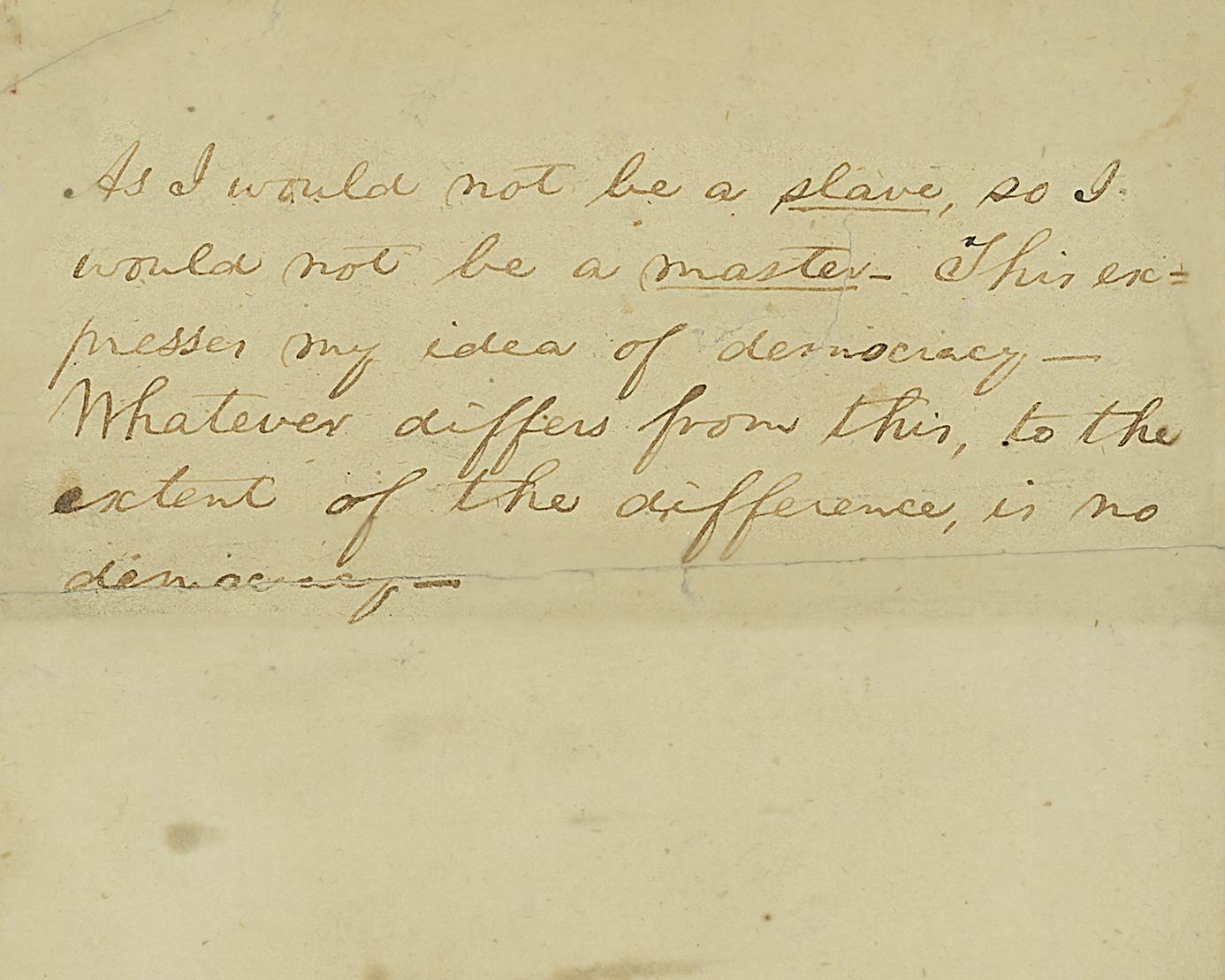
The Idea Of Democracy


 “As I would not be a slave, so I would not be a master. This expresses my idea of democracy. Whatever differs from this, to the extent of the difference, is no democracy.”- Abraham Lincoln, note written to himself, date unknown

I'm currently reading Our Ancient Faith: Lincoln, Democracy, and The American Experiment by Allen Guelzo.  So far, I've not run across the quote in the book but have noticed that Guelzo's take echoes some themes that have come up in this blog in recent years.  More on that later.

Wednesday, March 18, 2026

Personal Handling

I know you will not mind my being brutally frank when I tell you that I think I can personally handle Stalin better than either your Foreign Office or my State Department.  Stalin hates the guts of all your top people.  He thinks he likes me better, and I hope he will continue to.

President Franklin Roosevelt to Prime Minister Winston Churchill, March 18, 1942, from Churchill and Roosevelt: The Complete Correspondence

I think if I give him everything I possibly can, and ask nothing from him in return, noblesse oblige, he won't try to annex anything and will work with me for a world of peace and democracy.

President Franklin Roosevelt to former Ambassador to the Soviet Union, William C Bullitt, January 29, 1943, from For the President: Personal and Secret: Correspondence between Franklin D. Roosevelt and William C. Bullitt 


Image 

There are many things President Franklin Roosevelt got right in the run up to, and during, the Second World War.  He recognized Germany as a threat, not just in Europe, but globally.  FDR also had an ability to spot and promote talent.  Selecting George C Marshall as Army Chief of Staff in 1939 was not obvious, as he was promoted ahead of more than three dozen more senior officers, yet FDR did so after Marshall disagreed with him in a large meeting (for the full story read Management Lessons).  Marshall proved to be a brilliant choice as was Admiral Chester Nimitz, hand picked by FDR to command the Navy in the Pacific.  He also had the good sense to keep Marshall in the U.S. and instead agree that Dwight Eisenhower should command Allied forces for D-Day.

FDR also encouraged dissent.  The military chiefs and his war cabinet engaged in ferocious arguments at time, particularly from 1939 through 1942.   At one point in 1942, Marshall threatened to resign because of his disagreement with the president on the issue of invading North Africa, an issue on which FDR was proven correct - the American army was in no shape to fight the Germans in northwest Europe in 1942, or even 1943.  Marshall, who believed military officers should be apolitical and never voted, was initially a doubter about FDR but became an admirer during the course of the war.

Roosevelt exhibited a good strategic sense in the run up and early years of the war, agreeing with the military chiefs that Germany would be the priority in the event of a conflict with both that country and Japan, and with his instincts of where American military priorities should be in the critical eighteen months after Pearl Harbor.   He also had top notch instincts as to what issues required his involvement and decision making and what didn't.

As I've noted before, in Harry Hopkins he also had an informal channel through whom the military chiefs could take issues, trusting Hopkins, whom they held in high regard, to decide whether, and how, to make the case to FDR.(1)  This stands in stark contrast to LBJ, who in the run up to the Vietnam War, had no such route outside the one official channel controlled by Secretary of Defense Robert McNamara, who prevented dissenting voices from getting to LBJ.  For a comparison of FDR with LBJ on this issue read Dereliction of Duty.

On the debit side was FDR's obsession with China in the lead up to the war.  The military chiefs constantly admonished him for his public statements and pledges in support of China which amounted to writing checks that could not be cashed, refusing to recognize the weakness of America's position in the Pacific and its very limited ability to do anything practicable to assist China in resisting Japan.  They thought his actions ran the risk of precipitating a Japanese attack on the U.S., plunging us into war and running counter to the agreed upon strategy of focusing on Germany first.  On this the chiefs proved correct and FDR was only saved by Hitler's unforced error of declaring war on the U.S. on December 11, 1941.

However, the biggest debit item was FDR's failure to understand the Soviet Union and Josef Stalin and what that meant for his vision for the post-war world.  Chip Bohlen, a Soviet State Department specialist who, in 1953, would become Ambassador to the Soviet Union said of Hopkins that "Harry was inclined to dismiss ideology" and the same can be said of FDR. Roosevelt had a vague notion that the American and Soviet systems would, over time, converge in some unspecific way.(2)  He believed in personal diplomacy and in his ability to charm anyone.  The colonial empires of Britain and France offended FDR and he thought the war should spell an end to them. Why he did not understand the same thing about the USSR, which in that respect was merely a continuation of the land-based colonial empire established by the czars is an interesting question.

That's why even into 1944, when the Allies were clearly winning and the first signs of problems with the Soviets were arising, FDR insisted on continuing lend-lease supplies to the Soviets, including shipping materials that had no obvious short-term value to the war against the Nazis and despite increased evidence of Soviet industrial espionage in America.  At the Tehran conference in November 1943 and even more so at Yalta in February 1945, FDR went out of his way to ingratiate himself with Stalin while poking fun and, at times, insulting Churchill. The President simply could not fathom that Stalin was an ideologue and had no deep understanding of communism.  He completely lacked an understanding of how the Soviets thought.(3)

To illustrate how different the thinking was let's look at Kim Philby, the Englishman turned Soviet agent who ended up in a senior position in Britain's intelligence agency.  Philby would thoroughly betray his country (and the U.S.) leading to the deaths of many East Europeans fighting Soviet tyranny after the war.

After Germany's attack on Russia in June 1941, Philby advised his Soviet handlers that Churchill ordered all British espionage efforts against the USSR to cease, causing the Soviets to wrongly suspect Philby had been turned and become a double agent working for Britain because, in their world, suspending espionage operations made no sense (the U.S., both before and during the war, did not conduct espionage against the Soviets).  After all Soviet espionage against Britain and America during the war not only continued, but was expanded.  After an extensive investigation of Philby the Soviets concluded that his reporting was accurate.

FDR's obsession with the creation of the United Nations, something not a high priority to the Russians, allowed Stalin to winkle more concessions from the U.S. before grudgingly agreeing to its creation. 

Unlike Churchill, FDR remained aloof from Stalin's domination of eastern European countries which became evident during the last months of the war.  In August 1944, when the Polish Home Army rose up against the German occupation of Warsaw, while Stalin's forces halted their advance to let the Nazis eliminate the Poles, who they saw as a threat to the communist future plans for that country, Churchill pleaded with Stalin to allow British planes to fly over Warsaw to drop supplies and then land in Soviet territory to refuel, a request refused by the dictator.  FDR refused Churchill's request to join the British in making the request to Stalin.  For more on this episode read Warsaw Does Not Cry.  During the remaining months of the war FDR continued to resist Churchill's efforts to create a strong joint opposition to Stalin's plans.

Given Roosevelt's death in April 1945, less than three months into his fourth term, we can only be thankful for the big city Democratic party bosses who, in the summer of 1944, rejected FDR's plan to retain Vice-President Henry Wallace on the ticket.  The eccentric and naive Wallace was an unwitting tool of the communists and would have been a disaster as president.(4)  Instead Harry Truman joined the ticket, becoming FDR's successor and proving a much better post-war president on foreign policy than Roosevelt would have been.

 --------------------------------------------------------------------------

(1) The extent to which Hopkins was also held in high regard by the British is shown in a remarkable incident when Field Marshal Brooke, Chief of the Imperial General Staff, came to Hopkins to ask him to intervene in a dispute the British military chiefs were having with Winston Churchill. 

(2)  According to Bohlen, on a return flight from Moscow, on Hopkins last mission to Moscow in June 1945, Harry expressed "serious doubts as to the possibility of genuine collaboration with the Soviet Union", predicting "the American belief in freedom might lead to serious differences."

(3) FDR was not alone in his disinterest in, and failure to understand, ideology.  It was a common failing across the upper rank of civilian and military leaders at the time.  I am a great admirer of George C Marshall but his greatest failure was the year he spent in China as President Truman's special envoy trying to negotiate a settlement between the Nationalist government and its Communist opponents.  Marshall simply had no understanding of underlying communist ideology and his actions undermined the Nationalists.  By later in 1947, Marshall and Truman had a better understanding of the communist threat and responded aggressively in Greece and in Western Europe but by then it was too late and too difficult to save the Chiang's regime in China. 

At the time a common line spun by the USSR about the communists in China and Eastern Europe was that they were not "real" communists but merely "agrarian reformers", and this took in many unsophisticated Americans.  At the end of the war, and in its immediate aftermath, Whittaker Chambers was a senior editor at Time, the preeminent weekly news magazine of the era.  Chambers, a former communist party member in the 1920s and a commie spy in the 1930s before breaking with the party, engaged in a series of back and forths with Time correspondents in Eastern Europe who would post stories about communists describing them as agrarian reformers at which point Chambers would edit out the characterization, despite protests by the reporters that they were the ones on the scene with local knowledge.  Chambers would point out that they did not understand communists.

In September 1939, Chambers met with Assistant Secretary of State Adolf Berle to disclose the existence of a Soviet spy ring within the Roosevelt Administration, providing Berle with a list of names, including Alger Hiss.  Berle took the information to President Roosevelt who dismissed it.

(4)  In 1948, Wallace ran as the Progressive Party candidate for president.  He blamed the U.S. for the start of the Cold War and urged America to give up West Berlin in response to the Soviet blockade (for more read Berlin Divides).  Several years later, Wallace acknowledged he had been manipulated during the campaign by the communists who had infiltrated his organization.

Saturday, February 21, 2026

Huzzah!

 We had the pleasure of hosting Curt Fields for a week of events in Scottsdale.  Curt has portrayed Ulysses S Grant (real name - Hiram Simpson Grant) for the past seventeen years.  At this point it is probably more accurate to say Curt is Grant as he moves seamlessly into any part of the great man's life.  The National Park Service has Curt portray General Grant at its annual commemoration of the surrender of Robert E Lee's Army of Northern Virginia at Appomattox Court House. 

On Tuesday night he appeared as General Grant at the end of the war at the Scottsdale Civil War Roundtable at which we had a turnout of 200, our largest since before Covid.  Wednesday night, Curt was at the Sun City/Surprise Roundtable for a dinner with sixty.  Thursday morning was an appearance at the Scottsdale's Museum of the Western Spirit speaking to 75 senior citizens as President Grant.  That evening Curt wrapped up his schedule with another appearance at the Museum, speaking as the former president to an audience of one hundred, this time with a focus on the Indian policy of his administration and reflecting upon its failure.

At each event Curt captivated his audience, taking us back in time.  We hope to have him back.  

Below is General Grant and Grant with his personal secretary, Colonel Horace Porter.


Friday, January 30, 2026

A Turbulent Time


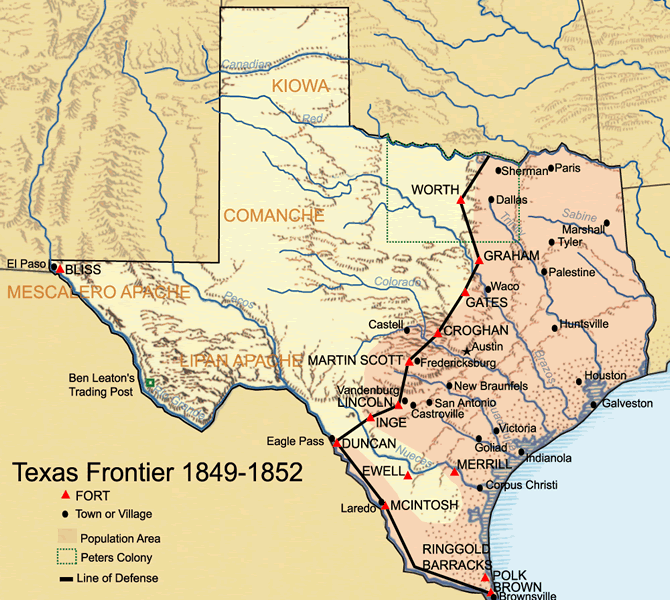
This map, from Texas Beyond History, a public education service of the Texas Archeological Research Laboratory (TARL) at the University of Texas at Austin, developed in collaboration with many other organizations, is useful in illustrating several aspects of Texas and American history. 

The map illustrates Texas near the end of a very turbulent period.(1) A new nation was born in 1836 when it established its independence from Mexico. Mexico's refusal to recognize Texas as independent and Texian expansionism led to Texas invading Mexico in 1841 and 1843 and two Mexican attacks on Texas in 1842 (see Yo, Adrian).  The second Mexican invasion triggered the bizarre episode of the Texas Archive War. A bankrupt Texas entered the United States in 1845, while the outcome of the Mexican War (1846-48) established the state's southern boundary on the Rio Grande (Mexico claimed it was the Nueces).  The Compromise of 1850 led to Texas relinquishing its claim to what is now New Mexico as far as the Rio Grande, which would have placed Santa Fe and Albuquerque in Texas.  You can read more about this episode at When Texas Invaded New Mexico. Meanwhile, the failure of the 1848 revolution in Germany resulted in a large migration of free-thinking Germans to Texas where most settled in the Hill Country west of Austin.

Though Texas was the largest state in the Union, most of its territory was dominated by Indians;  Comanche and, to a lesser extent, Apache.  The map shows the end point of a couple of centuries of fighting among the tribes.  The southern Great Plains had once been the home of the Navajo.  They were driven westward across the Rio Grande by the Apache.  In the early 1700s the Comanche (and their Kiowa allies) drifted south from Wyoming and pushed the Apache westward and southward.

It was the Comanche presence that caused newly independent Mexico to encourage Anglo settlement in Texas during the 1820s.  Mexico, and its predecessor Spain, had difficulty encouraging settlements from the Hispanic population and turned to the Americans to help form a protective barrier from Comanche raids.

The new nation of Texas still struggled against the Comanche, with one Indian raid in the early 1840s even reaching the Gulf Coast near Corpus Christi.  Along with its dire financial situation it was for protection from Mexico and from the Comanche that prompted the Texian agreement to enter the United States.  The result was the construction of the line of forts by the US Army as indicated on the map.

In areas of Texas, settlement extended beyond the defense lines.  This is a constant theme in American history.  It is the settlers who proceed the government, not the other way around.  In 1763 Britain attempted to establish a settlement line for its American colonies, but the effort failed as settlers moved on their own, in defiance of the government, into Kentucky and Tennessee.  After American independence, the pattern continued with westward expansion, settlers always outpacing the areas under direct government control, provoking conflict with Indians and triggering military intervention to restore the peace and protect the settlers.  You can read many military accounts from this era blaming settlers for most of the conflict.(2)  This was at a time when the U.S. government had little presence in everyday life, outside of local post offices, and maintained a very small military; its capacity a fraction of what we have become accustomed to over the past century.

Comanche raids continued for another twenty years.  In 2019 we visited the ancestral homestead of Lyndon Johnson in the Texas hill country and saw the home where LBJ's grandmother and aunt hid under the floorboards during an Indian raid around 1870.  

And those German immigrants in the Hill Country proved to be Unionists in 1861, leading to years of violent conflict with the Confederate government of Texas. 

-----------------------------------------------------

(1) Some would argue Texas has always been turbulent. 

(2) In any event it is difficult to see how any long-term coexistence with the raiding, nomadic Comanche could succeed, in contrast with the tribes in the southeast who adopted American ways and were still expelled. 


Monday, January 5, 2026

The Jason Russell House

On April 19, 1775, 49 Americans were killed in the fighting that began on the Lexington Green early that morning and continued at North Bridge in Concord.  For the rest of the day Americans from neighboring towns attacked the British as they retreated towards Boston.  Of the 49 deaths, twenty five occurred in Menotomy (now known as Arlington), the town southeast of Lexington and, of those, twelve were killed inside or on the property of the Jason Russell House which still exists.  The owner, Jason Russell, age 59, was killed, along with a number of men from Danvers who had rushed 16 to 18 miles that day to reach Arlington.

I recently came across the videos of Katie Turner Getty who has put together a series on the Revolutionary War in the Boston area.  They are very informative plus she has an authentic Boston accent!  This is her video on the events at the Jason Russell House and there is a lot more to watch on her YouTube channel and on her website.  She knows her stuff.

For more than a decade I worked less than two miles from the Jason Russell House and often passed it, but never went inside.  Wish I had. 

I wrote about April 19, 1775 in The Road Back, as well as Tough Guy, about another stalwart fighter in Menotomy that day, 78-year old Samuel Whittemore, who, after killing three British soldiers, was shot in the face, bayoneted somewhere between 6 and 13 times, clubbed in the head with a musket, and left for dead.  He lived another 18 years.

Sunday, August 17, 2025

All Possess Alike Liberty Of Conscience

Moses Seixas was a man with a plan in the summer of 1790. Forty six years old, the son of Portuguese Jews who emigrated to Rhode Island, Moses was warden of Newport’s Tauro Synagogue. President George Washington was making his first visit to Rhode Island, and Moses was determined to use the occasion to obtain express acknowledgement of the enfranchisement of American Jews under the new Constitution.

Washington’s visit also had a plan behind it. The prior year, he had undertaken a lengthy visit to the northern states as part of his strategy of drawing the new nation together and creating more popular support for the newly formed Federal government (he would tour the southern states in 1791). Rhode Island was not part of that tour, because it had yet to ratify the Constitution. The recalcitrant state, under pressure from the new federal government and neighboring states, along with the promise of a visit from Washington and Vice-President Thomas Jefferson, became the last of the original 13 states to ratify on May 29, 1790.

Sexias was to get what he wanted from his letter, but the President’s response expressed additional thoughts that are worth reflecting upon today.

On August 17, 1790 Moses sent a letter to the President, welcoming him to Newport on behalf of “the children of the stock of Abraham“, expressing their happiness in having the “invaluable rights of free Citizens“, and adding:

“we now with a deep sense of gratitude to the Almighty disposer of all events behold a Government, erected by the Majesty of the People – a Government, which to bigotry gives no sanction, to persecution no assistance – but generously affording to all Liberty of conscience, and immunities of Citizenship.”
The President responded the following day, echoing the warden’s phrasing but adds his own distinctive sentiments:
“The Citizens of the United States of America have a right to applaud themselves for having given to mankind examples of an enlarged and liberal policy: a policy worthy of imitation. All possess alike liberty of conscience and immunities of citizenship. It is now no more that toleration is spoken of, as if it was by the indulgence of one class of people, that another enjoyed the exercise of their inherent natural rights. For happily the Government of the United states, which give to bigotry no sanction, to persecution no assistance requires only that they who live under its protection should demean themselves as good citizens, in giving it on all occasions their effectual support.”
Much of the commentary on the letter by historians focuses on the passage that the Government “gives to bigotry no sanction, to persecution no assistance“, citing its importance for the concept of religious liberty, but its significance is deeper in its link to America’s unique founding principles. It is found in two sentences which do not have a counterpart in the Sexias letter. The first:
“It is now no more that toleration is spoken of, as if it was by the indulgence of one class of people, that another enjoyed the exercise of their inherent natural rights.”

The passage expresses two concepts:

First, the American version of “tolerance” is not something bestowed by a dominant group, or individual, upon other groups, because that kind of tolerance is revocable upon the discretion of the dominant group or individual. Bestowed “tolerance” was the concept used in most other societies in that age (and still used in many parts of the world), but in Washington’s parlance “tolerance” is that which we owe to each other as equals. In other “tolerant” societies of the time, the Jewish Community would be considered supplicants; in Washington’s they are equals.  In other words, tolerance is a mutual obligation, because it is a sign of equality.  It is that sense of mutuality that is foundational to this nation.

Second, the source of what we owe to each other as equals are our “inherent natural rights“. These rights are not created by the Declaration of Independence or the Constitution. It’s the other way around – these rights predate those documents and are a source for the text and ideas behind them. Specifically, the Constitution is not a document describing the rights of citizens – those inherent natural rights are so broad as to exceed any attempt to catalogue them in a document. Rather, the Constitution is a delineation of the specific powers delegated by the citizens, who hold those inherent rights, to the government in order for it to perform certain designated functions.

It was 25 year old James Madison who first pointed out how these concepts worked together in May 1776, during the debate on Virginia’s new state constitution. The draft constitution contained a Declaration of Rights, including a clause on religious liberty drafted by George Mason, providing that “all men should enjoy the fullest toleration in the exercise of religion“. Madison objected to the use of the word “toleration” because it implied toleration was a gift from government rather than an inherent natural right. Mason agreed and the draft was amended to read “all men are entitled to the full and free exercise” of religion. This approach is now embodied in the First Amendment our Constitution, not coincidentally authored by Madison:

Congress shall make no law respecting an establishment of religion, or prohibiting the free exercise thereof; or abridging the freedom of speech, or of the press; or the right of the people peaceably to assemble, and to petition the Government for a redress of grievances.
As for Washington, his views were not something newly formulated in 1790. In 1775, shortly after the Continental Congress named him commander of its military forces, he approved a plan to invade Canada. The civilian population of Canada, which the British had taken from France only twelve years prior, was almost exclusively Catholic, a religion detested by most American Protestants of that era. On September 14, 1775, Washington sent instructions to Benedict Arnold, commanding the American expedition about to start its epic campaign through the backwoods of Maine to Quebec. He directed Arnold to respect the religious beliefs of the Canadians. This, in and of itself, was not remarkable – doing so was wise strategy when the Americans were trying to get the Canadians to join them in the revolt against Britain. It was the way Washington expresses himself that is striking:

“While we are Contending for own own Liberty, we should be very cautious of violating the Rights of Conscience in others; ever considering that God alone is the Judge of the Hearts of Men and to him only in this Case they are answerable”
The second significant sentence in Washington's response to the Jewish congregation:
For happily the Government of the United states, which give to bigotry no sanction, to persecution no assistance requires only that they who live under its protection should demean themselves as good citizens, in giving it on all occasions their effectual support.”

In this passage, the President emphasizes the duty of every American is to be a good citizen by supporting the new federal government. Thought the letter does not refer specifically to the Constitution, Washington had  expressed that this was the underlying purpose of his state visits, and he seized every opportunity to promote it. The Constitution, not a common religion, was to bind all citizens together.  However, if you read more on Washington and many of the other Founders, what underlay all of this was a common sense of morality.  That duty of the citizen was not absolute, rather Washington's expression of that duty presupposes the government would act in a moral way that deserved the support of its citizens.  But not only the government.  As John Adams would write:

"Our Constitution was made only for a moral and religious people. It is wholly inadequate to the government of any other."
Both letters are worthy of a full reading, expressing their sentiments using the wonderful phrasing characteristic of that time, a writing style that only a generation later had fallen out of favor. I particularly like Washington’s closing lines:

” . . . while every one shall sit in safety under his own vine and figtree, and there shall be none to make him afraid. May the father of all mercies scatter light and not darkness in our paths, and make us all in our several vocations useful here, and in his own due time and way everlastingly happy.”
Moses’ closing words aren’t too bad either:
 “And, when, like Joshua full of days and full of honour, you are gathered to your Fathers, may you be admitted into the Heavenly Paradise to partake of the water of life, and the tree of immortality.”
You can find the full text of the Seixas letter here, and Washington’s full response here.

As a final note, it is often overlooked that Moses Seixas wrote a second letter to President Washington on August 17, 1790. This letter was on behalf of King David’s Lodge of Free and Accepted Masons, of which Seixas was Grand Master, and contained greetings from one member of a fraternal order to another member.

Friday, July 18, 2025

Day Of Glory

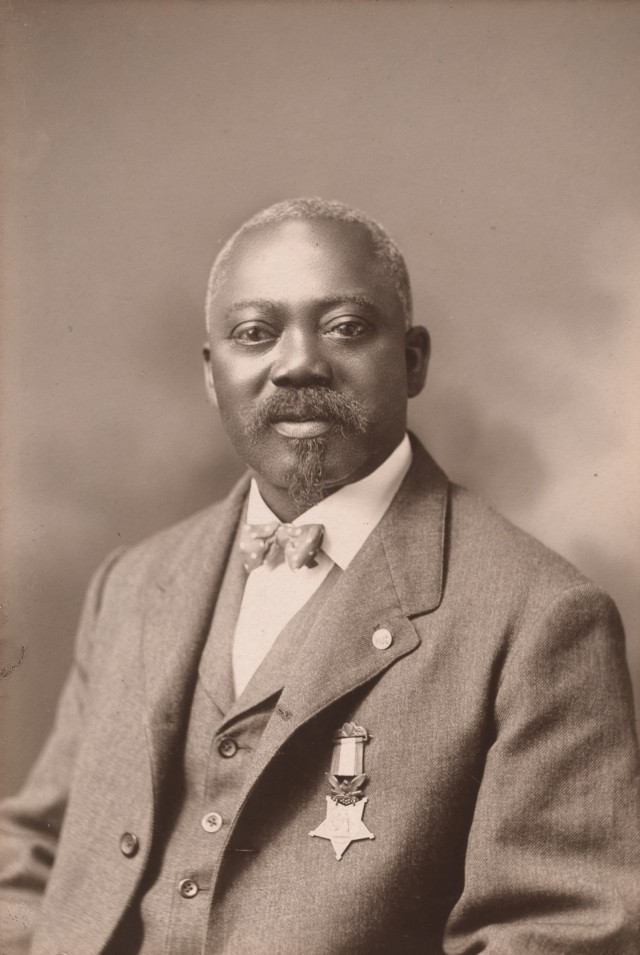
Army Sgt. William H. Carney 

On this date in 1863 occurred the Union assault on Fort Wagner near Charleston, SC, an event depicted in the movie Glory.  If you saw the film you'll certainly remember the scene when the character portrayed by Denzel Washington grabs the Union colors from the color guard of the 54th Massachusetts to prevent them from falling to the ground and is then shot as he rallies his fellow soldiers.

Meet William Carney.  Born in 1840 into slavery in Virginia.  His family was eventually freed and moved to Massachusetts.  When the 54th Massachusetts was organized as the first official black unit (designated as United States Colored Troops) in the Union army, Carney enlisted.  Promoted to sergeant, on July 18 he found himself among the leaders of the assault on the Confederate held fort.  Reaching the ramparts he saw the unit's color guard mortally wounded and grabbed the colors to prevent them from falling to the ground.

Wounded several times, Carney kept the flag flying as he rallied his men until finally collapsing from loss of blood.  Unlike Denzel Washington's character, Carney recovered from his serious wounds, and received the Medal of Honor on May 23, 1900.  His citation reads:

When the color sergeant was shot down, this soldier grasped the flag, led the way to the parapet, and planted the colors thereon. When the troops fell back he brought off the flag, under a fierce fire in which he was twice severely wounded. 

Some accounts call him the first black recipient of the Medal, but other black soldiers received the Medal before Carney.  However, the events for which Carney received the Medal preceded all of the others.

Carney returned to Massachusetts after being discharged, married, and became a mail carrier.  He died in 1908.  

For an account of a battle a month prior to Fort Wanger in which black soldiers, who had been slaves just weeks previously, resisted an Confederate assault read Milliken's Bend.

Army Sgt. William H. Carney 


Thursday, July 17, 2025

Cool

On this date in 1902, Willis Carrier completed the drawings for what became the world's first modern air conditioning system.  Carrier, born in 1876 in upstate New York and a graduate of Cornell, was working at the Buffalo Forge Company as a research engineer.

The Sackett-Wilhelms Lithographic & Publishing Company in Brooklyn, a Buffalo Forge customer, was having paper quality problems due to high summer humidity.  Carrier's device was designed to address this problem, though it was not until January 1906 that he was granted a U.S. patent for an Apparatus for Treating Air.

In 1915, Carrier and six other engineers formed the Carrier Engineering Corporation.  Today the Carrier business is part of United Technologies.

Having been a resident of south Florida for eight years and residing in Arizona since 2017, I give my heartfelt thanks to Mr Carrier for making these places habitable.

For a more culturally oriented discussion of cool, read Cool And Uncool

Thursday, July 10, 2025

Scopes At 100

On this date a century ago, the trial of John Scopes began in Clarksville, Tennessee.  The Scopes Monkey Trial, as it became known, was a national sensation at the time, given fodder for many books, and was the source material for the play, and later film, Inherit The Wind.  How the case is now remembered in many ways erases the nuances and complexity of the issues and people involved.

I first wrote about the case in 2015, with an update in 2022.  At the time of the 2015 post there were still some efforts to insert creationism into public school curriculum.  Those efforts seems to have ceased, but evolutionary biology now appears under assault from different quarters, it seems an appropriate date on which to post again.

------------------------------------------------------
Rather than the often repeated adage that the victors write the history of an event, the story of anything is actually determined by the unswerving adoption of one version of it, and the telling of that version by a determined cadre of writers. In time, the version with the most persistent adherents becomes the “truth.” – David & Jeanne Heidler in Henry Clay: The Essential American (2010)
I still recall the family getting in the car for the drive to Hartford, Connecticut. It was the late 1950s, and my father was taking us to pick up a monkey. He had a small role as an Italian organ-grinder in a play put on by a local community theater group. The director wanted to use a prop monkey, but dad insisted on the real thing. We housed that monkey for the next week; I remember it as nasty and mean-tempered, but the audience loved it, as well as dad in his bit part (he always had a knack for showmanship). The play was Inherit The Wind, based on a 1925 event in Tennessee that became popularly known as the Scopes Monkey Trial.

Seeing the play and, later, the movie, I accepted its narrative of the forces of enlightenment, reason, heroism, and tolerance (represented by Spencer Tracey in the movie, playing a character based on Clarence Darrow) against the forces of narrow-mindedness, mean-spiritedness, repression, and unthinking old-fashioned religion (represented by Frederic March playing a character based on William Jennings Bryan); a morality play of liberal versus conservative written during the McCarthy years. The play is still staged frequently by regional theaters (here’s a recent Wisconsin production), has gone through several Broadway revivals, most recently in 2007, with Christopher Plummer and Brian Dennehy. There was even a London production, in 2009, with Kevin Spacey. In most cases, it is widely accepted by audiences as historically accurate.

It was only years later, prompted by reading Edward Larson’s Summer For The Gods and doing related research that I appreciated how much more complex and interesting the real story was. American history is much more fascinating and instructive when you don’t try to neatly shoehorn it into boxes labeled “liberal,” “conservative,” “progressive,” and “reactionary” as Inherit The Wind did, aided by influential mid-20th century historians and literary critics such as Richard Hofstadter. Throughout our history, you’ll see prominent people with constellations of political views that are unrecognizable in today’s categories (see Sam Houston as an example).  I support the teaching of evolutionary theory but the full story behind the Scopes Trial is more interesting than the caricature of Inherit The Wind and, as I learned, the main character in this drama, William Jennings Bryan, would not neatly fit into any political classification in modern-day America.

The Background

Dayton in 1925

The early 20th century saw an explosion in the growth of public high schools. In 1890, there were fewer than 200,000 public high-school students nationwide; by 1920, more than two million. In Tennessee, fewer than 10,000 in 1910, but more than 50,000 by 1920. What were they to be taught?

At the same time, battles were heating up between Darwinists and some religious denominations over the teaching of evolution. State legislative fights over its inclusion in educational curriculum became common.

Legislative efforts barring the teaching of evolutionary theory were successful in a small number of states, including Tennessee, which passed its law in early 1925. It was part of a larger package of laws in a massive education reform bill that laid the foundation for state-supported public schools. It was signed into law by progressive Governor Peay. Violation of the ban on teaching evolution carried a $100 fine, but no jail. Bryan supported the bill, but unsuccessfully lobbied against having any fine attached to violating the evolution provision, though no one at the time expected any prosecutions under the statute.

John Scopes

Looking for a test case, the American Civil Liberties Union placed advertisements in Tennessee papers offering to defend anyone prosecuted under the Act. Leading citizens of the town of Dayton decided to take them up on it. While some were interested in challenging the law, many others just saw it as a good opportunity to create publicity and generate business for the town. Rather than showcasing a contentious, divided populace, as portrayed in the play, the actual trial took place in a festive atmosphere, according to reporters like H.L. Mencken. The key players in Dayton recruited John Scopes, a young, part-time schoolteacher, to be the defendant and agreed to pay any penalty imposed on him.

Dayton was a small town in East Tennessee, and part of the only Republican enclave in the state. Bryan won every southern state in each of his three presidential runs, but never carried Rhea County where Dayton was located. The town was also heavily Methodist in a state dominated by Baptists (the Baptist Convention, meeting in Memphis just before the trial, refused to add an anti-evolution plank to the denomination’s statement of faith).

Once the ACLU came into the case, Bryan — the country’s leading opponent of the teaching of evolution — agreed to become part of the prosecution’s team. And through some very complicated machinations, Clarence Darrow, the most famous criminal defense lawyer in America, joined the defense team. When this happened, the trial became the biggest story in the country, and was also followed heavily in Europe. A deluge of reporters descended on Dayton.

Why Evolution? Why Bryan?
 
In 1925, 65-year-old William Jennings Bryan was well known to every American, having run unsuccessfully three times as the Democratic Party’s presidential candidate (1896, 1900, and 1908). A remarkable orator — his “Cross of Gold” speech at the 1896 convention secured him the nomination — he is considered to be the first populist to run for President. In 1913, Woodrow Wilson appointed him Secretary of State, a post he resigned in 1915 when the pacifist Bryan became convinced Wilson was maneuvering the country into entering the First World War.

Bryan campaigned successfully in support of four constitutional amendments: direct election of senators, the Federal income tax, women’s suffrage, and Prohibition.  So why, in the 1920s, did he undertake leadership of the crusade against the teaching of Darwinism, and why did he think it was consistent with his other views?  From today's perspective, it doesn't seem to make sense.

Bryan believed in “popular sovereignty", always campaigning against big business and the banks and on behalf of the common people. When the Supreme Court overturned some of the early progressive labor laws, Bryan supported (unsuccessful) legislation to limit judicial review, and backed the Progressive use of popular referendums. He believed the people were entitled to what they wanted, and saw the evolution issue in the same way. According to Bryan:
It is no infringement on their freedom of conscience or freedom of speech to say that, while as individuals they are at liberty to think as they please and say what they like, they have no right to demand pay for teaching that which parents and the taxpayer do not want taught.
The deeper reason was Bryan’s concerns about the implications of Darwinism. Bryan was a committed Christian and pacifist. He rejected evolutionary theory as a matter of religious faith, but also believed Darwinism and its doctrine of “survival of the fittest” threatened the dignity and perhaps even the very existence of the weakest of the human flock. Bryan saw a direct connection between the excesses of capitalism and militarism — which he had denounced throughout his career — and Darwinism, which, as early as 1904, he had called “the merciless law by which the strong crowd out and kill off the weak.”

The concerns Bryan raised in 1904 were reinforced by recent events. The slaughter of WWI appalled Bryan. He saw German militarism as Darwinian selection in action; this was a common view at the time, as reflected in the words of Vernon Kellogg in his book Headquarters Nights: “Natural selection based on violent and fatal competitive struggle is the gospel of the German intellectuals.”

Bryan saw the modernist wing of the Progressives, led by Woodrow Wilson, willing to go down the same road. It is striking to see how much Darwinism was in the air of politics at the time. Wilson’s key 1912 campaign speech, “What is Progress?” espoused a Darwinian approach to American government:
Now, it came to me, as this interesting man talked, that the Constitution of the United States had been made under the dominion of the Newtonian Theory. You have only to read the papers of the The Federalist to see that fact written on every page. They speak of the “checks and balances” of the Constitution, and use to express their idea the simile of the organization of the universe, and particularly of the solar system — how by the attraction of gravitation the various parts are held in their orbits; and then they proceed to represent Congress, the Judiciary, and the President as a sort of imitation of the solar system. …
Living political constitutions must be Darwinian in structure and in practice. Society is a living organism and must obey the laws of life, not of mechanics; it must develop. All that progressives ask or desire is permission — in an era when “development” “evolution,” is the scientific word — to interpret the Constitution according to the Darwinian principle; all they ask is recognition of the fact that a nation is a living thing and not a machine. [emphasis added]
The new science of eugenics greatly troubled Bryan. The high school textbook used by John Scopes was A Civic Biology by George William Hunter, which defined eugenics as “the science of improving the human race by better heredity.” Hunter wrote,
If such people were lower animals, we would probably kill them off to prevent them from spreading … Humanity will not allow this, but we do have the remedy of separating the sexes in asylums or other places and in various ways preventing intermarriage and the possibility of perpetuating such a low and degenerate race.
The prior edition of Hunter’s textbook had contained language specifically citing biological deficiencies of African races.

Eugenics had many scientist adherents in the United States and England who believed that the human race could be made better via selective breeding to create a better and more progressive world. One of those scientists, A.E. Wiggam, expressed the connection between the teaching of evolution and eugenics:
“until we can convince the common man of the fact of evolution … I fear we cannot convince him of the profound ethical and religious significance of the thing we call eugenics.”

Holmes

During the 1920s and 30s, the eugenics movement gained momentum. By 1935, more than 30 states had laws mandating sexual segregation and sterilization of persons regarded as eugenically unfit. The most notorious expression of support for eugenics came in 1927 from the leading Social Darwinist on the Supreme Court, Oliver Wendell Holmes, Jr., who, in his opinion for the Court upholding Oklahoma’s sterilization law, exclaimed “three generations of imbeciles is enough.” The only dissenting vote was cast by Pierce Butler, the lone Catholic on the Court.

Within a few years, WWII and the revulsion against Nazi law and experimentation would put an end to the eugenics movement (though a revival of eugenics under another name seems to be arising based upon  modern advances in biology and genetics). The heyday of the eugenics movement and the rise of anti-evolutionary forces led to the Dayton trial in 1925. Bryan expressed his pithy view of the whole matter when commenting on the latest discovery of purported early human remains: “Men who would not cross the street to save a soul have traveled across the world in search of skeletons.”  In his closing argument at trial, Bryan explained that evolutionary theory:
". . . if taken seriously and made the basis of a philosophy of life, it would eliminate love and carry man back to a struggle of tooth and claw."
The Trial and its Aftermath
The ACLU and Darrow differed on trial strategy. The ACLU considered it a free speech case, but that was not Darrow’s interest.  As a militant atheist who did not believe in free will, he wanted to use the trial as an opportunity to directly assault Christianity and its beliefs about the creation of the universe and the human race. This discomfited many ACLU supporters, but — through a complicated series of maneuvers — Darrow seized control of the defense strategy and was cleverly able to lure Bryan to the stand, where he cross-examined him viciously on Biblical inconsistencies. (Darrow might have been a terrible person, but you’d want him defending you if you were on trial). This prompted a Congregational Church official who supported the legal challenge to send a note to the ACLU: 
“May I express the earnest opinion that not five percent of the ministers in this liberal denomination have any sympathy with Mr Darrow’s conduct of the case.”
Edwin Mims of Vanderbilt University, another supporter of the ACLU, wrote:
 “When Clarence Darrow is put forth as the champion of the forces of enlightenment to fight the battle for scientific knowledge, one feels almost persuaded to become a Fundamentalist.”
The jury quickly returned a verdict finding Scopes guilty. Bryan offered to pay the $100 fine, and the local school board offered to renew his contract for another year, but Scopes decided to go to graduate school, attending the University of Chicago and becoming a petroleum engineer.  The fine was ultimately rescinded and the Butler Act was repealed in 1967.

Five days after the end of the trial, William Jennings Bryan passed away while taking his afternoon nap.
 
In today's Wall St Journal, playwright David Mamet has a piece with observations on Inherit The Wind, noting that: 
The play and film were intended as ripostes to the House Un-American Activities Committee’s persecution of those accused of communist sympathies.
As such, the play had to tailor the story from 1925 into a narrative usable for a 1950s audience. It also reflects intellectual currents of the mid-century: 
"Inherit the Wind” paints the contest between reason and religion as zero-sum. Religion is a metaphysical concept. It can’t be observed as part of the physical world. But a little reflection must suggest that reason is equally metaphysical. Where does it exist save for in the human mind, which can be inaccurate, uninformed, depraved or plain wrong, and in which “the reasonable” changes through maturity and over time. 
The truth is both are necessary.  
The factors potentially mitigating the horrors wrought by our corruptible human feelings, and our equally defective reason are two. One is religion, which is to say our avowal of our imperfection. The other is the law, the attempt to codify religious intuition mechanically. There will always be an unresolved remainder in an arbitration between justice and fairness, reason and folly. This dissatisfaction is the human condition, the subject of the actual drama, and that which differentiates it from pageant, propaganda or mere entertainment. The hero of “Inherit the Wind” is Darrow but at the play’s end, he has learned nothing. And, so, neither have we.  
As Mamet points out, reason and faith operate in different ways.  I've read articles in which it is said that Saint Aquinas should be read to understand how faith and reason can be reconciled.  I don't think they need to be as each stand on their own.  They may overlap at times but they also exist parallel to each other.  One can understand a reasoned analysis and nonetheless have faith in a certain outcome.  I don't feel any need to reconcile those aspects.  They just exist. 

Sunday, June 22, 2025

The Raiding Zone

Came across this map of Comancheria, the homeland of the Comanche, showing the extent of the tribe's raiding areas into the 1870s.  The tribe dominated this region for almost two centuries, holding off the Spanish, Mexicans, and Anglos.  Their arrival in the early 18th century also drove the Apaches off the plains and into the mountains of New Mexico, Arizona, and Mexico.

The deeper red area, covering the Texas panhandle, the Midland-Odessa area, and slices of New Mexico, Oklahoma, Colorado, and Kansas was the heart of Comancheria, a no-go zone for outsiders.  The raiding area is much larger, in the east extending to Dallas-Fort Worth, Austin, and San Antonio.  In the 1840s, a Comanche raid even reached the Gulf Coast near Corpus Christi.  Comanche raids also extended well into Mexico.

In 2018 we visited the homestead of Lyndon Baines Johnson's parents and grandparents, about 60 miles west of Austin, and learned how family members narrowly escaped capture during a Comanche raid in the early 1870s. 

Image 

Wednesday, May 28, 2025

Indian Removal Act

On this date in 1830, President Andrew Jackson signed the Indian Removal Act.  The bill had been the subject of much controversy in Congress, before being passed by the Senate 28-19 on April 24, and in the House, on May 26, by the narrow margin of 101-97.  The only Representative from a district containing, or adjacent to, the affected tribes to vote against the bill was David Crockett.  You can read about Crockett's objections here.

The Removal Act, as proposed by President Jackson, with the enthusiastic support of most of the white population in the south, was designed to remove members of the Five "Civilized" Tribes (Cherokee, Chickasaw, Creek, Choctaw, and Seminole) from the southeast, moving them to what later became the state of Oklahoma.  The Removal Act provided the funding to allow this action.

The term "civilized" is used to distinguish these tribes from those in other areas of the country and in different eras.  These tribes all had established treaty relations, as autonomous nations, with the United States, and they were in compliance with those treaties.  The treaties established them on lands across the southeast and each tribe had organized governance structures and were pursuing agricultural and settled ways.  There was also considerable intermarriage between whites and tribe members.  This was a very different scenario from the situation with the nomadic tribes of the Great Plains like the Sioux and Comanche, which the federal government would face in future decades.

Some factions of each of the tribes would voluntarily remove themselves, but others refused to leave, leading to the forced migrations of the late 1830s, known as the Trail of Tears, as well as to the Seminole War of 1835 to 1842 in Florida.

Although it was their white neighbors who triggered the expulsion, it was carried out by the federal government, which, at the outbreak of the Civil War, led all the removed tribes, who also held black slaves, to support the Confederacy. 

The Indian ways of life in the Western Hemisphere were doomed from the moment Europeans first arrived.  The diseases the Europeans carried with them, and the lack of immunity of the native population resulted in population reductions of 80-90% across both continents.(1)  When the Pilgrims landed in Plymouth in 1620, they settled on the remains of an Indian village wiped out from disease.(2) 

Later, there was no way the United States would allow the nomadic raiding culture of the Plains Indians to continue.  The only path of survival was adaptation to European ways while keeping selective parts of native cultures.  This is what the tribes of the southeast tried to do and, indeed, they were living in peace with their neighbors in 1830.  The problem was the insatiable hunger for land by those white neighbors.  One of the arguments made in favor of the Removal Act was that the U.S. military establishment was so few in number that it could not prevent settler infringement on native lands, an infringement that would inevitably lead to violence, and thus the Removal Act actually protected the tribes. Whatever the arguments, the removal remains a blot on our history.

 -----------------------------------------------

(1) There is a lot of variation in population estimates for the pre-Columbian Western Hemisphere, but the bulk of Indians were south of the current borders of the U.S.  It's likely that less than 5% of the total population in 1491 lived within today's United States borders. 

(2) Mortality rates for the European settlers were also high.  Half of the Pilgrims died in that first winter, and in the Chesapeake region the toll was staggering, as you can read in The Barbarous Years.


Saturday, April 19, 2025

The Road Back

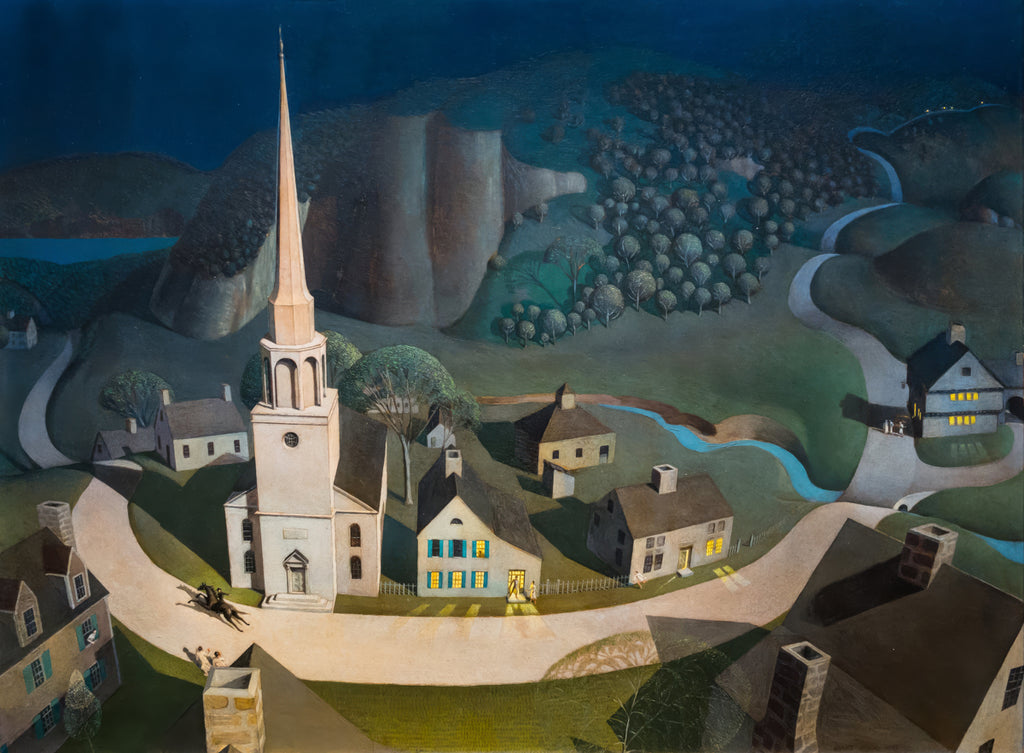
The Midnight Ride of Paul Revere, 1931 | McGaw Graphics

(The Midnight Ride of Paul Revere by Grant Wood, 1931)

Today is the 250th anniversary of Paul Revere's ride to warn of the British army advance into the countryside around Boston.  He set out late on the evening of April 18 to warn the countryside, was captured by the British, and released in time to appear on the Lexington Green the following morning. This is a repost from several years ago:


"During the whole affair, the rebels attacked us in a very scattered, irregular manner, but with perseverance and resolution, nor did they ever dare to form into any regular body.  Indeed they knew too well what was proper, to do so.  Whoever looks upon them as an irregular mob, will find himself very much mistaken.

"For my part, I never believed, I confess, that they would have attacked the king's troops, or have had the perseverance I found in them yesterday."

- Lord Percy, April 20, 1775

The quote is from Paul Revere's Ride by David Hackett Fischer, which I recently reread, and Lord Percy is referring to the final part of the British retreat from Lexington to Charlestown, along what is now known as Battle Road, on April 19, 1775.  Percy led a relief column out of Boston that morning to support the British force sent late the prior evening to seize Patriot arms stored in Concord.

When Lord Percy arrived in Lexington at mid-day he found a panicked British force hastening back from Concord in disarray, stunned by the resistance and the number of casualties inflicted upon them by the locals, whom, until that day, they held in contempt.  If Percy had not shown up it is doubtful any of the original British force would have made it back to Boston.  Under the direction of Lord Perc,y the combined force fought its way back with the most violent action of the day taking place in Menotomy (now Arlington).

Lord Percy's observation was perceptive.  For the most part he was not encountering local farmers spontaneously taking positions behind walls to shot at his soldiers.  These were regiments organized by local Massachusetts towns and under the direction of William Heath, a Roxbury farmer who had taught himself the rudiments of military strategy, and thought deeply in advance how to deal with British regulars.  The local regiments did not fight the British from fixed positions but rather formed a moving circle of skirmishers around the entire enemy column during this last phase of the British retreat.

Learning about the little-known Heath and the patriot military strategy is one of the joys of reading Fischer's book.  While it reclaims the legacy of Paul Revere it also tells the entire story of April 19 in great, and very readable detail.  Revere was much more than the man who made his famous ride.  He was instrumental in the years leading up to the events of April 19, becoming the key link between the artisans and tradesmen of Boston and the elite businessmen and lawyers like John Hancock, Joseph Warren, and Sam Adams.  He is seemingly everywhere, involved in every key event.

On the night of April 18-19 Revere was captured by the British on the road between Lexington and Concord.  Released later that evening he made his way to Lexington, where he had previously stopped to warn Hancock and Adams, who were staying at a house next to the Town Green, of the British expedition.  On his return he helped relocate the two patriot leaders to a more remote location and then learned they had left a large chest full of sensitive documents at a tavern on the Green!  Recruiting an assistant they removed the chest and carted it across the Green as dawn broke passing through the Lexington militiamen assembling there and seeing the approaching British troops.  As Revere reached the nearby woods he heard the first shots of the American Revolution.

Fischer is one of our great narrative historians and while Paul Revere's Ride is scholarly and full of fascinating footnotes at the end, it is also a rollicking and exciting tale as told by the author.  Washington's Crossing, about the darkest days of the Revolution in late 1776, is another narrative masterpiece by Fischer.  

In his introduction, Fischer explains his continued belief in the power of the narrative even as other approaches have come to dominate historical scholarship:

Pathbreaking scholarship in the 20th century has dealt mainly with social structures, intellectual systems, and material processes.  Much has been gained by this enlargement of the historian's task, but something important has been lost.  An entire generation of academic historiography has tended to lose sense of the causal power of particular actions and contingent events.  

An important key here is the idea of contingency - not in the sense of chance, but rather of 'something that may or may not happen' . . . An organizing assumption of this work is that contingency is central to any historical process, and vital to the success of our narrative strategies about the past.

To that end, this inquiry studies the coming of the American Revolution as a series of contingent happenings, shaped by the choices of individual actors with the context of large cultural processes.

Fischer's first book, originally his doctoral thesis, is Albion's Seed, the most important book ever written about the cultural differences between the British groups that settled America and their impact on the strands of American culture that powered this country throughout its history, at least until recent decades.

While modern academic theory has reduced all those of European origin into a faceless, indistinguishable blob of white supremacy, Albion's Seed reminds us of the strikingly different cultures from different geographical areas within England that settled in various parts of the New World - Puritans in New England, Quakers in the mid-Atlantic, Cavaliers in the South and the Scots-Irish in the backcountry.  Cultural and religious traditions in these groups varied tremendously and those differences carried over into America.

In the introduction to Paul Revere's Ride, Fischer speaks to the cultural traditions he identified in Albion's Seed writing:

Paul Revere's idea of liberty was not the same as our modern conception of individual autonomy and personal entitlement.  It was not a form of "classical Republicanism", or "English Opposition Ideology", or "Lockean Liberalism", or any of the learned anachronisms that scholars have invented to explain a way of thought that is alien to their own world.

He believed deeply in New England's inherited tradition of ordered freedom, which gave heavy weight to collective rights and individual responsibilities - more so than is given by our modern calculus of individual rights and collective responsibilities.

His genius was to promote collective action in the cause of freedom - a paradox that lies closer to the heart of the American experience than the legendary historical loners we love to celebrate.

And then there is Samuel Whittemore.  Read Tough Guy.