Showing posts with label Civil War. Show all posts

Saturday, February 21, 2026

Huzzah!

 We had the pleasure of hosting Curt Fields for a week of events in Scottsdale.  Curt has portrayed Ulysses S Grant (real name - Hiram Simpson Grant) for the past seventeen years.  At this point it is probably more accurate to say Curt is Grant as he moves seamlessly into any part of the great man's life.  The National Park Service has Curt portray General Grant at its annual commemoration of the surrender of Robert E Lee's Army of Northern Virginia at Appomattox Court House. 

On Tuesday night he appeared as General Grant at the end of the war at the Scottsdale Civil War Roundtable at which we had a turnout of 200, our largest since before Covid.  Wednesday night, Curt was at the Sun City/Surprise Roundtable for a dinner with sixty.  Thursday morning was an appearance at the Scottsdale's Museum of the Western Spirit speaking to 75 senior citizens as President Grant.  That evening Curt wrapped up his schedule with another appearance at the Museum, speaking as the former president to an audience of one hundred, this time with a focus on the Indian policy of his administration and reflecting upon its failure.

At each event Curt captivated his audience, taking us back in time.  We hope to have him back.  

Below is General Grant and Grant with his personal secretary, Colonel Horace Porter.


Friday, December 12, 2025

Induction

I was recently privileged to be inducted as an associate member of the Sons of Union Veterans of the Civil War, joining the Picacho Peak Camp in the Department of the Southwest of the SUVCW.  The SUVCW, with over 6,000 members, is the successor organization to the Grand Army of the Republic (GAR), the organization of Civil War veterans formed at the conclusion of that conflict.

The SUVCW is a Congressionally chartered non-profit corporation with three missions; Patriotic Education; Honoring Union Veterans and Veterans of all U.S. conflicts; and Preserving and Perpetuating the Grand Army of the Republic. 

To become a full member of the SUVCW, one must be a direct descendant of someone who served in the U.S. military during the Civil War, and such ancestry goes through a rigorous vetting process before a membership application is accepted. 

Because all of my ancestors arrived after the Civil War, I am eligible to become an associate member of the organization.  Several members of the SUVCW are members of our Roundtable and having spoken to two of the three camps in Arizona, I was very honored to be asked to join as an associate.

I know my parents and my grandparents would all be very pleased with my membership in the SUVCW, given how proud they were to be Americans, and how they honored those who established and sought to preserve the Union. The posts that I've done on my paternal and maternal grandfathers make that clear. 


Friday, July 18, 2025

Day Of Glory

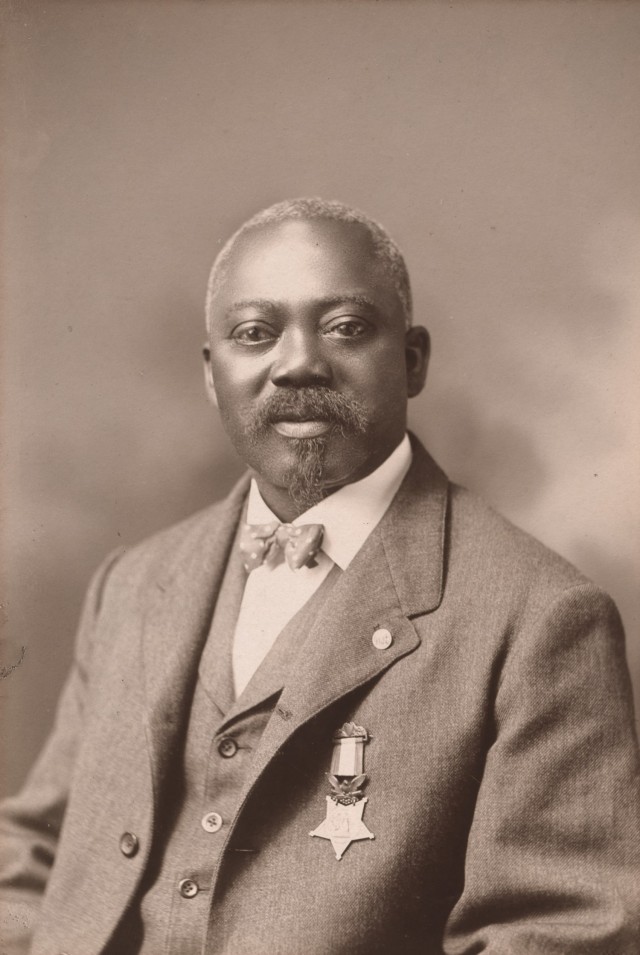
Army Sgt. William H. Carney 

On this date in 1863 occurred the Union assault on Fort Wagner near Charleston, SC, an event depicted in the movie Glory.  If you saw the film you'll certainly remember the scene when the character portrayed by Denzel Washington grabs the Union colors from the color guard of the 54th Massachusetts to prevent them from falling to the ground and is then shot as he rallies his fellow soldiers.

Meet William Carney.  Born in 1840 into slavery in Virginia.  His family was eventually freed and moved to Massachusetts.  When the 54th Massachusetts was organized as the first official black unit (designated as United States Colored Troops) in the Union army, Carney enlisted.  Promoted to sergeant, on July 18 he found himself among the leaders of the assault on the Confederate held fort.  Reaching the ramparts he saw the unit's color guard mortally wounded and grabbed the colors to prevent them from falling to the ground.

Wounded several times, Carney kept the flag flying as he rallied his men until finally collapsing from loss of blood.  Unlike Denzel Washington's character, Carney recovered from his serious wounds, and received the Medal of Honor on May 23, 1900.  His citation reads:

When the color sergeant was shot down, this soldier grasped the flag, led the way to the parapet, and planted the colors thereon. When the troops fell back he brought off the flag, under a fierce fire in which he was twice severely wounded. 

Some accounts call him the first black recipient of the Medal, but other black soldiers received the Medal before Carney.  However, the events for which Carney received the Medal preceded all of the others.

Carney returned to Massachusetts after being discharged, married, and became a mail carrier.  He died in 1908.  

For an account of a battle a month prior to Fort Wanger in which black soldiers, who had been slaves just weeks previously, resisted an Confederate assault read Milliken's Bend.

Army Sgt. William H. Carney 


Thursday, February 27, 2025

The Cooper Union Address

On this date in 1860, Abraham Lincoln spoke in New York City at Cooper Union Hall.  Lincoln had come to national attention through his series of debates with Stephen Douglas in 1858, though he ultimately lost the race to become United States Senator from Illinois, but it was his speech at Cooper Union that made him a viable candidate for the Republican nomination for President in 1860.

The speech was sponsored by the Young Men's Central Republican Union and was the third in a series, the first two given by Francis Blair, a founder of the Republican party and later advisor to President Lincoln, and Cassius M Clay, an abolitionist Republican from Kentucky.

Cooper Union, private college in Manhattan, was founded the previous year by Peter Cooper.  Lincoln spoke on a snowy night, in the Great Hall, located in the basement of the Union building, to an audience of 1,500.

His address was one of the longest speeches he ever gave.  It lacks the soaring eloquence and memorable  quotable sections of many of his other remarks but it was rhetorically effective for its purposes, designed as a political speech to help his campaign for the nomination, though this is never mentioned in the address.

The speech consists of three parts.  The first, reviewing the historical evidence regarding whether the federal government had the power to ban slavery in the territories, the second addressed to those in the South, with the final section a message to Republicans.

Lincoln starts by defining the question he seeks to answer:

Does the proper division of local from federal authority, or anything in the Constitution, forbid our federal government to control as to slavery in our federal territories?

Lincoln has a threefold purpose in answering the question.  First, to convincingly make the case that nothing forbids the federal government from controlling slavery in the territories; second to convey his personal belief in the wrongness of slavery, and third, concluding that the Constitution does not allow the federal government to interfere with slavery within the states where it already exists.  It is not an abolitionist speech.

The speech was also made in the context of the Supreme Court's Dred Scott decision, three years earlier, in which Chief Justice Taney declared that blacks, whether free or slave, were not citizens of the United States, and raised the possibility that the Court could eventually declare state constitutions banning slavery to be unconstitutional.(1)

In the first section, Lincoln reviews in detail the actions by the Continental Congress in banning slavery in the Northwest Territories, of the actions and inactions of the Constitutional Convention regarding slavery, and of the early Congressional sessions with regard to the treatment of the territories, with a particular emphasis on the role of those who had previously served in the Continental Congress and Constitutional Convention, in the course of which Lincoln rebuts Taney's fanciful history lesson in Dred Scott.(2) 

Here's an example of Lincoln's methodology:

In 1789, by the first Congress which sat under the Constitution, an act was passed to enforce the ordinance of ’87, including the prohibition of slavery in the Northwestern Territory. The bill for this act was reported by one of the “thirty-nine,” Thomas Fitzsimmons, then a member of the House of Representatives from Pennsylvania. It went through all its stages without a word of opposition, and finally passed both branches without yeas and nays, which is equivalent to a unanimous passage. In this Congress there were sixteen of the thirty-nine fathers who framed the original Constitution. They were John Langdon, Nicholas Gilman, Wm. S. Johnson, Roger Sherman, Robert Morris, Thos. Fitzsimmons, William Few, Abraham Baldwin, Rufus King, William Paterson, George Clymer, Richard Bassett, George Read, Pierce Butler, Daniel Carroll, James Madison.

This shows that, in their understanding, no line dividing local from federal authority, nor anything in the Constitution, properly forbade Congress to prohibit slavery in the federal territory; else both their fidelity to correct principle, and their oath to support the Constitution, would have constrained them to oppose the prohibition.

Again, George Washington, another of the “thirty-nine,” was then president of the United States, and as such approved and signed the bill; thus completing its validity as a law, and thus showing that, in his understanding, no line dividing local from federal authority, nor anything in the Constitution, forbade the federal government to control as to slavery in federal territory.

He begins his second section in this manner:

And now, if they would listen—as I suppose they will not—I would address a few words to the southern people.

In speeches before this, and during the war, Lincoln uses language much more conciliatory towards the south.(3)  But here, speaking to a Republican audience as he seeks to become the party's presidential nominee, he's being a little more snarky. 

He goes on to chastise the south for its references to "Black Republicans", and refutes their accusation that Republicans are a sectional party.  Lincoln then moves on to turn the southern argument that they are the conservatives and Republicans the revolutionaries on its head, asserting that it is the south that is revolutionary while Republicans take the same position as the Founders.

But you say you are conservative—eminently conservative—while we are revolutionary, destructive, or something of the sort. What is conservatism? Is it not adherence to the old and tried, against the new and untried? We stick to, contend for, the identical old policy on the point in controversy which was adopted by “our fathers who framed the government under which we live”; while you with one accord reject, and scout, and spit upon that old policy, and insist upon substituting something new.

Lincoln closes this section:

But you will break up the Union rather than submit to a denial of your constitutional rights.

That has a somewhat reckless sound; but it would be palliated, if not fully justified, were we proposing, by the mere force of numbers, to deprive you of some right, plainly written down in the Constitution. But we are proposing no such thing.

When you make these declarations, you have a specific and well-understood allusion to an assumed constitutional right of yours to take slaves into the federal territories, and to hold them there as property. But no such right is specifically written in the Constitution. That instrument is literally silent about any such right. We, on the contrary, deny that such a right has any existence in the Constitution, even by implication.

Your purpose, then, plainly stated, is that you will destroy the government unless you be allowed to construe and enforce the Constitution as you please, on all points in dispute between you and us. You will rule or ruin in all events.

Lincoln starts the final section; 

A few words now to Republicans. It is exceedingly desirable that all parts of this great confederacy shall be at peace, and in harmony, one with another. Let us Republicans do our part to have it so. Even though much provoked, let us do nothing through passion and ill temper. Even though the southern people will not so much as listen to us, let us calmly consider their demands, and yield to them if, in our deliberate view of our duty, we possibly can. Judging by all they say and do, and by the subject and nature of their controversy with us, let us determine, if we can, what will satisfy them. 

The question recurs, what will satisfy them? Simply this: We must not only let them alone, but we must somehow, convince them that we do let them alone. 

But while the federal government cannot interfere with slavery in the existing states, Lincoln emphasizes that the price of convincing the south that Republicans will act consistently with the Constitution is too high because it would require ceasing "to call slavery wrong, and join them in calling it right."  He then elaborates:

And this must be done thoroughly—done in acts as well as in words. Silence will not be tolerated—we must place ourselves avowedly with them. Senator Douglas’ new sedition law must be enacted and enforced, suppressing all declarations that slavery is wrong, whether made in politics, in presses, in pulpits, or in private. We must arrest and return their fugitive slaves with greedy pleasure. We must pull down our free state constitutions. The whole atmosphere must be disinfected from all taint of opposition to slavery before they will cease to believe that all their troubles proceed from us.

Lincoln ends with these words:

Let us be diverted by none of those sophistical contrivances wherewith we are so industriously plied and belabored—contrivances such as groping for some middle ground between the right and the wrong, vain as the search for a man who should be neither a living man nor a dead man—such as a policy of “don't care” on a question about which all true men do care—such as Union appeals beseeching true Union men to yield to disunionists, reversing the divine rule, and calling not the sinners but the righteous to repentance—such as invocations to Washington, imploring men to unsay what Washington said, and undo what Washington did.

Neither let us be slandered from our duty by false accusations against us, nor frightened from it by menaces of destruction to the government nor of dungeons to ourselves. LET US HAVE FAITH THAT RIGHT MAKES MIGHT, AND IN THAT FAITH, LET US, TO THE END, DARE TO DO OUR DUTY AS WE UNDERSTAND IT.

You can find the entire speech here. 

----------------------------

(1)  In the wake of the Scott decision, the Department of State ceased issuing passports to free blacks, a practice quickly reversed by Lincoln after he became president. 

(2)  Taney's opinion is perhaps the first great example of the application of the legal philosophy of a living constitution along with a rejection of what we would call today originalism.  In his dissent, Justice Curtis wrote:

[W]hen a strict interpretation of the Constitution, according to the fixed rules which govern the interpretation of laws, is abandoned, and the theoretical opinions of individuals are allowed to control its meaning, we have no longer a Constitution; we are under the government of individual men, who for the time being have power to declare what the Constitution is, according to their own views of what it ought to mean.”

(3) You can bookend Lincoln's political career with these more understanding sentiments.  First, from his 1854 Peoria Speech, marking his return to politics prompted by the Kansas-Nebraska Act, and second, from his Second Inaugural Address, March 4, 1865.

When southern people tell us they are no more responsible for the origin of slavery, than we; I acknowledge the fact. When it is said that the institution exists; and that it is very difficult to get rid of it, in any satisfactory way, I can understand and appreciate the saying. I surely will not blame them for not doing what I should not know how to do myself. If all earthly power were given me, I should not know what to do, as to the existing institution. 

If we shall suppose that American slavery is one of those offenses which, in the providence of God, must needs come, but which, having continued through his appointed time, he now wills to remove, and that he gives to both North and South this terrible war, as the woe due to those by whom the offense came, shall we discern therein any departure from those divine attributes which the believers in a living God always ascribe to him?


Tuesday, November 19, 2024

Ruggles Of Red Gap

undefined

On the 162nd anniversary of Lincoln's speech at the dedication of the National Cemetery at Gettysburg, Pennsylvania, here's Charles Laughton's recitation of the Address from the 1935 film, Ruggles of Red Gap, a clip I've posted before.  Laughton plays an English butler, Marmaduke Ruggles, won by an American in a poker game, who comes to the States and discovers a new way of life, ultimately deciding to make his way on his own.

Sunday, August 11, 2024

No Turning Back

 On May 5, 1864 the Army of the Potomac crossed the Rapidan River in Virginia, opening its 1864 campaign.  Accompanying the army's commander, George Meade, was US Grant, appointed in March as commander in chief of all U.S. armies.  At the same time, General Sherman began his advance on Atlanta and three other Union campaigns kicked off, two more in Virginia and one in Louisiana.  Though the latter three failed, Meade and Sherman's campaigns spelled the end of the Confederacy.

On that day, General Grant sent a letter to President Lincoln, telling him "Whatever happens, there will be no turning back."

Grant was pledging that he war in 1864 would be much different from 1861, 1862, and 1863.  In the prior three years most battles were one or two days, with an occasional three days of combat (Gettysburg, Chancellorsville).  And, in Virginia, each time the Army of the Potomac was defeated or stalemated, it would turn back.  That is what Grant was referring to in his letter to the president.

And so, it proved.  From May 6, when Robert E Lee's Army of Northern Virginia attacked the federal forces in the Wilderness, until June 12, the Army of the Potomac and Lee's army were in constant contact, in full battle or skirmishing.  And each time the Army of the Potomac encountered a stalemate it continued to advance.  By the end of that period more than 4 of every 10 soldiers in each army as of May 5 were killed or wounded.  The survivors were exhausted.

Grant then moved his army across the James River, laying siege to Petersburg for nine months.

The year of 1864 was the topic of the Annual Symposium of Emerging Civil War, held August 2-4 at Stevenson Ridge in Spotsylvania which I attended.  It was the 10th annual ECW symposium but my first.

I was able to speak directly with General Grant as you can see from the photo above.  That is Curt Fields who has played Grant with impeccable accuracy, both in speech and appearance, since 2010 and, I can assure you, Curt IS Grant.  Curt appeared via Zoom for our Roundtable in 2020 and will be coming in person in early 2026 to help celebrate the 250th anniversary of the United States; appropriate since Grant was president during the centennial of the country.  The conference was kicked off with Curt talking about the upcoming 1864 campaign at Massaponax Church which existed during the Civil War and still contains graffiti from soldiers of both armies.

For the next two days we heard from speakers on various aspects of 1864.  Some of the highlights: 

George McClellan's controversial West Point speech in June 1864 was the subject of a talk by Zachery Fry on the presidential election of that year.  McClellan was the Democratic nominee that year and I'd not previously been aware of the speech which was implicitly partisan.  McClellan's ideas of a suitable settlement of the war were mired in 1862, when it was still solely a war of Union, rather than of 1864 when emancipation was an additional war aim.  He seemed to think the country could return to its pre-war form, something that Senator Reverdy Johnson, Democrat from Maryland, realized was impossible two months prior.

More are familiar with Andersonville, the Confederate POW camp in Georgia, and the deadliest of the war, than with Elmira, New York, the location of the deadliest Union POW camp.  Derek Maxfield walked us through the history of the camp and why it proved so fatal for so many.

Jonathan Noyalas explained how and why Phil Sheridan came to command the army charged with finally eliminating the threat from Confederate forces in the Shenandoah Vally, how he succeeded, and its importance to the re-election prospects of President Lincoln.

"Damn the torpedoes, full speed ahead!"  Did Union Admiral David Farragut really say that?  Well, not exactly, according to Neil Chatelain but he did have himself tied to the mast to better observe.  Neil provided both a clear explanation of the attack on Mobile Bay while dispelling some of the myths that have grown around it and its significance.

Tim Talbott told the tale of the attack of United States Colored Troops at the Battle of New Market Heights, near Richmond in September 1864.  Another example of valiant efforts of Union soldiers, undermined by poor leadership and coordination.

The Army of the Tennessee missed a great opportunity to bag a Union Army at Spring Hill in November 1864.  Instead, the next day it launched its great frontal assault at Franklin, losing 7,000 men and 6 generals, including Pat Cleburne.  Joe Ricci explained how it all happened.

The meeting concluded on Sunday with a tour of Mule Shoe salient and of the portion of that line now known as The Bloody Angle, the scene of the most sustained hand to hand combat of the war, lasting twenty hours.  The Battle of Spotsylvania Court House lasted thirteen days, but it was the Union assault on the Mule Shoe Salient on May 12 that remains its most memorable day.  Ten years ago I wrote of that day and the memoirs of two survivors, one Union and one Confederate.

Our tour guide was Chris Mackowski, founder of ECW and moderator of the symposium.  Chris was a masterful guide, mixing the details of the events with well-chosen stories while keeping us oriented in the often confusing topography of the area.  He's the guy in the white shirt in the photo below.

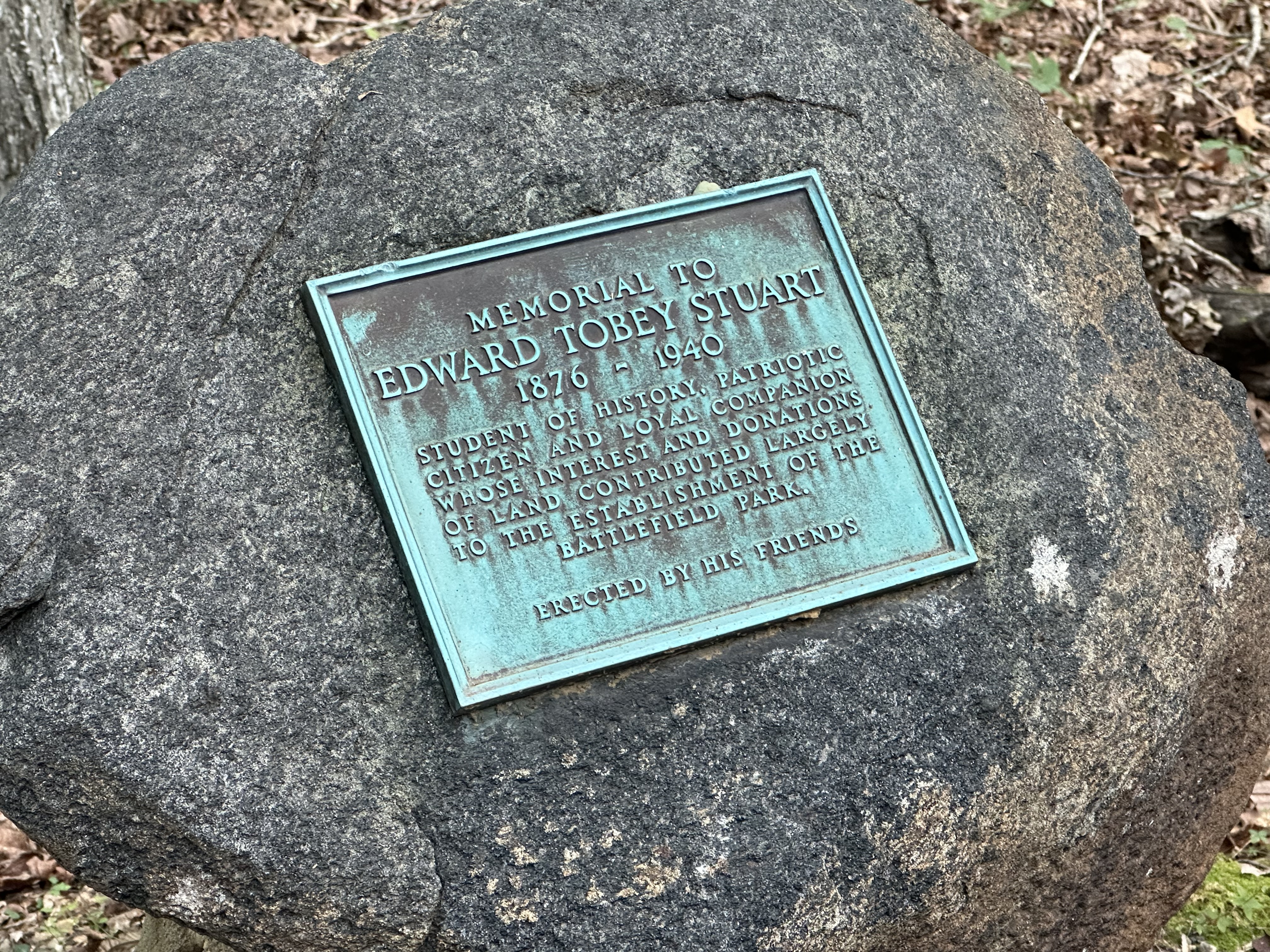
I particularly liked that Chris took us off the beaten path and into the woods to visit a little known and visited (and neglected) monument, pictured below.


Chris told us that Edward Tobey Stuart and his father were responsible for the original purchase of 130 acres at the battlefield, an acquisition intended to preserve it, well before it became a National Military Park.  He emphasized that it was the efforts of people like the Stuarts and those of us, who in a smaller way, contribute towards the preservation that is so important for the history of our country and the memory of those who fought there.  Over the past eight years our Roundtable has made $40,000 in donations to organizations like the American Battlefield Trust and the Central Virginia Batttlefields Trust which, with matching grants, has enabled the acquisition of more than $2.3 million in land parcels.

I plan on returning for the 11th symposium next year. 


Thursday, June 27, 2024

Caring For Each Other

File:Lucy Higgs Nichols Original.jpg

In a sea of white male faces in what looks like a late 19th century photo stands, in the center of the second row, a black woman.  What is going on here?  

The woman is Lucy Higgs Nichols, and the photo was taken Indiana in 1898.

Lucy Higgs, along with her very young daughter, escaped slavery in late June of 1862, traveling 30 miles before finding refuge with the 23rd Indiana Infantry Regiment near Bolivar, Tennessee.  She served with the regiment throughout the rest of the war as a nurse, cook, laundress, and forager, marching with the regiment in the Grand Review that took place in Washington DC in late May of 1865.  The 23rd saw hard fighting during the war, seeing action at Shiloh, the Vicksburg campaign, the Atlanta campaign, the March to the Sea, and on Sherman's Carolinas campaign.  Seventy two soldiers died in combat or from wounds, and 145 from disease.

The 1898 photo shows her with veterans of the 23rd, along with some veterans of the recent Spanish-American War.  They are celebrating the award of a $12 a month pension to Lucy, a pension obtained through the petitions of the regimental veterans.  Obtaining the pension became a national news story at the time.

Higgs was born into slavery in 1838.  The year after joining the 23rd, her daughter died during the Vicksburg siege and the regiment conducted her funeral.  At the invitation of the veterans, she returned with the regiment after the war to New Albany, Indiana, across the Ohio River from Louisville, Kentucky.  She worked for several of the officers and continued nursing sick veterans.  When she, in turn, became ill, the soldiers would nurse Lucy.  She was a member of the local Grand Army of the Republic (GAR) post(1), participating in all regimental reunions and marching in the annual Memorial Day parade. Among the former officers Lucy worked for was General Walter Gresham who commanded the 53rd Indiana during the war.  Gresham would go on to serve as Postmaster General in the cabinet of President Chester Arthur and as Secretary of State under President Grover Cleveland.  When Gresham's daughter married, Lucy, who by that time was considered a member of the family, attended the wedding in Chicago.

After the war, Lucy married John Nichols who had lived as a freedman in Tennessee before the war.  John passed in 1910 and Lucy Higgs Nichols died in 1915.

-------------------------------------------------

(1)  Though emancipation had occurred, there was still social segregation in much of the North.  However, recent research has revealed that most GAR posts admitted black veterans of the Civil War.  The shared experience of soldiering overcame the racial prejudice that existed in much of the Northern population.

Wednesday, April 10, 2024

What Was It About?

 Last week I had the pleasure of attending a lecture at Arizona State by Allen Guelzo, noted historian of Abraham Lincoln and the Civil War.  He is currently at Princeton University and previously taught at Gettysburg College.  The title of his lecture was "What Was the American Civil War Really About?".  Guelzo's thesis is that it was fundamentally about whether democratic representative government would survive and have a future.  He reminded us that, at the time, the United States was the only successful democracy in the world and that the leading powers in Europe were all eager to see its demise, with the odd exception of Russia.  Our country's survival was the most important outcome, regardless of the failure of Reconstruction.

This reminds me of the very misunderstood notion of American exceptionalism.  Exceptionalism does not mean wonderful or superior.  Exceptionalism was how the European powers saw the American nation when it was founded in the late 18th century.  The idea of a nation founded on a creedal document.  The motto on the seal of the United States is novus ordo seclorum ("a new order for the ages").  Foreigners recognized the new country and its people as something new and different.  Its pretentions to equality and democracy made America a strange, outrageous, and dangerous notion to a world of nations and empires based on monarchy and aristocracy.

Apart from its intellectual content, what was particularly striking about Guelzo was his eloquence, aided by a mellifluous broadcaster type voice.  Many of us were particularly amazed by the Q&A.  His response to questions, many of which were quite challenging, was astonishing well composed.  No ahs or ums.  No awkward pauses and he often pulled lengthy quotes from Lincoln letters and speeches seemingly with no effort.  During his talk and the Q&A he made reference to Lincoln's rhetorical techniques and I realized he was employing them himself, often adding humorous remarks.

I was invited to join some of the other attendees to have dinner with Prof Guelzo and was seated next to him and found him a wonderful dinner companion.  At the end of the dinner he engaged in another Q&A with us and it was as amazing as the one following the lecture.  Truly an extraordinary evening.


Tuesday, February 13, 2024

Great Moments In History

Going through my old books I came across Great Moments in History by Samuel Nisenson and Alfred Parker.  Published in 1932, Great Moments had been my mother's book (her maiden name is inscribed) and I remember reading, and loving, it as a child of 9 or 10.  It consists of 150 "Moments" described in one page, illustrated, and vividly written vignettes, beginning with The Exodus from Egypt (1285-1250 BC) and The First Olympic Games (776 BC) and concluding with Lindbergh's Transatlantic Flight (1927).  It is heavily weighted towards American history.

Samuel Nisenson wrote a series of similar books, primarily in the 1930s but continuing into the 1950s with titles like Minute Biographies, Minute Sketches of Great Composers, Great Moments in Catholic History, Great Moments in Baseball, History's 100 Greatest Events, and a 1934 biography of Franklin Roosevelt.

Written for general audiences and published by Grosset & Dunlap, one of the big publishing houses of the day, the books provide an insight into the America of that era.  I thought it would be interesting to see how and whether events related to race in America are portrayed almost a century ago.

One of the "Great Moments" is "The Introduction of Slavery in America: The Beginning of the Powerful Institution that was Nearly to Disrupt America" (August 1619), pictured below.  The narrative provides a pretty good summary of the origin and growth of slavery in the Western Hemisphere and concludes:

The spread of the institution of slavery had far-reaching and disastrous effects on the social history of the United States.  It created a sharp line of division between the northern manufacturers who did not need slaves and the southern planters who depended on them, a division that ultimately precipitated the American War Between the States in 1860.

Doesn't appear the authors had any doubts about the cause of the Civil War.

The next relevant Moment is in 1793, "The Invention of the Cotton Gin: The Remarkable Machine that Changed the History of America", pictured below.  We are given an account of the invention by Eli Whitney along with its impact on the economics of cotton.  This page concludes:

Between 1791 and 1801, the exports of cotton, now a cheap commodity, instead of a luxury, increased 100-fold, and slavery became an important industrial factor in the Southern states.  The South was soon a country of vast cotton plantations, while the slave system grew into a powerful institution that threatened to disrupt the Union and ultimately brought on the Civil War.

 The Capture of John Brown: The End of the Raid that Startled the Country! (Oct 18, 1859) is next up.

With the coming of the Civil War the next entry on the subject is"The Freeing of the Slaves: The Proclamation that made All Men Free and Equal in America!" (January 1, 1863), pictured below.

Unlike the prior entries, this narrative has serious flaws.  It states that Lincoln "freed all the slaves by his Emancipation Proclamation".  The effect of the Proclamation was much more limited, being restricted to slaves still held in areas controlled by the Confederacy on that date.  Non secessionist slave states, and slave holding areas already occupied by Union troop were not included.

The narrative concludes:

"Although the liberation of the Negroes at first threw the South into chaos, the gradual readjustment, after the war, placed the Negro on an equal footing with the White man and fulfilled the words of the Declaration of Independence that 'All Men are Created Equal'"

That is not what happened and, in the former slave states, the "readjustment" took the form of Jim Crow laws which began to be adopted in the final two decades of the 19th century.


The final Moment dealing with race in America is "The Reconstruction of the South" (1867-1876) and it goes badly awry.  We read of Northern "carpetbaggers", the Southern white "scalawags" who joined in their corrupt schemes, and government "completely into the hands of the Negroes".  It only ends when "the people finally rose and drove them out".  Once the states were readmitted "the Union was once more intact and a new industrial South replaced the broad plantation with its black slaves."

We find no mention of the Black Codes, instituted by southern states in 1865-66, or of the spree of violence by Whites against newly freed Blacks, actions which triggered the 1867 Reconstruction Act.


Great Moments in History was published in 1932 at the height of the influence of the Dunning School interpretation of the Civil War and Reconstruction.  William Dunning was a professor of history and political philosophy at Columbia University.  Extremely influential, Dunning taught and wrote that Reconstruction was a disaster, that freedmen were incapable of self-government, Blacks should not be allowed to vote or hold office, and segregation necessary; the military occupation of the South had been a mistake; and that the Reconstruction state governments had been corrupt and incompetent, a gross mischaracterization, particularly given the armed resistance they faced from recalcitrant Whites.  This caricature of reconstruction governments was prevalent for decades - I remember references to this in my middle school history book in the early 1960s, though by high school I think it was gone.

It is interesting that the greatest diversion between the text and the real history is in its most recent entry, illustrating the failure of post-Civil War America to find a way to assimilate Blacks at the same time it was successfully assimilating millions of immigrants.

This book was written during a period that some historians consider the nadir of the post-Civil War experience for Black Americans, the era between the World Wars (see Strange Fruit for more details), and it is a reflection of its times.

Monday, January 15, 2024

Catto

 An edited reprint of a prior Things Have Changed post

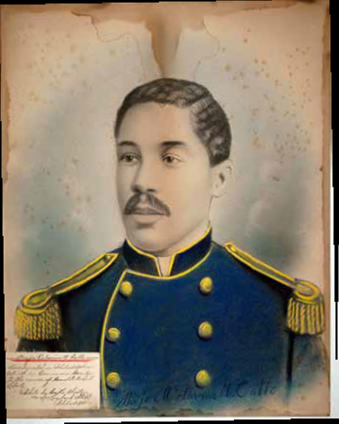
I've spent some time exploring the early history of professional baseball in America (I wrote about the origins of the pre-professional game in Madame Blatavsky and the Birth of Baseball).  The still-amateur game exploded in popularity in the Northeast and Midwest in the years after the Civil War with clubs being established in many cities and towns.  Coming across a discussion of the Pythian Base Ball Club of Philadelphia, a black ball team led by Octavius Catto, which mentioned that Catto died at the age of 32 in 1871 piqued my curiosity and I found a biography had been published at the website of the Society for American Baseball Research (SABR) Bioproject, which revealed Catto had been a significant public figure, known for much more than his baseball career.  More recently I've been making my way through a very long and very detailed biography of Catto, which exhaustively investigates his family background and race relations in Philadelphia, "Tasting Freedom: Octavius Catto and the Battle for Equality in Civil War America".  Catto's life and death are a reminder that while the white post-war South may have instituted legal (de jure) discrimination, and introduced a reign of terror to control the newly freed people, the de facto discrimination in Northern states also proved effective in resisting attempts at assimilation by blacks, sometimes with deadly consequences.

Octavius Catto

(Right, Catto from SABR Bioproject)

Catto was born in Charleston, South Carolina; his mother a free black woman and his father, born a slave but later freed by his master and becoming a Presbyterian minister.  In 1848 Reverend Catto moved his family to Philadelphia, the northern city with the largest black population, and during the 1850s young Octavius attended the Institute for Colored Youth (ICY), the city's only high school for blacks, where he was class valedictorian. In 1859 he was hired as a teacher at ICY in English, mathematics, Latin, and Greek.

During the Civil War, Catto actively led recruitment drives that raised several regiments of U.S. Colored Troops for the Union. With the end of the war he plunged into a leadership role, campaigning for passage of the 13th, 14th and 15th amendments, as well as undertaking direct actions, such as a campaign to allow blacks to ride on Philadelphia streetcars, which ultimately, with the help of his wife, succeeded.  The SABR biography provides a concise account of his impressive efforts to obtain full civil rights for the black community.

Even in baseball he was a pioneer, co-founding the Pythians in 1866 and becoming the team's star infielder.  According to the SABR biography:

". . . many of the players belonged to the Knights of Pythias Lodge, and thus they became the Pythians (derived from a mythical priestess at the Greek Temple of Apollo). Besides Catto, the Pythian leadership included other prominent blacks who emerged from Underground Railroad families. Club president James W. Purnell worked with abolitionists John Brown and Martin Delany, and vice president Raymond W. Burr was descended from American revolutionary Aaron Burr and was the son of a prominent black activist."

Catto saw baseball as promoting black self-improvement and an opportunity to press for integration.  In 1869 the Pythians played the first documented game between black and white teams, but while continuing to play such contests, the Pythian application to join the National Association of Base Ball Players was voted down.  Though, for a few years, black ball players were to occasionally play in the professional leagues, a firm color line was established by the late 1880s which remained in place until 1947 when Jackie Robinson joined the Brooklyn Dodgers.(1)

Catto led another campaign to get black voters to the polls in the Philadelphia mayoral election in 1871, despite white intimidation; the night before the election, two blacks were beaten and shot (one fatally), by whites.  The next day, Catto purchased a six-shot revolver and was on his way home to get the ammunition he had purchased when confronted by two white men who had been searching for him.  One of the men, Frank Kelly, pulled a revolver and shot Catto three times, killing him.  Kelly was eventually tried for murder, but despite the testimony of six eyewitnesses (three white and three black), all of whom stated the unprovoked Kelly shot Catto, he was acquitted by the all-white jury.

W.E.B. DuBois later wrote of Catto, 

"And so closed the career of a man of splendid equipment, rare force of character, whose life was so interwoven with all that was good about us, as to make it stand out in bold relief, as a pattern for those who have followed after.”

According to the SABR biography:

Even whites were outraged at Catto’s murder in his quest for civil rights. His funeral procession was the largest since Lincoln’s assassination and unprecedented for a black man. Over the three-mile route, tens of thousands of black and white Philadelphians watched in reverence for a fallen hero, as more than 125 carriages paraded by, containing Congressmen, military leaders, local politicians, students, colleagues, soldiers, ballplayers, and fellow civil rights activists.

Memory of Octavius Catto and his legacy faded over the years.  Over the past twenty years, he has received renewed recognition for his pioneering efforts.  In 2017, a 12-foot bronze statue of Catto was dedicated and erected in front of Philadelphia City Hall. 

------------------------------------------------------------

(1) The integration of Major League Baseball in April 1947, at a time when baseball was the most popular sport in America, was one of two significant events signaling a change in attitudes towards blacks in the late 1940s.  The other event was President Truman's July 1948 Executive Order mandating the desegregation of the military services.  For eight decades after the Civil War, white America resisted efforts by black Americans to assimilate into the life of this country, even while we were successfully assimilating millions of immigrants.  These two actions were turning points for America.

Sunday, November 19, 2023

Satchmo, Ruggles & Abe

Today marks 160 years since the dedication of the National Cemetery at Gettysburg and of President Abraham Lincoln's little speech.  Here are recitations by two glorious Americans, Louis Armstrong and Charles Laughton, the first born in Jim Crow New Orleans and who became a proud symbol of our country, the latter born in England, and who became an American citizen.

In The Archivist, we learned about Louis Armstrong's collection of tapes, recording whatever caught his broad interests.  In 1958, on a tape that included music from Count Basie, Coleman Hawkins, and a Bing Crosby/Bob Hope single, Armstrong recorded what he wrote as "Abraham Lincoln's Gettysburg Speech.  Narrated (by Louis Satchmo Armstrong)".  You can listen to it here.

Armstrong always maintained he was born on July 4.  While many researchers dispute this, I'm sticking with Louis.  

In 1935, Laughton played the role of an English butler transported to backwoods America in Ruggles of Red Gap.  As he learns about America he decides to strike out on his own.  This is the famous scene in which he recites the address.

Speaking of Laughton, I must recommend viewing the only film he directed, The Night of the Hunter.  Once seen, you will never forget it.


Four score and seven years ago our fathers brought forth on this continent, a new nation, conceived in Liberty, and dedicated to the proposition that all men are created equal.

Now we are engaged in a great civil war, testing whether that nation, or any nation so conceived and so dedicated, can long endure. We are met on a great battle-field of that war. We have come to dedicate a portion of that field, as a final resting place for those who here gave their lives that that nation might live. It is altogether fitting and proper that we should do this.

But, in a larger sense, we can not dedicate -- we can not consecrate -- we can not hallow -- this ground. The brave men, living and dead, who struggled here, have consecrated it, far above our poor power to add or detract. The world will little note, nor long remember what we say here, but it can never forget what they did here. It is for us the living, rather, to be dedicated here to the unfinished work which they who fought here have thus far so nobly advanced. It is rather for us to be here dedicated to the great task remaining before us -- that from these honored dead we take increased devotion to that cause for which they gave the last full measure of devotion -- that we here highly resolve that these dead shall not have died in vain -- that this nation, under God, shall have a new birth of freedom -- and that government of the people, by the people, for the people, shall not perish from the earth.

Abraham Lincoln
November 19, 1863


Tuesday, July 4, 2023

A Picnic On The Lawn

Several hundred people (some reports refer to thousands) turned out for the picnic on the lawn.  A platform had been erected for speakers, around which were arrayed rows of benches, well filled for most of the event.

Meanwhile groups reposed under every tree or walked to and fro along the shaded paths.  From the thick-leaved branches of the trees were suspended swings, of which all, both old and young, made abundant use.  Every contrivance which could add to the pleasure of the time was brought into energetic requisition, and altogether no celebration of the day presented a greater appearance of enjoyment and success.

A brass band played, while elsewhere on the lawn a choir sang, and tables were loaded with refreshments.

Sounds like fun, but there were also several unusual aspects to this picnic.

It was a fund-raiser for a Catholic congregation.

It was on the lawn of the White House.

It was July 4, 1864.

The Catholic congregation consisted of free blacks.

No one could remember an occasion when the White House grounds had been used for a private fund-raiser.

How did this come about?

Starting in early 1862, President Abraham Lincoln began receiving black citizens at the White House, and the pace of such receptions steadily increased over the remainder of his life.  These events are now documented in two recent books, A House Built By Slaves: African American Visitors to the Lincoln White House by Jonathan W White, and The Black Man's President: Abraham Lincoln, African Americans, & the Pursuit of Racial Equality by Michael Burlingam, about which I wrote in The Petition.

As word of the President's fair treatment of black delegations spread, more became emboldened to seek audiences with Lincoln.  On June 27, 1864 such a delegation met with the President.  A congregation of black Catholics had been meeting in the basement of St Matthews Church in the District, although they were denied access to its chapel.  The congregation needed to raise funds to build its own chapel and a school for children.  To this end a committee of three, led by cabinet maker Gabriel Coakley, entered the White House for its meeting. 

The committee had inquired of Commissioner of Public Buildings Benjamin French and discovered the White House grounds could only be used with permission of the President.  They asked Lincoln for permission to hold a fund raising event on the 4th and he gave them verbal approval.  When French issued the permit, Coakley presented it to the president on June 30 who signed it, "I assent/A Lincoln".

The picnic was a great success, raising $1,200 for the congregation.  The Philadelphia Inquirer reported of the day:

The entire colored population of Washington was out to-day with flags, music, &c, celebrating the Fourth by pic-nics, parades, &c.  A very large pic-nic was held by them in the public square between the White House and War Department.  They had colored bands, and colored speakers, and conducted themselves in a very orderly manner.

Not all publications were so complimentary.  Democratic papers in particular denounced the event.  From the Washington Constitutional Union:

The grounds, held by all patriots as something set apart and sacred, because invested with a national character, were prostituted and disgraced by the erection of stands for negro merchants to vend fruits and cakes and drinks to negro customers.

The paper went on to complain "these were negroes who did these things with the high approval and warm commendation of our president".

Not to be outdone, later that month the superintendent of the Third Colored Baptist Sabbath School asked for permission to conduct a fund-raising event described as a "demonstration of the appreciation of the colored people of the much-desired and highly appreciated privileges they are permitted to enjoy since the freeing of the slaves and abolishing of the black laws of the District of Columbia".  Permission was granted and the event held on August 4.

Wednesday, May 24, 2023

Ben Butler


The Scottsdale Civil War Roundtable ended its 2022-23 season with a special event; many members attending a performance of Ben Butler, a play presented at the Don Bluth Front Row Theatre.  The play is in the midst of an extended run at Don Bluth, and the theater made available discounted tickets to our group along with a special "talk back" session, at which, after the play's conclusion, the director, cast, and the playwright (who happened to be visiting that day), answered our questions.

Back at the beginning of the year, when one of our Board members approached me with the proposal to do this, explaining there was a play about Ben Butler and it had comic aspects, I was incredulous.  Ben Butler?  The incompetent Union general?  But I found that yes, indeed, it was about an incident involving Butler during the Civil War, and the play had garnered positive reviews.

My reaction was natural.  Ben Butler has a bad reputation.  Before the Civil War, Butler, a Massachusetts politician, was not only anti-abolitionist, he'd actually spoken in favor of slavery.  As a delegate to the 1860 Democratic Convention, he'd voted, ballot after ballot, for Jefferson Davis to be the party's presidential nominee.

However, he was a strong Unionist when secession occurred.  President Lincoln, desperate for Democratic support, appointed Butler as a general.  During the war he became notorious when as the general overseeing the occuption of the New Orleans area in 1862 he was accused of terrible conduct, including stealing silver spoons from wealthy Confederate supporters.  His generalship was generally poor, most notoriously in June 1864 when his incompetence resulted in the failure to capture Petersburg, Virginia, which, if successful, might have shortened the war by several months.  After another fiasco, Butler's failure to capture Fort Fisher, North Carolina, U.S. Grant was finally able to get Lincoln to agree to relieve him from his command.

By that time, Butler had become a Republican.  Elected to Congress, he led the prosecution in the 1868 impeachment trial of President Andrew Johnson.  Once again, many people then and now viewed his performance as incompetent.  Serving several terms, Butler played an important role in the passage of the Civil Rights Acts of 1871 and 1875 (the latter, the last enacted by Congress until 1957).

After several unsuccessful attempts to gain election as governor of Massachusetts until he changed parties once again, and was elected as a Democrat in 1882.

The play is centered on a specific incident in May 1861, one that casts Butler in a somewhat different light than many of his other actions.  The newly appointed general had just taken command of Fort Monroe, at the mouth of the James River in Virginia, when he was notified that three escaped slaves had entered the fort.  The slaves, Sheppard Mallory, Frank Baker, and James Townsend, had been employed by the Confederates in constructing fortifications for their planned assault on Fort Monroe.  Butler learned that a Major Carey was coming to the fort, under a flag of truce, to demand the return of the slaves.

At the beginning of the war the express policy of the Lincoln administration was not to interfere with slavery in the states where it was legal.  Moreover, the Fugitive Slave Act was, at least technically, still in force, and the three were the property of Colonel Mallory, serving in the rebel forces near the fort.  This was still 16 months before Lincoln announced the preliminary Emancipation Proclamation.  What was Butler to do?

Butler's solution was based on the general principles of the Laws of War, which allowed combatants to confiscate property declared as "contraband", most commonly materials used in the construction or support of military activities.  In this case, Butler refused to turn over the slaves to Carey on the grounds that they were "contraband" since they were being used to construct fortifications.  In his interpretation the slaves were the same as the shovels and axes they were using.  The enraged Carey left with his demands unsatisfied.

While Butler hoped to contain the fallout from his decision, within a couple of days 8 more escaped slaves reached the fort and a month later the total reached 500 (by end of the war the fort would receive more than 10,000 escapees).  Lincoln and his cabinet discussed Butler's decision and reasoning and decided to tacitly endorse it, though making no public announcement.  Nonetheless, across all theaters of the war escaped slaves began to be deemed contraband by Union commanders and set to work on constructing fortifications and supporting the federal army.  In 1862, Congress passed the first of its Confiscation Acts, providing legal support for Butler.

Butler also became an enthusiastic supporter for enlisting blacks as soldiers in the army and later, as mentioned, an advocate for civil rights.

The play Ben Butler takes this very serious moment and manages to deftly make its points with the use of comedy.  It is a very funny play that had all of us laughing uproariously at times.  There are only four roles, Butler, Mallory, Major Carey, and a fictional Union lieutenant.  The Don Bluth Theatre is in-the round, but the stage is not elevated, and there are only 74 seats, making for an intimate setting.  The cast was outstanding, and their performance successfully balanced the comic and the serious.  Everyone I spoke with loved the play and the performances.

We know little of the three escaped slaves beyond this incident.  Sheppard Mallory was regarded as the leader.  He was born around 1835, his wife was named Fanny (she later joined him at Fort Monroe).  They had several children and after the war the family remained in residence at Hampton Roads, near the fort.  Mallory died in 1924 at the age of 89.


Saturday, April 8, 2023

Custer's First Stand

In 2015 I did a series of posts covering the 150th anniversary of Lee's retreat from Richmond and Grant's pursuit.  From April 1 to April 12 you'll find daily posts at this link The Appomattox Campaign.  I'm reposting this one from the day before Lee's surrender.

Appomattox campaign - Wikipedia


The two armies raced to reach the "neck of the jug" at Appomattox.  For the Federals, General Phillip Sheridan assigned the task to his favorite subordinate, General George Armstrong Custer.

George Armstrong Custer is remembered today for his reckless decisions on June 25, 1876 when he decided, against orders, to have his 7th Cavalry Regiment attack a large Indian village along the Little Bighorn River in Montana.  Dividing his 600 trooper command into three detachments, Custer led 209 of his men along a high ridge overlooking the Indian encampment, which turned out to be the largest such gathering ever of the Plains Indians.  Custer and all his men would be dead within two hours and, six decades later, have the added ignominy of being subject to perhaps the least historically accurate, albeit very popular, Hollywood movie ever made (see They Died With Their Boots On).

The Custer of the Civil War is far less well known.  Born in 1839, Custer entered West Point in 1858 in the class of 1862 which, because of the outbreak of the Civil War, graduated a year early in 1861.  Custer ranked dead last academically in his class of 34, accumulating a then-record of 726 demerits for personal misconduct and coming near expulsion on several occasions.  With that record, and absent the war, Custer would have been assigned to some obscure frontier outpost.  Instead, he participated in the first Battle of Bull Run and was assigned to the staff of the Army of the Potomac.  Handling his assignments with alacrity and elan he quickly rose to command a brigade, becoming  Brigadier General of Volunteers on June 28, 1863.  He was 23 years old.
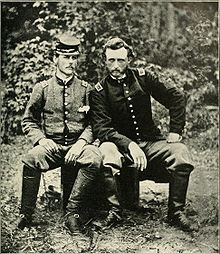
http://upload.wikimedia.org/wikipedia/commons/thumb/8/80/CusterandWashington01.jpg/220px-CusterandWashington01.jpg(Custer in 1862 with a former classmate captured by the Federals)
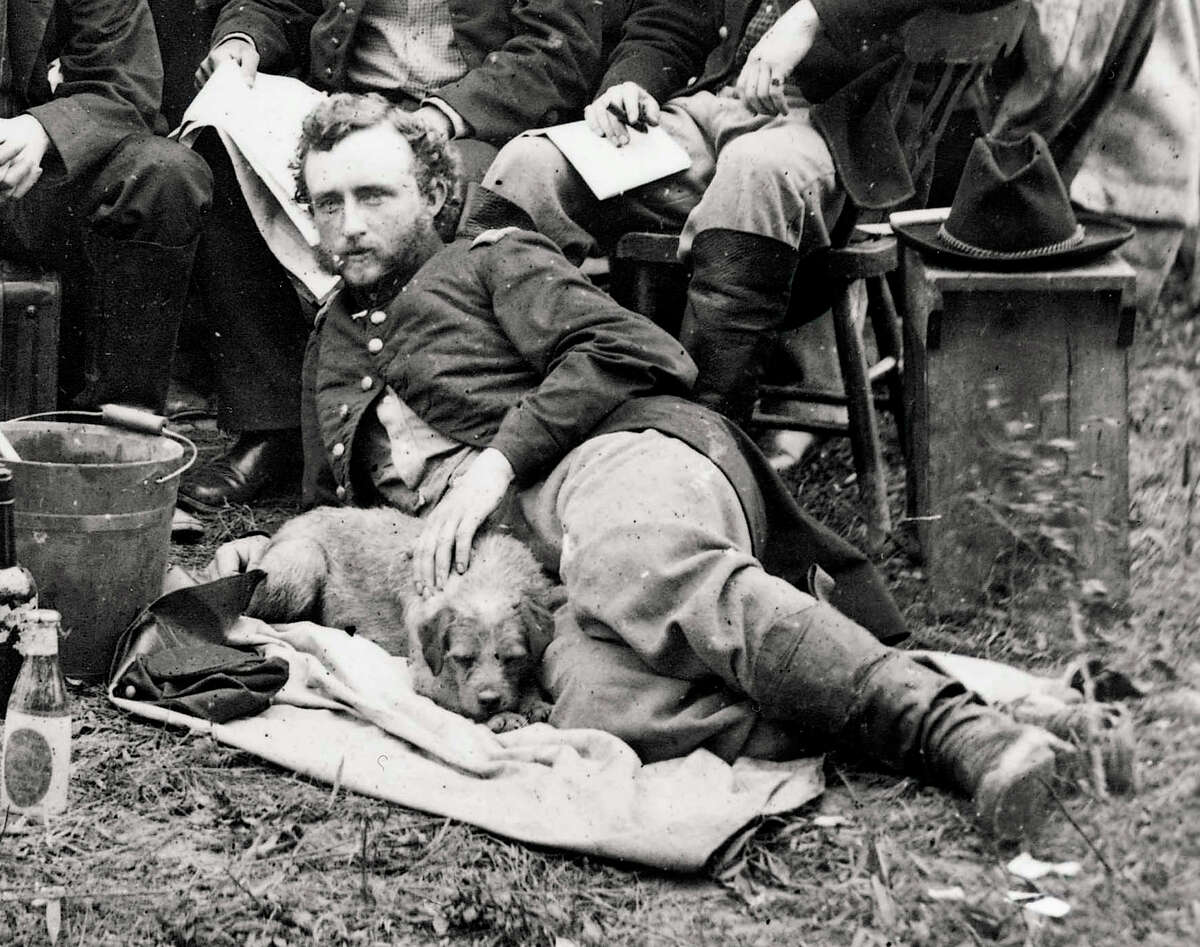
On the final day of the Battle of Gettysburg on July 3, 1863 he led his outnumbered brigade in a series of charges against the Confederate cavalry commanded by the famed and feared J.E.B. Stuart, thwarting his attack on the Union rear.  Throughout 1863 and 1864 he was successful in actions throughout Virginia and was promoted to command of a division in May 1864.  Later that year he helped destroy Jubal Early's army in the Shenandoah Valley.

Custer led his troops from the front and was solicitous of their welfare, a combination that made him very popular.  His aggressiveness made him a favorite of General Sheridan.  And he's all over the Appomattox Campaign.

McMurtry captures Custer as only he could

(Custer, with his dog) 

Custer played a key role at the battles of Dinwiddie Court House and Five Forks at the start of the campaign.  On April 3 it was Custer's division that defeated General Barringer (see General Barringer's Ride) at Namozine Church.  Two days later, his troops were part of the force blocking Lee's advance towards Jetersville and North Carolina.  The next day at Sailor's Creek, his division made the assault that broke the Confederate lines.  In that action, Custer captured Edward Porter Alexander's former artillery battalion commanded by Colonel Frank Huger.  Alexander wrote:

Custer & Huger had been great friends & class mates, & Custer made him ride along all day, & sleep with him that night, & treated him nicely.

For much of April 8, 1865 there was little contact between the armies.  Lee was north of the Appomattox River marching hard towards the neck of the jug, pursued by much of Grant's army.  Parallel to Lee, Sheridan's cavalry, led by Custer's division and trailed by General Ord's infantry was south of the river trying to reach Appomattox Station and Court House before the rebels.

Late that afternoon, Custer's troopers reached the Southside Railroad at Appomattox Station and captured a train with 300,000 rations intended for the hungry Confederate soldiers.  The rebel forces, mostly artillerymen, in the vicinity were startled to see Union troops in the area while most of Lee's army was still strung out on several miles of road to the east of Appomattox Court House.

After skirmishing, Custer ordered a full assault on the Confederates around 8pm under a full moon, scattering the enemy force and capturing 30 cannon and almost 1,000 prisoners.  Custer's division was now positioned directly in front of Lee's advancing army, blocking the only road to the west.  To locate Lee, Custer sent a unit under Colonel Augustus Root to Appomattox Court House.  Entering the village, they encountered Confederates and Root was killed in the fighting.

Lee knew that in the morning he would have to move west from the Court House and try to push aside Custer's cavalry.  But if the Federal infantry reached the field before that could be accomplished the game would be up for the Army of Northern Virginia.
____________________________________________________________________________
 

The plight of the Army of Northern Virginia was obvious to its general officers.  General Alexander recounts in his memoir that sometime on the 8th, several rebel generals conferred and "agreed that a speedy surrender was inevitable" and that they "thought it desirable that they should first suggest the necessity to Gen. Lee, that the blame or odium, if any, might be laid upon them instead of upon him".   Alexander reports that General Pendleton, who delivered the message to Lee, was "coldly received".

Despite Lee's rejection of his own officers suggestion of surrender, he and Grant continued their correspondence that day.  Grant sent a note:

Your note of last evening in reply to mine of the same date, asking the conditions on which I will accept the surrender of the Army of Northern Virginia, is just received.  In reply I would say that, peace being my great desire, there is but one condition I would insist upon, - namely, that the men and officers surrendered shall be disqualified for taking up arms against the Government of the United States until properly exchanged.  I will meet you, or will designate officers to meet any officers you may name for the same purpose, at any point agreeable to you, for the purpose of arranging definitely the terms upon which the surrender of the Army of Northern Virginia will be received.
Lee's response reached Grant around midnight:
I received at a late hour your note of today.  I did not intend to propose the surrender of the Army of Northern Virginia, but to ask the terms of your proposition.  To be frank, I do not think the emergency has arisen to call for the surrender of this army; but, as the restoration of peace should be the sole object of all, I desire to know whether your proposals would lead to that end.  I cannot therefore meet you with a view to surrender the Army of Northern Va., but, as far as your proposal may affect the Confederate States forces under my command, & tend to the restoration of peace, I should be pleased to meet you at 10 A.M. tomorrow on the old stage road to Richmond between the picket lines of the two armies.
Grant's Chief of Staff, General John Rawlins, upon reading Lee's note aloud, pronounced it "a positive insult" reminding the Union commander that he had no authority to meet with Lee to discuss the subject of a general peace, but the imperturbable Grant, echoing Lincoln's sentiments of April 4, responded that "Lee was only trying to be let down easily".

Tuesday, April 4, 2023

The Duty Of Preservation

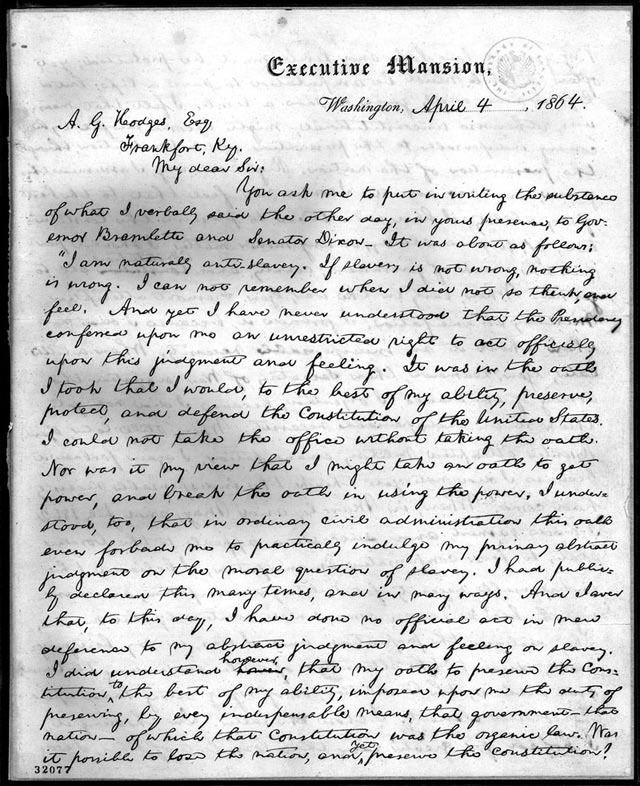
Letter to Hodges (1864) - Lincoln and Emancipation

On April 4, 1864 Abraham Lincoln wrote the letter below to Albert G Hodges.  The letter expresses the president's beliefs about the morality of slavery:

I am naturally anti-slavery.  If slavery is not wrong, nothing is wrong.

At the same time it set forth the constitutional constraints under which he believed he was obligated to act in accordance with:

And yet I have never understood that the Presidency conferred upon me an unrestricted right to act officially upon this judgement and feeling.
The letter arose from a meeting Lincoln had a couple of days before with Hodges, Governor Bramlette and Senator Dixon.  Bramlette was governor of Kentucky, Dixon a former senator from that state, and Hodges editor of the Frankfurt Commonwealth, the most influential paper in the state.  The meeting's purpose was for the Kentucky delegation to object to the recruitment of former slaves in that state into the Union army, a policy approved by the president.  Bramlette and Dixon, while supporters of the Union and opponents of secession, were not anti-slavery and offended by the prospect of black soldiers.

The importance of the letter resides first in the clear distinction Lincoln makes between his moral beliefs and his Constitutional authority as Chief Executive, a distinction I wish more politicians paid attention to.

The second important aspect is the question of what steps is it rightful for a president to take to preserve the Union.  Lincoln sets forth the issue: 

I did understand however, that my oath to preserve the Constitution to the best of my ability, imposed upon me the duty of preserving, by every indispensable means, that government – that nation – of which that constitution was the organic law. Was it possible to lose the nation, and yet preserve the Constitution? By general law life and limb must be protected; yet often a limb must be amputated to save a life; but a life is never wisely given to save a limb. I felt that measures, otherwise unconstitutional, might become lawful, by becoming indispensable to the preservation of the Constitution, through the preservation of the nation. Right or wrong, I assumed this ground, and now avow it. I could not feel that, to the best of my ability, I had even tried to preserve the Constitution, if, to save slavery, or any minor matter, I should permit the wreck of government, country, and Constitution all together.

Third, the president asserts that his decision was both necessitated by events (the failure of his proposal for compensated emancipation in the border states) and proven by the results: 

They declined the proposition; and I was, in my best judgment, driven to the alternative of either surrendering the Union, and with it, the Constitution, or of laying [a] strong hand upon the colored element. I chose the latter. In choosing it, I hoped for greater gain than loss; but of this, I was not entirely confident. More than a year of trial now shows no loss by it in our foreign relations, none in our home popular sentiment, none in our white military force, – no loss by it any how or anywhere. On the contrary, it shows a gain of quite a hundred and thirty thousand soldiers, seamen, and laborers. These are palpable facts, about which, as facts, there can be no caviling. We have the men; and we could not have had them without the measure.

Lincoln then challenges Hodges and his companions to contemplate where the Union would be without those 130,000 colored troops and laborers:

If he cannot face his case so stated, it is only because he cannot face the truth.

His final paragraph provides an early glimpse into the president's thinking on God's role in fulfilling a moral obligation and the costs entailed, a sentiment so memorably expressed in his Second Inaugural address in March 1865, a month before his murder.

I claim not to have controlled events, but confess plainly that events have controlled me. Now, at the end of three years’ struggle the nation’s condition is not what either party, or any man devised, or expected. God alone can claim it. Whither it is tending seems plain.If God now wills the removal of a great wrong, and wills also that we of the North as well as you of the South, shall pay fairly for our complicity in that wrong, impartial history will find therein new cause to attest and revere the justice and goodness of God.

The letter is a reminder of Lincoln's talents as a rhetorician and a politician.   His use of rhetoric makes disagreement difficult, while one must never forget that the president was not a philosopher but rather a practical politician, who was very careful to tailor his rhetoric to the specific needs of the moment.

---------------------------------------------------------------------------------

April 4, 1864

My dear Sir: You ask me to put in writing the substance of what I verbally said the other day, in your presence, to Governor Bramlette and Senator Dixon. It was about as follows:

“I am naturally anti-slavery. If slavery is not wrong, nothing is wrong. I can not remember when I did not so think, and feel. And yet I have never understood that the Presidency conferred upon me an unrestricted right to act officially upon this judgement and feeling. It was in the oath I took that I would, to the best of my ability, preserve, protect, and defend the Constitution of the United States. I could not take the office without taking the oath. Nor was it my view that I might take an oath to get power, and break the oath in using the power. I understood, too, that in ordinary civil administration this oath even forbade me to practically indulge my primary abstract judgement on the moral question of slavery. I had publicly declared this many times, and in many ways. And I aver that, to this day, I have done no official act in mere deference to my primary abstract judgement on the moral question of slavery. I did understand however, that my oath to preserve the Constitution to the best of my ability, imposed upon me the duty of preserving, by every indispensable means, that government – that nation – of which that constitution was the organic law. Was it possible to lose the nation, and yet preserve the Constitution? By general law life and limb must be protected; yet often a limb must be amputated to save a life; but a life is never wisely given to save a limb. I felt that measures, otherwise unconstitutional, might become lawful, by becoming indispensable to the preservation of the Constitution, through the preservation of the nation. Right or wrong, I assumed this ground, and now avow it. I could not feel that, to the best of my ability, I had even tried to preserve the Constitution, if, to save slavery, or any minor matter, I should permit the wreck of government, country, and Constitution all together. When, early in the war, Gen. Fremont attempted military emancipation, I forbade it, because I did not then think it an indispensable necessity. When a little later, Gen. Cameron, then Secretary of War, suggested the arming of the blacks, I objected, because I did not yet think it an indispensable necessity. When, still later, Gen. Hunter attempted military emancipation, I again forbade it, because I did not yet think the indispensable necessity had come. When, in March, and May, and July 1862 I made earnest, and successive appeals to the border states to favor compensated emancipation, I believed that the indispensable necessity for military emancipation, and arming the blacks would come, unless averted by that measure. They declined the proposition; and I was, in my best judgment, driven to the alternative of either surrendering the Union, and with it, the Constitution, or of laying [a] strong hand upon the colored element. I chose the latter. In choosing it, I hoped for greater gain than loss; but of this, I was not entirely confident. More than a year of trial now shows no loss by it in our foreign relations, none in our home popular sentiment, none in our white military force, – no loss by it any how or anywhere. On the contrary, it shows a gain of quite a hundred and thirty thousand soldiers, seamen, and laborers. These are palpable facts, about which, as facts, there can be no caviling. We have the men; and we could not have had them without the measure.

“And now let any Union man who complains of the measure, test himself by writing down in one line that he is for subduing the rebellion by force of arms; and in the next, that he is for taking these hundred and thirty thousand men from the Union side, and placing them where they would be but for the measure he condemns. If he cannot face his case so stated, it is only because he cannot face the truth.”

I add a word which was not in the verbal conversation. In telling this tale I attempt no compliment to my own sagacity. I claim not to have controlled events, but confess plainly that events have controlled me. Now, at the end of three years’ struggle the nation’s condition is not what either party, or any man devised, or expected. God alone can claim it. Whither it is tending seems plain. If God now wills the removal of a great wrong, and wills also that we of the North as well as you of the South, shall pay fairly for our complicity in that wrong, impartial history will find therein new cause to attest and revere the justice and goodness of God.

Yours truly,

A. Lincoln

Sunday, February 12, 2023

You Were Right, And I Was Wrong

On the 214th anniversary of Abraham Lincoln's birthday, we present the President's gracious letter to General Ulysses Grant on the successful conclusion of his campaign against Vicksburg.  Grant's daring campaign after taking Port Gibson and Grand Gulf was unprecedented, a Union army deliberately cutting itself off from its supply base.  Despite the doubts expressed by Lincoln at the time, Grant succeeded.  The President's letter is one of many examples of his extraordinary character.  Eight months later, Lincoln named Grant to take command of all Union forces.

Executive Mansion,
Washington, July 13, 1863.
Major General Grant
        My dear General
        I do not remember that you and I ever met personally. I write this now as a grateful acknowledgment for the almost inestimable service you have done the country. I wish to say a word further. When you first reached the vicinity of Vicksburg, I thought you should do, what you finally did—march the troops across the neck, run the batteries with the transports, and thus go below; and I never had any faith, except a general hope that you knew better than I, that the Yazoo Pass expedition, and the like, could succeed. When you got below, and took Port-Gibson, Grand Gulf, and vicinity, I thought you should go down the river and join Gen. Banks; and when you turned Northward East of the Big Black, I feared it was a mistake. I now wish to make the personal acknowledgment that you were right, and I was wrong.
        Yours very truly
                  A. Lincoln


Tuesday, November 29, 2022

Bates On Citizenship

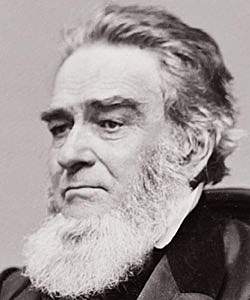
Edward Bates, seated, detail(Edward Bates, another Civil War guy with a beard)

On this date in 1862, Attorney General Edward Bates, an appointee of President Abraham Lincoln, issued an opinion on the following question:

Is a man legally incapacitated to be a citizen of the United States by the sole fact that he is a colored, and not a white man?

The Attorney General's opinion was prompted by an inquiry from Treasury Secretary Salmon Chase.  In turn, Chase's inquiry was triggered by an incident in which federal revenue cutter Tiger detained a schooner because it was commanded by a "colored man", in violation of a statute forbidding persons not citizens of the United States from such positions on American ships in the coasting trade.

The issue arose from a long history and specifically from Justice Taney's opinion in the Dred Scott case.  Generations of legal historians have argued about whether Taney's opinion was an actual holding of the Court, or merely dicta, without legal authority, because it went far beyond the decisional grounds which had resolved the case.  In any event, Taney's declaration that blacks, whether free or slave, could never be citizens of the United States, had practical and political impact.  At a practical level it led President Buchanan's State Department to cease issuing passports to free blacks, and politically it enraged abolitionists and others opposed to slavery, raising the specter that the Supreme Court could eventually force northern states to recognize slavery (read A Second Dred Scott Case? for those implications).

Let's start at the end of Bates' opinion where he brusquely dispatches Taney's opinion.

In this argument I raise no question upon the legal validity of the judgment in Scott vs. Sandford. I only insist that the judgment in that case is limited in law, as it is, in fact, limited on the face of the record, to the plea in abatement; and, consequently, that whatever was said in the long course of the case, as reported, (240 pages,) respecting the legal merits of the case, and respecting any supposed legal disability resulting from the mere fact of color, though entitled to all the respect which is due to the learned and upright sources' from which the opinions come, was ^^ dehors the record,^' and of no authority as a judicial decision.
With that, the Attorney General states with finality:

And now, upon the whole matter, I give it as my opinion that the free man of color mentioned in your letter, if born in the United States, is a citizen of the United States, and, if otherwise qualified, is competent, according to the acts of Congress, to be master of a vessel engaged in the coasting trade.

The path Bates follows to his conclusion is of interest as a matter of legal reasoning, the historical circumstances, and as reflecting commonly held views of blacks by whites, even by those who were against slavery.

Bates starts by noting an immediate problem - the lack of a "clear and satisfactory definition" of "citizen of the United States", and that most cases and opinions dealing with citizenship had "not turned upon the existence and the intrinsic qualities of citizenship itself, but upon the claim of some right or privilege as belonging to and inhering in the character of citizen."

In reading his opinion we must remember that in 1862 we are in a period before the adoption of the 14th  Amendment and the establishment of a citizen of the United States as a uniform federal proposition.  In 1862, citizenship was defined state by state.

Some claimed that the right to vote or hold office, as defined by each state, was an essential element of citizenship.  Bates dismisses this notion, "No more in the case of a negro than in case of a white woman or child".

In the Attorney General's view:

In my opinion the Constitution uses the word citizen only to express the political quality of the individual in his relations to the nation; to declare that he is a member of the body politic, and bound to it by the reciprocal obligation of allegiance on the one side and protection on the other. 

In a long passage, Bates acknowledges the practical realities where most blacks are, in fact, slaves, and its impact on thinking about citizenship.

It occurs to me that the discussion of this great subject of national citizenship has been much embarrassed and obscured by the fact that it is beset with artificial difficulties, extrinsic to its nature, and having little or no relation to its great political and national characteristics. And these difficulties, it seems to me, flow mainly from two sources. First, the existence among us of a large class of people whose physical qualities visibly distinguish them from the mass of our people, and mark a different race, and who, for the most part, are held in bondage. This visible difference and servile connection present difficulties hard to be conquered ; for they unavoidably lead to a more complicated system of government, both legislative and administrative, than would be required if all our people were of one race, and undistinguishable by outward signs. And this, without counting the effect upon the opinions, passions, and prejudices of men.

After writing that;

I have said that, prima facie every person in this country is born a citizen; and that he who denies it in individual cases assumes the burden of stating the exception to the general rule, and proving the fact which works the disfranchisement; 

Bates goes on to discuss specifically whether slavery, color, or race constitute such exceptions.

As to slavery, "whether or not it is legally possible for a slave to be a citizen" is not within the scope of the question Bates is answering, which concerns a free person of color.

As to color, the Constitution contains "not one word on this subject", and goes on;

It has never been so understood nor put into practice in the nation from which we derive our language, laws, and institutions, and our very morals and modes of thought ; and, as far as I know, there is not a single nation in Christendom which does not regard the new-found idea with incredulity, if not disgust. What can there be in the mere color of a man (we are speaking now not of race but of color only) to disqualify him for bearing true and faithful allegiance to his native country, and for demanding the protection of that country? 

From a modern perspective there are two aspects that stand out in this section.  First is the distinction being made between race and color.  Second is the concept that color as a disqualifier is a "new-found idea". 

It's the discussion of race that Bates spends the most time on, and it is here that he makes clear the distinction that some make between color and race.

There are some who, abandoning the untenable objection of color, still contend that no person descended from negroes of the African race can be a citizen of the United States. Here the objection is not to color, but race only. The individual objected to may be of very long descent from African negroes, and may be as white as leprosy, or as the intermixture for many generations with the Caucasian race can make him; still, if he can be traced back to negroes of the African race, he cannot, they say, be a citizen of the United States!

This is the Attorney General's response: 

Our nationality was created and our political government exists by written law, and inasmuch as that law does not exclude persons of that descent, and as its terms are manifestly broad enough to include them, it follows inevitably that such persons, born in the country, must be citizens, unless the fact of African descent be so incompatible with the fact of citizenship that the two cannot exist together. If they can coexist, in nature and reason, then they do coexist in persons of the indicated class, for there is no law to the contrary. I am not able to perceive any antagonism, legal or natural, between the two facts.

The opinion goes on to discuss state constitutions and some state court cases on citizenship and also addresses several other arguments against negro citizenship, one of which is that if negroes can be citizens, one might be elected President!  Bates dismisses that argument:

 . . . those who make that objection are not arguing upon the Constitution as it is, but upon what, in their own minds and feelings, they think it ought to be.

It is useful to understand the timing and historical circumstances surrounding the Bates opinion as well as his own background.

The opinion was issued on November 29, 1862.  Lincoln had issued the preliminary Emancipation Proclamation on September 22 and would issue the final version on January 1, 1863.   Though the Proclamation only impacted slaves in areas still held by the Confederacy it was part of a larger move, often prompted by Congress, to deal with slaves who had escaped into Union lines.  Regardless of intentions when the war began in 1861, the inexorable logic of events was drawing Congress and the Administration down the road of not just ending slavery everywhere in the country under the 13th Amendment but of creating national citizenship, intended to include all regardless of color and the extension of voting rights to black males, done by the 14th and 15th Amendments.

Edward Bates was not an advocate of social equality for blacks.  Born into a Virginia slave holding family, he moved to Missouri after the War of 1812.  Bates became the first state attorney general after Missouri was admitted to the Union in 1820 and went on to serve many years in the state legislature.  Politically he was a Whig, but joined the Republican Party after the passage of the Kansas-Nebraska bill in 1854 (the same bill which caused Abraham Lincoln to become politically active again).  

Though Bates opposed slavery, freeing his last slaves in 1851 and paying for their passage to Liberia, he was not an abolitionist.  At the 1860 Republican convention he, along with Lincoln, Chase, and Seward, was a candidate for the presidential nomination.  After his election, Lincoln asked all three of his competitors to join his cabinet.  Although he supported Lincoln in his wartime actions and in the issuance of the Emancipation Proclamation, Bates remained hesitant about the role freed blacks should play in American society.  He opposed Lincoln's initiative to allow blacks to join the Union army and I have been unable to determine whether he supported the extension of voting rights to male blacks.  Finding himself increasingly at odds with the President, Bates resigned his cabinet post in December 1864 and died in 1869.