Showing posts with label Appomattox Campaign. Show all posts

Saturday, April 8, 2023

Custer's First Stand

In 2015 I did a series of posts covering the 150th anniversary of Lee's retreat from Richmond and Grant's pursuit.  From April 1 to April 12 you'll find daily posts at this link The Appomattox Campaign.  I'm reposting this one from the day before Lee's surrender.

Appomattox campaign - Wikipedia


The two armies raced to reach the "neck of the jug" at Appomattox.  For the Federals, General Phillip Sheridan assigned the task to his favorite subordinate, General George Armstrong Custer.

George Armstrong Custer is remembered today for his reckless decisions on June 25, 1876 when he decided, against orders, to have his 7th Cavalry Regiment attack a large Indian village along the Little Bighorn River in Montana.  Dividing his 600 trooper command into three detachments, Custer led 209 of his men along a high ridge overlooking the Indian encampment, which turned out to be the largest such gathering ever of the Plains Indians.  Custer and all his men would be dead within two hours and, six decades later, have the added ignominy of being subject to perhaps the least historically accurate, albeit very popular, Hollywood movie ever made (see They Died With Their Boots On).

The Custer of the Civil War is far less well known.  Born in 1839, Custer entered West Point in 1858 in the class of 1862 which, because of the outbreak of the Civil War, graduated a year early in 1861.  Custer ranked dead last academically in his class of 34, accumulating a then-record of 726 demerits for personal misconduct and coming near expulsion on several occasions.  With that record, and absent the war, Custer would have been assigned to some obscure frontier outpost.  Instead, he participated in the first Battle of Bull Run and was assigned to the staff of the Army of the Potomac.  Handling his assignments with alacrity and elan he quickly rose to command a brigade, becoming  Brigadier General of Volunteers on June 28, 1863.  He was 23 years old.
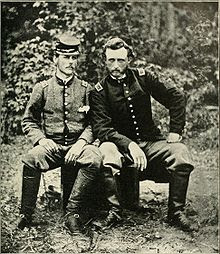
http://upload.wikimedia.org/wikipedia/commons/thumb/8/80/CusterandWashington01.jpg/220px-CusterandWashington01.jpg(Custer in 1862 with a former classmate captured by the Federals)

On the final day of the Battle of Gettysburg on July 3, 1863 he led his outnumbered brigade in a series of charges against the Confederate cavalry commanded by the famed and feared J.E.B. Stuart, thwarting his attack on the Union rear.  Throughout 1863 and 1864 he was successful in actions throughout Virginia and was promoted to command of a division in May 1864.  Later that year he helped destroy Jubal Early's army in the Shenandoah Valley.

Custer led his troops from the front and was solicitous of their welfare, a combination that made him very popular.  His aggressiveness made him a favorite of General Sheridan.  And he's all over the Appomattox Campaign.
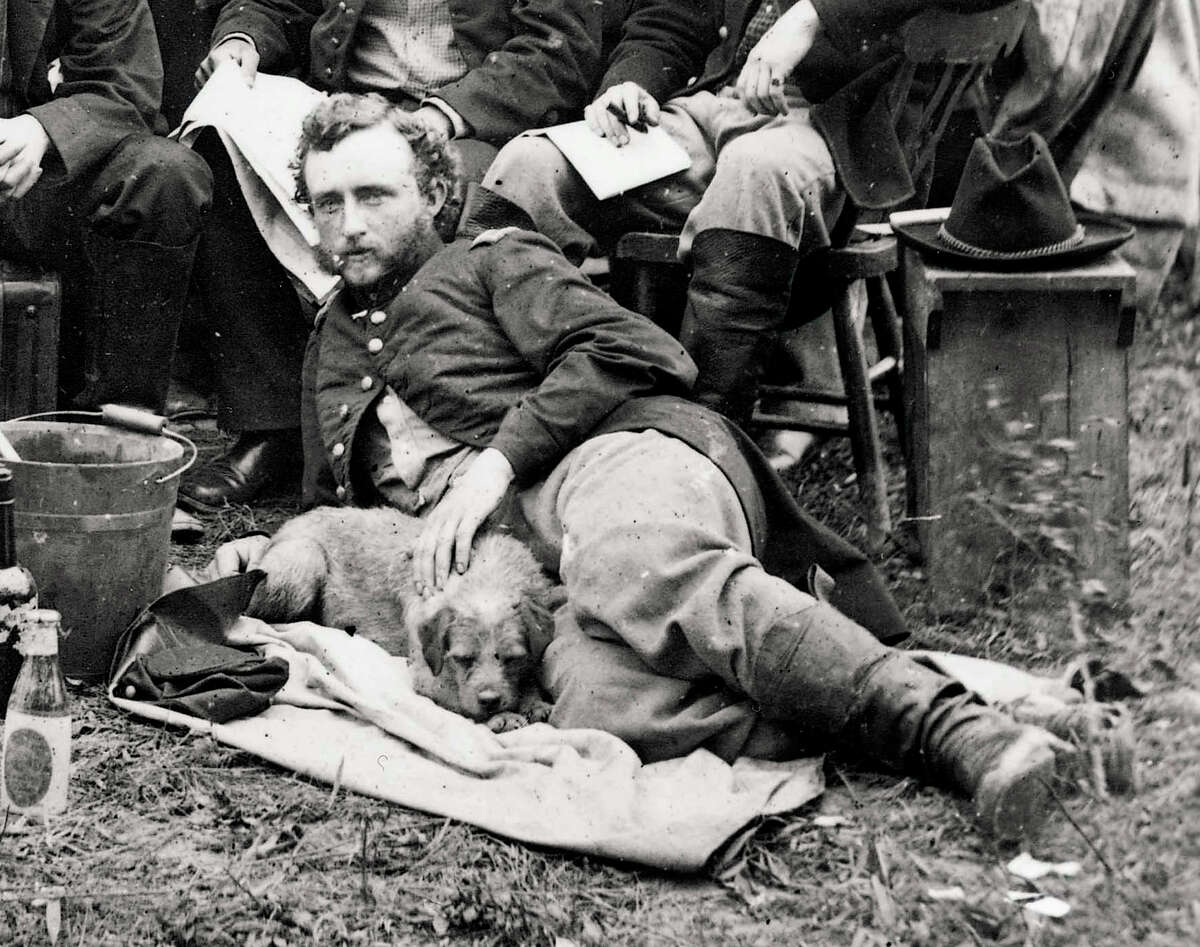
McMurtry captures Custer as only he could

(Custer, with his dog) 

Custer played a key role at the battles of Dinwiddie Court House and Five Forks at the start of the campaign.  On April 3 it was Custer's division that defeated General Barringer (see General Barringer's Ride) at Namozine Church.  Two days later, his troops were part of the force blocking Lee's advance towards Jetersville and North Carolina.  The next day at Sailor's Creek, his division made the assault that broke the Confederate lines.  In that action, Custer captured Edward Porter Alexander's former artillery battalion commanded by Colonel Frank Huger.  Alexander wrote:

Custer & Huger had been great friends & class mates, & Custer made him ride along all day, & sleep with him that night, & treated him nicely.

For much of April 8, 1865 there was little contact between the armies.  Lee was north of the Appomattox River marching hard towards the neck of the jug, pursued by much of Grant's army.  Parallel to Lee, Sheridan's cavalry, led by Custer's division and trailed by General Ord's infantry was south of the river trying to reach Appomattox Station and Court House before the rebels.

Late that afternoon, Custer's troopers reached the Southside Railroad at Appomattox Station and captured a train with 300,000 rations intended for the hungry Confederate soldiers.  The rebel forces, mostly artillerymen, in the vicinity were startled to see Union troops in the area while most of Lee's army was still strung out on several miles of road to the east of Appomattox Court House.

After skirmishing, Custer ordered a full assault on the Confederates around 8pm under a full moon, scattering the enemy force and capturing 30 cannon and almost 1,000 prisoners.  Custer's division was now positioned directly in front of Lee's advancing army, blocking the only road to the west.  To locate Lee, Custer sent a unit under Colonel Augustus Root to Appomattox Court House.  Entering the village, they encountered Confederates and Root was killed in the fighting.

Lee knew that in the morning he would have to move west from the Court House and try to push aside Custer's cavalry.  But if the Federal infantry reached the field before that could be accomplished the game would be up for the Army of Northern Virginia.
____________________________________________________________________________
 

The plight of the Army of Northern Virginia was obvious to its general officers.  General Alexander recounts in his memoir that sometime on the 8th, several rebel generals conferred and "agreed that a speedy surrender was inevitable" and that they "thought it desirable that they should first suggest the necessity to Gen. Lee, that the blame or odium, if any, might be laid upon them instead of upon him".   Alexander reports that General Pendleton, who delivered the message to Lee, was "coldly received".

Despite Lee's rejection of his own officers suggestion of surrender, he and Grant continued their correspondence that day.  Grant sent a note:

Your note of last evening in reply to mine of the same date, asking the conditions on which I will accept the surrender of the Army of Northern Virginia, is just received.  In reply I would say that, peace being my great desire, there is but one condition I would insist upon, - namely, that the men and officers surrendered shall be disqualified for taking up arms against the Government of the United States until properly exchanged.  I will meet you, or will designate officers to meet any officers you may name for the same purpose, at any point agreeable to you, for the purpose of arranging definitely the terms upon which the surrender of the Army of Northern Virginia will be received.
Lee's response reached Grant around midnight:
I received at a late hour your note of today.  I did not intend to propose the surrender of the Army of Northern Virginia, but to ask the terms of your proposition.  To be frank, I do not think the emergency has arisen to call for the surrender of this army; but, as the restoration of peace should be the sole object of all, I desire to know whether your proposals would lead to that end.  I cannot therefore meet you with a view to surrender the Army of Northern Va., but, as far as your proposal may affect the Confederate States forces under my command, & tend to the restoration of peace, I should be pleased to meet you at 10 A.M. tomorrow on the old stage road to Richmond between the picket lines of the two armies.
Grant's Chief of Staff, General John Rawlins, upon reading Lee's note aloud, pronounced it "a positive insult" reminding the Union commander that he had no authority to meet with Lee to discuss the subject of a general peace, but the imperturbable Grant, echoing Lincoln's sentiments of April 4, responded that "Lee was only trying to be let down easily".

Sunday, April 12, 2015

We Suffered No Insult In Any Way

The Appomattox Campaign
http://www.civilwar.org/photos/galleries/appomattox-court-house/images/last-salute.jpg(from Civil war.org)

April 12 was the appointed day for the formal surrender of the last and largest component of the Army of Northern Virginia, the infantry.

Before leaving Appomattox, U.S. Grant appointed General Joshua Chamberlain of Maine to receive the surrender on behalf of the Union army giving him instruction that "the ceremony to be as simple as possible, and that nothing should be done to humiliate the manhood of the Southern soldiers".

Chamberlain, one of the many heroes of Gettysburg (for others see The Last Full Measure and Forgotten Americans: George Sears Green), received a battlefield promotion to General at Petersburg in June 1864 after receiving a wound that was thought to be fatal.  It did indeed prove so, but not until 1914 when he suffered an infection related to the wound and was treated by the same doctor who had saved his life fifty years before (for more on Chamberlain's life see In Great Deeds Something Abides).

To conduct the Confederate surrender Lee selected General John B Gordon of Georgia, one of his best division commanders (and later to be Senator and Governor in Georgia, along with possibly being one of the leaders of the newly-formed Klu Klux Klan).
http://www.georgiaencyclopedia.org/sites/default/files/styles/article-gallery/public/m-6736.jpg?itok=oFNIgLW8(John Gordon)

The final ceremony began at 6 A.M. and it took nearly ten hours for all the Confederates to march by and stack arms.  Let's listen to the glorious 19th century prose of General Chamberlain, which made him such a popular commemoration speaker for decades, describing the surrender (from Bayonet! Forward):
It was now the morning of the 12th of April . . .

We formed . . .  to face the last line of battle, and receive the last remnant of the arms and colors of that great army ours had been created to confront for all that death can do to life.  We were remnants also . . . veterans, and replaced veterans; cut to pieces, cut down, consolidated, divisions into brigades . . . men of near blood born, made nearer by blood shed.  Those facing us - now thank God, the same.

Our earnest eyes scan the busy groups on the opposite slopes, breaking camp for the last time - taking down their little shelter-tents and folding them carefully, as precious things, then slowly forming ranks as for unwelcome duty.  And now they move.  The dusky swarms forge forward into gray columns of march.  On they come, with the old swinging route step, and swaying battle-flags.

. . . when the head of each division column comes opposite our group, our bugle sounds the signal and instantly our whole line from right to left, regiment by regiment in succession, gives the soldier's salutation, - from the "order arms" to the old "carry" - the marching salute.  Gordon at the head of the column, riding with heavy spirit and downcast face, catches the sounds of shifting arms, looks up, and, taking the meaning, wheels superbly, making with himself and his horse one uplifted figure, with profound salutation as he drops the point of his sword to the boot toe; then facing to his own command, gives word for his successive brigades to pass us with the same position of manual, honor answering honor.  On our part not a sound of trumpet more, nor roll of drum; not a cheer, nor word nor whisper of vain-glorying, nor motion of man standing again at the order; but an awed stillness rather and breath-holding as if it were the passing of the dead!
http://upload.wikimedia.org/wikipedia/commons/d/db/Joshua_Chamberlain_-_Brady-Handy.jpg (Joshua Chamberlain)

Now, it needs to be noted that Chamberlain was a renowned speaker for decades after the war and many of his stories grew in the repeated tellings.  The specifics of the gallantry of the surrender ceremony were, in reality, exaggerated in his tale but it's still a good story and in full accord with The Official Policy Of This Blog.

In Calkins' The Appomattox Campaign he quotes a Southern soldier:
We suffered no insult in any way from any of our enemies.  No other army in the world would have been so considerate of a foe that it had taken so long, so much privation, so much sacrifice of human life, to overwhelm.
EP Alexander left Appomattox that morning, riding to Richmond with a mixed group of Confederate and Union officers, including a United States Senator from Illinois.  Returning to his home in Georgia, he took a job teaching mathematics at the University of South Carolina before becoming a railroad executive.  Alexander became friends with President Grover Cleveland who in 1897 appointed him as arbiter in a boundary dispute between Nicaragua and Costa Rica which led to him living in Nicaragua for two years.

Returning to the U.S. he published the well-regarded Military Memoirs of a Confederate (1907), an  academic-style work of military history and analysis, and lectured at West Point before dying in 1910.

It was only decades later that historians researching his personal papers housed at the University of North Carolina realized that during his time in Central America, Alexander had written a much more personal and critical history of the Army of Northern Virginia, which was embedded in scattered form among his papers.  Reassembling and editing these paper took some time and Fighting For The Confederacy: The Personal Recollections of General Edward Porter Alexander was not published until 1989.   It is unusual among general officer memoirs of the Civil War in that it provides full and balanced portraits of the principals, even criticizing Robert E Lee, a man held in the highest esteem by Alexander.  Along with Grant's Personal Memoirs it represents the best of such writing.

Joshua Chamberlain later wrote of watching the remaining Confederates break camp the next morning:
. . . the morning of the 13th, we could see the men, singly or in squads, making their way slowly into the distance, in whichever direction was nearest home, and by nightfall we were left there at Appomattox Courthouse lonesome and alone.
It was over.


Saturday, April 11, 2015

Hope Of A Righteous And Speedy Peace


http://www.whitehousemuseum.org/images/white-house-north-face-c1853.jpg
The Appomattox Campaign

On the evening of April 11, four days after returning from City Point and two days after hearing the news of Lee's surrender, Abraham Lincoln speaks from a second floor balcony on the north side of the White House.  To the crowd gathered below, the President talks briefly about his thoughts on reconstruction for the seceeding states, focusing on the recent case of Louisiana.  It is his only public address between Lee's surrender and his own death three days hence.

The President starts by noting that the surrender two days prior of the "principal insurgent army, give hope of a righteous and speedy peace whose joyous expression can not be restrained".  He then passes on to the thorny issue of reconstruction and addresses criticism of his approach to the proposed reconstruction of Louisiana.

The pragmatism of Lincoln shows in his remarks regarding those who express disappointment that his mind does not appear firm on how reconstruction is to be implemented:
I have been shown a letter on this subject, supposed to be an able one, in which the writer expresses regret that my mind has not seemed to be definitely fixed on the question whether the seceding States, so called, are in the Union or out of it. It would perhaps, add astonishment to his regret, were he to learn that since I have found professed Union men endeavoring to make that question, I have purposely forborne any public expression upon it. As appears to me that question has not been, nor yet is, a practically material one, and that any discussion of it, while it thus remains practically immaterial, could have no effect other than the mischievous one of dividing our friends. As yet, whatever it may hereafter become, that question is bad, as the basis of a controversy, and good for nothing at all--a merely pernicious abstraction.
His advice against premature expression on questions that are still abstractions is something that should be remembered by all politicians.

In the course of discussing Louisiana, the President comments on voting rights for "the colored man".
It is also unsatisfactory to some that the elective franchise is not given to the colored man. I would myself prefer that it were now conferred on the very intelligent, and on those who serve our cause as soldiers.
Among those listening to the speech is John Wilkes Booth, who has spent the last several months organizing a plot originally to kidnap the President and spirit him to Richmond, a plot which, with the collapse of the Confederacy, has now mutated into a plan for assassination.  Upon hearing Lincoln endorse enfranchisement for some colored men, an enraged Booth turns to one of his co-conspirators and says: "That is the last speech he will make".
Image(Lincoln, April 11 from pogues. com)
________________________________________________________________________
That day at Appomattox Court House, in the midst of a pouring rain, 2,576 artillerymen surrendered and gave their parole.

Full Text of Remarks by Abraham Lincoln; April 11, 1865

We meet this evening, not in sorrow, but in gladness of heart. The evacuation of Petersburg and Richmond, and the surrender of the principal insurgent army, give hope of a righteous and speedy peace whose joyous expression can not be restrained. In the midst of this, however, He from whom all blessings flow, must not be forgotten. A call for a national thanksgiving is being prepared, and will be duly promulgated. Nor must those whose harder part gives us the cause of rejoicing, be overlooked. Their honors must not be parcelled out with others. I myself was near the front, and had the high pleasure of transmitting much of the good news to you; but no part of the honor, for plan or execution, is mine. To Gen. Grant, his skilful officers, and brave men, all belongs. The gallant Navy stood ready, but was not in reach to take active part.

By these recent successes the re-inauguration of the national authority -- reconstruction -- which has had a large share of thought from the first, is pressed much more closely upon our attention. It is fraught with great difficulty. Unlike a case of a war between independent nations, there is no authorized organ for us to treat with. No one man has authority to give up the rebellion for any other man. We simply must begin with, and mould from, disorganized and discordant elements. Nor is it a small additional embarrassment that we, the loyal people, differ among ourselves as to the mode, manner, and means of reconstruction.

As a general rule, I abstain from reading the reports of attacks upon myself, wishing not to be provoked by that to which I can not properly offer an answer. In spite of this precaution, however, it comes to my knowledge that I am much censured for some supposed agency in setting up, and seeking to sustain, the new State government of Louisiana. In this I have done just so much as, and no more than, the public knows. In the Annual Message of Dec. 1863 and accompanying Proclamation, I presented a plan of re-construction (as the phrase goes) which, I promised, if adopted by any State, should be acceptable to, and sustained by, the Executive government of the nation. I distinctly stated that this was not the only plan which might possibly be acceptable; and I also distinctly protested that the Executive claimed no right to say when, or whether members should be admitted to seats in Congress from such States. This plan was, in advance, submitted to the then Cabinet, and distinctly approved by every member of it. One of them suggested that I should then, and in that connection, apply the Emancipation Proclamation to the theretofore excepted parts of Virginia and Louisiana; that I should drop the suggestion about apprenticeship for freed-people, and that I should omit the protest against my own power, in regard to the admission of members to Congress; but even he approved every part and parcel of the plan which has since been employed or touched by the action of Louisiana.

The new constitution of Louisiana, declaring emancipation for the whole State, practically applies the Proclamation to the part previously excepted. It does not adopt apprenticeship for freed-people; and it is silent, as it could not well be otherwise, about the admission of members to Congress. So that, as it applies to Louisiana, every member of the Cabinet fully approved the plan. The message went to Congress, and I received many commendations of the plan, written and verbal; and not a single objection to it, from any professed emancipationist, came to my knowledge, until after the news reached Washington that the people of Louisiana had begun to move in accordance with it. From about July 1862, I had corresponded with different persons, supposed to be interested, seeking a reconstruction of a State government for Louisiana. When the message of 1863, with the plan before mentioned, reached New-Orleans, Gen. Banks wrote me that he was confident the people, with his military co-operation, would reconstruct, substantially on that plan. I wrote him, and some of them to try it; they tried it, and the result is known. Such only has been my agency in getting up the Louisiana government. As to sustaining it, my promise is out, as before stated. But, as bad promises are better broken than kept, I shall treat this as a bad promise, and break it, whenever I shall be convinced that keeping it is adverse to the public interest. But I have not yet been so convinced.

I have been shown a letter on this subject, supposed to be an able one, in which the writer expresses regret that my mind has not seemed to be definitely fixed on the question whether the seceding States, so called, are in the Union or out of it. It would perhaps, add astonishment to his regret, were he to learn that since I have found professed Union men endeavoring to make that question, I have purposely forborne any public expression upon it. As appears to me that question has not been, nor yet is, a practically material one, and that any discussion of it, while it thus remains practically immaterial, could have no effect other than the mischievous one of dividing our friends. As yet, whatever it may hereafter become, that question is bad, as the basis of a controversy, and good for nothing at all--a merely pernicious abstraction.

We all agree that the seceded States, so called, are out of their proper relation with the Union; and that the sole object of the government, civil and military, in regard to those States is to again get them into that proper practical relation. I believe it is not only possible, but in fact, easier to do this, without deciding, or even considering, whether these States have ever been out of the Union, than with it. Finding themselves safely at home, it would be utterly immaterial whether they had ever been abroad. Let us all join in doing the acts necessary to restoring the proper practical relations between these States and the Union; and each forever after, innocently indulge his own opinion whether, in doing the acts, he brought the States from without, into the Union, or only gave them proper assistance, they never having been out of it.

The amount of constituency, so to speak, on which the new Louisiana government rests, would be more satisfactory to all, if it contained fifty, thirty, or even twenty thousand, instead of only about twelve thousand, as it does. It is also unsatisfactory to some that the elective franchise is not given to the colored man. I would myself prefer that it were now conferred on the very intelligent, and on those who serve our cause as soldiers. Still the question is not whether the Louisiana government, as it stands, is quite all that is desirable. The question is, "Will it be wiser to take it as it is, and help to improve it; or to reject, and disperse it?" "Can Louisiana be brought into proper practical relation with the Union sooner by sustaining, or by discarding her new State government?"

Some twelve thousand voters in the heretofore slave-state of Louisiana have sworn allegiance to the Union, assumed to be the rightful political power of the State, held elections, organized a State government, adopted a free-state constitution, giving the benefit of public schools equally to black and white, and empowering the Legislature to confer the elective franchise upon the colored man. Their Legislature has already voted to ratify the constitutional amendment recently passed by Congress, abolishing slavery throughout the nation. These twelve thousand persons are thus fully committed to the Union, and to perpetual freedom in the state--committed to the very things, and nearly all the things the nation wants--and they ask the nations recognition and it's assistance to make good their committal. Now, if we reject, and spurn them, we do our utmost to disorganize and disperse them. We in effect say to the white men "You are worthless, or worse--we will neither help you, nor be helped by you." To the blacks we say "This cup of liberty which these, your old masters, hold to your lips, we will dash from you, and leave you to the chances of gathering the spilled and scattered contents in some vague and undefined when, where, and how." If this course, discouraging and paralyzing both white and black, has any tendency to bring Louisiana into proper practical relations with the Union, I have, so far, been unable to perceive it. If, on the contrary, we recognize, and sustain the new government of Louisiana the converse of all this is made true. We encourage the hearts, and nerve the arms of the twelve thousand to adhere to their work, and argue for it, and proselyte for it, and fight for it, and feed it, and grow it, and ripen it to a complete success. The colored man too, in seeing all united for him, is inspired with vigilance, and energy, and daring, to the same end. Grant that he desires the elective franchise, will he not attain it sooner by saving the already advanced steps toward it, than by running backward over them? Concede that the new government of Louisiana is only to what it should be as the egg is to the fowl, we shall sooner have the fowl by hatching the egg than by smashing it? Again, if we reject Louisiana, we also reject one vote in favor of the proposed amendment to the national Constitution. To meet this proposition, it has been argued that no more than three fourths of those States which have not attempted secession are necessary to validly ratify the amendment. I do not commit myself against this, further than to say that such a ratification would be questionable, and sure to be persistently questioned; while a ratification by three-fourths of all the States would be unquestioned and unquestionable.
I repeat the question, "Can Louisiana be brought into proper practical relation with the Union sooner by sustaining or by discarding her new State Government?

What has been said of Louisiana will apply generally to other States. And yet so great peculiarities pertain to each state, and such important and sudden changes occur in the same state; and withal, so new and unprecedented is the whole case, that no exclusive, and inflexible plan can be safely prescribed as to details and colatterals [sic]. Such exclusive, and inflexible plan, would surely become a new entanglement. Important principles may, and must, be inflexible.

In the present "situation" as the phrase goes, it may be my duty to make some new announcement to the people of the South. I am considering, and shall not fail to act, when satisfied that action will be proper.

Friday, April 10, 2015

I Bid You All An Affectionate Farewell

The Appomattox Campaign

The Confederate cavalry surrendered on the 10th with officers and men giving their parole.  EP Alexander encountered many of his former colleagues:
I met at the Federal headquarters many old army friends & acquaintances & the courtesy, consideration & good will of every one of them was shown in every way possible.  Indeed, Gen. Grant's spirit of kindness seemed to imbue his whole army down to the private soldiers & the teamsters one met upon the roads, who would turn out into the mud for any Confederate officer, & salute him . . .
He refers to running into one of his former classmates who offers him money to help get Alexander back to Georgia, remarking of the offer:
It is only a fair sample of the spirit that breathed everywhere, & which I believe would have animated the North every where but for the assassination of Lincoln.
It was also the day that both commanding generals took leave of their armies.

Robert E Lee issued a farewell to his troops:
General Order
No. 9

After four years of arduous service marked by unsurpassed courage and fortitude, the Army of Northern Virginia has been compelled to yield to overwhelming numbers and resources.

I need not tell the survivors of so many hard fought battles, who have remained steadfast to the last, that I have consented to the result from no distrust of them.

But feeling that valour and devotion could accomplish nothing that could compensate for the loss that must have attended the continuance of the contest, I have determined to avoid the useless sacrifice of those whose past services have endeared them to their countrymen.

By the terms of the agreement, officers and men can return to their homes and remain until exchanged. You will take with you the satisfaction that proceeds from the consciousness of duty faithfully performed, and I earnestly pray that a merciful God will extend to you his blessing and protection.

With an unceasing admiration of your constancy and devotion to your Country, and a grateful remembrance of your kind and generous consideration for myself, I bid you an affectionate farewell.
The next morning he left Appomattox to ride to Richmond where he resided for two months before accepting an offer to become President of Washington College (now Washington & Lee University) in Lexington, Virginia, a position he held until his death in 1870.

U.S. Grant left Appomattox Court House to make his way back to City Point and from there left for  Washington DC on April 12.  On the 14th, Grant would attend a Cabinet Meeting where President Lincoln would invite the General and his wife to join he and Mrs Lincoln in his box at Ford's Theater later that evening.  Grant declined as he and his wife had plans to travel later that day by train to Burlington, New Jersey to see their children.

Thursday, April 9, 2015

At Appomattox Court House

http://cdn2.americancivilwar.com/americancivilwar-cdn/north/grant_standing_promo.jpg (U.S. Grant)
http://upload.wikimedia.org/wikipedia/commons/7/7e/Robert_E_Lee_in_1863.png(R.E. Lee)
The Appomattox Campaign
 
At daybreak the Army of Northern Virginia launched its last offensive, designed to push the Federal cavalry off the road from Appomattox Court House to Appomattox Station.  After their long ride and fight of the previous evening Custer's troopers had been relieved and two other Union cavalry brigades held the position astride the road.

Initially the rebel infantry were successful driving the outnumbered Union horseman back but then, at the last possible moment, General Ord's infantry arrived, having marched more than thirty miles in twenty-four hours, sealing off the escape route and with Custer riding rapidly to the scene.  The end had come.Appomattox Court House
 (from history-map.com)

In his memoirs, Edward Porter Alexander recounts meeting with Lee who told him of his plans to surrender.  General Alexander recommended Lee instead order the army to scatter and make their way to either join General Johnston in North Carolina or report to their state governors for assignment.  He describes verbatim and at length both his argument and Lee's response which, since the memoir was written 30 years after the event is unlikely to be word for word accurate.  Nonetheless, the commander's response, as described by Alexander, is very much what we would have wanted the Lee of our imagination to say:
Suppose I should take your suggestion & order the army to disperse & make their way to their homes.  The men would have no rations & they would be under no discipline.  They are already demoralized by four years of war.  They would have to plunder & rob to procure subsistence.  The country would be full of lawless bands in every part, & a state of society would ensue from which it would take the country years to recover.  Then the enemy's cavalry would pursue in the hopes of catching the principal officers & wherever they went there would be fresh rapine & destruction.

And, as for myself, while you young men might afford to go to bushwhacking, the only proper & dignified course for me would be to surrender myself & take the consequences of my actions.

But it is still early in the spring, & if the men can be quietly & quickly returned to their homes there is time to plant crops & begin to repair the ravages of war.  That is what I must now try to bring about.
On hearing Lee's response, Alexander writes that he "was so ashamed of having proposed to him such a foolish and wild cat scheme".

Shortly thereafter, Lee received Grant's response to his letter of the previous evening; the note that had caused Grant's aide such consternation and of which Alexander, who only saw the text years later, remarked "I must say that I think this letter somewhat difficult to understand, & I could easily imagine Gen. Grant taking it only for a ruse to gain time":
Your note of yesterday is received.  I have no authority to treat on the subject of peace.  The meeting proposed for 10 A.M. today could lead to no good.  I will state, however, that I am equally desirous for peace with yourself, and the whole North entertains the same feeling.  The terms upon which peace can be had are well understood.  By the South laying down their arms, they would hasten that most desirable event, save thousands of human lives, and hundreds of millions in property not yet destroyed.  Seriously hoping that all our difficulties may be settled without the loss of another life, I subscribe myself, etc.,

                                                        U.S. Grant, Lieutenant-General
Lee replied immediately:
I received your note of this morning on the picket-line whither I had come to meet you and ascertain definitely what terms were embraced in your proposal of yesterday with reference to the surrender of this army.  I now ask an interview, in accordance with the offer contained in your letter of yesterday, for that purpose.
Now the mechanics of passing the messages and trying to arrange a cease-fire across a battlefield where the armies were in close contact over an area of several square miles, became extremely important.  Scattered fighting continued until between 10 and 11 A.M.  Several Confederate commanders sent out officers with truce flags.  At some locations Federal officers rode out from their lines and cease-fires took hold.  At another location a Confederate officer approached General Custer, who knowing nothing of the Lee-Grant letter exchange rejected the truce offer.  Shortly thereafter Custer, accompanied by only one orderly, rode into the Confederate lines and encountering General Longstreet demanded he unconditionally surrender his command and threatened to attack if he did not do so.  Longstreet's response to Custer is variously reported as "Pitch in as much as you like" or "go ahead and have all the bloodshed you want" and had him escorted back to the Union lines.

Around noon, Grant received Lee's note and he later remarked that the migraine headache he'd had since the prior day immediately lifted.

Lee's aides selected the home of Wilmer McLean for the meeting with Grant.  McLean was a wholesale grocer who, in 1861, owned a home in Manassas, Virginia, which served as headquarters for General Beuregard, commander of the Confederate Army, at the Battle of Bull Run, the first major battle of the war.  Deciding to move his family to safer ground he settled in 1863 at Appomattox Court House.  EP Alexander, who had met McLean in 1861, wrote:
The first hostile shot I ever saw strike, went through his kitchen.  The last gun was fired on his land and the surrender took place in his parlor . . . http://spotlights.fold3.com/wp-content/uploads/2012/12/wilmer-mclean_house1.jpg(McLean House)

Lee arrived at the McLean house around 1 P.M. dressed in a new, clean uniform.  When asked by one of his officers why he was dressed so well, Lee replied "I have probably to be General Grant's prisoner, and I must make my best appearance".

Grant arrived, rumpled and dirty, about a half hour later, having ridden eighteen miles since the morning with no chance to change his uniform.
http://media-1.web.britannica.com/eb-media/35/93035-004-E1A56FF0.jpg(from brittanica.com)

After some small talk, Grant sat down to write the terms of surrender.  He was known to be a remarkably fast and precise draftsman and this is what he handed Lee:
                                                               Headquarters, Armies of the United States
                                                               Appomattox Court House, Va., April 9, 1865
                                                               General R.E. LEE
                                                               Commanding C.S. Army

GENERAL:

In accordance with the substance of my letter to you . . . I propose to receive the surrender of the Army of Northern Virginia on the following terms; to wit:  Rolls of all the officers and men to be made in duplicate, one copy to be given to an officer to be designated by me, the other to be retained by such officer or officers as you may designate; the officers to give their individual paroles not to take up arms against the Government of the United States until properly exchanged; and each company or regimental commander sign a like parole for the men of their commands. The arms, artillery, and public property are to be parked and stacked, and turned over to the officers appointed by me to receive them.  This will not embrace the side-arms of the officers, nor their private horses and baggage.  This done, officers and men will be allowed to return to their homes, and not be disturbed by United States authority so long as they observe the their paroles and the laws in force where they may reside.

                                                                                      Very respectfully,
                                                                                      U.S. GRANT,
                                                                                      Lieutenant - General
(Original draft of surrender terms; preserved by Ely S Parker of Grant's staff)
2TermsofSurrender
1TermsofSurrender
Upon reading the terms Lee remarked to Grant, "This will have a very happy effect upon my army".

Lee had only one additional request, pointing out to Grant that many of his non-officer cavalrymen and artillerymen owned their own horses which they had brought into service and would need for spring planting.  Although Grant did not want to alter the written terms, he instructed his officers to allow all Confederates to keep their mounts when they left after the formal surrender.

Lee wrote out his acceptance of the terms, both commanders signed the papers, saluted each other and then Lee and his subordinates left the McLean house a little after 3 P.M.

Upon hearing the news, the Union troops erupted with cheers and the artillery fired salutes.  Hearing this Grant ordered the celebrations stopped saying "The Confederates are now our prisoners, and we do not want to exult over their downfall".

In his remarkable Personal Memoirs (a classic of American literature), written on his deathbed twenty years later, U.S. Grant reflected upon the day:
I felt like anything rather than rejoicing at the downfall of a foe who had fought so long and valiantly, and had suffered so much for a cause, though that cause was, I believe, one of the worst for which a people ever fought, and one for which there was the least excuse. 
Edward Porter Alexander wrote - with special emphasis:
For all time it will be a good thing for the whole United States, that of all the Federal generals it fell to Grant to receive the surrender of Lee.
Alexander also remarked on the importance of the last sentence in Grant's surrender terms allowing the Confederates to "not be disturbed by United States authority" as long as they abided by the terms of their paroles:
I've always been particularly impressed with the last sentence, which in such few & simple & unobjectionable words, practically gave an amnesty to every surrendered soldier for all political offences.  The subject had not been discussed, nor referred to in any way.  Nor did there seem, at the time, any likelihood that there would ever be any vindictive desire to hang or punish our prominent men for treason.  Nor would there have been had Mr. Lincoln lived.  But after his death there came a time when even Gen. Lee's blood was specially thirsted for, and when this provision enabled Gen. Grant to protect him even against President Johnson & with him every paroled soldier in the South.  For the terms given by Gen. Grant were followed in the surrender of all the other armies [for more, see The Largest Confederate Surrender].  Gen. Horace Porter has told me personally of President Johnson's insisting that "the hanging should begin" & of Gen. Grant's threatening to resign from the command of the army if the protection he had promised to the surrendered were violated in a single instance.
Alexander was right in recognizing this sentence's importance.  It meant no prison, no treason trials, no penalties for those who surrendered.  Arguably, Grant exceeded his authority by writing terms of peace, not just of capitulation for an army.  Fortunately, his personal prestige was such that later political attempts to alter the terms failed.

The formal surrender of the nearly 30,000 men of the Army of Northern Virginia was scheduled for April 10 (cavalry), April 11 (artillery) and April 12 (infantry).

While Lee and Grant were inside the McLean House, George Armstrong Custer was nearby renewing acquaintances with old Confederate friends.  After Lee and Grant left, General Sheridan paid Wilmer McLean $20 for the pine table on which the surrender documents were written.  He gave it to Custer for him to give to his wife, Libby, along with a note penned by Sheridan:
My dear Madam, I respectfully present to you the small writing table on which the conditions for the surrender of the Confederate Army of Northern Virginia were written by Lieutenant General Grant, and permit me to say, Madam, that there is scarcely an individual in our service who has contributed more to bring this about than your very gallant husband.
Libby Custer, who outlived her husband by nearly 57 years, cherished the table, which is now in the Smithsonian Museum.

(Replica of table at which Grant wrote surrender terms & given to Libby Custer)


Wednesday, April 8, 2015

Custer's First Stand

The Appomattox Campaign

The two armies raced to reach the "neck of the jug" first at Appomattox.  For the Federals, General Phillip Sheridan assigned the task to his favorite subordinate, General George Armstrong Custer.
http://www.old-picture.com/civil-war/pictures/George-Custer-001.jpg(Lieutenant George Armstrong Custer, 1862)

George Armstrong Custer is remembered today for his reckless decisions on June 25, 1876 when he decided, against orders, to have his 7th Cavalry Regiment attack a large Indian village along the Little Bighorn River in Montana.  Dividing his 600 trooper command into three detachments, Custer led 209 of his men along a high ridge overlooking the Indian encampment, which turned out to be the largest such gathering ever of the Plains Indians.  Custer and all his men would be dead within two hours and, six decades later, have the added ignominy of being subject to perhaps the least historically accurate, albeit very popular, Hollywood movie ever made (see They Died With Their Boots On).

The Custer of the Civil War is far less well known.  Born in 1839, Custer entered West Point in 1858 in the class of 1862 which, because of the outbreak of the Civil War, graduated a year early in 1861.  Custer ranked dead last academically in his class of 34, accumulating a then-record of 726 demerits for personal misconduct and coming near expulsion on several occasions.  With that record, and absent the war, Custer would have been assigned to some obscure frontier outpost.  Instead, he participated in the first Battle of Bull Run and was assigned to the staff of the Army of the Potomac.  Handling his assignments with alacrity and elan he quickly rose to command a brigade, becoming  Brigadier General of Volunteers on June 28, 1863.  He was 23 years old.
http://upload.wikimedia.org/wikipedia/commons/thumb/8/80/CusterandWashington01.jpg/220px-CusterandWashington01.jpg(Custer in 1862 with a former classmate captured by the Federals)

On the final day of the Battle of Gettysburg on July 3, 1863 he led his outnumbered brigade in a series of charges against the Confederate cavalry commanded by the famed and feared J.E.B. Stuart, thwarting his attack on the Union rear.  Throughout 1863 and 1864 he was successful in actions throughout Virginia and was promoted to command of a division in May 1864.  Later that year he helped destroy Jubal Early's army in the Shenandoah Valley.

Custer led his troops from the front and was solicitous of their welfare, a combination that made him very popular.  His aggressiveness made him a favorite of General Sheridan.  And he's all over the Appomattox Campaign.

http://thefederalistpapers.integratedmarket.netdna-cdn.com/wp-content/uploads/2014/09/staff-of-general-fitz-john-porter-lieutenant-william-g-jones-and-then-lieutenant-george-a-custer-reclining-the-peninsula-va-may-20-1862.jpg
(Custer, with dog on lower right, with his staff) 

Custer played a key role at the battles of Dinwiddie Court House and Five Forks at the start of the campaign.  On April 3 it was Custer's division that defeated General Barringer (see General Barringer's Ride) at Namozine Church.  Two days later, his troops were part of the force blocking Lee's advance towards Jetersville and North Carolina.  The next day at Sailor's Creek, his division made the assault that broke the Confederate lines.  In that action, Custer captured Edward Porter Alexander's former artillery battalion commanded by Colonel Frank Huger.  Alexander wrote:
Custer & Huger had been great friends & class mates, & Custer made him ride along all day, & sleep with him that night, & treated him nicely.
For much of April 8, 1865 there was little contact between the armies.  Lee was north of the Appomattox River marching hard towards the neck of the jug, pursued by much of Grant's army.  Parallel to Lee, Sheridan's cavalry, led by Custer's division and trailed by General Ord's infantry was south of the river trying to reach Appomattox Station and Court House before the rebels.

Late that afternoon, Custer's troopers reached the Southside Railroad at Appomattox Station and captured a train with 300,000 rations intended for the hungry Confederate soldiers.  The rebel forces, mostly artillerymen, in the vicinity were startled to see Union troops in the area while most of Lee's army was still strung out on several miles of road to the east of Appomattox Court House.

After skirmishing, Custer ordered a full assault on the Confederates around 8pm under a full moon, scattering the enemy force and capturing 30 cannon and almost 1,000 prisoners.  Custer's division was now positioned directly in front of Lee's advancing army, blocking the only road to the west.  To locate Lee, Custer sent a unit under Colonel Augustus Root to Appomattox Court House.  Entering the village, they encountered Confederates and Root was killed in the fighting.
http://1stconfederatebattalion.org/battle-of-appomattox-station.jpg
Lee knew that in the morning he would have to move west from the Court House and try to push aside the Union cavalry.  But if the Federal infantry under Ord reached the field before that could be accomplished the game would be up for the Army of Northern Virginia.
____________________________________________________________________________

 The plight of the Army of Northern Virginia was obvious to its general officers.  General Alexander recounts in his memoir that sometime on the 8th several rebel generals conferred and "agreed that a speedy surrender was inevitable" and that they "thought it desirable that they should first suggest the necessity to Gen. Lee, that the blame or odium, if any, might be laid upon them instead of upon him".   Alexander reports that General Pendleton, who delivered the message to Lee, was "coldly received".

Despite Lee's rejection of his own officers suggestion of surrender, he and Grant continued their correspondence that day.  Grant sent a note:
Your note of last evening in reply to mine of the same date, asking the conditions on which I will accept the surrender of the Army of Northern Virginia, is just received.  In reply I would say that, peace being my great desire, there is but one condition I would insist upon, - namely, that the men and officers surrendered shall be disqualified for taking up arms against the Government of the United States until properly exchanged.  I will meet you, or will designate officers to meet any officers you may name for the same purpose, at any point agreeable to you, for the purpose of arranging definitely the terms upon which the surrender of the Army of Northern Virginia will be received.
Lee's response reached Grant around midnight:
I received at a late hour your note of today.  I did not intend to propose the surrender of the Army of Northern Virginia, but to ask the terms of your proposition.  To be frank, I do not think the emergency has arisen to call for the surrender of this army; but, as the restoration of peace should be the sole object of all, I desire to know whether your proposals would lead to that end.  I cannot therefore meet you with a view to surrender the Army of Northern Va., but, as far as your proposal may affect the Confederate States forces under my command, & tend to the restoration of peace, I should be pleased to meet you at 10 A.M. tomorrow on the old stage road to Richmond between the picket lines of the two armies.
Grant's Chief of Staff, General John Rawlins, upon reading Lee's note aloud, pronounced it "a positive insult" reminding the Union commander that he had no authority to meet with Lee to discuss the subject of a general peace, but the imperturbable Grant, echoing Lincoln's sentiments of April 4, responded that "Lee was only trying to be let down easily".


Tuesday, April 7, 2015

Let The Thing Be Pressed

The Appomattox Campaign

After shattering a large part of Lee's army at Sailor's Creek, Phil Sheridan telegraphed U.S. Grant:
I have the honor to report that the enemy made a stand at the intersection of Burke's Station road with the road upon which they were retreating.  I attacked them with two divisions of the Sixth Army Corps and routed them handsomely, making a connection with the cavalry.  I am still pressing on with both cavalry and infantry.  Up to the present time we have captured Generals Ewell, Kershaw, Baron, Corse, De Foe [Du Bose], and Custis Lee, several thousand prisoners, 14 pieces of artillery, with caissons and a large number of wagons.  If the thing is pressed I think that Lee will surrender.
The next morning, as he prepared to leave City Point to return to Washington, President Lincoln saw Sheridan's message and telegraphed Grant:
General Sheridan says: "If the thing is pressed I think that Lee will surrender".  Let the thing be pressed.
________________________________________________________________________

The night of April 6-7 had been the second consecutive night march for Lee's shrinking and weary army.  In his essential memoir, Fighting For The Confederacy, Longstreet's artillery chief General Edward Porter Alexander wrote of that march:
. . . this night was actively wretched.  I was 8 hours in riding the 6 miles to Farmville.  The road was one sea of mud through which men, horses, ambulances, artillery, & cavalry splashed & foundered & stopped in the darkness & splashed & floundered & stopped again.  And if it was that to me on horseback what must it have been to the poor fellows on foot loaded with  muskets, blankets, & ammunition & worn with continuous marching & digging & lack of food.
http://www.cfcwrt.com/epa3.jpg
April 7 was another day of drama at High Bridge but on this day it was the retreating Confederates who were trying to burn the bridge in order to thwart the Federal pursuit rather than the Federals trying to burn it to cut off the Confederate retreat as happened on the previous day.  The rebels were only partly successful burning the railroad bridge but unable to destroy the lower wagon bridge before it was captured by Union troops ending Lee's hopes of being able to break contact with the pursuing Grant.

It was on that day that Alexander noted the Confederate soldiers were "beginning to foresee the inevitable end" and heard his cannoneers shouting to him "Don't surrender no ammunition!" and "Let us shoot up this ammunition first if we got to surrender!".

That afternoon U.S. Grant decided to open communications with Lee writing him at 5pm:
General:  The events of the last week must convince you of the hopelessness of further resistance on the part of the Army of Northern Virginia, in this struggle.  I feel that it is so, & regard it as my duty to shift from myself the responsibility of any further effusion of blood by asking of you the surrender of the Confederate States Army known  as the Army of Northern Virginia.
Grant's message reached Lee sometime after 9pm when he was with General Longstreet.  He showed it to Longstreet who replied "not yet".  Lee responded (Grant received it the next morning):
General:  I have received your note of this date.  Though not entertaining the opinion you express on the hopelessness of further resistance on the part of the Army of Northern Virginia, I reciprocate your desire to avoid useless effusion of blood, & therefore, before considering your proposition, ask the terms you will offer on condition of its surrender.
Lee knew he was in a trap.  Alexander summarized the situation:
We were now in a sort of jug shaped peninsula between the James River & the Appomattox, & there was but one outlet, the neck of the jug at Appomattox C.H. [Court House], and to that Grant had the shortest road! [See Map on April 3 post]
The only way out for Lee was to beat the Union army to the railroad (and rations) at Appomattox Station, three miles to the west of the Court House.  He ordered yet another night march.


Monday, April 6, 2015

Washburn's Last Charge

The Appomattox Campaign

Today sees the worst fighting since the storming of the Petersburg entrenchments on April 2.

At Sailor's Creek the Confederate army suffers a catastrophe when several divisions are cut off and forced to surrender after heavy combat.  Almost 8,000 rebel soldiers are killed, wounded or (mostly) captured (a quarter of the entire army), including seven generals, among them Richard Ewell, one of Lee's three corps commanders.
(from Civil War.org)

Many soldiers were grievously injured during the desperate struggle, among them Private Samuel E Eddy of the 37th Massachusetts.  Samuel Eddy was forty years old and living in the Berkshire hill town of Chesterfield when he volunteered for the army in 1862.  On April 6 his regiment was involved in fierce combat with Confederate forces under the command of General Custis Lee (Robert E Lee's son), who began surrendering.  The National Park Service campaign website describes what happened next:
The Colonel next in command (of Lee's forces) was in the act of handing his sword to adjutant (John S.) Bradley, when, seeing how small was the command (300 men) opposed to him, he drew back his sword, and attacked the adjutant with his pistol. Bradley grappled with his foe though wounded by his pistol shot (passing near his shoulder blade)—and they rolled into a hollow, where surrounded by rebels, Bradley was shot through the thigh, when Samuel E. Eddy private Co. D. shot the rebel Colonel as he was about to shoot Bradley through the head with his pistol. A rebel who saw the man who killed his Colonel—put his bayonet through private Eddy's body, the bayonet passing through the lung and coming out near his spine. Eddy dropped his gun, and tore the bayonet out from his body, then in a hand to hand struggle with his foe temporarily disabled him and crawled to his gun, and with it killed his antagonist.
A fellow soldier reported:
I saw him (Eddy) after the battle sitting on the ground. I says to him are you wounded? He said they have run a bayonet through me. I looked and saw where it entered his body and came out on his back. He said it did not hurt so very much when it went through, but the man twisted it when withdrawing it but the man never bayoneted another soldier, for Mr. Eddy was so indignant, that he shot him then and there.
Amazingly, Eddy survived his wound.  Taken to a field hospital at City Point he was treated for a bayonet wound passing between his third and fourth ribs and exiting through his back near the spine.  Discharged on June 9 he returned to Chesterfield.  In 1897 he received the Medal of Honor for his actions that day.  His citation reads:
Saved the life of the adjutant of his regiment by voluntarily going beyond the line and there killing one of the enemy then in the act of firing upon the wounded officer. Was assailed by several of the enemy, run through the body with a bayonet, and pinned to the ground, but while so situated he shot and killed his assailant.
Mr Eddy lived to the age of 86, passing away in 1909.
____________________________________________________

The same afternoon a related engagement occurred several miles northwest of Sailor's Creek.  It seemed clear to the Union generals that Lee intended to get his army to the north side of the Appomattox River near Farmville.  General Ord, commanding the Army of the James, was ordered to destroy any bridge that the Confederates could retreat across.  The most obvious crossing point was High Bridge with its span of almost a half mile looming 125 feet above the river.
(High Bridge from usacivilwar. com)

On the morning of the 6th, Ord sent a raiding party to scout the area and, if possible, burn the bridge.  The party, under the command of General Theodore Read, consisted of two elements; about eighty 4th Massachusetts cavalry led by Colonel Francis Washburn and eight hundred infantry commanded by Lieutanent Colonel Horace Kellogg.  Washburn was 26 years old, a Harvard student who volunteered in 1861 and veteran of fighting in Virginia, South Carolina and Florida.

After Read left on his mission, Ord received information that Lee's infantry was approaching the bridge on a path that would place them in the rear of the raiding force.  Ord sent Read an order to retreat on a roundabout way to the north to avoid capture but the messenger was captured by the rebels leaving Read unaware of his danger.

Nearing the river, Read sent Washburn's troopers to scout the bridge and they drove off the Confederates defending it and were preparing to fire it when they heard firing to their rear; it was rebel cavalry and infantry attacking Read's infantry in overwhelming numbers.  Riding to the sound of fire, the 80 Massachusetts cavalry, accompanied by General Read, rode round the federal infantry and charged an estimated 2,000 Southern troops, engaging them in hand to hand fighting.  Read was shot and killed, likely by the Confederate commander General Dearing who, in turn, was killed as he discharged his pistol.  Washburn was shot in the mouth, fell from his horse and was cut across the skull by a saber while on the ground.   Of the eleven Union cavalry officers, four were killed or mortally wounded, four wounded and the remaining three captured and the entire command met the same fate.
(From Calkins, The Appomattox Campaign)

Michael Sorenson in his online biography of Washburn provides additional detail and anecdote (though he inaccurately implies that Washburn, not Read, commanded the entire raiding force).  He writes that after after the war Confederate General Rosser, also part of the action that day, upon meeting a Union veteran took his hand and exclaimed  "You belonged to the 4th Massachusetts Cavalry?  Give me your hand!  I have been many a day in hot fights.  I never saw anything approaching that at High Bridge.  While your Colonel kept his saddle, everything went down before him!"

General Ord wrote of the engagement (from the Sorenson biography which includes other official reports on Washburn's charge):
Charge after charge was made by the handful of cavalry, led by the chivalrous Washburn, who captured more rebels than he had men; but Read fell mortally wounded, then Washburn, and at last not an officer of the cavalry party remained alive or unwounded to lead the men, and not until then did they surrender.  But, as I learned afterward, this stubborn fight in his front led General Lee to believe that a heavy force had struck the head of his column; he halted his whole army, began entrenching, issued what was called a stampeding order, so that not longer afterward Sheridan's cavalry and the Sixth Corps did overtake and strike him [at Sailor's Creek], and swept his lines for some two miles.
Unfortunately, the Union infantry did not fight with the spirit of the cavalry and surrendered as a group after Washburn's charge.  The wounded Washburn was also captured, being released upon the surrender on April 9.  Taken to his brother's home in Worcester, Massachusetts he died of his wounds on April 22.  Washburn received a posthumous brevet promotion to Brigadier General for his actions at High Bridge.
                                          (Francis Washburn)
http://highbridgebattlefieldmuseum.com/yahoo_site_admin/assets/images/WASHBURNWATERMARK.14073737_std.jpg


Sunday, April 5, 2015

Our Army Is Ruined

The Appomattox Campaign

Failing to find the expected rations at Amelia Court House on April 3, Robert E Lee issued an appeal for supplies to the local populace and spent the next day at Amelia surveying the disappointing response.  With much of his command remaining stationary during the day he'd lost his critical one day marching lead on the Federal army.

On the 5th the rebel columns resumed their trek amid scattered fighting taking place all through the day.  Tired, underfed and with the end clearly approaching morale was plummeting in the Confederate ranks.  And worse was to come.  Lee's intended line of march was southwest into North Carolina but he found himself blocked by a strong Union force at Jetersville (undoubtedly named in anticipation of the later fame of the Yankee baseball player) forcing him to change his route and send his weary troops straight west hoping to find another place where he could get ahead of the Union army and resume his southwest heading.

Late in the day, one of Sheridan's scouts sent him a captured letter, written earlier in the day, by a Southern soldier:
Dear Mama,

Our army is ruined, I fear.  We are all safe as yet.  Shyron left us sick.  John Taylor is well; saw him yesterday.  We are in line of battle this evening.  General Robert Lee is in the field near us.  My trust is still in the justice of our cause and that of God.  General [A.P.] Hill is killed.  I saw Murray a few moment since.  Bernard Terry [he] said was taken prisoner, but may get out.  I send this by a negro I see passing up railroad to Mecklenburg.  Love to all.

Your devoted son,
WM. B. Taylor
Colonel
(Sketch of Confederate soldiers drawing water from well while on retreat from Richmond; from nps. gov)

(Capture of Confederate supply train by Union cavalry; from nps. gov)


That night Grant meets with Sheridan and Meade and stresses "it is not the aim only to follow the enemy, but to get ahead of him".


Saturday, April 4, 2015

Let 'Em Up Easy

http://www.moc.org/sites/default/files/lincoln_in_richmond-moc-cropped-reduced.jpg(Moc.org)

The Appomattox Campaign

Abraham Lincoln had been at General Grant's headquarters at City Point near Petersburg since March 24 when the news came of the fall of Richmond on April 3 and he could not resist the temptation to see the rebel capital which the armies under his command had sought to capture for four often frustrating and always bloody years.

The next morning Lincoln, accompanied by his son Tad, traveled by ship and barge up the James River.  Landing two miles from the city he proceeded ahead with an armed escort from the U.S. navy eventually linking up with Federal cavalry which took him to the Confederate Executive Mansion where the President sat in Jefferson Davis' chair.

After leaving the mansion, the American President set out on a tour of the city accompanied by General Godfrey Weitzel whose troops were the first to enter Richmond the prior day.  Large crowds turned out to watch, the whites mostly silent, the blacks often cheering and reaching out to grab the President's hand.  Not all the blacks were slaves; there were more than 2,500 freed blacks in the city and even more in nearby Petersburg where 1/3 (3,614) of the black population was free according to the 1860 census, the largest such population in the Confederacy.
http://clevelandcivilwarroundtable.com/images/events/lincoln_richmond.jpg(Cleveland Civil War Roundtable)

At one point Weitzel asked the President for advice on how he should treat the citizens of the captured city.  Lincoln replied that he did not want to give orders on that topic but "If I were in your place,  I'd let 'em up easy, let 'em up easy."(1)

On April 7, President Lincoln returned to Washington.
___________________________________________________

Forty miles away at Amelia Court House, Lee's scattered troops were beginning to assemble as ordered.  The hungry soldiers expected to find 350,000 rations sent from Richmond on April 2 at the Richmond & Danville Railroad Station in the town but due to a mix-up in orders they found nothing awaiting them.  The crushing disappointment was yet another blow to Lee's getaway plans and further incentive for more disillusioned soldiers to quietly leave the ranks and go home.


-------------------------------------------------------------

(1) " Let 'em up easy" was Lincoln's general instinct at the moment of triumph, a sentiment echoed in his Second Inaugural Address, and in discussions with his cabinet where he indicated he would be just fine with Confederate officials escaping to Europe.  With the president's assassination a week later, we are left with the great "what-if?" of American history - would Reconstruction have turned out differently with Lincoln at the helm for the first three years rather than Andrew Johnson?  And, if so, would Lincoln have stayed with his "let 'em up easy" policy in the face of the violent white Southern violence directly at newly freed blacks and the implementation of the Black Codes by late 1865 and early 1866, or would the president have changed course?

Friday, April 3, 2015

General Barringer's Ride

The Appomattox Campaign

Lee and Grant's strategies for the next week were simple.  For Lee, it was to keep his army ahead of the Federals and to move west quickly towards Danville and then south to united with General Johnston in North Carolina.  For Grant it was to keep his army on the south side of Lee's march to prevent the linkup with Johnston and to eventually get ahead of the Confederates and block their route to the west.

The tactical execution of these strategies was much more complex.  To move quickly, Lee needed to keep his army moving in columns on different roads.  To have all the army moving on the same route would have slowed them down considerably.  This meant having the bridges across the Appomattox west of Amelia Court House open and for his army to be resupplied with ammunition and rations along the way.

Grant needed to have part of his army push Lee along and for that task he chose the deliberate and careful General Meade.  The other part of his force needed to race along south of Lee and find a place to get ahead of him and cut him off from further movement westward.  For the task he selected the aggressive and irascible General Sheridan.

(To see entire map move it towards the left - Appomattox end)

http://www.civilwaralbum.com/maps/appomattox_ch3.jpg(From Civil War Album.com)

On April 3 both armies were on the move and with the Confederate head start there was very little combat.  One exception was a cavalry engagement at Namozine Church, halfway between Petersburg and Amelia Court House, and an incident in that fight illustrates the strength of the long-standing relationships among the general officers on both sides as well as the comity that still existed between combatants even after four years of bloodshed.

Commanding the Confederate cavalry that day was General Rufus Barringer.  After his rearguard stand was broken by Union cavalry, Barringer and some of his men tried to escape but were captured by Union soldiers dressed as rebel soldiers.  The general and his officers were taken to that evening to General Sheridan's headquarters at the home of a Mrs Cousins on the Namozine Road.  They had dinner that night with Sheridan, his staff and Mrs Cousins and the next morning were invited to breakfast with Sheridan. 
                                                                                   (Rufus Barringer from ncpedia. org)
Engraving of Rufus Clay Barringer by J.K. Campbell. Image from Archive.org.
After breakfast, Barringer and his men set off eastwards with an escort for the Union headquarters at City Point on the James River.  While on the road they passed enormous columns of Federal troops and supplies moving west and one of Barringer's party recognized General Meade, with whom he had served in the pre-war U.S. Army, riding by, and stopped to introduce Barringer to him.  Meade offered the general some greenbacks to take with him to prison but the general refused but did ask that he be allowed to communicate with friends to supply him while a prisoner.  Then, according to Chris Calkins in The Appomattox Campaign:
Meade noticed that Sheridan had place only a corporal over the Confederate officers and immediately ordered a general officer to take his place, instructing him to tell the provost marshal in City Point that Barringer could reach anybody he wanted.
On April 5 after reaching City Point, Barringer met with the site commander, General Charles    Collis and President Abraham Lincoln who had been there since March 24.  Lincoln reminisced with Barringer about the days he'd served in Congress with his brother and asked him "Do you think I could be of any service to you?"  Lincoln gave the general a card of introduction for his use.  Barringer wrote in his diary of the meeting:
Called to see Mr Lincoln at Gen. Grant's H Qtrs - Pleased with him.  His leadership & manners have been misrepresented [by the] South.  Gave me a card to Mr Staunton [Secretary of War Edward Stanton].
General Barringer was released from prison on July 25, reaching home on July 8.  Barringer, who had opposed secession in 1860, became a Republican after the war and was condemned as a traitor by the Democratic press in North Carolina, before switching parties in 1888 to endorse the Democrat Grover Cleveland for President.  He died in 1895.


Thursday, April 2, 2015

I Advise That All Preparations Be Made For Leaving Richmond Tonight

The Appomattox Campaign

Grant's general offensive along the Petersburg siege lines began at 430am on Sunday morning April 2, 1865.  Fierce fighting erupted on the entire front.  Though some Confederate troops fought tenaciously (see, for instance the defense of Fort Gregg, called by some "The Confederate Alamo", the Union forces began to break through.
http://www.petersburgsiege.org/ftgregg.jpg(Storming Fort Gregg from petersburgsiege.org)

At 1040am Confederate Secretary of War John Breckinridge (a former United States Senator, Vice-President of the United States under President Buchanan (1857-61) and one of three rivals to Abraham Lincoln in the presidential election of 1860) received a telegram from Robert E Lee:
http://upload.wikimedia.org/wikipedia/commons/thumb/b/b8/John_C_Breckinridge-04775-restored.jpg/762px-John_C_Breckinridge-04775-restored.jpg (Breckinridge)
I see no prospect of doing more than holding our position here until night.  I am not certain I can do that.  If I can I shall withdraw to-night north of the Appomattox, and, if possible, it will be better to withdraw the whole line to-night from the James River.  I advise that all preparations be made for leaving Richmond tonight.
President Jefferson Davis received Lee's message while attending Sunday services at St Paul's Episcopal Church in Richmond.
 http://richmondthenandnow.com/Images/Articles/St-Paul%27s-Church.gif
Late that day, Lee told the War Department "It is absolutely necessary that we abandon our position tonight, or run the risk of being cut off in the morning".

At 8pm, Confederate troops began evacuating Petersburg and Richmond.

By 11pm, Jefferson Davis and the Confederate Cabinet departed Richmond by train from the Richmond & Danville Railroad depot (the same railroad mentioned in The Band's 1969 song The Night They Drove Old Dixie Down, "Virgil Caine is the name, and I served on the Danville train) headed towards Lynchburg and then south hoping to join Johnston's army in North Carolina and continue the fight.

Wednesday, April 1, 2015

Hold Five Forks At All Hazards

The Appomattox Campaign

By the end of March 1865, the strength of the Army of Northern Virginia was slowly seeping away as soldiers deserted daily driven by hunger, cold and despair over their conditions, even as Robert E Lee was forced to lengthen his defensive lines which began at Richmond, proceeded south for 20 miles to Petersburg and then curled around the southern and southwestern portions of the city extending ever westward in an effort to fend off the probes of General Ulysses S Grant's Union Army as it attempted to cut the final railroad links between the Confederate capital and the rest of the rapidly shrinking Confederacy.

For the next twelve days, THC will follow the path of the final campaign of the Army of Northern Virginia and the Army of the Potomac using as his primary source The Appomattox Campaign by Chris Calkins (1997).

The siege of Petersburg began in June 1864 (see Petersburg: Opportunity Missed,  The Overland Campaign Begins and The Bloody Angle for more on the events of May and June of 1864).  At the time Robert E Lee predicted that if his army was pinned down in a siege "then it will be a mere question of time" until all was lost.  For nine months, Lee had been unable to break the growing northern stranglehold on his army.

By late March, Lee knew the time would come soon when he would be forced to abandon Richmond.  His plan was to sidestep Grant and move his army first west, and then south to join General Joseph E Johnston in North Carolina where their combined forces would first defeat the Union army of General William Tecumseh Sherman and then turn north and defeat Grant.

On March 29, US Grant began his move to forestall Lee's plans.  His forces moved further west under orders to then attack north and west at the far end of Lee's line.  The goal was to cut the last railroad links to Richmond and Petersburg and block Lee's retreat route to the west.  To counter Grant's move Lee dispatched General George Pickett (of Gettysburg fame or infamy) with several thousand infantry to the area of Dinwiddie Court House.

Over the next three day, Pickett was forced back from Dinwiddie to the vinicity of the road junction at Five Forks.  If Five Forks were to fall there would be nothing to prevent the railroads from being cut by Federal troops.

Underscoring the importance of holding the position, on the evening of March 31, Lee sent a message to Pickett:
"Hold Five Forks at all hazards.  Protect road to Ford's Depot and prevent Union forces from striking the Southside Railroad.  Regret exceedingly your forced withdrawal, and your inability to hold the advantage you had gained."
(Pickett)

The harsh tone of the dispatch was different from that usually used by Lee, but the relationship between he and Pickett had become ever more poisonous since the afternoon of July 3 at Gettysburg.  Pickett blamed Lee for the destruction of his division in the charge across the open field, while Lee had little regard for Pickett's military skills, only keeping him on because of the lack of competent replacement general officers in the Confederate ranks.

Morning found Pickett's men entrenched around Five Forks anticipating an attack with a few hours.  But the day remained quiet and in early afternoon, Pickett and most of his commanders rode to the rear to indulge in a fish bake put on by another Confederate general, failing to inform their subordinates where they were going or to place someone in charge of the infantry in their absence.  You can guess what happened next.

Around 4pm, Union infantry and cavalry under General Phillip Sheridan, Grant's most aggressive and abrasive commander attacked the Confederate positions.  By the time Pickett returned to his troops it was too late, they were overwhelmed, outflanked and fleeing.  Several thousand were taken prisoner and the path to the Southside Railroad lay open to the Union.  We hope the fish bake was worth it.
http://upload.wikimedia.org/wikipedia/commons/thumb/d/d5/PhillipSheridanVignette.jpg/220px-PhillipSheridanVignette.jpg(Sheridan)

Receiving the news from Sheridan, Grant ordered an assault along the entire line of siege for early the next morning.

Lee knew that Richmond and Petersburg were no longer defensible and he would have to act according to Grant's timetable, not his own.  The race to the west was about to begin.

Richmond to Appomattox; from nps. gov