Showing posts with label Lincoln. Show all posts

Thursday, February 27, 2025

The Cooper Union Address

On this date in 1860, Abraham Lincoln spoke in New York City at Cooper Union Hall.  Lincoln had come to national attention through his series of debates with Stephen Douglas in 1858, though he ultimately lost the race to become United States Senator from Illinois, but it was his speech at Cooper Union that made him a viable candidate for the Republican nomination for President in 1860.

The speech was sponsored by the Young Men's Central Republican Union and was the third in a series, the first two given by Francis Blair, a founder of the Republican party and later advisor to President Lincoln, and Cassius M Clay, an abolitionist Republican from Kentucky.

Cooper Union, private college in Manhattan, was founded the previous year by Peter Cooper.  Lincoln spoke on a snowy night, in the Great Hall, located in the basement of the Union building, to an audience of 1,500.

His address was one of the longest speeches he ever gave.  It lacks the soaring eloquence and memorable  quotable sections of many of his other remarks but it was rhetorically effective for its purposes, designed as a political speech to help his campaign for the nomination, though this is never mentioned in the address.

The speech consists of three parts.  The first, reviewing the historical evidence regarding whether the federal government had the power to ban slavery in the territories, the second addressed to those in the South, with the final section a message to Republicans.

Lincoln starts by defining the question he seeks to answer:

Does the proper division of local from federal authority, or anything in the Constitution, forbid our federal government to control as to slavery in our federal territories?

Lincoln has a threefold purpose in answering the question.  First, to convincingly make the case that nothing forbids the federal government from controlling slavery in the territories; second to convey his personal belief in the wrongness of slavery, and third, concluding that the Constitution does not allow the federal government to interfere with slavery within the states where it already exists.  It is not an abolitionist speech.

The speech was also made in the context of the Supreme Court's Dred Scott decision, three years earlier, in which Chief Justice Taney declared that blacks, whether free or slave, were not citizens of the United States, and raised the possibility that the Court could eventually declare state constitutions banning slavery to be unconstitutional.(1)

In the first section, Lincoln reviews in detail the actions by the Continental Congress in banning slavery in the Northwest Territories, of the actions and inactions of the Constitutional Convention regarding slavery, and of the early Congressional sessions with regard to the treatment of the territories, with a particular emphasis on the role of those who had previously served in the Continental Congress and Constitutional Convention, in the course of which Lincoln rebuts Taney's fanciful history lesson in Dred Scott.(2) 

Here's an example of Lincoln's methodology:

In 1789, by the first Congress which sat under the Constitution, an act was passed to enforce the ordinance of ’87, including the prohibition of slavery in the Northwestern Territory. The bill for this act was reported by one of the “thirty-nine,” Thomas Fitzsimmons, then a member of the House of Representatives from Pennsylvania. It went through all its stages without a word of opposition, and finally passed both branches without yeas and nays, which is equivalent to a unanimous passage. In this Congress there were sixteen of the thirty-nine fathers who framed the original Constitution. They were John Langdon, Nicholas Gilman, Wm. S. Johnson, Roger Sherman, Robert Morris, Thos. Fitzsimmons, William Few, Abraham Baldwin, Rufus King, William Paterson, George Clymer, Richard Bassett, George Read, Pierce Butler, Daniel Carroll, James Madison.

This shows that, in their understanding, no line dividing local from federal authority, nor anything in the Constitution, properly forbade Congress to prohibit slavery in the federal territory; else both their fidelity to correct principle, and their oath to support the Constitution, would have constrained them to oppose the prohibition.

Again, George Washington, another of the “thirty-nine,” was then president of the United States, and as such approved and signed the bill; thus completing its validity as a law, and thus showing that, in his understanding, no line dividing local from federal authority, nor anything in the Constitution, forbade the federal government to control as to slavery in federal territory.

He begins his second section in this manner:

And now, if they would listen—as I suppose they will not—I would address a few words to the southern people.

In speeches before this, and during the war, Lincoln uses language much more conciliatory towards the south.(3)  But here, speaking to a Republican audience as he seeks to become the party's presidential nominee, he's being a little more snarky. 

He goes on to chastise the south for its references to "Black Republicans", and refutes their accusation that Republicans are a sectional party.  Lincoln then moves on to turn the southern argument that they are the conservatives and Republicans the revolutionaries on its head, asserting that it is the south that is revolutionary while Republicans take the same position as the Founders.

But you say you are conservative—eminently conservative—while we are revolutionary, destructive, or something of the sort. What is conservatism? Is it not adherence to the old and tried, against the new and untried? We stick to, contend for, the identical old policy on the point in controversy which was adopted by “our fathers who framed the government under which we live”; while you with one accord reject, and scout, and spit upon that old policy, and insist upon substituting something new.

Lincoln closes this section:

But you will break up the Union rather than submit to a denial of your constitutional rights.

That has a somewhat reckless sound; but it would be palliated, if not fully justified, were we proposing, by the mere force of numbers, to deprive you of some right, plainly written down in the Constitution. But we are proposing no such thing.

When you make these declarations, you have a specific and well-understood allusion to an assumed constitutional right of yours to take slaves into the federal territories, and to hold them there as property. But no such right is specifically written in the Constitution. That instrument is literally silent about any such right. We, on the contrary, deny that such a right has any existence in the Constitution, even by implication.

Your purpose, then, plainly stated, is that you will destroy the government unless you be allowed to construe and enforce the Constitution as you please, on all points in dispute between you and us. You will rule or ruin in all events.

Lincoln starts the final section; 

A few words now to Republicans. It is exceedingly desirable that all parts of this great confederacy shall be at peace, and in harmony, one with another. Let us Republicans do our part to have it so. Even though much provoked, let us do nothing through passion and ill temper. Even though the southern people will not so much as listen to us, let us calmly consider their demands, and yield to them if, in our deliberate view of our duty, we possibly can. Judging by all they say and do, and by the subject and nature of their controversy with us, let us determine, if we can, what will satisfy them. 

The question recurs, what will satisfy them? Simply this: We must not only let them alone, but we must somehow, convince them that we do let them alone. 

But while the federal government cannot interfere with slavery in the existing states, Lincoln emphasizes that the price of convincing the south that Republicans will act consistently with the Constitution is too high because it would require ceasing "to call slavery wrong, and join them in calling it right."  He then elaborates:

And this must be done thoroughly—done in acts as well as in words. Silence will not be tolerated—we must place ourselves avowedly with them. Senator Douglas’ new sedition law must be enacted and enforced, suppressing all declarations that slavery is wrong, whether made in politics, in presses, in pulpits, or in private. We must arrest and return their fugitive slaves with greedy pleasure. We must pull down our free state constitutions. The whole atmosphere must be disinfected from all taint of opposition to slavery before they will cease to believe that all their troubles proceed from us.

Lincoln ends with these words:

Let us be diverted by none of those sophistical contrivances wherewith we are so industriously plied and belabored—contrivances such as groping for some middle ground between the right and the wrong, vain as the search for a man who should be neither a living man nor a dead man—such as a policy of “don't care” on a question about which all true men do care—such as Union appeals beseeching true Union men to yield to disunionists, reversing the divine rule, and calling not the sinners but the righteous to repentance—such as invocations to Washington, imploring men to unsay what Washington said, and undo what Washington did.

Neither let us be slandered from our duty by false accusations against us, nor frightened from it by menaces of destruction to the government nor of dungeons to ourselves. LET US HAVE FAITH THAT RIGHT MAKES MIGHT, AND IN THAT FAITH, LET US, TO THE END, DARE TO DO OUR DUTY AS WE UNDERSTAND IT.

You can find the entire speech here. 

----------------------------

(1)  In the wake of the Scott decision, the Department of State ceased issuing passports to free blacks, a practice quickly reversed by Lincoln after he became president. 

(2)  Taney's opinion is perhaps the first great example of the application of the legal philosophy of a living constitution along with a rejection of what we would call today originalism.  In his dissent, Justice Curtis wrote:

[W]hen a strict interpretation of the Constitution, according to the fixed rules which govern the interpretation of laws, is abandoned, and the theoretical opinions of individuals are allowed to control its meaning, we have no longer a Constitution; we are under the government of individual men, who for the time being have power to declare what the Constitution is, according to their own views of what it ought to mean.”

(3) You can bookend Lincoln's political career with these more understanding sentiments.  First, from his 1854 Peoria Speech, marking his return to politics prompted by the Kansas-Nebraska Act, and second, from his Second Inaugural Address, March 4, 1865.

When southern people tell us they are no more responsible for the origin of slavery, than we; I acknowledge the fact. When it is said that the institution exists; and that it is very difficult to get rid of it, in any satisfactory way, I can understand and appreciate the saying. I surely will not blame them for not doing what I should not know how to do myself. If all earthly power were given me, I should not know what to do, as to the existing institution. 

If we shall suppose that American slavery is one of those offenses which, in the providence of God, must needs come, but which, having continued through his appointed time, he now wills to remove, and that he gives to both North and South this terrible war, as the woe due to those by whom the offense came, shall we discern therein any departure from those divine attributes which the believers in a living God always ascribe to him?


Sunday, November 19, 2023

Satchmo, Ruggles & Abe

Today marks 160 years since the dedication of the National Cemetery at Gettysburg and of President Abraham Lincoln's little speech.  Here are recitations by two glorious Americans, Louis Armstrong and Charles Laughton, the first born in Jim Crow New Orleans and who became a proud symbol of our country, the latter born in England, and who became an American citizen.

In The Archivist, we learned about Louis Armstrong's collection of tapes, recording whatever caught his broad interests.  In 1958, on a tape that included music from Count Basie, Coleman Hawkins, and a Bing Crosby/Bob Hope single, Armstrong recorded what he wrote as "Abraham Lincoln's Gettysburg Speech.  Narrated (by Louis Satchmo Armstrong)".  You can listen to it here.

Armstrong always maintained he was born on July 4.  While many researchers dispute this, I'm sticking with Louis.  

In 1935, Laughton played the role of an English butler transported to backwoods America in Ruggles of Red Gap.  As he learns about America he decides to strike out on his own.  This is the famous scene in which he recites the address.

Speaking of Laughton, I must recommend viewing the only film he directed, The Night of the Hunter.  Once seen, you will never forget it.


Four score and seven years ago our fathers brought forth on this continent, a new nation, conceived in Liberty, and dedicated to the proposition that all men are created equal.

Now we are engaged in a great civil war, testing whether that nation, or any nation so conceived and so dedicated, can long endure. We are met on a great battle-field of that war. We have come to dedicate a portion of that field, as a final resting place for those who here gave their lives that that nation might live. It is altogether fitting and proper that we should do this.

But, in a larger sense, we can not dedicate -- we can not consecrate -- we can not hallow -- this ground. The brave men, living and dead, who struggled here, have consecrated it, far above our poor power to add or detract. The world will little note, nor long remember what we say here, but it can never forget what they did here. It is for us the living, rather, to be dedicated here to the unfinished work which they who fought here have thus far so nobly advanced. It is rather for us to be here dedicated to the great task remaining before us -- that from these honored dead we take increased devotion to that cause for which they gave the last full measure of devotion -- that we here highly resolve that these dead shall not have died in vain -- that this nation, under God, shall have a new birth of freedom -- and that government of the people, by the people, for the people, shall not perish from the earth.

Abraham Lincoln
November 19, 1863


Tuesday, April 4, 2023

The Duty Of Preservation

Letter to Hodges (1864) - Lincoln and Emancipation

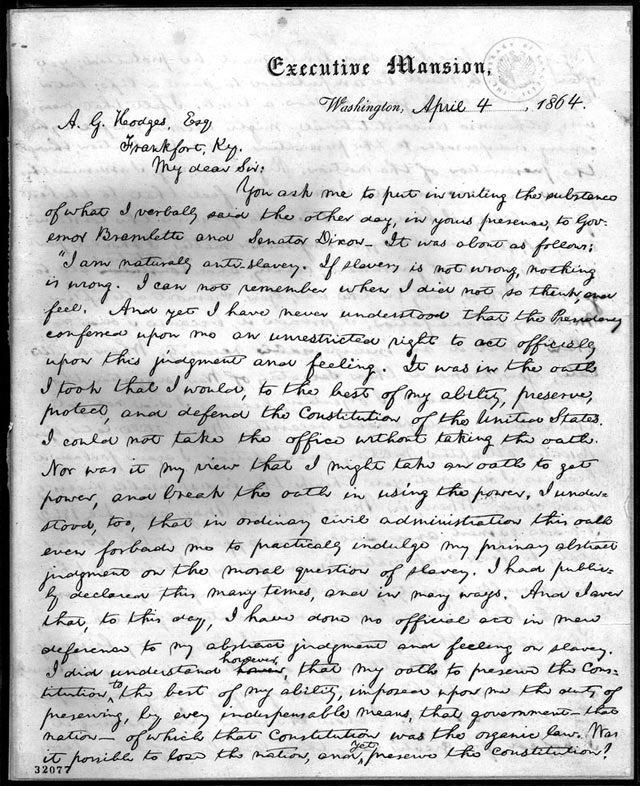
On April 4, 1864 Abraham Lincoln wrote the letter below to Albert G Hodges.  The letter expresses the president's beliefs about the morality of slavery:

I am naturally anti-slavery.  If slavery is not wrong, nothing is wrong.

At the same time it set forth the constitutional constraints under which he believed he was obligated to act in accordance with:

And yet I have never understood that the Presidency conferred upon me an unrestricted right to act officially upon this judgement and feeling.
The letter arose from a meeting Lincoln had a couple of days before with Hodges, Governor Bramlette and Senator Dixon.  Bramlette was governor of Kentucky, Dixon a former senator from that state, and Hodges editor of the Frankfurt Commonwealth, the most influential paper in the state.  The meeting's purpose was for the Kentucky delegation to object to the recruitment of former slaves in that state into the Union army, a policy approved by the president.  Bramlette and Dixon, while supporters of the Union and opponents of secession, were not anti-slavery and offended by the prospect of black soldiers.

The importance of the letter resides first in the clear distinction Lincoln makes between his moral beliefs and his Constitutional authority as Chief Executive, a distinction I wish more politicians paid attention to.

The second important aspect is the question of what steps is it rightful for a president to take to preserve the Union.  Lincoln sets forth the issue: 

I did understand however, that my oath to preserve the Constitution to the best of my ability, imposed upon me the duty of preserving, by every indispensable means, that government – that nation – of which that constitution was the organic law. Was it possible to lose the nation, and yet preserve the Constitution? By general law life and limb must be protected; yet often a limb must be amputated to save a life; but a life is never wisely given to save a limb. I felt that measures, otherwise unconstitutional, might become lawful, by becoming indispensable to the preservation of the Constitution, through the preservation of the nation. Right or wrong, I assumed this ground, and now avow it. I could not feel that, to the best of my ability, I had even tried to preserve the Constitution, if, to save slavery, or any minor matter, I should permit the wreck of government, country, and Constitution all together.

Third, the president asserts that his decision was both necessitated by events (the failure of his proposal for compensated emancipation in the border states) and proven by the results: 

They declined the proposition; and I was, in my best judgment, driven to the alternative of either surrendering the Union, and with it, the Constitution, or of laying [a] strong hand upon the colored element. I chose the latter. In choosing it, I hoped for greater gain than loss; but of this, I was not entirely confident. More than a year of trial now shows no loss by it in our foreign relations, none in our home popular sentiment, none in our white military force, – no loss by it any how or anywhere. On the contrary, it shows a gain of quite a hundred and thirty thousand soldiers, seamen, and laborers. These are palpable facts, about which, as facts, there can be no caviling. We have the men; and we could not have had them without the measure.

Lincoln then challenges Hodges and his companions to contemplate where the Union would be without those 130,000 colored troops and laborers:

If he cannot face his case so stated, it is only because he cannot face the truth.

His final paragraph provides an early glimpse into the president's thinking on God's role in fulfilling a moral obligation and the costs entailed, a sentiment so memorably expressed in his Second Inaugural address in March 1865, a month before his murder.

I claim not to have controlled events, but confess plainly that events have controlled me. Now, at the end of three years’ struggle the nation’s condition is not what either party, or any man devised, or expected. God alone can claim it. Whither it is tending seems plain.If God now wills the removal of a great wrong, and wills also that we of the North as well as you of the South, shall pay fairly for our complicity in that wrong, impartial history will find therein new cause to attest and revere the justice and goodness of God.

The letter is a reminder of Lincoln's talents as a rhetorician and a politician.   His use of rhetoric makes disagreement difficult, while one must never forget that the president was not a philosopher but rather a practical politician, who was very careful to tailor his rhetoric to the specific needs of the moment.

---------------------------------------------------------------------------------

April 4, 1864

My dear Sir: You ask me to put in writing the substance of what I verbally said the other day, in your presence, to Governor Bramlette and Senator Dixon. It was about as follows:

“I am naturally anti-slavery. If slavery is not wrong, nothing is wrong. I can not remember when I did not so think, and feel. And yet I have never understood that the Presidency conferred upon me an unrestricted right to act officially upon this judgement and feeling. It was in the oath I took that I would, to the best of my ability, preserve, protect, and defend the Constitution of the United States. I could not take the office without taking the oath. Nor was it my view that I might take an oath to get power, and break the oath in using the power. I understood, too, that in ordinary civil administration this oath even forbade me to practically indulge my primary abstract judgement on the moral question of slavery. I had publicly declared this many times, and in many ways. And I aver that, to this day, I have done no official act in mere deference to my primary abstract judgement on the moral question of slavery. I did understand however, that my oath to preserve the Constitution to the best of my ability, imposed upon me the duty of preserving, by every indispensable means, that government – that nation – of which that constitution was the organic law. Was it possible to lose the nation, and yet preserve the Constitution? By general law life and limb must be protected; yet often a limb must be amputated to save a life; but a life is never wisely given to save a limb. I felt that measures, otherwise unconstitutional, might become lawful, by becoming indispensable to the preservation of the Constitution, through the preservation of the nation. Right or wrong, I assumed this ground, and now avow it. I could not feel that, to the best of my ability, I had even tried to preserve the Constitution, if, to save slavery, or any minor matter, I should permit the wreck of government, country, and Constitution all together. When, early in the war, Gen. Fremont attempted military emancipation, I forbade it, because I did not then think it an indispensable necessity. When a little later, Gen. Cameron, then Secretary of War, suggested the arming of the blacks, I objected, because I did not yet think it an indispensable necessity. When, still later, Gen. Hunter attempted military emancipation, I again forbade it, because I did not yet think the indispensable necessity had come. When, in March, and May, and July 1862 I made earnest, and successive appeals to the border states to favor compensated emancipation, I believed that the indispensable necessity for military emancipation, and arming the blacks would come, unless averted by that measure. They declined the proposition; and I was, in my best judgment, driven to the alternative of either surrendering the Union, and with it, the Constitution, or of laying [a] strong hand upon the colored element. I chose the latter. In choosing it, I hoped for greater gain than loss; but of this, I was not entirely confident. More than a year of trial now shows no loss by it in our foreign relations, none in our home popular sentiment, none in our white military force, – no loss by it any how or anywhere. On the contrary, it shows a gain of quite a hundred and thirty thousand soldiers, seamen, and laborers. These are palpable facts, about which, as facts, there can be no caviling. We have the men; and we could not have had them without the measure.

“And now let any Union man who complains of the measure, test himself by writing down in one line that he is for subduing the rebellion by force of arms; and in the next, that he is for taking these hundred and thirty thousand men from the Union side, and placing them where they would be but for the measure he condemns. If he cannot face his case so stated, it is only because he cannot face the truth.”

I add a word which was not in the verbal conversation. In telling this tale I attempt no compliment to my own sagacity. I claim not to have controlled events, but confess plainly that events have controlled me. Now, at the end of three years’ struggle the nation’s condition is not what either party, or any man devised, or expected. God alone can claim it. Whither it is tending seems plain. If God now wills the removal of a great wrong, and wills also that we of the North as well as you of the South, shall pay fairly for our complicity in that wrong, impartial history will find therein new cause to attest and revere the justice and goodness of God.

Yours truly,

A. Lincoln

Sunday, February 12, 2023

You Were Right, And I Was Wrong

On the 214th anniversary of Abraham Lincoln's birthday, we present the President's gracious letter to General Ulysses Grant on the successful conclusion of his campaign against Vicksburg.  Grant's daring campaign after taking Port Gibson and Grand Gulf was unprecedented, a Union army deliberately cutting itself off from its supply base.  Despite the doubts expressed by Lincoln at the time, Grant succeeded.  The President's letter is one of many examples of his extraordinary character.  Eight months later, Lincoln named Grant to take command of all Union forces.

Executive Mansion,
Washington, July 13, 1863.
Major General Grant
        My dear General
        I do not remember that you and I ever met personally. I write this now as a grateful acknowledgment for the almost inestimable service you have done the country. I wish to say a word further. When you first reached the vicinity of Vicksburg, I thought you should do, what you finally did—march the troops across the neck, run the batteries with the transports, and thus go below; and I never had any faith, except a general hope that you knew better than I, that the Yazoo Pass expedition, and the like, could succeed. When you got below, and took Port-Gibson, Grand Gulf, and vicinity, I thought you should go down the river and join Gen. Banks; and when you turned Northward East of the Big Black, I feared it was a mistake. I now wish to make the personal acknowledgment that you were right, and I was wrong.
        Yours very truly
                  A. Lincoln


Thursday, August 25, 2022

The Petition

(Arnold Bertonneau)

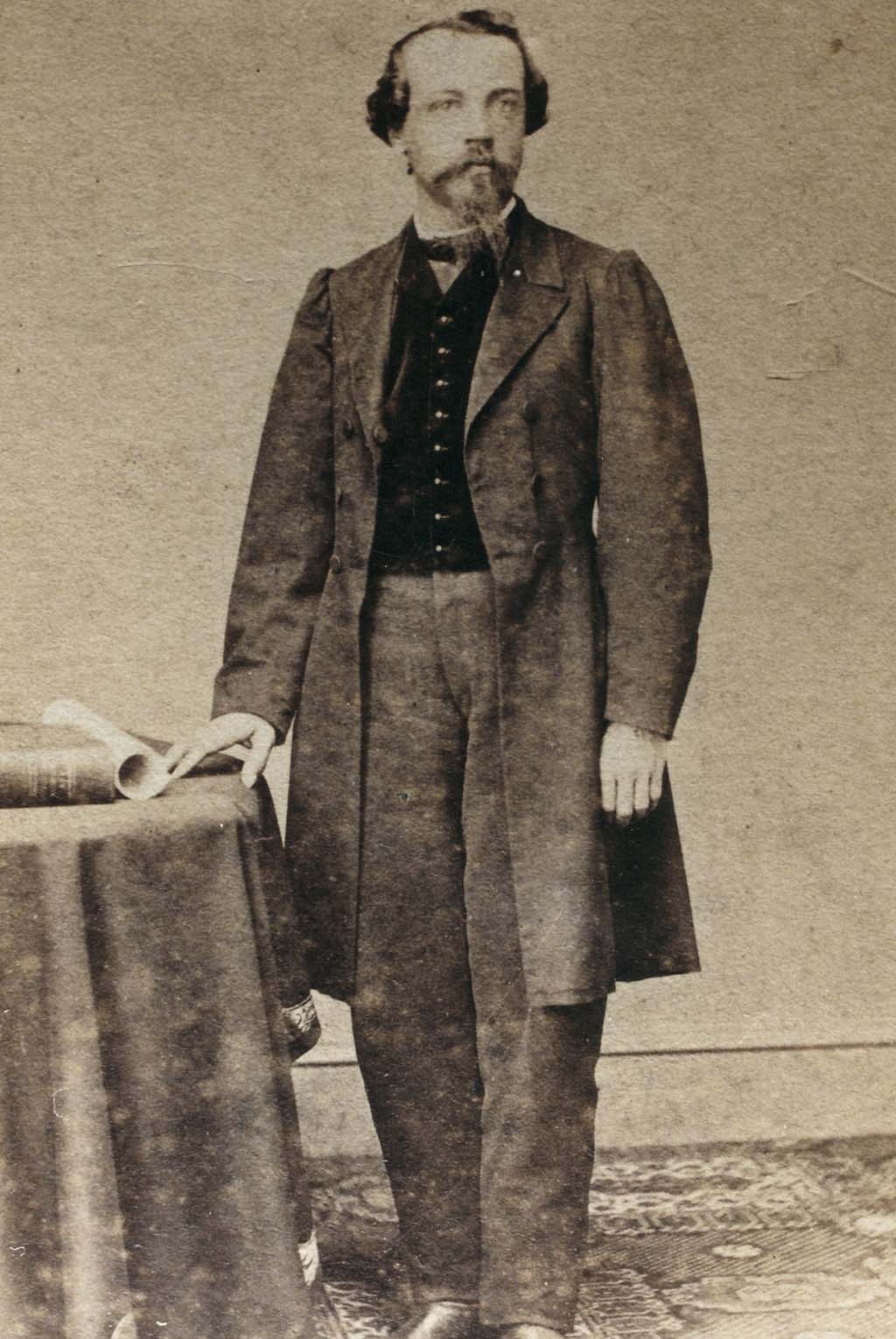
On the afternoon of March 3, 1864, two Creole mixed-race Louisianians from New Orleans, Jean Baptiste Roudanez and E Arnold Bertonneau, entered the White House to meet with President Abraham Lincoln.  Their purpose was to present a petition seeking enfranchisement of "all the citizens of Louisiana of African descent, born free before the rebellion".  Both the 46 year old Roudanez and 27 year old Bertonneau had French fathers and African mothers.

Thirteen years later, Bertonneau filed the first federal lawsuit seeking desegregation of public schools (Bertonneau v School District).  The circuit court's ruling dismissing the case was later cited by the Supreme Court in support of its decision in Plessy v Ferguson (1896).

In 1912 when Bertonneau, then living in California, died, his death certificate listed him as white. (1)

Bertonneau's life encapsulates the tortured nature of how race was handled in his lifetime, and the crushing disappointment of his hopes, and those of the black population, during the post Civil War era.

Bertonneau came to my attention because he appears in two books I've recently read; A House Built By Slaves: African American Visitors to the Lincoln White House by Jonathan W White, and The Black Man's President: Abraham Lincoln, African Americans, & the Pursuit of Racial Equality by Michael Burlingame (2).  Both authors are noted scholars of the era; White is a professor of American Studies at Christopher Newport University, while Burlingame is Chair in Lincoln Studies at the University of Illinois.

The topic of both books is Lincoln's relationships with African Americans, with a focus on the White House years, though Burlingame spends more time on Lincoln's experiences in Illinois where he had free black neighbors.  While I knew about some of these events, such as Lincoln's three meetings with Frederick Douglass, and his controversial August 1862 meeting with black ministers about colonization, the sheer number and variety of encounters between the president and blacks during his time in the White House was surprising to me.(3)  It truly was revolutionary, a revolution ended in the wreckage of Reconstruction.

Prior to Lincoln, we know of only two occasions when black Americans were invited to the White House.  The first, in 1812, was when James Madison and Secretary of the Treasury, Albert Gallatin, met with Paul Cuffe, a wealthy black merchant, ship builder, and fascinating figure in his own right, at which Cuffe successfully appealed to the president to overrule a customs decision to seize cargo on one of his vessels.  The second, John Tyler's invitation to minister Daniel Payne to preside at a funeral for the president's body servant.  Twenty years later, Payne had the opportunity to meet with Lincoln, later writing that he:

 "was a perfect contrast with President Tyler . . . President Lincoln received and conversed with me as though I had been one of his intimate acquaintances or one of his friendly neighbors".

There was also one other noteworthy interaction with an American president, though it took place in Philadelphia, the year before the White House was completed.  In 1799, a black diplomat from Santo Domingo dined with John Adams and Secretary of State Timothy Pickering.

One of my favorite incidents, occurred on July 4, 1864.  In late June a delegation of black Catholics met with Lincoln.  Barred from the sanctuary of the Catholic church in the city, and their children barred from public school, they sought to raise funds for a chapel and school, for which they sought the President's approval to use the White House grounds for a fund-raising picnic.  Lincoln granted their request, apparently the first time any group had used the White House grounds for  private fund-raising.  The picnic was a great success, in attendance and financially, and a month later a black Baptist church held a similar event at the White House.  These events triggered horrified reactions in the Democratic press.

Reading about Lincoln over the years, I've become more aware of his flaws and his mistakes.  Yet, even with that, my appreciation for his greatness and humanity has only grown, as well as my appreciation for how good a politician he was.  

While the books shed much light on Lincoln, they also reveal the world of free blacks as it existed in mid-19th century America, what they thought about Lincoln at the time, and the conditions and limits under which they had to navigate within white America.  Learning about their stories was what led me to do more reading on E Arnold Bertonneau.


Bertonneau and Roudanez sprang from a unique American community, the Creoles of southern Louisiana and, more specifically, the Creoles of Color.  Creoles were the descendants of French settlers prior to the American acquisition in 1803, as well as the French and mulattoes fleeing the turmoil in Santo Domingo and the Haitian Revolution in the early 1800s.  Within the category of Creoles were a significant number of mixed race persons who, in contrast to the rest of the country, were free, educated, and played a role in the general society of New Orleans.  In fact, many of these Creoles played a prominent role in the region, often large property owners, merchants, and sometimes owning slaves.  By the beginning of the Civil War there were 11,000 free blacks in Louisiana (predominantly Creole) and, in order to maintain their position in an increasingly race-conscious South, where the prior three decades had seen increasing restrictions not just on slaves, but also on free blacks, they emphasized their difference from other Africans.  Burlingame quotes an 1864 article in the New Orleans Tribune, the paper of the Creoles of color, to the effect:

". . . while we are of the same race as the unfortunate sons of Africa who have trembled until now under the bondage of a cruel and brutalizing slavery, one cannot, without being unfair, confuse the newly freed people with our intelligent population which, by its industry and education, has become as useful to society and the country as any other class of citizens."

This was also reflected in the views of whites.  In 1859, the New Orleans Picayune observed in an editorial:

"Our free colored population form a distinct class from those elsewhere in the United States.  Far from being antipathetic to the whites, they have followed in their footsteps, and progressed with them, with a commendable spirit of emulation, in the various branches of industry most adapted to their sphere.  Some of our best mechanics and artisans are to be found among the free colored men.  They form the great majority of our regular, settled masons, bricklayers, builders, carpenters, tailors, shoemakers . . . whilst we count among them in no small numbers, excellent musicians, jewelers, goldsmiths, tradesmen and merchants."

When the war began, almost 800 free blacks in New Orleans volunteered for the Native Guards, including Bertonneau who was appointed  captain, forming a regiment to protect the city from federal forces.  Bertonneau later wrote of this action, "Without arms and ammunition, or any means of self-defense, the condition and position of our people were extremely paralyzed; could we have adopted a better policy?".  Colored Creoles had been members of the Louisiana militia in the past, with several hundred fighting in the Battle of New Orleans in 1815, of whom twenty eight survivors were signatories to the petition presented to Lincoln in March 1864.

At the time, Bertonneau, then 24 and very light skinned with blue eyes, was already a prominent member of the Creole community, a prosperous wine merchant, member of La Societe d'Economic d'Assistance Mutuelle, and supporter of La Societe Catholique pour L'Institution des Orphelins dan L'Indigence (known also as the Couvent School, the first community school dedicated to education of black children in the Deep South).

Although Confederate authorities allowed the Native Guards to drill, they were not provided with arms or uniforms and so did not participate in the defense of New Orleans when the Federals successfully attacked in April 1862.  After the city's capture Union general, Benjamin Butler, urged the Native Guards to join the Union Army, which many did, along with escaped slaves, eventually forming three regiments.  Bertonneau was among these, being reappointed as a captain.

In early 1863, after General Nathaniel Banks replaced Butler, Banks decided to weed out black officers and Bertonneau resigned in protest stating:

"When I joined the Army I thought that I was fighting for the same cause, wishing only the success of my country would suffice to alter a prejudice which had existed.  But I regret to say that five months experience has proved the contrary."

In mid-summer 1863, when a Confederate attack on New Orleans seemed possible, Bertonneau reenlisted for a sixty day stint.

In the latter part of 1863 President Lincoln began putting pressure on Generals Banks and Shepley (the military governor of Louisiana) to hold elections for civilian officials and to convene a constitutional convention, in order to begin the process of bringing the state back into the Union.  Shepley responded by calling for elections and enfranchising white Union soldiers.  The colored Creole community sent petitions to Shepley and Banks asking for the right to vote, but neither responded.  It was decided to appeal directly to President Lincoln.

In January 1864, Roudanez and Bertonneau drafted the petition requesting enfranchisement for all of African descent, born free before the Civil War.  The petition was eventually signed by about 1,000 free blacks.

Accompanied by Pennsylvania Congressman William D Kelly, one of the founders of the Republican Party, the two met with the President on March 3, and presented their petition. (4)  The meeting is described by all sources as cordial.  

Author White summarizes Lincoln's reaction at the March 3 meeting:

If giving black men the right to vote became "necessary to close the war, he would not hesitate," he said, for he saw "no reason why intelligent black men should not vote".  But black suffrage was "not a military question" and he believed it had to be handled by the constitutional convention in Louisiana.  As president, Lincoln said that he "did nothing in matters of this kind upon moral grounds, but solely upon political necessities."  Since the petition based its claim "solely on moral grounds" it "did not furnish him with any inducement to accede to their wishes."

According to one observer of the meeting, Lincoln said "I regret, gentlemen, that you are not able to secure all your rights, and that circumstances will not permit the government to confer them upon you".

The president then went out to suggest that the petition be amended, and then sat down with his visitors to write out the suggested modifications, shocking some of the white observers in the room.

It is not known what changes the president suggested, but Roudanez and Bertonneau rewrote the petition over the next few days to include poor, uneducated, and newly freed blacks and it was resubmitted to Lincoln.  Ultimately, the change was not just tactical, as we can follow Bertonneau's own thinking and the realization that the fate of the free Creoles of color and those of the newly freed former slaves were linked.

The meeting apparently encouraged Lincoln to take an additional step.  On March 13, 1864 he wrote a letter congratulating Michael Hahn, who had just been elected governor of Louisiana.  It was brief, but pointed:

I congratulate you on having fixed your name in history as the first-free-state Governor of Louisiana. Now you are about to have a Convention which, among other things, will probably define the elective franchise. I barely suggest for your private consideration, whether some of the colored people may not be let in---as, for instance, the very intelligent, and especially those who have fought gallantly in our ranks. They would probably help, in some trying time to come, to keep the jewel of liberty within the family of freedom. But this is only a suggestion, not to the public, but to you alone.
Yours truly
A. LINCOLN
 After Lincoln's letter became public, journalist Whitelaw Reid (5) noted it was written at a time:
when negro suffrage was a thing to speak of in bated breath, and with many of shudder.  Even then, in advance of almost every leading man of the party which supported him, Mr Lincoln was found inquiring - in a quarter where he knew inquiry to be almost equal to command.
Even prior to the March 1864 meeting, Lincoln was taking cautious steps towards black suffrage.  In August 1863, Secretary of War, with the president's approval, directed military governor Shepley to register "all the loyal citizens of the United States" as eligible voters, omitting the qualifier of white; Shepley ignored the hint.(6)
 
Governor Hahn showed the president's letter to many constitutional convention delegates, all of whom were white, urging the enfranchisement of at least some blacks.  The delegates rejected doing so, but under pressure from Hahn and General Banks (who Lincoln directed to lobby for suffrage), they added a provision to the constitution allowing a future legislature to grant the vote to black men based on military service, intellectual merit, or payment of taxes.  Lincoln also showed the letter to Congressmen in DC as he lobbied unsuccessfully for approval of reconstruction in Louisiana.

It was only toward the end of the war that, for the first time, Lincoln spoke publicly about the enfranchisement of some black men (with specific reference to the situation in Louisiana), on April 11, 1865, in an impromptu talk from the balcony of the White House.  In the crowd that night was John Wilkes Booth, who, enraged by the prospect, told his fellow conspirators David Herold and Lewis Powell, "That means n ---- citizenship.  Now by God I'll put him through" and "That is the last speech he will ever make."  Three days later Booth fulfilled his vow.

From Washington, Roudanez and Bertonneau traveled to Boston where they were guests of honor at a banquet hosted by the governor of the state and attended by Frederick Douglass and William Lloyd Garrison at which Bertonneau delivered a plea for equal rights.
We ask that, in the reconstruction of the state government there, the right to vote shall not depend on the color of the citizen; that the colored citizen shall have and enjoy every civil, political and religious right that white citizens enjoy; in a word, that every man shall stand equal before the law. To secure these rights, which belong to every free citizen, we ask the aid and influence of every true loyal man all over the country. Slavery, the curse of our country, cannot exist in Louisiana again.

In order to make our state blossom and bloom as the rose, the character of the whole people must be changed. As slavery is abolished, with it must vanish every vestige of oppression. The right to vote must be secured; the doors of our public schools must be opened, that our children, side by side, may study from the same books, and imbibe the same principles and precepts from the Book of Books, learn the great truth that God “created of one blood all nations of men to dwell on all the face of the earth”; so will caste, founded on prejudice against color, disappear.

You can read the entire speech here. 

Bertonneau continued to play a role in lobbying for equal treatment, joining protests in 1866 of President Johnson's reconstruction plan allowing readmission of states without enfranchisement of blacks.  He was at the 1866 constitutional convention in New Orleans, as part of a group urging black suffrage, when it was attacked by a white mob which killed more than 30 blacks.

That attack and other violent incidents in the South, led Congress to impose a harder path towards reconstruction which resulted in another constitutional convention at which blacks, including Bertonneau, were delegates, and led to provisions allowing blacks to vote.  Bertonneau also helped establish integrated Masonic lodges in the state.

In the 1870s, Bertonneau held a position at the Customs House in New Orleans but the gains of the late 1860s were already starting to erode as Northern support for reconstruction began to fade.

In 1877 the Orleans Parish school board decided to resegregate New Orleans schools.  Bertonneau, by now the father of four children, filed his lawsuit in Federal District Court (you can find the case file here and the circuit court decision here) though two prior suits in state court had already failed.  As recounted above, his suit also failed.

Bertonneau's first wife died in 1888.  He remarried in 1891, had three more children, and opened a dry cleaning business (this photo shows Bertonneau, on the left, and two of his sons at his cleaning establishment).  His once active community involvement declined, perhaps because times for blacks were becoming much grimmer as Jim Crow took hold.  The 1896 case, Plessy v Ferguson, had its origin in the efforts of the black community in New Orleans to stem the tide of exclusion and repression.  Two years later the Louisiana legislature effectively disenfranchised most black voters, and two years after that riots in New Orleans destroyed many black businesses.  These events prompted many colored Creole families to leave.

In 1902, Bertonneau and his family joined the exodus, moving to California, where he died in Los Angeles in 1912.  His eldest son, Arnold John Bertonneau went on to a very successful business career in southern California, in the grocery and hotel business and becoming an organizer of a bank in Pasadena.

For Creoles of color, the 19th century was progress moving in reverse.  Their maximum period of rights peaked before the acquisition of New Orleans in 1803.  Until the Civil War they had to struggle to maintain those rights under a more rigid racial regime, that was tightening in the decades leading up to secession.  The return of the racial regime under Jim Crow led to even harsher repression, made even worse by the knowledge that the events of the 1860s had shown promise of a world where equal rights might be attainable, a promise that proved false. 

-----------------------------

(1)  Bertonneau is not unique in changing race.  Homer Plessy, the litigant in the famous 1896 Supreme Court case, was 7/8 white, but considered black in Louisiana.  In the 1910 census he is listed as black, but in 1920 is shown as white.

(2)  The title of Burlingame's book is taken from Frederick Douglass' speech on June 1, 1865 at Cooper Union in New York City, where he proclaimed Lincoln as:

"emphatically the black man's President, the first to show any respect for the rights of a black man, or to acknowledge that he had any rights the white man ought to respect"

Burlingame also points out that in December 1864, a Democratic opposition newspaper also called Lincoln "emphatically the black man's president" along with being "the white man's curse".

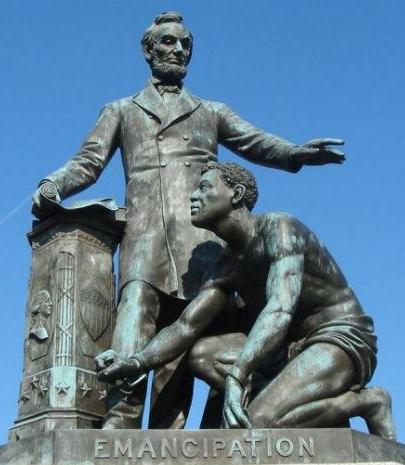
At different times, Douglass gave different perspectives on Lincoln.  In 1876, at the dedication of the Freedman's Monument, he called Lincoln "preeminently the white man's President".  Douglass was quite astute in tailoring his messages for his audience.  The 1865 speech was given to a black audience, while the 1876 talk was to a mixed audience, but with a message clearly designed for whites, including President Grant who was in attendance.   For more on the Freedman Monument speech you can read my 2016 post linked here.

(3)  One of those who met the president was Robert Smalls, a young man who escaped slavery by seizing a Confederate warship in Charleston Harbor and sailing it out to the blockading Union fleet.  Smalls eventually became the first black commander in the Union navy and, after the war, served five terms in Congress as a South Carolina representative.  His incredible saga is told in Be Free or Die by Cate Lineberry.

(4)  To my frustration, I've been unable to locate a full text of the petition.

(5)  Reid later become editor of the New York Tribune after the death of Horace Greeley.  A Republican, he was later appointed ambassador to Britain and France and was the party's vice-presidential nominee in 1892.

(6) The prior year, Attorney General Bates issued an official opinion "that the free man of color, if born in the United States, is a citizen of the United States", repudiating the Supreme Court's Dred Scott decision of 1857.

Tuesday, July 5, 2022

Vandalia

Driving on I-70 today across southern Illinois, we saw a sign announcing the presence of the oldest existing Illinois State House in the little town of Vandalia, so we got off to take a look.

Vandalia became the capital of Illinois in 1819, after the original capital of Kaskaskia was abandoned due to frequent flooding.  The town was specifically founded to be the new capital under an agreement that it would continue that designation for at least twenty years.   The first building constructed for use as a state house was poorly done and, as the mid-1830s approached, the townspeople, worried that in 1839 the capital would move north, built a new state house in an attempt to maintain Vandalia's status beyond the twenty-year deadline.

The building pictured below looked a bit different when inaugurated in 1836.  Built of red brick, it was unpainted, and the portico seen here was a later addition.  Despite the town's efforts, the legislature voted to move the capital to Springfield in 1839.

Young Abraham Lincoln started his political career when elected to the legislature on December 1, 1834 and, from 1836 to 1839 would have appeared frequently in the State House pictured below.  Lincoln had moved to Illinois in 1830, settling in the Sangamon County town of New Salem, the same county in which Springfield is located.

I was surprised to learn that Vandalia's population has grown by 40% since 1980 and now stands around 7,500.


Monday, May 30, 2022

Five Score Years Ago

78 year old Robert Todd Lincoln, son of Abraham, is helped up the steps of the Lincoln Memorial for its dedication ceremony, May 30, 1922.

r/HistoryPorn - May 1922: 78-year-old Robert T. Lincoln (son of Abraham Lincoln) is helped up the steps at the dedication of the Lincoln Memorial in Washington D.C. [1740x2048]

Robert was President Lincoln's eldest child, and the only one to survive to adulthood.  He served as Secretary of War in the Garfield and Arthur administrations, as Ambassador to the United Kingdom during the Harrison administration, and had a very successful business career.  Highly intelligent, he lacked the humor and warmth of his father.

On April 14, 1865, Robert turned down an invitation to accompany his parents to Ford's Theater.

In July 1881, Robert was present, at President Garfield's invitation, at the Sixth Street Train Station in Washington DC where he witnessed the fatal shooting of Garfield by Charles Guiteau.

In September 1901, Robert was present, at President McKinley's invitation, at the Pan-American Exposition in Buffalo NY, when McKinley was mortally wounded. Robert was outside the building where the shooting occurred and was not an eyewitness.

Saturday, February 19, 2022

The Most Magnificent Face And Eye

It is not often I come across a story about Abraham Lincoln I've not heard before, but it happened this morning while reading Barton Swaim's book review column in the WSJ.  Here it is, recounted in full:

On April 8, 1865, Lincoln visited Gen. Grant's headquarters near Richmond and consoled wounded Union soldiers in a field hospital.  When he began walking toward a tent separated from the others, a doctor tried to stop him.  Those, the doctor said, were for wounded Confederates. "That", Lincoln replied, "is just where I do want to go".

There, too, the president spoke peaceably to the wounded.  Years later one of the sick rebels, Col. Henry L. Benbow, recalled Lincoln extending his hand. "Mr President, I said, do you know to whom you offer your hand? 'I do not,' he replied.  Well, I said, you offer it to a Confederate colonel, who has fought you as hard as he could for four years.  'Well', said he, 'I hope a Confederate colonel will not refuse me his hand.'  No sir, I replied, I will not, and I clasped his hand in both mine.  I tell you, sir, he had the most magnificent face and eye that I have ever gazed into.  He had me whipped from the time he first opened his mouth."

Henry Benbow enlisted at the start of the war as captain in the 23rd South Carolina Infantry Regiment which spent most of the war with the Army of Northern Virginia.  Promoted to Colonel in 1862, he was wounded at Second Manassas later that year and again at the Battle of the Crater in July 1864.  Returning to action he was shot through both thighs and captured at Five Forks on April 1, 1865.  The hospital was located at City Point which is where Lincoln met him before returning to Washington later that day.  Released on June 15, Benbow returned to South Carolina where he died in 1907.

While researching Benbow, I came across a clipping from the February 24, 1909 edition of The Manning Times of Manning, South Carolina which is clearly the source of the anecdote recounted in the WSJ column.  In turn, the Times cites Youth's Companion magazine as the original source.  Youth's Companion was a popular children's magazine, published in Boston from 1827 to 1929.  The newspaper goes on report it also heard from a fellow veteran that Benbow had recounted the same story to him.  A couple of other details from the newspaper account:

If he had every walked up and down a Confederate line of battle, there would never have been a battle . . . Not long afterward the news came to us that he was dead, and I turned my face to the wall and wept.

Monday, June 15, 2020

Good Words


When Louis Armstrong was on the road, which was most of the time, he carried with him a taping system that was high-tech for its era.  It included recordings of his favorite music as well as tapes he made himself while touring.  The process occupied much of his time when he was not playing.

The Louis Armstrong Museum in the Corona neighborhood of Queens, NY (which is well worth a visit) has been releasing portions of those tapes.  Most recently is this recording of Armstrong reciting Abraham Lincoln's address at Gettysburg on November 19, 1863.  We don't know what prompted him to make the recording in 1958 but it is fitting for a man who escaped from poverty and abandonment in New Orleans early in the 20th century to become one of the most famous and well-liked people in America.

The electic nature of Armstrong's tapes is demonstrated by the other items on this one, described by the Museum as:
  . . chock full of music–Count Basie’s April in Paris, Coleman Hawkins’s The Hawk in Paris, Berklee College’s Jazz in the Classroom, an Alex Welsh broadcast, a Willis Conover Voice of America broadcast on Armstrong, a Bob Hope-Bing Crosby single, Patti Russo and more–but it’s the Lincoln speech, delivered between the end of the Basie album and Hawkins’s “Chiens Perdus Sans Collier (The Little Lost Dog),” that’s most memorable portion of the tape.
This link will take you to the recording.  It's worth 2 1/2 minutes of your time.

Wednesday, February 12, 2020

The Same Old Serpent

On the occasion of the 211th anniversary of the birth of the Great Emancipator . . .

From speech given on July 10, 1858 by Abraham Lincoln at Chicago.  In responding to a speech by Stephen Douglas, Lincoln reminds us that the great proposition of the Declaration makes those who arrived in America after the War for Independence equal to those descended from the patriots who fought in that struggle and that it is a principle that admits no exceptions.

We hold this annual celebration to remind ourselves of all the good done in this process of time of how it was done and who did it, and how we are historically connected with it; and we go from these [Independence Day] meetings in better humor with ourselves—we feel more attached the one to the other, and more firmly bound to the country we inhabit. In every way we are better men in the age, and race, and country in which we live for these celebrations.

But after we have done all this we have not yet reached the whole. There is something else connected with it. We have besides these men—descended by blood from our ancestors—among us perhaps half our people who are not descendants at all of these men, they are men who have come from Europe—German, Irish, French and Scandinavian—men that have come from Europe themselves, or whose ancestors have come hither and settled here, finding themselves our equals in all things. If they look back through this history to trace their connection with those days by blood, they find they have none, they cannot carry themselves back into that glorious epoch and make themselves feel that they are part of us, but when they look through that old Declaration of Independence they find that those old men say that “We hold these truths to be self-evident, that all men are created equal,” and then they feel that that moral sentiment taught in that day evidences their relation to those men, that it is the father of all moral principle in them, and that they have a right to claim it as though they were blood of the blood, and flesh of the flesh of the men who wrote that Declaration [loud and long continued applause], and so they are. That is the electric cord in that Declaration that links the hearts of patriotic and liberty-loving men together, that will link those patriotic hearts as long as the love of freedom exists in the minds of men throughout the world. [Applause.]

Now, sirs, for the purpose of squaring things with this idea of “don’t care if slavery is voted up or voted down” [Douglas’s “popular sovereignty” position on the extension of slavery to the territories], for sustaining the Dred Scott decision [A voice—“Hit him again”], for holding that the Declaration of Independence did not mean anything at all, we have Judge Douglas giving his exposition of what the Declaration of Independence means, and we have him saying that the people of America are equal to the people of England. According to his construction, you Germans are not connected with it. Now I ask you in all soberness, if all these things, if indulged in, if ratified, if confirmed and endorsed, if taught to our children, and repeated to them, do not tend to rub out the sentiment of liberty in the country, and to transform this Government into a government of some other form. Those arguments that are made, that the inferior race are to be treated with as much allowance as they are capable of enjoying; that as much is to be done for them as their condition will allow. What are these arguments? They are the arguments that kings have made for enslaving the people in all ages of the world. You will find that all the arguments in favor of king-craft were of this class; they always bestrode the necks of the people, not that they wanted to do it, but because the people were better off for being ridden.

That is their argument, and this argument of the Judge [Douglas] is the same old serpent that says you work and I eat, you toil and I will enjoy the fruits of it. Turn in whatever way you will—whether it come from the mouth of a King, an excuse for enslaving the people of his country, or from the mouth of men of one race as a reason for enslaving the men of another race, it is all the same old serpent, and I hold if that course of argumentation that is made for the purpose of convincing the public mind that we should not care about this, should be granted, it does not stop with the negro. I should like to know if taking this old Declaration of Independence, which declares that all men are equal upon principle and making exceptions to it where will it stop. If one man says it does not mean a negro, why not another say it does not mean some other man? If that declaration is not the truth, let us get the Statute book, in which we find it and tear it out! Who is so bold as to do it! [Voices—“me” “no one,” &c.] If it is not true let us tear it out! [cries of “no, no,”] let us stick to it then [cheers], let us stand firmly by it then. [Applause.]

Wednesday, February 13, 2019

The Peoria Speech

Yesterday was the 210th anniversary of the birth of our 16th president.  

After serving one term in Congress as a member of the Whig party, Abraham Lincoln returned to Springfield, Illinois in early 1849 to resume the practice of law, returning to active politics five years later amidst the controversy over the Nebraska-Kansas Act, which ended the Missouri Compromise of 1820 and opened up new territories for the potential expansion of slavery.  Opposing any expansion of the peculiar institution, on October 16, 1854 Lincoln spoke at Peoria, Illinois, an event which began his elevation into the national spotlight.

At Peoria, Lincoln made a moral case against slavery, and a pragmatic and legal case against its expansion while accepting its continuation in the states where it currently existed.  The entire speech can be read here.

He was unequivocal in his condemnation:
This declared indifference, but as I must think, covert real zeal for the spread of slavery, I can not but hate. I hate it because of the monstrous injustice of slavery itself. I hate it because it deprives our republican example of its just influence in the world---enables the enemies of free institutions, with plausibility, to taunt us as hypocrites---causes the real friends of freedom to doubt our sincerity, and especially because it forces so many really good men amongst ourselves into an open war with the very fundamental principles of civil liberty---criticising the Declaration of Independence, and insisting that there is no right principle of action but self-interest.
Yet he was also at pains to discuss the practical problems attached to slavery's elimination, a problem he saw no easy answer to.  His words resonated at the time, and the tragic inability to find a solution short of war, and then to postpone for so long attempting to integrate the former slaves into American society, continue to do so today.
Before proceeding, let me say I think I have no prejudice against the Southern people. They are just what we would be in their situation. If slavery did not now exist amongst them, they would not introduce it. If it did now exist amongst us, we should not instantly give it up. This I believe of the masses north and south. Doubtless there are individuals, on both sides, who would not hold slaves under any circumstances; and others who would gladly introduce slavery anew, if it were out of existence. We know that some southern men do free their slaves, go north, and become tip-top abolitionists; while some northern ones go south, and become most cruel slave-masters.

When southern people tell us they are no more responsible for the origin of slavery, than we; I acknowledge the fact. When it is said that the institution exists; and that it is very difficult to get rid of it, in any satisfactory way, I can understand and appreciate the saying. I surely will not blame them for not doing what I should not know how to do myself. If all earthly power were given me, I should not know what to do, as to the existing institution.

Wednesday, December 12, 2018

Abe

You may recognize the feller I hung out with last night (THC is the guy on the right!).

James Hayney has portrayed our 16th President for the past fifteen years. He was asked by the Secret Service to play Lincoln at the 150th anniversary of the agency for an event at Ford's Theater, and portrayed the president at the National Portrait Gallery at President Obama's first inauguration.  And he lives near Gettysburg so you can imagine how often he's asked to make appearances there.

Last night at our Civil War Roundtable in Scottsdale he spoke, fully in character, about the lies, legends, and myths surrounding his life.  It was done with eloquence and much humor.  He closed with a stirring performance of the Gettysburg Address which, I must admit, dampened my eyes a bit.

It was one of the most well attended Roundtable events in our history, with almost 300 people present.

In my role as Program Chairman I had the pleasure of hosting James and his delightful wife, Beverly, at dinner the night before the event and can assure you James is very Lincolnesque in real life!

Monday, February 12, 2018

On The Birthday Of The Great Emancipator

How I wish the birthdays of our two greatest presidents were still national holidays.

On the 109th anniversary of his birth this link takes you to fourteen THC posts on our 16th President.

Sunday, August 6, 2017

The Proposed 13th Amendments

Slavery was abolished by the 13th Amendment to the U.S. Constitution, passed in the Senate on April 8, 1864, the House on January 31, 1865 (Steven Spielberg's Lincoln centered on the House vote), and ratified by the required number of states on December 6, 1865.

But before the successful 13th Amendment, there were two failed 13th Amendments, the first of which is an historical curiosity, the second of historical impact and interest.

The first attempt at a 13th Amendment was passed by overwhelming majorities in the Senate and House in April and May of 1810, and submitted to the states for ratification.  The proposed amendment, referred to as Titles of Nobility, would have stripped American citizenship from anyone accepting a title of nobility, pension, present, office, or emolument from "any emperor, king, prince or foreign power".

We have no written record of any debate in Congress over the amendment, so the reasons for its proposal and passage remain debated.  There was a long history, dating back to the 1780s of state suspicion of foreign powers and of those beholden to them who might seek to reimpose monarchical rule.  Soon after ratification of the Constitution, some states did propose amendments along these lines but no action was taken by Congress.

The 1810 revival of the subject was likely due to continued wariness of Britain, as well as suspicion of Emperor Napoleon, then at the height of his power, compounded by the presence in the U.S. several years earlier of Jerome Bonaparte, the Emperor's younger brother, who married an American with whom he had a son.  Jerome later returned to Europe where his brother installed him as King of Westphalia, while at the same time ordering him to divorce his wife. 

Ratification was required by 13 states at the time in order for adoption of the amendment.  By early 1812, eleven states had ratified.  In December of that year, New Hampshire approved the amendment but in the intervening months Louisiana had been admitted to the Union, raising the threshold to 14 states.  No additional state ratified, and with the preservation of the U.S. under the terms of the 1815 Treaty of Ghent, ending the War of 1812 with Britain, and the fall of Napoleon later that year, the motivation behind the amendment had disappeared.

The second proposed 13th Amendment to pass Congress arose from attempts to stop secession and avoid a civil war.   The 36th Congress, which reconvened in December 1860, had frantically searched for a resolution to the secession crisis.  More than 200 resolutions on slavery and 57 Constitutional amendments were introduced before the proposed amendment passed.  Known as the Corwin Amendment because it was introduced in the House, which narrowly passed it with the required two-thirds vote on February 28, 1861, by Republican Congressman Thomas Corwin, it was designed to reassure the slave states regarding the status of slavery.  Corwin is little remembered today, but at the time was very well known, having previously served as governor of Ohio, a U.S. senator, and Secretary of the Treasury (and later named by President Lincoln as Ambassador to Mexico, a nomination well received by Mexico since, Corwin, like Lincoln, opposed the Mexican-American War).  Its text:
No amendment shall be made to the Constitution which will authorize or give to Congress the power to abolish or interfere, within any State, with the domestic institutions thereof, including that of persons held to labor or service by the laws of said State.
The language tracks that of the Constitution in avoiding direct mention of "slavery" and protects slavery in perpetuity in those states where it was already established by state law.
 TCorwin.jpg(Thomas Corwin)

Introduced in the Senate by the fiercely anti-slavery senator from New York, William Seward, Lincoln's rival for the Republican presidential nomination, and later his Secretary of State, it was passed with no votes to spare on March 2. 

By the time the Amendment passed Congress, the seven states of the Deep South had seceded; South Carolina (December 20, 1860), Mississippi (January 9, 1861), Florida (January 10), Alabama (January 11), Georgia (January 19), Louisiana (January 26), and Texas (February 1).

Two days after the Senate vote President Abraham Lincoln was inaugurated.  In his address he spoke to the Corwin Amendment:
I understand a proposed amendment to the Constitution—which amendment, however, I have not seen—has passed Congress, to the effect that the Federal Government shall never interfere with the domestic institutions of the States, including that of persons held to service ... holding such a provision to now be implied constitutional law, I have no objection to its being made express and irrevocable.
For Lincoln the Corwin Amendment merely stated what he already believed; the Constitution did not provide any authority to the Federal Government to interfere with slavery in the states where it already existed.  That is why he did not object to it and what he meant by "holding such a provision to now be implied constitutional law".

Three states quickly ratified the amendment; Kentucky (April 4); Ohio (May 13); and Rhode Island (May 31), but events on the ground made it irrelevant.

On April 12, Confederate forces at Charleston, SC opened fire on the Federal garrison at Fort Sumter.  President Lincoln's willingness to respond with force to suppress the rebellion prompted the four states of the Upper South to secede; Virginia (April 17), Arkansas (May 6), North Carolina (May 20), and Tennessee (June 8).

As a legal matter, the effectiveness of the Corwin Amendment, if it had been ratified, remains a source of contention for scholars, with some maintaining it could never be altered while others argue a subsequent Constitutional amendment could revoke the Corwin Amendment, as was done with the Prohibition Amendment regarding alcohol.

It could also never have persuaded the states that had already seceded to rejoin the Union.  There could not be completely confident a subsequent Constitutional amendment could not override Corwin; they already had a complete guarantee now that they had seceded and adopted a Constitution explicitly recognizing slavery as a founding principle of the new nation; and the proposed amendment did not address their overriding fear that if they remained in the Union but slavery could not be extended to new territories, its continued existence could not be guaranteed - and they were very aware that this last concern was the explicit strategy of the Republican Party - contain and then slowly strangle slavery.  For example, there is nothing in the Corwin Amendment that would have prevented Congress from repealing the Fugitive Slave Act.

The Corwin Amendment would also have posed a problem for Republicans if it had prompted the seceding states to rejoin the Union.  The Dred Scott decision (1857) had upset the Constitution's delicate balancing act by declaring that blacks, slave and free, could not be citizens of the United States, free states could not prevent slaves from accompanying their masters, and that Congress had no power to forbid slavery in the territories. Overturning Dred Scott was at the heart of the Republican Party platform, and President Lincoln ignored the decision when he took office, ordering the issuance of passports to free blacks who had been denied them by the State Department on the ground they were not citizens.  It is difficult to see how the turmoil over slavery could have been quelled with both the Corwin Amendment and Dred Scott in place.

As often happened, Lincoln got to the heart of the matter in a letter he wrote to his friend Alexander Stephens of Georgia while he was still President-elect.  Lincoln and Stephens became friends when they both served in Congress during the late 1840s.  After Lincoln's election they initiated a conversation by letter in an attempt to find some way to head off secession.  Thought Stephens opposed secession, when Georgia left the Union he agreed to become Vice President of the Confederacy.  Lincoln wrote
Do the people of the South really entertain fears that a Republican administration would, directly or indirectly, interfere with their slaves, or with them, about their slaves? If they do, I wish to assure you, as once a friend, and still, I hope, not an enemy, that there is no cause for such fears.  The South would be in no more danger in this respect than it was in the days of Washington. I suppose, however, this does not meet the case. You think slavery is right and should be extended; while we think slavery is wrong and ought to be restricted. That I suppose is the rub. It certainly is the only substantial difference between us. 


Sunday, February 12, 2017

My Grandfather & The Great Emancipator

 
The February 12, 1949 edition of the Stamford (CT) Advocate carried nine headlines above the front page fold.  Illustrating the importance of local newspapers and their breadth of coverage in that era, five of the stories were international (mostly related to the new Cold War), two concerned events in Washington DC, and one reported on 4,000 people marooned by heavy snow in Idaho and California.  The only local story, accompanied by a photo, was headlined "Grocer Says Union Tactics Force Closing Of Business".  The grocer was my maternal grandfather, Nathan Cohen (I've written previously of my paternal grandfather, RMS Republic and Our Grandfather Louis, and maternal great grandfather, Our History and My History).

When I was growing up in Norwalk, Connecticut in the 1950s and 60s, my grandfather owned a toy store in nearby Stamford.  I remember the distinctive aroma of wooden floors and shelves as you walked in.  The decor was minimalistic, even by the standards of the time.  There was a soda machine in the front that dispensed glass bottles.  As a treat, my grandfather would occasionally take me on his Sunday trips to the Bronx to visit toy wholesalers.  Grandpa was tough, direct, interesting, and smart. I thought the world of him.

It must have been sometime in the mid or late 60s that I learned from my mother how Nate came to be running a toy store, and why he had no employees.

Born in 1898 on the Lower East Side of Manhattan to Russian Jewish immigrant parents, Nate Cohen (sometimes called Nat) moved to Stamford by the early 1920s.  For years he carefully saved his money while working as a butcher for a wholesaler, and preparing to strike out on his own.

In 1935 he opened a credit and delivery store at 907 Main Street in downtown Stamford, converting it to Cohen's Self-Service Market six years later, one of the first self service markets in that part of the state.  Self-service markets were a relatively new development.  In a traditional store, the shopper went to a counter and told a clerk what they wanted.  The clerk would then bring the requested goods to you.  In a self serve store, the shopper walked the store and brought the items they selected to the clerk (the first patent for a Self Serving Store (US 1,242,872) was issued on October 9, 1917 to Clarence Saunders of Memphis, Tennessee.  Saunders went on to open a chain of stores which he named Piggly Wiggly).

Nate's store was successful enough to support his wife and young daughter (my mom).  They were never wealthy; he and my grandmother lived in a one-bedroom, three room apartment when I was growing up, but Nate took great pride in the business he'd built.  And, as the business grew, he added three or four employees.

Local 1507 of the Retail Clerk's International Association approached him in 1938, asking that he  allow his employees to join the union.  Nate "had no objection . . . because I felt that the labor union movement generally was a good thing for this country" and asked his employees if they wanted to join. They did, and he signed a one-year contract.  Each year he asked his employees and, with their consent, signed annual contracts until 1949.  Throughout, he always paid his employees higher than the union scale.

In the intervening years, Stamford grew rapidly, its population increasing from 49,000 in 1940 to 74,000 by 1950, as part of the great post-war suburban boom that saw Connecticut's population soar by more than 75% from 1940 to 1970.  The city was enjoying prosperous times.

When it came time for the annual renewal at the end of 1948, three of Nate's employees told him they didn't see the need for the union, so he declined to enter into another contract.  In response he was warned to sign "or else".  He chose "or else".  Grandpa didn't like being threatened and he stuck by his decisions once he made them.

On February 1, 1949 the union called a strike but only grandpa's newest employee, hired three months before as a favor to a family in the neighborhood, walked out, starting a one-man picket line.  But that wasn't the problem; it was the other union tactics.

Nate told the Advocate:
. . . truck drivers who have tried to make deliveries have been threatened and intimidated to such an extent that they not only are afraid to bring supplies to my store, but are even afraid to leave such supplies some place else where I could go and pick them up myself.
My mother told me what her father did not tell the Advocate; one of the drivers had been badly beaten by union thugs.

Nate added that he had tried to get supplies from other retailers but they were warned to stop helping him "or else".  He also reported to the police that men were watching his house and trailing him where ever he went during the day.  Within 10 days business dropped by 40% as he ran out of supplies on his shelves.

According to my mother, the beating of the driver greatly upset my grandfather and he decided he could not put other drivers or his employees in danger.  He decided to close the store, announcing it in an open-letter that took up 1/3 of an inside page of the Advocate and published the same day as the story.  He also told the Advocate "that a small neighborhood grocery story cannot now carry on under union domination".   When asked about his future plans, Nate told the paper, "I don't know what I'm going to do now.  All I know is that I can't continue this way".

The full text of his eloquent letter can be found below, but here are the closing paragraphs.
What would you do?  I am a little man trying to earn a living.  The men with me are loyal to me.  All we want is to keep going and make enough to provide for our families.  I have no money to go on fighting for a principle.  I guess I am just like a million other shop-keepers, who if they found themselves some day caught in a bewildering situation like mine would do just what I am forced to do now, shut up shop.

It is hard to give up what you have built up over many years, but I must do just that, close up my business.  Therefore, with regret I have to announce that my store and market will close its doors the evening of Saturday, February 12, 1949 - the birthday of the Great Emancipator.
The Retail Clerks Union merged with the Amalgamated Meat Cutters in 1979 to form the United Food and Commercial Workers Union which today has 1.3 million members.

Grandpa soon opened the toy store, but vowed never to hire another employee.  He was a man of his word.

While rummaging through my attic, I came across the Stamford Advocate of February 12, 1949 and remembered the story my mother told me decades before.  I wish I'd had the foresight to ask my grandpa about it before he passed in 1973. 
-------------------------------------------------------------------------------------------------------------
To the Friends and Customers of Cohen's Self-Service Market:
I am putting this in the paper to explain to you all my position, because it is impossible for me to talk to each one of you personally.

For many years I have been running a neighborhood grocery store and market at 907 Main Street, Stamford, Connecticut.  I have tried hard to give you the best at the right prices and you have shown that you liked what I was doing by giving me your trade.  I want to thank you.

You know my store.  It is not large, just myself and three helpers, but I am proud of it. I believe that you enjoyed trading here with [illegible] as a friend and neighbor on a personal basis, and I tried hard to please you, which I must have done or else you would not have given me more and more of your trade each year.

Before the war, an organizer of the Retail Clerk's International Association, Local 1507, approached me and said he would like to organize my helpers.  I had no objection and helped him because I felt that the labor union movement generally was a good thing for this country.  I still feel that where there is no direct contract between the owner and those working for him that a union is all right.  Anyway, I signed a contract and have signed one every year since until this year.  I now have NO contract with the union, as the last one expired the first of January, 1949.

Ten years is a long time -- long enough to learn a lot.  One is that a small neighborhood grocery story cannot now carry on under union domination.  I have certainly given the matter a fair trial, ten years of it.  I have always paid those who worked for me more than the union scale.  We were happy working together in our store where we could talk things over at any time.  We certainly have no need for an outsider to come in and tel us what we should do whether we like it or not.  We felt we could get along by ourselves without outside interference and therefore I informed the union that I thought it best not to sign up for another year.

I am not going to complain as that would only make matters worse.  Name calling has never done any good as far as I have ever seen, and besides I can't afford to spend the money to print such stuff.  So here is what happened and here is what I have decided is the only thing I can do.

I was told to sign a contract for the year 1949 "or else".  I chose the "or else".  The union called a strike on me to make me sign.  I then had four men in the store besides myself.  One had been with me for four years and another for ten years.  The two others for only a short while.  One man who had been with me only three months walked out.  He started a one man picket line.  Three out of the four refused to go on strike and are here helping me run the store.

My friends and neighbors have been willing to come in the front door of my place but goods have to come in the back door or else in a very short time I would have nothing to sell.  As I said before, I am not going to make a list of all my trouble.  All I will say is that though there is no real strike, through there has been no election, and although I have no contract with the union, truck drivers who have tried to make deliveries have been threatened and intimidated to such an extent that they not only are afraid to bring supplies to my store, but are even afraid to leave such supplies some place else where I could go and pick them up myself.

What would you do?  I am a little man trying to earn a living.  The men with me are loyal to me.  All we want is to keep going and make enough to provide for our families.  I have no money to go on fighting for a principle.  I guess I am just like a million other shop-keepers, who if they found themselves some day caught in a bewildering situation like mine woud do just what I am forced to do now, shut up shop.

It is hard to give up what you have built up over so many years, but I must do just that, close up my business.  Therefore, with regret I have to announce that my store and market will close its doors the evening of Saturday, February 12, 1949 - the birthday of the Great Emancipator.

                                                    Gratefully yours,
                                                             NAT COHEN

Thursday, April 14, 2016

The Freedman's Monument Speech

Emancipation Memorial.jpgPaid for by freed slaves, the Emancipation Memorial, more popularly known as the Freedmen's Monument, was dedicated in Lincoln Park on Capitol Hill on April 14, 1876, the eleventh anniversary of President Abraham Lincoln's assassination.  In attendance for the event was President Ulysses S Grant, along with a mixed audience of white and black.

The dedication speech was given by Frederick Douglass.  Douglass and Lincoln met three times during the Civil War and their relationship (a relationship THC has previously written about) was complex with the initial wariness of Douglass giving way to admiration.  In his speech, Douglass, a brilliant orator and a brilliant man, tried to honor Lincoln while at the same time attempting to explain white and black to each other, using Lincoln to do so.  He was also trying (unsuccessfully) to prompt stronger federal reaction to violence against the freed slaves in the South.

Below are some excerpts from the speech, along with THC's attempt to make some comments but the entire speech makes for rewarding reading because the complexity of its theme is hard to convey by excerpts.

To the extent the speech is still remembered today it is for these two passages:
He was preeminently the white man’s President, entirely devoted to the welfare of white men. He was ready and willing at any time during the first years of his administration to deny, postpone, and sacrifice the rights of humanity in the colored people to promote the welfare of the white people of this country . . . You are the children of Abraham Lincoln. We are at best only his step-children; children by adoption, children by forces of circumstances and necessity.
------------
Viewed from the genuine abolition ground, Mr. Lincoln seemed tardy, cold, dull, and indifferent; but measuring him by the sentiment of his country, a sentiment he was bound as a statesman to consult, he was swift, zealous, radical, and determined.
These observations tie back to Douglass' starting point - the different worlds inhabited by blacks (even those free before the war) and whites.  Early in his speech he uses the occasion to comment on the changes since the war as well as noting the remaining dangers:
Harmless, beautiful, proper, and praiseworthy as this demonstration is, I cannot forget that no such demonstration would have been tolerated here twenty years ago. The spirit of slavery and barbarism, which still lingers to blight and destroy in some dark and distant parts of our country, would have made our assembling here the signal and excuse for opening upon us all the flood-gates of wrath and violence.  
He then goes on to praise the occasion with perhaps a note of false, but necessary, optimism in light of the continued lack of acceptance of freed blacks:
I refer to the past not in malice, for this is no day for malice; but simply to place more distinctly in front the gratifying and glorious change which has come both to our white fellow-citizens and ourselves, and to congratulate all upon the contrast between now and then; the new dispensation of freedom with its thousand blessings to both races, and the old dispensation of slavery with its ten thousand evils to both races — white and black.
Douglass moves on to the purpose of the monument, that:
those of aftercoming generations may read, something of the exalted character and great works of Abraham Lincoln, the first martyr President of the United States.
It is then that he moves on to his startling proposition (at least to his white audience):
Truth is proper and beautiful at all times and in all places, and it is never more proper and beautiful in any case than when speaking of a great public man whose example is likely to be commended for honor and imitation long after his departure to the solemn shades, the silent continents of eternity. . . Abraham Lincoln was not, in the fullest sense of the word, either our man or our model. In his interests, in his associations, in his habits of thought, and in his prejudices, he was a white man. 
After this assertion comes the portion from the first excerpt THC quotes above.  But between the ellipses inserted into the abridged remarks, Douglass lays down quite a damning indictment of Lincoln from the black perspective.  THC didn't quote it in full because he wants you to read the whole thing!

After filing his charges, Douglass evokes the patience that blacks demonstrated with the man despite the difficulties:
Our faith in him was often taxed and strained to the uttermost, but it never failed. When he tarried long in the mountain; when he strangely told us that we were the cause of the war; when he still more strangely told us that we were to leave the land in which we were born; when he refused to employ our arms in defense of the Union; when, after accepting our services as colored soldiers, he refused to retaliate our murder and torture as colored prisoners; when he told us he would save the Union if he could with slavery; when he revoked the Proclamation of Emancipation of General Fremont . . . Despite the mist and haze that surrounded him; despite the tumult, the hurry, and confusion of the hour, we were able to take a comprehensive view of Abraham Lincoln, and to make reasonable allowance for the circumstances of his position. We saw him, measured him, and estimated him; not by stray utterances to injudicious and tedious delegations, who often tried his patience; not by isolated facts torn from their connection . . . we came to the conclusion that the hour and the man of our redemption had somehow met in the person of Abraham Lincoln.
--------------
Any man can say things that are true of Abraham Lincoln, but no man can say anything that is new of Abraham Lincoln. His personal traits and public acts are better known to the American people than are those of any other man of his age. He was a mystery to no man who saw him and heard him. Though high in position, the humblest could approach him and feel at home in his presence. Though deep, he was transparent; though strong, he was gentle; though decided and pronounced in his convictions, he was tolerant towards those who differed from him, and patient under reproaches.  
It is only then that Douglass turns to the realities faced by President Lincoln and his acknowledgement of the wisdom of his strategy:
I have said that President Lincoln was a white man, and shared the prejudices common to his countrymen towards the colored race. . . His great mission was to accomplish two things: first, to save his country from dismemberment and ruin; and, second, to free his country from the great crime of slavery. To do one or the other, or both, he must have the earnest sympathy and the powerful cooperation of his loyal fellow-countrymen. Without this primary and essential condition to success his efforts must have been vain and utterly fruitless. Had he put the abolition of slavery before the salvation of the Union, he would have inevitably driven from him a powerful class of the American people and rendered resistance to rebellion impossible. 
That is the point at which Douglass adds the second quote  regarding the view "from the general abolition ground".   He furthers adds a truthful and meaningful distinction in Lincoln's thoughts:
Though Mr. Lincoln shared the prejudices of his white fellow-countrymen against the Negro, it is hardly necessary to say that in his heart of hearts he loathed and hated slavery. 
He returns again to the criticism faced by Lincoln from all sides:
Few great public men have ever been the victims of fiercer denunciation than Abraham Lincoln was during his administration. He was often wounded in the house of his friends. Reproaches came thick and fast upon him from within and from without, and from opposite quarters. He was assailed by Abolitionists; he was assailed by slave-holders; he was assailed by the men who were for peace at any price; he was assailed by those who were for a more vigorous prosecution of the war; he was assailed for not making the war an abolition war; and he was bitterly assailed for making the war an abolition war.
Douglass goes on to contrast Lincoln's predecessor, "the patrician" President Buchanan and his timid approach to the crisis of secession with the steady judgment of "the plebeian" Lincoln and ending the passage with these wonderful sentiments.
The trust that Abraham Lincoln had in himself and in the people was surprising and grand, but it was also enlightened and well founded. He knew the American people better than they knew themselves, and his truth was based upon this knowledge.
He closed with these words:
When now it shall be said that the colored man is soulless, that he has no appreciation of benefits or benefactors; when the foul reproach of ingratitude is hurled at us, and it is attempted to scourge us beyond the range of human brotherhood, we may calmly point to the monument we have this day erected to the memory of Abraham Lincoln.
Douglass' hopes for a new day in race relations were to be dashed with the onslaught of Jim Crow laws in the South during the 1880s and 1890s, ensuring white supremacy for another three quarters of a century as well as the large scale refusal in the North to accept social equality with blacks and widespread, but more subtle, means of discrimination.