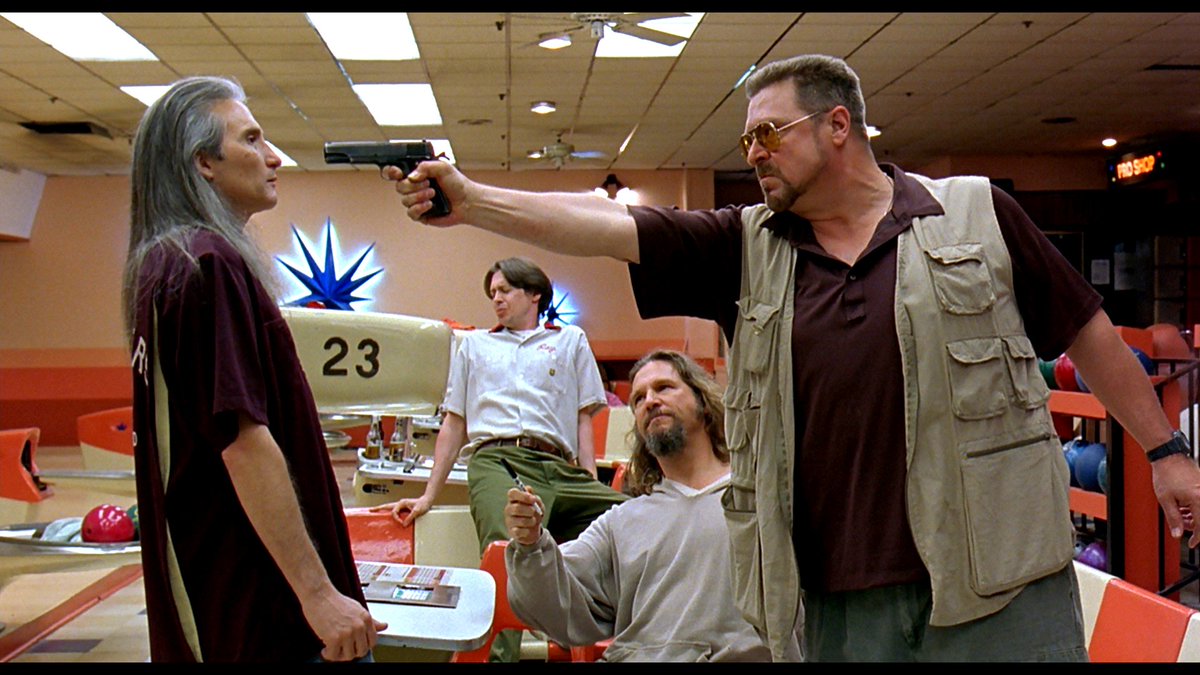
I missed it when Smokey turned 80 on May 6 (hat tip to Traces of Texas). Smokey is Jimmie Dale Gilmore, a singer-songwriter from Texas who has been performing with the Flatlanders since 1972 and been nominated for three Grammys.
For most of us, however, Jimmie is best known as Smokey in The Big Lebowski, his only acting role (other than playing himself in a couple of films). Playing an aging, pacifist bowler he is drawn into a dispute with Walter Sobchak about whether his foot slipped over the line. Smokey's request that the Dude mark his score as 8 triggers a response from Walter, in which the latter prevails and the Dude marks it zero. It is Jimmie's only scene in the movie and it is quite memorable.
Sometimes you just gotta make a stand, because sometimes there's a man . . . I won't say a hero, 'cause, what's a hero? But sometimes there's a man. I'm talkin' about the Dude here. Sometimes, there's a man. well, he's the man for his time and place. He fits right in there. But sometimes there's a man, sometimes, there's a man. Aw. I lost my train of thought there.
And, if you don't agree, well, that's just, like, your opinion, man.
Over the past year, I've watched perhaps 15 episodes of Gunsmoke, the classic CBS Western series that ran for 635 episodes from 1955 through 1975. Though I certainly knew about Gunsmoke growing up, I didn't remember it clearly unlike a number of other TV Westerns I enjoyed as a kid. Researching the background of the series it looks like the reason I didn't have a lot of memories was that for its first 12 seasons it ran at 10pm on Saturdays, too late for me as a child. By the time it switched to 730 or 800pm on Mondays in 1967, I was older and too cool to watch what I considered an "old folks" western.
Until 1955, TV westerns were geared towards a children's audience with shows like Roy Rogers, The Cisco Kid and, my favorite, Hopalong Cassidy. Then, in two weeks that fall, the first "adult" westerns premiered, The Life and Legend of Wyatt Earp (which ran for six seasons) and Gunsmoke.
Gunsmoke was immensely popular over the course of its 20 season run. For the 18 years for which ratings are available it finished as the #1 show four times (all from 1957 to 1961) and in the top ten 13 seasons (1956-63, 1967-73). It also had unusual stability in its cast with James Arness (US Marshal Matt Dillon) and Milburn Stone (Galen "Doc" Adams) in all 20 seasons, while Miss Kitty Russell (Amanda Blake) was there for the first 19. Marshall Dillon's deputies, Chester B Goode (Dennis Weaver) and Festus Haggen (Ken Curtis) were there for 9 and 11 seasons respectively.
From 1955 through May 1961, Gunsmoke was a half hour show and after 1966 it was filmed in color. All the shows I've watched are one hour black & white so between 1961 and 1966.
Watching it now, Gunsmoke reveals itself to be a much more complex and subtle show than I would have guessed. Although its opening featured Matt Dillon drawing his gun on a bad guy, there has been relatively little gunplay in the shows I've seen. The scripts are strongly morally focused, but the characters and dialogue are not simple morality plays (watch for instance, two shows from 1964-5, Gilt Guilt and The New Society).
Added: After initially posting this I watched a half-hour episode from the second season (1956-7), "Bloody Hands", which starts with Matt Dillon killing three outlaws, triggering what we would call PTSD today. Unnerved, Matt rages that there will always be someone else he has to kill and decides he can no longer do it, resigning as Marshall and turning the job over to Chester. A few days later Chester comes to find him, telling Matt a gunman has come into town, killed a bar girl, and no one can stand up to him other than Matt. Dillon initially refuses and then comes this dialogue:
Chester: I been thinkin' lately a whole lot about all this and there's just somethin' that you been forgettin'!
Matt Dillon:
That so.
Chester: Yeah, that's so. It's men like Stanger and Brand, 'cause they got to be
stopped! That's all. They gotta be! I'd do it if I could, but I can't. I
just ain't good enough. Most men ain't, but you are. It's kinda too bad
for ya that ya are, but that's the way it is and there ain't a thing in
the world you can do about it.
The episode ends with Dillon putting on his gunbelt and riding back into Dodge.
Many of the "bad" guys have a sympathetic side and some of the stories end in ambiguous ways, leaving the viewer to speculate on what happens next. While it did not feature a recurring cast of characters like Gunsmoke, I found myself thinking of the similarities between Gunsmoke and The Twilight Zone, shot in similar black and white style, in the use of close-ups, and also telling stories with a point. And just like Twilight Zone, there have been some unexpected twists near the end of some of the Gunsmokes.
Gunsmoke is also unsparing in its depiction of the inhabitants of Dodge City and, in particular, of the struggling settlers trying to carve out a living from the prairie, some honestly, some not so much.
The three main characters are strong and honorable, but they are not pushovers and totally unsuited for TV as it exists in the 21st century. Matt Dillon always finds the right path but does not hesitate to use his size and fists to achieve it, even if involves bending, or sometimes ignoring, the law and remains stoic throughout, rarely giving way to sentiment. Doc Adams is a cranky old guy who does not give an inch, while Miss Kitty, with whom Matt has a long-standing and ambiguous relationship, is the proprietor of a saloon and gambling hall with a hint of a shady past. The lessons provided are delivered roughly with no sugar coating. It is striking to compare it to modern TV which seems to know only two modes, providing gentle and trite lessons via one-dimensional characters or cynical, world weary observations. Gunsmoke, by avoiding both, evokes an America that seems ever more distant in the past, but which might be helpful to revive.
Watching Gunsmoke prompted me to research the era of the TV western, an era I remember as a child, as it peaked during the years when I was between 5 and 15 years old (1956-66) and I watched a lot of them. The peak was 1959, with thirty western series on the three networks and 8 of the top ten rated shows being of the genre. Even Hollywood studios couldn't figure out why they were so popular.
Several of the shows provided career starters for actors who went on to become major movie and TV stars; Rawhide with Clint Eastwood practicing his squint, Maverick, with James Garner pioneering his brand of light comedy, and Wanted: Dead or Alive, starring Steve McQueen and his scattergun.
Some of the others shows I watched:
The Lone Ranger, another big favorite, Wagon Train, with Ward Bond who played in so many John Ford and John Wayne films, Bonanza, the first color western, Have Gun - Will Travel, with Richard Boone (my parents considered this so adult I was only allowed to watch it a couple of times); Bronco, Sugarfoot, Cheyenne, with Clint Walker, and The Rifleman, with ex-Brooklyn Dodger Chuck Connors.
And let's not forget, Bat Masterson with Gene Barry, Death Valley Days, an anthology series running 18 years and 452 episodes, hosted by Ronald Reagan just before he became governor of California, Tales of Wells Fargo, Tombstone Territory, Zorro with Guy Williams, Laredo, Laramie, and Branded with Chuck Connors and its memorable theme song, a series portrayed somewhat fancifully in The Big Lebowski.
Along with Bat Masterson and Wyatt Earp, many other figures of the Old West were portrayed in series of at least 50 episodes including Wild Bill Hickok, Annie Oakley, Jim Bowie and Kit Carson.
There were also a number of hour-long successful "big" westerns, inspired by the success of Bonanza, which premiered in the fall of 1959 - The Virginian, The High Chapparal, and The Big Valley. I didn't care for any of them, even on rewatching The Virginian and The Big Valley recently, though I've become a big fan of Barbara Stanwyck, who stars in The Big Valley, in her movie roles.
Written by Mick Jagger and Keith Richards, this version of Dead Flowers by Townes Van Zandt appears in The Big Lebowski (a THC #10 all-time movie favorite). I prefer the Van Zandt cover to the Rolling Stones original on Sticky Fingers (1971) because of its compelling lassitude. And the video is brilliant.
Van Zandt died in 1997, prior to release of the film. According to Wikipedia, "much of Van Zandt’s life was spent touring various dive bars,
often living in cheap motel rooms and backwoods cabins. For much of the
1970s, he lived in a simple shack without electricity or a phone".
Sometimes a joke is just a joke, sometimes with the Coen Brothers it's also a joke but also something else, and sometimes there's a man . . . now, where was I?
On first seeing Hail, Caesar!, the 2016 film by the Coen Brothers, during its theatrical release, I seriously misunderestimated it. You can find my initial take here.
Watching it on cable a few months later caused me to reassess and move it up a few notches in the Coen oeuvre. This time I caught the underlying themes of faith v science and utopianism v practicality. Here's my second take.
While my reassessment discussed issues of faith I think the film can be more explicitly seen as a Christian parable. Being Jewish I'm out of my theological depth when it comes to Christianity but the Coen Brothers are in the same situation and it didn't stop them, so here goes.
In Hail, Ceasar! Jesus is embodied in Eddie Mannix, the general manager of the studio. He is shown as devoted to his Catholic faith with frequent visits to his confessor. In my prior post I wrote of Mannix:
"He's willing to tackle the tough job at the studio enduring constant
strain, long hours, and separation from his family, sacrificing himself,
rather than take what he sees as a simpler, less stressful role at
Lockheed."
But, it's more than that. Eddie is a man of faith. Both the screenwriter communist study group and Lockheed represent pure materialism. For the communists, materialism is a matter of Marxist creed; there is no place for spirituality in their world. Or, as Baird Whitlock, the dimwit actor so well portrayed by George Clooney, who has been temporarily converted to their creed explains to Mannix:
"These guys were pretty interesting, though. They've actually figured out the laws that dictate, well - everything, history, sociology, politics, morality. Everything. It's all in a book called Kapital."
Here's Professor Marcuse explaining to Baird how it works (sorry for the bad sound synch):
It's a more benign materialism for the Lockheed executive; it's just the world he exists in.
Eddie Mannix is willing to give to Caesar (the studio owner) what is owed but no more. But in doing so he will drive those driven solely by materialism (the communists) from the studio just as Jesus drove the materialists (moneychangers) from the Temple. Art and creativity may generate material goods but they have a spiritual aspect too, as does the very act of creating it, which Eddie explains to Baird after slapping him around a bit:
"Shaddup. You're gonna go out there and you're gonna finish "Hail Caesar!". You're gonna give that speech at the feet of the penitent thief and you're gonna believe every word you say. You're gonna do it because you're an actor and that's what you do. Just like the director does what he does, and the writer and the script girl and the guy who claps the slate. You're gonna do it because the picture has worth and you have worth if you serve the picture and you're never gonna forget that again."
And, after solving the problems of one day at the studio, Eddie returns to church, still struggling with a job offer from Lockheed that promises wealth, security, normal hours, and more time with his family. From the confessional booth:
Eddie: May I ask you something, Father?
Father: Of course, my son.
Eddie: If there's something that's easy . . . is that . . .
Father: Easy?
Eddie: Easy to do, easy to - an easy job - not a bad job, it's not bad. But then there's another job, that's . . . that's not so easy. In fact it's hard. It's so hard, Father, sometimes I don't know if I can keep doing it. But it seems right.
[Silence. Then:]
Father: God wants us to do what's right.
With that advice, Eddie's decision is made. He will stay with the studio, bringing art and creativity in the world though it means dealing with misfits, idiots, gossips, incompetents, prima donnas, and, of course, materialists. He sacrifices his personal happiness, and that of his family, to suffer on our behalf.
Or perhaps he's just a shallow man, afraid of new challenges, comfortable in doing what he does best, perhaps unconsciously avoiding the burden of family duties, all on behalf of creating trifles like Hail, Caesar! to please the public and his boss.
A disquisition by Walter Sobchak regarding the importance of establishing well-defined boundaries for behavior in complex societies with reference to the anarchic consequences that flow from the breaching of said rules without corrective action being taken. Attention must be paid!
"Also, Dude, Chinaman is not the preferred nomenclature, Asian-American, please."
The key scene fromThe Big Lebowski, which sets up the entire rest of the movie. Watch The Dude, Walter and Donnie decide to seek redress for the Dude's peed upon rug (after all, it tied the room together). As a bonus, the beginning of the clip features a song by a recent recipient of the Nobel Prize for Literature.
Before I'm done, faithful readers will have watched the entire movie in snippets.
. . . in which, along with Mr Cobb, appearances are made by Jacques Derrida, Michel Foucault, Willie Mays and Michael Jordan, along with a brief explanation from Walter of The Big Lebowski regarding a key concept.
The burgeoning academic field of "memory" and "memory studies" proceeds along two tracks. The first is exemplified by This Republic Of Suffering(2008) authored by Drew Gilpin Faust, now president of Harvard University, in which she explored how the dead of the American Civil War were remembered by the survivors and the next generation. It examines how and why we choose to remember and shape those memories.
There is a second, trendier and more radical, track that rather than studying the process of memory, seeks to construct new memories. Wilfred M McClay, a professor of history at the University of Oklahoma disapprovingly quotes the views of historian John Gillis (professor emeritus, Rutgers), to the effect that memory has "no existence beyond our politics, our social relations and our histories", adding "We have no alternative but to construct new memories as well as new identities better suited to the complexities of a post-national era". In other words it is the duty of the historian not just to study memory but to construct new memories of the past so as to encourage others to want a future world in accordance with the historian's desire.
. . . the newly dominant theorists within the humanities and social sciences assert that it is impossible to tell the truth about the past or to use history to produce knowledge in any objective sense at all. They claim we can only see the past through the perspective of our own culture and, hence, what we see in history are our own interests and concerns reflected back at us. The central point upon which history was founded no longer holds: there is no fundamental distinction any more between history and myth.
In one sense, the intellectual havoc wreaked on the study of history by the disciples of Jacques Derrida, Michel Foucault and thenihilist approachof semiotics inspired deconstruction would seem to differ from either of the tracks of memory studies described before, but as Windschuttle notes, when combined with the rise of cultural studies the result is what Professor Gillis advocates; the erasure of the past and the construction of new memories consistent with current prevailing academic social theory. (Derrida (L), third baseman, Amarillo, Texas League; Foucault (R), shortstop, Hamburg, Hanseatic League)
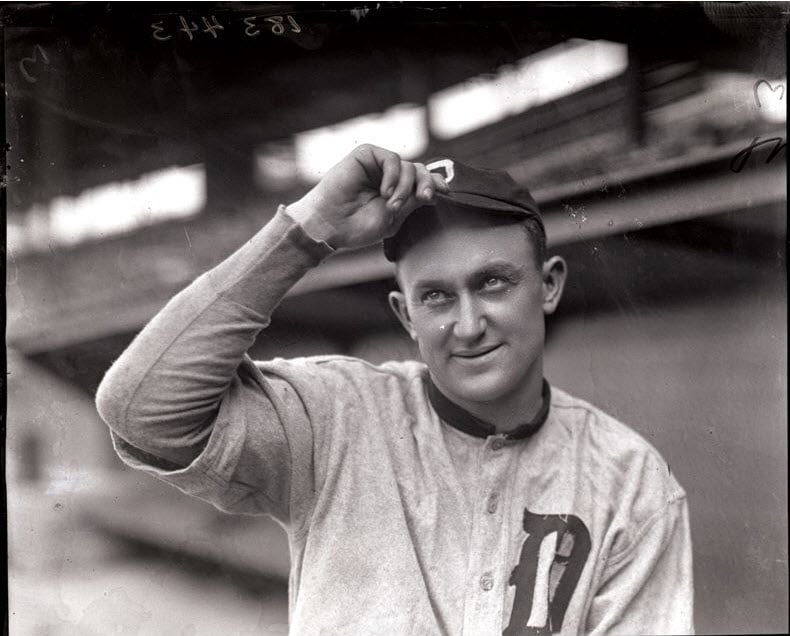
As a dedicated fan of baseball and its history, THC has always known that Tyrus Raymond Cobb, who played from 1905 to 1928, and is still considered one of the five or ten greatest players in baseball history, was possibly a psychopath or at least a sociopath, hated by all his fellow ballplayers, uncontrollably violent (killing at least one man and perhaps as many as three) as well as a virulent racist. In a 2012 post (Take Me Out of the Ballgame), THC wrote of Cobb that he was "a generally unpleasant and violent guy . . he was also a virulent racist (even for a period when racism was not uncommon)".
How did THC come to that conclusion? Well, for one thing, it was in the air. It's the kind of thing that knowledgeable baseball fans say to each other when the subject of Cobb arises. It comes up casually in books on other ballplayers and events; here's Timothy Gay in his biography, Tris Speaker: The Rough And Tumble Life Of A Baseball Legend (2006) which THC just completed reading:
"Cobb . . . was a scary sociopath. The mere sight of black people so filled him with rage that, on several occasions, he brutally pistol-whipped African American men whose only offense was to share a sidewalk with him."
Cobb was not always considered an insanely violent figure from a Gothic horrow show, though he'd always had a reputation as a tough, fearsome ballplayer, known for getting into fights. The turning point was sportswriter Al Stump. In 1960, Stump was asked by Cobb to work with him on an autobiography published soon after Ty's death on July 17, 1961,My Life In Baseball: The True Record. My Life presented Cobb as he wished to be remembered but in the December 1961 edition of True Magazine, Al Stump began publishing a very different account of the recently deceased ballplayer entitled Ty Cobb's Wild 10-Month Fight To Live:
The article, published in three
installments, depicted Cobb as feisty and ill-tempered as ever, downing
painkillers and scotch, and living in his Atherton, California, mansion
without electricity because of a minor billing dispute with Pacific Gas
and Electric Company. “When I wouldn’t pay,” Stump quoted Cobb as
saying, “they cut off my utilities. Okay—I’ll see them in court.”
Carrying more than a million dollars in stock certificates and bonds in a
paper bag (he’d gotten rich investing in Coca-Cola and General Motors
stock), as well as a loaded Luger, Cobb checked into hospitals and
berated doctors and staff for treatment, only to demand that Stump
smuggle in liquor for him or sneak him out on late-night visits to bars
and casinos. Stump said he complied with Cobb’s wishes because he feared
for his own life. (Smithsonian.com, August 30, 2011)
Stump also claimed Cobb told him: “In 1912—and you can write this down—I killed a man in Detroit.”
The True magazine article won the Associated Press award for the best sports story of 1962. Biographies in the intervening years, while not as outrageous in style as Stump's True article, reinforced the image it created - the best known being Ty Cobb, by Charles Alexander, published in the 1980s, which emphasized Cobb's racism.
Three decades later, Stump, who always claimed My Life In Baseball was a "cover-up", went back to the well again to write a full biography of Cobb which contained even more lurid tales, Cobb: The Life And Times Of The Meanest Man Who Ever Played Baseball (1994), a book in which a later biographer describes Stump as portraying Cobb as a "monster in superstar's clothing". It was this book that became the basis for the 1994 movie, Cobb, starring Tommy Lee Jones and directed by Ron Shelton (who also wrote and directed the best baseball movie ever made, Bull Durham). The movie depicts Cobb as a vicious, racist, violent, crude, out of control and a generally horrible person who commits a murder and, as a 74 year old suffering from cancer, attempts to rape a Reno cocktail waitress. It certainly influenced THC; he left the theater thinking it was probably a bit exaggerated but seemed to capture the essence of the man.
By the time Charles Leerhsen began researching his terrific 2015 biography, Ty Cobb: A Terrible Beauty, which THC highly recommends, the Cobb as monster image was embedded in our consciousness. Leerhsen recounts that when he spoke with Ron Shelton about his film, Shelton confidently assured him that "It is well known that Ty Cobb may have killed as many as three people".
Possibly contributing to all this was that Cobb was a southerner from Georgia (a rarity in baseball in those days, dominated by players from the northeast and midwest), raised during the peak of Jim Crow and lynchings, known to have quite a temper and so those tales we all heard fit into our preconceptions of what someone from that milieu must have been like.
Ty Cobb: A Terrible Beauty is proudly revisionist and achieves its goal in forcing the reader to rethink their views of Cobb. Along with being a straight forward biography it is also a personal assault on the credibility of Al Stump, with the author scathingly commenting "The only things coauthor Al Stump explored deeply were Cobb's reserves of Scotch and bourbon". The book is well researched, using original sources and to the extent THC has been able to double check citations and based on his review of other baseball historian's reactions, it appears accurate.
Cobb was fiercely competitive, reacted quickly to any perceived insult, intimidated fellow ballplayers, fought often and was disliked by many, but did not kill anyone, was not an attempted rapist, didn't wave a gun at hospital staff during his final illness, didn't pistol whip African-American men and had no antipathy towards African-Americans beyond the nonetheless appalling normal amount of racism of white Americans in that era. He was equal opportunity when it came to violence. While in THC's view, Leerhsen occasionally goes too far in trying to rehabilitate Cobb - there are some specific instances in the book where he tries too hard to absolve or explain away Ty's behavior - THC is willing to grant the premises in the first sentence of this paragraph though after a while the reader gets it - Stump made a lot of stuff up - so he could have eased up on the Stump-bashing once he established that point. But there was also a core of violence in him, and many who encountered him, including fellow ballplayers, feared Ty Cobb. And yes, maybe he was a little crazy though he clearly does not meet the definition of a psychopath or sociopath.
While reading the book, two athletes kept coming to mind: Willie Mays and Michael Jordan.
One of the best aspects of the book is it rekindled THC's interest in Ty Cobb, the ballplayer who at the time of his retirement, had more hits, doubles and stolen bases than anyone, who still holds the record for highest career batting average (.366) and in the first election to the Hall of Fame in 1936 received more votes than Babe Ruth, Walter Johnson, Honus Wagner and Christy Mathewson. Leerhsen brings his accomplishments and, more importantly, his style of play to life. It must have been thrilling to see the man in his prime and as exciting as it is to read about it, one is left wishing we had more than the few surviving fragments of film of Cobb in action. In particular, his daring and disruptive base running reminds THC of reading (and watching the limited video) about the base running exploits of Willie Mays, who decades later was greatly admired by Cobb. The book is full of vivid and exciting descriptions of Cobb's disruptive style of play and is worth reading just for these. Here's one example from the 1911 season:
"Cobb singled, went all the way to third on Crawford's routine infield
groundout, 'easily beating Pat Newman's hurried and inaccurate throw',
then trotted home on Jim Delahanty's sacrifice fly. Two innings later,
he turned a badly handled infield roller into a double, went to third on
a fielder's choice, and scored the tying run on a Delahanty single . .
. The following week . . . Cobb had three steals, including a swipe of
home that succeeded despite the four Clevelanders who had him trapped in
a rundown - until he spun away and slide across the plate . . . ".
Leerhsen recovers for us the many statements of admiration for Cobb from his fellow ballplayers. Few considered him a friend but they did respect him. As George Sisler remarked "The greatness of Ty Cobb was something that had to be seen and to see him was to remember him forever", Explaining why Cobb had fans in every rival city, famed sportswriter Heyward Broun wrote: "because he gave them more for their hard-earned ticket than any man alive or dead".
To understand Cobb as a student of the game, listen to his insights when interviewed in 1930 by Grantland Rice, the most famous sportswriter in America in those days:
THC thinks Leerhsen correct in his observation regarding Ty's approach to the game that "the role he assigned himself as an offensive player -
to be the cause of worry in the opposition. He did this not by running
wild on the base paths but by seeming to run wild. " Ty believed it was useful to be wild, unpredictable and a bit crazy out there. The trouble was two-fold; it led players and other watching to think he really was that way and, in fact, he really was that way even though he didn't think of himself that way.
The resemblance to Michael Jordan is in his obsessive competitiveness. Jordan thrived on the rage he built upon encountering any slight, real or imagined, as did Cobb. Both were hypersensitive to criticism, even if not meant as criticism. In his lunatic and brilliantly entertaining epic, The Book Of Basketball, Bill Simmons describes Jordan as having a "competitive disorder" and being "pathologically competitive". Simmons compares the men he considers the two greatest players in NBA history, Bill Russell (#2) and Jordan (#1) this way:
Russell embraced his biggest foe [Wilt Chamberlain], befriended him and allowed him to shine in meaningless moments, even as he was secretly ripping out the guy's heart without him realizing it. Jordan settled for tearing out hearts and holding them up like the dude from [Indiana Jones and the] Temple of Doom. He wanted his rivals to know it was happening. That's what he loved most - not the winning as much as the vanquishing. Russell just loved winning.
When Leerhsen writes of A's manager Connie Mack warning his players "Don't get Cobb mad" it brings to mind Simmons comment on Jordan:
Jordan's opponents learned to leave him alone by the mid-nineties, leading to a phenomenon unlike anything else we've witnessed before of since: Michael became basketball's version of a sleeping tiger. In a league full of smack-talkers, chest thumpers and yappers, incredibly, he remained completely off-limits.
Simmons tells of an exhibition game when a rookie started talking smack to Jordan and his coach pulled him aside with the admonishment, "Never talk to him. You hear me? That's the one guy you don't talk smack to!"
Cobb had notoriously shaky relations with his teammates though by 1912 Leershen tells us "They had come to realize that for their own mental health, they just
had to accept that he'd always be drawing lines in the sand,
overreacting and generally making things more complicated".
Jordan was the same way, brutally demanding and grating on his own teammates (you can read more about that in The Jordan Rulesby Sam Smith). And, like Cobb, Jordan could sound unhinged at times, ranting about the dark forces arrayed against him; even in his induction speech at the Basketball Hall of Famehe couldn't let it go; Simmons calledit"an off-the-cuff, uncomfortable, petty, biting, rambling, vindictive,
score-settling speech during what's meant to be nothing more than a
celebration". On second thought, even Cobb wouldn't have gone as far as Jordan in his HOF speech. (Charles Conlon's famous photo of Cobb stealing third base in 1909)
The reader is left with the impression that Cobb found playing in the majors to be a grind. Ty was very smart, observant and a constant student of the game, always looking for a little edge. "I believe in putting up a mental hazard for the other fellow", he said, " Every play was a problem of some sort". He didn't engage in the partying and drinking common among ballplayers of that era (though he was a gamber), concentrating on thinking about the game and planning his next gambit. Fielder Jones, manager of the St Louis Browns, remarked of Cobb, "Every time we have a [team] meeting I hold him up as an example of what quick thinking and intelligence will do for a man."
"He fought for every point and fought his fellows if they
did not battle as hard for victory as he had", wrote sportswriter Hugh Fullerton, "I sat behind Cobb on the
clubhouse porch . . . watching him instead of the game. He moved
before each pitch, and leaped in one or another direction each time a
ball was thrown, never still for an instant and always tensely observant
of every move on the field."
The basics of Cobb's personality were in place before he joined the Detroit Tigers in 1905. Leerhsen's research on Cobb's family and upbringing brings us a new perspective on that personality.
Cobb's father, William Herschel (WH) Cobb was descended from hill country
Cobbs in North Carolina. WH's grandfather, William Alfred Cobb "was a Methodist
minister who tested the patience of his parishioners by preaching to
Indians and white alike, then pushed the congregation around the bend by
preaching against slavery" which led to being run out of the county in 1848. Ty's grandfather, John Franklin Cobb, was an
antislavery Republican.
Unusually for those times, Cobb's father was a college graduate, first in his class, and went on to enter politics. His attitudes about race were unusual for that time and place. In 1901 at a meeting of the Georgia Agricultural Society he explained, "History teaches that three systems of controlling people have been tried: slavery, serfdom and education and that the first two have been dismal failures."
Elected to the State Senate, WH Cobb opposed a bill that would have forbid tax revenue generated by whites from being used to pay for Negro education stating, according to Leerhsen, "the negro had contributed to the upbuilding of the state, and that he
had an interest in our government. . . He said that we ought to be
generous with the negro and help him to become a useful and helpful
member of society". The proposal was narrowly defeated.
WH Cobb later became editor of his hometown paper, the Royston Record, owned by a self-described abolitionist and printed on the owner's brother's press, a man who boasted of having been "the only man in Georgia who voted for Abraham Lincoln."
Obsessed with baseball, at an early age Ty displayed the temperment problem which was to plague him for his entire life. In 1901, his father, whom Ty idolized, wrote his 15-year old son advising him to "Conquer your anger and wild passions that would degrade your dignity and belittle your manhood."
And then, while playing in the minor leagues and only three weeks before being elevated to the majors by the Detroit Tigers, Ty's mother shot and killed his beloved father on the night of August 8, 1905. What precisely happened that night remains murky more than a century later. What is known is that WH Cobb had told his much younger wife that he was leaving to visit an outlying farm and would not be returning home that night, but he came back that evening and was outside the family home when his wife shot him from inside. Unlike the portrayal in the Stump book and the movie Cobb, his father was killed by a pistol shot, not a shotgun, and was on the ground, not second floor balcony.
Rumors were rampant that Amanda Cobb had been having an affair and WH's announced overnight visit to the farm was just a ruse to obtain evidence of her infidelity. His family demanded justice and Amanda was indicted for voluntary manslaughter with her husband's family telling people they would present evidence of her cheating at trial. However, when the trial occurred in March 1906 (with Ty in attendance), no such evidence was presented and in a single day it was over and Amanda acquitted. Ty never spoke publicly of the matter during the rest of his life.
It was with this additional burden that 18-year old, sensitive and quick to take offence Ty Cobb entered the major leagues. The game he entered was a much more violent one than we are accustomed to today. One observer counted 355 assaults on umpires by players and fans in the course of the 1909 season and brawls between rival teams and even teammates were frequent occurrences.
The major league life was wild and woolly on a daily basis. As Bill Veeck noted years later:
"Wake up the echoes at the Hall of Fame and you will find that
baseball's immortals were a rowdy and raucous group of men who would
climb down off their plaques and go rampaging through Cooperstown,
taking spoils, like the Third Army bustling through Germany".
One of the normal components of that life was hazing by veterans of rookie players. This could often be brutal, but in Leerhsen's account, "What seems certain is that Cobb's hazing was harsher and went on for far longer than the typical rookie's". In 1906 it got so bad manager Bill Armour took the unusual step of intervening to stop the harassment of the Tigers young star.
Ty's background and personality contributed to triggering the intense hazing. He was a southerner in an ethnic northern game, in an era where regional differences were more pronounced than today. He was relatively well-educated and well-read compared to most ballplayers - on his first visit to Washington with the Tigers, Ty visited the Library of Congress (and he was an astute investor and businessman, becoming the first millionaire ballplayer by the time he retired). He was just different in his attitudes. Sportwriter EA Batchelor observed "that Ty came from a higher social plane than had spawned the bullies made them all the more determined to drive him off the squad". And further feeding his antagonists was that it quickly became clear to them that their needling, pranks and insults really got to Cobb. Leershen writes, "He never rolled with life's punches, rather, he
led with his chin . . . Sticks and stones broke his bones and names
would always harm him". In the view of his teammate, future fellow Hall of Famer and long-time rival, Sam Crawford "He came up with an antagonistic attitude, which in his mind turned any little razzing into a life-or-death struggle".
It all led to Ty's still mysterious absence from the club for six weeks late in the season for which, in Leerhsen and others, the likely explanation was an emotional collapse leading to hospitalization. Whatever happened, Ty's innate character combined with his terrible first full year in the major leagues made for combustible mixture. As Grantland Rice, a friend and admirer, wrote years later:
When I first met Cobb I found him to be an extremely peculiar soul, brooding and bubbling with violence, combative all the way, a streak, incidentally, he never lost.
Throughout his career, though much less after he retired, he reacted quickly to any perceived insult. In commenting on his penchant for fighting Leerhsen writes:
. . . he provided such a dizzying array of examples to choose from -
fights with complete strangers, fights with teammates, fights with rival
players, fights with hotel employees shopkeepers, and rowdy cranks
[fans] . . .
The author goes on to provide an account of his behavior over a short period during the 1916 season; fighting with Buck Herzog of the Giants both on and off the field; an incident in Comiskey Park when, angered by a called third strike, he threw his bat into the stands; flinging a handful of dirt into
the face of a Senators pitcher; and being pulled out of stands
in St Louis by teammates and police before he could pummel a heckler.
There are also the stories of Cobb sharpening his spikes and deliberately spiking other players. For the most part, Leerhsen debunks that successfully but he also makes it clear that as an opposing player you had best not get in what Ty thought was a space he had a right to and quotes a number of players to the effect that Cobb did not deliberately injure other players. As Burt Shotton put it:
"Cobb was the roughest, toughest player I ever saw, a terror on the base
paths. He was not dirty, though. I never saw him spike a player
deliberately. But if you ever got in the way of his flying spikes,
brother, you were a dead turkey."
A story told by Ossie Bluege best captures Cobb's personality on the field. Early in his career, Ossie, third baseman with the Washington Senators from 1922 to 1939, encountered Cobb, then in his late 30s when Ty made a base running error and was caught dead between 2nd and 3rd. Bluege came over to tag him when:
". . . he just
threw himself at me with spikes in the air. He didn't slide. He just
took off and came at me in midair, spikes first, about four or five feet
off the ground, so help me just like a rocket. He hit me in the upper
part of the arm, and cut my shirt sleeve". Bluege hung on to ball.
Next day, Cobb comes up to him during batting practice "sweet as apple
pie".
"Son", he said "I hope I didn't hurt you"
"I'm alright", I said
"Good",
he said. Then the look in his eyes changed just a little, his face got
mean, and he said, "But remember - never come up the line on me."
It was being potentially humiliated in front of everyone as a result of his baserunning mistake that led to the spiking. Cobb simply could not abide the embarrassment.
A former A's pitcher, Rube Bressler, interviewed in The Glory Of Their Times, best summarized Cobb's approach to the game:
"'I never saw anybody like him. It was his base. It was his game. Everything was his. The most feared man in the history of baseball.'"
As to race, Leerhsen does not uncover anything unusually virulent about Cobb's attitude. It is also probably safe to assume that while Leerhsen cannot find any
statements by Cobb on race during his playing days, he likely had the
same attitudes of most whites that blacks were inferior. He did have fights with blacks, but then he fought with everybody. Moreover, the author debunks the motivating factors in several of these instances and, regarding two of the most brutal cases, discovered that Cobb's opponent were white and not black as had always been reported. As an aside, the book reports the typically awful and bigoted way blacks were reported on in the white media of the time.
Whatever his attitudes about race when he was younger, by 1952 he was telling a reporter:
"I see no reason in the world why we shouldn't compete with colored athletes as long as they conduct themselves with politeness and gentility. Let me say also that no white man has the right to be less of a gentleman than a colored man. In my book, that goes not just for baseball but for all walks of life".
He praised Roy Campanella as a "great catcher" and after Campanella was paralyzed in a auto accident and the Dodgers played a benefit game for him, Cobb wrote Dodger owner Walter O'Malley thanking him "for what you did for this fine man". He also called Willie Mays "the only player I'd pay money to see". (Cobb with Don Newcombe, 1950s)
Aware of his reputation for toughness and how people regarded his behavior, Cobb was forever protesting he was misunderstood but seemed incapable of fundamentally changing that behavior. "It wouldn't be far off the mark to say that Cobb spent the first half of his life trying to seem unhinged" Leerhsen comments, "and the second half explaining he had been acting deliberately the whole time".
He was consistent to the end. Leerhsen interviews someone who was a medical student at the time of Cobb's last hospitalization at Emory Hospital in Atlanta and with him daily for those last two months. He confirms that Cobb did not keep a gun in his room nor cash and securities on his night stand, contrary to Al Stump's assertions but goes on to add, "He was a real redhead with a hair-trigger temper" who couldn't tolerate
incompetence or "the lack of that drive for excellence that was so much
a part of the Cobb philosophy. He was an unusual man with a keen mind
and yet he could never put up with people who didn't, like him, strive
to excel."'
While Ty Cobb: A Terrible Beauty, effectively debunks the worst of the Cobb stories and recreates the vitality and excitement he brought to baseball, he remains someone you might not want to invite to your dinner party and there is an underlying sadness to the tale. "He was a man who needed a tremendous amount of love", one of his grandchildren told Leerhsen ,"but who nevertheless pushed everyone away".
One of the big things that the movie Cobb got wrong about the man is the Tommy Lee Jones portrayal of him as someone who was arrogant and wanted crowds and opponents to hate him. InThe New Bill James Historical Baseball Abstract (2001), James may have come closer to the truth, writing of photographs he'd seen of Cobb with a crazy look on his face:
It is not an angry look; it is, rather, a look of acute embarrassment, a look of inadequacy. Ty Cobb's racism and his anger, I believe, were fueled not by smugness or even resentment, but by an unusually intense fear of his own limitation. No one is more macho than a man who feel inadequate; no one walks straighter than a man who is half drunk. When Ty Cobb felt threatened he lashed out at the world. He felt threatened a lot - but as long as he wasn't challenged, he was a very nice man.
Well, maybe Bill went a bit far with that last phrase. Now, go read Leerhsen's book.
If William Shakespeare had written The Big Lebowski. Written by Adam Bertocci and performed by Brandon Hardesty, both of whom had a little too much time on their hands. Brilliant.
From Elvis Costello and only available on The Big Lebowski soundtrack.
She was smitten from the first
By a curious fellow
She said I love the way you talk
And with a flounce she announced it
I love the way that you pronounced it
"Marshmallow"
Well she liked to sing along
To her favourite song
From the year that she was born
See how mysterious her fate is
She had to get born in the eighties
So speak to me, just like you should
Then we can do those wicked things
And if you want, we'll make it good
Before my mood swings
Well he looked like one of those
Who would take off his clothes
Like you would peel a tangerine
No one's been known to decline this
Once he has found out what your sign is
So speak to me, just like you should
Then we can do those wicked things
And it you want, we'll make it good
Before my mood swings
Inspired by Joe Posnanski's recent post onSandy Koufax and anobservationbyBill Jamesa few days ago about Sandy and Dazzy Vance.
Sandy Koufax never pitched in or won a major league game after he turned 30 when his career was ended by an elbow injury.
Dazzy Vance's major league career was derailed at the start by an elbow injury and he did not win a major league game before he turned 31.
Both combined overpowering fastballs with devastating curves.
Both are in the Hall of Fame.
They are the two greatest pitchers in the history of the Dodgers (though Van Lingle Mungo still has the best name and definitely thebest song of any Dodger pitcher).
Arthur Charles Vance was born in rural Iowa in 1891 and raised in Nebraska. He began his professional baseball career in 1912, briefly reaching the majors in 1915 (with the Pirates and Yankees, going 0-3 in 30 innings with an ERA of 4) and again in 1918 (with the Yankees, pitching only 2 1/3 innings with an ERA of 15). Throughout this time he was plagued by arm problems and by 1920 seemed destined never to return to the majors.
As the story goes (please refer to Official Policy Of This Blog) during the 1920 season, while in a poker game in New Orleans, Dazzy banged his elbow on the table and felt intense pain. The doctor he consulted performed some type of surgery on his elbow (Bill James speculates he removed floating bone chips) giving Dazzy immediate relief and his arm never gave him trouble again.
In 1921 Dazzy won 21 games in the minors and the next year his contract was purchased by the Brooklyn team, then known as the Robins after their manager Wilbur Robinson. He was an immediate sensation and over the next ten years (ages 31 to 40) he was spectacular in an era when slugging had taken over the game and the Robins, or Dodgers as they became known later in the decade, were consistently mediocre.
Over those ten years, Dazzy won 165 games, leading the league in ERA 3 times, in FIP (fielding independent pitching) 7 years and in shutouts on 4 occasions. He also led the league in strikeouts seven times, in WHIP walks + hits per inning) three times, in Hits/9 innings 4 times, strikeouts per 9 on 8 occasions and strikeout/walk ratio 8 times.
His greatest season was 1924, when his won/loss record was 28-6 with an ERA of 2.16 and striking out 262, impressive anytime but even more so in the context of the times. His ERA was lower by more than half a run than the next best pitcher and the 262 Ks was a staggering total since the runnerup had only 135 and no one else in the league even reached 100. All things considered and adjusted for the offensive onslaught it may have been one of the ten best pitching performances in history.
In 1930, 39 year old Dazzy had a record of only 17-15 but his ERA was 2.61 with the next closest being 3.87 and he still led the league in strikeouts in a year in which the National League had an average of more than .300!
Dazzy pitched until 1935. He entered the Hall of Fame in 1955 and died in 1961.
------------------------------------------------------------------------------------------------
Sanford Koufax was born in 1935 and raised in Brooklyn and Long Island. The 19-year old was signed by the Dodgers after his freshman year of college at the University of Cincinnati. Head Dodger scout, Al Campanis said:
There are two times in my life the hair on my arms has stood up. The first time I saw the ceiling of the Sistine Chapel and the second time, I saw Sandy Koufax throw a fastball.
Considered a "bonus baby" because he signed for more than $4,000 the Dodgers were required to keep him on their major league roster for two years so Sandy never pitched in the minors. He spent most of those two years (1955-6) on the bench only pitching sporadically. When he did he struck out a lot of batters and walked a lot of batters. Over the next four years he was in and out of the starting rotation, showing flashes of brilliance (striking out 18 in a game in 1959) but often struggling with his control.
It finally came together in 1961 and for the next six years Koufax was phenomenal. He won 129 games, losing only 47, leading the league in ERA 5 times, FIP every year, shutouts three times and strikeouts on 4 occasions. He also had the best WHIP in four years, H/9 innings and K/9 innings five times and in strikeout/walk ratio three times.
Koufax was also surrealistically dominant in low-scoring games. Years ago, Bill James researched Sandy's performance in 1963 and 1964 in games where the Dodgers scored 1, 2 or 3 runs. THC did the same for the 1965 and 1966 seasons (thank you, Baseball-reference.comwhich is the source for all stats used in this post). During those four seasons Koufax went 41-17 in those games (.703 winning percentage), an astounding achievement (although the specific averages vary depending upon the era, at all times in baseball history a pitcher getting one, two or three runs in support will lose more than 60% of the time). In the 17 games he lost Sandy gave up more than three runs on only 6 occasions and only once gave up as many as six.
And if Sandy got more than three runs of support? In 1965 and 1966 when getting more than three runs Koufax won 30 games and lost only one. Yes, you are reading that correctly. Yes, it was a hitting poor era but even in that context it is a mind-boggling accomplishment. Was Sandy helped by having as his home-field pitching friendly Dodger stadium? Yes, but he also had the lowest-road ERA during that period.
Of course, as an astute THC reader, you are probably asking as you read this; "Yes, that seems to be impressive but how did Sandy's peers Juan Marichal and Bob Gibson perform under those circumstances?" A very good question, and THC will embark on a further research project and report back on the results.
During those last two seasons Koufax pitched in constant pain. He began having elbow problems in early 1965 and was told he was risking the use of his left arm if he continued pitching. He and the team doctor embarked on a treatment program to keep him going as long as possible.
His regimen for those two seasons started by taking Empirin with codeine before the game and after the fifth inning. He also took butazolidin, a very powerful non steroidal anti-inflammatory drug which was later banned for human use in the U.S. and U.K. because of its dangerous side effects. Sandy would also cover his upper body in capsaicin ointment before pitching. Capsaicin is the active ingredient that gives chili pepper its potency. In Jane Leavy's wonderful biography, Sandy Koufax, she tells of a rookie mistakenly putting on one of Koufax's uniform tops before it had been laundered and running into the clubhouse screaming as he began to feel the effects of the capsaicin. No one could understand how Koufax could stand it - actually it smelled so much no one wanted to stand near him. At the end of each game Sandy's elbow would turn black swelling up to twice its size and he would soak it in ice. Finally, near the end of the 1966 season he was told he would permanently lose the use of his arm if he continued leading to his retirement at the end of the season.
Elected to the Hall of Fame in his first year of eligibility, Sandy is currently a Special Advisor to the Los Angeles Dodgers.
And, of course, THC will always remember Koufax refusing to pitch the opening game of the 1965 World Series because it was Yom Kippur and then coming back to beat the Twins in Game 5 and pitching a shutout on two days rest to win Game 7 and the series, a moment immortalized in The Big Lebowski (everything on THC leads back to The Big Lebowski) by Walter Sobchak as "3,000 years of beautiful tradition from Moses to Sandy Koufax".
----------------------------------------------------------------------------------
Now it's time for some ultimate Fantasy Baseball. Let's take Koufax and Vance at their peaks and combine them into Dazzy Koufax (DK). It works because one retired at 30 and the other didn't win a game till he was 31. We end up with 16 seasons (ages 25-40) and a record of 304 wins and 165 losses with 3490 strikeouts. Dazzy Koufax's WAR (Wins Above Replacement, a measure of relative value) is 107.2, placing him #7 all-time, just behind Lefty Grove and just in front of Tom Seaver. For their entire careers, ages 19 to 44, DK racks up 362 wins, 4441 strikeouts, and a WAR of 116.
Those are career numbers, but this tells you how terrific DK would have been on a year to year basis as he would have led the league in the following categories over the 16 years:
On this day in 138AD the Roman Emperor Hadrian named Antoninus Pius as his successor. Later that year, Hadrian died of natural causes, and Antoninus reigned for the next 23 years. Antoninus is still remembered as one of the few "good" Emperors and had a mostly peaceful reign, dying of old age in 161AD, leaving Rome to his successor Marcus Aurelius (mostly known today for being played by Richard Harris in the movie Gladiator).
ON THE OTHER HAND:
On this day in 50AD, the Roman Emperor Claudius named Nero, the 14-year old son of his third wife, Agrippina, as his successor. Four year later Claudius died, poisoned by Agrippina, according toTacitus. Nero ascended to the throne, killing Brittanicus, Claudius' son by his second wife and later (again according to Tacitus) his own mother, Agrippina. Nero became one of Rome's most despised Emperors and was removed by a rebellion in 68AD in which he committed suicide.
"The Dude abides. I don't know about you but I take comfort in that. It's good knowin' he's out there. The Dude. Takin' 'er easy for all us sinners. I sure hope he makes the finals."


 (Derrida (L), third baseman, Amarillo, Texas League; Foucault (R), shortstop, Hamburg, Hanseatic League)
  (Charles Conlon's famous photo of Cobb stealing third base in 1909)
 (from
(from  (Cobb with Don Newcombe, 1950s)
 (from
(from