Showing posts with label Rome. Show all posts

Friday, June 26, 2026

The Transformation Of Rome

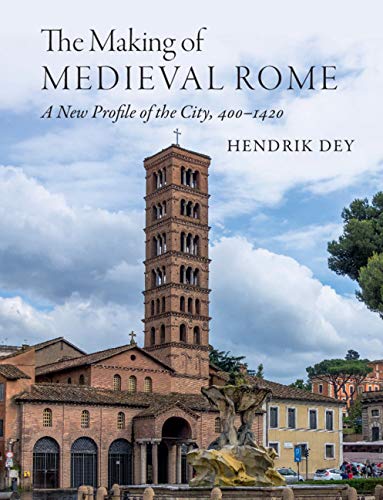
The Making of Medieval Rome: A New Profile of the City, 400 – 1420 

 The 2015 post, Belisarius Enters Rome, discussed the decline and slow rise of the city of Rome from the 4th to the 19th centuries.  Most prominent of the sources cited for the late Empire and early Medieval periods was Richard Krautheimer's Rome: Profile of a City, 312-1308, published in 1980.  Krautheimer's work is still highly regarded but over the past 40+ years a great deal of new archeological work in Rome on its formerly neglected medieval period has been conducted, along with a reanalysis of the written sources, and the findings change some of the picture we'd previously had, and which is reflected in my earlier post.  In particular, the timing of the key periods of transition from the city of the Caesar's to today's city has changed from the "traditional" explanation of why when looking at the ancient monuments, a visitor is often looking down into an excavated area ten or more feet below street level.

I prefer the cover of Krautheimer's book!

Rome 

I find it fascinating when reading, or visiting Rome, to realize how many layers of history are present both visible and below our feet. 

Hendrik Dey's 2021 book, The Making of Medieval Rome: A New Profile of the City, 400-1420, incorporates these new findings and builds upon his 2011 work, The Aurelian Wall and the Refashioning of Imperial Rome, AD 271-855, which I read in 2022. 

The Making of Medieval Rome and Belisarius Enters Rome have the same starting place.  Dey reminds us that from the 2nd century BC through the 4th century AD, Rome "was the most populous city outside of China that the world had ever seen" and that until the 18th century no European city would rival it in size and population.  He then notes that a Roman from 200 AD would, in 600 AD, see "a place transformed beyond recognition, and wept to see it". 

For centuries the city was dominated by ruins, its inhabitants living, around, within, and on top.  New buildings, including churches, were built from recycled stones, bricks, columns, and fragmented marble.  The lime for the mortar needed for construction was created by melting marble and limestone blocks from the imperial era.

The inhabitants, who for a thousand years never amounted to more than 5-10% of the number during the imperial era, were scattered across the landscape within the Aurelian Walls. 

Although the city's population had begun to decline in the 4th century and further after its sack by the Goths in 410, there was some rebound after the sack with the population by mid-5th century at perhaps 350,000. Dey dates the tipping point of steep decline to the aftermath of the Vandal sack of 455, after which there is evidence of an accelerated pace of building abandonment and decay.  The ability to recover was also degraded as the inflow of taxes from the rest of the Empire, along with grain from North Africa and the steady flow of immigrants into the city all ceased.  By the end of the century the population may have been reduced to 50,000.  From then, until at least the 15th century, Dey estimates the population never exceeded 50-60,000 and may, at times, have been a low as 20-30,000.

Though the situation was somewhat stabilized during the reign of Theodoric the Great (489-526) there was awareness that the days of glory were past.  Theodoric's chancellor Cassiodorus marveled:

It is clear how great Rome's population must have been, the vast enclosure of the city walls, the sprawling embrace of the spectacle buildings, the marvelous size of the baths, the numerousness of the grain mills specifically dedicated to feeding the people. 

But, as Krautheimer noted in his book;

Try as Cassiodorus might, his efforts to halt the erosion were in vain.  Sewers were in need of repairs. So were aqueducts . . . The public granaries had 'collapsed through old age'. . . Bronze statues all over were being looted '. .  nor are they mute; the ringing sound they give forth under the blows of thieves . . . wakes the dozing watchman.'  Marble, lead, and brass were looted from public buildings . . . Temples, Cassiodorus complains, 'have been handed over to spoliation and ruin' . . . Many of the great mansions, too, had been abandoned . . .    

In the wake of the Gothic Wars of 535-554, which saw the Byzantine reconquest of Italy, Dey disagrees with Krautheimer, about the strength of the role of the papacy in governing the city.  According to Dey, it was the Byzantine civil administration which controlled the city, though the papacy was becoming stronger during that period.  The Byzantine state owned the city's public architecture and was responsible for its maintenance and that of the public works, including the aqueducts.

While the pace of construction, reconstruction, and maintenance was less than that of earlier centuries, the quality of the work by a still functioning building industry continued until the last decades of Byzantine rule in the mid-8th century. 

In Belisarius Enters Rome I wrote:

A transformed city emerged from the wreckage of the Gothic Wars in the later 6th century, with a much diminished population concentrated along the Tiber River, particularly on the former Campus Martius on the east bank, and in the Travestere and the area that later became the Vatican on the west bank, where water was more readily available (referred to as the abitato).  Large tracts of the ancient city, including the Forums, the hills (including the Palatine on which the Imperial Palace was sited), and the area around the Colosseum, were mostly abandoned except for the farms and vineyards that had sprung up among the ruins and for the churches and monasteries scattered among the ruins, most prominently the Lateran in the far southeast of the walled city, which until the 15th century was the seat of the Papacy; an area known as the disabitato.  

In contrast, Dey reports the concentration of population within what Krautheimer referred to as the abitato occurred no earlier than the 11th century.  For the five hundred years after the Gothic Wars, the much diminished population was scattered more broadly across the city's landscape.  Dey writes:

There is now broad consensus that Rome's remaining tens of thousands of inhabitants tended to collect in settled 'islands" scattered across much of the intramural area and separated by more or less vacant stretches of abandoned buildings and ruins, some of which sprouted gardens and orchards and pastures. . . . Proximity to main roads was desirable . . . Running water from surviving aqueducts was also important.

Dey goes on to note that the excavations of the past forty years have revealed that during the Byzantine period the population was not as impoverished as previously thought.  Mediterranean trade routes still operated, there is significant evidence of imported tableware and ceramic, and of still-existing local manufacturing capabilities.

The significant change came in the 8th century with Byzantine support reduced as the empire came under more pressure from the Arab onslaught and the end of the Mediterreanan trade with the Arab conquest of North Africa.  It was only that then Rome became a state ruled by the popes, and the papacy began investing more in public buildings and infrastructure. 

Later in the 8th century, wealth began to flow back into the city, much from donations from the Frankish kingdom and from the agricultural lands and cities outside Rome acquired by the papacy.  With these resources the papacy, between 772 and 816, undertook infrastructure improvements including repairing the Aurelian Wall and restoring four aqueducts to working condition.  This revival continued into the mid-9th century.  Even with these activities new surfaces for roadbeds consisted of poorer and less stable materials than the pavers used in antiquity and the drains and sewers ceased to be cleaned and maintained over the course of the century.  Two large earthquakes hit the city during the 9th century destroying more of the ancient structures.

It was also during this period that the structures in the imperial forum area began to be demolished for  reuse in Church-sponsored building projects.  According to Dey, the travertine pavement in the Forum of Caesar was removedf as while as the white marble revetment from the walls in the Forums of Trajan and Peace.  The white marble from Trajan's was burned to produce 7,000 tons of lime to be used in construction elsewhere.  The pavements of the Trajan, Augustus, and Nerva forum were removed during this period, as small structures, buildings, and animal pens began to appear within.  

Such dwellings are basically urban farmhouses that resemble actual rural residences . . . such that even members of the nobility lived among domestic animals, and gardens and orchards.

It was during this time of Papal supremacy that once building materials were removed from the imperial forum area, the Church opened the area to private landowners. 

Despite this, Dey claims the central forum area well into the 9th century still looked, from a distance, much as it had at the end of the Empire.   However, from late in that century into the mid-11th, the power of the papacy declined and that of local families rose, resulting in a loss of central authority within the city.

The restoration of the Aurelian Wall around 850 would be the last for three centuries.  No significant civic monument or infrastructure was built for two centuries.  The last repair of the aqueducts was carried out around 860 and by the 11th century, all but one had gone out of service.  The failure of the aqueducts would have led to the abandonment of the neighborhoods dependent on their water supply.

Indicators across the city point to the 11th century as the inflection point when Rome's previously diffuse settlement landscape began to contract into a denser nucleus in the low-lying plains between the slopes of the Capitoline Hill and the Tiber in the west, leaving the hills in the eastern half of the intramural area mostly uninhabited.

It was during this period that dirt, rubbish, and sediment began to accumulate in the area of the Forum, as well as the Pantheon.

But it is the period from the mid-11th century to the 13th century that Dey dates the real visible and topographic transformation from ancient to medieval Rome.  It is during this era that we see Roman nobles living in fortified complexes with walls and towers; the population clusters in the lower lands of the Campus Martius, and when;

. . . thick deposits of soil and rubble covered widely separated areas of low-lying terrain raising the ground across parts of the [Forums and Colosseum areas], the southern Campus Martius, Trastevere, and elsewhere several meters above late ancient and early medieval levels. 

Until the excavations of recent decades it had been thought the submersion of ancient Rome's low-lying areas by fifteen feet or more below current street levels had incurred incrementally over centuries due to soil washed from the hills, Tiber floods, and disposed wastes.  It now appears to have occurred in a matter of decades in;

. . . a coordinated series of interventions on a massive scale, involving the systematic infilling of low-lying areas with vast quantities of earth and rubble . .  .

New religious and domestic architecture would no longer take shape in and among the blasted wrecks of a bygone age, but rather safely atop them.  The thousand-year-old ruins that until then had threatened collapse, damaged buildings and blocked streets when they did collapse, and trapped swampy pools of muck undrained by long-blocked sewers, became the solution to the problem.  By razing and/or leveling off ruins and spreading the rubble evenly, the masterminds behind this feat of urban engineering created a solid base for future urban development.  Atop the fill, new roads and churches and residential neighborhoods took shape, less exposed to flooding and, for the first time, largely independent of the contours of the ancient city now buried beneath them.

This topographical transformation were lasting.  Since the 12th century, ground levels have increased by less than 0.5 meters (1.5 feet) in Rome.  This project appears to have been undertaken by a revitalized Papacy.   

Sunday, January 18, 2026

Methodologies

The ruins of Pattara lay near the Mediterranean coast in southwestern Turkey.  A once flourishing city in the Roman province of Lycia.  After a forest fire in 1993 cleared the area, the ruins of a road monument were discovered.  Erected in 46 AD and dedicated to the Emperor Claudius, the structure displays 53 city names and 65 routes and distances, including previously unknown cities which got the archaeologists quite excited.  Below is a corner block of the monument.


What interested me more was the inscription:

To Tiberius Claudius, son of Drusus, Caesar Augustus Germanicus, Pontifex Maximus, with his fifth tribunician power, eleventh salutation as emperor, father of fatherland, and fourth consulate in prospect, the savior of their nation, (dedicated by) Lycians as Rome- and Caesar-loving loyal allies, for they were freed from mutiny and lawlessness and banditry by his divine foresight; after the conduct of state was (taken) from the incompetent majority and entrusted to councilors chosen from amongst noblest men, (and) by this means they (Lycians) were given the possession of the homeland by him (Emperor) through Quintus Veranius, legatus propraetore of Tiberius Claudius Caesar Augustus, they (Lycians) have recovered concord, the fair administration of justice and the ancestral laws. 


It's this section that caught my eye:

". . . for they were freed from mutiny and lawlessness and banditry by his divine foresight; after the conduct of state was (taken) from the incompetent majority and entrusted to councilors chosen from among noblest men . . ."

What occurred in Pattara is that with the permission of the Roman governor and the emperor, the democratic government (the "majority") was removed, replaced with an appointed aristocracy, and peace and security restored.

A constant thread in history is that people seek to live in security, peace, and with protection and opportunity for their family and property.  Though it is often mistaken for the end purpose or goal, democracy is simply one of the methodologies for achieving these goals.  If it fails to do so, people will choose other methods.

Saturday, January 17, 2026

The New Rome Metro Stations

Two new stations have opened in Rome, at the Colosseum and Porto Metronia, and I can't wait to see them.  Both display archeological findings uncovered during construction.  This video by Darius Arya shows the stations and the displays.  Darius was wonderful videos on ancient Rome and Italy.  If you are interested in the topic you shouldn't miss them. 

Friday, July 11, 2025

Berenike

Berenike was the Roman Empire’s southernmost port,Last year Smithsonian Magazine carried an article on the recent excavations at the Ptolemaic port of Berenike on the Red Sea, the Egyptian end of the sea trade with India, which have revealed more about the depth of the connections between the two regions.
Though the port was founded by the Greek Ptolemaic dynasty (320-30 BC), the trade was greatly expanded after Rome annexed Egypt in 30 BC.  THC wrote about this trade and the farthest reaches of the Roman Empire in The Farthest Outpost.  It's not just the extent of the trade and the navigation skills and knowledge needed for it, but the logistics of building an isolated port on the Red Sea, separated from the rest of Egypt by a vast desert requiring the establishment and maintenance of a safe and secure land-based transport system.

From the Smithsonian article:

In antiquity, this site, known as Berenike, was described by chroniclers such as Strabo and Pliny the Elder as the Roman Empire’s maritime gateway to the East: a crucial entry point for mind-boggling riches brought across the sea from eastern Africa, southern Arabia, India and beyond. It is hard to imagine how such vast and complex trade could have been supported here, miles from any natural source of drinking water and many days’ arduous trek across mountainous desert from the Nile. Yet excavations are revealing that the stories are true.

Archaeologists led by Steven Sidebotham, of the University of Delaware, have revealed two harbors and scores of houses, shops and shrines. They have uncovered mounds of administrative detritus, including letters, receipts and customs passes, and imported treasures such as ivory, incense, textiles, gems and foodstuffs such as pots of Indian peppercorns, coconuts and rice. The finds are not only painting a uniquely detailed picture of life at a lesser-known but critical crossroads between East and West. They are also focusing scholarly attention on a vast ancient ocean trade that may have dwarfed the terrestrial Silk Road in economic importance and helped sustain the Roman Empire for centuries.

“All the ancient sources talk about this place,” he says. One Greco-Roman text, known as the Periplus Maris Erythraei, or “Voyage around the Erythraean Sea”—which Bhandare, of Oxford, described as “a kind of Lonely Planet guide for the first century A.D.”—lists the port as a hub for maritime trade routes stretching south as far as modern-day Tanzania, and east, past Arabia, to India and beyond. But Berenike’s location was lost for centuries, until the Italian explorer Giovanni Belzoni, after nearly perishing from thirst in the search, rediscovered it in 1818 and hired a Bedouin youth to dig in the Isis temple with a giant seashell. A handful of European and American travelers followed, but the entire area fell back out of reach for decades, designated off-limits by an Egyptian army keen to control the coastline close to Sudan.

And as archaeologists are busy analyzing the growing material finds, other scholars are reassessing literary sources to better evaluate the economic impacts of these intercontinental networks. They already knew that trade was robust. In the early first century A.D., before trade reached its peak, the Greek geographer Strabo described eastbound fleets of more than 100 merchant ships. Another key source, a contract known as the Muziris papyrus dating from the second century, is more specific, describing a loan between an Alexandria-based businessman and a merchant for a return voyage to Muziris. On the reverse side, the text details the cargo of a ship called the Hermapollon, which included 140 tons of pepper, 80 boxes of nard (an aromatic oil used for perfumes, medicines and rituals), and around four tons of ivory. Its value, after payment of the Roman Empire’s 25 percent import tax, was nearly seven million sesterces, which scholars have calculated was easily enough to buy a luxury estate in central Italy, or, if you prefer, to pay 40,000 stonecutters for a year. That translates into some vast fortunes.

The island of Socotra, mentioned in the article, is also the subject of a THC post. 

Berenike today: 

Berenike today 


Tuesday, April 9, 2024

The View

Image

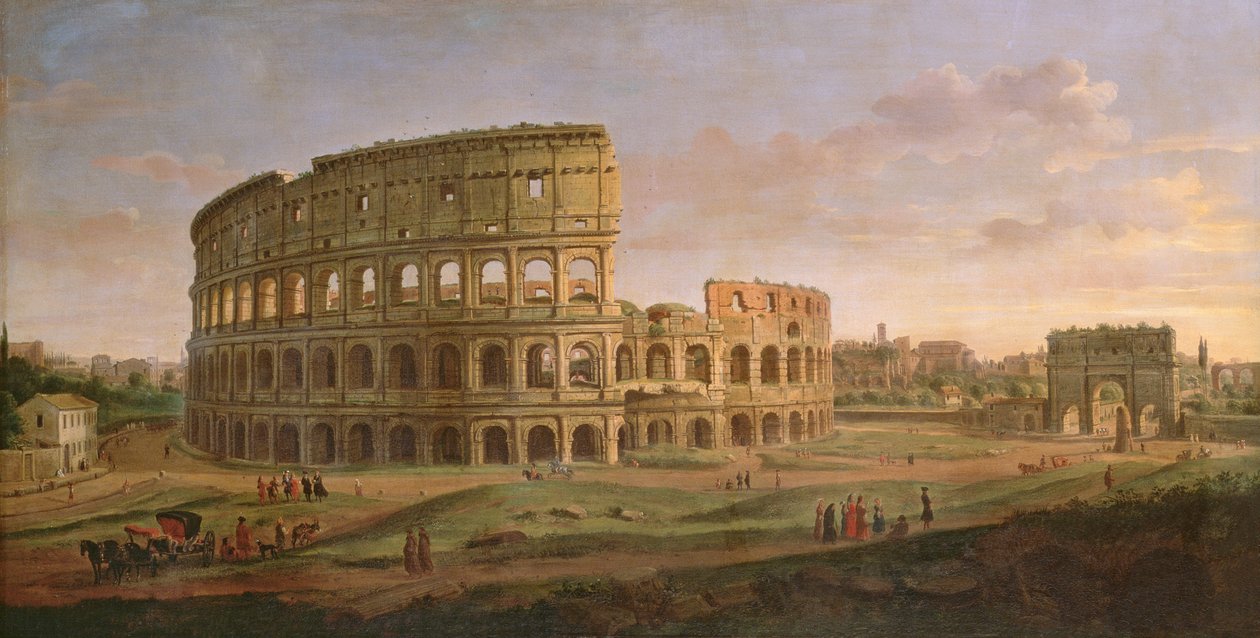
Casper van Wittel, born and trained as a painter in the Netherlands in 1652, emigrated to Italy in the late 1670s where he remained until his death in 1736.  Known for his landscapes, van Wittel was a popular artist of the times and his paintings provide a record of how Rome looked before its transformation, beginning in the late 19th century into the metropolis it is today. I've written before about van Wittel. Of note, it was only around 1900 that Rome regained the same population it had in the second century AD.  For more on what happened between those times read Belisarius Enters Rome.

This painting depicts the Colosseum, built in the 70s AD and the area around it.  It is a bucolic scene.  In other paintings of the amphitheater, van Wittel depicts sheep grazing next to the remains of the monumental structure.  On the right is the Arch of Constantine, constructed 315-20.  In front of it is the mysterious, and stubby, Meta Sudans which existed until it was destroyed during Mussolini's dictatorship in the 1930s.  In the far distance behind the arch to the extreme right is the aqueduct that brought water to the Palatine Hill where the emperor's palace was located.  The severing of the aqueduct in the 6th century meant the abandonment of the Palatine.

The perspective of the painting is from the lower part of the Esquiline, one of the seven hills of Rome.  To the left of the artist would be the ruins of Trajan's Baths.  In the Meta Sudans post there is an 1890 photo showing some of this area.  Looking to the right of the Arch and aqueduct, this 1850 photo, taken from the Colosseum provides a view of the Palatine which would have been very similar to what van Wittel would have seen a 150 years previously.

Monday, March 18, 2024

Thinking About Rome

There's a social media meme going round in which guys are asked about how often they think about Rome.  As can be seen from THC's history it turns out to be quite often.  

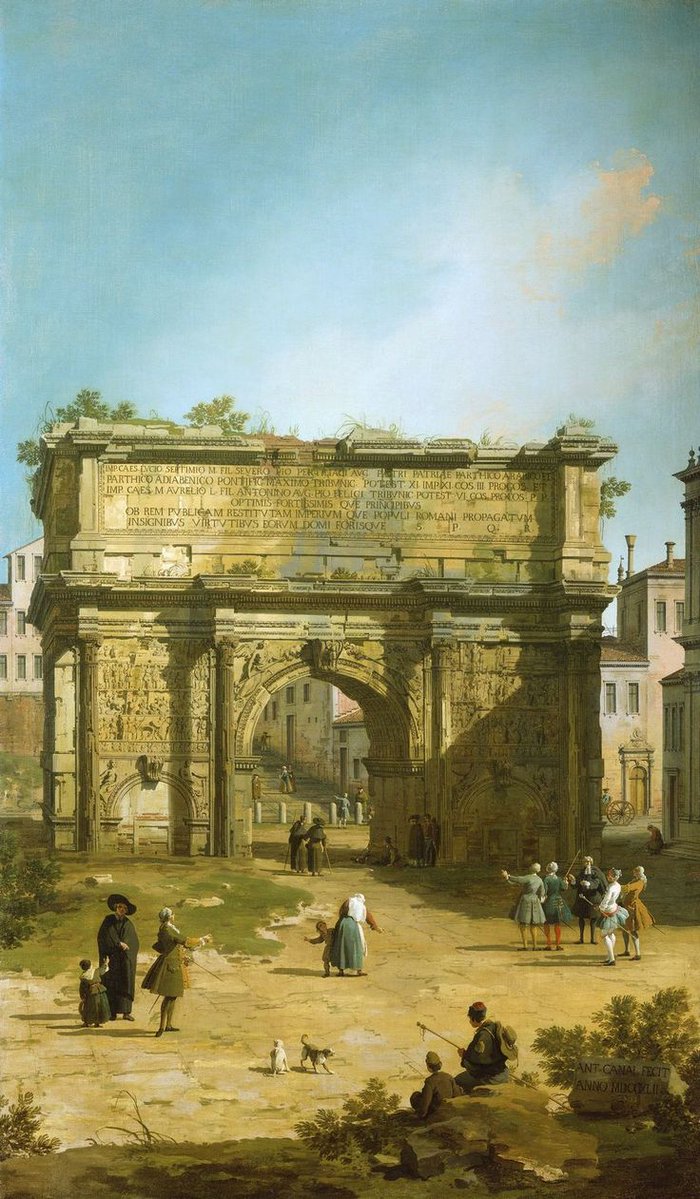
Most recently I came across a painting of the Arch of Septimius Severus in 1742 by Canaletto and a photo of the arch from 1895 (via Imperator Cat on twitter).  The two provide a graphic illustration of the disrepair the Forum had fallen into after the 6th century when the drains were no longer maintained and the area subject to frequent flooding.

Severus was emperor from 193 to 211 and the Arch celebrates his victories over the Parthians in Mesopotamia and annexation of new lands.

Image

ImageComparing the two pictures you can see the dramatic difference after the flood sediment and debris were removed during the 19th century.  In the painting the top of the arch on right is barely visible, while the photo shows the arch fully revealed.  Examining the height of the people around it, the sediment was 10-15 feet deep.

And, to tell the truth about how often I think of Rome, it is pretty frequently because this 33"x46" map hangs in the room where I am writing this is a constant reminder.

There are several things that make this map, which depicts, in great detail, the Roman road network and cities, exceptional.  First, is the date portrayed, 211 AD, at the death of Severus.  Most maps depicting the geographic height of the empire use 117 AD, right after Trajan's conquest of Mesopotamia.  However, Trajan's conquest was fleeting, with the lands abandoned within a year or two, along with a portion of the Dacian conquest from a dozen years before.  In contrast the boundaries in the 211 map all existed for a minimum of fifty years, with most enduring for centuries.

The map also shows the Severan advance into the deserts of Libya (the emperor was a native of Leptis Magna in that province) and reflects the most recent discoveries and research on Roman boundaries.  Until recently it had been thought the the Roman border in Arabia went north from the Red Sea and through the center of today's Jordan.  However we now know the Roman lands included much of what is now northwestern Saudi Arabia which is reflected in the map.  The map also depicts the 21st century discovery of a Roman garrison on the Farasan Islands near the southern end of the Red Sea (discussed in The Farthest Outpost).

This wonderful map was prepared by Dr Michael Ditter in Germany.  Dr Ditter has created a series of maps of the ancient world which you can find at his website.

As to what I think about Rome, I recommend you read Ciceroing.

Thursday, February 8, 2024

The Boy Is Back In Town

Visitors admire a massive, 13-meter (yard) replica of the statue Roman Emperor Constantine commissioned for himself after 312 AD that was built using 3D technology from scans of the nine giant original marble body parts that remain, as it was unveiled in Rome, Tuesday, Feb. 6, 2024. The imposing figure of a seated emperor, draped in a gilded tunic and holding a scepter and orb, gazing out over his Rome, is located in a side garden of the Capitoline Museums, just around the corner from the courtyard where the original fragments of Constantine's giant feet, hands and head are prime tourist attractions. (AP Photo/Andrew Medichini)

After an absence of over a thousand years, the colossal (42.6 feet high) statue of the Emperor Constantine, is complete and back in Rome, having just been unveiled in the garden of the Capitoline Museum, overlooking the Roman Forum.

Constantine, born around 280, spent from 306 to 312 maneuvering to seize control of the western portion of the Roman empire.  In 312 he defeated the Emperor Maxentius at the Battle of the Milvian Bridge outside of Rome, and sometime in the next few years the statue was completed and placed in the Basilica of Maxentius, located between the Forum and the Colosseum.  According to Wikipedia:

The great head, arms and legs of the Colossus were carved from white marble, while the rest of the body consisted of a brick core and wooden framework, possibly covered with gilded bronze.

The statue was pillaged during the early Middle Ages although various portions of the statue have been preserved and ended up in different Italian museums.  I'd seen the head and other fragments during my visit to the Capitoline in 2006.

(Statue fragments)

undefined

The unveiled statue is a recreation that, according to this AP article:

 . . . was imagined using 3D modelling technology from scans of the nine giant original marble body parts that remain.

Constantine went on to defeat Licinius, his rival in the East, in 324, reuniting the empire under one ruler.  Before his death he began the construction of a new capitol, modestly called Constantinople, and accepted baptism as a Christian on his deathbed.

Tuesday, December 5, 2023

Theodoro

While we usually think of 1453 as the date of the final demise of Rome with the fall of Constantinople to the Ottomans, it was on this date in 1475 the last remnant of the Roman world was extinguished.  Strangely enough it was on the Crimean Peninsula on the north side of the Black Sea.

Starting in the Sixth Century BC, Greek settlements were established on the south side of the Crimea.  The Roman Republic came into contact with the Greek city-states in the First Century BC, and from that time until the mid-4th Century AD, Rome either occupied or treated the Crimean cities as allies.  After a two century interruption when nomadic warriors from the steppes overran the peninsula, the Byzantines reestablished Roman authority in the late Sixth Century AD.  Over the next six centuries the Eastern Roman Empire indirectly or directly, as a province, ruled the area. 

When the Fourth Crusade was diverted from the Holy Land and instead captured Constantinople in 1204, the Byzantine remnants splintered in three; the Empire of Nicea on the eastern shore of the Sea of Marmara, which recaptured Constantinople in 1261, the Despotate of Epirus in northern Greece, and the Empire of Trebizond, on the southeastern shore of the Black Sea.  Trebizond extended its rule to the Crimea.

(Empire of Trebizond at its maximum extent)

Map of the Empire of Trebizond shortly after the foundation of the Latin Empire in 1204, featuring the short-lived conquests in western Anatolia by David Komnenos (later reconquered by the Empire of Nicaea) and Sinope (later conquered by the Sultanate of Rum).

During the 14th and early 15th centuries the Eastern Roman Empire with its capital of Constantinople was steadily squeezed by the rising power of the Ottomans until finally, in 1453, Constantinople fell.  By 1461 the last surviving parts of the Empire, located in Greece, had also fallen.  That same year, Trebizond also surrendered to the Ottomans.  All that was left of the Roman world was the tiny principality of Theodoro on the Crimea, adjacent to the Crimean colonies of Genoa.

undefined

The principality was also known as Gothia, because of the presence of a large Hellenized Gothic population.  Wikipedia describes the principality as, "a mixture of Greeks, Crimean Goths, Alans, Circassians, Bulgars, Cumans, Kipchaks, and other ethnic groups, most of whom were adherents to Orthodox Christianity and Hellenized. The principality's official language was Greek."  It goes on to tell us:

Various cultural influences can be traced in Gothia: its architecture and Christian wall paintings were essentially Byzantine, although some of its fortresses also display a local as well as Genoese character. Inscribed marble slabs found in the region were decorated with a mixture of Byzantine, Italian, and Tatar decorative elements.

In 1475, the Ottomans decided it was time to put an end to the principality and reduced the territory, capturing its capitol, Theodoro (modern Mangup) on December 5.

1,145 years after the founding of Constantinople, Rome was no more.


Wednesday, October 11, 2023

The Right Gesture

Eight days ago I wrote a post discussing the Arch of Titus (see Journey's End?).  Now we see this magnificent gesture by Italy, 1,953 years after the events commemorated by the arch, a triumph for Rome, a tragedy for the Jewish people.

I applaud the statement of President Biden regarding Hamas and its assault on the citizens of Israel.

Now what is needed is for Israel to have the time to eradicate Hamas operatives and its infrastructure in Gaza.  If it requires a reoccupation of the territory so be it.  Will those who support Israel now continue to do so as it moves towards this goal?

Too often over the past fifty years we've seen, in Israel and elsewhere, drawn out and punctuated violence, interrupted by cease fires or the presence of UN Peacekeepers.  The net result is more violence, more suffering, and more death than if the response to incidents of terror and aggression had been allowed to  conclude.

The pressures will grow greater as Israel responds. (1) As an example here's an article from the Associated Press (AP), "Under heavy bombing, Palestinians in Gaza move from place to place, only to find no place is safe".  As we know, AP employs Hamas sympathizers and co-locates its operations in Gaza with Hamas.  It is effectively a Hamas operative.  Another example of a once respected Western institution with its substance hollowed out and replaced by horror.

Notice the carefully sculpted language of the AP:

But residents say there is no real escape in Gaza, which has been under a suffocating 16-year blockade imposed by Israel and Egypt. When war breaks out, as it has four times since the Hamas militant group seized power in 2007, even U.N. facilities that are supposed to be safe zones risk becoming engulfed in the fighting.

War just breaks out!  It's magic!  Somehow a war just started! No mention that the four times it has broken out it because Hamas initiated attacks on Israel.  And Gaza is not under a blockade.  Gaza, and Hamas which governs the area has received billions in foreign aid, including from the United States, since Israel voluntarily withdrew from Gaza in 2005.  Since then Gaza has been the largest per capita recipient of foreign aid of any country or territory in the world.  Those monies were supposed to be spent on improving the infrastructure, education, and economy of the people of Gaza.  Instead, Hamas has diverted it towards arms and terrorism.  Israel provides free electricity and water and, apart from the periods during and immediately after Hamas attacks Israel, Gazans are able to enter Israel to work (it now turns out that some of those granted work permits were actually Hamas operatives casing potential targets for slaughter).  There is no blockade, except when imposed by Hamas' own actions.  Nonetheless, expect more of this garbage to be spewed by the media.

What Hamas is about has nothing to do with a two-state solution or the present government of Israel.  I've no use for Netanyahu, wish he had not come back into power, think much of Israel's settlements policy is misguided, and am appalled by what appear to be recent murderous criminal acts by settlers, but this attack would have happened whatever Israeli coalition was governing.(2)  Hamas is an Islamist Supremacy organization.  It is opposed to the existence of Israel and to the presence of living Jews in the area.  Its charter is clear on that and everything you hear to the contrary is just hand waving by Hamas sympathizers designed to obscure that truth.  

UPDATE:  Well, what have we here?  Just to show you that my statements about AP were not hyperbole, here is an article on the background of the writer of the AP story linked above.  Turns out he's called for the destruction of Israel, compared Israelis to Nazis.  He joined AP recently after working for Al Jazeera and two anti-Israel NGOs. 

FURTHER UPDATE:  From yesterday's Tablet an article by Armin Rosen on "How Hamas Fooled The Experts", to whom:

Hamas remained a semi-legitimate player, treated as just one unremarkable thread in the Middle East’s rich tapestry of mildly threatening, gun-toting political dreamers. Even to the most hardened Israeli security officials they were a Muslim Brotherhood offshoot whose extreme rhetoric and regrettably unshakable habit of murdering Jewish civilians could be understood within the normative politics of “resistance movements.” Their behavior could therefore be modulated and controlled through a proper combination of sticks and carrots.

Rosen says he was one of those people who bought into the expert opinion. His conclusion:

The moral being that to predict this week’s attack, you simply had to ignore the policy world’s access and credential-fueled orgy of confidence in its own superior understanding of human motives, and instead study an abundant and in retrospect unambiguous public record of what Hamas has tried to do and says it wants to do. Then you had to make the not unreasonable analytical leap of actually believing them.

---------------------------------------------------

(1) UPDATE, Nov 2 - We are already seeing wavering from politicians in the U.S., including the President.  Here's a recent example from the callow youth serving as the junior senator from Connecticut, Chris Murphy:

Image

What does this porridge of words actually mean?  Hamas terrorists, but just those responsible for the recent attacks, must be "held accountable" and "the ability of Hamas to carry out similar attacks in the future must be eliminated".  Senator Murphy wants Israel to shift to a "more deliberate and proportionate" campaign that is "surgically targeting" the bad guy "leaders", but apparently not the rank and file Hamas.  He also implies Israel is not following the law of armed conflict, but I've seen no evidence of that.  How does Murphy not know that is what Israel is doing now?  If it is not, we will need the Senator's expertise as to how better to be surgical when the "terrorist infrastructure" is underneath and intertwined with civilians, a deliberate strategy by Hamas, and itself an actual violation of the law of armed conflict.  

Also note, Murphy sanctimoniously conveying the wisdom from America's counterterrorism campaign that "terrorists groups feed off of the grievances caused by civilian harm".  Duh.  Just think how bad the October 7 attacks would have been if Israel had been attacking Gaza at the time!!  By the way, terrorist groups also feed off of great successes.  October 7 was a propaganda coupe for Hamas in that respect.  Moreover, even without Israeli action, Hamas with the assistance of the United Nations (and U.S. taxpayers) has been very successfully instilling a sense of grievance and hatred of Jews in Gazan schoolchildren.

Murphy has the luxury of being able to offer useless advice from his perch in DC.  The Israelis have to deal with the reality on the ground.  I think what is really happening is that Democrats like Murphy are seeing the polling of young Democrats who do not support Israel and are now trying to reposition themselves politically.  The truth is that Murphy's expertise is in his ability to keep getting elected, which is he very skilled at.  Other than that he knows nothing.

(2) Nov 11 - Just realized I fell myself into one of the Equity Gang language traps.  When I refer to settlements, I am referring to those on the West Bank, outside of the Jerusalem area.  When the Equity Gang refers to settlements they mean all of Israel, and every Jew residing there.

Tuesday, October 3, 2023

Journey's End?

Image

This thread by David Parnell, historian of the Roman Empire, and specialist on the time of Justinian in the sixth century AD touches on a subject I've read about before - what happened to the artifacts taken by the Romans from the Second Temple in Jerusalem after its sack and destruction in 70 AD and particularly the fate of the Temple Menorah.

The photo above is from the inside of the Arch of Titus, on the Sacred Way between the Forum and the Colosseum, erected in commemoration of the emperor's capture of the Jewish city.  I've walked through it and seen the various artifacts raised in triumph.

https://upload.wikimedia.org/wikipedia/commons/thumb/c/c2/7_Rome_View_of_the_Arch_of_Titus.jpg/1008px-7_Rome_View_of_the_Arch_of_Titus.jpg

As Parnell points out we know the Menorah was taken to Rome because of its portrayal on the Arch and the reference to it by the Jewish historian Josephus, who defected to the Roman thus surviving to write his histories of the Jewish revolt and broader story of the Jews.  Josephus tells us the Menorah was present during the celebration of Roman victory and describes it 

"the candlestick that was made of gold... its middle shaft was fixed upon a basis, and small branches were produced out of it to a great length, having the likeness of a trident in their position, and every one had a socket made of brass for a lamp at the tops of them."

The next relevant reference in literature to the Temple treasures is more than four centuries later, by the Byzantine historian Procopius, who was also private secretary to Justinian.  Writing of the Byzantine conquest of the Vandal kingdom in North Africa in 533, he states that among the treasures sent from Carthage to Constantinople after the conquest "were the treasures of the Jews, which Titus, the son of Vespasian, together with certain others, had brought to Rome after the capture of Jerusalem."  If the Menorah was among these treasures it would have been displayed during the Roman General Belisarius' triumph in Constantinople the following year.

How did those treasures get from Rome to Carthage?  In 455, the Vandals, led by Geiseric, sacked Rome, and took an enormous amount of loot back to Carthage.  Though not mentioned specifically in any contemporary chronicle it appears, based on Procopius, that the Temple artifacts were among the loot.

Procopius goes on to write that the Jews of Constantinople, seeing the temple artifacts, urged Justinian to send them back to Jerusalem.  According to Procopius, the emperor agreed and "quickly sent everything to the sanctuaries of the Christians in Jerusalem."  Though Justinian was hostile to the Jews, with Christianity now the religion of the empire and Jerusalem a pilgrimage site, he may have thought it appropriate to give the artifacts to the Christians there.

After that the artifacts disappear from history.  What might have happened?  In 614, the Persians, in the midst of the last great war of antiquity (602-28) conquered the Roman province of Palestine and we know they took Christian artifacts, including the True Cross, back to their lands in Mesopotamia.  Though the Cross was returned at the end of the wars in 629, could the Jewish artifacts have remained with the Persians? 

Also left unanswered is whether the Menorah was still among the "treasures" taken by Belisarius back to Constantinople in the sixth century.  The gold of the Menorah would have been very valuable.  Could it have been melted down by a Roman emperor to help finance the empire's costly wars?  If so, the most likely time would have been during the reign of Marcus Aurelius (161-80).  Serious barbarian incursions across the Danube during his reign placed the empire under great stress and it is reported that Marcus was reduced to auctioning furniture from his palace to help pay for the military.  Might the Menorah have been destroyed at that time? 

Sunday, August 20, 2023

Fading With Age

Long before living memory our ancestral way of life produced outstanding men, and those excellent men preserved the old way of life and the institutions of their forefathers. Our generation, however, after inheriting our political organization like a magnificent picture now fading with age, not only neglected to restore its original colours but did not even bother to ensure that it retained its basic form and, as it were, its faintest outlines. 

What remains of those ancient customs on which he [Ennius] said the state of Rome stood firm? We see them so ruined by neglect that not only do they go unobserved, they are no longer known. And what shall I say of the men? It is the lack of such men that has led to the disappearance of those customs. 

Of this great tragedy we are not only bound to give a description; we must somehow defend ourselves as if we were arraigned on a capital charge. For it is not by some accident—no, it is because of our own moral failings—that we are left with the name of the Republic, having long since lost its substance. 

- Cicero, De re publica (On The Republic or On The Commonwealth); via Laudator Temporis Acti

De re publica was composed by Cicero (106-43 BC) between 54 and 51 as a series of dialogues set in the prior century.  The sixth and final book of De re publica is The Dream Of Scipio (Somnium Scipionis), of which I've previously written in Mastering The Tides Of The World, a post that also describes Cicero's fate amid the wreckage of the faded Republic.

Large parts of the dialogues have been lost over the ages.  The quote is from the fifth book of the dialogues which focuses on the role a citizen should play in government.

Cicero wrote the dialogues during the last years of the Republic.  From the time of the Social War (90-88 BC) the Republic staggered on, its long-standing institutions not capable of addressing the social tensions arising from the city's domination of the Mediterranean.   As it was being written, Caesar was conquering Gaul and shared in the triumvirate of Pompey and Crassus, the latter dying at Carrhae in 53 in his failed quest to conquer the Parthians.  

Caesar would cross the Rubicon in 49, plunging Rome into civil war.  Pompey was killed in 48. Emerging triumphant in 45, Caesar would be murdered a few months later, followed by Cicero's death the following year.  The Republic was dead.

You can read more about Cicero in Cicero And His Friends and Ciceroing.

Monday, July 31, 2023

Rome On The Caspian


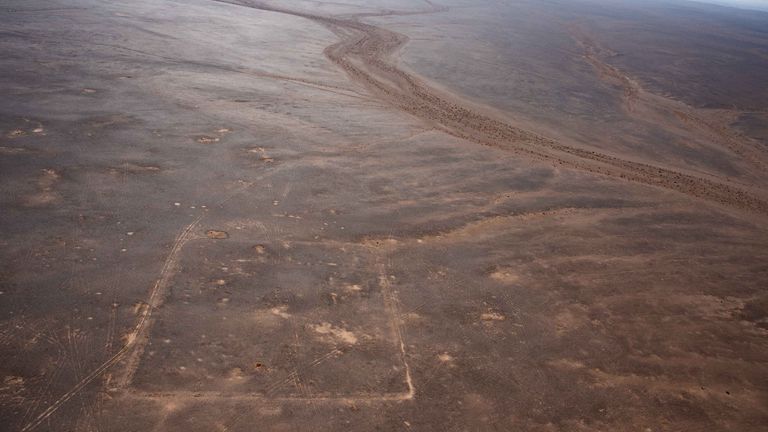
Albania (not the current country on the Adriatic, but an ancient nation on the southwest shore of the Caspian Sea) was a client state of Rome, off and on, for many centuries, from Pompey's expedition in 65 BC to the reign of the Emperor Heraclius in the first half of the seventh century AD.

The inscription reads:

'(In the reign of) Emperor Domitian Caesar Augustus Germanicus, Lucius Julius Maximus, centurion of the Legio XII Fulminata (carved this).'

The reference is to Domitian who was emperor from 81-96 AD.

It is possible that the town of Ramana, a little north of Baku and just a few miles from the Caspian, may have been founded by the Roman legions and derives its name from Romana.  It was noted in 1903 that older inhabitants referred to the place as Romani.

Legio XII Fulimata was created by Julius Caesar in 58 BC as part of his campaign to conquer Gaul.  It was transferred to the East around 40 BC where it participated in Marc Antony's campaigns against the Parthians.  The legion was defeated at the outbreak of the First Jewish-Roman War in 66 AD at Beth Horon, near Jerusalem.  It served the rest of its existence on the Eastern Frontier where the last mention of the unit is around 400 AD, stationed at Melitene, in modern Turkey, along the Euphrates River.

On the map below, Baku and Ramana are on the peninsula on the eastern side of Albania.

undefined Though this is the easternmost Roman inscription found, Roman soldiers involuntarily found themselves further east.  Thousands of Roman captives from Crassus' army at Carrhae in 53 BC and those surrendered along with the Emperor Valerian in 260 AD, were transported much further east by the Parthians and later the Sassanians to work on construction projects.  It is also possible some served in garrisons on the far east frontiers in Central Asia and there are tales (and controversial archaeological and genetic findings) of Roman soldiers ending up within the empire of China, protecting towns in the deserts of what is now Xinjiang.

Saturday, April 29, 2023

The Vastness

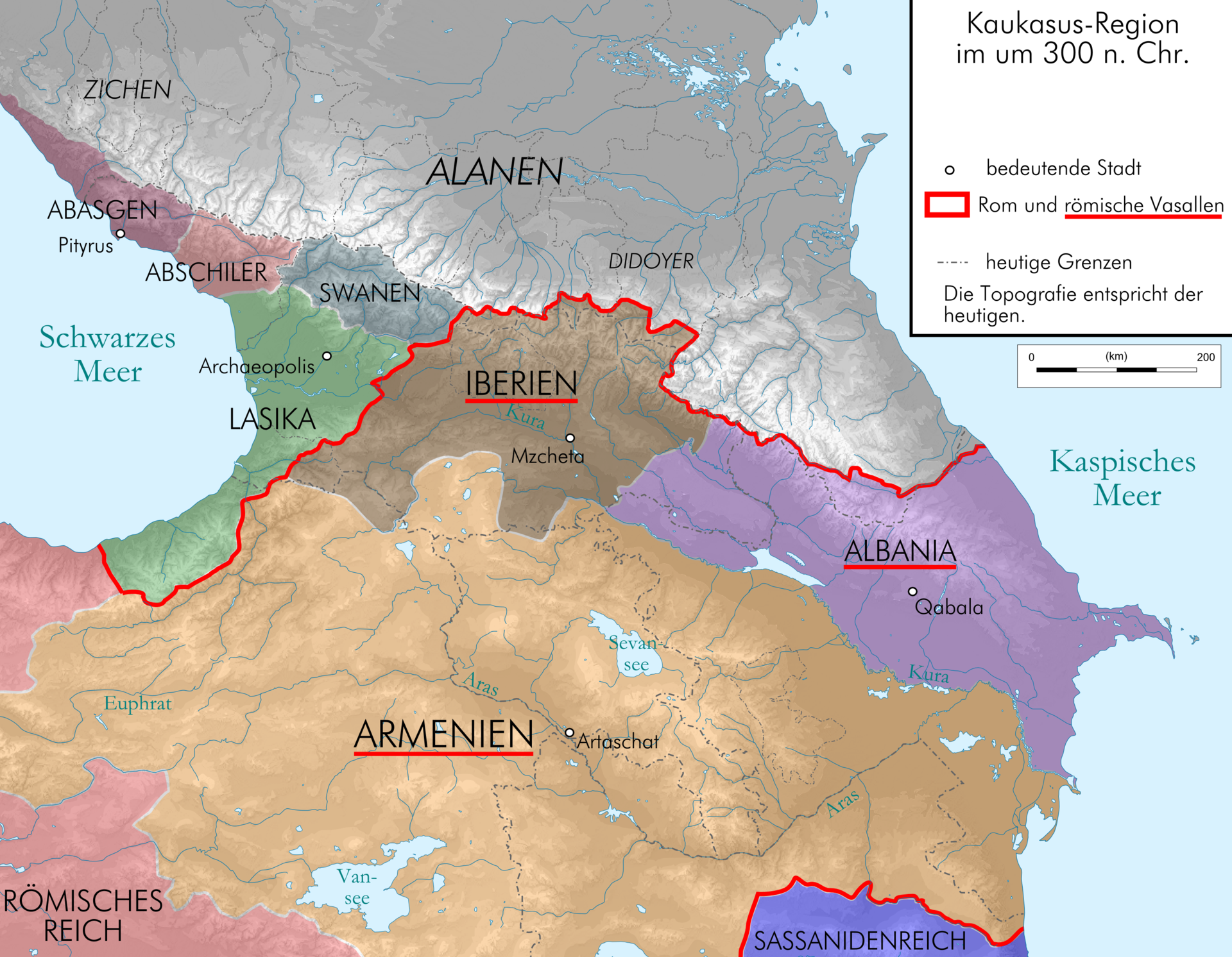
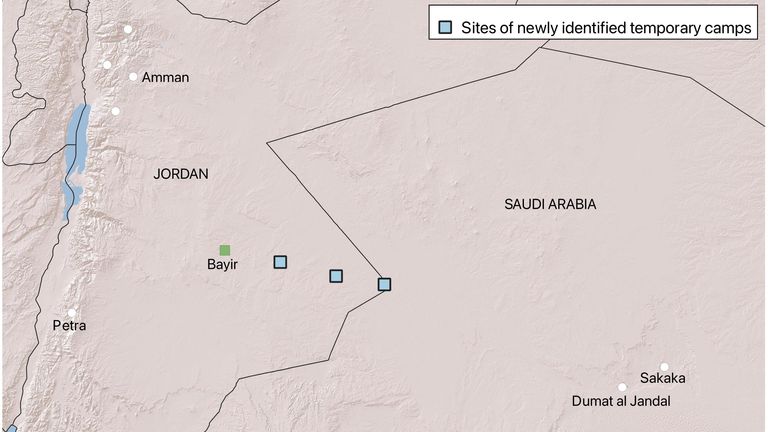
Roman military camp northern ArabiaThree previously unknown Roman forts have been identified in the bleakness and isolation of the Arabian Desert.  First located via Google Earth, they are in the southeast part of present-day Jordan, adjacent to Saudi Arabia.  As reported in Sky News and elsewhere, the discoverers and authors of a new study believe the forts were built in support of the Roman takeover of the Nabataean kingdom after the death of its king in 106 AD.  
Roman Camp found in Arabia - Oxford University
(Credit: EAMENA).

The discovery is another example of the realization in recent decades that the Roman expansion into Arabia went much further than thought by earlier scholars.  On the map above, you can see Dumat al Jandal in the far southeast, an oasis deep within the desert.  We now know that Roman centurions were stationed here during the second century AD to monitor and police trade routes between the Persian Gulf and Nabataea.

More on the history of the Nabataean Kingdom and the Roman penetration into Arabia and the Red Sea can be found in The Farthest Outpost.

Saturday, November 5, 2022

Tilt

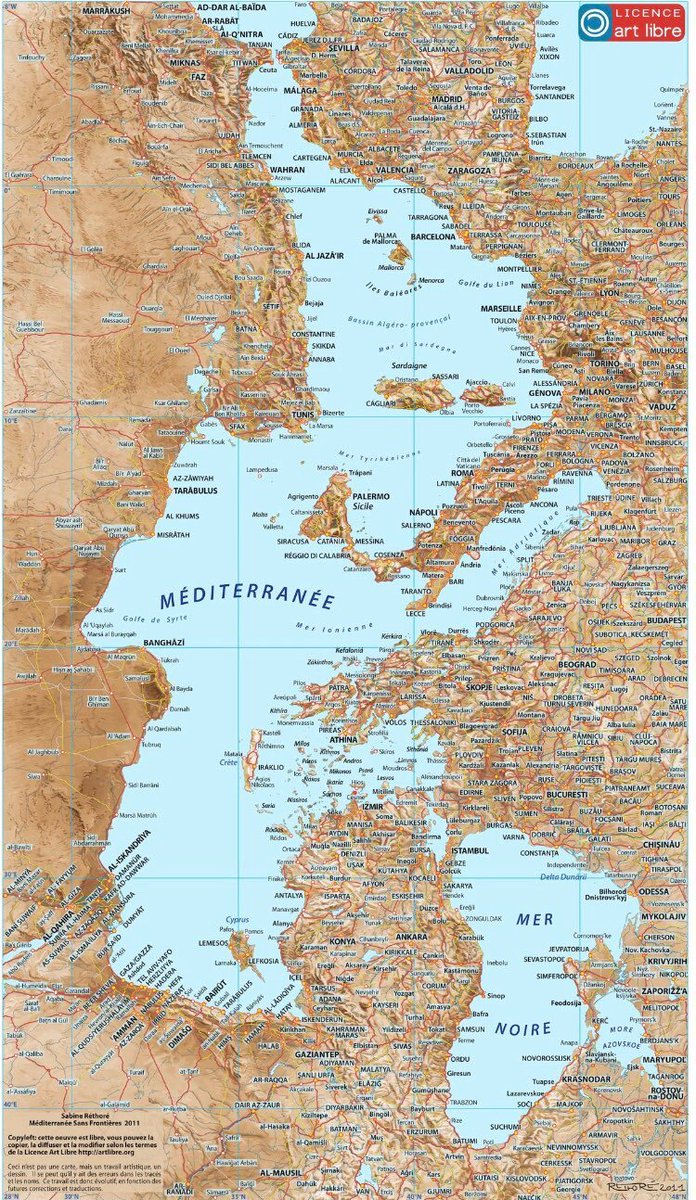
This view of the Mediterranean and surrounding lands on a north-side axis instead of the usual east-west is disorienting but brings you into the perspective of those living in Classical times.

Image

I've always liked these different perspectives and wrote about a view from the Horn of Africa a few months ago.  Without a scale, my first impression is that the Mediterranean looks more like one of the Great Lakes than a Sea, and it accentuates the connection between it and the Black Sea.

More than 90% of the lands shown were part of the Roman Empire during its heyday of the first three centuries AD - the only time when the Mediterranean was completely under the control of one power.  The centrality of Italy, Sicily and what is now Tunisia in North Africa is also emphasized as is the connection between Asia Minor (which looks like Michigan to me) and Greece, with the scattered islands between looking like shattered shards of marble.  You can easily see how the Anatolian farmers spread from Asia Minor into the Balkans and the rest of Europe from 7000 to 3000 BC.  From 3000 BC on, Europe was overrun by the Yamnaya of the Eurasian steppes, whose genetic imprint now dominates throughout the continent, except for isolated Sardinia, which retains its Anatolian imprint.

Something else is accomplished by this view.  In the traditional orientation, while Rome dominates a lot of Europe, most is still left to the "barbarians".  But in the Roman view, what we see here was, by far, more important - it is where civilization, wealth, and population resided, not the poor and underpopulated north and east of Europe.

Wednesday, August 17, 2022

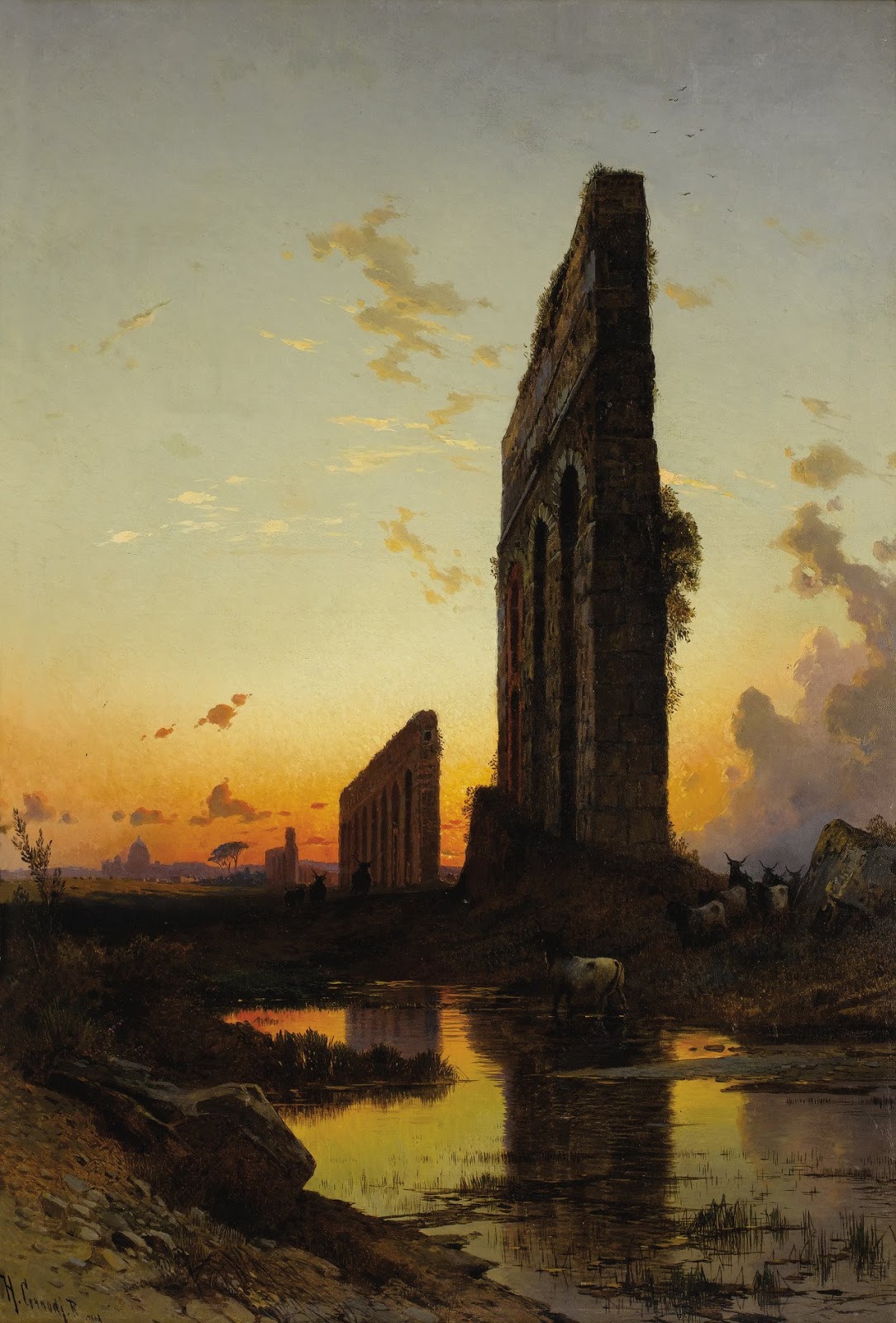
Sunset At Aqua Claudia

 Image

By Hermann Corrodi, an Italian painter; done sometime in the 1870s.  The remnants of a vanished world.  

The Aqua Claudia was one of the largest capacity aqueducts supplying water to Rome.  Started under Emperor Caligula (37-41 AD) and completed in the reign of Emperor Claudius (41-54 AD), it eventually extended to most of the districts of Rome, including the Imperial Palace on the Palatine Hill.  Most of its 43 mile length was underground until it emerged on the plains outside Rome from where it was carried on arches the last few miles into the city.   The cutting of Aqua Claudia and the other aqueducts during the 6th century siege of Rome by the Goths accelerated the decline of the classical city, prompting the abandonment of the Palatine Hill, and migration of the city's remaining population to other locations in Italy or closer to the Tiber River.

From Wikipedia, this is a current view of the largest remaining section of the aqueduct.


Monday, May 2, 2022

Recent Reading

Notes on books I've read and enjoyed over the past few months and which have not been previously mentioned on THC.

Non-Fiction

Roman republic and empire history is one of my favorite subjects and The War The Made The Roman Empire by Barry Strauss was a good read.  The story of the rivalry and then war between Octavian (Augustus) and Antony and Cleopatra is well told.

It was during the time of the empire that Christianity arose and in Dominion, Tom Holland explains why the viewpoint of the new religion was so fundamentally different from the mindset of Classical times and how, even today, even for those of different religions or no religion, the ethos of Christianity still has such an impact.  Fascinating read and fodder for good discussion.

The fourth century saw the triumph of Christianity in the empire.  In The Final Pagan Generation by Edward J Watt, we learn from the perspective of four leading pagan politicians, authors, and philosophers born near the beginning of the century and dying near its end what it was like.  We know what happened during that century, but it was not evident to those living then what would happen and none of them seem to have foreseen the course of events.  It is a reminder to all of us, that it is only looking back that things appear to arrange themselves in a pattern (see the sidebar to this blog for some wisdom from Joe Walsh on this subject).  It also prompts the reader to wonder whether we are in a similar situation in this century.

The Verge: Reformation, Renaissance and Forty Years That Shook the World (1490-1530) by Patrick Wyman tells the story of the pivotal figures in the ending of the medieval era and of setting us on the path to the modern world.  Very insightful.  It also fits with the three part THC series, Ten Years After (1519-29) on six important events during that decade and which you can read here, here, and here.

Not covered in Wyman's book, but occurring during the same period is The Catalogue of Shipwrecked Books by Edward Wilson-Lee, the story of Christopher Columbus and his illegitimate, but recognized son, Hernando Colon, who accompanied him on his last voyage to the Americas, and created the greatest collection of books in the world at this time.  A story I'd had no clue about until stumbling across an article about it recently (see Book of Lost Books).

The Rise of African Slavery in the Americas by David Eltis is a detailed study of the early days of the Atlantic slave trade before the mid-18th century.  It covers the economics and logistics of the trade.  Eltis includes a lengthy discussion of how and why the coastal African states engaged in the trade and how they were able to keep European powers from gaining footholds in their territories during this period. 

Colin Calloway's book, One Vast Winter Count: The Native American West before Lewis & Clark recounts the history of Indians from their entry into North America during the Ice Age until the beginning of the 19th century, focusing on what is now the United States west of the Mississippi.  A vast temporal and geographical scope which the author handles well.  The book gives the reader an appreciation for the culture, struggles, and conflicts over that timespan.

I had the pleasure of interviewing U of Virginia professor and head of its Civil War Center, Caroline Janney via Zoom for our Civil War Roundtable and we hope to have her back in person.  Her recent book, Ends of War, has received glowing reviews and contained a lot that was new to me.  The usual tale of Lee's surrender at Appomattox, was his army disbanded and went home.  It turns out it was not as simple as that as a large portion of his army was not at Appomattox so how to effect its surrender raised questions as did many other aspects of the surrender even for those there on April 9.

Carrying the story further is Gregory Downs, After Appomattox, the story of the military occupation of the South after the end of the Civil War.  Downs recounts the struggle the rapidly shrinking army faced in trying to maintain order, particularly in light of the massive violence unleashed by white southerners against blacks and those whites seen as their allies.

When Michael Collins, who remained alone in the Apollo Command Module, while Neil Armstrong and Buzz Aldrin landed on the moon, passed last year, it reminded me I'd never read his book Carrying the Fire, reputed to be one of the finest astronaut memoirs.  I've now read it and concur.  Written in the 1970s, after he'd left NASA, Collins provides amazing and interesting detail on what it was like to train as an astronaut, how relatively primitive the technology was, and how astonishing it was that from start to finish the moon landing project took only eight years.  Collins also seems to be more self-reflective than many of those early astronauts and his portrayal of himself and his fellow astronauts is fascinating. 

San Francisco has always been somewhat offbeat, but in the 1970s it was going completely off the rails.  Cult City by Daniel J Flynn is the tale of Jim Jones and his People's Temple that began in the Bay Area and ended with murder and mass suicide in Guyana.  Flynn has a chilling story of how a charlatan like Jones succeeded by drawing in vulnerable people with the active assistance of local and state political figures.

San Francisco may not be any better today, at least according to San Fransicko by Michael Shellenberger.  Shellenberger, a progressive who recently announced his candidacy for governor, taking on the incumbent Gavin Newsom, writes of the city's, and the state's botched efforts to deal with the mentally ill and addicted overrunning its streets, park, and sidewalks.  Constricted by the dictates of ideology enormous amounts of monies have been spent to little effect.  This is a sensitive issue for me, due to issues in my own family going back a half-century and it is frustrating and infuriating to see the same false arguments still trotted out by mental health "advocates" decades later.  While the problems they created remain unsolved, many of these advocates make a nice living from all the monies flowing in to supposedly solve the problem.

The Baseball 100 by Joe Posnanski is a feast for fans who love the sport and great writing.  Joe can make anything interesting and his ranking of baseball's 100 greatest players provides him great material to work with.  I really didn't care about the specific ranking for any player, I just wanted to enjoy the writing and getting there. I did.

Fiction

Ridgeline by Michael Punke (author of The Revenant) is a fictionalized telling of the events leading up to the Fetterman Fight in December 1866, in which Crazy Horse and a tribal alliance wiped out eighty U.S. soldiers.  Told from the soldier and Indian perspectives.  Excellent.

It starts in Hawaii just before Pearl Harbor and takes us to Hong Kong and Japan during the war.  Five Decembers by James Kestrel begins with murders and the investigation by a Honolulu detective.  Intrigue on an epic scale over a five year period.

The fate of Jews under German occupation during WW2 varied greatly.  In The Invisible Bridge, Julie Orringer describes the little known story of Hungarian Jews, alternately persecuted and protected by their own government, until late in the war when the Nazis occupied the country.  A sprawling, moving book.

I love Michael Connelly's books, particularly those featuring detective Hieronymus (Harry) Bosch.  As Harry, a Vietnam War vet, is aging out, Connelly has introduced a new detective, Renee Ballard.  I had not found her as interesting but in The Dark Horse, they join forces and the partnership and Ballard's character finally take off.

And in August, we'll get the latest in Martin Walker's Bruno, Chief of Police series, set in the Dordogne region of France.  I can't wait.

I'm updating this to include a series of five crime novels I completed reading about a year ago.  The unusual setting is Constantinople in the second quarter of the 19th century, and the main character is Yashim, a eunuch and detective, at the service of the Sultan.  It's a time of reform, turmoil, and intrigue in the failing Ottoman Empire.  Great characters and detail to give the reader a flavor of an unfamiliar world.  The first novel in the series is The Janissary Tree.  The author is Jason Goodwin, who wrote a fabulous rumination on Ottoman history in Lords Of The Horizon, which I quoted from in Part 2 of The Song Of Jan Sobieski.

Sunday, March 27, 2022

An Honorable Man

Damian Lewis performing an excerpt from Marc Antony's funeral oration speech from Shakespeare's Julius Caesar.  Wonderfully done.  It is a reminder of the brilliance of Shakespeare's language.  How many of these phrases have become a part of our common heritage, so easily familiar to us four hundred years later?


What remains most puzzling about the assassination is the lack of thorough planning by the conspirators beyond the act of killing Caesar.   Though there were many plotters, Brutus, because of his reputation for integrity, fidelity to the Republic, and possibly because of the rumor that he was Caesar's son (probably not), was the key participant, and it was Brutus who insisted that Caesar be the sole target.  Antony, Caesar's chief subordinate, who could have easily been killed, was instead deliberately spared.  It was as if the conspirators thought once Caesar was dead the Republic would spontaneously regenerate itself, a fatal error, compounded by allowing Antony to speak at Caesar's funeral.

In reality we don't know precisely what Antony said, and he certainly would not have said it in the same tone as Lewis.  Immediately after the assassination, public opinion was divided in Rome.  Antony would have been speaking in a public forum to a large crowd without the benefit of modern amplification.  His speech, of necessity, was pitched more broadly and more loudly.  Whatever he said, it was effective, rousing the crowd, generating outrage and anger.  What was now a mob left the scene and began hunting down the conspirators who had fled to their homes and strongholds.  Eventually they were to flee Rome altogether.  Within two years, most of the conspirators were dead.

Caesar's death triggered more than a decade of civil wars.  First, between his supporters and his killers and then among his supporters culminating in the conflict between Octavian (Caesar's nephew) and Marc Antony and Cleopatra.  It was only with Octavian's victory at Actium in 31 BC, Antony and Cleopatra's suicides the following year, and, by order of Octavian, the murder of Caesarion, the 13-year old child of Cleopatra and Julius Caesar, that the civil strife ended.

Tuesday, February 22, 2022

Floor Plan

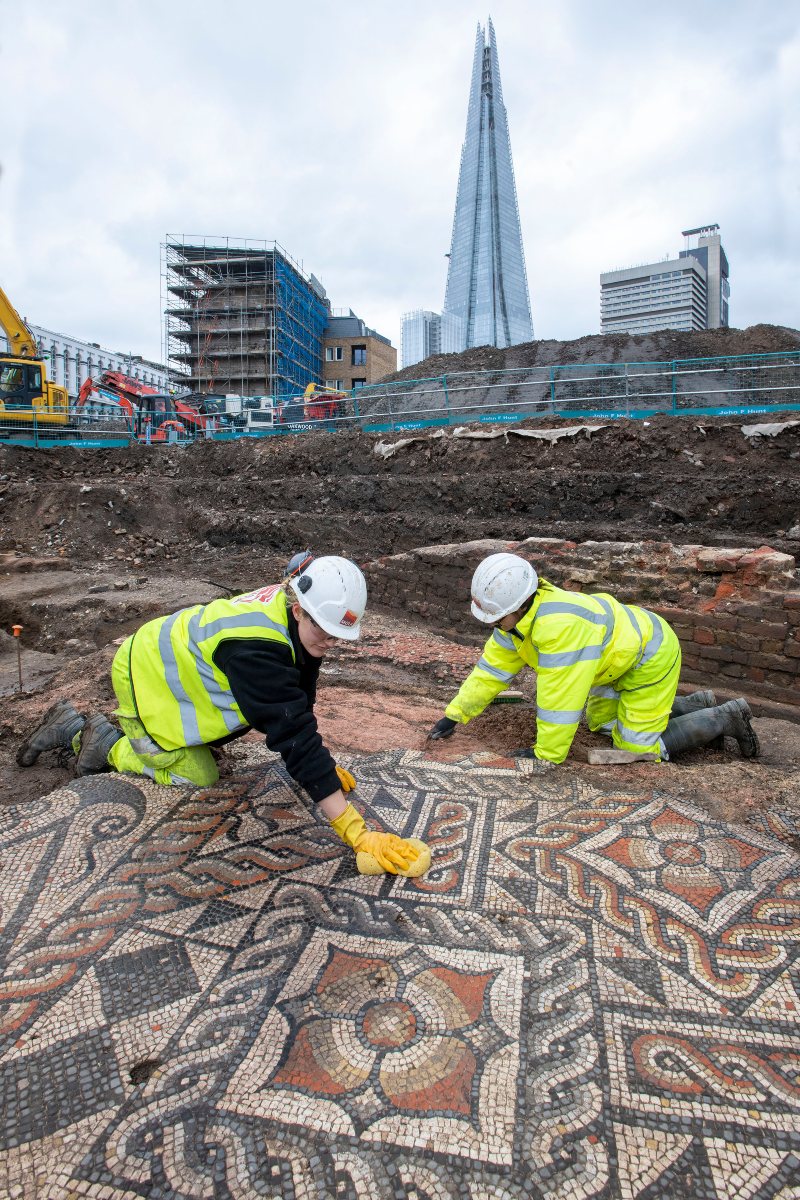
It is remarkable how so many long-buried Roman mosiac tiled floors have been discovered in recent years in the Near East, Anatolia, North Africa, the Balkans, Italy, France, and this one in London.  I particularly like the juxtaposition in this photo between ancient and modern.  This one is thought to date from 175-225 AD.  Imagine how many more await discovery!  For more on this find read here. 

Roman mosaic floor found at Southwark Street development site

Monday, January 10, 2022

Ciceroing

Robert A. Kaster, The Appian Way: Ghost Road, Queen of Roads (2012; rpt. Chicago: University of Chicago Press, 2014), pp. 101-103:

Marcus Tullius Cicero is unavoidable in my line of work, and not the sort of man who provokes mild emotions in those who make his acquaintance. Loathing and affection are the only choices. By now I have spent enough time in his company, through teaching and writing, to work past the first of those feelings and arrive at the second. Certainly, he is everything that those who loathe him say: an egotist who was impossibly high-maintenance as a friend; often blinkered and bloviating as a statesman; moody, inconstant, and self-dramatizing as a man; and—what finally did him in—not nearly as clever a political player as he thought he was, or as his enemies actually were. Yet he was also a loyal friend in his turn, and witty company, a man who (I think) really did try to do what he thought was right, and who along the way wrote some of the best prose ever composed in any language, with the same impact on the future of Latin that Shakespeare and the King James Version of the Bible have had on English. But above all he left himself exposed and accessible, and that is the thing in the end that moves me beyond simple respect.

A chief reason Cicero is so easy to loathe is that he left so much of himself on view. We know him better than we can know any human being in Western history before Saint Augustine, because no one in the West before Augustine left so large a written legacy of such a personal kind. The texts, and the body of commentary that has grown up around them, fill ten feet of shelving in my office, and my collection is not especially large: speeches, rhetorical treatises, philosophical tracts, and above all the correspondence, over twenty years' worth, that he carried on with family, friends, and enemies. Of course most of the writing is carefully calculated, intended to present the writer in the best possible light in whatever circumstance prompted the writing: that is one of the jobs that rhetoric is supposed to do, and Cicero was a master of the craft. But even though the writing may not offer a transparent window on his soul, it does give excellent access to his lively mind. You see the wheels turning, you come to understand the move that's being made and anticipate the move that's coming next, and in so doing you reach across more than twenty centuries in a way that is exhilarating and moving.

I've referred to Cicero (106-43 BC) in a number of posts, most recently in Mastering the Tides of the World, and even wrote about his birthplace.  Last year I read and wrote about Cicero And His Friends: A Study of Roman Society in the Time of Caesar, Marie Louis Antoine Gaston Bossier's study from the late 19th century, a book which prompted me to liken Cicero to the John Adams we see in the Jefferson-Adams correspondence of 1812-26, and I've read Robert Harris' trilogy of novels about Cicero's life and the last years of the Republic.

Coming across the quote from Kaster at Laudator Temporis Acti (the source for the Official Motto of this Blog - "The Value of Useless Knowledge") spurred me to think further about my interest in Cicero and, more broadly, in the Roman Republic and Empire.  For Cicero himself it is, as Kaster points out, that we can see him fully formed as an individual person in a way unlike other figures before him, and for several centuries thereafter (Augustine writes more than 400 years after the death of Cicero).  Certainly his writings seem, to an extent, relevant regardless of date, and his personality, with its strengths and glaring weaknesses evident in a way we can only infer in his contemporaries.  But that relatedness can only go so far and, in that respect, ties in with my interest and perspective on Rome.

With my fascination with history going back to childhood, Rome has always loomed large for me, with its unique place in western history.  It's a combination of fascination, recognition of its achievements, and the sheer expanse and duration of its domination imposing, on its own terms, a period of peace and stability not seen before and which disappeared in the wake of its collapse.  Moreover, as it moved from Republic to Empire it proved adaptable in creating a devotion to a common culture out of a patchwork of religions, tribes, and other groups as described in this post.  But it is not a desire to replicate or restore such a system and I am as fascinated with the costs of the republic and empire as with its achievements.

The classical world of Greece and Rome, and Cicero, while the source of some of the key ideas that have powered Western thought over the centuries, also represents a very different ethos from the modern world. The classical historian Tom Holland gets at this in his most recent book, Dominion: How the Christian Revolution Remade the World :

The more years I spent immersed in the study of classical antiquity, so the more alien I increasingly found it. The values of Leonidas, whose people had practised a peculiarly murderous form of eugenics and trained their young to kill uppity Untermenschen by night, were nothing that I recognised as my own; nor were those of Caesar, who was reported to have killed a million Gauls, and enslaved a million more. It was not just the extremes of callousness that unsettled me, but the complete lack of any sense that the poor or the weak might have the slightest intrinsic value. Why did I find this disturbing? Because, in my morals and ethics, I was not a Spartan or a Roman at all. That my belief in God had faded over the course of my teenage years did not mean that I had ceased to be Christian. For a millennium and more, the civilisation into which I had been born was Christendom. Assumptions that I had grown up with — about how a society should properly be organised, and the principles that it should uphold — were not bred of classical antiquity, still less of 'human nature', but very distinctively of that civilisation's Christian past.

Holland's point is that even the non-religious in the West have absorbed basic concepts of the universality of all people from the Christian tradition, in fact the very basis of the Western concept of human rights, something which did not exist in classical thought.  In advancing his thesis he does not downplay Christianity's contradictions and failures over the centuries but rather emphasizes that the aspirational starting places in classical and Christian thought are completely different.  I'm still mulling over Holland's thought-provoking book, which I recently read.

I write this as a non-Christian.  I'm Jewish.  On my first visit to Rome in 2006 I walked under the Arch of Titus, the Roman Emperor and conqueror of Jerusalem; the man responsible for the destruction of the Second Temple, located on the Temple Mount, and the subjugation of Judea.  As you pass through the arch you can't help but notice it is decorated with carvings of religious artifacts looted from the Temple and being carried away in triumph by Roman soldiers Image result for arch of titus location mapand if you are walking from the Forum through the arch you will be looking at the Colosseum, built in part with the labor of Jewish slaves captured in that war (66-70 AD).  The Emperor Hadrian (117-38 AD), a devotee of Hellenism and enemy of the Jews, decreed a temple honoring the gods of Rome should be placed on the vacant Temple Mount as a demonstration of Roman power, a decree that prompted one final great revolt, finally suppressed after three years, resulting in the banishment of all Jews from Jerusalem and the surrounding area and  changing the name of the province from Judea to Palestine.  Starting in the 4th century the Eastern Roman emperors placed increasing restrictions on Jewish life in Palestine, until finally in the aftermath of the great Roman-Persian War of the early 7th century, the triumphant Emperor Heraclius proclaimed the Jews would be forcibly converted. Before this could be undertaken in a large scale manner, an unexpected threat came out of the desert, sweeping the most prosperous part of the Roman Empire and all the Persian Empire away. The limited and scattered fragments of information that survive indicate those Arab tribesmen were supported by the Jews of Palestine.

So no big summation here, just some thoughts prompted by Cicero.  And I'll keep writing about Rome.  Speaking of which . . . 

UPDATE:  Found via Laudator Temporis Acti another quote from the Kaster book which captures my attitude:

Whereas earlier generations of British scholars and intellectuals tended to admire the Roman Empire as a forerunner of their own, the consensus in postimperial Britain has shifted, and there now seems to be broad agreement that the Romans were bastards. My view is that the Romans were what they were, and that understanding what they were does not advance by taking an attitude toward them, especially when the attitude is one of moral superiority.

Thursday, December 23, 2021

Mastering The Tides Of The World

I've written before of some of the unexpected lessons and pleasures of writing history related posts.  Now that I've been at this for a few years it is not uncommon to see connections between posts I wrote at different times, even though I failed to see those connections at the time.  A case in point is about contingency in history and specifically the inability of humans to predict the long-term impacts of our actions and how they may appear successful, unsuccessful, conscientious, or reckless, depending on when they are evaluated.  This post revisits and recombines a couple of earlier pieces.

In Federalist 1, Alexander Hamilton wrote:

It has been frequently remarked that it seems to have been reserved to the people of this country, by their conduct and example, to decide the important question, whether societies of men are really capable or not of establishing good government from reflection and choice, or whether they are forever destined to depend for their political constitutions on accident and force. 

If there be any truth in the remark, the crisis at which we are arrived may with propriety be regarded as the era in which that decision is to be made; and a wrong election of the part we shall act may, in this view, deserve to be considered as the general misfortune of mankind.

But it is often difficult to determine what the right decision or wrong election may be, or at least to accurately predict the consequences.  In his remarkable eulogy for Neville Chamberlain in November 1940, Winston Churchill eloquently (and graciously, considering how shabbily Chamberlain treated him before he became Prime Minister) expressed this uncertainty:

It is not given to human beings, happily for them, for otherwise life would be intolerable, to foresee or to predict to any large extent the unfolding course of events. In one phase men seem to have been right, in another they seem to have been wrong. Then again, a few years later, when the perspective of time has lengthened, all stands in a different setting. There is a new proportion. There is another scale of values. History with its flickering lamp stumbles along the trail of the past, trying to reconstruct its scenes, to revive its echoes, and kindle with pale gleams the passion of former days. What is the worth of all this? The only guide to a man is his conscience; the only shield to his memory is the rectitude and sincerity of his actions. It is very imprudent to walk through life without this shield, because we are so often mocked by the failure of our hopes and the upsetting of our calculations; but with this shield, however the fates may play, we march always in the ranks of honour.  

In JRR Tolkien's The Return of the King, a similar sentiment is expressed in the words of Gandalf at the Council of Gondor during the great debate on how to best resist Sauron:

Other evils there are that may come . . . Yet it is not our part to master all the tides of the world, but to do what is in us for the succor of those years wherein we are set, uprooting the evil in the fields that we know, so that those who live after may have clean earth to till.  What weather they shall have is not ours to rule.

Churchill and Tolkien differ in their emphasis, of which I've previously written.  For Churchill it can be difficult to determine how a decision may play out even in the immediate future, with rectitude and sincerity our only anchor in this process.  Tolkien seems to be saying we can know the right decision to be made now, and it is a decision that must be made, but how it plays out in the longer-term will be determined by others.  The similarities and differences may derive from their personal experiences and personalities.  Churchill, born in 1874 and Tolkien, born in 1892, both served in the Western Front trenches in France but while Churchill's views were rooted in his study of history, his upper-class upbringing and sense of Englishness, Tolkien's love of Nordic folklore, along with his committed Christianity, gave him a different perspective.

Iain Pears' 2002 novel, The Dream of Scipio, confronts us directly with both the need to make decisions and the uncertainty and consequences of those decisions.  The Dream of Scipio is unsettling from its opening passage, "Julien Barneuve died at 3:28 on the afternoon of August 18, 1943.  It had taken him twenty-three minutes exactly to die, the time between the fire starting and his last breath being sucked into his scorched lungs.  He had not known his life was going to end that day, although he suspected it might happen", until its terse and chilling closing paragraph.

Scipio is an inverted version of the author's best selling novel, An Instance Of The Fingerpost (1997), concerning a curious series of events taking place in and around Oxford in mid-17th century England, as told in parallel narratives by four participants.  Like Fingerpost, Scipio is set in and around a specific geography, in this case the Avignon region of southern France, but unlike the earlier story it is set in three different time periods over a 1500 year period.  While Fingerpost concerns itself about the same events seen from multiple perspectives, Scipio tells of different events that all raise the same questions about how one should act and make choices in life.  The narrative in Fingerpost is more straightforward, even with the variations in the tale, but is more oblique in its approach to the larger questions it raises, questions that are front and center throughout Scipio, which employs an intertwined narrative moving back and forth across its three time periods.

The earliest historical setting of Scipio is the crumbling Roman province of southern Gaul around 475 AD.  Manlius Hippomanes is a member of the dwindling elite of wealthy Romano-Gallic aristocrats, educated in classical philosophy and literature in a world that no longer has use for either, and from which the last of the Roman Legions who protected them disappeared a decade before.  While the Goths approach from the west and the Burgundians hover threateningly to the north some of his compatriots dream of being rescued by a renewed Roman Empire and others, like the real-life Sidonius Apollinaris, actively resist, Manlius believes himself more practical minded and steers a course designed to save what he believes can be saved and to do whatever must be done to achieve that goal, even at a high cost.

The second story tells the tale of Olivier de Noyen, an aspiring poet and courtier of Cardinal Ceccani, a real historical figure, in the Papal Court at Avignon as the Black Death approaches and then engulfs the city during the middle of the 14th century.  His role as courtier to a Cardinal involves him in the complicated plotting over whether the Papacy should stay in Avignon or return to Rome and leads to an encounter with another historical figure, the rabbi Gersonides, eventually forcing him into choosing what, and whom, to save and to betray.  De Noyen is also a collector of ancient manuscripts and discovers a copy of The Dream Of Scipio, a puzzling tract written by Manlius, who by this time is considered a Catholic saint; an ironic ending for the aristocrat considering his true beliefs and actions. 

The final setting is Vichy France during WWII, and centers on Julien Barneuve, a scholar and intellectual, emotionally numbed by his experience in the trenches during the prior war.  When someone observes that he is sitting in a library while the world burns he replies:

The world did burn.  I was at the cremation.  And it would have been better if I had stayed in a library.  One person, at least, would be alive now who is dead, because I wouldn't have been there to bayonet him.

With the defeat of France in 1940, Julien accepts an appointment from a friend as a minor functionary in the Vichy regime, a position from which he believes he may be able to save as much as possible from the barbarian Nazis.  At the same time he is studying de Noyen's poetry and through him Manlius' Dream.  Julien, after rediscovering hope through reuniting with his long elusive lover, realizes it requires he make choices between Vichy, the Resistance, and the actions needed to protect his love, even as it dawns on him that he has fatally misread both de Noyen and Manlius.
(Prisoners taken by Vichy militia)

All three protagonists live in dark times of crisis for civilization; the end of the classical era amidst rampaging barbarians; the advent of the Black Death; and the seeming triumph of the Nazis.  All are confronted with decisions about what is worth saving and face conflicts between friendship and loyalty.  Each make compromises to try to preserve something they believe is of even more value.  Terrible consequences follow many of those decisions, some recognized beforehand, some unanticipated.  The Dream of Scipio asks should we decide how to make a decision based upon its perceived consequences or are there values more important, regardless of consequences, since we cannot know in advance what those consequences may really be.  It asks, what is civilization?  How do we preserve it?  What if we are mistaken about what civilization consists of?  What if, in saving civilization from barbarians, we become barbarians ourselves? It asks, but does not answer.  Pears writes elsewhere:

Every cataclysm is welcomed by somebody; there is always someone to rejoice at disaster and see in it the prospect of a new beginning and a better world.  Equally, however much an act of God, there is always someone ready to take responsibility for any event or, failing that, to have blame thrust upon them.

In trying to answer these questions characters commit what they know to be terrible acts in order to preserve what they believe is best in the world, while others commit acts that have horrible consequences they did not intend.  

At the same time, most of the main characters are obsessed with how they will be remembered, yet in every case they are either forgotten or remembered in a way divorced from the reality of their lives and in ways they would not have appreciated.

Pears does not betray to the reader his own views, wanting us to constantly feel uneasy and on guard.  Julien's closest friends are Bernard, a skeptic, atheist, and man of the left who ends up with the Resistance, and Marcel, religious, and a man of the right who offers his friend a job with Vichy.  Pears deliberately makes it difficult for us to clearly sympathize with either and disrupts any preconceived notions we may have.  Julien recalls an incident when, as children, Marcel threw a stone, breaking a church window, a deed for which Bernard takes the blame:

This was the event Bernard had referred to, one of those moments of childhood from which the whole of adult life can be projected.  Julien, nervous, innocent, but standing fast.  The insouciant Bernard, making the grand gesture in the name both of friendship and of self-aggrandizement, his actions extravagant but generous.  And Marcel, a little cowardly and frightened, afraid of authority, not wishing to take on the ownership of his deeds, content for others to be punished instead of him.  The resister, the collaborator, and the vacillating intellectual . . . 

Except that Julien remembered it like that only because Bernard retold the story many years later and brought it back to his mind.  Imposed his narrative on what had become the faintest of recollections; created memories by his skill as a raconteur  . . . 

But, on a few occasions, he was almost certain he remembered that it was Bernard who had thrown the stone and run away, and Marcel who had been beaten.

In this passage, Pears also touches on the issue raised in Ty Cobb: A Terrible Beauty - how do we come to know what we know?  When are the stories we tell ourselves over and over again about ourselves and others just stories rather than memories?  How much does memory influence the answers to the questions Pears poses the reader?

For readers who wish to delve deeper there is a further layer of interpretation. While the fictional Manlius never wrote a book titled The Dream of Scipio, Somnium Scipionis (Dream of Scipio) is a famous piece by the 1st century BC Roman writer and politician, Cicero, which tells of the dream of Scipio Aemilianus (the destroyer of Carthage in 146 BC), in which his grandfather Scipio Africanus (who defeated Carthage to end the Second Punic War in 201 BC) appears and instructs his grandson on what makes a good Roman citizen, while at the same time pointing out the relative insignificance of Rome in the scheme of the cosmos, and discussing virtue from a Stoic perspective. In the novel, Olivier de Noyen initially thinks that what he has found is just another copy of this work before realizing it was composed by Manlius.  In turn, Cicero's work was the subject of a 5th century AD commentary by a Roman aristocrat, Macrobius Ambrosius Theodosius, a contemporary of the fictional Manlius, and both Cicero's original and Macrobius's work have prompted philosophical examination over the centuries.(1)

Cicero himself was caught in the same dilemma presented in the novel.  Born in 106 BC, Cicero was one of the "new men" who rose to prominence in the last years of the Roman Republic.  Devoted to the preservation of the Republic, he opposed the ambitions of Julius Caesar, after earlier supporting him, and approved, after the fact, of his assassination, an act which, in retrospect, doomed the Republic he loved.  When Octavian, Caesar's 19-year old nephew, and adopted heir, showed up in Rome in the aftermath of Caesar's death, Cicero felt confident he could manipulate the young man, using him as a tool to restore the Republic, but the calculating Octavian ultimately allied himself with Marc Anthony, an enemy of Cicero, and together they put an end to Cicero's plan.  As a price for their alliance, Octavian agreed to Anthony's demand that Cicero die.  Eighteen months after Caesar's death, Cicero's hands and head were nailed to the Rostrum in the Roman Forum.  The Republic and Cicero were dead.

-------------------------------------------------------------

(1)  Though Macrobius is little known or read today, I came across this passage in Boswell's Life of Johnson, regarding Johnson's father introducing the young man to his Oxford tutor in 1728:

. . .  he behaved modestly, and sat silent, till upon something which occurred in the course of the conversation, he suddenly struck in and quoted Macrobius; and thus he gave the first impression of that more extensive reading in which he had indulged himself.