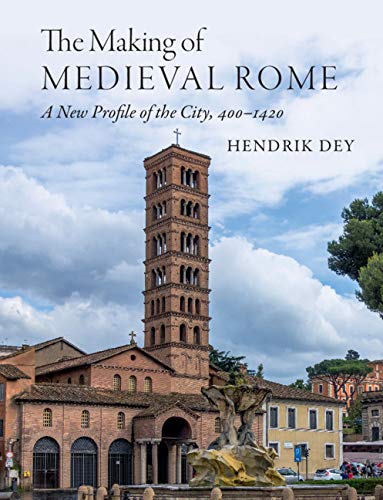
The 2015 post, Belisarius Enters Rome, discussed the decline and slow rise of the city of Rome from the 4th to the 19th centuries. Most prominent of the sources cited for the late Empire and early Medieval periods was Richard Krautheimer's Rome: Profile of a City, 312-1308, published in 1980. Krautheimer's work is still highly regarded but over the past 40+ years a great deal of new archeological work in Rome on its formerly neglected medieval period has been conducted, along with a reanalysis of the written sources, and the findings change some of the picture we'd previously had, and which is reflected in my earlier post. In particular, the timing of the key periods of transition from the city of the Caesar's to today's city has changed from the "traditional" explanation of why when looking at the ancient monuments, a visitor is often looking down into an excavated area ten or more feet below street level.
I prefer the cover of Krautheimer's book!

I find it fascinating when reading, or visiting Rome, to realize how many layers of history are present both visible and below our feet.
Hendrik Dey's 2021 book, The Making of Medieval Rome: A New Profile of the City, 400-1420, incorporates these new findings and builds upon his 2011 work, The Aurelian Wall and the Refashioning of Imperial Rome, AD 271-855, which I read in 2022.
The Making of Medieval Rome and Belisarius Enters Rome have the same starting place. Dey reminds us that from the 2nd century BC through the 4th century AD, Rome "was the most populous city outside of China that the world had ever seen" and that until the 18th century no European city would rival it in size and population. He then notes that a Roman from 200 AD would, in 600 AD, see "a place transformed beyond recognition, and wept to see it".
For centuries the city was dominated by ruins, its inhabitants living, around, within, and on top. New buildings, including churches, were built from recycled stones, bricks, columns, and fragmented marble. The lime for the mortar needed for construction was created by melting marble and limestone blocks from the imperial era.
The inhabitants, who for a thousand years never amounted to more than 5-10% of the number during the imperial era, were scattered across the landscape within the Aurelian Walls.
Although the city's population had begun to decline in the 4th century and further after its sack by the Goths in 410, there was some rebound after the sack with the population by mid-5th century at perhaps 350,000. Dey dates the tipping point of steep decline to the aftermath of the Vandal sack of 455, after which there is evidence of an accelerated pace of building abandonment and decay. The ability to recover was also degraded as the inflow of taxes from the rest of the Empire, along with grain from North Africa and the steady flow of immigrants into the city all ceased. By the end of the century the population may have been reduced to 50,000. From then, until at least the 15th century, Dey estimates the population never exceeded 50-60,000 and may, at times, have been a low as 20-30,000.
Though the situation was somewhat stabilized during the reign of Theodoric the Great (489-526) there was awareness that the days of glory were past. Theodoric's chancellor Cassiodorus marveled:
It is clear how great Rome's population must have been, the vast enclosure of the city walls, the sprawling embrace of the spectacle buildings, the marvelous size of the baths, the numerousness of the grain mills specifically dedicated to feeding the people.
But, as Krautheimer noted in his book;
Try as Cassiodorus might, his efforts to halt the erosion were in vain. Sewers were in need of repairs. So were aqueducts . . . The public granaries had 'collapsed through old age'. . . Bronze statues all over were being looted '. . nor are they mute; the ringing sound they give forth under the blows of thieves . . . wakes the dozing watchman.' Marble, lead, and brass were looted from public buildings . . . Temples, Cassiodorus complains, 'have been handed over to spoliation and ruin' . . . Many of the great mansions, too, had been abandoned . . .
In the wake of the Gothic Wars of 535-554, which saw the Byzantine reconquest of Italy, Dey disagrees with Krautheimer, about the strength of the role of the papacy in governing the city. According to Dey, it was the Byzantine civil administration which controlled the city, though the papacy was becoming stronger during that period. The Byzantine state owned the city's public architecture and was responsible for its maintenance and that of the public works, including the aqueducts.
While the pace of construction, reconstruction, and maintenance was less than that of earlier centuries, the quality of the work by a still functioning building industry continued until the last decades of Byzantine rule in the mid-8th century.
In Belisarius Enters Rome I wrote:
A transformed city emerged from the wreckage of the Gothic Wars in the later 6th century, with a much diminished population concentrated along the Tiber River, particularly on the former Campus Martius on the east bank, and in the Travestere and the area that later became the Vatican on the west bank, where water was more readily available (referred to as the abitato). Large tracts of the ancient city, including the Forums, the hills (including the Palatine on which the Imperial Palace was sited), and the area around the Colosseum, were mostly abandoned except for the farms and vineyards that had sprung up among the ruins and for the churches and monasteries scattered among the ruins, most prominently the Lateran in the far southeast of the walled city, which until the 15th century was the seat of the Papacy; an area known as the disabitato.
In contrast, Dey reports the concentration of population within what Krautheimer referred to as the abitato occurred no earlier than the 11th century. For the five hundred years after the Gothic Wars, the much diminished population was scattered more broadly across the city's landscape. Dey writes:
There is now broad consensus that Rome's remaining tens of thousands of inhabitants tended to collect in settled 'islands" scattered across much of the intramural area and separated by more or less vacant stretches of abandoned buildings and ruins, some of which sprouted gardens and orchards and pastures. . . . Proximity to main roads was desirable . . . Running water from surviving aqueducts was also important.
Dey goes on to note that the excavations of the past forty years have revealed that during the Byzantine period the population was not as impoverished as previously thought. Mediterranean trade routes still operated, there is significant evidence of imported tableware and ceramic, and of still-existing local manufacturing capabilities.
The significant change came in the 8th century with Byzantine support reduced as the empire came under more pressure from the Arab onslaught and the end of the Mediterreanan trade with the Arab conquest of North Africa. It was only that then Rome became a state ruled by the popes, and the papacy began investing more in public buildings and infrastructure.
Later in the 8th century, wealth began to flow back into the city, much from donations from the Frankish kingdom and from the agricultural lands and cities outside Rome acquired by the papacy. With these resources the papacy, between 772 and 816, undertook infrastructure improvements including repairing the Aurelian Wall and restoring four aqueducts to working condition. This revival continued into the mid-9th century. Even with these activities new surfaces for roadbeds consisted of poorer and less stable materials than the pavers used in antiquity and the drains and sewers ceased to be cleaned and maintained over the course of the century. Two large earthquakes hit the city during the 9th century destroying more of the ancient structures.
It was also during this period that the structures in the imperial forum area began to be demolished for reuse in Church-sponsored building projects. According to Dey, the travertine pavement in the Forum of Caesar was removedf as while as the white marble revetment from the walls in the Forums of Trajan and Peace. The white marble from Trajan's was burned to produce 7,000 tons of lime to be used in construction elsewhere. The pavements of the Trajan, Augustus, and Nerva forum were removed during this period, as small structures, buildings, and animal pens began to appear within.
Such dwellings are basically urban farmhouses that resemble actual rural residences . . . such that even members of the nobility lived among domestic animals, and gardens and orchards.
It was during this time of Papal supremacy that once building materials were removed from the imperial forum area, the Church opened the area to private landowners.
Despite this, Dey claims the central forum area well into the 9th century still looked, from a distance, much as it had at the end of the Empire. However, from late in that century into the mid-11th, the power of the papacy declined and that of local families rose, resulting in a loss of central authority within the city.
The restoration of the Aurelian Wall around 850 would be the last for three centuries. No significant civic monument or infrastructure was built for two centuries. The last repair of the aqueducts was carried out around 860 and by the 11th century, all but one had gone out of service. The failure of the aqueducts would have led to the abandonment of the neighborhoods dependent on their water supply.
Indicators across the city point to the 11th century as the inflection point when Rome's previously diffuse settlement landscape began to contract into a denser nucleus in the low-lying plains between the slopes of the Capitoline Hill and the Tiber in the west, leaving the hills in the eastern half of the intramural area mostly uninhabited.
It was during this period that dirt, rubbish, and sediment began to accumulate in the area of the Forum, as well as the Pantheon.
But it is the period from the mid-11th century to the 13th century that Dey dates the real visible and topographic transformation from ancient to medieval Rome. It is during this era that we see Roman nobles living in fortified complexes with walls and towers; the population clusters in the lower lands of the Campus Martius, and when;
. . . thick deposits of soil and rubble covered widely separated areas of low-lying terrain raising the ground across parts of the [Forums and Colosseum areas], the southern Campus Martius, Trastevere, and elsewhere several meters above late ancient and early medieval levels.
Until the excavations of recent decades it had been thought the submersion of ancient Rome's low-lying areas by fifteen feet or more below current street levels had incurred incrementally over centuries due to soil washed from the hills, Tiber floods, and disposed wastes. It now appears to have occurred in a matter of decades in;
. . . a coordinated series of interventions on a massive scale, involving the systematic infilling of low-lying areas with vast quantities of earth and rubble . . .
New religious and domestic architecture would no longer take shape in and among the blasted wrecks of a bygone age, but rather safely atop them. The thousand-year-old ruins that until then had threatened collapse, damaged buildings and blocked streets when they did collapse, and trapped swampy pools of muck undrained by long-blocked sewers, became the solution to the problem. By razing and/or leveling off ruins and spreading the rubble evenly, the masterminds behind this feat of urban engineering created a solid base for future urban development. Atop the fill, new roads and churches and residential neighborhoods took shape, less exposed to flooding and, for the first time, largely independent of the contours of the ancient city now buried beneath them.
This topographical transformation were lasting. Since the 12th century, ground levels have increased by less than 0.5 meters (1.5 feet) in Rome. This project appears to have been undertaken by a revitalized Papacy.

No comments:
Post a Comment