Showing posts with label Ottomans. Show all posts

Tuesday, December 5, 2023

Theodoro

While we usually think of 1453 as the date of the final demise of Rome with the fall of Constantinople to the Ottomans, it was on this date in 1475 the last remnant of the Roman world was extinguished.  Strangely enough it was on the Crimean Peninsula on the north side of the Black Sea.

Starting in the Sixth Century BC, Greek settlements were established on the south side of the Crimea.  The Roman Republic came into contact with the Greek city-states in the First Century BC, and from that time until the mid-4th Century AD, Rome either occupied or treated the Crimean cities as allies.  After a two century interruption when nomadic warriors from the steppes overran the peninsula, the Byzantines reestablished Roman authority in the late Sixth Century AD.  Over the next six centuries the Eastern Roman Empire indirectly or directly, as a province, ruled the area. 

When the Fourth Crusade was diverted from the Holy Land and instead captured Constantinople in 1204, the Byzantine remnants splintered in three; the Empire of Nicea on the eastern shore of the Sea of Marmara, which recaptured Constantinople in 1261, the Despotate of Epirus in northern Greece, and the Empire of Trebizond, on the southeastern shore of the Black Sea.  Trebizond extended its rule to the Crimea.

(Empire of Trebizond at its maximum extent)

Map of the Empire of Trebizond shortly after the foundation of the Latin Empire in 1204, featuring the short-lived conquests in western Anatolia by David Komnenos (later reconquered by the Empire of Nicaea) and Sinope (later conquered by the Sultanate of Rum).

During the 14th and early 15th centuries the Eastern Roman Empire with its capital of Constantinople was steadily squeezed by the rising power of the Ottomans until finally, in 1453, Constantinople fell.  By 1461 the last surviving parts of the Empire, located in Greece, had also fallen.  That same year, Trebizond also surrendered to the Ottomans.  All that was left of the Roman world was the tiny principality of Theodoro on the Crimea, adjacent to the Crimean colonies of Genoa.

undefined

The principality was also known as Gothia, because of the presence of a large Hellenized Gothic population.  Wikipedia describes the principality as, "a mixture of Greeks, Crimean Goths, Alans, Circassians, Bulgars, Cumans, Kipchaks, and other ethnic groups, most of whom were adherents to Orthodox Christianity and Hellenized. The principality's official language was Greek."  It goes on to tell us:

Various cultural influences can be traced in Gothia: its architecture and Christian wall paintings were essentially Byzantine, although some of its fortresses also display a local as well as Genoese character. Inscribed marble slabs found in the region were decorated with a mixture of Byzantine, Italian, and Tatar decorative elements.

In 1475, the Ottomans decided it was time to put an end to the principality and reduced the territory, capturing its capitol, Theodoro (modern Mangup) on December 5.

1,145 years after the founding of Constantinople, Rome was no more.


Saturday, April 9, 2022

The Ottoman Perspective

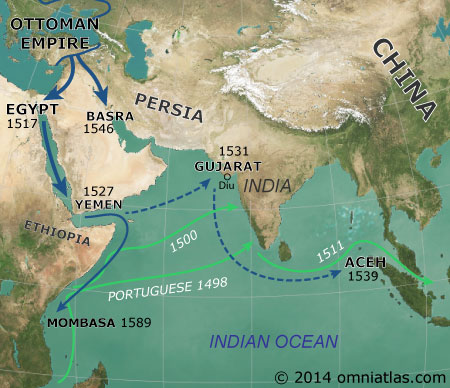
Captain Major of the Seas of Arabia discussed how Portugal became the dominant power in the Indian Ocean during the 16th century.  The Ottoman Age of Exploration by Giancarlo Casale provides a different perspective on that time and place.

/media/img/articles/2014/ottoman/IndianOcean.jpg

The Ottomans have been frequently portrayed as reactive and relatively uninterested in the Indian Ocean but Casale's thesis is that the Ottoman encounter with the Indian Ocean and that empire's attempts to exert its controls had parallels to the Western European experience during the age of exploration in the Americas and the Indian Ocean. (For more THC posts on the Ottomans go here.)

It was in 1517 that the Ottomans first came into direct contact, via the Red Sea, with the Indian Ocean and its surrounding territories after destroying the Mamluks and occupying Egypt.  Before carrying forward the story, Casale gives us some context.  He reminds us of the relative isolation of Western Europe, during the 15th century, before Columbus sailed, at a time when Muslim merchants could travel "virtually unobstructed" from Morocco to Southeast Asia, and Ming China was sending naval expeditions which reached Ceylon, the Persian Gulf, and East Africa.  But Muslim is not equivalent to Ottoman.  In the 15th century, the Ottomans were focused on expansion in Europe from their original base in what is now western Turkey.  They conquered Greece, the southern Balkans, and made Constantinople their capital after its capture in 1453.  Ottoman merchants were not traversing the Muslim world at the time.

As to the Portuguese, who reached India in 1498, pioneering a direct trade route for precious spices from South Asia to Europe via the Cape of Good Hope, they continued to have bigger goals.  In the short term the Portuguese royal family used the wealth generated in the spice trade to finance its plans for expansion in Morocco, but its longer term goal was even more ambitious.  Casale writes:

"As contemporary records make clear, they were well aware of the superiority of the traditional Egyptian route, such that Egypt and the Holy Lands remained at the very center of their strategic calculations throughout the early decades of the sixteenth century.  By their own admission, in fact, early Portuguese strategists hoped not to permanently bypass Egypt, by means of their blockade of the Red Sea, by rather to pave the way for an invasion of Egypt by weakening the Mamluks' access to customs revenues and raising money for themselves in the process".

Ultimately the goal was to conquer Egypt and the Holy Land and open a more direct, less risky, and less expansive route to the Indian Ocean.  In retrospect it seems a lunatic aspiration, given Portugal's limited financial and manpower resources, but what that country and Spain accomplished in the early 16th century in the Americas, Africa, and South Asia on a relative shoestring budget showed anything was possible.

Prior to the arrival of the Portuguese in the Indian Ocean, the spice trade to the Middle East, North Africa and Europe was routed through Egypt.  Between its agricultural productivity and the revenues generated via the spice trade, Egypt prospered (for the similar role Egypt played in the Roman Empire, read The Farthest Outpost).  With its conquest, the Ottomans now had access to that trade, but faced Portugal's efforts to blockade the Red Sea and seize outposts in the Persian Gulf and along the southern coast of Arabia.

Rapidly acquiring knowledge of South and East Asia and with access to maps and charts of the area, in the 1520s the Ottomans began to challenge Portugal's dominance, first attempting to conquer Yemen at the south end of the Red Sea, and developing alliances with the rulers of Gujarat, in what is now western India, efforts that were to continue until near the close of the century.

Casale documents the difficulties faced by the Ottomans, attributable to several factors:

The lack of a direct sea link between the Mediterranean and the Red Sea, meant an entirely new fleet had to be constructed for operations in the Red Sea and Indian Ocean, a costly proposition as galley and ship construction was extremely expensive.  On three occasions during the century, the Ottomans began construction on a canal to link the Nile with the Red Sea, but abandoned each due to cost and technical issues.

Difficult logistics.  The lack of sufficient mature forests in Egypt and Arabia meant wood and other basic raw materials needed for shipbuilding had to be imported from Anatolia or Lebanon, and expensive and time consuming proposition.

Continued instability in Yemen.  After its initial conquest in the early 1520s, there were several revolts by Yemenite tribesmen, a couple of which temporarily ended Ottoman control of the territory.  These revolts impeded Ottoman plans for action in the Indian Ocean and, once again, required diversion of financial, naval and land forces to reassert control.

Over and above these regional issues there was an ongoing back and forth in Constantinople involving the Sultans and their viziers over where the Empire's priorities should be - Europe?  The Safavid dynasty in Iran?  The Indian Ocean?  The degree of Ottoman aggressiveness in South Asia depended on how the winds were blowing in the Bosporus, and the winds frequently changed.

Despite these challenges the Ottomans accomplished quite a bit during the 16th century.  In the 1530s the dynasty conquered Iraq, seizing Basra, giving it access to the Persian Gulf trade and opening a new front with Portugal, which had taken Hormuz, at the narrowest part of the Gulf, in 1509.

The Ottomans were able to prevent Portugal from gaining a permanent foothold in Yemen, despite repeated efforts, and finally decisively defeated efforts to blockade the Red Sea.

Along with maintaining, at a high cost, its position in Yemen, the Ottomans also seized Eritrea on the opposite side of the Red Sea.

Developed close relations with Gujurat and Aceh, at the north end of the island of Sumatra, supplying arms and troops to both to support their opposition to the Portuguese.

In 1589, a raid by corsair Mir Ali, came within a whisker of evicting Portugal from the Swahili Coast of East Africa, which would have transformed the entire conflict and the ability of the Iberian Kingdom to continue its spice trade.  Only a series of freakish events prevented this from becoming a reality.

All of this helped the Ottomans to develop a free trade position for its merchants which allowed it to become a bigger player than Portugal in the spice trade. 

Perhaps the biggest threat was the plan for a major Ottoman offensive in 1567, which was derailed by yet another revolt in Yemen.  This involved a coordinated offensive with the Ottomans sending a large fleet into the Indian Ocean, also involving Muslim Indian states and the Sultanate of Aceh (which would move against the Portuguese stronghold of Malacca).

Despite its ultimate failure, Portugal remained continually worried about the Ottoman threat, but by the end of the century both powers were in decline.

The royal obsession with Morocco led Portugal to disaster in 1578, when its young king launched a crusade to conquer that North African kingdom, an effort that resulted in its army being destroyed and the king and much of the royal male line killed.  Two years later, Portugal was absorbed by King Philip  of Spain, for whom the Indian Ocean was a backwater to which he would pay little attention.  By the time Portugal became independent again in 1640 most of its possessions were gone, taken by the English and Dutch.

The Ottomans began a period of stagnation in latter decades of the century, with less resources being allocated to the Red Sea and Indian Ocean.  In 1622, the Iranian Safavids took Hormuz from Portugal, severing Ottoman Basra's links with India and by the 1630s, Ottoman rule of Yemen permanently ended, weakening the Red Sea-India connection.

Along with telling this story, Casale's book also introduces us to fascinating characters like Sokollu Mehmed, the long serving vizier from 1565 to 1579, and advocate for an expansive Indian Ocean policy, Ozdemir Pasha, who rose from lowly origins to suppress a huge revolt in Yemen and conquer Eritrea, and Sefer Reis, the corsair, whose clever tactics drove the Portuguese from the shores of Arabia and the Red Sea.

Wednesday, November 27, 2019

The Longest Siege

Twenty one years . . . 

On September 28, 1644 galleys of the Knights of Malta attacked an Ottoman convoy enroute from Constantinople to Alexandria.  The attack was successful, the Knights seizing the Chief Black Eunuch of the Sultan's Harem and pilgrims on their way to Mecca.  It was quite a haul and the Knights prepared to sell their 350 male and 30 female captives into slavery.

The Knights of Malta had been a long-time thorn in the side of the Ottoman Empire.  Originating as the Knights Hospitallers in early 12th century Jerusalem.  After the final loss of the Holy Land in 1291, the Knights occupied the island of Rhodes, their home for the next two centuries, from which they launched raids of plunder against the neighboring Moslem (and occasionally Christian) states.  As the Ottomans began their rise in the 14th century, eventually conquering the nearby mainland and islands, Rhodes preserved its independence until Sulemain the Magnificent laid siege, forcing the Knights to leave in 1522.   In 1530, Charles V of Spain granted the Knights a new home, the island of Malta, as a perpetual fief in return for an annual tribute of a Maltese Falcon.  For more on the Knights read The Stuff That Dreams Are Made Of.

Putting ashore on the nearby Venetian province of Crete, the Knights sent ashore a number of captives and slaves and then sailed away.
Image result for map of venetian crete
In 1644 the Ottomans remained masters of the Eastern Mediterranean.  By then the Ottomans and Christian Europe found themselves in the middle of a long stalemate.  Two centuries of Ottoman success against Christian states had been brought to a halt with the failed siege of Malta in 1565 and the destruction of the Ottoman fleet by a temporary Christian alliance at the Battle of Lepanto in 1571.  Since then, periodic wars had broken out but frontiers were fairly stable, the only significant differences being in the Ukraine and southern Poland where the Ottomans added territory.  The stalemate was to end with the Grand Turk's unsuccessful siege of Vienna in 1683 and the Christian counterattack on the heels of the withdrawing Ottoman army.

While Venice still ruled the island of Crete, the lagoon bound state was on the decline.  It had lost most of his advantageous trading rights within Ottoman territory along with the island of Cyprus and many smaller islands, as well as its outposts in Greece.  And with the New World discovered and new trading routes to the East, its commercial dominance was fading.  Venice had ruled Crete since 1205, the Catholic Venetians treating the Orthodox Cretans with contempt, inspiring many revolts by the local inhabitants.

At the Ottoman Court many saw this as an opportunity to evict Venice from Crete, the last Christian outpost in the Eastern Mediterranean.  In the spring of 1645, a large Ottoman fleet left Constantinople, its destination a mystery but with rumors flying ahead of it that Malta was its target.  The rumors had been deliberately planted by the Ottomans.  On June 23, 1645 the Venetians were surprised to find the Ottoman fleet anchored off the Cretan coast.  Landing on the island, the Ottomans began their conquest.

By May 1648 all of the island, with the exception of its capital, Candia (now Heraklion), was occupied by the Turks and an estimated 40% of the island's population had perished.  That month the Ottoman army began its siege and blockade of Candia, which was to last until 1669.
Image result for siege of candia

What accounted for the length of the siege?  For the Ottomans there were many distractions.  Other wars, particularly in Hungary and Transylvania diverted resources.  Venetian fleets periodically blockaded the Dardanelles, the narrow strait leading to the Sea of Marmara and Constantinople.  Raids by Christian fleets in the Aegean further disrupted Ottoman supply lines.  Finally, it was a period of intense court intrigues and coups at the Ottoman court.  The net result was the Ottomans were able to sustain a force large enough to maintain the siege but not strong enough to assault the city.

In 1664 the Ottomans negotiated a temporary peace with the Hapsburgs and were able to turn their attention and resources back to Crete.  In early 1668 a large Ottoman army landed on the island to join the blockade force.  European powers also sent aid to the Venetians, 6,000 soldiers from France and smaller contingents from Savoy, Malta, Naples and the Papal States.  Encourage by the support the Venetians turned down an Ottoman peace offer under which they would have retained half the island.

Actions in the summer of 1669 sealed Candia's fate.  A fleet sent by France met disaster with its flagship exploding leading to the withdrawal of France's troops.  The remaining garrison of Candia was reduced to 3,600 men and on September 5 Francesco Morosini, commander of the garrison, surrendered.

The cost of the final two years of the siege was enormous with more than 100,000 Ottomans and 29,000 Christians dying.

It was to be the last major territorial expansion of the Ottoman Empire.  Crete remained under Ottoman rule until 1897.

What must have it been like to be part of the siege?  If you were born in Candia in 1648 you would have lived your entire youth while under siege.  Reading about the siege reminds me of The Adventures of Baron Munchausen, the loony 1988 tale of an endless siege of a city on the sea by the army of the Grand Turk.


Thursday, July 26, 2018

On History And Timing

We've written posts on both Ottoman sieges of Vienna, the first in 1529 and the second in 1683, but what I neglected was their relative historical significance.  If Vienna had fallen in the first siege there was a significant chance that the Ottomans would have advanced further into central Europe perhaps sending the course of history into a new channel, while the city's fall in 1683 would have been an endpoint for the Ottomans, rather than a signal for further conquest.

In 1529 the Ottomans were at the peak of their powers under Suleiman the Magnificent.  After the fall of Constantinople in 1453 they had proceeded to solidify their hold on the Balkans.  Early in the 16th century they turned their attention to the Middle East, quickly conquering Syria, the Holy Land, Egypt, Iraq, and Arabia, becoming the protectors of Islam's most sacred sites including Medina and Mecca.  Returning to Europe they conquered the island of Rhodes evicting the Knights Hospitallers who had been a thorn in their side for decades (read The Stuff That Dreams Are Made Of) and capping it all by destroying the Hungarian monarchy in 1526 bringing them into the heart of Europe.  The Ottoman dynasty was dynamic and its military sophisticated by the standards of the times.

By 1683 the situation was much different.  The mid-16th century was the highpoint of Ottoman expansionism.  Turkish fleets roamed the Mediterranean, in cooperation with the King of France, against their mutual enemies.  On land the Sultan's army seemed invincible.

Then, in 1565, the Ottomans attempted to capture Malta, the new home of the Knights Hospitallers.  It was a disastrous failure, followed six years later by the devastating naval defeat at Lepanto, off the Greek Coast in which the allied Western navies crushed the Ottomans.  After Lepanto, the Ottoman fleet slowly degraded and the naval threat from Constantinople diminished.

On land, while the Ottomans were still effective on the defence, they faced a stalemate in central Europe, where they and the Hapsburgs traded incremental territorial gains back and forth.  It was only in the steppe lands north of the Black Sea where the Turks attained some permanent gains, but in lands with no larger strategic impact.

After Suleiman's death in 1566, the Sultanate was occupied by a series of ineffectual sultans.  Along with the navy's deterioration, the army became resistant to changes in military technology and tactics, areas in which the West was beginning to move ahead.

In retrospect the campaign of 1683 should be seen as nothing more than a large-scale raid, a last effort to reclaim ancient glory.  In the Balkans and Central Europe, the Ottomans followed a tradition of slowly assembling armies in the spring, with the forces meeting near Belgrade and then slowly advancing north along the Danube River.  With its borders now so far from Constantinople, the Ottoman army would usually not reach the frontier until mid-summer leaving little time for campaigning before it withdrew in the fall, which is precisely what happened in 1683.

But what would have happened if Vienna had fallen in 1683?  The city would have been sacked, robbed of its possessions, and its remaining inhabitants ransomed or carted off into slavery.  It is unlikely though that Vienna would have been permanently occupied.  It was well beyond the existing frontier, and difficult to supply and maintain even a small occupying force.  It could have been easily reconquered.  The city's fall would have been a shock to Western Europe, but one without lasting consequences, and one easily reversed.

What the second siege did mark was the definite end of Ottoman dreams of expansion in Europe and psychologically is freed Europe from its fear of the Sultanate.  A counteroffensive led by the Hapsburgs quickly conquered Hungary and though the Ottomans remained in the Balkans for two more centuries their power was broken.


Sunday, July 16, 2017

Ten Years After: The Ottomans Come A'Knocking (Part 3)

The long awaited final installment of the three part series regarding six events which transformed the course of history between 1519 and 1529.

The first part covered the New World - the entrance of Cortes into the Aztec capital, Tenochtitlan, and the coming of smallpox to the American mainland.

The second discusses two turning points in the Reformation; the excommunication of Martin Luther (January 1521), and Henry VIII's decision to pursue marriage with Anne Boleyn (February 1526).

The last event is also entangled with continental politics, particularly the impact of the Sack of Rome in May 1527 by the forces of Charles V, the Hapsburg monarch who also became Holy Roman Emperor.  For our last installment we will backtrack a bit to 1525.

The Queen Mother Writes The Sultan

The early 16th century in Europe saw interminable warfare among the royalty of Europe with one of the fiercest rivalries between Francois I of France and the Hapsburg (and Holy Roman) Emperor Charles V.  In late 1524 Francois led an army into Italy, seizing Milan and laying siege to Pavia.  In February 1525 an army sent by Charles to relieve the siege completely smashed the French force and captured Francois.

Even before the Battle of Pavia, Francois sought seeking allies among the enemies of the Hapsburgs, entering into an alliance with Poland the very year he invaded Italy.  But with his defeat and capture the need became even more urgent.  Even while the King was in captivity, the Queen Mother, Louise of Savoy, dispatched an emissary to Suleiman the Magnificent, the Ottoman Sultan, carrying a letter imploring the Sultan:
“ I had left my son’s freedom to the fairness of Charles. But, he is insulting my son. I entreaty you to make my son free with your great world sovereignty, and grand power that the world recognised”.
Allégorie de la régence de Louise de Savoie - Gestes de Blanche de Castille BNF Fr5715.jpg(Louise of Savoy)

Suleiman responded:
“You! Francois, the King of French province! [Note the reference to France as an Ottoman province!] You have sent a letter to us with your ambassador and informed us about the enemy that entered to your country and imprisoned you. So, you asked our favour for your freedom. It is not bizarre for a sovereign to be defeated or to be imprisoned. Do not worry about it. We have taken our arms and have been riding our horses for days and nights. Every thing will be as the God wishes”.
Though the Ottoman probably did not need a solicitation to justify his next move, the Queen Mother's plea and the promise of an alliance provided a proper causus belli.  The history of Ottoman expansion in Europe was covered in The Song of Jan Sobieski, but to quickly recap; the Ottomans first ventured into Europe in 1354, smashed the Serbian state in 1389, defeated the Crusades mounted in 1396 and 1444, and captured Constantinople in 1453.  Nonetheless, until 1525 their depredations (excepting a brief excursion into southeastern Italy in 1480) had been restricted to the remote and barbarous Balkans.

Between the Balkans and the Hapsburgs in Vienna lay the Kingdom of Hungary.  Already under threat from the Ottomans who had seized Hungary's southernmost fortress at Belgrade in 1521, Louis II, King of Hungary and Bohemia had agreed to a marriage alliance, wedding Mary of Hapsburg in 1522.

Fulfilling his pledge, Suleiman set forth with his army from Istanbul in April 1526.  Four months later, on August 26, 1526, the Ottomans slaughtered the Hungarian army at Mohacs.  Among the dead was the Hungarian king.  The kingdom was shattered, most to fall under Ottoman rule while a sliver in the north and northwest came under Hapsburg sway. The path to Vienna was now clear and France and the Ottomans had established an alliance that was to last for almost three centuries.

Suleiman Retreats From Vienna

On October 15, 1529 the Sultan lifted the three week siege of Vienna and, amidst the autumn rains, began the long trek back to Istanbul.  He had set out that spring with great expectations but the gigantic force of infantry, cavalry and artillery, Muslim and Christian had been hampered in its advance by endless rains and flooding.  It was not until September 8 that Buda had been captured and Vienna not reached until late September.  Tunneling and mining failed to bring down the walls, as did direct assault.

If Vienna had fallen the way into central Europe for the Turks would have been open.  Even with this failure, the expectations of Christian Europe were that Suleiman would return, and return soon.  The threat remained.  The reality was it was an unrecognized turning point.  The Turks returned for a second siege, but not until 1683.  In the interim was a century and an half of back and forth.  In the Mediterranean, the Knights of Malta defeated the Turkish invasion of 1565 (read, The Stuff That Dreams Are Made Of), and the Ottoman fleet was defeated at Lepanto in 1571.  Though the French alliance paid off, as during the 1540s the Turkish fleet wintered in Toulon, and dominated the sea, seizing tens of thousands of slaves in its ceaseless raiding.  But for the first time in almost two centuries, the Sultans were not constantly advancing.  Europe had a breathing space.

Conclusion

The ten years from 1519 to 1529 saw the European conquest of the Americas made inevitable by the ravages of disease, the Catholic Church challenged after twelve centuries as the ruling faith of Europe, new dynamic of faith and conflict within Christianity created, and the beginning of the end of the remorseless Ottoman threat, all of which set the stage for the era of European world dominance.

--------------------------------------------------------------------------------------------------------------------

Along with the six events profiled in this series, I researched another which, as it turned out, fell just outside this period but which had consequences that continue to ripple through history; the transport of sub-Saharan African slaves to the Americas.  The scale of this transfer was such that until the mid-19th century more Africans than Europeans had cumulatively come to the New World since 1492.

"Africans" had been present from the start as part of the initial Spanish and Portuguese expeditions to the New World.  However, they were either Moors; Arab or Berber captives from wars in North Africa or seized from ships, or in some instances, Moorish slaves from sub-Saharan Africa captured, in turn, by the Spanish or Portuguese.

Although there is reference to a 1502 slave transhipment from sub-Sahara Africa it appears the beginnings of the systematic trans-Atlantic trade was in 1517 or 1518.  Over the next 300 years, 10-11 million Africans were imported with more than one million others dying during transport.

Of these about 47% went to Brazil and 32% to the British and French sugar plantations in the Caribbean.  Another 17% were transported to Spanish possessions (two-thirds to Cuba).  The colonies (and later states) that were to constitute the United States account for about 389,000-407,000 (or 4%).

Sub-Sahara Africa also saw another large slave trade to the east and north with an estimated 10-20 million slaves transported to the Muslim countries of North Africa and the Middle East over a period of one thousand years.  During those same years, an estimated one million Europeans were enslaved by corsairs sailing from the Barbary states of North Africa.  There was also a lively slave trade during the Dark Ages of European slaves taken from the pagan areas of Germany and the Baltics during the Crusades to bring those areas to Christianity, sold via France to Muslim traders in Spain, as well as a well-established trade by Vikings selling captive slaves to the Turkish and Abbasid caliphates.


Tuesday, August 23, 2016

The Ottomans Turn East: Chaldiran & Marj Dabiq

When the eighth Ottoman sultan, Bayezid II, died on May 26, 1512, the Empire he left behind was mostly built on expansion into Europe from the Ottoman heartland in western Asia Minor.  The Ottomans crossed the Dardanelles at Gallipoli in 1354 and rapidly began expanding into the Balkans, dominating most of the region by the end of the 14th century.  With the capture of Constantinople in 1453, final destruction of the Serbian Kingdom, the new trans-Danubian dependencies in Wallachia and Moldavia, and the submission of the Khanate of the Crimea, its hold was consolidated by the time of Bayezid's death.  Although there would be further European expansion (for more on that, read The Stuff That Dreams Are Made Of, and The Song of Jan Sobieski), the greatest future territorial growth of the empire would occur in the Middle East and North Africa.

Two battles, the first occurring 502 years ago on this date in 1514, and the second, five hundred years ago as of tomorrow, marked the great directional change in Ottoman expansionism, and had repercussions for the history of the region that are still felt today.  

(Ottoman Empire in 1500, outlined in red, from euroatlas)
http://www.euratlas.net/history/europe/1500/entity_6084.jpg

Bayezid's successor was his youngest son, Selim, who was in his early 40s in 1512.  The events that brought him to the Sultanate were triggered when Bayezid, who had reigned since 1481, announced his oldest son as his heir.  Selim revolted upon this news, defeated his father's troops, forcing him to abdicate and go into exile (he died a month later), and then putting his brothers and nephews to death to avoid future threats to his rule.
http://i-cias.com/e.o/ill/s09-selim1.jpg(Selim I)

Selim faced two external challenges upon ascending the throne.  The first, a longstanding rivalry with the Mamluk Sultanate which had ruled Egypt since 1250 and also occupied Syria, and the second, the new, and aggressive, Safavid dynasty of Iran/Persia.

The Safavid's were Selim's first priority.  The Safavid family were able to seize power in the early 1500s in the midst of the turmoil and fragmentation that followed the slow disintegration of the empire founded by Tamerlane the Great.  They quickly defeated rivals and reassembled an empire that covered all of modern Iran, parts of Afghanistan, Turkmenistan, Azerbaijan, Iraq and the eastern part of Turkey.  The Safavid's aggressive expansion quickly brought them to the Ottoman borders, and they added a second element to their threat; the Safavid's were Shiite Muslims, while the Ottomans were Sunni.  When the Safavids began recruiting soldiers from the Turkish tribes on their border with the Ottomans, and Selim became alarmed that they were trying to provoke a Shiite uprising in the Ottoman lands, he decided on a forceful response. Receiving a religious ruling that Shah Ismail and the Safavids were unbelievers and heretics, he assembled his army and rapidly marched eastwards into the mountainous terrain of Kurdistan.

The Ottomans encountered the Safavid army near the town of Chaldiran (just inside the current border of Iran), and the two armies battled on August 23, 1514.  The Ottomans held two advantages; they had perhaps twice as many soldiers as their opponents, and they were better armed, both with firearms and artillery.   The result was a rout, and the Ottomans pushed on to temporarily conquer the Safavid capital of Tabriz.  Safavid expansion to the west was permanently blocked, and the Ottomans took possession of eastern Anatolia and norther Mesopotamia (Iraq).(Monument commemorating Battle of Chaldiran, from wikipedia)

It was not the end of warfare between the Ottomans and Safavids (their dynasty lasted until 1722).  The next hundred years saw frequent and lengthy outbreaks of war.  While the Safavids prevailed occasionally, overall the Ottomans were more successful, seizing the rest of Mesopotamia all the way to the Persian Gulf, and holding it until British Commonwealth troops seized it in 1917-18 during World War One.

With the immediate threat from the Safavids checked, Selim turned his attention to the Mamluks.  While there had been a war between the regimes in the late 15th century, the Mamluks were not a direct threat to Ottoman rule, although the dynasties vied for control of the spice trade and religious supremacy in the Sunni world.

The Mamluks originated as ethnic Turks and Georgians, brought as slaves to Eqypt to serve its Arab rulers, a process that began in the 9th century.  After training and conversion to Sunni Islam, the Mamluks would be freed but were expected to continue to serve their masters, both in administration and in the military.  The Ayyubid dynasty of the 12th and 13th centuries made extensive use of Mamluks and they were the backbone of the Sultan Saladin's army which defeated the Christian crusaders and reconquered Jerusalem.

In 1250, a Mamluk uprising was successful and they established their own sultanate, centered in Egypt.  The new dynasty consolidated its rule, expanding into Syria and defeating the Mongols, who overran much of the Middle East from 1258 on.  During the mid 14th century the original Turkish Mamluk dynasty was overthrown by Circassian Mamluks, from the region of the Caucasus.  Relying on their traditional methods of warfare, the Mamluks, unlike the Ottomans, had not adapted the new technologies of firearms and artillery.

In 1516, Mamluk Sultan Al-Ashraf Qansuh al-Ghawri marched north with his army to bring to an end disturbances in the Syrian portion of his empire.  He had been lulled by emissaries of Selim that the Ottomans remained focused on the Safavids and thus did not expect a conflict.  However, Selim advanced into Mamluk lands and the armies met on August 24, 1516 at Dabiq, a town in modern Syria, just five miles south of its border with Turkey.  As at Chaldiran, Ottoman numbers and technology carried the day and the Mamluks were completely defeated and al-Ghawri killed.  Not giving the Mamluks time to regroup, Selim advanced rapidly, capturing Damascus, entering Egypt in early 1517, occupying all of the former Mamluk lands, and becoming protector of the holy sites in Medina and Mecca in Arabia.  Even with their success, the Ottomans arranged for members of the Mamluks to administer Egypt on their behalf.
 (Portrait of Sultan al-Ghawri from wikipedia)

The successful campaigns of Selim resulted in all of the Middle East falling to the Ottomans, with Egypt remaining under its control for three centuries and the lands of Syria, Iraq and Arabia for yet another century beyond that, until the end of the Ottoman regime in the aftermath of World War One.  The Arab world, which had already seen turmoil and decline in the centuries before the arrival of the Ottomans, became even more of a backwater afterwards, as the Ottomans did themselves by the end of the 17th century.
 https://upload.wikimedia.org/wikipedia/commons/4/47/Territorial_changes_of_the_Ottoman_Empire_1520.jpg(Empire 1520, from wikimedia)

Selim, who died in 1520, is considered one of the most able Ottoman Sultans.  The empire tripled in size during his short reign and he paved the way for his son and successor, Suleiman the Magnificent (1520-66), who expanded the empire further in both Europe, Asia and Africa.
https://upload.wikimedia.org/wikipedia/commons/2/2a/Territorial_changes_of_the_Ottoman_Empire_1566.jpg(Empire 1566, from wikmedia)

One final, and chilling note, about Dabiq, the town where the Mamluks met their end.  Today, it is the place where, in ISIS ideology, the final battle for domination of the world between Christians and Muslims will take place, and their online magazine is called Dabiq.


Friday, September 13, 2013

The Battle of Vienna: The Ride of Jan Sobieski


Part 2

Early on the morning of September 12, 1683 Polish, Hapsburg, Saxon, Bavarian and Franconian infantry and cavalry, accompanied by Jan Sobieski on horseback, advanced downhill through the slopes and ravines to confront the Turkish army on the plains of Vienna.  The attackers were outnumbered by the Ottoman army but that army had lost the qualitative edge it had held over the Europeans in the 1400s and early 1500s.(Sobieski)

A century before, the series of very capable Ottoman sultans ended with the death of Suleiman the Magnificent (his immediate successor was known as Selim the Sot) and a stalemate ensued in the Balkans.  From the Hapsburg perspective their greatest foes and threats were the French, not the Turks, and in the early 17th century the dynasty became preoccupied with the Thirty Years War (1618-48), the intra-Christian religious war that convulsed much of western and central Europe. With one brief exception the Hapsburgs and Turks co-existed in peace from 1606 to 1680, the main point of contention being Transylvania and the remnant of Hungary (now governed by the Hapsburgs), ruled by Protestant princes, who were often allied with the Turks in opposition to the Catholic Hapsburgs.  While the Balkan front remained stable the Turks gained territory around the Black Sea where they occupied much of what is now southern Russia, The Ukraine and the Polish province of Podolia.(Ottoman Empire at its peak)

The result was that while there was growing internal stagnation and decay, the Ottoman Empire appeared still strong to many European observers in the mid-17th century.  Its geographic expanse was enormous, it was prosperous, for the most part internally peaceful and Constantinople with nearly a million inhabitants was the largest city in the world outside China.  For a clear eyed, entertainingly written and sometimes affectionate account of the rise, decay and fall of the empire THC highly recommends Lords of the Horizons by Jason Goodwin (1998) who writes:

"The city's position was the soldered joint which bound the bell of Ottoman Asia to the balloon of Ottoman Europe.  Its barracks housed the only standing army in Europe, the notorious janissaries, whose lives were dedicated to war . . . Just as the army, passing through the countryside, was able to feed and supply itself without reference to the surrounding lands [due to the logistical excellence of the Ottomans], so Constantinople seemed to float free of its immediate environment. . .  Two thousand ships sailed in with foodstuffs each year.  Nothing in Instanbul was left to chance, and so great was the city's appetite that while it was the Venetians, famously, who discerned and pursued the pattern of trade in the Eastern Mediterranean, it was really the Turks who willed that pattern into being, controlling it by fiat and regulation."

And the prosperity extended beyond the great city and Goodwin goes on to point out:

"Trade was conducted on an imperial scale.  Bertrand de la Brocquiere was in Damascus when a caravan came in from the desert, and it took two nights and three days to settle in.  In Belgrade's shops in the mid-sixteenth century a German visitor found 'everything as in the most advanced cities of Italy and Germany.'"
And while it was a Moslem state and the emperor was considered the Caliph of Islam, it was also, by the standards of the time, relatively tolerant.  Those standards were certainly different from today's and from the more modern view expressed by George Washington in his famous letter to the Tauro Synagogue (see All Possess Alike Liberty of Conscience) but they did allow for a degree of religious freedom for Christians and Jews though in a clearly subservient position to Moslems.  I stress the word "relatively" here so as not to be misunderstood.  Justice in the Empire could be arbitrary, swift and violent, particularly if you were not a Moslem, and the janissaries mentioned in the quote above were obtained by seizing young Christian boys from the Balkans and bringing them to Constantinople to be raised and trained in the art of war.  Each non-Moslem community was organized as a millet and, as Goodwin writes:

"as long as the millet did not come into conflict with Islamic organisation and society, provided it stumped up its taxes and kept the peace, its leaders were left to run their own affairs . . . Shielded from the bullies of the Counter-Reformation, Protestant doctrine spread through Ottoman Hungary: the boy levy, in fact, was never extended to Hungary, and in the Balkans, beyond this single impostion, no efforts were made to convert Christians to Islam."
Compared to Christian Europe racked by the religious wars of the Reformation and Counter-Reformation and the expulsion of Jews from many communities as well as Moslems from Spain and Portugal, sometimes the Turks did not look so bad and, as one example, many of the Jews expelled from Spain were welcomed as immigrants by the Ottomans.

To understand the origins of the Ottoman campaign of 1683 we need to look at Hungary.  While most of Hungary had been governed by the Ottomans for more than a century a small sliver remained in Hapsburg hands.  However, the Magyar nobles were mostly Protestant and other Magyars were Orthodox Christians in contrast to the Hapsburgs who were fervent Catholics, leading the Magyars to prefer the Turks who they viewed as more tolerant.  A Magyar revolt against the Hapsburgs was supported by the Turks and triggered a train of events leading to the Ottoman File:Central europe 1572.png(Lighter green is Ottoman Hungary; Light blue Hapsburg Hungary)

decision to campaign against the Hapsburgs.  Leopold I was seen as weak by the Ottoman Grand Vizier, Kara Mustafa, and there was an(Leopold, 'nuff said)  opportunity for territorial gain and plunder, though it remains uncertain whether Vienna itself was the original target (the Ottomans kept few written records and most of those that still exist are in inaccessible archives in Turkey).

Leopold remained focused on the French threat and left only a small garrison of 11,000 soldiers in Vienna.  He called for support from the German principalities and the kings of Europe.  And one key factor was about to change in the balance of forces.  Poland was an ally of France and had not aided the Hapsburg before against the Turks.  In fact, Poland was supporting the Hungarian rebels against Leopold.

The Polish-Lithuanian Commonwealth of the 16th and 17th centuries was unique.  Run by a feudal nobility it had an elective monarchy, resulting in a King with much less power than those with the same title in England, France and Spain and not as strong as the Hapsburg monarch.  At its peak in 1648, it extended beyond modern Poland and Lithuania to included most of what is today Belarus, The Ukraine and Slovakia.  However, that same year saw a massive uprising by the Cossacks in the Ukraine, triggering a chain of events leading to a broader war and attacks from the growing power of Russia.  Poland lost its eastern territories and the Turks saw an opportunity to attack the weakened commonwealth, seizing the province of Podolia in 1672.  Jan Sobieski, who had already achieved some military victories against the Turks, was elected the Polish King in 1674 and continued to try to regain the lost province.  Meanwhile, Leopold I was happy to have the Turks occupied attacking the Poles allowing him to continue his war with the French.

With the start of the Ottoman campaign in 1683, the French lobbied to keep Poland from helping the Hapsburgs, including making large payments to some of the Polish nobility.  Even though Sobieski's wife was French-born he saw the Ottoman threat as a larger one, and in fact, the mystery over the destination of the Ottoman army contributed to the decision as well as the opportunity to recover the lost lands of Poland and eventually the Polish Parliament voted to enter into an alliance with the Hapsburgs which was signed in May 1683.

In July, Sobieski led his army (with one of his most trusted contingents consisting of Muslim Tartars from the Russian steppes) towards Vienna and after uniting with Hapsburg and German troops, crossed the Danube northwest of the city on September 6.

The actions of the Grand Vizier Kara Mustafa remain a puzzle to military historians.  In his rush to reach Vienna, he left behind the heavy artillery which could have pulverized the city walls.  Once the siege was laid, he resisted launching a general assault which, in the judgement of many, would have likely succeeded.   There's been speculation that he didn't order the assault because the Ottoman custom was that if a city or town was taken by assault the(Kara Mustafa) victorious troops had three days to plunder and loot but it the city surrendered all its wealth would go to the Sultan (with a nice cut for the Grand Vizier).  It is also baffling to figure out why the Turkish camp was not fortified once Mustafa learned the relief army was approaching and why he failed to order outposts set up in the hills surrounding Vienna through which the Poles and others would have to approach.
(From raremaps.com)

Even with these mistakes the siege was a close run thing.  Goodwin describes its climax:

"The outer walls were breached; the inner walls were crumbling  . . . always the eerie, slow, methodical trenching and mining . . . On 4 September, a mine blew a big hole in the inner wall of the city; whole lengths began crumbling.  Belated assaults were launched with increasing ferocity upon these breaches; but overnight the citizens did their best to repair the holes, and fought back with equal ferocity, although the effects of the siege were beginning to tell.  Butcher's meat had run out; vegetables were scare; families sat down to donkey and cat.  The elderly and weak began dying, and disease stalked the unpaved streets."
The attack on September 12 began with an assault by German infantry on the Turkish camp.  After a midday halt, the Polish cavalry and infantry under Sobieski joined the action and the Turks collapsed.  Kara Mustafa fled, collecting as much of the army as he could but it was a rout and much wealth was left in the camp.  It was the worst defeat suffered by the Ottomans since they'd entered Europe in 1354.  On his way back to Constantinople, Mustafa was met by the Sultan's representatives and told he must pay the price for failure as a vizier.  He was strangled with a bowstring and his head sent to the Sultan in a velvet bag.

For the Poles and Jan Sobieski it was the last moment of glory.  Without the Polish army it is doubtful the relief would have succeeded, but soon thereafter Poland was plunged once again into war on many fronts and less than a century after Sobieski's death in 1696 the kingdom no longer existed, partitioned among Prussia, Austria and Russia and erased from the map until 1919.


The defeat of the Turks in 1683 was a turning point.  The Ottomans were never again a threat to attack Europe and it signaled the start of a 230 year retreat.  The Hapsburgs, quickly following up their victory, captured Budapest in 1686 recovering most of the Kingdom of Hungary soon thereafter and their armies reached as far as Belgrade by the end of the century.  Though much of the Balkans did not see the Turks definitively ousted until the 19th and early 20th centuries (see First Balkan War), the rest of Europe began to look west after 1683 and by the 1800s the Empire known as "the sick man of Europe" was kept alive only by the support of Britain and France who saw it as a bulwark against the growing Russian empire and its ambitions in the Balkans and Middle East.  Even the reformist revolt of the "Young Turks" in 1908 could not save the empire and when it sided with the Germans and Austrians in World War One it sealed its fate (a fate shared by its Hapsburg rivals) and the new nation-state of Turkey emerged from the ashes of the Empire after the war.

So, goodnight Vienna and sleep well, Jan Sobieski.