Showing posts with label European History. Show all posts

Sunday, November 24, 2024

What Is The Third Estate?


These principles become even more rigorous when it is a matter of dealing with privileged orders. I take “privileged” to mean anyone who falls outside the provisions of the common legal system either because he claims not to be subject to common legality at all or because he claims to have exclusive rights. We have provided sufficient proof of the fact that any privilege is by nature unjust, odious, and contrary to the social pact. A privileged class is to the Nation what individual advantages are to the citizen. Like them, it is not something that can be represented. But even this is not quite enough. A privileged class is to the Nation what harmful individual advantages are to the citizen. The legislator does his duty in sup-
pressing them. The parallel also serves to reveal a final difference, which is that an individual advantage that is harmful to others is at least useful to its owner, while a privileged class is a pestilence upon the nation that is forced to suffer its existence. To make the comparison more exact, one would have to compare a privileged class in a nation to a frightful disease devouring the living flesh of the body of its unhappy victim. With this in mind, it is easy to see why a privileged class might feel a need to cloak itself in all the honorable distinctions it can find.  A privileged class is therefore harmful not only because of its corporate spirit but simply because it exists. The more it has been able to obtain of those favors that are necessarily opposed to common liberty, the more it is essential to exclude it from the National Assembly. 

But if privileged individuals enjoy an estate that makes them the enemy of the common order, not the beneficiaries of simple distinctions that are almost indifferent to the law, then they should be positively excluded.

- What is the third estate? by Abbe Sieyes (Emmanuel Joseph Sieyes)

What Is The Third Estate? by Sieyes, a Roman Catholic clergyman, was published in January 1789, several months before the meeting of the Estates General at Versailles and proved very influential with the delegates.  The Estates being convened were those of the Clergy (First Estate), Nobility (Second Estate), and Commons (Third Estate).  The French monarchy, desperate to solve its financial crisis, was forced to call the Estates General together for the first time in more than 170 years.  What was to be the relative status of each estate was a subject of much controversy leading to the meeting, and during its first month.

The essay starts with this memorable line:

What is the Third Estate? Everything. What has it been hitherto in the political order? Nothing. What does it desire to be? Something.

Though Sieyes was a member of the First Estate, he was elected as a delegate of the Third Estate to the assemblage at Versailles.

While seeking the overturning of the existing system of hierarchy in France, Sieyes was a moderate in the context of what became the French Revolution, which plunged into violence and terror, though some historians, like Simon Schama, contend violence was an essential element from the start, leading to the ascension of Napoleon Bonaparte and a quarter century of European war.  However, whatever his intent, the dehumanizing rhetoric deployed by Sieyes was one of the earliest signs of the direction the Revolution would eventually take.

In the National Assembly (as the Estates General redesignated itself in 1789), Sieyes eventually lost influence because of his opposition to the abolishment of tithes and confiscation of Church lands.  He voted for the execution of Louis XVI though, unlike most, he avoided making any statement about why he cast his vote; he supported the Girondin and was not a Jacobin, though managed to kowtow enough during the height of the Terror to avoid the guillotine.  Years later, asked what he did during the Terror he responded, "I survived".

After the Jacobin Terror ended in 1794 with Robespierre's beheading, Sieyes served on diplomatic missions to The Hague and Prussia. In 1799, he became a member of the Directory, France's governing body, supporting the efforts of Napoleon to seize power the following year, retiring from politics soon after.  He died in 1836.  Sieyes was a survivor.

Friday, August 9, 2024

It Begins

On this date in 1914, the British light cruiser HMS Birmingham rammed and sunk the U-15, the first German submarine to be lost in World War One.  The armies of the continent were mobilizing, about to plunge Europe into the disaster that set the course for the rest of the century.

Following the assassination of Archduke Franz Ferdinand, heir to the throne of Austria-Hungary (AH), and his wife Sophie, in Sarajevo on June 28, by the teenage Slav nationalist Gavrilo Princip, the Austrians delivered an ultimatum to Serbia on July 23, and then declared war on the Serbs five days later.  Serbia's ally Russia, began mobilizing its military against AH on July 31.  In response, AH's ally Germany, declared war on Russia the following day and then on Belgium and Russia's ally France on August 3.  The following day, the United Kingdom made its declaration against Germany.  Two days later AH went to war against Russia, and Serbia issued its declaration against Germany.

As with the American Civil War, none of the parties, to quote Abraham Lincoln's second inaugural address, "expected for the war the magnitude or the duration", while "Each looked for an easier triumph, and a result less fundamental and astounding".

In preparation for a visit to Western Front battlefields next month, I've been doing some reading.  While some has focused on the military aspects like The First World War by Hew Strachan and The Western Front by Nick Lloyd, I've also been delving into the origins of the war.  A few years ago I read Christopher Clark's The Sleepwalkers: How Europe Went to War in 1914.  Over the last month I read July Crisis by TG Otte and listened to a series on podcasts on The Rest Is History, the outstanding podcast by British historians Tom Holland and Dominic Sandbrook, on the assassination of Franz Ferdinand and the failed diplomatic efforts of the following five weeks that gave the world its war. 

The period from the morning of June 28 to July 31 leaves one with the same feeling as watching a "by the numbers" horror movie where find yourself thinking "don't open that door!", "don't go in that room!!", and "splitting up is a really bad strategy!!!", yet the characters proceed to go ahead, nonetheless.

What is striking is how much the actions of the major actors in those weeks, Austria-Hungary, Russia, and Germany was driven by fear, not expansionism or militarism.  Austria-Hungary saw itself as a weakening power, threatened by the demands of multiple nationalities within the empire, and particularly by its Slav population incited, as they saw it, by the Serbs.  Without action to finally end the Serb threat, the Hapsburg faced a dire future, a view shared by a Germany, increasingly concerned about its main ally's slow decline.  The Russians felt humiliated by recent diplomatic setbacks and worried about the lose of reputation and status if it failed to respond in defense of its ally Serbia.  The Germans feared the rapid growth of the Russian economy and its military strength which might surpass theirs within a decade, as well as the growing strength of France, leading to threats on two fronts.  As for the French, they mostly played an inciting role in this period, encouraging strong action by their Russian ally, while seeing an opportunity to liberate Alsace-Lorraine.

Though AH was seeking to militarily punish Serbia, none of the countries sought a general European war, yet they achieved that result, due to miscalculation, negligence and inattentiveness early in the crisis, and the irresponsibility of diplomats in AH, Russia, Germany, and France, along with the disengagement of Britain for much of July.

The Serbian government did not plan, nor desire the assassination, and made some ineffective efforts to stop the team of assassins once learning something was afoot.  But it was organized by Serbs of the secretive Black Hand organization, led by Dragutin Dimitrijevic, known more widely by his alias of Apis, who was also chief of Serbian Military Intelligence.  Through intermediaries a group of young and reckless Slav idealists, including the Bosnian Serb Princip, were easily manipulated into carrying out the attack on the Archduke.

Franz Ferdinand was selected as a target because as heir to the ailing 83 year old monarch Franz Joseph, he was seen as the leading AH proponent for war against Serbia, and was also advocating for a larger role for Slavs within the empire as a counterbalance to the Hungarians, a policy which, if successful, would undermine Serbian goals of establishing a larger Slav state to be run by Serbs.  On the latter issue, the Serbs made the correct assessment, but on the former, not only was Franz Ferdinand not an advocate of war against Serbia, he was the leading figure opposing a war on that nation.

On the morning of June 28 it took a series of individual decisions by officials and a lack of communication to bring about that moment when, by chance, after the driver took a wrong turn, the car carrying Franz Ferdinand and his wife stopped directly in front of the dejected Princip, who had seen one of his fellow plotters toss a bomb at the car earlier with little impact, and believed their attempt had failed completely.  Princip took advantage, acted quickly, firing two shots, and killing Ferdinand and Sophie.  If any one of those decisions or actions had gone differently Princip would never have had the opportunity.

In the aftermath most AH political and military figures saw an opportunity to attack and dismantle Serbia and designed an ultimatum they knew would be unacceptable to the Serb government.  Heedless of the larger implications of its plans it plunged ahead.  Astonishingly it was not until just before issuing its ultimatum, premised on a fast followup attack on Serbia, that the civilian government was informed by its military that it would not be prepared to attack until mid-August!  Nor did anyone give any much thought to what would happen if Russia intervened.  To the extent Russia was considered the Austrians figured that since they had been diplomatically humiliated when AH annexed Bosnia-Herzegovina in 1908 and in Balkan War maneuvering it would react the same in 1914.  But Russia, looking at those same two events when it backed down, was determined not have it happen again.

While efforts were made in Germany, Russia, and near the end of July by Britain, to prevent a wider war, they proved at cross-purposes and ineffectual.  Perhaps if Europe still had statesman with the skill and vision of Metternich, Bismarck, and Disraeli, there would have been a faster and more effective attempt to find a solution short of war but statesmen were in short supply in July 1914.

What followed cost more than ten million lives, ended the monarchies in Russia, AH, Germany,  completed the dissolution of the Ottoman Empire, gave birth to fascism and communism, and planted the seeds for the next European war.  

Austria-Hungary, the country most responsible for the war, proved inept militarily, setting the stage for its self-destruction.  In a giant humiliation for the empire, its first three attempted invasions of the small nation of Serbia were easily repulsed.  It was only with the help of Bulgaria and Germany that it finally succeeded in late 1915.  Indeed, Austria's only military successes in the war occurred with German help and under its direction; the offensive against Russia in 1915, the attack on Romania in 1916, and the offensive against Italy in 1917.

As for Serbia, whose unstable and faction ridden political scene lit the fire leading to the war, a quarter of its population died.  Though Serbia emerged from the war as the leading power in the new Yugoslavia, it was also unstable and violence prone.  In 1934, the Yugoslav king was murdered by Croatian nationalists.  In World War Two, the Germans occupied Yugoslavia, triggering a partisan war of resistance in which 10% of the population died and a fascist Croatian puppet state killed somewhere between 200,000 and 400,000 Serbs.  After the war, under the rule of the Communist Tito, a unified Yugoslavia existed for four decades, but after his death the nation fell apart, going through a series of bloody civil wars, finally splitting into six different nations.  No one dreams anymore of a greater Slav nation.

Gavrilo Princip was immediately captured after the assassination, admitted his guilt but, at 19, was too young to be executed under the law of Austria-Hungary.  Sentenced to life imprisonment he died from tuberculosis on April 28, 1918, six months before the end of the war.  

In 1917, the Serbian government-in-exile convicted the inveterate plotter Apis in a conspiracy to assassinate Prince Regent Alexander.  Apis, the individual most responsible for the war, was executed in June of that year.


There is a school of history which believes the World War was inevitable, given the military buildup in the early 20th century, and the rivalry of the Great Powers.  I'm not an adherent of that school of thought because I lived through the Cold War.  Growing up in that period, it was difficult to see a peaceful ending, yet the Cold War ended unexpectedly and peacefully.  People and contingency play a large part in how events turn out. 

In the case of pre-war Europe, the great naval buildup by Germany which caused tension with Britain had ceased.  In 1912, France extended its term of military service from two to three years which allowed it to significantly increase its army, leading Germany to divert funds from its navy to army.  The result was an easing of tension between Germany and Britain and the beginnings of productive discussion between the two countries. Sir Edward Grey, Britain's secretary of state, was a firm advocate of better relations and meetings between foreign ministers of the two countries might have occurred later in 1914, if war had not intervened.  Improved relations between the two great powers would have lessened the chances of war.

Without a war, Franz Ferdinand would have become emperor when his uncle died in 1916.  Could he have succeeded in his plan to grant autonomy to a Slav entity within the empire?  If so, could that have eased tensions?

Without a war could Russia, the fastest growing economy in Europe, continue its rapid industrial expansion?  Could it deal with its rising class tensions and could the Romanovs have transformed into a more constitutional monarchy?  Well, perhaps that last one is a bit much as it would have required brains.  Without a war, does Lenin (the horrible, but indispensable man) ever return to Russia?

It was Italy's participation in the war, and the disappointment with its share of the spoils afterwards, that emboldened Mussolini and led to the rise of fascism.  Without a war in 1914, does fascism still emerge?

And then, we have Germany without a losing war.  Enough said.

Tuesday, September 20, 2022

And How Was Your Day?

On June 18, 1815, Frederick Cavendish Ponsonby had what could be characterized as either a very, very, bad day or a miraculous day, because it had elements of both.

Frederick Cavendish Ponsonby - Wikipedia

It was the day of the Battle of Waterloo.  Ponsonby, commander of the 12th Light Dragoons in Wellington's army, led his unit in a charge against the French, which was initially successful but momentum took the cavalry too far into the French lines where it suffered heavy casualties.

In the course of the action Ponsonby was wounded in both arms, then knocked off his horse by a saber cut.  After being dismounted he was stabbed in the back by a French lancer.  As he lay helpless on the ground, a French soldier robbed him of valuables.  He caught a momentary break when a Major from the French Imperial Guards Dragoons recognized him, gave the grievously injured Ponsonby some brandy, and then left, promising to find help.  After the French cavalryman disappeared, another French soldier appeared and used Ponsonby's prone body as a shield while he fired at the British.  Later that day the Prussian cavalry appeared on the field, promptly charging the French and trampling Ponsonby in the process, injuring him further.  As evening approached the Prussian infantry appeared and the wounded man was robbed yet again.

With the end of the battle as night fell and Napoleon and the remnants of his army fled, a badly wounded British dragoon crawled onto Ponsonby's legs where he slowly expired and then the commander was discovered by a soldier of the 40th Foot, who stood guard over him all night to protect him from further robbery.  Surprisingly, Ponsonby survived, regaining his health under the nursing of his sister, Lady Caroline Lamb. Undoubtedly his recovery was hastened by being bled of 120 imperial ounces in the two days after the battle!

After coming across this story, I did some more research on Ponsonby and came across his biography at the History of Parliament website and it is quite fascinating and amusing - it quotes a contemporary who attributed his recovery after Waterloo to "the extreme tranquillity of his character, which was never ruffled by irritation or discontent".  Ponsonby, born in 1783, was the second son of the 3rd Earl of Bessborough, meaning that under British inheritance law he was out of luck, as everything would go to the first son, so in 1800 he joined the army.  He rose quickly, serving with distinction during Wellington campaign on the Iberian Peninsula (1809-14) and being promoted to colonel.

Ponsonby's sister who served as his nurse, Lady Caroline Lamb, was quite a character in her own right.  Caroline, a writer and poet who spoke French, Italian, Latin, and Greek, was also a wild child, engaging in a scandalous affair with Lord Byron and an affair with Wellington immediately after Waterloo.  Mental instability, exacerbated by alcohol and laudanum abuse, led to her death at 32.  Her husband, William Lamb, became Prime Minister four years later.

After recovery from his wounds, which left his right arm permanently paralyzed, Ponsonby resumed his seat in Parliament, though one commentator noted that "though an amiable man, Fred Ponsonby is the worst of all representatives, never going near his constituents or the House of Commons".

He left Britain in 1821 traveling to Italy and onto the Ionian Islands and Malta.  According to the Parliament website:

The need to remain abroad stemmed from his gambling debts, in settlement of which the duke of Wellington, who had taken an interest in his welfare since Waterloo, wrote on 21 Mar. 1822 to advise him to take a post in the Mediterranean ‘at present, and to look to go to India hereafter when you will be a major-general’, which will enable ‘you in a few years to return with means to pay your debts’:

I cannot conclude this letter without urgently entreating you to recollect what it is that has obliged you to separate yourself from your family and friends, and to quit the most advantageous and agreeable position that ever fell to the lot of any man in England. I am afraid that you can go to no part of the world whether near or distant in which you will not find means and opportunities of getting into similar scrapes; and you may rely on it that their only result will be to occasion fresh and increased regret to yourself and sorrow to your family and friends and to none more than ... [myself].

With help from Wellington, Ponsonby received appointment in January 1824 as inspecting officer of the Ionian Islands.

Returning to England the following year he married a daughter of Colonial Secretary Lord Bathurst.  The wedding provided some mirth as "At the altar he could not find the ring. After 20! minutes search, it was at the bottom of his pantaloon pocket". 

From 1827 to 1836 Ponsonby served as lieutenant-governor of Malta.  A long-time acquaintance visited the island and "found him living unpretentiously in a small house with a single servant, and was gratified that his host ‘has acquired by his rapid rise no humbug and pomp of office, but is just as free and open as I remember him fifteen years ago’"

He is one of the simplest, most manly, unaffected men that I know, with very good sterling sense, a sweet temper, and with the manners and experience of a man that has seen much of the world and has profited by what he has seen. The extreme, patient good humour with which he submitted to all his sufferings during the battle of Waterloo and in his very slow recovery afterwards, are said to have been the means of carrying him through ... Since that day he has been unable to use the fingers of his right hand and now writes with his left; but he contrives with singular ingenuity to wield a racket or indeed clench anything with it. Lady Emily is just as she was before her marriage, very good-humoured, but with a silly giggling manner which often offends, though only meant to do so occasionally.

Benjamin Disraeli also spent time with him on Malta and considered Ponsonby a "most charming fellow". 

Returning to England, in early 1837 he died suddenly while sitting down to a meal.  It was reported that "the physicians long ago pronounced that the action of his heart was disordered, that he might live on for years, but that when the crisis came, he would die suddenly, as if by a pistol shot".

His son, Henry Frederick Ponsonby, served 25 years as private secretary for Queen Victoria.


Below is the account of the events at Waterloo as told by Ponsonby to Lady Shelly who provided it in a letter written to Ponsonby's mother:

”At one o’clock, observing, as I thought,unsteadiness in a column of French infantry of 1,000 men or thereabouts, which was advancing with an irregular fire, I resolved to charge them. As we were descending at a gallop we received from our own troops on the right a fire much more destructive than theirs, they having begun long before it could take effect, and slackening as we drew nearer. When we were within 50 paces of them, they turned, and much execution was done amongst them, as we were followed by some Belgians who had remarked our success. But we had no sooner passed through them, than we were attacked in our turn before we could form, by about 300 Polish Lancers, who had come down to their relief—the French artillery pouring in amongst us a heavy fire of grape-shot, which, however, for one of our men killed three of their own. In the melee I was disabled almost instantly in both my arms, and followed by a few of my men who were presently cut down—for no quarter was asked or given—I was carried on by my horse, till receiving a blow on my head from a sabre, I was thrown senseless on my face to the ground. Recovering, I raised myself a little to look round, being I believe at that time in a condition to get up and run away, when a Lancer, passing by, exclaimed : ” Tu n’es pas mort, coquin,” (You’re not dead, naughty) and struck his lance through my back. My head dropped, the blood gushed into my mouth; a difficulty of breathing came on, and I thought all was over. Not long afterwards (it was then impossible to measure time, but I must have fallen in less than ten minutes after the charge) a tirailleur came up to plunder me, threatening to take away my life. I told him that he might search me, directing him to a small side pocket, in which he found three dollars, being all I had. He unloosed my stock, and tore open my waistcoat, then leaving me in a very uneasy posture. He was no sooner gone, than another came up for the same purpose, but assuring him I had been plundered already, he left me. When an officer, bringing on some troops (to which probably the tirailleurs belonged) and halting where I lay, stooped down and addressed me, saying he feared I was badly wounded, I replied that I was, and expressed a wish to be removed into the rear. He said it was against the orders to remove even their own men, but that if they gained the day, as they probably would, for he understood the Duke of Wellington was killed and that six battalions of the English army had surrendered, every attention in his power should be shown me. I complained of thirst, and he held his brandy bottle to my lips, directing one of his men to lay me down on my side, and placed a knapsack under my head. He then passed on into the action, and I shall never know to whose generosity I was indebted, as I conceive, for my life. Of what rank he was I cannot say; he wore a blue great-coat. * By-and-bye another tirailleur came, and knelt down and fired over me, loading and firing many times, and conversing with great gaiety all the while. At last he ran off, saying: ‘Vous serez bien aise d’entendre que nous allons nous retirer. Bon jour, mon ami.’ (You will be glad to hear that we are going to withdraw. Good day, my friend)

“Whilst the battle continued in that part, several of the wounded men and dead bodies near me were hit with the balls, which came very thick in that place. Towards evening, when the Prussians came up, the continued roar of cannon along their and the British line, growing louder and louder as they drew near, was the finest thing I ever heard. It was dusk when the two squadrons of Prussian cavalry, both of them two deep, passed over me in a full trot, lifting me from the ground, and tumbling me about cruelly—the clatter of their approach and the apprehensions it excited may be easily conceived. Had a gun come that way, it would have done for me. The battle was then nearly over, or removed to a distance. The cries and groans of the wounded all around me became every instant more and more audible, succeeding to the shouts, imprecations, and cries of ” Vive l’Empereur,” the discharges of musketry and cannon, now and then intervals of perfect quiet which were worse than the noise. I thought the night would never end. Much about this time one of the Royals lay across my legs—he had probably crawled thither in his agony—his weight, convulsive motions, his noises, and the air issuing through a wound in his side, distressed me greatly—the latter circumstance most of all, as the case was my own.

“It was not a dark night, and the Prussians were wandering about to plunder, and the scene in “Ferdinand Count Fathom” came into my mind, though no women, I believe, were there. Several Prussians came, looked at me, and passed on. At length one stopped to examine me. I told him as well as I could, for I could speak but little German, that I was a British officer, and had been plundered already. He did not desist, however, and pulled me about roughly before he left me. About an hour before midnight I saw a soldier in an English uniform coming towards me. He was, I suspect, on the same errand, but he came and looked in my face. I spoke instantly, telling him who I was, and assuring him of a reward if he would remain by me. He said that he belonged to the 40th Regiment, but that he had missed it. He released me from the dying man, and being unarmed, he took up a sword from the ground, and stood over me, pacing backwards and forwards.

“‘At 8 o’clock in the morning some English were seen at a distance. He ran to them, and a messenger was sent off to Colonel Harvey. A cart came for me—I was placed on it, and carried to a farmhouse, about a mile and a half distant, and laid in the bed from which poor Gordon, as I understood afterwards, had been just carried out. The jolting of the carriage and the difficulty of breathing were very painful. I had received seven wounds; a surgeon slept in my room, and I was saved by continual bleeding—120 ounces in two days, besides a great loss of blood on the field.

Monday, April 11, 2022

Mohi

On the morning of April 11, 1241 King Bela IV of Hungary, a large and prosperous kingdom, awoke near the small village of Mohi.  With him were his younger brother Prince Carloman and the five leading prelates of the Hungarian Church, who doubled as military leaders.  Around him a large army, the best of Hungarian fighters.

By sunset Carloman and the prelates would be dead, the army annihilated, and King Bela in flight for his life, a flight that would not end until the King found refuge on a small island in the Adriatic Sea, while his kingdom was overrun.

The Mongols had arrived.

MongolsinEurope

Mongol expansion began during the reign of Genghis Khan (1206-27) during which he united the tribes of Mongolia, invaded north China, and conquered much of Central Asia.   In 1222-23 he sent a large raiding force under the brilliant general Subutai to explore areas to the west.  The raid swept through Persia and into and over the Caucasus, across the Volga and Don, where it encountered the forces of Kievan Rus (the first Russian state founded by Scandinavian adventurers), which the Mongols quickly destroyed.  Then, they vanished back east.

Genghis was succeeded as Great Khan by one of his sons, Ogedei who, in 1235 ordered an attack on  Kievan Rus to be carried out by one of Genghis' grandsons, Batu.  In December 1237 the Mongol assaults began and Rus towns were sacked and destroyed one by one, culminating in the utter devastation of Kiev in December 1240.  The destruction was total, with the populace either slaughtered, enslaved, or left in poverty to fend for themselves.  Six years later a Papal envoy to the court of the Great Khan passed through the region and left this description:

They (the Mongols) attacked Rus', where they made great havoc, destroying cities and fortresses and slaughtering men; and they laid siege to Kiev, the capital of Rus'; after they had besieged the city for a long time, they took it and put the inhabitants to death. When we were journeying through that land we came across countless skulls and bones of dead men lying about on the ground. Kiev had been a very large and thickly populated town, but now it has been reduced almost to nothing, for there are at the present time scarce two hundred houses there and the inhabitants are kept in complete slavery.

It was the utter destruction of Kiev and other Rus cities, that led to the eventual rise of Muscovy, which had escaped the worst of the Mongol onslaught. 

Even as Kievan Rus was subdued, the Mongols were planning their next advance, across the Carpathians and into the plains of Hungary; flatlands suitable for the maintenance of the large horse herds necessary to sustain their way of life.  A permanent occupation was planned.

Hungary was ruled by the descendants of the Magyars, a steppe tribe which had attacked the area from the east in 895, quickly conquering the flat and fertile lands on either side of the Danube.  For the next sixty years, Magyar raiders terrified Europe, attacking not only nearby neighbors in Austria, Germany, and Poland, but ranging as far afield as France, Italy, and even Spain (for more on this period, read Having A Bad Century).  After being decisively defeated in 955, the Magyars settled down and began to be integrated into the European feudal structure and accepting Christianity by the end of the century.

The kingdom prospered, covering not only present day Hungary, but large portions of Romania, Slovakia, Croatia, and Slovenia.  The king's annual income easily exceeded that of his counterparts in France and England.

Secure, and not comprehending the Mongol threat, Bela had not even bothered to respond to Batu's demand that he surrender his kingdom.

In early 1241, Subutai and Batu swept through Moldavia and Wallachia and into Hungary, reaching the outskirts of Pest on the banks of the Danube(1).  However, the Mongols then began a withdrawal, giving hope to the Hungarians that they were discouraged and leaving the country.  It was instead an elaborate trap.

When Bela awoke that morning he was unaware that just two days before another Mongol army had destroyed a Polish/Silesian army to the north.  This Mongol force was a diversionary thrust, designed to keep Poland and Silesia from coming to the assistance of the Hungarians.  On April 9, at Leignitz in southern Poland, Henry II, Duke of Poland and Silesia, died, along with most of his army.

The battle of Mohi was hard fought for most of the day, until the Hungarians finally collapsed in the afternoon.  The Mongols left open an avenue for the retreat of their opponents, designed to string them out and allow them to be slaughtered at leisure.  Though Bela escaped, almost all of his soldiers were killed.

After their triumph, the Mongols broke into separate columns pillaging and destroying towns.  If they encountered any resistance, all in the town would be killed.  Over the next few months, every town in Hungary fell to them, with the capital, Esztergom, being last in December 1241.  However, because of their lack of siege engines, the Mongols were unable to capture the stone citadels and castles within many of the towns.

Another Mongol force rode in search of Bela, following his path all the way to the Adriatic, but always a step too slow.

What was to happen next?  What happened was unexpected, at least for the Europeans who had experienced the Mongol assault.  In March 1242 the Mongol army began its withdrawal from Hungary.  It is still uncertain why.  One theory is the death of Ogedei in December 1241 required all the Mongol blood princes to return to the capital in Mongolia to select a new Khan.  Another is that, though the Mongol invasion had been successful, the costs were too high to maintain a presence in Hungary.  Various other theories have been offered, but there is no consensus.  The bottom line is the Mongols were gone.

By the time the Mongols returned in the 1280s, the Hungarians were prepared.  Bela, who ruled until 1270, had noted how castles and citadels had held out, and fortified Hungarian towns much more strongly and the invasion was repelled.

The Mongols continued to dominated the Russian steppes for the next two centuries and extract tribute and obtain submission from the principalities in the wooded lands, such as Muscovy.  Though they did not return for conquest further west, over the next quarter century, the Mongols occupied much of the Middle East, ending the Caliphate in Baghdad, occupying Syria, and coming within a few days march of Jerusalem.  To the east, they completed the conquest of all of China, and attempted to invade Japan and Java.  By 1270 they had established the largest contiguous land empire in human history.

-----------------------------------------------
(1)  Opposite Pest, which lay on the Hungarian plains, was Buda on the hills west of the Danube.  The towns were later combined to form Budapest.  At the time, Hungary's capital was Esztergom, about thirty miles north of Pest.  After the Mongol invasion, Bela transferred his capital to Pest.


Tuesday, October 26, 2021

The Pastoral City

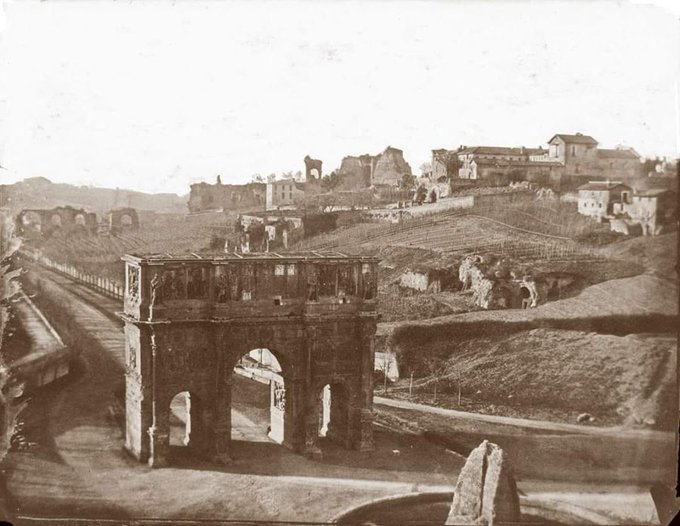
 Came across this remarkable 1850 photo of Rome.

Image

It looks like it is taken from inside the Colosseum, probably on its second level, and it pictures the area to the west of the structure. The stone sticking up in the lower right center is the remnant of the Meta Sudans, which was bulldozed at Mussolini's order.  Directly center is the Arch of Constantine (constructed in the early 4th century).  The modern road has been rerouted so it passes around, not through, the Arch.  Further down that road on the right is part of the aqueduct that carried water to the Palatine Hill.  The elevated ground in the distance behind the aqueduct is the Aventine Hill and the valley in between is where the Circus Maximus was located.  

The upper center-right of the photo is dominated by the Palatine Hill, home of the Imperial Palace.  During the time of the empire it was almost completely covered by palace buildings.  In 1850 the highest point has a monastery on it though you can see remnants of the palace as the hill slopes down to the aqueduct.  If you could see 90 degrees to your right the Sacred Way leading to the Forum would appear.

The other thing to note is how much of the hill was devoted to agriculture and pasture.  After the 6th century Gothic Wars, this area and much of the rest of the former imperial city ceased to be a place of dense urban habitation.  From Belisarius Enters Rome:

Large tracts of the ancient city, including the Forums, the hills (including the Palatine on which the Imperial Palace was sited), and the area around the Colosseum, were mostly abandoned except for the farms and vineyards that had sprung up among the ruins and for the churches and monasteries scattered among the ruins, most prominently the Lateran in the far southeast of the walled city, which until the 15th century was the seat of the Papacy; an area known as the disabitato

This is what the area between the amphitheater and the Lateran looked like in 1870.   Today it a busy and congested part of the city.

The disabitato existed into the 19th century with the expansion of the city into the Rome we know today only after the reunification of Italy in 1870.  The remaining densely populated part of the city was located on the Tiber in what was called the Campus Martius at the time of the Republic and Empire and on the other side of the river in the area near what became the Vatican in the Middle Ages.

At the time the photo was taken the population of the entire city was probably around 150,000 to 175,000 compared to about a million in 150 AD.  It was not until the 1930s that Rome's population exceeded that of the Second Century AD.

The photographer was Ludovico Tuminello (1824-1907).

Wednesday, August 4, 2021

Consequences

On the evening of August 4, 1789 the newly assembled National Assembly of France voted to abolish the "privileges" of nobility.  Formed in the turmoil of the early days of the French Revolution, the Assembly represented all of the estates (Nobility/Religious/Bourgeois) of the country.  The proposal was introduced by the Vicomte de Noailles, a member of the nobility.  Noailles had served under the Marquis de Lafayette during the American Revolution and negotiated the formalities for the surrender of Lord Cornwallis' army at Yorktown.

Count Mirabeau, one of the early leaders of the Revolution and an advocate for establishment of a constitutional monarchy along the lines of Britain, denounced the elimination of privileges as the victory of the "theorists" who had nothing practical to offer the people.

Within a few years most of the nobility who agreed that night to give up their privileges were executed, imprisoned, or in exile.  Noailles escaped to America, returning to France after Napoleon took power in 1799.  Other members of his family were not so fortunate.  His wife was guillotined in 1794 along with her mother and paternal grandmother.  Her sister was spared at the last minute due to the intervention of U.S. Minister to France James Monroe, but only after she witnessed the beheadings of her family.

The privileges given up by the nobility in 1789 were real, though the delusions of the theorists eventually led to an orgy of mass murder and chaos resulting in the eventual seizure of power by Napoleon.  In today's world even the "privileges" being so easily tossed about as an epithet only exist in the minds of the "theorists" who increasingly control our institutions.

Wednesday, January 6, 2021

Sawdan

For twenty four years in the 9th century an Arab Emirate existed in southern Italy.  In 847 the seaport of Bari, on the Adriatic Coast, was seized by Saracens and held until 871.  For the final 14 years of its existence it was ruled by Emir Sawdan Al-Mawri, a figure of whom we know little, but the little we know indicates he was a remarkable figure of his time.  While other cities and towns in southern Italy came under Arab control in the 9th and 10th centuries, including Taranto and Otranto in Apulia and Reggio in Calabria, Bari was the only emirate recognized by the Abbasid Caliphate in Baghdad.

A word on terminology.  The raiders and conquerors of Muslim faith who dominated the Mediterranean in those centuries go under many names in Christian chronicles and documents, including Arabs, Saracens, and Moors.  We will use Arab for simplicity sake, though most of those involved with the events described were not from the Arabian peninsula.  In fact, many were Berbers, native to North Africa and recent converts to Islam, descendants of those who invaded Spain in the early 8th century, or natives of those lands who had converted. 

In 698 the Arabs captured Carthage, the last outpost of the Byzantine empire in North Africa.  By early in the next century raids were being conducted on Sicily and Italy but it was not until in the early 9th century that the nature of the threat changed.  In 812 Arab raiders plundered the island of Ischia (near Naples), while in 827 a full scale invasion of Sicily began.  Within 20 years much of the island was controlled by Arabs, who made Palermo their capital; in 877 Syracuse fell, and the last Byzantine outpost surrendered in 902.

Italy was vulnerable. Relatively poor compared to the Arab states, its main asset were people who could be captured and sold as slaves.  The peninsula was also politically fragmented with the area around Rome ruled by the Papacy while further south there were multiple polities.  Gaeta was a small city-state to the north of the Duchy of Naples, nominally subordinate to the Byzantine Empire but, in reality, autonomous.  Northwest of Naples was Capua, under Lombard rule (a Germanic tribe which entered Italy in 568),  eventually combined with Benevento.  There were two remaining Lombard principalities, the Duchies of Benevento and Salerno, usually antagonistic to each other, while Amalfi, tucked away on the coast which now bears its name, had carved out an independent (and prosperous) seafaring existence.  Since the time of Charlemagne, late in the prior century, all of these entities owed allegiance to the Carolingian dynasty which ruled what is today France, the Low Countries, Germany and North Italy, but it was an allegiance mostly honored in the breach.

In 846 an Arab fleet landed in Ostia, raiders marched a dozen miles to Rome, sacking those parts of the city outside the ancient Aurelian walls, and looting relics from the original St Peter's Church.  Marching down the coast, they wintered near Naples before leaving in spring.  Three years later the Arabs returned in another attempted raid on Rome, but were defeated in a naval battle.  That did not end the depredations.  For the next century, hamlets, villages and small towns were at the mercy of these raiders.  Even religious sanctuaries were not spared.  The famous abbey at Monte Cassino was sacked and the surviving monks did not feel safe to return for a half century.  All along the coast "Saracen" towers were built to provide early warning to communities.

                                                   (Saracen Tower on Amalfi Coast near Praiano; photo by me)
(From Wikipedia; includes some inaccuracies, such as missing Duchy of Naples, between Amalfi and Capua, and showing Byzantine territory not conquered until the 10th century but close enough)

While South Italy was under constant threat by the Arabs, the relationship between Christians and Muslims was not always antagonistic.  Neapolitan merchants sold slaves to the Arabs and imported Arab mercenaries to protect the Duchy from the neighboring Christian Lombard (Benevento, Capua and Salerno) principalities.  The relationship of the Duchy of Naples with the Arab states, and the numerous Arab residents of the city led the Carolingian Emperor Louis II, while campaigning in the area, to complain that Naples was a "second Palermo [the Arab capital of Sicily] or Africa".  For many years, an Arab band was encamped on the slopes of Mount Vesuvius at the invitation of Naples, being tolerated until they became indiscriminate in selecting targets for their raids. 

When civil wars broke out between the Lombard principalities each hired large bands of Arab mercenaries who were allowed to plunder the area during the "down time" between fighting.  In 842 the city of Capua was sacked and burned by Benevento's Muslim mercenaries eventually prompting its inhabitants to build a new city, in a less vulnerable location a few kilometers away (which became the modern city of Capua).  For the remainder of the century Arab bands used the ancient Roman amphitheater in the old city as a base from which to stage raids.  At one point, the ancient Greek temples of Paestum, south of Salerno, were also used as a base by raiders.  When Gaeta, a coastal city-state between Naples and Rome, felt threatened by its neighbors it imported an Arab band which carved out a territory from which it launched raids for three decades.  The Duchy of Amalfi grew rich on its trade with North Africa and Egypt and when the Pope and the Byzantines attempted to form a Christian alliance to drive the Muslims from the region it failed because Salerno, Naples and Amalfi entered into a peace treaty with the Arabs.  Moreover the limited documents available from that period show that individual Muslims lived in some of these principalities and even owned land.

It was during this period that Arab raiders attempted to permanently seize footholds on the peninsula. Reggio, at the toe of Italy, was seized in the early 10th century and held for many decades.  A band of Arab raiders seized the small town of Cetera, halfway between Amalfi and Salerno, raiding across the countryside for the next twenty years.  And in Apulia (the heel of Italy), other bands seized Otranto and Taranto (the latter held for more than 30 years).  But Bari was the biggest prize.

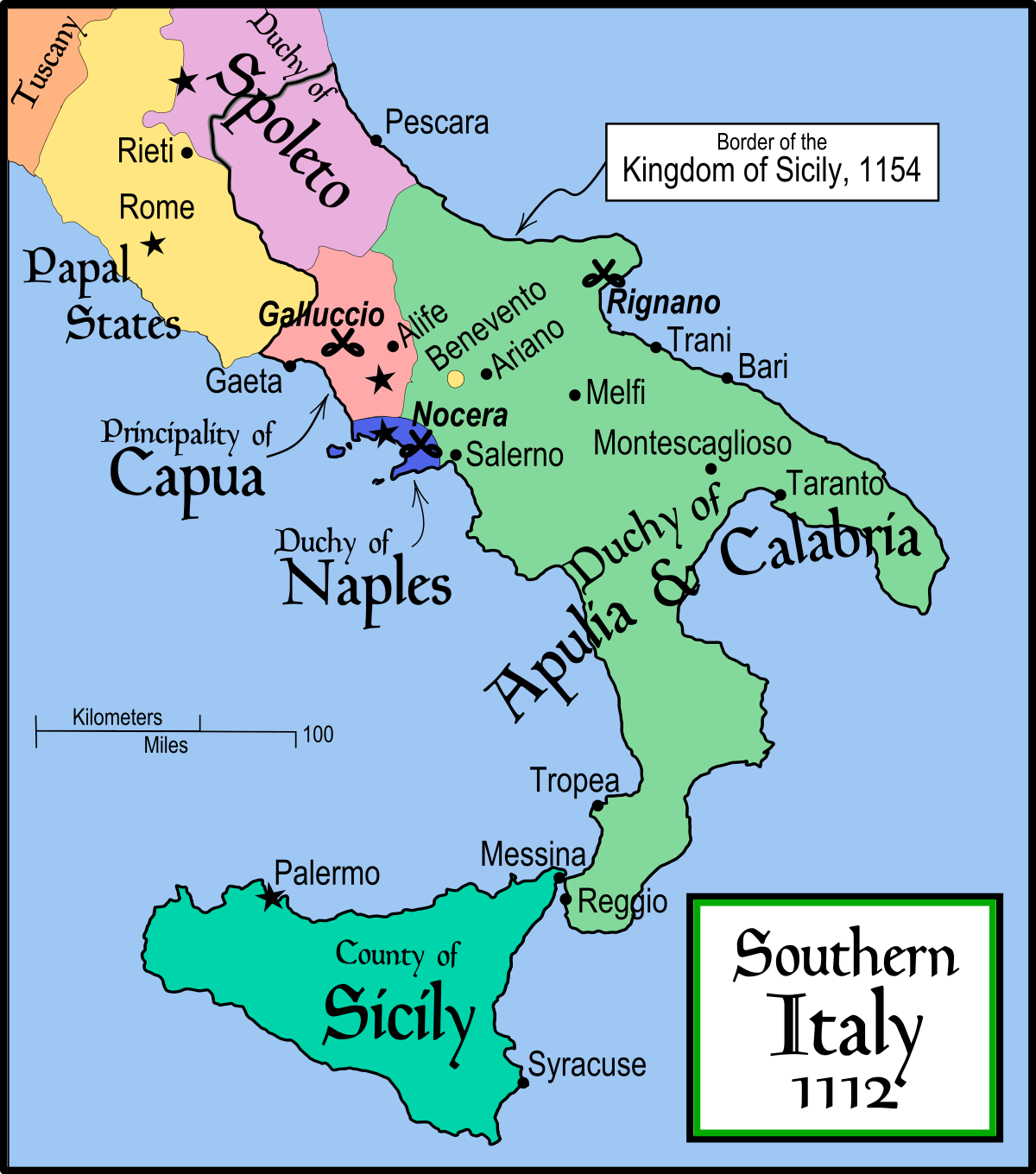
(The map below shows the situation in the mid-12th century but shows the locations of most of the cities mentioned, including Bari, Taranto, Benevento, Salerno and Naples.)

County of Sicily - Wikipedia

Bari was the most prosperous seaport of the region.  In later years it would become even wealthier serving as a slave depot, primarily for Venice, used to store slaves from Slavic lands (primarily the areas that became Poland and Prussia) before transport and sale to Arab principalities.

In 847 the city was seized by a band of Arab raiders under the leadership of Kalfun, a shadowy figure who may have been part of a mercenary garrison installed by the Prince of Benevento to control Bari.  Kalfun was probably of Berber origin, possibly an escaped servant of the Aglahbid dynasty which ruled North Africa and Sicily.  Kalfun's successor, Mufarrag, who became emir in 852, sought and obtained recognition as an emirate from the Abbasid Caliph and expanded its territory, launching raids across the southern part of the peninsula.  Sawdan was next in line, taking power in 857.

According to Barbara Kruetz, author of Before The Normans: Southern Italy in the Ninth & Tenth Centuries, we only have fragmentary information about the emirate and Sawdan.  

At some point in the mid-860s, the Frankish monk Bernard, on his way to the Holy Land with two companions, came to Bari . . . 

They obtained from Sawdan safe conduct letters addressed to the princes of Baghdad and Jerusalem.

The narrative of Bernard's journey suggests no shock that Bari, 'formerly belonging to the Beneventans' was now in Muslim hands; Bernard and his companions received courteous treatment there and seem simply to have accepted the fact that Bari was no longer part of the Christian world.

Kruetz also writes of the Chronicle of Ahimaaz, an eleventh century Hebrew narrative of the history of a south Italian Jewish family:

Many of the anecdotes in this chronicle seem questionable, but it is noteworthy that Sawdan  . . . is memorialized in it as a wise and eminently civilized ruler . . . Doubtless much of this story was romantic fiction . . . Yet it is interesting that the author, who did not mince words concerning the havoc wreaked by Arab raids (and on some key Jewish communities), nonetheless depicted Muslim Bari as a stable and well-governed city.

She also points to evidence that "Bari under Muslim rule came to be accepted as simply another piece of the south Italian jigsaw puzzle, merely one more entity to be dealt with", citing Christian rebels fleeing to Sawdan for protection and the emir's envoys coming to Salerno where they were lodged in the bishop's palace. 

That is not to say that Sawdan was a peaceful man.  Far from it.  Plunder was essential to his survival and prestige.  His bands pillaged all over south Italy, particularly Benevento and Capua, burning the fortified town of Ascoli, seizing the castle of Venafro near the abbeys of Monte Cassino and San Vincenzo, from both of which massive gold ransoms were extracted.  He also defeated Lombard attempts to recapture Bari.

By the mid-860s it seemed like south Italy might be headed in the same direction as Sicily.

Enter Louis II, great-grandson of Charlemagne and, since 844, King of Italy and Holy Roman Emperor.   In response to calls for help against the Arabs and a desire to assert his real, as opposed to nominal supremacy, Louis II ventured south in 866 with a goal of retaking Bari. What he encountered was a tangled web of competing principalities and shifting alliances which delayed him, leading initially to several unsuccessful campaigns before Bari finally fell in February 871 Bari fell, resulting in Sawdan's capture and transport to Louis' headquarters in Benevento, where the most remarkable part of the emir's story takes place.

Mere months later, in August 871, Louis found himself and his family suddenly surrounded and put under guard in close confinement.  After a month of negotiations, Louis and the family were released but only after he had taken an oath never to return to Benevento; a humiliating end to what had seemed a triumphal campaign for the emperor.

What happened?

Although Louis came south to rid the area of the threat from Bari, he had showed no signs of leaving after its fall.  For the families ruling the local principalities that was a bad thing because they had no desire to submit themselves to Louis. And, according to all the surviving chronicles, much of the blame for the seizure of Louis was due to Sawdan.

Sawdan must have had a substantial reservoir of charm to draw upon.  He quickly became popular at Benevento, entertaining a constant stream of well-born visitors and dining frequently with Louis.  According to Kreutz:

"He became a lighting rod, attracting Lombard complaints about the Franks and Frankish complaints about the Lombards.  Then . . . he put to use what he had learned from each side . . . [Sawdan] purportedly inflamed the Beneventans by warning that Louis planned to send many of them north, in chains; . . . The evidence suggest that Sawdan had access to information from both sides, and that he passed it on in the manner most likely to be helpful to his own cause."

Louis left Benevento, never to return, dying four years later.  Sawdan, kept in comfortable captivity in Benevento, was released upon Louis' death and then, unfortunately, disappears from history so we do not know his fate.

Monday, August 31, 2020

Captain Major Of The Seas Of Arabia

 In the early part of the 16th century, a Portuguese explorer and aristocrat, Afonso de Alberquerque became known as the Caesar of the East and Captain-Major of the Seas of Arabia.  While familiar with the European exploration of the Americas I had only a vague notion what the Portuguese had accomplished in the Indian Ocean during the same time frame.

One of the joys of writing this blog has been coming around brief mentions in other books or articles I've read to someone or to events I'd never heard of and then taking the time to learn more - for instance, with Henry Lafayette Dodge or, more recently, with The Last Message.  In this case I came across an intriguing reference to Alberquerque and began doing research online.  Dissatisfied with the online material I finally tracked down and read the leading work on the subject, Foundations of the Portuguese Empire, 1415-1580 by Bailey W Diffie and George D Winius (1977).  Though we can not recapture the essential personal characteristics of those who carried out the exploration and its exploitation, their deeds make for fascinating reading.

It was from the Portugese kingdom in the mid-15th century that daring captains began venturing south along the coast of Africa under the direction of Henry the Navigator.  For seventy years they inched their way slowly southward, discovering and colonizing the Azores and Cape Verde Islands along the way, before Bartolomeu Dias sailed around the southern tip of Africa in 1488, followed a decade later by Vasco de Gama who reached India, a voyage that forever linked Europe with Asia. And then within twenty years later the Portugese created the first European empire across the Indian Ocean.

The Portuguese of the 15th century exuded self-confidence and martial ardor.  After centuries of struggle against the Muslim occupation the final portions of what became Portugal were liberated in 1249.  With the help of its long-time English allies, Portuguese trade expanded and it began looking for new territories in Africa and among the newly discovered islands of the Atlantic.

In the Americas, Spanish and Portuguese adventurers had significant advantages in their encounters with natives.  Their technology (sailing ships, arms and armor, horses) was significantly better than those they faced and, unknown to them initially, the biggest contributor to their success were the germs that hitched a ride with the Europeans, exposing native populations to a host of diseases for which they had no immunity, eventually reducing the pre-Columbian population of the Americas by 80-90%.

The Portuguese found well-equipped opposition with the odds more balanced when they encountered Asian peoples.  And on the disease front it was the Europeans who were the more vulnerable, in Africa as well as Asia to malaria and other tropical diseases.  The distances involved were also much greater, it being three times farther from Portugal to India than from Spain to the Americas.  And Portugal itself had a smaller population and was poorer than Spain.  Given these difficulties there were never more than 12-14,000 Portuguese in the Indian Ocean Empire.

During these years, the priority for Portuguese kings was expansion in the Muslim areas of North Africa, particularly Morocco.  By the start of this period, Muslim holdings in Iberia had been reduced to the Kingdom of Granada, which finally fell in 1492.  Portugal began seizing footholds in Morocco like Ceuta and Tangier with the idea of conquering the entire area.

Meanwhile, Portuguese captains ventured down the African coast, seeking a route to the fabled wealth of India and the spice lands.  Along the way they also initiated a slave trade with African kingdoms, a trade that accelerated in the 16th century with the discovery of America.  The Muslim world already had a centuries long slave trade going on the east coast of Africa.  The Muslim states of North Africa also routinely raided the northern shores of the Mediterranean in search of Europeans to enslave.

Venice had dominated the spice trade for centuries from its outposts in the eastern Mediterranean and Aegean seas serving as the middleman between the Muslims and the states of Christian Europe.  In term the Muslims controlled the trade in the Indian Ocean and from the source of spices - India and the far eastern islands of what is now Indonesia.  The Venetian Doges had a long-standing alliance with the Mamelukes who ruled Egypt untl 1517 but their relations with the Ottomans were trouble and led to an interruption of the spice trade just as the Portuguese finally found the route to India via the Cape of Good Hope.

Following de Gama's first voyage the Portuguese moved rapidly to exploit their advantage sending 81 ships in annual convoys from 1501 to 1506 with more than 7,000 sailors and soldiers.  It was a grueling voyage.  Outbound ships left Lisbon between February and April, swinging southwest, almost to Brazil, to catch the tradewinds, the ships would round the Cape of Good Hope between June and August, arriving in Goa in late summer or early fall.  The return voyage would begin between Christmas and April, arriving in Lisbon in the fall, a roundtrip equivalent to circling the globe at the equator.

The Portuguese quickly captured the bulk of the spice trade and by 1503-4 the German bankers and merchants formerly based in Venice had come to Lisbon.  Diffie and Winius characterize Portugal as a wharf for goods transiting from Asia to the booming markets of Northern Europe.

After an initial successful India voyage in 1503-4 Afonso de Albuquerque returned in 1506 and remained until his death a decade later.  Afonso, born in 1453 and from a family of the aminor nobility, was educated at the court of Afonso V.  From 1471 to 1481 he achieved  a distinguished military career fighting in war with Morocco, Castile and in a campaign in Italy against the Ottomans.  He later became Master of Horse and held other prestigious titles under his good friend, John II but when John was succeeded by Manuel I in 1495 his career fell into eclipse until his performance in the India expedition of 1503 allowed him to finally gain Manuel's confidence.  On his return to India he carried the king's appointment as Viceroy of India, an appointment he retained until his death.

A master strategist, Albuquerque parlayed a relatively weak Portuguese position by exploiting divisions among Asian rulers seizing Goa and other Indian ports, Malacca which controlled the straits between the Malay peninsula and Sumatra and Ormuz at the exit of the Persian Gulf.  His strategy was to control all the entrances to the Indian Ocean, from the Atlantic, Red Sea, Persian Gulf and Pacific.  While thwarted in the attempt to completely shut off access, particularly that of Muslims, Albuquerque came close to achieving his goal.  He failed to take Aden which controlled the approaches to the Red Sea although he led expeditions into those waters, also attempting to take Jidda on the Arabian peninsula.

In contrast to their views of Muslims, seen as implacable enemies, and the native peoples of the Americas, seen as an inferior civilization and targets for conversion, the Portuguese had a different take on the peoples they encountered in Asia who they considered civilized and made no concerted effort to convert to Christianity.

Later in the 16th century the Portuguese ventured into the waters of East Asia, establishing trading outposts with China at Macao and in Japan at Nagasaki.  Roundtrip voyages from Portugal to these outposts required two to three years.  According to Diffie and Winius, the Portuguese admired the Japanese more than any other Asia peoples:
"Probably the main reason that the Portuguese and the Japanese struck it off so well was that they had many qualities in common.  In China it was the mandarin bureaucrat and his writing brush who stood at the top of the social ladder and even symbolized the society; but it was the hereditary fighting class, the samurai, whose wearing of the sword symbolized Japan - and made the sword-wearing Portuguese feel at home  . . . the samurai pride and rigid code of honor . . . was similar to the chivalry and pride of the Iberian nobleman."
A little known and quite astonishing episode took place during this period showing a different side of the Portuguese.  For several centuries, stories had circulated in Europe about a mysterious Christian monarch to the east known as Prester John.  Europeans, under constant threat from Muslims, believed that if they could only locate the kingdom of Prester John the resulting alliance of Christian states could finally defeat the Muslims.  Then word arrived of a Christian state to the south of Egypt in the Abyssinian highlands ruled by an African monarch.  With great difficulty some Portuguese emissaries made contact with the rulers of Ethiopia.

In the early 1540s Ethiopia came under attack by Somali Arabs who carried all before them, threatening the very existence of the Kingdom.  By chance, a Portuguese fleet was operating in the Red Sea and received a plea for help.  Four hundred Portuguese under the command of Cristovao da Gama responded.  In the Americas other Iberian conquistadores had entered highland in force but with the goal of conquest and visions of riches.  In this case, the Portuguese went to support their fellow faith members with no personal potential for gain.  In two years of fighting the volunteers defeated the Somalis, saving the kingdom, but at great cost - da Gama captured and beheaded and only a quarter of the four hundred surviving.   Diffie and Winius observe:
"The story of the Portuguese association with Abyssinia has an unreal quality because it smacks more of chivalric romance than of motives people of today can understand. . . The Portuguese conquistadores made far better thieves - and also far better saints - than we."
In the late 16th century the Portuguese were ousted from their Indian Ocean Empire by the Dutch and English, though Goa and Macao remained as relics tolerated for several centuries by India and China.  The loss can be attributed to several factors.

The Empire never prospered as much as anticipated in part because the Portuguese ignored the profitable intra-Asian trade in favor of exports directly to Portugal.  Their Dutch and English successors built their trading empires on the intra-Asian trade.

The profits that did accrue to the Portuguese monarchs were spent on their neverending crusade to conquer Morocco and the Indian Ocean empire always remained starved for resources.  The Moroccan obsession ultimately proved a grand failure.  In 1578 the boy-king Sebastian led an army into Morocco for the intended final conquest but Instead, the king and his army were massacred and the kingdom plunged into financial and dynastic chaos, leading in 1580 to a union with Spain that last for six decades.

Diffie and Winius contrast the relative success of the Dutch and English with the failure of Portugal and Spain:
"European monarchs [Spanish, Portuguese, French] have always been far more interested in what went on under their noses than in places thousands of miles away, and the only historic empires safe from periodic neglect [Dutch & English] were those built and operated by joint stock companies, which had no outside interests to distract them."

Wednesday, April 29, 2020

Show Me The Money

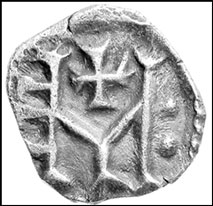
Silver penny minted around 660AD

The 5th century collapse of the Roman Empire in western Europe began a slow decline in the monetary economy.  During Roman times the western provinces had a robust money-based economy with the regular introduction of gold, silver and bronze coins from various mints.  Much of the circulation was prompted by payments to soldiers, factories supplying the legions, and the massive bureaucracy created by 4th century emperors.

For more on the end of the Western empire read Belisarius Enters Rome, and the Life of St Severinus.

With the empire gone, most mints closed, payments to soldiers ceased, the bureaucracy gone, and trade declined.  Bartering and payments in kind became more common.  Gold coins still circulated and indeed into the early 7th century the Frankish kings received subsidies in the form of gold coins from the Byzantine empire.  However, with the great Persian War (602-628) rapidly followed in the 630s and 640s by the Muslim conquest of the most prosperous Byzantine provinces, the Frankish subsidies ceased.  For more on the travails of the Eastern Empire read A Great War.

It has been known for some time that silver coins began to appear to replace the more scarce gold coins.  Their lesser value and more availability allowed for more use in commerce and helped the slow revival of Western Europe's economy.  What remained unknown was the source of the silver.  Scholars speculated that much of it came from Roman bullion that had been melted down and recast or imported from the Mediterranean.  A 2018 paper, published in the journal Antiquity, may provide an answer.

Using lead analysis of ice cores, the authors pinpointed a mining complex, located at Melle (near the modern town of Deux-Sevres), in Western France, as the source of the silver, beginning in the period between 640 and 670. Lead levels are key because silver is derived from lead ores.  We've already learned much about the lead industry during Roman times as elevated levels of lead have been found in ice cores dating back to the early centuries AD in ice sheets in Greenland and the Alps. Lead levels collapsed with the end of the Western Empire, taking centuries to rise again to similar levels.  However, even during the gap centuries, lead levels varied and scientists using analytical tools and prevailing winds have been able to identify specific lead sources, including the Melle mines.

The authors were able establish the mid-7th century dating from the Alpine ice cores by calibrating the cores with three other known events - the total collapse in lead pollution at the time of the Blakc Death from 1349-53, the increase in bismuth levels with the gigantic series of eruptions from an Icelandic volcano between 934 and 939, and the identifiable markers from the great eruption of 536 (for more on the last event read The Big Sleepy Chill).

The existence of the Melle mines have been known for some time and during the 9th and 10th centuries they provided large amounts of coins to the Frankish kingdom during the time of Charlemagne and his immediate successors.  The 2018 paper establishes they were the original source for the transition from gold to silver, enabling Frankish mints to initially produce gold coins  alloyed with silver and subsequently switching to all silver coins within a quarter century.

And now we understand event in the revival of the West.

Tuesday, January 14, 2020

Cicero And His Friends

Of all excesses the most dangerous perhaps is the excess of good; it is at least that of which it is most difficult to correct oneself, for the culprit applauds himself, and no one dares to blame him.

- Gaston Boissier in Cicero And His Friends, writing of Cato the Younger.
I've just finished reading Cicero And His Friends: A Study of Roman Society in the Time of Caesar by Marie Louis Antoine Gaston Bossier (1823-1908), French classical scholar, professor of Latin Oratory at College de France, and permanent secretary of the most prestigious assembly of scholar in that country, the Academie Francaise.  His study of Cicero was originally published in the 1870s or 1880s (I found varying reference dates) and the version read by me is a 1897 English translation.

The work is a study of the personalities of Cicero (106-43BC) and several of his friends, some obscure to us today; Atticus and Caelius, while others retain their fame, their names still echoing through the corridors of history, Cato, Caesar, Brutus, Octavian (Augustus).

Cicero remains of interest today, both for his own works, thoughts, and career, but also for the window he allows us into a 2,000 year old world that in some aspects is incomprehensible to us, but in others very familiar.  It was Cicero's vast and constant correspondence over decades, significant portions of which have survived, that provide a glimpse of the events, personalities and motivations of those involved with the last days of the Roman Republic and the emergence of the Empire.  The sheer volume of Cicero's correspondence allowed for books containing it to be published in the centuries after his death; a death imposed by one of his last correspondents, Octavian.

It is also unique for the knowledge we are granted of the Roman world.  Prior to Cicero we have narrative histories by authors such as Polybius, and after Cicero we encounter Tacitus, Livy, and Suetonius among others.  But they are historians, compilers of events and anecdotes.  With Cicero we have a participant in world-shaking events and he and his friends are writing as those events occur.  It is as if for a brief moment a spotlight shines upon thirty years of the city's six centuries of dominance.  All the rest remains in shadow.

But what a time for that spotlight to shine!  We are in the final decades of the Republic, when factional fighting, bribery, and power struggles dominate the streets of Rome.  Bossier is very perceptive about the nature of that struggle, the frailty of the Republic, and both the problems and benefits of the coming Empire; benefits that depended on whether you were a Roman aristocrat or a resident of the conquered provinces which at that time were seen as opportunities for plunder by those aristocrats, a system reformed with the advent of Augustus.

Cicero resonates with modern readers because his own personality comes through so clearly in the letters.  He is scholarly, a brilliant orator, a defender of the Republic, able to foster relationships with both the fiercest defenders of the Republic and those who threaten it, as well as irresolute and vain.  Along the way we learn of his often fraught relationship with his wife, his concern for his daughter, whom he adores, difficulties with his son, and the latest scandalous gossip which he enjoyed so much.  Cicero reminds me of John Adams.  When reading the Adams-Jefferson letters one is struck by the contrast.  The cool, controlled, personally remote Jefferson writes one letter to every three of Adams, while Adams cannot contain himself; his personality, his volubility shine through - he comes alive in the deluge of words, unlike Jefferson.  So it is with Cicero.

Bossier's prose (or at least the translation) is a pleasure to read.  It flows effortlessly, like the finest of late 19th century and early 20th century historical writing, full of astute observations, and with a determination to cast all of Cicero's correspondents in full, trying to understand motivations, and not resorting to caricature.

In a reminder that feelings of living in troublesome times is not unique to us, Bossier writes near the closing of the book:
To the interest that the personality of Cicero gives to his letters, a still more vivid interest is added for us.  We have seen, in what I have just written, how much our time resembles that of which these letters speak to us.  It had no solid faith any more than our own, and its sad experiences of revolutions had disgusted it with everything while inuring it to everything.  The men of that time knew, just as we do, that discontent with the present and that uncertainty of the morrow which do not allow us to enjoy tranquillity or repose.  In them we see ourselves; the sorrows of the men of those times are partly are own, and we have suffered the same ills of which they complained.  We, like them, live in one of those transitional periods, the most mournful of history, in which the traditions of the past have disappeared and the future is not yet clearly defined . . .
For more on Cicero read The Dream of Scipio and Arpino.

Friday, December 27, 2019

Don't Be A Kulak Day

Today is the 90th anniversary of Josef Stalin's declaration of war on the kulaks.  Or, as he put it in his own inimitable style on December 27, 1929, the goal of the Union of Soviet Socialist Republics (USSR) was "liquidation of the kulaks as a class", adding "Now we have the opportunity to carry out a resolute offensive against the kulaks, break their resistance, eliminate them as a class and replace their production . . ."

On January 30, 1930 the Communist Party Politburo formalized the decision in a resolution entitled, "On measures for the elimination of kulak households in districts of comprehensive collectivization".  Under the resolution all kulak family members were to be placed in one of three categories:
To be executed or imprisoned
To be internally exiled to remote regions of the USSR
To be used as forced labor in their local regions
All kulak property was to be confiscated regardless of category.

The term "kulak" in the late Russian empire referred to peasants who owned at least 8 acres of land but after the Bolshevik Revolution in 1917 became more vague over the next decade, and by the time of Stalin's announcement meant any peasant who owned land or livestock, had tenants on their property, or sold surplus food on the open market.  Communists viewed these kulaks as obstacles to collectivization, accusing them of hoarding grain and livestock. Whatever an individual kulak believed or how they acted was irrelevant, as a class they needed to be eliminated.  To put it as Stalin thought about it, whatever a kulak subjectively thought or did, looking at it objectively (as Stalin did) they would ultimately be an opponent of true communism and needed to be dealt with in a preventative manner.

Stalin's announcement was not the first time kulaks were declared an enemy of the Bolsheviks.  In August 1918, during the Russian Civil War, as the Bolsheviks tried to gain control over the rebellious countryside, Lenin issued a directive:
"Hang (hang without fail, so the people see) no fewer than one hundred known kulaks, rich men, bloodsuckers. [...] Do it in such a way that for hundreds of versts [kilometers] around the people will see, tremble, know, shout: they are strangling and will strangle to death the bloodsucker kulaks".
No one has an accurate account of the numbers of kulaks killed or exiled as a result of the 1930 resolution.  Estimates of the dead range from 700,000 to several million (accounting is difficult since the dekulakization process overlaps with the related Soviet induced famine in the Ukraine during those years).  Documents examined after the fall of the USSR indicate that 1,803,392 persons were sent to labor camps in 1930 and 1931 with only 1,317.022 actually arriving at their destinations.

Economically, the agricultural sector of the USSR never recovered, with the Soviets needing to import grain and food stocks for the remainder of its existence.

Similar debacles occurred in every other communist state, though varying in the degree of violence, with the worst examples being Pol Pot's Cambodia and Mao's China.  Cambodia saw a quarter of its population die in four years, while Mao's anti-landlord campaign from 1949 to 1953 resulted in several million deaths.  I have a Chinese friend whose grandfather, a local landlord in the Shanghai area, was sentenced to 25 years hard labor after the communists came to power.  He died in a camp.  Decades later the family discovered that prior to Mao taking power in 1949, their grandfather had supported and helped fund the communists.  It didn't save him once they took power.  In a socialist world, class distinctions are much more important than individual actions.  The category your rulers place you in determines your fate.  A lesson to keep in mind.

Wednesday, November 27, 2019

The Longest Siege

Twenty one years . . . 

On September 28, 1644 galleys of the Knights of Malta attacked an Ottoman convoy enroute from Constantinople to Alexandria.  The attack was successful, the Knights seizing the Chief Black Eunuch of the Sultan's Harem and pilgrims on their way to Mecca.  It was quite a haul and the Knights prepared to sell their 350 male and 30 female captives into slavery.

The Knights of Malta had been a long-time thorn in the side of the Ottoman Empire.  Originating as the Knights Hospitallers in early 12th century Jerusalem.  After the final loss of the Holy Land in 1291, the Knights occupied the island of Rhodes, their home for the next two centuries, from which they launched raids of plunder against the neighboring Moslem (and occasionally Christian) states.  As the Ottomans began their rise in the 14th century, eventually conquering the nearby mainland and islands, Rhodes preserved its independence until Sulemain the Magnificent laid siege, forcing the Knights to leave in 1522.   In 1530, Charles V of Spain granted the Knights a new home, the island of Malta, as a perpetual fief in return for an annual tribute of a Maltese Falcon.  For more on the Knights read The Stuff That Dreams Are Made Of.

Putting ashore on the nearby Venetian province of Crete, the Knights sent ashore a number of captives and slaves and then sailed away.
Image result for map of venetian crete
In 1644 the Ottomans remained masters of the Eastern Mediterranean.  By then the Ottomans and Christian Europe found themselves in the middle of a long stalemate.  Two centuries of Ottoman success against Christian states had been brought to a halt with the failed siege of Malta in 1565 and the destruction of the Ottoman fleet by a temporary Christian alliance at the Battle of Lepanto in 1571.  Since then, periodic wars had broken out but frontiers were fairly stable, the only significant differences being in the Ukraine and southern Poland where the Ottomans added territory.  The stalemate was to end with the Grand Turk's unsuccessful siege of Vienna in 1683 and the Christian counterattack on the heels of the withdrawing Ottoman army.

While Venice still ruled the island of Crete, the lagoon bound state was on the decline.  It had lost most of his advantageous trading rights within Ottoman territory along with the island of Cyprus and many smaller islands, as well as its outposts in Greece.  And with the New World discovered and new trading routes to the East, its commercial dominance was fading.  Venice had ruled Crete since 1205, the Catholic Venetians treating the Orthodox Cretans with contempt, inspiring many revolts by the local inhabitants.

At the Ottoman Court many saw this as an opportunity to evict Venice from Crete, the last Christian outpost in the Eastern Mediterranean.  In the spring of 1645, a large Ottoman fleet left Constantinople, its destination a mystery but with rumors flying ahead of it that Malta was its target.  The rumors had been deliberately planted by the Ottomans.  On June 23, 1645 the Venetians were surprised to find the Ottoman fleet anchored off the Cretan coast.  Landing on the island, the Ottomans began their conquest.

By May 1648 all of the island, with the exception of its capital, Candia (now Heraklion), was occupied by the Turks and an estimated 40% of the island's population had perished.  That month the Ottoman army began its siege and blockade of Candia, which was to last until 1669.
Image result for siege of candia

What accounted for the length of the siege?  For the Ottomans there were many distractions.  Other wars, particularly in Hungary and Transylvania diverted resources.  Venetian fleets periodically blockaded the Dardanelles, the narrow strait leading to the Sea of Marmara and Constantinople.  Raids by Christian fleets in the Aegean further disrupted Ottoman supply lines.  Finally, it was a period of intense court intrigues and coups at the Ottoman court.  The net result was the Ottomans were able to sustain a force large enough to maintain the siege but not strong enough to assault the city.

In 1664 the Ottomans negotiated a temporary peace with the Hapsburgs and were able to turn their attention and resources back to Crete.  In early 1668 a large Ottoman army landed on the island to join the blockade force.  European powers also sent aid to the Venetians, 6,000 soldiers from France and smaller contingents from Savoy, Malta, Naples and the Papal States.  Encourage by the support the Venetians turned down an Ottoman peace offer under which they would have retained half the island.

Actions in the summer of 1669 sealed Candia's fate.  A fleet sent by France met disaster with its flagship exploding leading to the withdrawal of France's troops.  The remaining garrison of Candia was reduced to 3,600 men and on September 5 Francesco Morosini, commander of the garrison, surrendered.

The cost of the final two years of the siege was enormous with more than 100,000 Ottomans and 29,000 Christians dying.

It was to be the last major territorial expansion of the Ottoman Empire.  Crete remained under Ottoman rule until 1897.

What must have it been like to be part of the siege?  If you were born in Candia in 1648 you would have lived your entire youth while under siege.  Reading about the siege reminds me of The Adventures of Baron Munchausen, the loony 1988 tale of an endless siege of a city on the sea by the army of the Grand Turk.


Thursday, November 14, 2019

Face Off

At the 1937 international exposition in Paris the pavilions of Nazi Germany and the Soviet Union faced off against each other.  Thank God both regimes have disappeared.

Thursday, December 13, 2018

Berlin Divides

It was seventy years ago this month that Berlin became a city divided, a status it retained until the Berlin Wall, constructed in 1961, came down on that memorable evening in November 1989.

The event occurred amidst the turmoil of the Berlin Blockade and the relief airlift launched by the United States and Britain to keep its sectors of the city supplied.

With the end of the Third Reich in May 1945, Berlin was divided into four zones of occupation (Soviet, American, British, and France) but governed as a unified city.  The entire country was also divided into four zones, but Berlin lay completely within the Soviet zone.  In order to support their occupation forces and supply its sectors, the Western Allies had the right to use certain rail and road lines to connect their zones in Western Germany with their Berlin sectors.  Governance of the entire structure was through the four-power Allied Control Council (ACC).

(Berlin: Occupation Sectors from Air Force Historical Support Division)
Map of Berlin divided into sectors or zones; after WWII and during the Berlin Airlift.

As relations between the Soviet Union and the West worsened, Stalin decided on a plan designed to force the U.S., Britain, and France to choose between withdrawing from Berlin or agreeing to his wishes regarding the future of Germany.  On March 20, 1948 the Soviet delegates walked out on what proved to be the final meeting of the ACC.  Over the next three months the Soviets intermittently interfered with Western shipments to Berlin.

Germany was in the middle of an economic crisis and the Soviets refused to agree to currency reform efforts.  On June 18 Britain, French, and the United States announced the introduction of the Deutsche Mark (DM) as the new currency in their sectors.  The following day, the Soviets began permanently restricting and, within a few days, completely blocking the rail and road supply links to the Western Allies sectors in Berlin.  Only the air corridors remained open but the Soviets thought the Allies incapable of the massive airlift needed to maintain the civilian population of Berlin.  As of late June, western Berlin had only 36 days of food supplies and 45 days of coal.

From a military perspective the West was vulnerable.  There were only about 21,000 British, American, and French military personnel in Berlin and fewer than 150,000 troops (and only one combat ready division) in West Germany, while the Soviets had 1.5 million soldiers in East Germany.

President Harry Truman was confronted with deciding how to respond.  Though the U.S. commanders on the ground in Germany and Europe, Lucius Clay and Curtis LeMay, urged a strong response, he was getting different advice from his senior civilian and military advisers in Washington.

Army Secretary Kenneth Royall, Secretary of Defense James Forrestal, acting Secretary of State Robert Lovett, and Truman's military advisor, Admiral William Leahy all believed the Western Allied position in Berlin to be militarily indefensible and quickly overrun if the Soviets attacked.  Army Chief of Staff Omar Bradley advised that it would be better for the U.S. to pull out of Berlin on its own terms, than to be forced out.  Walter Bedell Smith, the current U.S. ambassador to the Soviet Union, and former chief of staff to General Eisenhower in WW2 also thought America should leave Berlin.  Several months into the crisis, Bedell Smith remarked:
"Our present hysterical outburst of humanitarian feeling keeps reminding me that just three and a half years ago I would have been considered a hero if I had succeeded in exterminating those same Germans with bombs."
The initial response from our British and French allies was also undecided on how to respond.

And there was a political aspect, with a presidential election coming in November.  Thomas Dewey had just wrapped up the Republican nomination and was considered by the press as a sure victor in November.  Truman was also facing what looked like a strong third-party challenge to his left from  Henry Wallace.

Wallace, an Iowan, had been Secretary of Agriculture under FDR, then served a Vice-President during Roosevelt's third term, before being forced off the ticket in 1944 by Democratic party bosses, clearing the path for Truman, and returned to FDR's cabinet as Secretary of Commerce.  He was also, as Andrei Cherny writes in The Candy Bombers (a highly recommended account of the Berlin Airlift), a "profoundly strange" man who "believed the future could be foretold by markings on the Great Pyramid of Egypt", and convinced FDR to add the pyramid to the dollar bill.  He was also involved with theosophists (for more on this odd group read Madame Blatavsky and the Birth of Baseball).

Wallace was also not unsympathetic to the communists.  In September 1946 he was fired by Truman after attacking his policy of opposing Soviet domination in Europe.  As Truman moved to counter Soviet aggression, Wallace became even more outspoken.  In March 1947 in response to the announcement of what became known as the Truman Doctrine under which it became the "policy of the United States to support free peoples who are resisting attempted subjugation by armed minorities or outside pressure", Wallace declared that "America will become the most hated nation in the world", placing all blame on America for the emerging Cold War.  He opposed the Marshall Plan calling it a "blueprint for war". Throughout 1947 Wallace spoke to enthusiastic audiences of up to 30,000 people announcing, at the end of the year, a third party presidential run as the Progressive Party candidate.  Wallace knew he could not win an election from hope to deny Truman victory and ultimately allow Progressives to take over the Democratic Party.

As 1948 began international tensions already high, became worse after a successful communist coup in Czechoslovakia, the last remaining free country in Eastern Europe.  Wallace excused the coup on the grounds that the communists were driven to it by threats of a Rightist coup.  It should come as no surprise that as the Soviets ratcheted up pressure on Berlin, Wallace urged an American withdrawal in order to preserve the piece.

From a political perspective Truman was faced with a strong Republican opponent, and a Wallace campaign that could siphon off much needed votes.

Harry Truman decided to stand firm in Berlin.  The logistical obstacles to supply the city were overwhelming but, by trial and error over the next three months along with Herculean efforts by the American and British Air Forces, a viable air corridor was established.  We were fortunate that during the next year no crisis erupted elsewhere in the world, as the U.S. had no additional air logistical capacity to deploy.  It was all needed to keep Berlin supplied.

At the Progressive Party convention in Philadelphia during July, enthusiasm ran high and Wallace was doing well in the polls. With thirty being the average age of delegates, and three quarters having no prior political involvement, it appeared to be a transformational youth movement.

(Berlin after WW2 ended, from Rare Historical Photos. com)
Excellent aerial view showing devastation and bombed out buildings over wide area.

In the meantime though, the airlift was transforming American and German views of each other.  The horrors of Nazism and hundred of thousands of dead American soldiers left little sympathy for German civilians trying to survive amidst the ruins of their shattered cities.  We did want we needed to do to prevent outright starvation, but economically and spiritually the country remained prostrate, and in Berlin there were still food shortages and little rebuilding; that was fine with most Americans but in 1948 the Soviet threat, the determination of the Germans in Berlin to resist the Russians, and their enthusiastic response to the Airlift sparked more public sympathy and interest in American efforts to help German recovery.

One specific event had a profound impact on both Germans and Americans during the blockade. On July 18, 1948, while on approach to Templehof Airport in Berline, C-54 pilot Gil Halvorsen, wiggled his wings and dropped chocolate bars attached to a handkerchief parachute to children waiting below.  The prior day while at Templehof, Halvorsen while walking around encountered the children who were watching the planes land and asked him questions about the aircraft.  He gave them gum and promised he'd drop them candy the next day after wiggling his wing.  Halvorsen continued his daily candy runs and when news reached the airlift commander he organized Operation Little Vittles; soon American children sent candy for the drops and eventually U.S. candy manufacturers made donations; 23 tons of candy were dropped in toto, and Halvorsen became known as The Candy Bomber, giving title to Cherny's book.  The candy drops became a symbol of America's willingness to help and of the perseverance of Berliners.

(C-54 Lands At Templehof, from wikipedia)


In November Truman pulled off one of the most surprising upsets in presidential history beating Dewey.  Ironically, it was the Berlin Airlift that probably was the critical factor.  For independent voters it demonstrated that Truman could be tough in protecting America's interests.  For potential Wallace voters seeing the reality of the heartless face of communism in its willingness to starve millions of civilians, the American response to help those in need, and the Democratic party's attacks on Wallace as a tool of communism, blunted their progressive enthusiasm.  Early in the fall it looked like Wallace was going to get 6-7% of the vote, guaranteeing a Dewey victory, but the campaign collapsed in the final weeks and Wallace polled only 2.5% (1.15 million).  Even then it was close; the Wallace vote threw New York to Dewey, while if the Progressive candidate had received only 7,000 more votes in Ohio, and 18,000 in California the race would have gone to the House of Representatives, and 69,000 more in five other states given Dewey an outright victory.

The Western Allies knew winter would be their biggest challenge, as coal needs increased, and worsening weather restricted the airlift on many days.  And, in the midst of this, Berlin was scheduled to have its first municipal elections since 1946 in which a communist party faced three non-communist opponents.  The Soviets, knowing the communists would lose the election tried a mixture of threats, gifts, and force to intimidate Berliners.

(Airlift: Winter 48-49, from US Department of Defense)
Map of the Berlin Airlift Air Bases -Winter, 1948-1949

From the start the city's population, no matter how they disliked the Russians and/or communists knew that if the Western Allies abandoned them, they would have to live under Soviet domination, a fear the Soviets made use of by constantly reminding the populace of the consequences they would suffer if they supported the West, and then were left behind when the British and Americans withdrew.

On November 30 the city parliamentarians of the Soviet supported local communist party held an assembly in which they declared themselves the legitimate government of the city.  In conjunction with this, the Soviets accelerated their campaign to discourage Berliners from voting in the municipal elections scheduled for December 5.  Along with threats the Soviets made generous offers to those who agreed not to vote; Soviet ration cards, nearly a ton of coal to each household, unlimited amounts of electricity, and a half pound of candy for each school age child.  They also reminded Berliners, "if you vote on the 5th, you vote for war".

Meanwhile, General Lucius Clay, commander of the American garrison in the city, who had become the symbol of Allied defiance of the Russians, found himself stranded in West Germany where he had gone for meetings, because of days of thick fog in Berlin.  Worried that his absence would be taken as an indicator of weakened American resolve Clay and his wife boarded a flight during the night of December 4 taking off through the mist.  Arriving in Berlin before dawn the fog was so dense the controllers at Templehof refused permission to land because visibility was less than 100 feet.  According to Cherny, "Clay barged into the cockpit and grabbed the microphone from the pilot."  Permission to land was granted, the plane landed, skidded to a stop, and was escorted by servicemen with hand held flashlights to its stand, since the pilot could not otherwise see anything on the taxiway.

An overwhelming 86% of eligible Berliners cast their votes on December 5, with the Social Democrats, the strongest anti-communist party of the opposition winning more votes than the others combined.  Two days later the newly elected city government took power.  With the election, Berlin became divided, with East Berlin governed by the communist party, and the three sectors under Allied occupation having a different government.  Though some connections between East and West Berlin continued until the building of The Wall in 1961severed all contact, it would be 43 years before the city would be unified under one government.

One other significant event occurred in December involving the French.  Initially the French, suffering through the rise and fall of multiple governments in Paris and with the French Communists, a strong political force, supporting Stalin's actions, hesitated to strongly support the American and French response.  However, in August they agreed to build a new airport in their sector to support the airlift, completed in early November, built almost entirely by hand by 17,000 Berliners working around the clock, and having the longest runway in Europe.

There was a problem though.  About 400 yards from the runway were two towers of Radio Berlin, the Soviet propaganda arm.  They were not illuminated and posed a danger to landing planes.  The Soviets refused to move the towers, even though the Americans offered to pay for rebuilding in a different location.

On the morning of December 16, British and American officers at the airport were asked to come to French General Jean Ganeval's conference room for a reception.  They found plentiful food but no explanation for their summons.  At 1045 they were startled to hear a huge explosion and saw the two Russian radio towers collapse.  Ganeval, who had been grossly insulted by Soviet behavior earlier that fall, told his guests, "You will have no more trouble with the tower."

The Allies and the people of Berlin persevered through the winter; Stalin knew he could not prevail.  On May 12, 1949 the Soviets lifted the blockade, though the airlift was not declared ended until September 30, as the Allies continued flights in order to build up a three month stockpile of supplies in case the Russians changed their minds.

In the course of the airlift, the Allies made 280,000 flights to Berlin to deliver more than 2.3 million tons of supplies.  Seventeen American and eight British planes crashed during the effort, and 40 British along with 31 Americans died.

In the 1950s, Henry Wallace realized his 1948 Progressive Party campaign had actually been run by communists and expressed regret that he had not understood that at the time.

"Candy Bomber" Hal Halvorsen, a Utah Mormon, remained in the Air Force until 1974.  His final assignment was as group commander at Templehof Airport.  Hal recently celebrated his 98th birthday and splits his time between Utah and Arizona, where he winters.

Hal Halvorsen
13131