President Trump: "We get a lot of bullshit thrown at us by Putin, if you want to know the truth. He's very nice all the time, but it turns out to be meaningless." pic.twitter.com/VMnXSTuCiK
On Wednesday the Wall Street Journal carried a piece by one of my favorites, Holman Jenkins Jr (and isn't that a perfect name for a WSJ op-ed writer). The title was "Trump's Trumpy Ukraine Gambit". While rightfully excoriating the Biden Administration's incoherent and ineffectual approach to the Ukraine war, his focus is on the current president. Referencing Trump's calling Zelensky a "dictator" he writes:
Mr Trump's all-purpose strategy when frustrated is tit-for-tat. It fills his need to dominate the news constantly while he fumbles around for a laurel to award himself in place of the one that got away. . . . A Trump blather blaming Ukraine for not negotiating segued into something he clearly didn't mean, yet now his team must mumblingly agree Ukraine started the war.
And concludes:
So here we are. In most instances, Mr Trump flops around noisily (and offensively) and then lands on the path of least resistance. He wants a win and doesn't care how. The U.S. clearly has a lot of turmoil to go through before it surfaces a leadership cadre to handle the moment we're actually living in. But we still have to live in the moment and the best of realistic possible outcomes, perhaps surprisingly, remains on the cards in the next year or so: Turn a hot war into a cold one. Build up Ukraine's military to outwait the Putin regime on its path to atrophy and decay.
Since the Jenkins column we've now had further developments. On Thursday, while meeting with British Prime Minister Starmer, a reported asked Trump about the "dictator" remark. Trump's response; "Did I say that? I can't believe I said that. Next question."
And then we had today's debacle. Whether it was Zelensky's lack of self-control or bad advice (1), he made a fatal mistake in confronting the president. It is not a matter of who is right and who is wrong. You just do not try, particularly if you are in Zelensky's position, to argue with Donald Trump in public. I am not sure Zelensky's position is recoverable short of a groveling humiliating apology and even that may not work as, in the end, I believe Trump prefers a deal with Russia.
The proposed, and now dead, minerals deal with Ukraine did not contain an American security guarantee. I was okay with that from my perspective, but I think Trump's idea was to leave things open so if he got a better deal with Putin he would just walk away from any Ukraine deal. After all, it's just a piece of paper to him. We just saw the same thing in play regarding the 25% tariffs being imposed on Mexico and Canada. Trump loudly complained about those who entered into the stupid trade deals we now have. Well the last person to enter into one of those "stupid" deals was Donald Trump in 2019. He demanded that NAFTA be revised with terms more favorable to the U.S. and Canada and Mexico ultimately agreed. Now he denounces his own agreement. His word cannot be relied upon and other foreign leaders will take note.
Given Trump's reckless and contradictory statements it is often difficult to figure out what he really believes and what his ultimate goals are. Are tariffs "wonderful" and a mechanism to balance the budget and eliminate the personal income tax or are they bargaining chips to get better trade deals? I have no idea and it may be that Trump doesn't either.
Trump talks about annexing Canada, or part of it, and imposing tariffs while at the same time demanding it restart its part of the Keystone Pipeline, even as he denounces Canada for stealing in its trade relations, and claiming that country sells nothing we need. At the same time, he has undercut the conservative candidate for prime minister in this summer's election. Prior to Trump's bombastic statements, the conservative was handily leading Trudeau's party. Polling currently now shows a dead heat. What's the goal here? Or is Trump just improvising like he usually does? (2)
With regards to Russia, Trump seems to be making the same mistake with Putin that FDR made with Stalin and the old USSR. a total miscalculation as to Putin's goals.(3) Much of the Trump crowd blames NATO and Ukraine for the war. But while Russian propaganda plays on this theme, Putin himself has stated the war is about something else, as his lengthy interview with Tucker Carlson made clear. Despite Tucker's frantic efforts to get Putin to talk about NATO expansion as the cause, Putin delivered a lengthy lecture on Russian and Ukraine history, starting in the 9th century. In Putin's view Ukraine has no right to exist as an independent state as it is inherently Russian. Putin, both in the interview, and as shown in Russian actions in the occupied Ukrainian territories, is determined to wipe out the country, and crush Ukrainian culture and language.
I oppose NATO expansion but the idea that the decrepit armed forces of our NATO allies were actually capable of threatening Russia is laughable and everything since the start of the war in 2022 only underlines the lack of collective NATO capabilities (in that respect Trump and Vance are correct). On the other hand, Putin's attack on Ukraine precipitated two long time neutral countries, Sweden and Finland, to join NATO and they actually have decent military establishments.
The idea by the Trump administration that it can persuade Putin to loosen his ties to China is not going to work. Putin is not a communist but he believes the failure of the USSR was a disaster for Russia as it lost its empire, an empire that he wants to reconstitute. Reuniting the empire is his version of Make Russia Great Again. The Europeans and Americans are the biggest obstacles to that goal, while China is his biggest ally in fulfilling his aspirations since it also accomplishes Xi's goals.
Even with all this, it is hard to have any sympathy for the Democrats in light of the Obama and Biden administrations inept policies regarding Russia and the mythology about Trump and Russia created by the Democrats and their media allies during President Trump's first administration (for more read Ukraine Blues). Let's not forget that in the run up to the Russian invasion in February 2022, the Biden administration was sending clear signals that if Putin agreed to just "wetting his beak" by taking the rest of the Donbas, the U.S. would be okay with that. And during the first 48 hours of the invasion Biden and European leaders were telling Zelensky he needed, for his own safety, to leave Ukraine. I've always admired Zelensky's courage in staying at Ukraine's darkest hour. It was a shame to watch him today fumble the deal inches from the goal line.
-----------------------------------
(1) Were these the same people who advised him to essentially endorse Harris in the election? At best, Harris would have been a weak reed to rely upon. A little sucking up to Trump would not have hurt - he loves that stuff.
(2) Let's contrast Trump and the Democrats. The Democrats consistently lie about their policies. One need go no further than to look at the Harris campaign. Trump has two different modes. The first is when he is absolutely clear about his policies (for instance, immigration) but lies and exaggerates about the facts supporting his case. The second is when you can't make sense of his policies - as with Ukraine, tariffs, and Canada - possibly because he doesn't know, but he lies and exaggerates about whatever he is saying about those issues at that particular moment.
Vladimir Lenin died on this date one hundred years ago. That was a good event but a shame he had not died a decade earlier, before he had the chance to inflict so much damage on so many people. A man full of hate who, upon gaining power, reveled in being merciless to his perceived enemies. In October 1917, he led the Bolshevik Revolution which overthrew the social democrats who had been governing Russia since the overthrow of the Czar in February. In January 1918, he ordered the Bolsheviks to forcibly dissolve the Constituent Assembly, the first freely elected representative body in Russian history, and then consolidated the communist dictatorship. In September 1918 he launched the Red Terror; mass shootings "inflicted without hesitation" in order to intimidate the populace. As Krylenko, Lenin's Minister of Justice, stated, "execution of the guilty is not enough, execution of the innocent will impress the masses even more."
The extreme measures extended to those who supported the party but dissented from any of its actions. In early 1921, sailors of the Russian fleet at Kronstadt, an island near St Petersburg, who had supported the Bolsheviks completed since the October revolution, demanded an end to the monopoly of Bolshevik power, economic freedom and restoration of civil rights for peasants. This was not a democratic revolution, as the sailor demands were based on class differences. The repression by Lenin's government was ruthless. Military suppression in which thousands were killed in the fighting while those who survived were executed or imprisoned. Lenin used the incident to complete suppression of any dissent within the party and to completely eliminate any competing parties.
Lenin was inserted into the revolutionary chaos of Russia by the Germans who hoped his presence would undermine the new government's efforts to continue its participation in the First World War (read The Sealed Train for details). Though the German effort succeeded in the short-term, longer term it led to the rise of the Soviet Union, which proved much more deadly for Germany less than three decades later.
For decades, defenders of the Soviet Union and communism contended that it was Stalin that perverted Lenin's vision (and some have continued to do so even more recently - see the New York Times 2017 celebration of the 100th anniversary of the Bolshevik Revolution; read Normalizing Mass Murder and Repression), Solzhenitsyn's works and the documentation that became available with the fall of the Evil Empire in 1991, ended any doubt it was Lenin who instituted Terror and the Gulag as a tools of governance.
Lenin's life and death raise questions.
Do the impersonal forces of history govern? How much of a role do individuals play in determining the tides of history?
Certainly, Marxism is based on the former. But in the case of the Bolshevik Revolution it was Lenin's personality and fanaticism that determined the course of his party. None of his colleagues exhibited the stridency; none had the charisma of Lenin. He was, for the worse, the indispensable man.
Without the presence of Lenin, it is very unlikely the Bolshevik Party
would have seized power later in 1917. It was Lenin who unflinchingly insisted on the coup that, as historian Edward
Crankshaw wrote in the October 1954 edition of The Atlantic:
The Bolshevik Party in crisis was nothing but Lenin's will and the men
who were prepared to submit to it absolutely. If Lenin had resigned
after his return to Russia in 1917 it would have lost its identity,
swallowed up by the Mensheviks and the "Compromisers." Lenin would have
formed another party, but too late to win for himself the government of
Russia; there would have been no Soviet Union. On the other hand, had
Lenin given in to the popular demand and allowed his most trusted
colleagues to persuade him into compromise, he would have lost his own
identity and Bolshevism would have lost its meaning; there would have
been no Soviet Union.
When is extra-judicial violence justified to protect against those who would destroy any possibility of a freer and democratic society?
The social democrats who ruled Russia in the interim between the abdication and Lenin's coup, knew what he was plotting. While they did try to arrest him at one point, their indecisiveness and ineffectivness allowed the Bolsheviks to ultimately succeed. They lacked the will to do what needed to be done; arrange for the killing of Lenin. Without Lenin, Russian history takes a different course. We don't know what that course may have been, but we know the tragedy of the next 74 years and the toll it took on millions of lives and its long term impact politically. The same question arises in the case of Hitler, like Lenin, a unique and irreplaceable personality.
Fifty years ago today The Gulag Archipelago was published by a French outlet.
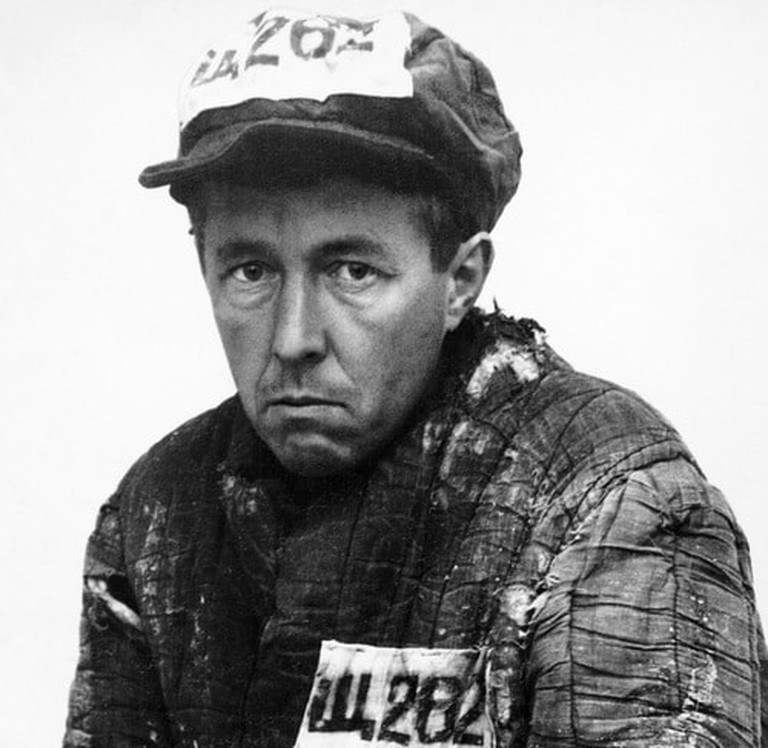
On February 12, 1974 KGB agents came to the Moscow apartment of Alexander Solzhenitsyn and
took him to the notorious Lefortorvo prison where he was strip-searched
and interrogated. The next day, he was bundled onto a plane and sent
to Frankfort, West Germany. The day after that he was charged with
treason and stripped of his Soviet citizenship.
These events were triggered by the French publishing house issuance on December 28, 1973 of The Gulag Archipelago 1918-1956: An Experiment in Literary Investigation. The publication was an electrifying event in the West and set off a panicked reaction by the Soviet government.
While some memoirs of prisoners of the Gulag had previously been published, including by Solzhenitsyn during the Khrushchev-era
thaw in the early 1960s (which ended with his overthrow in 1964), and
Khrushchev himself had given his famous secret speech in 1956 (the text
of which was obtained by Israeli intelligence and disseminated in the
West) denouncing Stalin's excesses, there was still no comprehensive picture of what had happened in the Soviet Union under Lenin and Stalin, while Vasily Grossman's towering novelistic portrayal and comparison of Communism and Nazism, Life and Fate, had not yet been smuggled to the West. In the West, Robert Conquest had published his seminal work, The Great Terror,
on the purges of the late 1930s but he, and the book, came under
sustained attack from American academic "experts" on the Soviet Union.
It was not until the Soviet archives became available in the 1990s that
Conquest's view was proved accurate, prompting the mocking suggestion
that the next edition of The Great Terror should be retitled I Told You So, You F**k**g Fools (this has been inaccurately attributed to Conquest himself; the British author Kingsley Amis was the real perpetrator).
Even Khrushchev's 1956 speech was only the Soviet version of a "modified limited hang out".
It attributed all crimes to Stalin, focusing on his persecution of
fellow Communist Party members, and did not provide an accounting of the sufferings of millions of
designated "class enemies".
What was stunning about The Gulag Archipelago was its definitive
linking of the creation of the terror state to Lenin and his henchmen
like Nikolai Krylenko, Chairman of the Revolutionary Tribunal (1918-22) and later Chief State Prosecutor at innumerable show-trials, who stated "in regard to convicted hostile-class elements . . . correction is impotent and purposeless" and in a more recent book by another author, is quoted exclaiming "We must execute not only the guilty. Execution of the innocent will impress the masses even more!"
(in 1938, Krylenko was arrested in one of Stalin's purges and after a
20-minute trial was immediately shot; no one was impressed). Stalin
merely inherited and then perfected what Lenin created. And the book
contained voluminous documentation along with witness testimony. The
American diplomat, George Kennan, called it:
"the most powerful single indictment of a political regime ever to be levied in modern times"
The author, a decorated WWII veteran, had been imprisoned in the Gulag
in 1945 for making disparaging remarks about Stalin in a letter.
Released in 1956 (Stalin died in 1953 and over the next three years the
Gulag camps were mostly emptied), he secretly, and at great personal
risk, set to compiling his history of the Gulag, completing it in 1968.
Because of the danger of discovery and confiscation he never worked on
the entire manuscript at once, storing it in sections with trusted
friends at various locations in and around Moscow. The manuscript was
eventually copied onto microfilm and was smuggled to France. Meanwhile,
the KGB became aware of the book and began frantic attempts to seize it
to prevent publication (not yet being aware that the microfilm version
had already reached the West). There were still three
typewritten versions of the manuscript in the Soviet Union and in the
summer of 1973 the KGB found one of them after interrogating one of
Solzhenitsyn's trusted typists. The distraught typist hung herself a
few days after being released.
For the Soviet leadership, Solzhenitsyn's book questioned the very
legitimacy of the Soviet state and its founding, but one thing had
changed by 1974. Under Stalin and Lenin, Solzhenitsyn would have been
quickly imprisoned and then shot. By the 1970s the choices were mostly
reduced to imprisonment, internal exile or expulsion (though untraceable
murder was still occasionally employed on dissidents). Solzhenitsyn
posed a difficult dilemma. In 1970 he had received the Nobel Prize for
Literature for his novel One Day In The Life Of Ivan Denisovich,
an account of life in a Gulag camp published during the Khrushchev
thaw. Deciding that imprisonment or internal exile would turn him into a
martyr and constant source of Western pressure for his release, the
regime decided expulsion was the better course.
The Gulag Archipelago is not a dry history. It is brimming with
passion, anger, contempt, caustic wit and acerbic asides. The accretion
of detail on person after person, on trial after trial, on lawless and
arbitrary decrees and on the squalid dehumanizing world of the camps is
relentless and overwhelming and the translation by Thomas P Whitney captures it all.
To give you a flavor for its power, below is an excerpt from The Gulag Archipelago Two (in the U.S the book was published in two volumes, each about 700 pages). It's from a chapter is entitled "The Archipelago Metastasizes",
which tells the sorrowful tale of the building of the White Sea-Baltic
canal in the early 1930s. Stalin demanded the building of a canal that
would allow the passage of Soviet naval vessels from one sea to the
other in order to avoid the Arctic Ocean, setting a 20-month deadline
for completion. Hundreds of thousands of prisoners were assigned to its
construction. The canal was dug by hand without any mechanical
equipment under terrible physical conditions and brutal oversight from
abusive guards. 250,000 prisoners died during its construction. The canal
was poorly designed and never functioned as planned. Solzhenitsyn is
unsparing in his portrayal of this debacle, near the end of the
chapter recounting a visit he made to the canal in 1966 and of the official tour he took:
"It's so shallow", complained the chief of the guard, "that
not even submarines can pass through it under their own power, they have
to be loaded on barges, and only then can they be hauled through."
And what about the cruisers? Oh, you hermit-tyrant! You nighttime lunatic! In what nightmare did you dream up all this?
And where, cursed one, were you hurrying to? What was it that burned
and pricked you - to set a deadline of twenty months? For those
quarter-million men could have remained alive. Well, so the
Esperantists stuck in your throat, but think how much work those peasant
lads could have done for you! How many times you could have roused
them to attack - for the Motherland, for Stalin!
"It was very costly", I said to the guard.
"But it was built very quickly!", he answered me with self-assurance.
Your bones should be in it!
The chapter ends with this summing of accounts:
My Lord! What canal is there deep enough for us to drown that past in?
(Building the canal)
From West Germany, Solzhenitsyn emigrated to the United States moving to
Vermont where he lived for many years. In the summer of 1975 he was
invited to speak by George Meany, President of the AFL-CIO, to speak at the organization's dinner in Washington DC where he said:
I have tried to convey to your countrymen the constrained
breathing of the inhabitants of Eastern Europe in these weeks when an
amicable agreement of diplomatic shovels will inter in a common grave
bodies that are still breathing. I have tried to explain to Americans
that 1973, the tender dawn of détente, was precisely the year when the
starvation rations in Soviet prisons and concentration camps were
reduced even further. And in recent months, when more and more Western
speechmakers have pointed to the beneficial consequences of détente, the
Soviet Union has adopted a novel and important improvement in its
system of punishment: to retain their glorious supremacy in the
invention of forced-labor camps, Soviet prison specialists have now
established a new form of solitary confinement -- forced labor in
solitary cells. That means cold, hunger, lack of fresh air, insufficient
light, and impossible work norms; the failure to fulfill these norms is
punished by confinement under even more brutal conditions.
While in DC, Meany and others tried to arrange a meeting between Solzhenitsyn and President Gerald Ford. Ford, with the concurrence of Henry Kissinger, refused to invited the author to the White House, for fear of endangering the emerging detente with the Soviet Union.
In 1990, Solzhenitsyn's Soviet citizenship was restored in the waning
days of that country's existence and he returned to Russia in 1994,
dying in 2008 at the age of 89.
The Gulag Archipelago is both a factual and rhetorical attack on Soviet communism. It is also a tract of powerful moral reflection on humanity. The author reflected on what he learned during his decade in the Gulag:
"Gradually it was disclosed to me that the line separating good and evil passes not through states, nor between classes, nor between political parties either - but right through every human heart - and through all human hearts. This line shifts. Inside us, it oscillates with the years. And even within hearts overwhelmed by evil, one small bridgehead of good is retained."
I'd already been reading Wayne Hsieh but the others have just been added in the past three days.
As with Covid and other topics where I've quickly put together initial reading lists, I suspect it will also quickly change. Over time you observe which sources follow the evidence regardless of where it leads and which have a preferred narrative they are selling into which they fit what is convenient so, at this point, I read my current list with caution.
We already see this in the effort of some to impose their chosen narratives about the course of the war. It is too early to tell who is winning and who is losing, at least as to the future of Ukraine. I think it clear that due to Putin's miscalculation(1) and the resistance of the Ukrainians, he has lost the bigger strategic issue, mobilizing and uniting a previously inert Europe against him. Regardless of your analysis of the causes of the war, President Zelensky and many Ukrainian citizens have proven to be exemplars of physical and moral courage.
With his decision to launch an invasion of the entire Ukraine, Putin has raised the stakes and the dangers for all of us.
As pointed out at the end of my previous Ukraine post, what happened before February 24 is now academic. We are in a new world and Russia, Ukraine, Europe and the U.S. are each faced with a new set of options and decisions. And it is difficult to predict whether Putin is more dangerous as victor or if he is facing defeat, which, in turn, places an obligation on European and U.S. decision makers to be prudent and calm in their actions and in their rhetoric. Things could easily get much worse.
(1) By miscalculation, I refer to Putin's decision not to be satisfied with detaching the Donbass from Ukraine. If he had stopped there Ukraine would have been militarily powerless to reverse the situation, and Europe and the U.S. would have sighed in relief and done nothing meaningful in response.
The original version of this post contained serious formatting errors which are now corrected and additional edits have been made . . .
The finest pop song about an historical event is undoubtedly Roads To Moscow, the 1973 song composed and recorded by Al Stewart which I saw performed in 1974 at the Orpheum Theater in Boston while he was on tour in support of the album Past, Present, and Future. The events he describes began more than 78 years ago as Operation Barbarossa, the German surprise attack on the Soviet Union, triggering the bloodiest conflict in human history. By its end in May 1945, 4.3 million Germans were dead, mostly military personnel, and perhaps up to 27 million Russians, two thirds of them civilians.
Stewart's song balances a vivid, poignant, and historically accurate lyric with a lovely melody, a Russian influenced chorus, and an evocative and emotional arrangement. He tells the story of a Soviet soldier, one of tens of millions of people caught in the horrific tragedy caused by two of the most brutal regimes to ever be inflicted upon the human race - Nazi Germany, led by Adolph Hitler, and the Communist Soviet Union of Josef Stalin. It's a world of spiritual darkness and limited and terrible choices for the common people trapped by those events, a dilemma also brought to life by Alan Furst in his splendid series of novels set in the same time period - particularly Night Soldier and Dark Star.
Let's look at the lyrics and explore the song in more detail.
They cross over the border the hour before dawn
At about 315am on the morning of June 22, 1941, the German army launched Operation Barbarossa. The attack, including 14 Finnish and 13 Romanian divisions, involved 3.8 million soldiers, 3,400 tanks, 3,500 aircraft and 700,000 horses. Facing the onslaught were about 2.5 million frontline Soviet troops (the Red Army had about 4 million men under arms in total in the European part of the country).
Though Hitler and Stalin had been allies since the August 1939 signing of the Nazi-Soviet Nonaggression Treaty, which divided Poland and the Baltic States between them, they were long-term ideological enemies and a conflict was inevitable at some point. However, the specific timing of the German attack was dictated by Hitler's desire to remove what he viewed as Britain's last hope for support in the war, the same motive that drove Napoleon's disastrous invasion of Russia in 1812 (for more on this read Bonapartaroo Barbarossa).
Ideological considerations drove Nazi decisions as to how the war would be conducted. The inhabitants of occupied portions of the Soviet Union were to be starved, driven out, or left as slave labor for German settlers, captured Red Army communist commissars to be executed, and roving extermination squads (Einsatzgruppen) organized that would ultimately kill a million Jews.
In the months leading to the attacks, Stalin dismissed multiple warnings from his own intelligence services as well as from Churchill and Roosevelt, claiming they were provocations designed to entice him into a war with Germany that would only benefit the Western capitalist powers. As late as the night of June 21-22 he ordered the execution of German defectors who entered Soviet lines to warn of the imminent attack. The result was that Red Army troops were left deployed in forward positions near the border, in vulnerable formations ill-suited to defense.
The Soviet Army was still recovering from Stalin's 1937-38 purge (possibly triggered by information planted by German agents) of senior military leadership in which at least 75% of these officers were killed, and its poor performance in the 1939-40 Winter War with Finland, gave the German military what proved to be unwarranted confidence that the Russians would be quickly defeated. This overconfidence also contributed to the inexplicable lack of attention by the Germans to the logistical challenges of a massive campaign designed to penetrate deeply into the Soviet Union, challenges that were ultimately to doom Barbarossa.
The border referred to in the lyric was different from the 1939 Soviet border. With the 1939 pact, Stalin was able to occupy half of Poland, all of the Baltic States and the Romanian province of Bessarabia. By advancing the border, he gained strategic depth against attack, while also arresting, murdering, and deporting hundreds of thousands of citizens of those countries who he believed might oppose his plans (a sordid tale told in disturbing detail in Timothy Snyder's Bloodlands). In addition, with his surprise attack on Finland in October 1939 he gained buffer room for Leningrad and the crucial northern port of Murmansk.
Moving in lines through the day Most of our planes were destroyed on the ground where they lay
The Luftwaffe destroyed over 2,000 Soviet aircraft on the ground that first day, losing only 35 planes in its attacks. More than 3,900 Soviet planes were destroyed in the first three days, giving the Germans overwhelming air superiority.
Waiting for orders he held in the wood Word from the Front never came By evening the sound of the gunfire was miles away Ah, softly we move through the shadows, slip away through the trees Crossing their lines in the mists in the fields on our hands and our knees And all that I ever, was able to see The fire in the air glowing red, silhouetting the smoke on the breeze
In those first days and weeks many Soviet troops found themselves isolated behind the rapidly advancing Germans and without order amidst the command chaos. "The Front" refers not to the front lines where the soldiers were, but to the organization of Russian armies into "Fronts", equivalent to American Army Groups on the Western Front. In other words, they heard nothing from the High Command.
While many isolated or surrounded soldiers surrendered (nearly 3 million by the end of 1941, 3/4 of whom would die in German captivity) many thousands were eventually able to find their way back through gaps between the rapidly advancing German Panzer units and the slower infantry following behind to rejoin their comrades, our narrator being one of those. Others remained uncaptured but behind enemy lines, becoming the core of the partisan units that would harass the Germans for years (and who make an appearance later in the lyrics).
All summer they drove us back through the Ukraine Smolensk and Vyazma soon fell By autumn we stood with our backs to the town of Orel
In this passage, the narrator uses the terms "us" and "we" in reference not to his personal location but rather to the overall plight of the Red Army.
The German attack was divided into three army groups. Army Group North advanced through the Baltic States towards Leningrad, while Army Group South drove the Soviets, "back through the Ukraine", culminating in September with a great encirclement near Kiev in which more than 700,000 Soviets were killed or captured.
The third, and initially most powerful, group was Army Group Center, taking the road to Moscow along with Smolensk, Vyazma, and Orel were located. The Battle of Smolensk lasted from July 10 to September 10, with the Red Army losing nearly a half million soldiers dead, wounded, or captured. The battle was prolonged because in its early stages Hitler diverted panzer units to the south for the Kiev encirclement. The delay in capturing Smolensk may have fatally delayed the German drive on Moscow.
With the panzers returning to Army Group Center, the advance on Moscow resumed in late September, racing against the onset of winter. During October, the Germans pulled off two more giant encirclements at Vyazma and Bryanks, in which another million Soviet soldiers were killed or captured. Orel fell on October 3 to General Guderian's tanks.
Closer and closer to Moscow they come Riding the wind like a bell General Guderian stands at the crest of a hill
On November 15, the Germans began their final push on Moscow. General Heinz Guderian (1888-1954), commander of the Second Panzer Army, is considered one of the finest tank generals of the war, performing brilliantly during the Poland invasion and then leading the armored spearheads in the 1940 French campaign. Guderian's task was to approach the Soviet capital from the southwest and encircle it. Though he made some advances, his overextended forces were halted short of the capital and left in vulnerable defensive positions. On December 26, 1941 he would be dismissed from command because of a dispute with his superiors (including Hitler) over how to respond tactically to the recently launched Soviet offensive. Recalled to duty by Hitler in 1943 after the disaster at Stalingrad, he was charged with rebuilding the army's panzer capabilities. On July 21, 1944, the day after the failed assassination attempt against Hitler, Guderian was appointed Army Chief of Staff. Though often arguing with Hitler about tactical decisions, he remained a faithful supporter of the Fuehrer until the end of the war.
(Guderian)
Winter brought with her the rains Oceans of mud filled the roads Glueing the tracks of their tanks to the ground While the sky filled with snow
In this section, two weather periods are mixed together. From late October until mid-November came a period of cold rain, turning the primitive Soviet road network into a sea of mud. Then came freezing temperatures, making the roads stable and more passable. The final German push was launched in this window before the onset of brutal cold and snow made offensive operations much more difficult.
(Mud season, November 1941)
And all that I ever was able to see The fire in the air glowing red silhouetting the snow on the breeze
Now the red is silhouetting "the snow on the breeze" rather than "the smoke on the breeze" of the first verse, signaling the passage of time from the warmth, sun, and disaster of June to the bitter cold, snow, and hope of December.
In the footsteps of Napoleon the shadow figures stagger through the winter
The German offensive continued until December 5 under increasingly taxing conditions with heavy snow and temperatures plunging to well below zero. Counting on achieving complete victory by the end of fall, German soldiers had not been issued winter clothing, nor were tanks, assault guns, and motor vehicles designed and equipped to operate in these conditions. At these temperatures the recoil fluid, lubricating oil and firing pins on German artillery, anti-tank, and machine guns failed, tank turrets would not turn and trucks had to be kept constantly running, using precious fuel. And all these troubles amplified by the already overstressed German supply system virtually collapsing in the winter conditions.
Yet despite these difficulties, isolated German units got within 15 miles of the Kremlin, while to the northwest the main German forces were within 25 miles of the city.
A German officer wrote of conditions during the advance:
It is icy cold . . . To start the engines, they must be warmed by lighting fires under the oil pan. The fuel is partially frozen, the motor oil is thick, and we lack antifreeze to prevent the cold water from freezing.
The remaining limited combat strength of the troops diminish further due to the continuous exposure to the cold. It is much too inconvenient to shelter the troops from the weather . . . In addition, the automatic weapons of the groups and platoons often fail to operate, because the breeches can no longer move.
On December 3, the commander of Fourth Panzer Group reported its offensive combat power "has run out" because of "physical and moral over-exertion, loss of a large number of commanders, inadequate winter equipment".
Finally recognizing the reality of the brutal conditions and the disintegration of offensive capabilities Hitler and the High Command issued a halt order on December 5.
References to Napoleon were also a constant theme of Soviet propaganda which constantly reminded German troops of the fate of the last western invader, whose myth of invincibility, along with his army, disappeared in the Russian winter.
Falling back before the gates of Moscow Standing in the wings like an avenger
What kept the German high command pressing ahead for so long despite the casualties and exhaustion of men and equipment was the persistent belief the Russians had exhausted their reserves and were on the verge of collapse. It was a massive miscalculation and demonstrated the complete failure of German intelligence assessments. They underestimated the willingness of Stalin to move troops from the Soviet Far East as well as the capability of the brutal and ruthless Soviet system to mobilize an almost endless number of reserves (unlike Hitler, who resisted fully mobilizing the German economy and populace until 1944, Stalin immediately took such measures). Between June 22 and December 31, the Soviets lost 4 million men, the equivalent of its entire army on June 22 yet still had 4 million under arms at the end of the year. It is hard to believe any other society surviving with that magnitude of loss in such a short time.
Less than 24 hours after the German offensive halted, the Soviets began launching their own attacks, designed to push back and isolate the German forces near Moscow. In a series of actions lasting until the beginning of March 1942, the exhausted Germans were forced back more than 100 miles, permanently eliminating the threat to Moscow.
While Soviet soldiers were somewhat better equipped for the weather, the winter conditions still took a toll, a toll only enhanced by Soviet commanders still favoring frontal assaults. Thus, despite its success, the tactical shortcomings of the Red Army can be seen in the disparity in casualties during its three month offensive - 1.6 million for the Soviets versus 262,000 for the Germans.
And far away behind their lines the partisans are stirring in the forest Coming unexpectedly upon their outposts, growing like a promise
You'll never know, you'll never know Which way to turn, which way to look, you'll never see us As we're stealing through the blackness of the night You'll never know, you'll never hear us
Though not a major factor in 1941, by the following year the partisan threat became a major problem for the extended supply lines of the German army. Partisan warfare in Russia was on a completely different, and larger, scale than in most of the rest of Europe, involving huge numbers, semi-organized and large scale assaults on German rear lines. Big chunks of the Soviet countryside behind enemy lines remained out of German control throughout the war and forcing many troops to be diverted to fighting partisans.
And the evening sings in a voice of amber, the dawn is surely coming
Using "amber" in this context is very interesting. Amber is a fossilized tree resin, valued as a gemstone. From 1500 BC there was an Amber Road by which this material was moved in trade from the shores of the Baltic to the Mediterranean. The leading source of amber was near what used to be the city of Konigsberg in Prussia, now known as Kaliningrad and part of Russia since 1945.
The famous Amber Room was initially constructed in Konigsberg and gifted in 1716 by the Prussian King to Peter the Great of Russia. Installed in a palace outside of Petersburg (later Leningrad), the room was expanded, eventually covering 590 square feet and containing over 6,000 pounds of amber on panels backed with gold leaf and mirrors.
(The Amber Room)
During the war the German Army dismantled the Amber Room and transported it back to Konigsberg. Disappearing at the end of the war, its location remains unknown, one of the last mysteries of the war.
The voice of amber is soothing - its message that things will get better. The next lines tell us how:
The morning road leads to Stalingrad And the sky is softly humming
We've moved ahead several months to the summer of 1942. Unlike 1941, when the German Army was powerful enough to attack the Soviets from across its entire front, the Nazis summer offensive would be more limited in scope. On June 28, the Germans attacked in the south, aiming for the oil fields of the Caucasus region and the heavy industrial town of Stalingrad. The Germans advanced quickly, nearly reaching the Caspian Sea, but became bogged down in Stalingrad, with an increasingly obsessed Hitler insistent upon its capture. The fighting lasted for almost six months ending in catastrophe for the Nazi regime with the destruction of the Sixth Army and the allied Hungarian and Romanian armies, along with heavy losses in other German units. Of 91,000 prisoners taken by the Russians only 5,000 ever returned to Germany, some not until a decade after the end of the war. The cost of victory was staggering for the Red Army - another 1.1 million dead, wounded or captured.
(Russian soldiers, Stalingrad)
In a military sense the failure to knock the Soviets out by the fall of 1941 was the turning point in the war, the point where unconditional victory by Germany became impossible but Stalingrad was the symbolic turning point of the war and both Stalin and Hitler were aware of its symbolism at the time. The horror of the battle from the Russian perspective is captured best inLife and Fateby Vassily Grossman, one of the greatest works of 20th century literature, in a section recounting the struggle of one Red Army squad to hold a ruined building amidst the rubble of the city. Of course, being a Russian novel, everyone dies.
After Stalingrad, German military leaders no longer believed the war could be won, though it was not certain how long it might take the Soviets to win.
Two broken Tigers on fire in the night Flicker their souls to the wind We wait in the lines, for the final approach to begin It's been almost four years, that I've carried a gun At home it'll almost be spring The flames of the Tigers are lighting the road to Berlin
The lyrics here are very cleverly structured. The first line tells us of "two broken Tigers" followed by a reference to "the final approach" but we don't know where or when it is. The next line tells us it's been "almost four years that I've carried a gun", placing us in 1945, but still not giving us a location as Soviet armies are fighting from the Baltic to Hungary. Then it's revealed that the flaming Tigers are also "lighting the road to Berlin", creating a vivid and precise word picture.
The Tiger was the heaviest and most powerful tank produced by Germany during the war. Like much German equipment it was over engineered, overly complex to manufacture and required high level maintenance to keep operational. The Tiger I was produced from 1942 to 1944 and the Tiger II from 1944 on, but fewer than 2,000 made it to the army. When it was available and running the Tiger proved devastatingly effective.
(Tiger II)
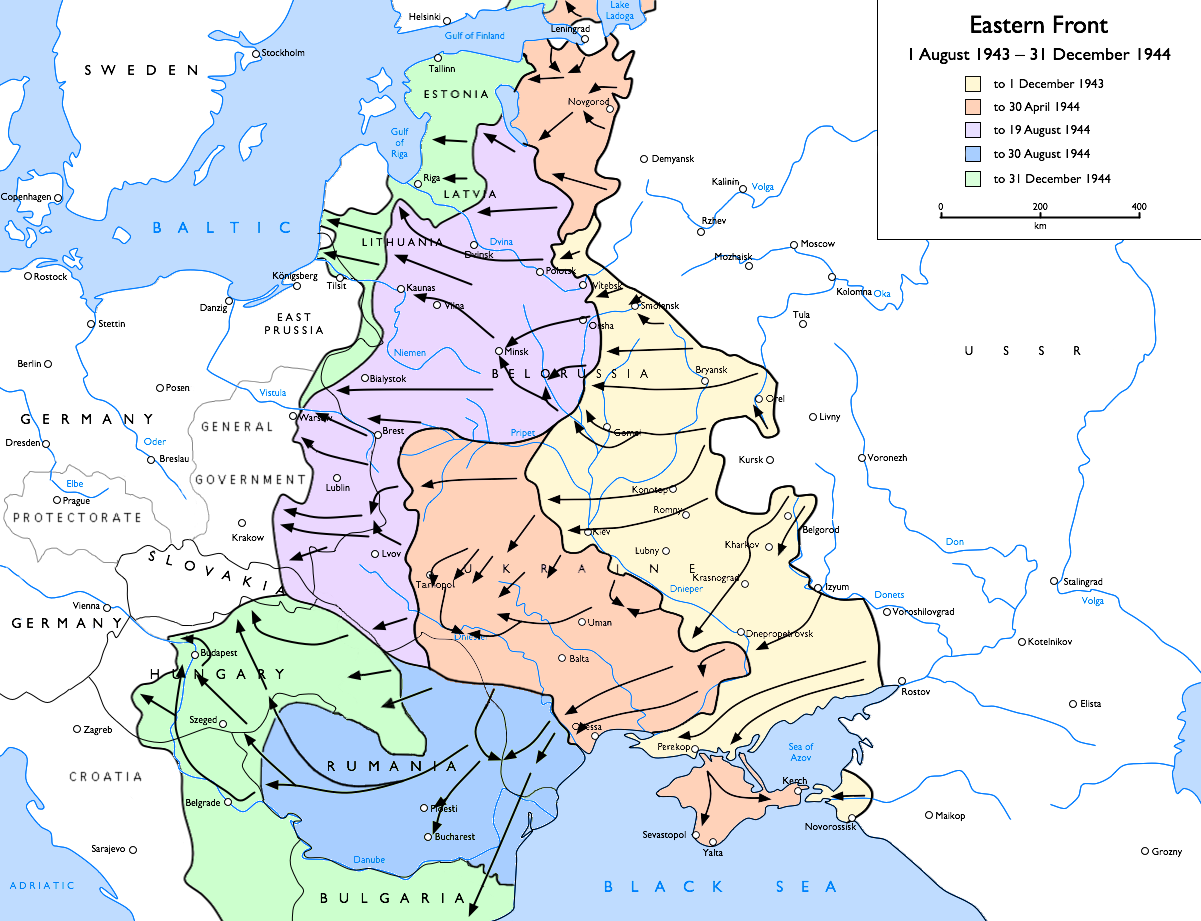
It's now April 16, 1945. The Red Army is less than 50 miles from Berlin. Much has transpired since the German surrender at Stalingrad in February 1943. In July 1943 Hitler attempted his last major attack on the Eastern Front near the city of Kursk. It quickly proved unsuccessful, the Soviets counterattacked, and from then until the end of the war the Red Army conducted a series of attacks. The German siege of Leningrad ended and most of the Ukraine was reconquered by the end of 1943. In June 1944, the Soviets crushed Army Group Center and drove the Germans out of Russia, advancing into Poland where by late July they were on the outskirts of Warsaw. Then followed another of the countless tragedies of the war when the Polish Home Army rose up to evict the Germans. Stalin, who opposed the anti-communist Poles, ordered the Red Army to stand by while the Nazis crushed the uprising, killing 200,000 Poles and razing the city (for more on the uprising read Warsaw Does Not Cry).
In late 1944, the Soviets advanced into the Balkans, causing Romania and Bulgaria to switch sides and reaching the borders of Hungary.
On January 12, 1945 the Russians renewed their attack on the Polish front, sweeping away the Germans quickly advancing to the Oder River near Berlin, where they paused to regroup for the final assault.
Ah, quickly we move through the ruins that bow to the ground The old men and children they send out to face us, they can't slow us down All all that I ever, was able to see The eyes of the city are opening now, it's the end of a dream
The Berlin campaign lasted from April 16 through May 2. Though the assault contributed to the "ruins that bow to the ground" much of the city was already ruined by American and British bombing raids, some consisting of more than 1,000 bombers striking the city.
The reference to "old men and children" refers to the Volksstrum ("People's Storm"), a national militia consisting of all men between 16 and 60 capable of bearing arms, formed in October 1944, as the manpower needs of the crumbling Third Reich became ever more desperate (though even boys of 14 and 15 would see service by the end). Poorly armed and trained, the Volkssturm units were of varying effectiveness and took heavy casualties.
Notice the contrast with the opening verse of the song. In 1941, the narrator speaks of defeat, confusion, and retreat; four years later he is moving triumphantly forwards to victory.
(Berlin 1945)
Despite the claim that "old men and children . . . they can't slow us down", the Volkssturm and remaining regular Wehrmacht units imposed heavy losses on the Army army - 79,000 dead and 270,000 wounded in less than three weeks, a per day toll higher than any the Soviets had suffered since the dark days of 1941. The human cost was made higher by Stalin's cynical move to place Marshals Zhukov and Koniev in competition to be first to Berlin, relentlessly mocking and scolding them, leading to reckless frontal assaults, particularly by Zhukov (for more on him readThe Secret of Khalkin Gol). And, with the encouragement of Stalin and the Red Army command, the victorious soldiers took a terrible vengeance on German civilians.
I'm coming home, I'm coming home Now you can taste in the wind, the war is over And I listen to the clicking of the train wheels as we roll across the border
The lyric brims over with optimism. Against all odds, our narrator has survived and looks forward to being reunited with his family. In reality the odds were low that any soldier on the front line on June 22, 1941 would be alive and healthy enough to fight continuously and still be in the Berlin fighting.
8.6 million Red Army personnel died in the war; effectively the original 1941 army was killed twice over. In comparison, the United States suffered 296,000 battlefield deaths with another 100,000 dead due to accidents and illnesses.
Nor were all the Russian dead solely the responsibility of the German army. Life for Red Army soldier during the war was brutal. Commanders employed tactics that wasted countless lives. If you died, particularly early in the war, it was unlikely your family would be notified. Any infraction, real or imagined, was subject to harsh discipline and extreme punishment. During the first 18 months of the war (the only period for which we have figures), 160,000 Soviet soldiers were executed for cowardice or desertion. By comparison, only one American was executed for these offenses during the entire war. For those not summarily executed there were the Punishment Battalions and Companies to which officers and soldiers were sentenced to be used, in Stalin's words, at "the most difficult parts of the front, to give them the possibility to redeem their crimes against their country with blood". The Punishment units were deployed for tasks such as suicidal front assaults and the clearing of minefields by marching through them, making it no surprise that an estimated 400,000 died in the process. Their existence was such an embarrassment to the Soviets after the war that the existence of the units was officially denied.
And there were the Red Army's blocking detachments formed to shoot down retreating soldiers - retreating Red Army soldiers. In this clip from the movie Enemy At The Gates, which takes place at Stalingrad, you can watch (about 2 minutes in) a blocking detachment in action (the first 20 minutes of the movie are stunning and accurate, after that it falls apart).
The optimism of those that survived extended beyond the relief of being alive and reuniting with family. The memoirs and recollections of returning soldiers and officers are filled with belief and hope that conditions in the Soviet Union would be improved. There was a feeling that, through their war effort, the common Soviet citizen had proven to Stalin they could be trusted, that the regime need not fear them, that the fear of being subject to arbitrary justice would end and there would be a new start for the Soviet people and a new and more cordial relationship with their government.. It was not to be.
And now they ask me of the time That I was caught behind their lines and taken prisoner "They only held me for a day, a lucky break", I say They turn and listen closer I'll never know, I'll never know Why I was taken from the line and all the others To board a special train and journey deep into the heart of Holy Russia And it's cold and damp in this transit camp And the air is still and sullen And the pale sun of October whispers The snow will soon be coming
In his account of the German-Soviet struggle, Absolute War, author Chris Bellamy writes, "the Red Army was the only one in the world where being taken prisoner counted as desertion and treason". Stalin believed any soldier who allowed himself to be captured was a traitor and potential counter-revolutionary, and that Russians exposed to Westerners for any length of time became a danger to the Soviet state. Bellamy adds:
The Soviet government and military command had absolutely no interest in what happened to Soviet people in German captivity. When prisoners of war who survived were released at the end of the war [3 of the 4 million POWs died due to the German policy of exposing them to the elements and leaving them to starve, though a small number also died serving as guinea pigs during the initial testing of the gas chambers used at Auschwitz], they were usually sent to the Gulag or shot, and the same fate even befell many who had fought and crawled their way out of German encirclements during the war.
Our narrators falls into this last group. His years of valiant service and suffering are to no avail.
Also subject to this treatment were civilians who either volunteered or been seized and taken to Germany as slave laborers. Bellamy estimates that up to 1.8 million returning Soviet citizens were sent to Gulag camps or shot.
In Stalingrad: The Fateful Siege, Anthony Beever tells the tale of a Soviet lieutenant caught in this madness. Captured by the Germans in August 1942, he manages to escape and rejoin the Red Army, where he is promptly arrested, charged as a deserter, and sentenced to a Punishment Company. Realizing his sentence is an effective death penalty, he deserts to the Germans! We don't know his fate but it is unlikely he had a happy ending.
To their mutual disgrace, both Britain and America contributed to this horror. Between 1945 and 1946, the two countries forcibly repatriated over a million Russians who did not want to return to the Soviet Union. While it was the British who insisted on honoring agreements made with Stalin during the course of the war, the United States eventually went along. The returnees were among those sent to the Gulag or shot.
Even for those escaping the Gulag or execution, optimism proved misplaced. Stalin believed that after the "laxity" of the war years, Soviet discipline needed to reimposed to prevent any sliding back from the pre-war accomplishments of the state. The post-war years proved grimly repressive with further waves of purges and the elimination of those tiny, fragile zones of personal autonomy some had carved out during the war. Stalin even ordered the removal of crippled and disabled war veterans from the streets of Moscow because he felt their presence demoralizing. It was in this atmosphere that a young returning officer, Alexander Solzhenitsyn, found himself sentenced to ten years in the Gulag for telling a joke about Stalin.
And I wonder when I'll be home again and the morning answers, "Never" And the evening sighs and the steely Russian skies go on forever
I find these the saddest line in music and no matter how often I hear them they affect me as powerfully as the first time. They represent the betrayal of the hopes and dreams of people caught up in a horrible time, who thought they'd survived the worst, only to find themselves condemned to death, exile, continued fear and hopelessness.
We take leave of our narrator as he disappears into the mist beneath the steely Russian skies passing to an unknown fate, like so many other millions. We'll end with some lines from the poet Osip Mandlestam (1891-1938), who himself died in a Gulag transit camp after sentencing for committing "counter-revolutionary activities" consisting of writing a poem mocking Stalin.
Mounds of human heads
Are wandering into the distance
I dwindle among them
Nobody sees me
Today is the 90th anniversary of Josef Stalin's declaration of war on the kulaks. Or, as he put it in his own inimitable style on December 27, 1929, the goal of the Union of Soviet Socialist Republics (USSR) was "liquidation of the kulaks as a class",adding "Now we have the opportunity to carry out a resolute
offensive against the kulaks, break their resistance, eliminate them as a
class and replace their production . . ."
On January 30, 1930 the Communist Party Politburo formalized the decision in a resolution entitled, "On measures for the elimination of kulak households in districts of comprehensive collectivization". Under the resolution all kulak family members were to be placed in one of three categories:
To be executed or imprisoned
To be internally exiled to remote regions of the USSR
To be used as forced labor in their local regions
All kulak property was to be confiscated regardless of category.
The term "kulak" in the late Russian empire referred to peasants who owned at least 8 acres of land but after the Bolshevik Revolution in 1917 became more vague over the next decade, and by the time of Stalin's announcement meant any peasant who owned land or livestock, had tenants on their property, or sold surplus food on the open market. Communists viewed these kulaks as obstacles to collectivization, accusing them of hoarding grain and livestock. Whatever an individual kulak believed or how they acted was irrelevant, as a class they needed to be eliminated. To put it as Stalin thought about it, whatever a kulak subjectively thought or did, looking at it objectively (as Stalin did) they would ultimately be an opponent of true communism and needed to be dealt with in a preventative manner.
Stalin's announcement was not the first time kulaks were declared an enemy of the Bolsheviks. In August 1918, during the Russian Civil War, as the Bolsheviks tried to gain control over the rebellious countryside, Lenin issued a directive:
"Hang (hang without fail, so the people see) no fewer than one hundred
known kulaks, rich men, bloodsuckers. [...] Do it in such a way that for
hundreds of versts [kilometers] around the people will see, tremble,
know, shout: they are strangling and will strangle to death the
bloodsucker kulaks".
No one has an accurate account of the numbers of kulaks killed or exiled as a result of the 1930 resolution. Estimates of the dead range from 700,000 to several million (accounting is difficult since the dekulakization process overlaps with the related Soviet induced famine in the Ukraine during those years). Documents examined after the fall of the USSR indicate that 1,803,392 persons were sent to labor camps in 1930 and 1931 with only 1,317.022 actually arriving at their destinations.
Economically, the agricultural sector of the USSR never recovered, with the Soviets needing to import grain and food stocks for the remainder of its existence.
Similar debacles occurred in every other communist state, though varying in the degree of violence, with the worst examples being Pol Pot's Cambodia and Mao's China. Cambodia saw a quarter of its population die in four years, while Mao's anti-landlord campaign from 1949 to 1953 resulted in several million deaths. I have a Chinese friend whose grandfather, a local landlord in the Shanghai area, was sentenced to 25 years hard labor after the communists came to power. He died in a camp. Decades later the family discovered that prior to Mao taking power in 1949, their grandfather had supported and helped fund the communists. It didn't save him once they took power. In a socialist world, class distinctions are much more important than individual actions. The category your rulers place you in determines your fate. A lesson to keep in mind.
"Most of all the blood. My arms are up to the elbows in blood."
- Nikita Khrushchev's (1894-1971) response to playwright Mikhail Shatrov when asked during his retirement what he regretted.
"Paradise is a place where people want to end up, not a place they run from. What kind of socialism is that? What kind of shit is that, when you have to keep people in chains? What kind of social order? What kind of paradise?"
- From tapes recorded by Khrushchev in his retirement. This passage was not included in the transcribed memoir his son helped to smuggle to the West and published in 1970 as Khrushchev Remembers; it came to light in 1990 when the full tapes became available.
Both quotes are from Red Plenty, one of two outstanding books I've read in recent years on the post-Stalin Soviet Union. I thought it an appropriate day to post this since today is International Workers Day; first proclaimed in 1904 by the Sixth Conference of the Second International, a convening of European socialist and communist parties.
Red Plenty (2010), by the English novelist Francis Spufford, is set in the years between Stalin's death (1953) and the end of the Khrushchev "thaw" in the late 1960s. It tells the story of the brief era when the Soviet economy was growing faster than any other country except Japan, Khrushchev was promising Soviet living standards would exceed the U.S. by 1980, and a fully planned, fully centralized economy, embracing the capabilities of the new field of computing made it seem attainable, before it all came crashing down resulting in the economic stagnation of the 70s and 80s, and the final collapse of the Evil Empire.
The brilliant accomplishment of Red Plenty stems from Spufford being a fine writer who concocted what he calls "faction", a mixture of fact and fiction. We meet fictional young idealists, factory managers, and party strivers, along with Khrushchev, Alexei Kosygin, and other apparatchiks as he spins a story with heavy doses of economic theory in an entertaining and instructive way. Because it is set in the post-Stalin era with The Terror and specter of mass murder and the gulag no longer hanging over everyone, the complete failure of the Soviet planing system makes for an even more powerful tale.
Through his deft storytelling, Spufford demonstrates that the more centralized a society is at the top, the more vulnerable it is to small mishaps at the bottom which can ripple back through the entire system. And he sums up the deterioration of the system:
Stalin had been a gangster who really believed he was a social scientist. Khrushchev was a gangster who hoped he was a social scientist. But the moment was drawing irresistibly closer when the idealism would rot away by one more degree, and the Soviet Union would be governed by gangsters who were only pretending to be social scientists.
The book is only 300 pages and also has 50 pages of the best footnotes I've ever read (one of the quotes is from there).
These reviews capture the unique aspects of Red Plenty:
"I finished it in awe, not merely at Spufford's Stakhanovite research, but at his skill as a novelist, his judgement as a historian and his sheer guts in attempting something simultaneously so weird and yet so wonderful." - The Sunday Times (UK)
Everyone knows the economic central planning in the Soviet Union was a failure . . . Few will expect to pick up a longish book on the topic by a non-economist and devour it almost in a sitting. But that is what you have in store with Red Plenty. It is part detective story - who or what is killing the Soviet economy? - and part a brilliantly clear explanation of some very intricate history and economics." - The Economist
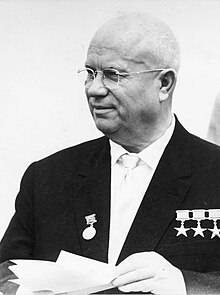
Khrushchev personified the new generation raised by Stalin after he wiped out the old Bolsheviks and anyone else with broader intellectual horizons and experience of the world outside the Soviet Union. Poorly educated, resentful of the bosses, crude and violent, Nikita initially brought into Stalin's view of the world. During the Great Purge he personally oversaw the actions in the Ukraine, approving close to 50,000 executions. During the war he was political director at the Battle of Stalingrad, ruthlessly driving the military commanders, and not hesitating to demand executions. Rising in the hierarchy after the war, he joined the Politburo, participating in the increasingly bizarre parties at the Supreme Leader's dacha where Stalin demanded his subordinates dance with each other as he ridiculed them, constantly reminding them that, when he was gone, "the capitalists will drown you like little kittens".
Underestimated by his opponents, he outmaneuvered them all after Stalin's death and by 1957 was the new Supreme Leader. Most surprisingly, in March 1956 he denounced Stalin and his crimes (though not Lenin's) at the Party Congress, while later that year he ruthlessly suppressed the rebellion in Hungary. But within the Soviet Union the last of the gulag prisoners were released and some literature critical of Stalin was allowed to be published.
Unlike both his predecessors and successors he believed a nuclear war unwinnable, but his recklessness provoked crises in Berlin and Cuba. He seemed to have some sense that changes were needed in the system but, like Stalin, he was a devotee of Lysenko's crackpot theories on genetics and agriculture. While a continued apostle of centralized planning he was prone to frequent temperamental eruptions as his own thinking was disorganized and chaotic.
He strikes me as a man with some insight into the problems inherent in the Soviet system but without the intellectual tools to figure out a solution. It was as much his increasingly erratic behavior as his anti-Stalinism that lead to his removal in October 1964. Even some of those who supported his limited opening of society approved the Politburo action because of his unpredictable behavior. In a change from Stalin times, instead of being exiled or jailed, Khrushchev was merely moved to a smaller dacha, given a smaller car, and watched carefully.
The other book I'd strongly recommend is Russia And The Idea Of The West (2000) by Robert English, the story of the evolution of Soviet reformers in the post-Stalin era, and the emergence of Mikhail Gorbachev. Stalin's isolation of the Soviet Union was so effective that the ignorance of the rest of the world by those who followed him in power and the next rising generation during the 1950s and 1960s is quite striking. English shows how the "new thinking" allowed under Khrushchev continued to evolve even during the more repressive regime that followed his overthrow and the growing determination of Gorbachev and others to end the confrontation with the West which they, unlike the Left in Europe and America, viewed as the fault of the Soviet Union.
When portions of the Soviet archives became available after 1991, numerous arrest lists were found with Stalin's notations. Some, like the one above, directed blanket executions. Others, consisting of hundreds and sometimes thousands of names had Stalin's check next to those to be executed. He spent a lot of time going through those lists.
This month is the 100th anniversary of the birth of Alexander Solzhenitsyn, author of The Gulag Archipelago (for background on the bookread this). The passage below from the book remains the most vivid in my memory 40-plus years after reading.
The Gulag Archipelago is not dry history, instead brimming
with passion, anger, contempt, caustic wit and acerbic asides. The
accretion of detail on person after person, on trial after trial, on
lawless and arbitrary decrees, on the squalid dehumanizing world of
the camps is relentless, overwhelming, and the translation by Thomas P. Whitney captures it all.
The passage is from a
chapter entitled “The Archipelago Metastasizes,” which tells the
sorrowful tale of the building of the White Sea-Baltic canal in the
early 1930s. Stalin demanded a canal that would allow
the passage of Soviet naval vessels from one sea to the other in order
to avoid the Arctic Ocean, setting a 20-month deadline for its completion.
Hundreds of thousands of prisoners were assigned to its construction.
The canal was dug by hand without the assistance of any mechanical equipment, under
terrible physical conditions, and with brutal oversight from abusive guards. A quarter million human beings perished in the process. Poorly designed, the
canal never functioned as planned.
Solzhenitsyn is unsparing in his portrayal of the debacle and near
the end of the chapter recounts a visit he made to the canal in 1966 as
he was completing research on the book which he was secretly working on. He recounts the official tour he took:
“It’s so shallow“, complained the chief of the guard, “that
not even submarines can pass through it under their own power, they
have to be loaded on barges, and only then can they be hauled through.“
And what about the cruisers? Oh, you hermit-tyrant! You nighttime
lunatic! In what nightmare did you dream up all this?And where, cursed
one, were you hurrying to? What was it that burned and pricked you — to
set a deadline of twenty months? For those quarter-million men could
have remained alive. Well, so the Esperantists stuck in your throat, but
think how much work those peasant lads could have done for you! How
many times you could have roused them to attack — for the Motherland,
for Stalin!
“It was very costly“, I said to the guard.
“But it was built very quickly!“, he answered me with self-assurance.
Your bones should be in it!
The chapter ends with this summing of accounts:
My Lord! What canal is there deep enough for us to drown that past in?


 Because of the danger of discovery and confiscation he never worked on
the entire manuscript at once, storing it in sections with trusted
friends at various locations in and around Moscow. The manuscript was
eventually copied onto microfilm and was smuggled to France. Meanwhile,
the KGB became aware of the book and began frantic attempts to seize it
to prevent publication (not yet being aware that the microfilm version
had already reached the West). There were still three
typewritten versions of the manuscript in the Soviet Union and in the
summer of 1973 the KGB found one of them after interrogating one of
Solzhenitsyn's trusted typists. The distraught typist hung herself a
few days after being released.
Because of the danger of discovery and confiscation he never worked on
the entire manuscript at once, storing it in sections with trusted
friends at various locations in and around Moscow. The manuscript was
eventually copied onto microfilm and was smuggled to France. Meanwhile,
the KGB became aware of the book and began frantic attempts to seize it
to prevent publication (not yet being aware that the microfilm version
had already reached the West). There were still three
typewritten versions of the manuscript in the Soviet Union and in the
summer of 1973 the KGB found one of them after interrogating one of
Solzhenitsyn's trusted typists. The distraught typist hung herself a
few days after being released. (Building the canal)


 On June 28, the Germans attacked in the south, aiming for the oil fields of the Caucasus region and the heavy industrial town of Stalingrad. The Germans advanced quickly, nearly reaching the Caspian Sea, but became bogged down in Stalingrad, with an increasingly obsessed Hitler insistent upon its capture. The fighting lasted for almost six months ending in catastrophe for the Nazi regime with the destruction of the Sixth Army and the allied Hungarian and Romanian armies, along with heavy losses in other German units. Of 91,000 prisoners taken by the Russians only 5,000 ever returned to Germany, some not until a decade after the end of the war. The cost of victory was staggering for the Red Army - another 1.1 million dead, wounded or captured.