Showing posts with label History. Rome. Show all posts

Sunday, August 18, 2024

The New Dig

We recently watched an excellent three part series on PBS about new discoveries at Pompeii.  About a third of the city buried by the AD 79 eruption of Vesuvius remains unexcavated.  Recently, a new section of the city has been the site of a new archaeological dig and the PBS series reveals the interesting findings, as well as provided the current interpretation of the sequence of events around the eruption.

The dig found several striking mosiacs in a combined bakery and residential residential of a wealthy Pompeii resident and does a fine job of explaining the findings.

This article contains more background, along with brief trailers for the episodes.  Recommended.

Saturday, April 1, 2023

They Never Saw It Coming

 Echoing the theme of my post Mastering The Tides of the World.


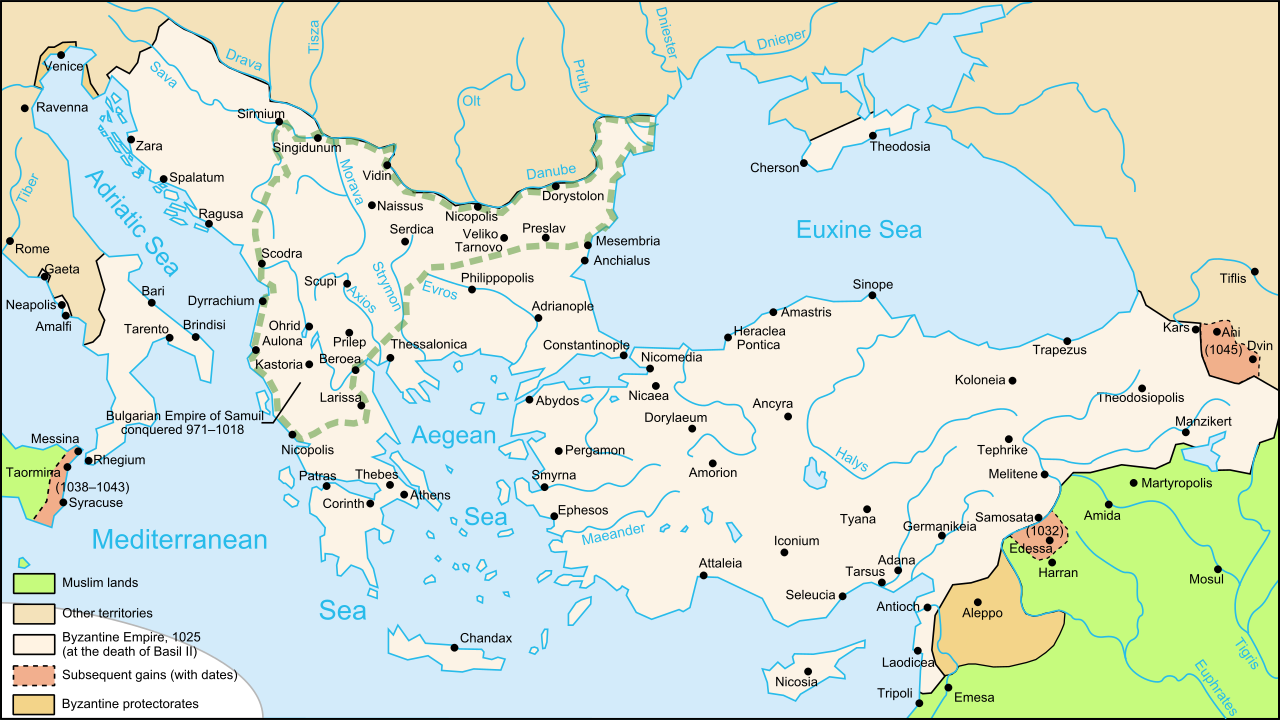
In 1025, Basil II (The Bulgar Slayer) died, leaving the Byzantine Empire in seeming good health, dominating both the Balkans and Anatolia.

Empire at the death of Basil II

undefined

The Arab threat, which placed the very existence of the Empire at risk from the mid-7th century until the mid-9th century had abated.  Over the past century, the Byzantines had reconquered the eastern portions of Anatolia and retaken Antioch and the approaches to the Holy Land, reducing the adjacent Arab principalities to dependencies.

In the Balkans, Basil had completely obliterated the Kingdom of Bulgaria, another constant threat for the past three centuries.  The empire's position in southern Italy was strengthened and the reconquest of Sicily appeared within reach.

The Empire was strong, both militarily and economically.

Then a succession of weak emperors followed, while Seljuk Turk invaders from Central Asia entered Anatolia.  In 1071 the Empire suffered a devastating defeat at Manzikert.  Over the next ten years, internal strife and the advance of the Turks led to the loss of most of Anatolia, a Roman territory for a thousand years.  Despite minor resurgences over the next century, the Byzantines were on the defensive, finally calling on the Western European adventurers of the Fourth Crusade to rescue them.  That "rescue" turned into the Latin assault on Constantinople and its sacking and fall to fellow Christians in 1204.  Though the Byzantines recovered their capitol in 1261, the reassembled and more geographically limited empire was a shadow of its former self, explaining why it never became Lebronstantinople.

Friday, September 30, 2022

The Most Distant Places

A well-done video on the travels of the Romans across their world and the state of knowledge of geography.  Covers explorations to China, India, sub-Saharan Africa, and northern Europe.  I touched on some aspects of this topic in The Farthest Outpost.

Saturday, July 2, 2022

Roman Wall Blues


(Hadrian's Wall)

By WH Auden (1907-73)

Over the heather the wet wind blows,
I've lice in my tunic and a cold in my nose.

The rain comes pattering out of the sky,
I'm a Wall soldier, I don't know why.

The mist creeps over the hard grey stone,
My girl's in Tungria; I sleep alone.

Aulus goes hanging around her place,
I don't like his manners, I don't like his face.

Piso's a Christian, he worships a fish;
There'd be no kissing if he had his wish.

She gave me a ring but I diced it away;
I want my girl and I want my pay.

When I'm a veteran with only one eye
I shall do nothing but look at the sky.

Tungria was located in what is now Belgium and was then part of the Roman Empire.  Tungrians were among the auxiliary troops garrisoning the forts along Hadrian's Wall. 


Tuesday, October 26, 2021

The Pastoral City

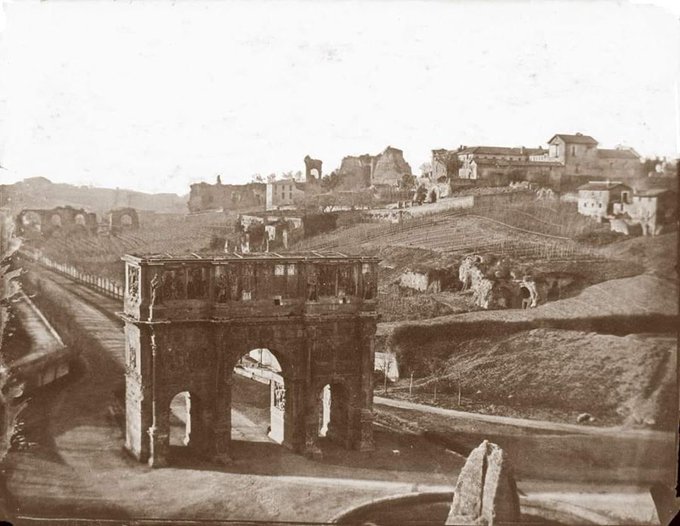
 Came across this remarkable 1850 photo of Rome.
Image

It looks like it is taken from inside the Colosseum, probably on its second level, and it pictures the area to the west of the structure. The stone sticking up in the lower right center is the remnant of the Meta Sudans, which was bulldozed at Mussolini's order.  Directly center is the Arch of Constantine (constructed in the early 4th century).  The modern road has been rerouted so it passes around, not through, the Arch.  Further down that road on the right is part of the aqueduct that carried water to the Palatine Hill.  The elevated ground in the distance behind the aqueduct is the Aventine Hill and the valley in between is where the Circus Maximus was located.  

The upper center-right of the photo is dominated by the Palatine Hill, home of the Imperial Palace.  During the time of the empire it was almost completely covered by palace buildings.  In 1850 the highest point has a monastery on it though you can see remnants of the palace as the hill slopes down to the aqueduct.  If you could see 90 degrees to your right the Sacred Way leading to the Forum would appear.

The other thing to note is how much of the hill was devoted to agriculture and pasture.  After the 6th century Gothic Wars, this area and much of the rest of the former imperial city ceased to be a place of dense urban habitation.  From Belisarius Enters Rome:

Large tracts of the ancient city, including the Forums, the hills (including the Palatine on which the Imperial Palace was sited), and the area around the Colosseum, were mostly abandoned except for the farms and vineyards that had sprung up among the ruins and for the churches and monasteries scattered among the ruins, most prominently the Lateran in the far southeast of the walled city, which until the 15th century was the seat of the Papacy; an area known as the disabitato. 

This is what the area between the amphitheater and the Lateran looked like in 1870.   Today it a busy and congested part of the city.

The disabitato existed into the 19th century with the expansion of the city into the Rome we know today only after the reunification of Italy in 1870.  The remaining densely populated part of the city was located on the Tiber in what was called the Campus Martius at the time of the Republic and Empire and on the other side of the river in the area near what became the Vatican in the Middle Ages.

At the time the photo was taken the population of the entire city was probably around 150,000 to 175,000 compared to about a million in 150 AD.  It was not until the 1930s that Rome's population exceeded that of the Second Century AD.

The photographer was Ludovico Tuminello (1824-1907).

Sunday, June 20, 2021

Deconstruction

 The Circus Maximus and the Imperial Palace, 200 AD and today.

Image

Circus Maximus, with seating for about 200,000 spectators is located in the valley between the Palatine and Aventine Hills in Rome.  The Imperial Palace started in the 1st century AD, eventually expanding to occupy much of the Palatine.

Although some of the deconstruction over the centuries is due to the ravages of time, it was substantially aided by the use of the marble facing and stone interiors from both structures for constructing newer buildings in Rome.  Circus Maximus, located in a low area, was frequently flooded once the drainage system constructed by the Romans was no longer maintained, resulting in much of it being buried under tens of feet of mud, which has only recently begun to be excavated, revealing some of the remaining structure for the first time in centuries.