On this date in 1942, the SS Ohio, an American built oil tanker requisitioned by the British Navy the month before, and loaded with 13,000 tons of aviation fuel, reached the Grand Harbor at Malta. The rudderless tanker, a gaping hole in its stern and its decks awash, had to be towed in. The Ohio was one of 5 ships of the original convoy of fourteen that had survived repeated German attacks to reach the island. The fuel carried by the ship would save Malta.
The story of WW2 is dominated by great battles and campaigns, but lesser known events proved just as critical. The arrival of the Ohio is one of those.
The Mediterranean island of Malta was the object of one of the two great sieges of the war, lasting from June 1940 to November 1942, the other being Leningrad which lasted from September 1941 to January 1944 (1).
Malta had been a British possession since 1800, its position between Italy to the north and North Africa to the south, and midway between Gibraltar to the west and Alexandria and the Suez Canal to the east, making it of immense strategic importance and a major base for the British Navy.
The events of June 1940 were to make its importance even more critical. With the surrender of France, that country's possessions in Tunisia, Algeria, and Morocco were now under the control of Vichy, the French government collaborating with the Nazis and hostile to Britain. That same month Mussolini declared war on Britain and France, making Libya, Italy's North African colony, a threat to Egypt and the Suez. That same month, Italy began undertaking aerial bombing of Malta, which proved ineffective.
Over the next two years, Axis efforts against the island waxed and waned, going through various levels of effectiveness. For the British it was critical to maintaining the supply lines to its forces in the Middle East where the 8th Army was fighting the Italians, and beginning in early 1941, the Germans under Rommel, as well as interfering with German and Italian efforts to supply their forces in North Africa. For the Germans and Italians, neutralizing Malta would enable support for Rommel and cripple British defenses in the Middle East.
At times, the Luftwaffe deployed a large part of its fighter and bomber fleet against the island, but the failure of Germany to ever launch an invasion of the isolated island was a major strategic failure on its part.
Malta had multiple vulnerabilities. It required constant supply of food for its population, In addition, the British garrison, particularly the air force and navy required large amounts of fuel oil. This necessitated the need for supply convoys to undertake the dangerous passage through the Med. In early 1942, the Germans and Italians began their fiercest campaign to cut off the island and by mid-summer Malta was in desperate conditions, the food supply nearly gone and the aviation fuel essential to its defense almost gone. An effort to send two supply convoys in June was a costly failure and by the beginning of August, rationing on Malta reached a critical point; adult male workers got 1,690 calories a day, while women and children received 1,500 calories daily.
As a last chance gamble to keep Malta going, the British launched Operation Pedestal on August 3, 1942. The convoy, consisting of fourteen merchant ships of which the Ohio was the most important, left Britain on that date. On the night of August 9/10, the convoy passed Gibraltar and it was at that point that the German and Italian navies and air forces pounced. To protect the convoy the British deployed at various times, four aircraft carriers, two battleships, seven cruisers, thirty two destroyers, four minesweepers, and eleven submarines. The Axis deployed six cruisers, twelve destroyers, twenty one submarines, and nearly 600 fighters and bombers.
Axis attacks began on August 11, with the sinking of the carrier Eagle. The following day the cargo vessel Deucalion was badly damaged and forced to leave the convoy, and another carrier and a destroyer also badly damaged. That night the cruisers Nigeria and Cairo were sunk and the Ohio suffered a hit, blowing a 23x26 foot hole in the hull, blowing the steering gear apart, and starting a fire which its crew was able to extinguish. The deck was blown open so one could look down into the ship. Later in the night of August 12/13 several of the cargo ships were sunk or damaged.
(First hit on the Ohio)

On the morning of the 14th, the cargo ship Waimarama, carrying ammunition and high octane fuel, was hit and disintegrated but on the 13th and 14th four cargo ships reached Malta. Right after the Waimarama exploded a damaged German plane crashed into the deck of the Ohio, causing more damage. Bombs hit the boiler room and the stern. The crew abandoned ship but Captain Dudley Mason, looking at his burning ship, decided to return with a volunteer crew and got the ship underway again.
(Dudley Mason)

The destroyers Penn and Braham lashed themselves to the sides of the Ohio, running cables under the ship to hold it together as they towed it toward Malta. Later that day, Ohio was hit by another bomb which broke its keel. Captain Mason once again ordered the ship abandoned and then, once again, decided to reboard and restart. The following afternoon, the Ohio finally made it to Malta, still towed by the destroyers lashed to its sides, with a minesweeper acting as a stabiliser at its stern, even as it was attacked by twenty bombers that hit the ship several more times, destroying its rudder. We'll let Wikipedia describe its entrance into the harbor:
Ohio was towed into Grand Harbour at 09:30 on 15 August, to cheering crowds and a band playing Rule Britannia. The crowd fell silent as the ships entered harbour, men removed their hats, women crossed themselves and a bugle sounded Still. The tanker discharged oil into two tankers and water was pumped in at the same time, to reduce the chance of structural failure. Ohio settled on the bottom just as the last of the fuel was emptied.
(Ohio entering Malta Harbor)
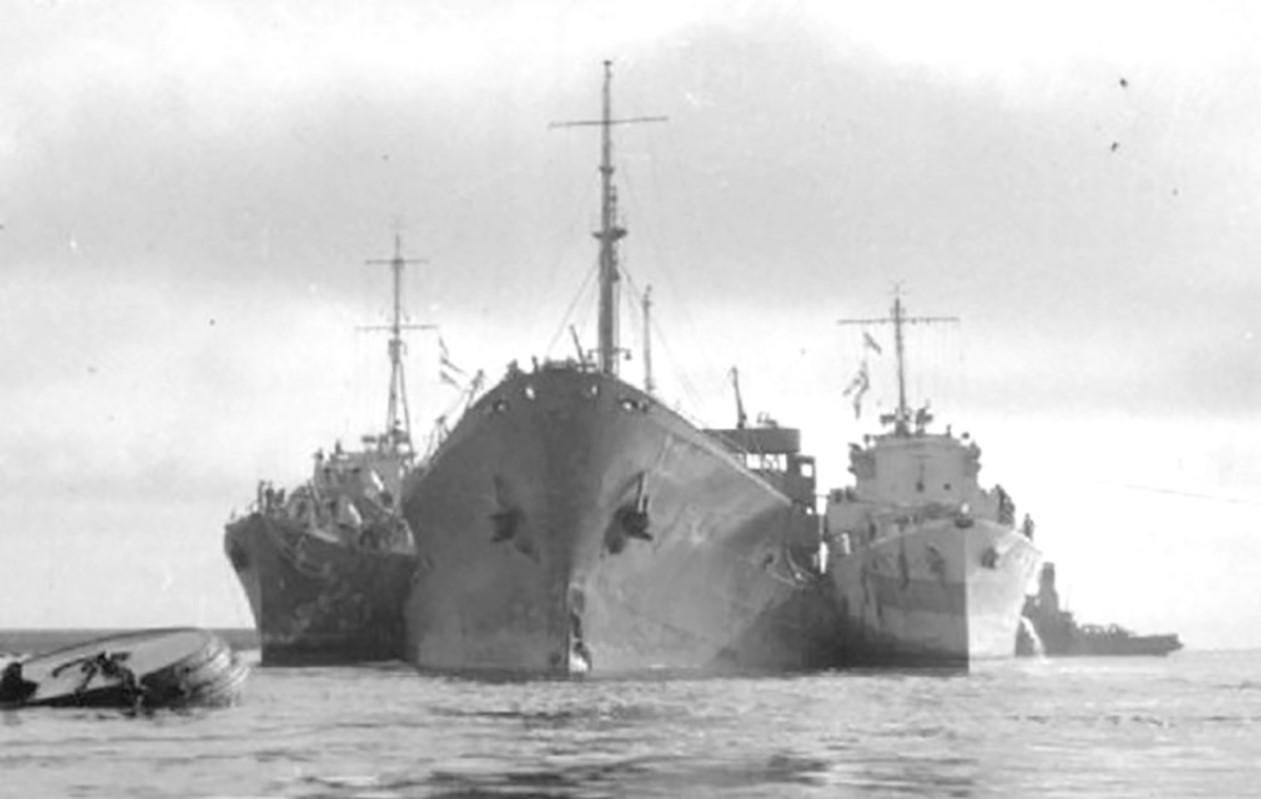
(Another view of Ohio entering the harbor. You can see how low it is in the water.)

Captain Mason stood at salute as the welcoming band played. Mason and his chief engineer were both badly burned and flown back to Britain for treatment. For his actions, Mason, a member of the British Merchant Navy, was awarded the George Cross, the highest British award for non-operational gallantry or gallantry not in the presence of an enemy and is considered the equivalent of the Victoria Cross, the highest military valour award. In addition, the crew of the Ohio received a Distinguished Service Order, five Distinguished Service Crosses, and seven Distinguished Service Medals. This is the text of Mason's award, after which he was granted a private audience with King George.
The KING has been graciously pleased to award the GEORGE CROSS to Captain Dudley William Mason, Master, SS Ohio. During the passage to Malta of an important convoy Captain Mason's ship suffered most violent onslaught. She was a focus of attack throughout and was torpedoed early one night. Although gravely damaged, her engines were kept going and the Master made a magnificent passage by hand-steering and without a compass. The ship's gunners helped to bring down one of the attacking aircraft. The vessel was hit again before morning, but though she did not sink, her engine room was wrecked. She was then towed. The unwieldy condition of the vessel and persistent enemy attacks made progress slow, and it was uncertain whether she would remain afloat. All next day progress somehow continued and the ship reached Malta after a further night at sea. The violence of the enemy could not deter the Master from his purpose. Throughout he showed skill and courage of the highest order and it was due to his determination that, in spite of the most persistent enemy opposition, the vessel, with her valuable cargo, eventually reached Malta and was safely berthed. (The award is dated 4th September, 1942.)
Along with the nine cargo ships, Britain lost one carrier and another damaged, two cruisers and one destroyer sunk and two cruisers damaged, along with 500 dead, but Malta was saved. In November the Allies landed in North Africa and the tide of the war in Europe changed.
-----------
(1) Leningrad was, by far, a more deadly siege with more than a third of the city's prewar population of more than 3 million perishing, most by starvation.

No comments:
Post a Comment