Showing posts with label Texas. Show all posts

Friday, January 30, 2026

A Turbulent Time


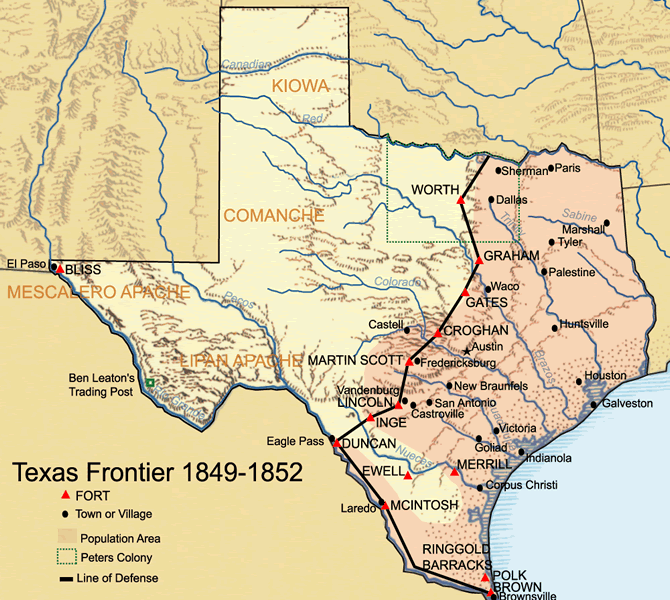
This map, from Texas Beyond History, a public education service of the Texas Archeological Research Laboratory (TARL) at the University of Texas at Austin, developed in collaboration with many other organizations, is useful in illustrating several aspects of Texas and American history. 

The map illustrates Texas near the end of a very turbulent period.(1) A new nation was born in 1836 when it established its independence from Mexico. Mexico's refusal to recognize Texas as independent and Texian expansionism led to Texas invading Mexico in 1841 and 1843 and two Mexican attacks on Texas in 1842 (see Yo, Adrian).  The second Mexican invasion triggered the bizarre episode of the Texas Archive War. A bankrupt Texas entered the United States in 1845, while the outcome of the Mexican War (1846-48) established the state's southern boundary on the Rio Grande (Mexico claimed it was the Nueces).  The Compromise of 1850 led to Texas relinquishing its claim to what is now New Mexico as far as the Rio Grande, which would have placed Santa Fe and Albuquerque in Texas.  You can read more about this episode at When Texas Invaded New Mexico. Meanwhile, the failure of the 1848 revolution in Germany resulted in a large migration of free-thinking Germans to Texas where most settled in the Hill Country west of Austin.

Though Texas was the largest state in the Union, most of its territory was dominated by Indians;  Comanche and, to a lesser extent, Apache.  The map shows the end point of a couple of centuries of fighting among the tribes.  The southern Great Plains had once been the home of the Navajo.  They were driven westward across the Rio Grande by the Apache.  In the early 1700s the Comanche (and their Kiowa allies) drifted south from Wyoming and pushed the Apache westward and southward.

It was the Comanche presence that caused newly independent Mexico to encourage Anglo settlement in Texas during the 1820s.  Mexico, and its predecessor Spain, had difficulty encouraging settlements from the Hispanic population and turned to the Americans to help form a protective barrier from Comanche raids.

The new nation of Texas still struggled against the Comanche, with one Indian raid in the early 1840s even reaching the Gulf Coast near Corpus Christi.  Along with its dire financial situation it was for protection from Mexico and from the Comanche that prompted the Texian agreement to enter the United States.  The result was the construction of the line of forts by the US Army as indicated on the map.

In areas of Texas, settlement extended beyond the defense lines.  This is a constant theme in American history.  It is the settlers who proceed the government, not the other way around.  In 1763 Britain attempted to establish a settlement line for its American colonies, but the effort failed as settlers moved on their own, in defiance of the government, into Kentucky and Tennessee.  After American independence, the pattern continued with westward expansion, settlers always outpacing the areas under direct government control, provoking conflict with Indians and triggering military intervention to restore the peace and protect the settlers.  You can read many military accounts from this era blaming settlers for most of the conflict.(2)  This was at a time when the U.S. government had little presence in everyday life, outside of local post offices, and maintained a very small military; its capacity a fraction of what we have become accustomed to over the past century.

Comanche raids continued for another twenty years.  In 2019 we visited the ancestral homestead of Lyndon Johnson in the Texas hill country and saw the home where LBJ's grandmother and aunt hid under the floorboards during an Indian raid around 1870.  

And those German immigrants in the Hill Country proved to be Unionists in 1861, leading to years of violent conflict with the Confederate government of Texas. 

-----------------------------------------------------

(1) Some would argue Texas has always been turbulent. 

(2) In any event it is difficult to see how any long-term coexistence with the raiding, nomadic Comanche could succeed, in contrast with the tribes in the southeast who adopted American ways and were still expelled. 


Saturday, December 3, 2022

The Crossing

Yesterday marked 190 years since Sam Houston crossed the Red River, entering Texas for the first time and ending his three-year self imposed exile among his Cherokee friends (with whom he had also lived for three years earlier in his life), after abruptly resigning as governor of Tennessee in 1829.

Houston is one of the most fascinating and instructive figures in American history during the period after the first generation of Founders and before the Civil War, emerging into the spotlight as a hero of the War of 1812 and protege of General Andrew Jackson and, in his last public act, resigning of governor of Texas after refusing to take an oath to the Confederacy in 1861, and during those decades embodying actions, principles, and beliefs that don't fit neatly into 20th and 21st century categories; that, indeed, seem baffling at times.  And not just today.  Reading Texas history of that era it is hard to find anyone who didn't either love or hate Houston.  There was no in between regarding the man.

Houston was governor of two states (Tennessee and Texas); Congressman from Tennessee; Senator from Texas; and President of the Republic of Texas.  Chronologically, Sam was an American citizen, an official citizen of Cherokee Nation (and his second wife was Cherokee), a citizen of Mexico, of the Republic of Texas, and finally, once again, an American.

A slave owner; the only Southern senator to vote against the Kansas-Nebraska Bill of 1854; opposing secession as Governor of Texas in 1861; and, in 1856, having the support of the most ardent abolitionist in the Senate (Charles Sumner of Massachusetts) if he chose to run for the Presidency.

A man who lived with the Cherokee for six years over the course of his life, spoke their language, became a member of the tribe, befriended those from many other tribes, representing the interests of those tribes in Washington, and who gave possibly the most impassioned speech heard on the Senate floor during the 19th century regarding the rights and humanity of the Indian tribes (1), yet whose political mentor and friend was Andrew Jackson, author of the most unjustified American government action against peaceful tribes.

It is the Jackson connection that looms over Houston's decision to go to Texas.  Sam had been in Washington earlier in 1832, lobbying on behalf of the tribes exiled to the Arkansas Territory.  It was during that trip that Houston, feeling he'd been insulted by Ohio congressman William Stanberry who'd accused him of graft regarding an Indian rations contract, upon encountering Stanberry on the street beat him with a hickory cane.  Houston was brought up on charges by the House, convicted, reprimanded and given a $500 fine, which he left D.C. without paying.  But before leaving he met with his friend, President Andrew Jackson.  The contents of their conversation is unknown but subject to much speculation, mostly around Jackson's interest in acquiring Texas for the United States.  Was Houston urged to go to Texas to pave the way for that acquisition?  We don't know for certain but some of Sam's actions four years later, during the Runaway Scrape, when Houston may have been luring the Mexican army into a confrontation with the American army just across the border in Louisiana, lend some credence to that idea.

I've written quite a number of posts on Houston which you can find here.

----------------------------------------------------------------------

(1)

"The honorable Senator from Indiana says in substance that God Almighty has condemned [the Indians], and made them an inferior race, that there is no use in doing anything for them. . .  Sir, it is idle to tell me that.  We have Indians on our western borders, whose civilization is not inferior to our own . . .  The Indian has a sense of justice, truth and honor that should find a responsive chord in every heart.  If the Indians on the frontier are barbarous  . . . who are we to blame for it?  They are robbed of the means of sustenance; and with hundreds and thousands of them starving on the frontier, hunger may prompt to such acts as prevent their perishing  . . .

We should be careful if it were with a power able to war with us; and it argues a degree of infinite meanness and indescribable degradation on our part to act differently with the Indians, who confide in our honor and justice, and who call the President their Great Father, and confide in him."

Sunday, September 11, 2022

Yo, Adrian

On this date, 180 years ago, the Mexican army occupied San Antonio for the second time in 1842.  Though it would be evicted several days later, the event is a reminder that even after the surrender of Santa Anna after the Battle of San Jacinto in 1836, Mexico refused to recognize the independence of Texas until 1848.

The hostility was mutual, with the Texian republic attempting invasions of Mexico on several occasions, as discussed in the post When Texas Invaded New Mexico.  The first Mexican invasion in 1842 triggered Texian suspicions of the Tejano population and led to Juan Seguin, a hero of the war for independence, to flee to Mexico as recounted in Juan Seguin Returns to the Alamo.   The invasion also led to the bizarre episode of the Texas Archive War.

The Mexican army general leading the occupation of September 11, 1842 was Adrian Woll, and his career exemplies the wandering and cross-national and cultural allegiances of many figures of that period like Sam Houston, who at various times was a citizen of the United States, the Cherokee Nation, Mexico, and the Republic of Texas.

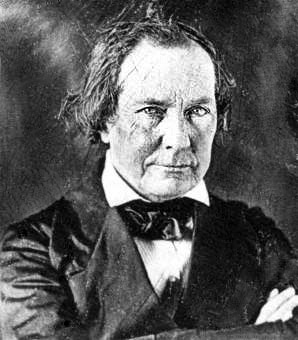
Portrait of Adrián Woll (Woll)

A native of France, where he was born in 1795, the young Woll served in Napoleon's army as part of the prestigious Imperial Guard.  After Waterloo and the Bourbon restoration, Wool sought his future and his fortune in the New World, arriving first in the United States where he had a letter of introduction to General Winfield Scott, then commander of the US Army in the northeast states.  Winfield advised Woll that there were great opportunities for someone like him in Mexico where its war for independence was underway.

Arriving in Mexico and using his past experience as an entry point (serving under Napoleon was a great asset), Woll rose quickly in the military, eventually joining the forces of General Antonio Lopez de Santa Anna.  After independence he became a Mexican citizen, appointed colonel in 1828 and brigadier general in 1832, assisting Santa Anna in suppressing internal rebellions.

When Santa Anna crossed the Rio Grande in February 1836 to suppress the rebellion in Texas, Woll served as quartermaster general, arriving in San Antonio two days after the fall of the Alamo.  Fortunately avoiding San Jacinto, where Santa Anna was defeated and captured, Wool was tasked by General Filisola, the senior Mexican commander, to seek an armistice with the Texians.

In 1842, Woll was appointed commander of the Department of Coahuila and ordered to invade Texas.  Seven days after occupying San Antonio, Woll's troops were defeated at the Battle of Salado Creek, and retreated across the Rio Grande.

Despite his defeat, Woll was hailed as a hero, promoted to Major General and given command of the Army of the North.  Amid the constant tumult of Mexican politics, in 1844 Woll joined a revolt against Santa Anna, was arrested and imprisoned and then freed the following year.

During the American invasion in the Mexican War, Wool served under Santa Anna once again, until Winfield Scott captured Mexico City, at which point Wool left for Europe, while Santa Anna, deposed once again, fled the country.  Five years later, Woll returned with Santa Anna, who seized power once again, only to be tossed out again a year later, and the general, once again, returned to Europe (Santa Anna ended up on Staten Island).

In the late 1850s, the peripatetic officer returned to Mexico and was reinstated as a general, this time defending the government of Miguel Miramon against the insurgency of Benito Juarez.  Though Wool was successful militarily, the Miramon government collapsed and Woll, like so many times before, returned to Europe.

The final sojourn of the occasional Mexican general occurred in 1863 when he returned to support Napoleon III's effort to installed the Archduke Ferdinand Maximilian of Austria as Emperor of Mexico.  Named as adjutant general of the occupation forces, Woll also became Maximilian's chief aide-de-camp.  In the fall of 1865, Maximilian dispatched Woll to France to meet with Napoleon to urge changes in the military support being provided.  Upon arriving in France, Woll discovered that, under pressure from the United States, Napoleon had decided to withdraw French troops from Mexico, leaving Maximilian on his own.  Woll decided that his best course of action was to finally stay put in France, where he died in 1875.  Maximilian, determined to establish his reign as Emperor stayed in Mexico, where his army was defeated and he was captured and executed in 1867.

Tuesday, May 3, 2022

. . . and Rereading

As I've grown older the ratio of my rereading to reading books for the first time has increased, partially due to the fact I've already read a lot of books, and partially from the realization I usually get great joy (and only occasional disappointments) from rereading.  Because I've usually read other related materials since my original read, rereading tends to give me more insight and see more connections, and sometimes reveals flaws I had not recognized the first time around.  The passage of time can also result in the rereading having a different impact.  I first read the Lords Of The Rings trilogy as a teenager and then reread it at the age of 50 when the movies were released.  Both times I recognized it as a monumental achievement, but the sections that emotionally resonated with me the most at 50 were often different from those when I was much younger.

Here's some of the rereading I've been up to more recently.

Fiction

During the first year of Covid, I decided to read for a second time the twenty volume series by Patrick O'Brian, the Aubrey-Maturin novels, of which the first is Master and Commander (also the title of the splendid movie adaptation of the novels and main characters; Russell Crowe is the embodiment of Lucky Jack Aubrey, Paul Bettany less so as Dr Stephen Maturin).  Introduced to the novels thirty years ago by a friend, I quickly read the first 10 or 12 and then waited each year for the next volume up until the time of O'Brian's death in 2000.  This time I read the entire series within six months which gave me a different perspective and better sense of the flow of the story.  This is simply the best set of historical novels I've ever read.  It is as though O'Brian is writing them in the early 1800s; his treatment is consistent, not giving an inch to modern ideas or thoughts.  These characters exist fully in their time. I plan on a third go round in 2030.

Nero Wolfe, the massive, sedentary detective, who rarely left his Manhattan brownstone in the course of solving crimes with the assistance of his mobile staff, including Archie Goodwin, who narrates the tales created by author Rex Stout, was a favorite of mine as a teenager.  This time I picked up The Black Mountain, an anomaly in the series, as Wolfe reluctantly leaves home to return to his native Montenegro to bring a miscreant to justice.

In the late 1970s and into the 1980s, Bruce Chatwin wrote a series of sometimes fact-based but semi-hallucinatory books including The Songlines, about aboriginal Australians, and The Viceroy of Ouidh, about Brazilian slave traders in Dahomey (both of which I recommend).  On The Black Hill is the complete opposite; set in one place in the English borderlands of Wales, it tells of the life of two farming brothers and not a lot happens, at least on the surface.  A beautifully written tale about harsh lives relieved by rare transcendent moments.

A while ago I also reread six Philip Marlowe novels by Raymond Chandler, written between 1939 and 1953, the first of which is The Big Sleep, a great read though I still don't understand the plot.  Doesn't make a difference as you read Chandler for his writing and Marlowe's dialogue, which inspired this THC post.

I'm currently making my way through The Rumpole Omnibus.  Horace Rumpole, or Rumple of the Bailey, was the creation of English barrister John Mortimer, who followed his adventures, love of poetry, puns, and the law, and the encounters with his wife, She Who Must Be Obeyed, through several books in the 1970s and 80s.  It's like revisiting an old friend.  Immortalized by Leo McKern in the BBC adaptation.

Non-Fiction

In 1828, young Crauford Tait Ramage, then tutor of the sons of the British Consul in Naples, set off on a solo two month walking tour of southern Italy.  His account, published forty years later as The Nooks and By-Ways of Italy was edited and reissued in 1987 as Ramage In South Italy, which I first read in the 90s and reread last year.  The Italy Ramage toured was little-known, even to many on the peninsula, the towns and villages desperately poor and isolated, many still perched on hills back from the coast because a mere thirty years had passed since the thousand year threat from Saracen slave raiders had finally abated.  I love travel literature like this, which I quoted from in a 2013 post on Paestum, and that written by the likes of Patrick Leigh Fermor, Negley Farson, and Eric Newby.

A recent conversation with a friend about the truth and myth surrounding the Alamo led me to reread a slim volume by North Carolina State history prof and Texan native James Crisp, Sleuthing The Alamo.  What I wrote about the book in 2014 in Part 2 of my Remember (My Visit To) The Alamo series still holds:

Sleuthing The Alamo is an outstanding way to learn about how historians do their job.  Crisp takes the controversy around Crockett's death along with an alleged racist speech by Sam Houston and brings you along for the ride as he traces the origins of various stories and documents, going back to the primary sources to get to the truth.  It's a short, but very illuminating book written in an engaging personal and non-academic style.

Crisp also draws on his personal history to illuminate the role race and ethnicity play in how the Alamo is remembered in different ways since 1836. 

A brief passage in Hampton Sides, Blood and Thunder: The Epic Story of Kit Carson and the Conquest of the American Southwest inspired my investigation into, and long post on, Henry Lafayette Dodge.  Now that I've spent a few years living in the Southwest a rereading seemed timely and I drew even more from the book the second time around.  My original reading and move to Arizona prompted me to other read works which have enriched my understanding of the region, its history, and its peoples, including The Spanish Frontier in North America and The Mexican Frontier 1821-46, both by David Weber, No Settlement No Conquest by Richard Flint, the story of Coronado's expedition of 1540-42, and The Apache Wars by Paul Hutton.

In 1938, the Central Committee of the Communist Party of the Soviet Union issued what became known as the Short Course, a history of communism and the Bolshevik Party, for use in the Soviet educational system.  The editor in chief of the Short Course was Josef Stalin.  In that regard Martin Amis' 2001 book, Koba the Dread (Koba was Stalin's nickname back in his Georgian youth), can be read as his Short Course history on the rule of Lenin and Stalin from 1917 to 1953.  Lengthier books like The Gulag Archipelago and the novel Life and Fate provide much more detail and insight into that regime, but my recent rereading of Koba leads me to believe it is not a bad starting place; it's like reading Lenin and Stalin's Greatest Hits, except it's recounting a horror show.  Along the way, Amis wrestles with his father's earlier infatuation with communism and his good friend Christopher Hitchen's remaining faith in Trotsky and Lenin (which he eventually backed away from).

Koba, along with two other relatively short books, can be used to describe why the Soviet Union failed.  Koba covers the mass murder phase from the Bolshevik counter-revolution in 1917 to Stalin's death in 1953.  Red Plenty by Francis Spufford, one of the oddest and memorable books I've ever read, explains how the post-Stalin era with its optimism that a completely planned economy could succeed, came crashing down in failure by 1970, while Russia and the Idea of the West by Robert English explains how a new generation of communists, including Mikhail Gorbachev, realized how desperately behind the Soviet Union was compared to the West, and how their own country was responsible for starting the Cold War.

Thursday, April 7, 2022

Traces Of Texas

I like websites with old photos like Shorpy and Babel Colour.  Here's another one, Traces of Texas.  Old photos with good commentary of Texas people and locations over the years.


Thursday, September 30, 2021

The Texas Archive War

Mrs. Eberly fires off cannon

A few cannon shots over a dispute about which town will house some files?  Welcome to Texas history.

From the Revolution of 1836, through its time as a Republic teetering on the edge of bankruptcy, to its first stint as a state (1845-61) it was a wild ride.  THC has posted on the Alamo, the invasion of Nuevo Mexico and the threatened invasion of New Mexico and, of course, Sam Houston, who towered over every other figure in this period, loved or hated by every Texan.

Like so many other events of those times, the Archive War revolved around Sam Houston who was, at the time, President of the Republic of Texas.  First elected president from 1836 to 1838, Houston could not run for a second term under the Texas Constitution, which also provided for three years terms after 1838.  Next up was as president was Mirabeau Lamar, a fierce opponent of Houston; while they greatly differed on policy, particularly towards Mexico and the Indians, Houston's personality also had a significant polarizing impact on Texas politics and factional infighting.  In December 1841, Houston returned as president.

Mexico had never recognized Texan independence and in 1842 launched two invasions of the republic, occupying San Antonio both times along with some towns on the Gulf coast, but eventually withdrawing.  However, the invasions created a panic in the western and central parts of Texas, including its capital Austin.  Sam Houston, who disliked Austin and preferred Houston, founded in 1837 and, of course, named after him, as the capital of the republic, saw an opportunity.

Houston often referred to Austin as "the most unfortunate site on earth for a seat of government", refused to move into the presidential "mansion", a small one story log house, instead taking a room at the boarding house of Mrs Angelina Eberly.

In the wake of the first Mexican invasion in early 1842, Houston called a special session of congress in Houston, arguing that Austin was defenseless, and ordered his Secretary of State to move the Republic's archives to Houston, though no action was taken at the time.  Austin residents formed a Committee of Safety, warning Houston that any attempt to remove the archives would be resisted.  

After the second invasion in September 1842, Houston called a special session at Washington-on-the-Brazos (about halfway between Austin and Houston), the town where Texian independence had been declared in 1836.  Houston's proposal to move the capital to Washington was defeated by one vote, but he nonetheless moved agencies out of Austin to Washington and then, in December 1842, Sam declared Houston the temporary capital and sent a squad of rangers, under Colonel Thomas Smith and Captain Eli Chandler, to Austin to remove the archives.

On December 30, 1842, the rangers managed to load three wagons with the archives before boarding house owner Mrs Eberly noticed them, ran to a cannon kept loaded to alert residents of Indian raids, and fired it (depicted above), alerting the town.  The Committee of Safety organized a pursuit of the wagons, taking with it a cannon from the town arsenal, finally catching up with them at Brushy Creek, north of Austin. The rangers had not expected a pursuit and after a cannon shot surrendered and were escorted back to Austin where the archives were restored to their rightful home.

No one was hurt in the making of this war.

Austin was named temporary capital in 1845 when Texas was admitted to the Union, a location which became permanent after a referendum in 1850.


Monday, March 9, 2020

How Did Davy Die?

Three days ago marked the 184th anniversary of the fall of the Alamo in San Antonio.  This is a reworking of a post from several years ago . . .

James Bowie, William Travis and David Crockett ascended into legend with their deaths at the Alamo on March 6, 1836. We have a pretty good idea how the first two perished. Bowie, immobilized and delirious, likely with typhoid fever, was killed in his bed while Travis was shot in the head early in the fight while directing fire from a cannon on the north wall. But what about Crockett, who in 1836 was the only nationally known figure at the Alamo?
http://upload.wikimedia.org/wikipedia/commons/8/89/David_Crockett.jpg(David Crockett; Wikipedia)
David Crockett (he called himself David, not Davy) rode into San Antonio on February 8 as a former three term U.S. Congressman from Tennessee, who after being defeated in the last election declared “You can all go to Hell, I’m going to Texas” and set out to establish a new life. On his ride he was joined by about 30 friends and adventurers. Arriving after the revolution began, and finding land grants available for those joining the rebel forces, he and his compatriots quickly signed up.

Crockett though, was more than just a former Congressman. He was the first popular folk character from America’s west, and its most nationally known figure, other than Andrew Jackson.  David Crockett, born poor, a frontiersman, hunter and scout went into politics, initially as an ally of Jackson, and later as his fierce opponent over the distribution of federal lands and removal of the “civilized” Indian tribes from the southeast, a policy Crockett opposed, being the only Congressman in the southeast to vote against the funding measure (an opposition shown in the Disney series), and about which he wrote, “I believe it was a wicked, unjust measure“.

The character Davy Crockett, arriving in Washington in 1827, quickly became known for his entertaining storytelling and anecdotes and was converted into a figure of popular entertainment around whom myths and legends grew. Many plays were staged with Davy or a thinly disguised version of him as the centerpiece, the most popular of which, Lion Of The West, premiered in New York City. From 1835 through 1841 Davy Crockett’s Almanack was published and in 1834 Crockett added to his renown with the publication of A Narrative Of The Life Of David Crockett, Written By Himself which became a best seller and sparked a nationwide speaking tour (Crockett was particularly popular in New England).http://blog.nyhistory.org/wp-content/uploads/2012/06/Crockett_1837_32.jpg(From NY Historical Society)

Of Crockett’s actions during the siege, which began on February 23, we have little information; on the 25th Travis noted in a message to Sam Houston “The Hon. David Crockett was seen at all points, animating the men to do their duty“, and Susannah Dickinson remembered Crockett playing his fiddle to entertain the garrison. Did Crockett, by rank only a private, play a significant role in planning the defense and leading the men during the siege? It is impossible to know but the very limited evidence is suggestive since after the first two days Bowie was incapacitated with fever and Crockett a famous and popular figure two decades older than Travis.

Our best information, from early in the siege, is Crockett and his men were stationed behind a hastily erected wooden palisade fence that ran at an angle from the southwest corner of the Alamo mission church to the start of the south wall, making it a particularly vulnerable spot if attacked. In the darkness of early morning on March 6 the Mexican assault breached the north and south walls first and then swept across the open plaza as some of the surviving Texians retreated into the Long Barracks. The last rebels left out in the open would likely have been Crockett and his men near the church. Did they die fighting by the palisade? Did some try to seek refuge in the church? Had they moved their post by then? Or were Crockett and some of his men among the up to 60 Texians who may have tried to escape by going over the walls near the palisade only to be cut down on the open prairie by the mounted Mexican lancers waiting for them?
(The palisade at which Crockett and his men were stationed started at the right side – from the viewer perspective – of the Alamo mission church)

What are our sources for the end of the Alamo? There are several Mexican ones, of which more below. We also have accounts of various riders sent out with messages from the Alamo before March 3 and the stories of the few civilian survivors spared by Santa Ana, the most prominent of which were Joe, William Travis’ slave, and Susannah Dickinson, wife of one of the defenders. Joe was with Travis until he was killed then going into the church, joining Dickinson. Both Joe and Dickinson reported seeing Crockett’s body near the church, surrounded by dead Mexican soldiers, as they were being escorted out after the fighting ended. It remains unclear how long after the fighting ended this occurred, but their observations are consistent both with Crockett dying in combat or being executed at the end of the battle.

After that it gets murkier. The best account I’ve found is Sleuthing The Alamo by James E Crisp, a professor of history at North Carolina State University (and Texas native). Sleuthing The Alamo is an outstanding way to learn about how historians do their job. Crisp takes the controversy around Crockett’s death along with an alleged racist speech (which turned out not to be) by Sam Houston and brings you along for the ride as he traces the origins of various stories and documents, going back to the primary sources to get as near to the truth as possible. It’s a short, very illuminating book, written in an engaging personal and non-academic style.

After the fall of the Alamo various stories were quickly in circulation about the fate of Crockett, with some newspapers reporting he went down fighting, others claiming Davy was captured and executed, and a couple even reporting his escape!

There were two other events giving these reports some context.
  • On March 27 the Mexican army massacred about 350 Texians at the coastal town of Goliad. These soldiers had surrendered a few days earlier under a promise of clemency. The local Mexican commander, General Urrea, protested vigorously against the execution order from Santa Anna, who sent an officer from San Antonio to oversee the killing.
  • At San Jacinto on April 21, 1836 Sam Houston defeated a detachment of the Mexican army capturing several hundred men, including Santa Anna and other senior commanders, most of whom were imprisoned on Galveston Island until their return to Mexico.
As early as March 11 news reached the Texian army in Gonzales about the end at the Alamo. On that same day Sam Houston wrote a letter stating “After the fort was carried, seven men surrendered and called for Santa Anna and quarter. They were murdered by his order.“

The June 9, 1836 edition of the New York Courier and Enquirer carried a letter from a correspondent in Galveston Bay who purported to convey an account from an eye witness:
After the Mexicans had got possession of the Alamo, the fighting had ceased, and it was clear day light, six Americans were discovered near the wall yet unconquered, and who were instantly surrounded and ordered by General Castrillon [a senior Mexican commander] to surrender, and who did so under a promise of his protection, finding resistance any longer in vain – indeed, perfect madness – Castrillon was brave and not cruel, and disposed to save them. He marched them up to that part of the fort where stood “his Excellency” [Santa Anna] . . . David Crockett was one of the six. The steady fearless step and undaunted tread, together with the bold demeanor of this hardy veteran -“his firmness and noble bearing“, to give the words of the narrator, had a most powerful effect on himself and Castrillon . . . Castrillon addressed “his Excellency” – “Sir, here are six prisoners I have taken alive; how shall I dispose of them?” Santa Anna looked at Castrillon fiercely, flew into a most violent rage, and replied “Have I not told you before how to dispose of them? Why do you bring them to me?” At the same time his brave officers drew and plunged their swords into the bosoms of their defenceless prisoners!!
Sergeant George Dolson served as an interpreter with the Texian army on Galveston Island. On July 18, his superior officer asked him to attend the deposition of an unnamed Mexican officer. The next day he wrote a letter to his brother in Michigan in which he described what happened, published by the Detroit Democratic Free Press in September (though no written record of the deposition has been found). Dolson wrote of the Mexican officer:
He states that on the morning the Alamo was captured, between the hours of five and six o’clock, General Castrillon, who fell at the battle of San Jacinto, entered the back room of the Alamo, and there found Crockett and five other Americans, who had defended it until defence was useless. They appeared very much agitated when the Mexican soldiers undertook to rush in after their General, but the humane General ordered his men to keep out, and, placing his hand on one breast, said “here is a hand and a heart to protect you; come with me to the General-in-Chief, and you shall be saved.” . . . The brave but unfortunate men were marched to the tent of Santa Anna. Colonel Crockett was in the rear, had his arms folded, and appeared bold as the lion as he passed my informant. Santa Anna’s interpreter knew Colonel Crockett, and said to my informant, “the one behind is the famous Crockett“. When brought in the presence of Santa Anna, Castrillon said to him, “Santa Anna, the august, I deliver up to you six brave prisoners of war.” Santa Anna replied, “who has given you orders to take prisoners, I do not want to see those men living – shoot them.” As the monster uttered these words each officer turned his face the other way, and the hellhounds of the tyrant dispatched the six in his presence, and within six feet of his person.
These stories of survivors being executed after the battle are also consistent with an account published in Mexico City in 1837 by Ramon Martinez Caro, Santa Anna’s personal secretary during the Texas campaign (though it does not mention Crockett):
Among the 183 killed there were five who were discovered by General Castrillon hiding after the assault. He took them immediately to the presence of His Excellency who had come up by this time. When he presented the prisoners he was severely reprimanded for not having killed them on the spot, after which [Santa Anna] turned his back upon Castrillon while the soldiers stepped out of their ranks and set upon the prisoners until they were killed . . . We all witnessed this outrage which humanity condemns but which was committed as described. This is a cruel truth, but I cannot omit it.
Caro had been imprisoned at Galveston. Could he have been the source for the Dolson letter?
Throughout the rest of the century and into the middle of the 20th there continued to be parallel stories of Crockett going down fighting, alongside those those of his being executed. The giant 1905 painting in the Texas Capital shows him swinging a musket as the Mexican soldiers closed in. At http://www.latinamericanstudies.org/alamo/crockett-alamo.jpgnearly the same time Teddy Roosevelt described Crockett’s last minutes in his 1895 book, Hero Tales From American History (as quoted in Crisp’s book):
. . . the last man stood at bay. It was old Davy Crockett. Wounded in a dozen places, he faced his foes with his back to the wall, ringed around by the bodies of the men he had slain. So desperate was the fight he waged, that the Mexicans who thronged round him were beaten back for the moment, and no one dared to run in upon him. Accordingly . . . the musketeers loaded their carbines and shot him down. Santa Anna declined to give him mercy. Some say that when Crockett fell from his wounds, he was taken alive, and was then shot by Santa Anna’s order; but his fate cannot be told with certainty, for not a single American was left alive.
And, as late as 1934 the frontispiece of the popular book The Adventures of Davy Crockett was a painting of a bound Crockett being brought to Santa Anna (below).
In 1955 two events happened that transformed the Crockett story. One had an immediate impact; the other was a time bomb that would detonate two decades later.

The first was the broadcast of Walt Disney’s three part series, Davy Crockett: King Of The Wild Frontier which transfixed the American public, including 4-year old Gumby Mark. The series ended with Davy fighting to the end against the Mexican attackers. Disney established an indelible image in our minds of an heroic Davy who would never surrender, and it was an image we liked.

The second was the publication in Mexico City of the diary of Jose Enrique de la Pena by Jesus Sanchez Garza. De la Pena (1807-40), a Colonel in the Mexican army, was present at the Alamo. How the diary (or more properly an account based upon diary entries) came into Garza’s hands has never been determined. The publication received little notice in the United States at the time, but controversy about it exploded in 1975 when an English translation by Carmen Perry was published. I’ve read the 1997 edition of the translation with an introduction by Professor Crisp, published as With Santa Anna In Texas.

Before discussing de la Pena, there was another Mexican memoir first published in 1966. Lieutenant Colonel Jose Juan Sanchez Navarro briefly mentions the attack: “by six-thirty in the morning not a single enemy existed . . . some cruelties horrified me among them the death of an oldster whom they called Cocran“. While there was a Texian defender named Robert Cochran he was only twenty six years old. Could Navarro have been referring to Crockett who would have turned 50 that year and was one of the oldest Texians in the Alamo?

And what does de la Pena have to say?
Some seven men had survived the general carnage and, under the protection of General Castrillon, they were brought before Santa Ana. Among them was one of great stature, well proportioned, with regular features, in whose face there was the imprint of adversity, but in whom one also noticed a degree of resignation and nobility that did him honor. He was the naturalist David Croket, well known in North America for his unusual adventures, who had undertaken to explore the country and who finding himself in Bejar at the very moment of surprise, had taken refuge in the Alamo, fearing that his status as a foreigner might not be respected. Santa Anna answered Castrillon’s intervention with a gesture of indignation and, addressing himself to the sappers, the troops closest to him, ordered that they shoot them. The commanders and officers were outraged at this action and did not support the order, hoping that once the fury of the moment had blown over these men would be spared; but several officers who were around the president and who, perhaps, had not been present during the moment of danger, became noteworthy by an infamous deed, surpassing the soldiers in cruelty.They thrust themselves forward, in order to flatter their commander, and with swords in hand, fell upon these unfortunate, defenseless men just as a tiger leaps upon his prey. Though tortured before they were killed, these unfortunates died without complaining and without humiliating themselves before their torturers. It was rumored that General Sesma was one of them; I will not bear witness to this, for though present, I turned away horrified in order not to witness such a barbarous scene. . . I confess that the very memory of it makes me tremble and that my ear can still hear the penetrating, doleful sound of the victims.
Close-up of the top of the José Enrique de la Peña Narrative Top(Section of the de la Pena manuscript mentioning “Croket” in fifth line)

The 1975 publication found fertile ground in the turmoil of that decade, setting off heated debate between revisionist historians, who delightedly took it as proof the beloved hero was a sniveling coward and used the diary’s claims as part of a more general attack on American values and traditions, and those who insisted that an American hero like Crockett would have fought to the death rather than surrender and de la Pena’s claims must therefore be fraudulent. The debate over the legitimacy of the diary and of de la Pena’s writings about Crockett continues to this day, though it probably peaked in the 1990s.

Taking the account on its face, why would de la Pena, who by 1837 was in prison, write it? The edition I read is about 190 pages of which less than one page contains the Crockett account and the entire siege and attack is covered in just twelve pages. It was intended as a denunciation of Santa Anna and some of his senior commanders who, in de la Pena’s view, neglected the welfare of their soldiers and conducted a strategically foolish campaign resulting in the loss of Texas. The very reason he was in jail was for participating in a failed rebellion against Santa Anna’s government.

His introduction reveals to us an angry and anguished young man:
. . . the accumulation of lies told to falsify the events, . . . the ignorance, stupidity, and cruelty displayed by the ministry and the commander in chief in this war . . . the honor and self-esteem of every military man who participated, so deeply hurt by the great inaccuracies in official records as to dates, deeds and places; and above all the honor of the country, deeply compromised by its leaders and no less by the truth and the atrocity of its crimes – these are the principal causes which compelled me to publish the diary . . .
The infamies that have occurred in this campaign, infamies that must have horrified the civilized world and whose memory will continue to provoke pain for many years hence, should not remain hidden. In referring to them, I shall thrust aside my personal feelings, and my friends will cease to be friends from the moment that I publish the evils committed against my country and the deeps perpetrated against humanity.
De la Pena is scathing about the lack of preparation for the march into Texas and Santa Anna’s strategy of dividing his army instead of concentrating it for an advance up the coast, but his anger reaches a fever pitch when writing of what he, and other officers, believed was a completely unnecessary attack on the Alamo (he claims Mexican commanders had information that Travis would have surrendered if no relief came from Houston’s army within the next two days), leaving many soldiers dead and hundreds wounded and suffering terribly without any medical treatment because of Santa Anna’s failure to bring doctors and medical supplies with the army.

Above all, he was horrified by the killing of the Alamo survivors and the massacre at Goliad, a horror shared by many other officers. De la Pena believed it a criminal act dishonoring the army and also counterproductive, inciting even more resistance by Texian rebels who knew their only alternatives were to win or die. A Mexican patriot who condemned the Texas rebellion and believed it could have been defeated, de la Pena also refers frequently to the bravery of the rebels and their fair and honorable treatment of Mexican prisoners. From his perspective the purpose of telling the tale of the death of Crockett and his fellow survivors was to show the despicable Santa Anna, and his description of their deaths is followed with this lament:
To whom was this sacrifice useful and what advantage was derived by increasing the number of victims? It was paid for dearly, though it could have been otherwise had these men been required to walk across the floor carpeted with the bodies over which we stepped, had they been rehabilitated generously and required to communicate to their comrades the fate that awaited them if they did not desist from their unjust cause. They could have informed their comrades of the force and resources that the enemy had.
Jose Enrique de la Pena died in 1840 at the age of 33 before he could publish his broadside about the loss of Texas. Santa Anna (1794-1876) was president of Mexico eleven different times from 1833 through 1855 during which he lost not only Texas, but the entire northern territory of his country to the United States during the Mexican War (1846-8) and living, during one of his many periods of exile on Staten Island in New York.

Some of those who contesting the authenticity of the de la Pena papers have raised valid points (you can get a sense of the back and forth by reading this). One of the most instructive lessons for me has been about the limitations of relying on translations of materials originally written in other languages. It turns out that several points of apparent contradiction in the English version of de la Pena’s work disappear when one goes back to the original Spanish, and that a previously unknown document written by de la Pena and located at Yale University in 1994 provides additional corroboration for his story. While I do not think the question has been, or ever will be, completely resolved (for instance, de la Pena’s account of the death of Travis is inconsistent with other evidence) my judgement is that, on balance, the evidence favors the authenticity of the diary and of de la Pena’s account of the Alamo. While we will never know for certain the exact circumstances it is likely that David Crockett was among those executed at the end of the battle, though Davy Crockett still lives on.

As for me, I like to think of Crockett’s end being as portrayed in the underrated 2004 movie, The Alamo. That’s my version of Davy.

Tuesday, October 23, 2018

Texas In The Beginning

In 1837 this was the first Executive Mansion of the Republic of Texas, home of its first President, Sam Houston.  For more on Houston read Sam Houston: The Raven.  Photo from the Texas State Library & Archives Commission.

The "Executive Mansion, 1837-38

Saturday, November 18, 2017

When Texas Invaded New Mexico

Yes, it happened and eventually got to the point where an American president threatened to use U.S. troops against Texas.

It started with the Texas War of Independence in 1836, at the end of which the Republic of Texas became a nation and the Mexican army withdrew (for more on the war, read Remember (My Visit To) The Alamo! series, and Sam Houston: The Raven).  The treaty signed by Santa Anna left the boundaries of Texas ill-defined and the refusal of Mexico, after Santa Anna's removal from office, to ratify the treaty and recognize Texas as an independent nation created an unstable situation where Texas was both expansionist and constantly worried about the prospects of another Mexican invasion.

Most Texians asserted that their country's western boundary extended to the Rio Grande and encompassed all of present day New Mexico and Colorado east of that river.

(From wikipedia)


Initially the situation was contained by the Republic's first President, Sam Houston, who did not press boundary issues and followed a policy of reconciliation with Mexico as well as with the powerful Indian tribes in the area.  Limited to one term by the Republic's constitution, Houston was succeeded in December 1838 by Mirabeau Lamar who was elected to a three year term.  Lamar's policy was of aggressive expansion, hostility to Mexico, and undertaking of punitive expeditions against the tribes, prompting retaliation against settlers.

All of this was against a confusing situation in the new nation of Mexico, which had achieved independence from Spain in 1821.  Although its 1824 Constitution was federalist, the instability, and frequent turnover of governments in Mexico City, along with the ascension of centralizers, like Santa Ana, led to unrest in many parts of the country and, in particular, in the northern border territories and states.  California, Sonora, and New Mexico all saw revolts in the 1830s.  In January 1840 Federalist leaders in Nuevo Leon, Coahuila, and Tamaulipas, meeting in Laredo, declared independence and the creation of the Republic of the Rio Grande.  Although the central government soon suppressed the rebellion its leaders fled into Texas from which they launched another unsuccessful revolt.  Though Texas remained officially neutral, it did provide support to the Yucatan in its war for independence from 1840 to 1846.

Texas itself was a ramshackle country; the national government was broke and civil organization minimal at any level.  The entire western half of the country was off limits to Anglo settlers because of the Comanche threat and, on occasion, the Comanche raided deep into Texas.  In 1840 a late raid actually reached the Gulf Coast mid-way between Corpus Christi and Houston.  

That same year Lamar appointed three Texians living in Santa Fe as commissioners and sent them a letter they could use to invite the people of Neuvo Mexico, then part of Mexico, to join the Republic of Texas.  The overture was not successful and the following year, Lamar decided to send an expedition to Santa Fe, despite the opposition of the Texas Congress.  The expedition was to be initially presented to New Mexico authorities as for the purpose of commerce but its real purpose was to seize control of the lucrative trade of the Santa Fe Trail and to annex New Mexico.  Lamar's deception was fairly obvious as the "trading" expedition was accompanied by five companies of infantry and one of artillery under the command of General Hugh McLeod, a West Point graduate.

(Mirabeau Lamar, from wikipedia)
https://upload.wikimedia.org/wikipedia/commons/2/27/Mirabeaulamar_2.jpg

Three hundred and twenty one men set out from Austin in June 1841.  They had little knowledge of the route to Santa Fe, at one point mistaking the Wichita River for the Red River and following it in the wrong direction for twelve days.  Food supplies ran low and they lacked sufficient water.  One attack by Kiowas killed five soldiers, while another attack resulted in the expedition losing all its cattle and a large number of horses.  These troubles were exacerbated by the desertion of their two Mexican guides who made way to Taos where they warned Governor Manual Armijo of the approaching Texians.

Armijo quickly mobilized more than 1,000 soldiers and advanced east, surrounding the main body of hungry, weary and thirsty Texians near Tucumcari.  McLeod and his men surrendered on October 5, without firing a shot.  Over the next ten weeks the prisoners were marched to El Paso, then to Mexico City, and finally imprisoned in Veracruz.

Lamar's tenure, which ended in December 1841 was a disaster between the failure of his Mexico policy, the wars caused by his Indian policy and the decrepit finances of the Republic.  After annexation, Lamar served in the state legislature and was appointed by President Buchanan as minister to Nicaragua and later Costa Rica before dying in 1859.
http://images.slideplayer.com/30/9553297/slides/slide_24.jpg

The US minister to Mexico intervened on behalf of the prisoners and was able to obtain their release in April 1842.  After his release, Hugh McLeod served in the Texas legislature and married a cousin of Mirabeau Lamar.  A fierce opponent of Sam Houston (for a quarter century Texas politics was about whether you were for or against Houston) McLeod joined the Confederacy, serving as colonel in Hood's Texas Brigade before dying of pneumonia in Virginia in early 1862.

In the meantime tensions between Mexico and Texas exploded.  In March 1842, Mexican troops occupied Goliad, Victoria, and San Antonio causing panic across Texas.  Though the occupation forces soon retreated, San Antonio was reoccupied by the Mexicans for several days in September.   Sam Houston, reelected president in December 1841, order a punitive expedition towards the Rio Grande, apparently more to appease Texian public opinion than to engage in pitched battles.  After capturing Laredo the expedition's commander ordered a retreat but more than 300 Texians refused and, under the leadership of political opponents of Houston, decided to cross the Rio Grande.  They were defeated in a battle near the town of Meir with thirty killed and the rest captured.

While being marched to Mexico City, the Texians made a mass escape eluding capture for seven days.  An enraged Santa Anna (president, once again) ordered their execution.  The Governor of the state of Coahuila refused to obey the order which was finally modified to require the execution of every tenth man, to be determined by the drawing of lots.  On March 25, 1843 seventeen of the prisoners were shot.  Many of the survivors died in prison while others were released from time to time, with the last obtaining their freedom in September 1844.

Meanwhile, Texas made two additional attacks on Nuevo Mexico in 1843.  Charles Warfield, fur trapper and Texas army officer, led 24 men in a retaliatory campaign, attempting to seize Mora, New Mexico (northeast of Santa Fe).  Driven off, his band later murdered Mexican trader Antonio Jose Chavez, on the Santa Fe Trail.

This was followed in the same year by an expedition of 200 men led by James Snively, quartermaster of the Texas army, to attack Mexican merchants on the Santa Fe Trail and, if possible, seize the town.  In June, Snively's band defeated a unit of Mexican soldiers. However, their was broad dissatisfaction with Snively among his men and the command voted to divide itself.  Several days later Snively's command unexpectedly encountered a troop U.S. Army Dragoons under Capt Philip St George Cooke which had been sent to protect Mexican caravans on the trail after the killing of Chavez.  Cooke informed Snively he was on American territory  Though Snively protested he was on Texas territory, Cooke surrounded the Texan camp and disarmed the men, ending the expedition.

Phil Cooke was a noted Indian fighter, and served under George McClellan was a cavalry commander during the Peninsula Campaign in 1862.  He was removed and sent to non-combat posts, in part because of the army's humiliation when Cooke's son-in-law, Jeb Stuart led his cavalry command on a successful ride around the entire Union Army.   You can still buy Cooke's memoirs on Amazon:
https://images-na.ssl-images-amazon.com/images/I/51eTycb91oL._SY445_QL70_.jpg

Snively went on to join the California Gold Rush in 1849, moving on to the Arizona Territory in 1858 where he played a role in organizing Yuma County while continuing to prospect.  He eventually settled in the Phoenix area and was killed by Apaches while exploring near Wickenburg, Arizona in 1871.

In 1845, Texas agreed to be annexed by the United States but it was not the end of its aspirations to expand its border westwards.  The following year General Philip Kearny seized Nuevo Mexico which became part of the United States with the end of the Mexican War in 1848.  Texas continued to assert that its western boundary was on the Rio Grande, actually sending a commission to organize Santa Fe County under Texas Law, prompting local citizens to file a petition with the American government to allow New Mexico to be organized as a territory.

New Mexico now became part of the greater crisis over slavery that engulfed the Union.  With the legal status of slavery in both California and New Mexico in question and Texan claims regarding borders the situation once again became explosive.

In March 1849, President Zachary Taylor took office.  Taylor, hero of the Mexican War and Louisiana slave owner was expected to look favorably on the expansion of the peculiar institution but, to the South's surprise and outrage, Taylor proved a fierce opponent to slavery's expansion into the territories.  To end the dispute, President Taylor urged the citizens of California and New Mexico to draft constitutions, apply for statehood, and avoid becoming territories.

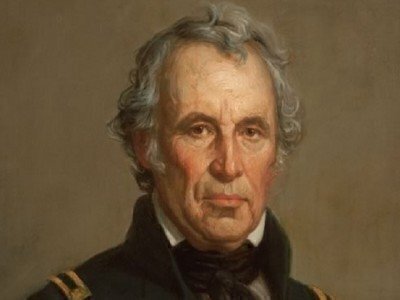
(President Taylor, from constitutioncenter.org)
zachary-taylor

Tempers grew hotter.  Texans who favored both territorial and slavery expansion began to agitate to secure their Rio Grand boundaries by force, with the Governor of Texas threatening to send troops to Santa Fe, as well as threatening secession.  In February 1850 Taylor met with Southern leaders and warned them that anyone "taken in rebellion against the Union, he would hang ... with less reluctance than he had hanged deserters and spies in Mexico."  He ordered reinforcement of U.S. Army garrisons in New Mexico and instructed that any attempt by Texas to assert its claims to New Mexico be met with force.

Taylor began writing a message to Congress about the crisis but never finished it.  After an Independence day ceremony and picnic at the White House, the president fell ill, dying five days later.  His successor Millard Fillmore, was a much less formidable character, and Congress reasserted itself eventually passing a series of measures that became known as the Compromise of 1850.  The first bill passed, on September 9, was the Texas and New Mexico Act which established the current boundaries of Texas, made New Mexico a territory and allowed it to choose whether to be slave or free when it became a state (which did not happen until 1912), and provided that the United States would pay off $10 million of the debts of the Republic of Texas (which had teetered on the edge of bankruptcy throughout its nine years of independence).

With that the dispute between New Mexico and Texas came to a close.
Though with those Texans you can never be sure.


Saturday, February 25, 2017

Juan Seguin Returns To The Alamo

 February 25, 1837, San Antonio, Republic of Texas

Precisely a year earlier, on February 25, 1836, Captain Juan Seguin left the besieged Alamo at the order of Colonel William Travis.  He carried with him a request for help from the army gathering under the command of Sam Houston at Washington-on-the-Brazos.  Making his way without detection through General Santa Ana's forces, which had arrived in San Antonio on the 23rd, Sequin made his way to Houston, but the general was determined not to allow his small and unready army to encounter the well-trained Mexican force.
http://www.sanjacinto-museum.org/images/2013/commanders/JuanSeguin-Large.png(Juan Seguin, San Jacinto museum)

In a predawn assault on March 6, the Alamo fell and all its defenders killed ((for more on the myths and controversies surrounding the Alamo read Remember (My Visit To) The Alamo)).  The victorious Santa Ana resumed his march eastward, seeming on the verge of extinguishing the rebellion, when six weeks later at San Jacinto, near present day Houston, his force was destroyed by the Texian army led by Sam Houston.  Juan Seguin led his men bravely in the fight and was subsequently promoted to Lieutenant Colonel.

Seguin was born in 1807 at Bexar (later San Antonio), the largest town in Texas, then part of a province within the Spanish Empire of the Americas.  His family was one of the most prominent in Texas and of tejano (Texians of hispanic descent) origin.  In the 1820s, after Mexico obtained its independence from Spain, Juan's father, Erasmo worked with Moses Austin and his son, Stephen, on facilitating the settlement of thousands of Anglo settlers from the United States.  In 1829, Juan was elected Judge of San Antonio and became Alcade (Mayor) of the town in 1834.  Jim Bowie, the Louisiana adventurer who'd settled in Texas and married the daughter of another prominent local family. became a close friend.

When the Texas Revolution began in the fall of 1835, the Juan sided with the revolutionaries as did most Texas tejanos.  At the time the divisions were not between anglos and tejanos but rather about whether Mexico should operate on a federal or centralized basis.  Santa Ana had sought power pledging to be a federalist, but upon attaining the presidency quickly became a centralizer.  Along with Texas, several other Mexican provinces also rebelled at the same time.

Juan Seguin participated in the storming of San Antonio on December 5, 1835 and then worked with Bowie in preparing the defense of the Alamo.
Robinson to Houston - Page 1(1837 letter from James Robinson, VP of the Texas Provisional Government to Sam Houston, recommending Juan Seguin for an appointment)

Following San Jacinto and the capture of Santa Ana, the Mexico army retreated south of the Rio Grande but refused to recognize the independence of Texas.  In November 1836, Lt Col Seguin took over command of the Texian garrison at San Antonio.  In late February, he organized a  ceremony to bury the remains of the defenders from the 1836 battle.

After Santa Ana captured the Alamo he ordered the bodies of the defenders collected in three locations inside and just outside the walls and had them burned.  It is unclear what happened to the remains over the next year, but in February 1837, Seguin ordered the remaining ashes and bone fragments collected and had a Bexar carpenter make a coffin.  Juan caused the lid to be inscribed with the names of Crockett, Travis and Bowie (though it was impossible to identify the remains).

Seguin ordered church bells to peal throughout the day and led a procession through the street of the town to the Alamo.  Three volleys were fired over the casket.  Addressing the crowd in Spanish, he proclaimed (according to an account published several weeks later in the Columbia (later Houston) Telegraph & Register):
Companions in Arms!! These remains which we have the honor of carrying on our shoulders are those of the valiant heroes who died in the Alamo. Yes, my friends, they preferred to die a thousand times rather than submit themselves to the tyrant's yoke. What a brilliant example! Deserving of being noted in the pages of history. The spirit of liberty appears to be looking out from its elevated throne with its pleasing mien and point to us saying: "There are your brothers, Travis, Bowie, Crockett, and others whose valor places them in the rank of my heroes." Yes soldiers and fellow citizens, these are the worthy beings who, by the twists of fate, during the present campaign delivered their bodies to the ferocity of their enemies; who, barbarously treated as beasts, were bound by their feet and dragged to this spot, where they were reduced to ashes. The venerable remains of our worth companions as witnesses, I invite you to declare to the entire world, "Texas shall be free and independent or we shall perish in glorious combat."
Later that year Juan Seguin was elected to the Texas Senate, serving until 1840, but the alliance between tejanos and anglos was beginning to weaken.  Two factors were at play.  The first was the flood of American settlers moving to Texas in the wake of obtaining independence, many of whom brought with them prejudices against tejanos and catholics.  Second, the continuing threat of further attacks on the new republic by Mexico.  Caught in the middle were tejanos, increasing mistrusted by their fellow citizens of the Texas republic.
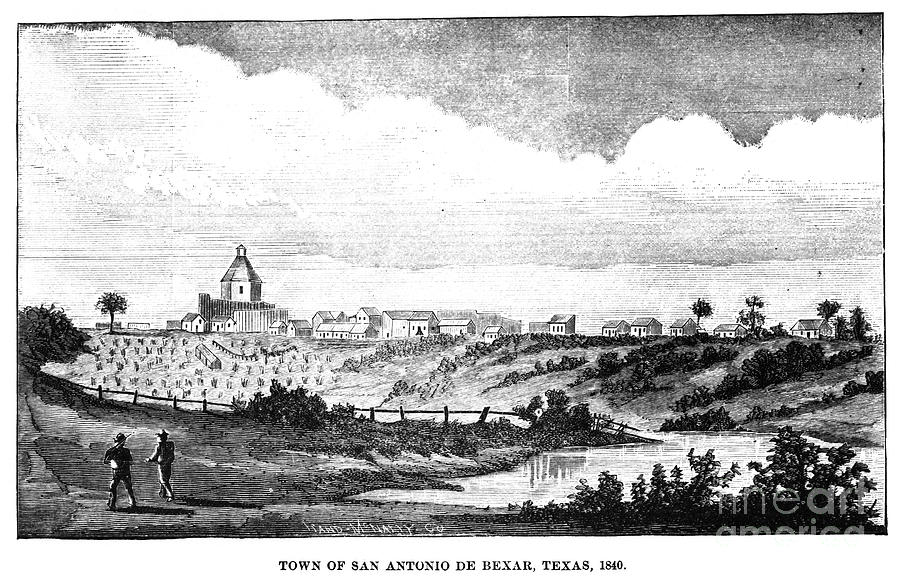
http://images.fineartamerica.com/images-medium-large/san-antonio-de-bexar-texas-granger.jpg
(from fine art america)

Sequin was once again serving as mayor of San Antonio when matters came to a head in 1842.  In January, Mexico announced its planned invasion of Texas (in part in retaliation for a failed Texian invasion of New Mexico the prior year), offering amnesty to anyone who did not resist.  In early March, the Mexican army seized Goliad, Refugio and Victoria and, on March 5, captured San Antonio, which it held until March 9 before retreating (Mexican forces would again occupy the town from September 11 through 20 of that year).  Juan Seguin and his family were among those who fled the invasion.  However, there was a growing clamor among the anglo settlers that unfairly portrayed Juan as a collaborator with the invading forces (to which the Mexican commander contributed by claiming Seguin was still a loyal Mexican citizen).  He was forced to resign in April and to protect himself and his family, fled to Mexico.

When Santa Ana learned of Seguin's presence he offered him a choice - prison or joining the army.  Seguin joined and served for the next six years until the end of the Mexican-American War in 1848, after which he returned to Texas.  Seguin remained politically active in the 1850s and 60s, but conditions continued to worsen for tejanos.  Eventually (at some point between the late 1860s and 1883 according to various sources), Juan moved to Nuevo Laredo, in Mexico just south of the Rio Grande where his son was mayor, where we live until his death in 1890.

In recent decades his role in helping Texas obtain its independence has been increasingly recognized and Juan Seguin is now celebrated as a Texas hero.  On July 4, 1976 his ashes were returned from Mexico to be reburied in the Texas town of Seguin, named in his honor in 1837.

(Status of Juan Seguin, Seguin, Texas, from andrew butler photo)
http://www.andrewbutlerphotos.com/img/s/v-3/p1624632434-3.jpg

Tuesday, May 26, 2015

Texas Rising

Texas Rising 
THC likes early Texas history (see Sam Houston: The Raven & The Alamo Series) so on Monday evening he got suckered into watching the first night of the three-part History Channel series Texas Rising covering events from the fall of the Alamo (March 6, 1836) to the aftermath of the Battle of San Jacinto (April 21, 1836) a time also known as the Runaway Scrape because of the retreat of the Texian army and the panicked flight of many Anglo families in its wake.

What a mess is Texas Rising!  Horrible dialogue, bizarrely misplaced geography, odd characterizations and historically unreliable. THC knows better than to expect complete historic fidelity in any work of popular entertainment but it's almost as though Texas Rising set out to deliberately mangle the saga of the Texas Revolution.  Here, have a look.  And carefully take in that first scene set on a cliff towering over the landscape, quite unlike anything you'll find in coastal Texas where these events took place.

In just the first few minutes last night we saw (1) the wrong date given for the fall of the Alamo; (2) the Alamo pictured as a formidable fortress rather than the rundown mission it was; (3) a miraculous "lone survivor" from the garrison's defenders and (4) a "freed" black man executed as one of the remaining six defenders captured at the end of the battle, even though no freed blacks fought with the garrison and the Mexican army took care not to kill the few slaves they found at the Alamo after their owners had been killed.  And further to that last point, later in the show we learn from Sam Houston himself that "Texas is slave free" which would have come as a surprise to the several thousand slaves owned by Anglo settlers.

It's too bad because they recruited quite a good group of actors including Bill Paxton (though he is terribly miscast as Houston), Brendan Fraser, Ray Liotta, Christopher McDonald (who achieved screen immortality as Shooter McGavin in Happy Gilmore), Jeremy Davies and Kris Kristofferson as President Andrew Jackson!  (Fraser, Liotta, McDonald, Davies below)
Brendan Fraser as Billy AndersonRay Liotta as LorcaChristopher McDonald as Henry KarnesJeremy Davies as Ephraim KnowlesKris Kristofferson as Andrew Jackson(Kristofferson)
If you're interested in that era of Texas just go read THC's posts.

Saturday, December 13, 2014

Remember (My Visit To) The Alamo! (Part 3)

For Parts 1 & 2 see here and here.

The Alamo In TV And Movies

THC watched the Disney series on Davy Crockett as a four year old in late 1954 and early 1955.  He still remembers the details of a few scenes, including the last one at the Alamo.

In 1954 Walt Disney signed a deal with ABC to deliver an hour long TV show every week and get the funds he desperately needed to complete the construction of his revolutionary amusement park Disneyland.  The new show, also called Disneyland, premiered on October 27, 1954.  Davy Crockett, Indian Fighter debuted on December 15.  A second episode, Davy Crockett Goes To Congress was broadcast on January 26, 1955 and a third, Davy Crockett At The Alamo aired on February 23, 1955.  The response exceeded Disney's expectations, setting off a nationwide Crockett craze and marketing bonanza which last for most of 1955.  Even the theme song from the show, The Ballad Of Davy Crockett, went to #1 on the charts. And yes, THC proudly wore a coonskin cap.
http://upload.wikimedia.org/wikipedia/en/4/4d/Davy_Crockett,_King_of_the_Wild_Frontier_FilmPoster.jpeg
In May 1955 Disney released an edited version of the three episodes as a full length movie, Davy Crockett: King Of The Wild Frontier and late in the year broadcast two more TV episodes, Davy Crockett's Keelboat Race (Nov 16) and Davy Crockett And The River Pirates (Dec 14).  These last two also featured another legendary figure, Mike Fink (1770?-1823), the "King of the Keelboaters".

Disney made a star out of Fess Parker who played Crockett (and a decade later portrayed Daniel Boone in a hit TV series).  His co-star was Buddy Ebsen, who after escaping the Alamo returned to Tennessee, changed his name to Jed Clampett and while out hunting discovered oil, became rich and moved to Beverly - Hills that is.

Some of the series is available on YouTube.  One portion that THC did not remember portrays Crockett speaking in Congress in opposition to Andrew Jackson's request that Congress provide him funds for the removal of the Cherokees and four other southeastern Indian tribes; you can watch the segment below.  David Crockett really did speak in Congress in opposition though the Disney speech is just a mite different.  The measure passed by only five votes (102-97).  Crockett is portrayed as wearing a buckskin outfit which is not what he wore in Washington.  The picture of him in Part 2 shows the type of clothing he normally wore.
And here is the climax of Davy Crockett At The Alamo which shows Davy atop the north wall with the screen fading out as he's swinging his musket.  He's wearing a coonskin cap but as far as we know David Crockett did not wear coonskin caps at all, though it appears Davy Crockett did.   It also shows Bowie's death, though being debilitated by illness it's an open question whether he was conscious of what was going on around him by that time. The Alamo you see is much smaller than the real thing which had a three-acre open plaza in the middle.
As far as historical accuracy some of the basic framework of the Crockett story is right and the series pays attention to the self-awareness of Crockett and his friend about the propagation of the myth of Davy Crockett but overall it's not very accurate, though not nearly as awful as They Died With Their Boots On, the 1941 George Armstrong Custer biopic starring Errol Flynn.

In 1960 came The Alamo, directed by John Wayne, who also starred as Davy Crockett.  Co-starring Richard Widmark as Jim Bowie and Laurence Harvey as William Travis the film was a commercial failure and deservedly so.   While Wayne made many classic movies this is definitely not one of them.  Both as history and movie it is terrible.

The scene below shows the end of the battle and Crockett's death.  Like the Disney series, The Alamo shows the attack taking place in full daylight while in reality it started in pitch darkness at 5am and ended as the sun was rising.  Once again Crockett is inaccurately shown wearing buckskins and a coonskin cap.  Unlike the Disney series it does show Crockett in the area of the Alamo we think most likely to have been his post but it also has him blowing himself up by putting a torch to the powder magazine which is completely fanciful.  Jim Bowie is seen dying on a bed that is placed outside while he was actually confined to his room, dying and delirious.  Pretty much everything that happens earlier in the movie is also wrong. [NOTE: The sound doesn't work quite right on this clip but it doesn't make any difference!] 


The next attempt to show the battle in a movie was The Alamo (2004).  Originally intended as a $200 million budget blockbuster, with Ron Howard directing, it was scaled back to a $100 million budget and directed by John Lee Hancock, a Texas native and one of the screenwriters.  Starring Billy Bob Thornton as Crockett, Jason Patric as Bowie, Patrick Wilson as Travis, Dennis Quaid as Houston and Emilio Echevarria as Santa Anna it was another box office disaster.

THC has a soft spot for the 2004 movie.  Unlike Wayne's version it is somber, not stirring. It's uneven, some scenes sit there inert amidst clumps of clumsy dialogue, Quaid is lousy as Houston (the movie ends with the battle of San Jacinto) and Santa Anna is treated as a cardboard clown, but at the same time there are some very moving and subtle scenes, sparkling passages of dialogue (Travis and Bowie talking near the end, Crockett telling of his Indian fighting days around the campfire), Patric and Wilson are well-cast, the Mexican attack starts in the darkness and as history it is pretty well done; the sets and costumes are accurate and some of the ethnic complexities of the times are captured, particularly in the portrayal of Juan Seguin, a tejano who supported the revolution (though several years later he fled to Mexico as Anglo intolerance increased).  Most of all Thornton is just wonderful as Crockett, capturing David's awareness that he's also Davy Crockett and his ambivalence about it, at times reveling in playing the role and at other times feeling trapped by Davy.  At one point he tells Bowie:
If it was just me, simple old David from Tennessee, I might drop over that wall and take my chances but that Davy Crockett fella, they're all watching him.
This is the somewhat overwrought trailer:
This clip shows events on February 23 when Bowie's attempt to parley was interrupted by Travis' cannon shot.  In the scene you can see that Bowie seems familiar with General Castrillon which is an accurate portrayal.  When he came to Texas, Bowie married into one of the oldest and wealthiest Tejano families in San Antonio and he knew many senior Mexican officials.  His wife and most of her family died of fever leaving Bowie devastated.  The movie portrays him as a fatalistic and morose figure.
The most controversial scene in the movie is Crockett's death.  At the end of the prior scene we've seen Crockett and a few of his surviving men retreat into the church as Mexican soldiers overwhelm their position; the Mexicans charge and David and his men brace themselves.  The screen goes black and then suddenly we are in daylight.  This is the first time a version resembling the de la Pena account has been shown on screen.  The filmmakers do a good job meshing the David and Davy aspects together (you can hear Crockett muttering to himself "Davy Crockett" as he realizes he must play the role one last time).   It still wasn't enough for some folks who were outraged that Davy was not seen going down fighting but for THC, who admires Crockett and thinks that something along the lines of de la Pena account is likely true, it's a thumbs up.


Friday, December 12, 2014

Remember (My Visit To) The Alamo! (Part 2)

For Part 1 go here.

Part 2:  What About Davy Crockett?

Sam Houston didn't want a battle, believing San Antonio de Bexar was too isolated from the other Texian settlements and the Alamo indefensible with the small force at hand; the strategy of the commander of the Texian army was to lure Santa Anna deep into Texas, away from his supply lines buying him time to train and create a disciplined Texian army.  In January 1836 he sent James Bowie (b. 1796) to remove the cannon from the Alamo and bring them back to his growing army though he gave Bowie some discretion to act as he saw fit.
http://www.sanjacinto-museum.org/images/2013/commanders/SantaAnna-Large.png(Santa Anna from San Jacinto Museum)

With the exception of Santa Anna, none of the senior Mexican officers wanted a battle at the Alamo, believing that their advance should be along the Gulf coast of Texas and that the inland town of San Antonio was a strategic dead end.  Unfortunately, only Santa Anna's opinion counted.  And then having arrived in San Antonio, they believed Santa Anna's decision to attack an isolated position held by a small number of rebels instead of either leaving it under siege with a small force and proceeding with the bulk of the army deeper into Texas or, in the alternative, waiting a couple of days until their heavy artillery reached San Antonio, artillery which could knock down the walls of the Alamo and force the garrison to surrender, was an unjustified waste of the lives of their soldiers.

Bowie was returning to the town he'd first settled in when he came to Texas in 1830 having left Louisiana in the wake of a huge land fraud in which he played a leading role in, a fraud which triggered decades of property disputes in what became the state of Arkansas.  Bowie had achieved regional notoriety in 1827, after the bloody Sandbar Fight outside of Natchez, Mississippi in which he'd been badly wounded while killing another man with his famed Bowie knife.
http://upload.wikimedia.org/wikipedia/commons/6/68/Jimbowie.jpg(Bowie; Wikipedia)
On February 3, Bowie was joi,ned in San Antonio by William Barret Travis (b. 1809), a lieutenant colonel in the new Texas army who brought eighteen soldiers with him.  Travis arrived in Texas in 1831, abandoning a wife, young child and failing law practice back in Alabama.  Unlike Bowie, he was an early and fervent advocate for Texas independence and his impetuous actions at the coastal town of Anhuac nearly triggered the revolution in 1832 before cooler heads prevailed.
http://upload.wikimedia.org/wikipedia/commons/a/a1/William_B._Travis_by_Wiley_Martin.JPG(Travis; Wikipedia)
Travis and Bowie agreed they should defend the Alamo, but quarreled over command eventually arriving at a tenuous agreement to share it.  The delicate nature of the arrangement was demonstrated when Bowie tried to parley with the Mexicans upon their arrival in San Antonio, a meeting disrupted by a cannon shot ordered by Travis.

Bowie, Travis and David Crockett (b. 1786) ascended into legend with their deaths at the Alamo (for a good combined biography of the three read Three Roads To The Alamo by William C Davis).  We have a pretty good idea how the first two perished.  Bowie, immobilized and delirious, likely with typhoid fever, was killed in his bed while Travis was shot in the head early in the fight while directing fire from the cannon on the north wall.  But what about Crockett, who in 1836 was the only nationally known figure at the Alamo?
http://upload.wikimedia.org/wikipedia/commons/8/89/David_Crockett.jpg(David Crockett; Wikipedia)

When David Crockett (he called himself David, not Davy) rode into San Antonio on February 8, he was a former three term U.S. Congressman from Tennessee, who after being defeated in the last election declared "You can all go to Hell, I'm going to Texas" and set out to establish a new life.  On his ride to Texas he was joined by about 30 friends and adventurers.  Arriving after the revolution  started he found that land grants were available for those joining the rebel forces.  He and his compatriots quickly signed up.

Crockett though, was more than just a former Congressman.  He was the first popular folk character from America's west, and its most nationally known figure, other than Andrew Jackson.  David Crockett, born poor, a frontiersman, hunter and scout went into politics, initially as an ally of Andrew Jackson, and later as his fierce opponent over the issues of the distribution of federal lands and on the removal of the Indian tribes from the southeast, a policy Crockett opposed, being the only Congressman in the southeast to vote against the removal, about which he wrote, "I believe it was a wicked, unjust measure".

The character Davy Crockett, after arriving in Washington in 1827, quickly became known for his entertaining storytelling and anecdotes and was converted into a figure of popular entertainment around whom myths and legends grew.  Many plays were staged with Davy or a thinly disguised version of him as the centerpiece, the most popular of which, Lion Of The West, premiered in New York City.  From 1835 through 1841 Davy Crockett's Almanack was published and in 1834 Crockett added to his renown with the publication of A Narrative Of The Life Of David Crockett, Written By Himself which became a best seller and sparked a nationwide speaking tour (Crockett was particularly popular in New England).http://blog.nyhistory.org/wp-content/uploads/2012/06/Crockett_1837_32.jpg(From NY Historical Society)
Of Crockett's actions during the siege, which began on February 23, we have little information; on the 25th Travis wrote in a message carried to Houston "The Hon. David Crockett was seen at all points,
animating the men to do their duty", and Susannah Dickinson (of whom, more below) remembered  Crockett playing his fiddle to entertain the garrison.  Did Crockett, who by rank was only a private, play a significant role in planning the defense and leading the men during the siege?  It is impossible to know but the very limited evidence is suggestive, given that after the first two days Bowie was incapacitated with fever and Crockett was a famous and popular figure two decades older than Travis.

Our best information, from early in the siege, is that Crockett and his men were stationed behind a hastily erected wooden palisade fence that ran at an angle from the southwest corner of the Alamo mission church to the start of the south wall, making it a particularly vulnerable spot if attacked.  In the darkness of early morning on March 6, the Mexican assault breached the north and south walls first and then swept across the open plaza as some of the surviving Texians retreated into the Long Barracks.  The last  rebels left out in the open would likely have been Crockett and his men near the church.  Did they die fighting by the palisade?  Did some try to seek refuge in the church?  Had they moved their post by then?  Did Crockett move from the palisade and towards the north wall when Travis was killed early in the fight? Or were Crockett and some of his men among the up to 60 Texians who may have tried to escape by going over the walls near the palisade only to be cut down on the open prairie by the mounted Mexican lancers waiting for them?
(The palisade at which Crockett and his men were stationed started at the right side of the front of the Alamo mission church)
(Mark Churms painting giving good idea of relative placement of wooden palisade and Alamo church)

What are our sources for the end of the Alamo?  There are several Mexican ones, of which more below.  We also have accounts of various riders sent out with messages from the Alamo before March 3 and the stories of the few civilian survivors spared by Santa Ana, the most prominent of which were Joe, William Travis' slave, and Susannah Dickinson, wife of one of the defenders.  Joe's account was that he was with Travis until he was killed at which time he went into the church, joining Dickinson.  Both Joe and Dickinson reported that as they were being escorted out after the fighting ended they saw Crockett's body near the church, surrounded by dead Mexican soldiers.  It remains unclear how long after the fighting ended they left the church and observed the carnage outside, but their observations are consistent both with Crockett dying in combat or being executed at the end of the battle.

After that it gets murkier.  The best account THC found is Sleuthing The Alamo by James E Crisp, a professor of history at North Carolina State University, from which the summary below is drawn except as noted otherwise.  As a side note, Sleuthing The Alamo is an outstanding way to learn about how historians do their job.  Crisp takes the controversy around Crockett's death along with an alleged racist speech by Sam Houston and brings you along for the ride as he traces the origins of various stories and documents, going back to the primary sources to get to the truth.  It's a short, but very illuminating book written in an engaging personal and non-academic style.

Within a short time of the fall of the Alamo various stories were in circulation about the fate of Crockett with some newspapers reporting he went down fighting, others that he was captured and executed and a couple even reporting his escape!

Before we review those accounts there are two other events to give some context.
  • On March 27 the Mexican army massacred about 350 Texians at the coastal town of Goliad.  These soldiers had surrendered a few days earlier under a promise of clemency.  The local Mexican commander, General Urrea, protested vigorously against the execution order from Santa Anna, who sent an officer from Bexar to oversee the killing.
  • At San Jacinto on April 21, 1836 Sam Houston defeated a detachment of the Mexican army capturing several hundred men, including Santa Anna and other senior commanders, most of whom were imprisoned on Galveston Island until their return to Mexico.
As early as March 11 news reached the Texian army in Gonzales about the end at the Alamo.  On that same day Sam Houston wrote a letter stating "After the fort was carried, seven men surrendered and called for Santa Anna and quarter.  They were murdered by his order."

The June 9, 1836 edition of the New York Courier and Enquirer carried a letter from a correspondent in Galveston Bay who purported to convey an account from an eye witness:
After the Mexicans had got possession of the Alamo, the fighting had ceased, and it was clear day light, six Americans were discovered near the wall yet unconquered, and who were instantly surrounded and ordered by General Castrillon [a senior Mexican commander] to surrender, and who did so under a promise of his protection, finding resistance any longer in vain - indeed, perfect madness - Castrillon was brave and not cruel, and disposed to save them.  He marched them up to that part of the fort where stood "his Excellency" [Santa Anna] . . . David Crockett was one of the six. The steady fearless step and undaunted tread, together with the bold demeanor of this hardy veteran -"his firmness and noble bearing", to give the words of the narrator, had a most powerful effect on himself and Castrillon . . . Castrillon addressed "his Excellency" - "Sir, here are six prisoners I have taken alive; how shall I dispose of them?"  Santa Anna looked at Castrillon fiercely, flew into a most violent rage, and replied "Have I not told you before how to dispose of them?  Why do you bring them to me?"  At the same time his brave officers drew and plunged their swords into the bosoms of their defenceless prisoners!! 
Sergeant George Dolson served as an interpreter with the Texian army on Galveston Island.  On July 18, his superior officer asked him to attend the deposition of an unnamed Mexican officer.  The next day he wrote a letter to his brother in Michigan in which he described what happened; a letter published by the Detroit Democratic Free Press in September (though no written record of the deposition has been found).  Dolson wrote of the Mexican officer:
He states that on the morning the Alamo was captured, between the hours of five and six o'clock, General Castrillon, who fell at the battle of San Jacinto, entered the back room of the Alamo, and there found Crockett and five other Americans, who had defended it until defence was useless. They appeared very much agitated when the Mexican soldiers undertook to rush in after their General, but the humane General ordered his men to keep out, and, placing his hand on one breast, said "here is a hand and a heart to protect you; come with me to the General-in-Chief, and you shall be saved." . . . The brave but unfortunate men were marched to the tent of Santa Anna.  Colonel Crockett was in the rear, had his arms folded, and appeared bold as the lion as he passed my informant.  Santa Anna's interpreter knew Colonel Crockett, and said to my informant, "the one behind is the famous Crockett".  When brought in the presence of Santa Anna, Castrillon said to him, "Santa Anna, the august, I deliver up to you six brave prisoners of war."  Santa Anna replied, "who has given you orders to take prisoners, I do not want to see those men living - shoot them."  As the monster uttered these words each officer turned his face the other way, and the hellhounds of the tyrant dispatched the six in his presence, and within six feet of his person.
These stories of survivors being executed after the battle are also consistent with an account published in Mexico City in 1837 by Ramon Martinez Caro, Santa Anna's personal secretary during the Texas campaign (though it does not mention Crockett):
Among the 183 killed there were five who were discovered by General Castrillon hiding after the assault. He took them immediately to the presence of His Excellency who had come up by this time.  When he presented the prisoners he was severely reprimanded for not having killed them on the spot, after which [Santa Anna] turned his back upon Castrillon while the soldiers stepped out of their ranks and set upon the prisoners until they were killed . . . We all witnessed this outrage which humanity condemns but which was committed as described.  This is a cruel truth, but I cannot omit it.
Caro had been imprisoned at Galveston.  Could he have been the source for the Dolson letter?

Throughout the rest of the century and into the middle of the 20th there continued to be parallel stories of Crockett going down fighting, along with those of his being executed.  The giant 1905 painting in the Texas Capital showed him swinging a musket as the Mexican soldiers closed in.  At http://www.latinamericanstudies.org/alamo/crockett-alamo.jpgnearly the same time Teddy Roosevelt described Crockett's last minutes in his 1895 book, Hero Tales From American History (as quoted in Crisp's book):
. . . the last man stood at bay.  It was old Davy Crockett.  Wounded in a dozen places, he faced his foes with his back to the wall, ringed around by the bodies of the men he had slain.  So desperate was the fight he waged, that the Mexicans who thronged round him were beaten back for the moment, and no one dared to run in upon him.  Accordingly . . . the musketeers loaded their carbines and shot him down.  Santa Anna declined to give him mercy.  Some say that when Crockett fell from his wounds, he was taken alive, and was then shot by Santa Anna's order; but his fate cannot be told with certainty, for not a single American was left alive.
And as Crisp points out, as late as 1934 the frontispiece of the popular book The Adventures of Davy Crockett was a painting of a bound Crockett being brought to Santa Anna (below). 
It was in 1955 that two events happened that transformed the Crockett story.  One had an immediate impact; the other was a time bomb that would detonate two decades later.

The first was the broadcast of Walt Disney's three part series, Davy Crockett: King Of The Wild Frontier which transfixed the American public, including 4-year old THC.  The series ended with Davy fighting to the end against the Mexican attackers (we'll have more on the Disney show in Part 3 of this series).  Disney established a contemporary image in our minds of an heroic Davy who would never surrender, and it was an image we liked.

The second was the publication in Mexico City of the diary of Jose Enrique de la Pena by Jesus Sanchez Garza.  De la Pena (1807-40), a Colonel in the Mexican army, was present at the Alamo.  How the diary (or more properly an account based upon diary entries) came into Garza's hands has never been determined.  The publication received little notice in the United States at the time, but controversy about it exploded in 1975 when an English translation by Carmen Perry was published.  THC recently read a 1997 edition of the translation with an introduction by Professor Crisp,  published as With Santa Anna In Texas.

Let's see what de la Pena wrote about Crockett and then we'll talk about the context, which is extremely important in understanding his document. On second thought, let's first note another Mexican memoir that was first published in 1966.  Lieutenant Colonel Jose Juan Sanchez Navarro briefly mentions the attack: "by six-thirty in the morning not a single enemy existed . . . some cruelties horrified me among them the death of an oldster whom they called Cocran".  While there was a defender named Robert Cochran he was only twenty six years old.  Could Navarro have been referring to Crockett who would have turned 50 that year and was one of the oldest Texians in the Alamo?La guerra de Tejas; memorias de un soldado(Briscoe Center for American History, U of Texas)

And what does de la Pena say?
Some seven men had survived the general carnage and, under the protection of General Castrillon, they were brought before Santa Ana.  Among them was one of great stature, well proportioned, with regular features, in whose face there was the imprint of adversity, but in whom one also noticed a degree of resignation and nobility that did him honor.  He was the naturalist David Croket, well known in North America for his unusual adventures, who had undertaken to explore the country and who finding himself in Bejar at the very moment of surprise, had taken refuge in the Alamo, fearing that his status as a foreigner might not be respected.  Santa Anna answered Castrillon's intervention with a gesture of indignation and, addressing himself to the sappers, the troops closest to him, ordered that they shoot them.  The commanders and officers were outraged at this action and did not support the order, hoping that once the fury of the moment had blown over these men would be spared; but several officers who were around the president and who, perhaps, had not been present during the moment of danger, became noteworthy by an infamous deed, surpassing the soldiers in cruelty. They thrust themselves forward, in order to flatter their commander, and with swords in hand, fell upon these unfortunate, defenseless men just as a tiger leaps upon his prey.  Though tortured before they were killed, these unfortunates died without complaining and without humiliating themselves before their torturers.  It was rumored that General Sesma was one of them; I will not bear witness to this, for though present, I turned away horrified in order not to witness such a barbarous scene. . .  I confess that the very memory of it makes me tremble and that my ear can still hear the penetrating, doleful sound of the victims.
Close-up of the top of the José Enrique de la Peña Narrative Top(Section of the de la Pena manuscript mentioning "Croket" in fifth line)

The 1975 publication found fertile ground in the turmoil of that decade in America, and set off heated debate between those, including revisionist historians, who delightedly took it as proof that the beloved American hero was a sniveling coward and used the diary's claims as part of a more general attack on American values and traditions, and those who insisted that an American hero like Crockett would have fought to the death rather than surrender and that de la Pena's claims must therefore be fraudulent and his supporters, by definition, anti-American.  In fact, a debate over the legitimacy of the diary and of de la Pena's writings about Crockett continues to this day, though it probably peaked in the 1990s.

Taking the account on its face, why would de la Pena, who by 1837 was in prison, write it?  His purpose was not to write an account of Crockett or even of the Alamo.  The edition THC read is about 190 pages of which less than one page contains the Crockett account and the entire attack is covered in just twelve pages. De la Pena's account is intended as a denunciation of Santa Anna and some of his senior commanders who, in his view, neglected the welfare of their soldiers and conducted a strategically foolish campaign resulting in the loss of Texas.  The very reason he was in jail was for participating in a failed rebellion against Santa Anna's government.

His introduction reveals to us an angry and anguished young man:
. . . the accumulation of lies told to falsify the events, . . . the ignorance, stupidity, and cruelty displayed by the ministry and the commander in chief in this war . . . the honor and self-esteem of every military man who participated, so deeply hurt by the great inaccuracies in official records as to dates, deeds and places; and above all the honor of the country, deeply compromised by its leaders and no less by the truth and the atrocity of its crimes - these are the principal causes which compelled me to publish the diary . . .

The infamies that have occurred in this campaign, infamies that must have horrified the civilized world and whose memory will continue to provoke pain for many years hence, should not remain hidden.  In referring to them, I shall thrust aside my personal feelings, and my friends will cease to be friends from the moment that I publish the evils committed against my country and the deeps perpetrated against humanity.
De la Pena is scathing about the lack of preparation for the march into Texas and Santa Anna's strategy of dividing his army instead of concentrating it for an advance up the coast, but his anger reaches a fever pitch when writing of what he, and other officers, believed was a completely unnecessary attack on the Alamo (he writes of the Mexican commanders having information that Travis would have surrendered if no relief came from Houston's army within the next two days), leaving many soldiers dead and hundreds wounded who suffered terribly without any medical treatment because of Santa Anna's failure to bring doctors and medical supplies with the army.  Above all, he was horrified by the killing of the Alamo survivors and the massacre at Goliad, a horror shared by many other officers.  De la Pena believed it was a criminal act that dishonored the army and was also counterproductive, since it incited even more resistance by the Texian rebels who knew their only alternatives were to win or die.  He was a Mexican patriot who condemned the Texas rebellion and believed it could have been defeated while still referring frequently to the bravery of the rebels and of their fair and honorable treatment of Mexican prisoners. From his perspective the purpose of telling the tale of the death of Crockett and his fellow survivors was to show how despicable Santa Anna was, and his description of their deaths is followed with this lament:
To whom was this sacrifice useful and what advantage was derived by increasing the number of victims? It was paid for dearly, though it could have been otherwise had these men been required to walk across the floor carpeted with the bodies over which we stepped, had they been rehabilitated generously and required to communicate to their comrades the fate that awaited them if they did not desist from their unjust cause. They could have informed their comrades of the force and resources that the enemy had.
http://www.rationalsys.com/images/parkville9.JPG
As just one example of the objections of the Mexican commanders to Santa Anna's death decrees, we have the consistent account of the actions of General Manuel Fernandez Castrillon, who protested not only the killing of the survivors at the Alamo but also the order to massacre the Goliad prisoners.  Castrillon, once a close ally of Santa Anna, grew disenchanted with him and was killed at San Jacinto where many of the Texians remarked on his bravery.  Castrillon was buried nearby at the plantation of his friend Lorenzo de Zavala, the tejano Vice-President of the newly proclaimed Texas Republic,

Jose Enrique de la Pena died in 1840 at the age of 33 before he could publish his broadside about the loss of Texas.  Santa Anna (1794-1876) was president of Mexico eleven different times from 1833 through 1855 during which he lost not only Texas ,but the entire northern territory of his country to the United States during the Mexican War (1846-8).  In one of his many periods of exile from Mexico he lived on Staten Island, New York for several years.
  
Some of those who have contested the authenticity of the de la Pena papers have raised valid points, which have triggered further fascinating research (you can get a sense of the back and forth by reading this).  One of the most instructive lessons for THC has been about the limitations of relying on translations of materials originally written in other languages.  It turns out that several points of apparent contradiction in the English version of de la Pena's work disappear when one goes back to the original Spanish, and that a previously unknown document written by de la Pena and located at Yale University in 1994 provides additional corroboration for his story.  While THC does not think the question has been resolved 100% (for instance, de la Pena's account of the death of Travis is inconsistent with other evidence) his judgement is that, on balance, the evidence favors the authenticity of the diary and of his account of the Alamo. While we will never know for certain the exact circumstances it is likely that David Crockett was among those executed at the end of the battle, though Davy Crockett seems to live on.

NEXT:  PART 3  The Alamo In TV And Movies