Showing posts with label The Beatles. Show all posts

Monday, April 6, 2026

Tomorrow Never Knows

On this date sixty years ago, The Beatles began recording Tomorrow Never Knows, the revolutionary and groundbreaking track from the album Revolver, released in August 1966.  Though it was the last song on the second side of that album, it was the first song recorded in the sessions for the record, something I was surprised to discover decades later.  At the time, we'd never heard anything remotely like this before, and thought its placement as the closing song was a signal that big musical changes were coming for The Beatles.  As with A Hard Day's Night, the title is from an off hand remark by Ringo.  Before settling on Tomorrow Never Knows was called The Void and Mark 1.

Tomorrow Never Knows is primarily a one-chord song with a droning tone, interspersed with weird, swirling snippets from something strange, and backwards guitar bits.  Behind it is Ringo's drum pattern, which remains unchanging throughout.  I've seen recent commentary from younger listeners thinking that because the drum pattern is so unerringly accurate Ringo must have played a small part that was then digitally repeated.  However, the technology did not exist at the time and it really is Ringo from start to finish.  George Harrison plays sitar or tamboura, depending on the analysis, on the track.

Topping it off are Lennon's lyrics, "turn off your mind, relax and float downstream/ All play the game
Existence to the end, of the beginning".  John's instruction to George Martin was to make his voice sound like he was the Dalai Lama singing from a mountaintop, which, with some studio ingenuity, Martin accomplished by feeding the vocal through a revolving Leslie speaker inside a Hammond organ (the effect starts 87 seconds into the song).

The most innovative aspect was the use of tape loops  This description is from The Beatles Recording Sessions: The Official Abbey Road Studio Session Notes by Mark Lewisohn (1988):

Perhaps the most striking sound on Tomorrow Never Knows is one of tape loops [the sound achieved by tape saturation, by removing the erase head of a machine and then recording over and over on the same piece of tape]. . . .  The seagull-like noise on Tomorrow Never Knows is really a distorted guitar. (According to studio documentation, other loops used included the sounds of a speeded up guitar and a wine glass.)  "We did a live mix of all the loops," says George Martin. "All over the studios we had people spooling them onto machines with pencils while Geoff [Emerick] did the balancing.  There were many other hands controlling the panning." . . . "It was done totally off the cuff.  The control room was as full of loops as it was people".  "I laid all of the loops onto the multi-track and played the faders like a modern day synthesizer" says Emerick.

You can watch a video about the recording here which contains additional details and differs in some respects from the Lewisohn book.  You can listen to the isolated tape loops here.

Thursday, August 18, 2022

The New Guy: Ringo

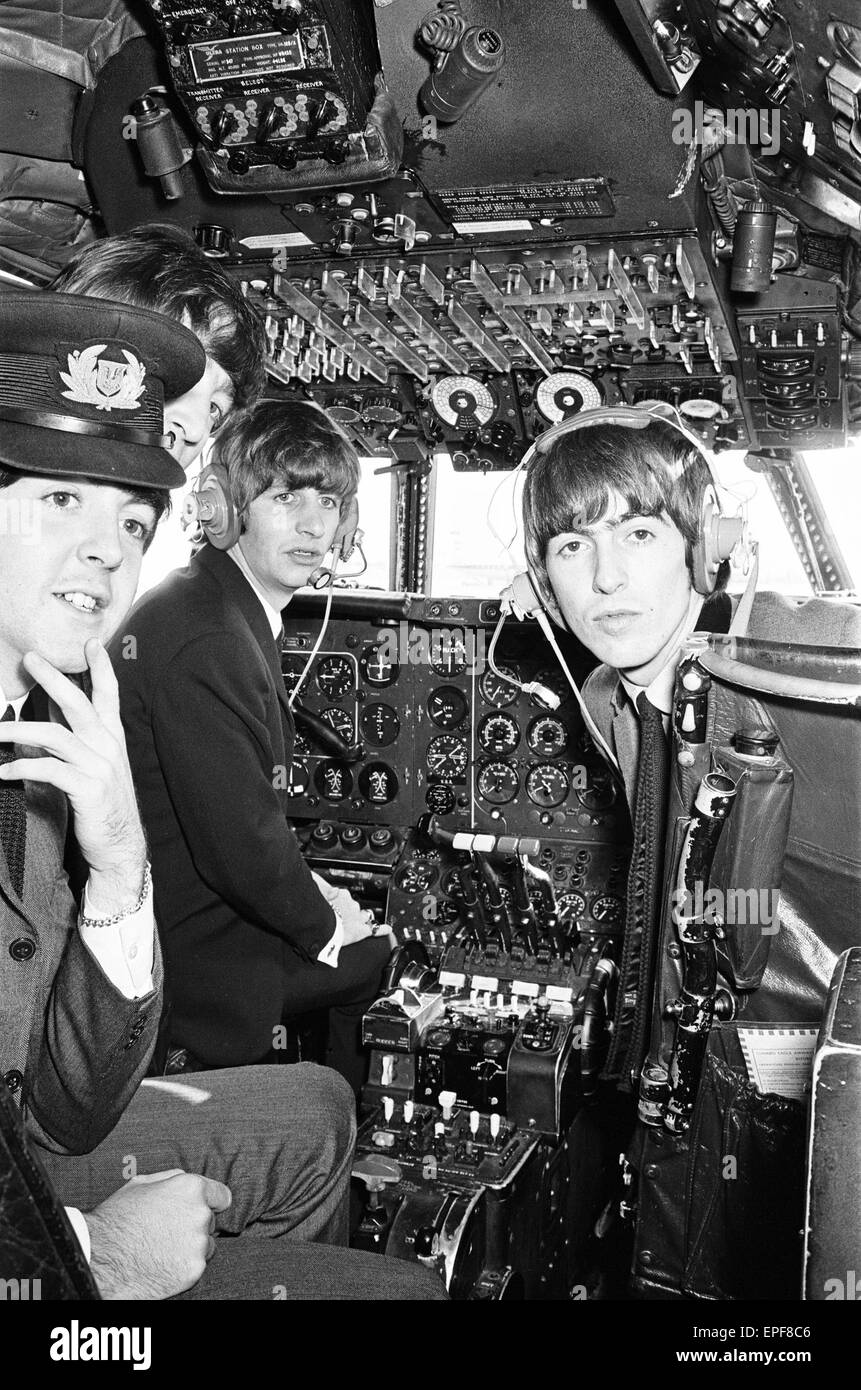
The Beatles in Liverpool for the Premier of a Hard Day's Night. Ringo Starr,  George Harrison and Paul McCartney pictured here in the cockpit of the  plane on their flight to Liverpool.

On this date sixty years ago, Ringo Starr made his first performing appearance with The Beatles.  He turned 82 last month and still looks good.

I've come to really appreciate Ringo's drumming, which I did not so much during the 60s.  If you've read this blog you know that I love Keith Moon, who played with flash, incredible energy and often was musically leading The Who.  Ringo's style was very different and listening more deeply over the decades, I understand how well they served the songs.  Ringo didn't have a "style" in the sense that Moon or John Bonham did.

The first time I noticed it in the 60s, was in the intro and first verse of Sgt Pepper's A Day In The Life (listen as Ringo kicks in about 47 seconds into the song) but, other than that, I didn't pay much attention to him.  Now I understand much better what he brings to the music of The Beatles.

For one thing, there are few drummers who have more recognizable drum riffs.  If all you heard were the drums you'd know what the song was.

Some examples:

I Feel Fine - the drum break at around 1:20, though Ringo's samba style beat throughout is outstanding.

Ticket To Ride - the off-kilter beat throughout the song; so distinctive.

Come Together

Others I enjoy, listed chronologically:

The punctuated beat of She Loves You

The intro on the exuberant Tell Me Why, which also features one of Lennon's best vocals

In My Life

Ringo has been often quoted that Rain is his favorite drumming part.  Great interplay with McCartney's bass.

She Said She Said - that compressed cymbal sound and the subtle tempo change in the middle

Groundbreaking in many ways, Tomorrow Never Knows is held together by Ringo's unusual metronomic drum pattern and Paul's drone bass.  This is before digital magic was available in the recording studio.  It's Ringo live throughout. 

Strawberry Fields Forever - wistful and beautiful.  Ringo stays away from obvious choices.

And then we arrive at Abbey Road, the band's last recording and Ringo's consistently best and most innovative work from start to finish.  It's worth listening to him on every song.  We've already listened to Come Together, but we also have Something (particularly on the bridge), Here Comes The Sun. The End, and Polythene Pam/She Came In Through The Bathroom Window.

The special treat on Abbey Road is You Never Give Me Your Money, which is several different song snippets put together by Paul.  I think it is one of the 5 best songs by the group.  This video deconstructs each track so you can hear Ringo's brilliance but you should also listen to George and John's guitar work, Paul's piano track and the vocal track.

Monday, August 30, 2021

Tomorrow Never Knows

Revolver was released 55 years ago this month and its last track was Tomorrow Never Knows, a song unlike anything The Beatles had previously recorded and unlike anything we'd heard before.  For us teens it was an indication of where the band and music in general would be heading in the future.  Oddly enough, Tomorrow Never Knows was the first song recorded for the album back in April 1966.

The song featured many recording innovations discussed in the video below by Giles Martin, son of George Martin.  And don't miss the unusual repetitive drumming by Ringo which must have been difficult to maintain for three minutes.


Monday, July 13, 2020

The Opening Chord

It's one of the most famous and mysterious chords in pop music history - the opening chord to A Hard Day's Night, The Beatles single released on this date in 1964.  The song became #1 everywhere that had record charts at the time - UK, US, Australia, Canada, Ireland, New Zealand, Netherlands, Norway, South Africa, Sweden, as did the album of the same name and the movie was both a critical and popular hit.

The song sounded different and more sophisticated than the previous Beatle songs.  Here it is with its distinctive opening chord.

Figuring out what was played on that chord was a source of dispute for years.  Below is a 2014 account by Randy Bachman based on his visit to Abbey Road studios where Giles Martin, son of George Martin, played the original tapes.  Bachman was guitarist for The Guess Who (No Time, American Woman, These Eyes) and later Bachman-Turner Overdrive (Taking Care of Business, You Ain't Seen Nothing Yet).

I really enjoy listening to Bachman's explanation because he is such a fan himself and his excitement and enthusiasm is engaging.