Showing posts with label Neil Young. Show all posts

Monday, April 13, 2026

Harvest Moon

From Neil Young in 1992.  Background vocals on the recording by Linda Ronstadt.  Bringing back beautiful dreamy memories.  Think I can stay there for awhile.

Because I'm still in love with youI want to see you dance againBecause I'm still in love with youOn this harvest moon 


Wednesday, March 30, 2022

Buffalo Springfield . . . Again

As a percentage of recorded repertoire, I probably have more Buffalo Springfield on my playlist than any other artist - 23 of their 34 (or is it 35? more on that later) recorded songs.  They were only together for a short time but three of the band members, Richie Furay, Stephen Stills, and Neil Young, went on to long and successful careers.  While the Springfield's drummer, Dewey Martin, was okay, bassist Bruce Palmer was terrific, something I only discovered years later when listening to their albums on better audio systems.

Buffalo Springfield - Buffalo Springfield.jpg

The first album by the L.A. based band (though Young and Palmer hailed from Canada, and Neil had previously been in a band with Rick James!!) was released on December 5, 1966.  Titled simply as Buffalo Springfield it was a mild success.  I'd read about the band in some magazine and intrigued by the article, though I'd never heard any of their music, went into New York shortly after it was released to (I think) Sam Goody's, which was THE place to find the widest selection of music, and purchased the album.

I really liked the record.  It was fresh sounding and original.  All the songs were written by either Stills or Young; Furay was to start contributing tunes on the second album.  Great harmonies, intriguing lyrics on the Young songs, with Furay singing lead on most.  

However, the album was marred by its horrible production.  The arrangements were mediocre, there was no bottom (bass and drums barely there), and it sounded tinny.  Even with that it was enjoyable.

There is an oddity about that first album.  The version I still have can no longer be found.  The December 5 release contained 12 songs.  However, later in December, the band released a single, For What It's Worth, which was not on the album.  Written by Stills in November 1966 in the aftermath of the Sunset Strip riots, For What It's Worth, became the first and only hit single released by Buffalo Springfield, rising to #7 on the Billboard charts by the spring of 1967.  Trying to capitalize on its popularity, Atco Records released a new version of the first album in March, adding For What It's Worth and bumping another tune, Baby Don't Scold Me off the album.   For what's it's worth, For What It's Worth is one of my least favorite Springfield songs.

But what catchy songs.  The album starts off in high gear with Stills' Go And Say Goodbye.  His other contributions are strong, including Leave, featuring the first of Neil Young's trademark blistering guitar solos, and Hot Dusty Roads, a favorite of my high school buddies and I to harmonize on as we drove randomly around our home town.

Young's songwriting efforts included the weird and wonderful Nowadays Clancy Can't Even Sing, which veers between 4/4 and 3/4 time.  Not yet confident of his voice, Neil declined the vocal letting Richie take the lead.

Neil's other outstanding effort is Flying On The Ground Is Wrong, with its interesting chord structure and middle section.  And I love this lyric:

City lights at a country fair
Never shine but always glare
If I'm bright enough to see you
You're just too dark to care

Though For What It's Worth hit the Top Ten as a single, the album only had middling success.

 BuffaloSpringfieldBuffaloSpringfieldAgain.jpg

Ten months later, on October 30, 1967, the band released Buffalo Springfield Again.  I consider this one of the finest rock albums ever made, an electic mix of sounds and styles that works together and would not be released today.  The album, produced by Jack Nitzsche, sounds great.  Listen to any song from the first album and then to the opening of Mr Soul, the first song on Again, and you immediately hear the difference.

The first side of the album (yes, kids, albums had sides back then) is Perfect.  Young's Mr Soul opens with its punch lyrics, harmonies and a searing guitar solo.  Next up A Child's Claim To Fame by Richie with James Burton on dobro, a catchy, country-inflected tune.  Stills gets the third slot with Everydays with its sleek, jazzy sound, accented by electric piano.  Then it's back to Neil on the ethereal, haunting, and orchestral Expecting To Fly.  The side closes with a stunning transition from the strings of Expecting to Fly to the slashing guitar on Bluebird by Stills with its closing lines; Do you think she loves you?/Do you think at all?  The dueling guitars of Stills and Young soar and it ends with the unexpected banjo play out.

The second side is strong but not as consistent as the first but it contains what I think is a Perfect pop song, Rock and Roll Woman.  Lyrics, harmony, music and all in 2:47.


Even as Again was being recorded the band started to fray.  Bruce Palmer was arrested for marijuana possession and deported for several months and Neil Young, for the first time, temporarily quit the band.  Neil was to repeat this behavior with Stills and Furay repeatedly over the next 35 years.

Like its predecessor, Again was only a middling success, but unlike the first album there was no hit single.

I still remember reading a glowing review of the album in Crawdaddy, the first magazine devoted to covering rock music in a critical way.  Sort of a early version of Rolling Stone.  I was a subscriber for a year or two.

Buffalo Springfield - Last Time Around.jpg

Released on July 30, 1968 Last Time Around, the third and final Springfield album, was only done to fulfill the band's contractual commitments, but it is a fine recording nonetheless; its sound, while not up to the standards of Again, is much better than the first album.  The band was completely fractured by this point, as Young had definitively quit, an act symbolized on the album's cover with Neil looking in a different direction than his band-mates.  The record, stitched together by Richie Furay and producer Jim Messina, only contained two songs penned by Young, and only one on which he actually sings and plays.  The latter is the gentle I Am A Child, the former the gorgeous On The Way Home, sung by Furay (though we rush ahead to save our time/ we are only what we feel/ and I love you/ can you feel it now?).

Furay was hitting his stride on Last Time Around.  Along with the vocals he contributed It's So Hard To Wait, Kind Woman (which became a mainstay for the rest of his career, and featured Rusty Young, who was to join him in Poco, on pedal steel) and the striking oddity of The Hour Of Not Quite Rain, which sounds unlike anything else recorded by the band.  Not Quite Rain originated in a contest by an Los Angeles radio station promotion arranged with the band, in which listeners were asked to submit lyrics which the Springfield would put to music and record.  Micki Callen's poetical lyrics won and Furay composed the music.

The compositions by Stills show his sound evolving into what we heard later in Crosby, Stills & Nash and in his solo career on songs like Four Days Gone and Questions

And then it was over.  In August, Young began recording his first solo album, released in January 1969.  At the same time, Stills was getting together with David Crosby and Graham Nash, while Furay, Messina, and Rusty Young formed Poco.

Intially, Stills had the greatest success as CSN became probably the biggest band in the world during 1969-70.  When Young joined CSN in '70 it was seen as a boost to his career, which only saw him become a superstar with the release of After The Gold Rush in late '70 and Harvest in early '72.  Meanwhile Poco received positive critical recognition but achieved only middling success, like Springfield, with record buyers.

Stills also saw initial success with his solo career in the early 70s but that soon faded.  CSN continued as a popular touring band for decades but has not been a creative force since the 70s.  Richie Furay's career with Poco ended when he left the band in 1974, and he has been in several other groups over the years, including as an opening act for a Linda Ronstadt tour in 2006.  In the early 80s he became senior pastor at a non-denominational Christian church in Colorado.  Richie's announced a farewell performance concert in June 2022.

Neil Young has had the longest and most successful career, releasing more than 40 albums between 1969 and 2021, and though the quality has been erratic, he's been spectacularly good at his peak.  Neil is not a good collaborator; he's a guy who needs to be in charge, which is why he's walked out on Springfield, Crosby, Still, Nash & Young, and on Stills and Furay several times.  He finally found the perfect match in Crazy Horse, a bar band that plays anything Neil wants, and provides a platform over which he can do as he pleases with his guitar solos.

I saw Neil play with Crazy Horse in 1986 and it was as good as I could have hoped, with Young's guitar soaring over everything.  In 2001 I finally saw Crosby, Stills, and Nash after being talked into it by my sister.  I was reluctant because they had a reputation back in their heyday of not sounding good in concert and their music sounded dated to me.  I went and I was wrong.  Very good show.  Harmonies were tight, Stills could still really play guitar and Suite: Judy Blue Eyes, which I'd long been sick of, sounded ten times better than the recorded version.

Monday, March 28, 2022

Time Fades Away

Cause you know how time fades, time fades away

You know how time fades away

- Neil Young, Time Fades Away

Bill James recently responded to two questions on the "Hey Bill" section of Bill James Online (and you really should spend $3 a month for access to everything on his site), that touch on issues we've often discussed, (1) how memory and the passing of time impacts our evaluation of people and events and (2) how changing standards impact our evaluation.   While Bill is answering questions specific to baseball, his responses, as they often do, apply much more broadly to how we think about and discuss history.

The first question was why the Baseball Writers Association rejected electing Johnny Mize and Jim Bunning to the Hall of Fame, though both were eventually selected by the Veteran's Committee; Mize in 1981 and Bunning in 1996.  Mize and Bunning's careers were not long ago, the former from 1936 to 1953, the latter from 1955 to 1971.  James' response is they were not elected early because they did not meet the HOF standards of the time, though by today's baseball analytical standards they are clearly qualified.

But the essential point here is that the way of evaluating players in that era was COMPLETELY different.  It was entirely about meeting standards--a process that worked 80% of the time, but failed in some cases.  The questions of "How many games did he win for his team?" or "How much better was he than an average player?" or "How much better was he than a replacement player" or "What was his effective winning percentage?" . ... those type of questions absolutely were never asked.  They were zero percent of the process.  There was no understanding that you COULD evaluate players in that way, and there was no one calculating how players would rank if you DID evaluate them that way.  It couldn't be done; the background research had not been done to make it possible to do that.  
 
Prejudice against Mize based on personal factors didn't have anything at all to do Mize not being elected.  What it was, rather, is that the entire process by which we now evaluate players, and by which we now recognize Mize to have been a great player, simply did not exist at the time that he was on the ballot, and he was not recognized as a great player.  He was thought of as being the way we think now about Carlos Delgado or Mark Teixeira or Tino Martinez or Mike Sweeney or Ryan Howard or Adrian Gonzalez--and don't get me wrong; some of those guys may deserve Hall of Fame selection, too, when all the dust settles, but he was thought of the way that we think of those players.  
 
Bunning is essentially the same; he is not an obvious Hall of Famer in terms of meeting the traditional standards by which players were evalauted before sabermetrics.  The number one identifier of greatness for a starting pitcher before sabermetrics was winning 20 games.  The number of 20-win seasons by a pitcher is a very, very, VERY good predictor of Hall of Fame selection before 1980, and somewhat after.  Bob Lemon is in the Hall of Fame because he won 20 games 7 times--period.  Catfish is in the Hall of Fame because, in addition to some other selling points, he won 20 games five straight times.  That's all it is; there isn't anything more complicated than that.   
The second question was about Pete Rose and Willie Mays.  In response to another question on players who got the most out of their talent, James singled out Willie Mays and two other players as uniquely getting over their career 90% of what they were capable of.  The followup question asked whether Pete Rose could be considered in the same category - while less talented, he got a lot out of what he had.  Bill rejected the premise of the question.
Well. . .I think it misses something.  Rose was unique.   There is no other Pete Rose.  He not only hustled, he made a great SHOW out of hustling.  He RAN to the batter's box, running all out, as hard as he could run in that 60-foot sprint between the on-deck circle and the batter's box.  He RAN to first base when he walked--HARD.  Top speed.  He ran to the dugout at the end of the inning; he ran to his position at the start of the inning.  
 
There were other elements to his uniqueness.  He had a philosophy of competitiveness that he talked about and tried to share with others.  I remember one thing he said, "My Dad gets angry when a football player calls for a fair catch."   He charged into Ray Fosse full speed BECAUSE YOU WERE SUPPOSED TO DO THAT.  
 
He came to represent a set of values, a set of expectations, and he was, before his fall, very widely admired because of that.   It's impossible to explain to a younger reader, because the reference points have disappeared.   It's like this story.   William F. Buckley once organized a huge treasure hunt game for his children, in which he took the family's silverware and much of their china and buried it on the family's island property, I think on Martha's Vinyard but it may have been some other Island.  He did that one weekend, planning the Treasure Hunt for the next weekend, but that week a hurricane moved through, and tore the island apart, throwing around millions of tons of sand and completely re-designing the coast line.  They were never able to find the family's silverware and china.   Buckley's wife was not pleased.  
 
It's like that; there was a hurricane that moved through Rose's life, and all of the reference points to what he had once been were destroyed.   
 
Rose was a unique, one-of-a-kind player.   Willie Mays was a unique, one-pf-a-kind player.  Do they have certain traits in common?  Sure.   But were they essentially the same?  Definitely not.   They were both unique.  They were much more different than the same.  

Bill doesn't actually answer the question asked which focused on getting the most out of your talent and abilities.  But what he does reference is how memory changes our perception, particularly if you weren't there at the time.  I remember the Pete Rose discussed in the first two paragraphs.  If you don't what you are more likely to remember is the gambling scandal and his suspension and a lot of questionable behavior and bad judgment since his banning. 

One aspect of Hey Bill I particularly enjoy is that his responses are stream of consciousness.  It is evident he does not revise, edit, or spellcheck his responses.  You are hearing what is on his mind, even if it is sometimes not directly on point, or wanders off halfway through the response.  No matter what he is saying, or how he says it, the responses are always interesting, even when he is in his Jamesian gruff or dismissive mode.

As I get older I see the old guideposts and common references fade away.  What I've experienced is no longer the common experience.  Historical or cultural references I could make 20 or 30 years ago and expect a broad spectrum of people to recognize have disappeared.  The result is my thinking context is fundamentally different from someone a generation or more younger.  It's the same process every generation goes through as it ages.

---------------------------
James full response on Bunning/Mize question:

I think you are not processing how baseball careers were evalauted at that time.  Mize would have hit the ballot about 1958, 1959, sometime in there.  In that era, and for 30 years after that, players were evaluated by whether or not they met STANDARDS.  The absolute standards of Hall of Fame accomplishment were 500 homers and 3,000 hits (and 300 wins for pitchers.)  Mize being essentially a power hitter, the central test for him was whether he had hit 500 homers.  He didn't get CLOSE to 500 homers, winding up with .. ..what was it, 359 or something.  Not checking the details as I go.  He didn't get close to 3,000 hits.  
 
There were other standards that were important as well, of course--a .300 batting average, winning batting championships, winning MVP Awards, holding  major records, and playing for championship teams.  
 
Mize was close to DiMaggio in terms of Home Runs and career length, and not terribly far behind him in batting average, but DiMaggio was a completely different animal; he had won three Most Valauble Player Awards, was a great defensive player and had been a key figure on many championship teams.   Mize was not a GREAT defensive player, had not won any MVP Awards and was not a key figure on any championship teams, although he was a spear carrier on a couple of Yankee teams at the end of his career.  His image was badly hurt by the phenomenon of the 1947 New York Giants, who hit more home runs than any team in history up to that point--which was a very well known fact at the time--but had finished fourth.  The idea was that "they're not really great players; they're just guys who hit a bunch of cheap home runs in the Polo Grounds, where it was less than 300 feet down the foul lines."  
 
But the essential point here is that the way of evaluating players in that era was COMPLETELY different.  It was entirely about meeting standards--a process that worked 80% of the time, but failed in some cases.  The questions of "How many games did he win for his team?" or "How much better was he than an average player?" or "How much better was he than a replacement player" or "What was his effective winning percentage?" . ... those type of questions absolutely were never asked.  They were zero percent of the process.  There was no understanding that you COULD evaluate players in that way, and there was no one calculating how players would rank if you DID evaluate them that way.  It couldn't be done; the background research had not been done to make it possible to do that.  
 
Prejudice against Mize based on personal factors didn't have anything at all to do Mize not being elected.  What it was, rather, is that the entire process by which we now evaluate players, and by which we now recognize Mize to have been a great player, simply did not exist at the time that he was on the ballot, and he was not recognized as a great player.  He was thought of as being the way we think now about Carlos Delgado or Mark Teixeira or Tino Martinez or Mike Sweeney or Ryan Howard or Adrian Gonzalez--and don't get me wrong; some of those guys may deserve Hall of Fame selection, too, when all the dust settles, but he was thought of the way that we think of those players.  
 
Bunning is essentially the same; he is not an obvious Hall of Famer in terms of meeting the traditional standards by which players were evalauted before sabermetrics.  The number one identifier of greatness for a starting pitcher before sabermetrics was winning 20 games.  The number of 20-win seasons by a pitcher is a very, very, VERY good predictor of Hall of Fame selection before 1980, and somewhat after.  Bob Lemon is in the Hall of Fame because he won 20 games 7 times--period.  Catfish is in the Hall of Fame because, in addition to some other selling points, he won 20 games five straight times.  That's all it is; there isn't anything more complicated than that.   
 
Bunning won 20 games only one time.   There are other standards, there were other standards that were relevant to Hall of Fame selections 30 years ago, but Bunning's 224-184 career won-lost record is not really of a Hall of Fame standard.  I would guess that MOST starting pitchers with records similar to that are not in the Hall of Fame.  (Dennis Martinez, 245-193; Frank Tanana, 240-236; Luis Tiant, 229-172, George Mullin, 227-196; Mel Harder, 223-186; Paul Derringer, 223-212; Hooks Dauss, 222-182; Jerry Reuss, 220-191.)   Bunning never pitched for a championship team, and was badly hurt by the collapse of the 1964 Phillies, in the same way that Mize was hurt by the 1947 Giants.  
 
It was NOT prejudice.  It was not.  The processes by which these players are now recognized as great players simply did not exist, or carried no weight in the discussions.  There was a different process of recognizing greatness.  By THAT process, Mize and Bunning fell short.  


Sunday, February 28, 2021

Rockin' The Rest

 From 1990 on, the last part of the My Concert series (I'll continue to update this):

 
November 14, 1997
U2
Smashmouth
Pro Player Stadium
Miami, FL
 
Took the THC daughter and two of her friends. Although we were quite a way from the stage our seats were directly in line with the speakers and it was incredibly loud (and I like loud music).  My ears were full of static for several days after.
 
August 20, 2001
Crosby, Stills and Nash
Oakdale Theater
Wallingford, CT
 
Talked into going to this by my sister.  Thought CSN would sound outdated and they had this reputation back in their heyday of not sounding good in concert.  I went and I was wrong. Very good show.  Their harmonies were tight and David Crosby's tenor was strong and beautiful.  Suite: Judy Blue Eyes was about 10 times better than the recorded version.
 
June 15, 2002
Elvis Costello & The Imposters
Oakdale Theater
Wallingford, CT
 
When I Was Cruel tour.  The Imposters were The Attractions without bassist Bruce Thomas, who'd been fired by Elvis. Another terrific Costello concert with three encores, the final one ending with Lipstick Vogue followed by I Want You, which is a very, very creepy ballad and a very, very odd, but Elvis-like choice, to end a concert.
 
September 10, 2003
Steely Dan
Oakdale Theater
Wallingford, CT 

Good, solid but not great show by one of my favorite bands.

July 14, 2007
Los Lonely Boys
New Haven Green
New Haven, CT

An outdoor, free concert on the Green in downtown New Haven on a balmy summer evening, sitting on the grass and listening to Henry, JoJo and Ringo Garza, the brothers of Los Lonely Boys.  Guitar-driven improvising, climaxed with a 20+ minute version of Onda.  Felt like I was back in 1971.  Very underrated band that was not as popular as it should have been.
 
April 15, 2008
Elvis Costello
Tony Bennett
Saturday Night Live Studio
NBC 30 Rock
New York City 

In 2008-9, Elvis filmed 20 shows for Spectacle TV in which he interviewed other musicians and then they performed separately and together.  Filming was done in the Saturday Night Live Studio, which was cordoned off into a smaller area with seating for about 250-300 people.  At the time, I worked for GE which owned NBC and a couple of people at 30 Rock knew I was an Elvis fan and got me tickets so I took Mrs THC and two close friends.  Tony Bennett was immensely cool.  He sang The Way You Look Tonight.  His voice was no longer what it once was, but he sang that song so beautifully I teared up. Elvis is a fine interviewer and the conversation was lively.  Diana Krall, Elvis' wife was seated in front of us (we were three rows from the stage) and Tony impulsively went out into the audience and pulled her up to perform a song with him.  A memorable evening.

May 28, 2009
Robert Randolph & The Family Band
Tarrytown Music Hall
Tarrytown NY

Robert Randolph is a unique entertainer and along with The Family Band one of the best club and party acts you will ever see.  Everyone in the audience was standing for the entire show.  Randolph plays pedal steel like lead guitar.
 
June 10, 2009
Elvis Costello
Beacon Theater
New York City

The Sulphur to Sugarcane tour with Elvis supported by a country band with no drummer.  Excellent, as usual.  32 songs, including encores.  Highlight was The Delivery Man.
 
March 5, 2014
Robert Randolph & The Family Band
Crescent Ballroom
Phoenix, AZ

Mrs THC and I raised the average age in the club by several years.  Awesome show by the awesome Robert Randolph.  Here's a clip from that show.

June 15, 2014
Kenny Wayne Shepherd featuring Robert Randolph
Ridgefield Playhouse
Ridgefield, CT

Ace guitarist Shepherd and ace pedal steel player Randolph, a dynamite combo.

August 14, 2014
Tedeschi Trucks Band
Simsbury Meadows
Simsbury CT

Susan Tedeschi's voice and Derek Truck, master of the slide guitar, are a perfect pair, as husband and wife and musicians.  Unexpectedly started off with a creative cover of Traffic's Who Knows What Tomorrow Will Bring.
 
April 8, 2016
Elvis Costello
Larkin Poe
Mesa Arts Center
Mesa, AZ

Mostly an Elvis solo show, with occasional backing by Larkin Poe and Nils Lofgren.  Heavy media with clips of Elvis' musician dad and Elvis in his early days.  Reimagined versions of songs from his huge catalogue.  This venue was designed for concerts and the sound quality was amazing.  We were in the last row of the 4th balcony and the sound was crystal clear.
 
September 2017
Los Lobos
Criterion Theatre
Bar Harbor, Maine
 
A fun time in a small venue (several hundred seats).  Thirty years after first seeing them the band still sounded fine and David Hidalgo's voice had held up well. 

November 2017
Tedeschi Trucks Band
Orpheum Theater
Phoenix, AZ
 
As good as the last time around. 

November 16, 2019
The Black Keys
Talking Stick Resort Arena
Phoenix AZ

This was one fine rock n roll show.  The sound quality was clear and crisp, particularly for large arena.

November 5, 2021
Tommy Emmanuel
Mesa Arts Center
Mesa AZ

Back to live music!  What a great guitarist and showman.

November 10, 2021
Elvis Costello & The Imposters
Federal Theater
Phoenix AZ
 
Elvis once again.  No opening act.  Played for 2 1/2 hours.  New stuff, old stuff, in between stuff.  His voice is not what it once was, but still a fine show.  Played half the songs I heard at his first concert in 1977. 

May 17, 2023
Billy Strings
Financial Theater
Phoenix AZ

Had wanted to see Billy since discovering him in the fall of 2021.  Outstanding show.  Nearly three hours highlighted by a 30 minute combo of several songs including Hide and Seek.  Incredible guitarist and the players in his band (banjo, fiddle, upright bass, mandolin) are just as good.
 
April 15, 2024
Ukelele Orchestra of Great Britain
Casa de Christo Lutheran Church
Scottsdale AZ 
 
Been a fan for years. Good musicians with a great sense of musical humor.  Covered everything from ZZ Top to Robert Palmer, The Clash, Willie Nelson, a medley of Live on Mars/My Way/For Once in My Life/Substitute/Born Free, The Muppet Show Theme, the Bond movie theme, to Black Sabbath's Paranoid intertwined with Dance of the Sugar Plum Fair.  Also a straight and gorgeous version of Dreams by The Cranberries and closed with Kiss' God Gave Rock n Roll to You. 
 
May 28, 2024
Molly Tuttle
Musical Instruments Museum Theater
Phoenix AZ
 
Molly is part of the new bluegrass thing along with Billy Strings and Sierra Hull.  A terrific show with a mixture of originals, bluegrass (lovely version of Shady Grove), and rock covers featuring She's A Rainbow by the Stones and Jefferson Airplane's White Rabbit.  None of the covers were straight; all introduced unique elements. 
 
March 5, 2025
Chicago
Celebrity Theater
Phoenix AZ
 
A last minute invite from a friend; had not known they were still touring. A fun show though the sound balance could have been better.  Played their hits (of which there were many) and most popular cuts off their albums.  Musically, they miss their phenomenal original guitarist (Terry Kath) and drummer (Danny Seraphine) but still enjoyable.  Only three of the original members are still with the band.  
 
March 16, 2025
Taj Mahal
Musical Instruments Museum Theater
Phoenix AZ 
 
I first heard Taj in the late 60s but had never seen him perform.  He's now almost 82 and moving a lot slower than he used to but his voice and playing was as strong as ever.  Played electric, acoustic, and steel guitar, ukelele, banjo, and keyboards.  An eclectic mix of country blues, roots music, reggae and even Hawaiian music.  A fun show.
 
December 10, 2025
Billy Strings
BOK Center
Tulsa OK
 
Fantastic long show by Billy and the boys.  Only knew about 1/3 of the songs but it did not make any difference.  Next morning visited the Bob Dylan Center. 

Tuesday, January 5, 2021

I Was So Much Older Then, I'm Younger Than That Now

My Back Pages was the last song recorded by Bob Dylan for his album Another Side of Bob Dylan released in August 1964.  Signaling the end of his "protest" song period, it is an acknowledgement that issues and life are more complicated than he had previously portrayed.  His next album, Bringing It All Back Home in March 1965, included no protest songs and began his move into a new electric sound to the outrage of many of his earliest folk music fans.

Dylan never performed the song in concert until 1988.  The version below is from a 1992 show at Madison Square Garden celebrating the 30th anniversary of the release of his first album (59 years have now passed!).  You will notice many familiar faces; Neil Young, Tom Petty, George Harrison, Eric Clapton and Roger McGuinn of The Byrds who had a hit with the song in 1967.  The back up band assembled for the concert is also outstanding, including 3/4 of the original Booker T & The MGs - Booker T Jones (keyboards), Donald "Duck" Dunn on bass and Steve Cropper on guitar.  Cropper also composed Sittin' On the Dock of the Bay with Otis Redding and In The Midnight Hour with Wilson Pickett.  On drums is Jim Keltner who played with John Lennon, George Harrison, Ringo Starr, Joe Cocker, Dylan, The Traveling Wilburys and a host of others.  Musical director for the show was guitarist G.E. Smith (in the green suit), leader of the Saturday Night Live house band for many years.


Crimson flames tied through my ears
Rolling high and mighty traps
Pounced with fire on flaming roads
Using ideas as my maps
"We'll meet on edges, soon, " said I
Proud 'neath heated brow
Ah, but I was so much older then, I'm younger than that now
Half-wracked prejudice leaped forth
"Rip down all hate, " I screamed
Lies that life is black and white
Spoke from my skull, I dreamed
Romantic facts of musketeers
Foundationed deep, somehow
Ah, but I was so much older then, I'm younger than that now
 
Girl's faces formed the forward path
From phony jealousy
To memorizing politics of ancient history
Flung down by corpse evangelists
Unthought of, though, somehow
Ah, but I was so much older then, I'm younger than that now
 
A self-ordained professor's tongue
Too serious to fool
Spouted out that liberty is just equality in school
"Equality, " I spoke the word
As if a wedding vow
Ah, but I was so much older then, I'm younger than that now
 
In a soldier's stance, I aimed my hand
At the mongrel dogs who teach
Fearing not I'd become my enemy
In the instant that I preach
My existence led by confusion boats
Mutiny from stern to bow
Ah, but I was so much older then, I'm younger than that now
 
Yes, my guard stood hard when abstract threats
Too noble to neglect
Deceived me into thinking I had something to protect
Good and bad, I define these terms
Quite clear, no doubt, somehow
Ah, but I was so much older then, I'm younger than that now

Thursday, January 10, 2019

The Buffalo Springfield Non-Reunion

One of the best bands of the 1960s was Buffalo Springfield.  After making three albums the group broke up in 1968 with three members going on to longer careers - Steven Stills as part of Crosby, Stills & Nash, a solo career, and he's still touring, currently with Judy Collins who, so many years ago, inspired his writing Suite: Judy Blue Eyes; Neil Young as the junior partner in Crosby, Still, Nash & Young, and with a monster solo career; and Richie Furay as the founder of country-rock band Poco and now as a minister (Richie tells some funny stories about meeting Steven and Neil and on the intersection between his post-Buffalo Springfield career and his ministry).

Recently a YouTube video popped up showing all five original members (including Dewey Martin and Bruce Palmer) casually rehearsing for a planned tour in 1986.  The tour never happened (my guess is the always difficult Young was the reason why) but it's a lot of fun to see the band finding their way through a new Neil Young song (which eventually evolved into the song Eldorado, which sounds like a Mark Knopfler tune, along with an intermediate period when it was called Road of Plenty, which Young never recorded; plus you can hear the beginnings of the riff that became Like A Hurricane).  About three minutes in you can listen to Young and Stills discussing where to take the song.  Enjoy.


Wednesday, October 31, 2018

A Star Is Born

The bad news first.  A Star Is Born gets bogged down in its second half and, like all too many recent movies, could have been twenty minutes shorter.  Also the second half features some pop music which is dreadful (I enjoyed that the movie was an indictment of modern pop).  Actually, since you know exactly how this movie is going to turn out they could have skipped from the middle to Lady Gaga's closing number.

The good news:

The first half is dynamic and completely enjoyable with the exhilarating immediacy of the music scenes, the best I've seen in a non-documentary film other than Get On Up, the James Brown biopic.

All of the music is original - most of it composed by Willie Nelson's son with contributions from Bradley Cooper and Lady Gaga - and it's quite good (including the pop stuff which is supposed to be obnoxious).  I didn't know Cooper could compose, play, and sing (though I knew he was one of our nation's finest air guitarists).

The film looks great - kudos to first time director Cooper.

I became a Lady Gaga fan.  She was captivating.  I never paid much attention to her before because of the atrocious pop music videos and her weird costumes.  Here, at least in the first half, she appears with very little makeup and she's a good looking lady.  It also turns out she's a fine actress and she and Cooper have terrific chemistry together (as do Cooper and Sam Elliot - Cooper's character even sounds like Elliot).  And boy, can she sing!  I'm going to get that record of duets she recorded with Tony Bennett.  She has range, tonal control, and a throaty undertone.  Even though I was disappointed in the last section of the film make sure you stick around to hear her closing song.

Though updated from the 1950s and 1970s film versions it is also a surprisingly old-fashioned movie thematically.  A Star Is Born is about the importance of marriage, the efforts the two principals make to sustain it, what both are willing to sacrifice for each other, and, ultimately the different priority each places on career versus marriage.


Sunday, October 22, 2017

Cowgirl In The Sand

Enigmatic rock classic that never gets old.   Recorded in 1969 by Neil Young & Crazy Horse, it remains a staple of Young's concerts nearly 50 years later.  This version, from a 1990s concert, is 18 minutes long.  If you don't have time to listen to the whole thing, just take in the guitar intro during the first three minutes.

The story is that one day when Young was sick abed with a fever he wrote Cowgirl In The Sand, Cinnamon Girl, and Down By The River.  I read it on the internet so it must be true.


And here's an acoustic version from 1971.

Tuesday, August 15, 2017

I'm Not Going Back To Woodstock

I'm not going back to Woodstock for awhile
Though I long to hear that lonesome hippie smile
I'm a million miles away
From that helicopter day
No I don't believe I'll be going back that way
Neil Young at his most disheveled and dissolute.
The opening lines:
It's too dark to put the keys in my ignition
And the morning sun has yet to climb my hood ornament
And I also haven't been back to Woodstock for awhile, and don't believe I'll be going back that way.


Saturday, November 5, 2016

Cinnamon Girl

A 1991 concert version of the song from Neil Young's 1969 album, Everybody Knows This Is Nowhere.  Featuring a lot of guitar with a classic riff, including a musical quote from Norwegian Wood near the end.

I've always liked that the song ended with a chorus that lyrically had nothing to do with any of the previous lyrics, but sounded great on its own. 

Pa send me money now
I'm gonna make it somehow
I need another chance
You see your baby loves to dance
Yeah...yeah...yeah.


And while we're at it, here's another Neil live rocker from the same era, Rockin' In The Free World, in which he solos while simultaneously trying to strangle the guitar.


Thursday, June 30, 2016

Old Man

Two Neil Youngs from 2015.  One is 69 years old, the other, 40.  THC particularly liked this comment from YouTube:
Very meta experience, that must have been... to have someone singing a song you wrote when you were young, about someone old who's forgotten youth, and duet with a young guy who's singing it... dressed as the young you.
And we have now reached the age where THC himself is sometimes referred to by The THC Daughter as "old man".  Then again, he remembers buying Harvest, Neil Young's fourth album, when it was released in 1972, listening to Old Man, and thinking "well, that's a long time off for me".  Sigh. 

Thursday, August 6, 2015

Soloing With Neil Young

Via the wonders of Dragontape, THC has compiled this audio of some of his favorite Neil Young guitar solos through the editing of YouTube videos (all guitars, no vocals).  Neil certainly lacks the technical chops of the various Steely Dan guitarists (see Steely Dan Guitar Solos) but makes up for it with his emotive powers.

Track List:

Cowgirl In The Sand
Powderfinger
Down By The River
Mansion On A Hill
Leave (Buffalo Springfield)

Like A Hurricane
I've Been Waiting For You
Mr Soul (Buffalo Springfield)
Cinnamon Girl
Cowgirl In The Sand

You can listen here. [UPDATE: If you are seeing this post on a PC or tablet you can click either the video or the link to hear the mix.  If you are seeing it on a mobile device you are only seeing the link and it will not play properly - sorry.]

Thursday, July 9, 2015

Ten Years After: 1519-1529 (Part 1)

During a ten year period in the early 16th century six events occurred that greatly impacted the future  of Europe and the Americas.  THC was inspired to do this series after rereading Conquest: Montezuma, Cortes, and the Fall of Old Mexico by Hugh Thomas. It seemed like a lot was happening during those years, prompting the research which resulted in these three posts.  The point is not that these years were a special turning point; THC views history as a stream of interlinked events and, in retrospect, everything in history is "blow back", but rather that there were a lot of interesting events in these years that interacted together in sometimes unexpected ways.

November 8, 1519: Hernan Cortes enters Tenochtilan 
http://xenohistorian.faithweb.com/latinam/images/cortes-montezuma.jpg(16th century Spanish drawing of the meeting between Moctezuma and Cortes.  The woman next to Cortes is Marina, a Mayan interpreter who played a pivotal role as the main conduit for negotiations and conversation between the Spanish and Mexica.  She later bore Cortes a son. From xenohistorian)

"Columbus sailed the ocean blue" in 1492, but for more than two decades the New World (once it was accepted that the lands were not Asia) was an afterthought for Spain.  Great riches had not been found and what precious metals had been discovered were disappearing, along with the native population that worked for the conquerors.  The major Spanish (or more properly Castilian, the part of the newly united Spain from which most settlers came) presence was limited to the islands of Hispaniola (current day Dominican Republic & Haiti), Puerto Rico, Cuba and Jamaica along with a small, struggling settlement on the mainland in Panama.

The governors of the Spanish islands were constantly on the look out for opportunities to seize new lands and find new wealth.  In 1517 and then again in 1518 the Governor of Cuba, Diego Valazquez, sent small expeditions to the mainland to explore the coast north of Panama, seeking treasure and if there might be a passage to Asia.  The first expedition ran into disaster in the Yucatan with more than 50 Spaniards being killed.  The second expeditionfound evidence that north of the Yucatan there was a culture of more sophistication and wealth than the Spanish had found on the Caribbean islands.

What they saw were the outlying districts of a culture based in central Mexico that was the most complex, prosperous and heavily populated area (between 8 and 10 million) of North America, centered on the central valley that today houses Mexico City.  Only a century earlier a tribe had emigrated from somewhere to the north, settling in the valley and seizing control and then began a period of rapidly expansion, creating a tribute empire running from the Gulf of Mexico to the Pacific and south towards the modern southern border of Mexico.  The tribe were the Mexica, often referred to as the Aztecs.
 
Sending back word of their discovery, Governor Valazquez began putting together a large expedition to learn more about this country and find trading opportunities but without authorization to establish settlements.  This was not, in Valazquez's view, an expedition of conquest.  To lead it he named Hernan Cortes.  Cortes, born in Castille in 1484, emigrated to Hispaniola in 1506.  There he caught the eye of Valazquez, then an aide to the governor of the island.  In 1511 when Valazquez received permission to lead an expedition to conquer Cuba he named Cortes as an aide.  After the conquest Cortes received further promotions.

Cortes was a remarkable man.  Brtual and also a great leader capable of inspiring loyalty.  He never appears to have lost his self-confidence, at least outwardly, even in the worst of moments and thus was able to keep men following him when they might have otherwise panicked.  Throughout his career Cortes also exhibited a good deal of subtlety in his approach, using indirect means when better suited, avoiding confrontation when unnecessary, and able to psychologically dominate many of his opponents.

Hugh Thomas summed it up in his assessment:
The word which best expresses Cortes actions is 'audacity': it contains a hint of imagination, impertinence, a capacity to perform the unexpected  . . . Cortes was also decisive, flexible, and had few scruples.
All of which proved useful in Mexico.

Cortes organized the expedition with his usual energy and thoroughness on a scale exceeding Valazquez's expectations, consisting of eleven ships and 530 men (a substantial portion of the male Castilian population of Cuba).  All of which prompted second thoughts by his mentor who became worried that Cortes might exceed his orders and steal the glory of any new discovery for himself.  Although the Governor made half-hearted attempts to stop him, Cortes ignored them and left Santiago, Cuba in November 1518, arriving in the Yucatan in February 1519, and finally in the area near modern Veracruz, Mexico in April.

In his first week in Mexico Cortes observed two things. First, he received emissaries from the Mexico emperor, Moctezuma.  The emissaries alternately welcomed and threatened but they also came with presents showing the astonishing wealth of the Mexica.  He also heard from several local tribes how much they felt oppressed by the Mexica.  With his characteristic decisiveness, Cortes decided to seize the opportunity and march, with Indian allies, from the lowlands to the mile-high Valley of Mexico and meet Moctezuma.  Before leaving the coast he established a formal settlement (Villa Rica de la Vera Cruz), in violation of his orders from Valazquez, asserted autonomy from the Governor and scuttled his ships, sending a message to his men that the only outcomes for them were success or death.  Cortes kept asking the Mexica emissaries when he could visit Moctezuma but they kept putting him off, claiming the emperor was busy.

In the Mexica capital, Tenochtilan, the arrival of the strangers provoked much discussion and hesitation about what to do.  Moctezuma seems to have been a vacillating character, uncertain of himself and others.  While some of his counselors urged an attack on Cortes and warned of the danger he posed, Moctezuma would not approve such action.

Having no response from the emperor, Cortes set off with his men in August 1519.  Their route took them through the land of the Tlaxcalans, a tribe unsubdued by the Mexica who were also hostile initially to Cortes.  After a series of battles in which the Spaniards defeated the Tlaxcalans, they decided to ally themselves with Cortes against their hated enemy the Mexica.

(Route of Cortes from Wikipedia)

On November 8, Cortes entered Tenochtitlan without opposition while receiving greetings from the Mexica nobles as well as the emperor.  The Castilians were astonished at the city and indeed the entire Valley of Mexico.  Tenochtilan had an estimated population of 200,000; the only Christian European city of the time which might have been as populous was Naples, a place only a couple of the conquistadors had seen.  The biggest city most of them had been in was Seville, which may have had 30,000 people.  But it was not just the size of the city.  Tenochtitlan was orderly, clean, filled with beautiful gardens, large buildings and pyramids, and looked unlike any European city.  Set in the middle of a large lake it was connected to a network of smaller cities on the mainland by causeways. a network of cities that were also clean and well organized.  The Mexica had also tamed the lake putting in dikes and creating artificial floating islands on which they grew crops.
http://www.mexicolore.co.uk/images-5/563_20_2.jpg
(Lake of Mexico with Tenochtitlan in center)
http://caryndiiorio.wikispaces.com/file/view/Aztec_pyramids_(at_Tenochtitlan).jpg/180557781/Aztec_pyramids_(at_Tenochtitlan).jpg(Recreation of Temple District of Tenochtitlan from caryndilioro)

The next six months were remarkable, though having read several accounts it is still unfathomable to THC how Cortes did it.  Cortes seems to have personally cast some type of spell over Moctezuma who revealed the vast wealth of the Mexica and allowed Cortes to dominate he and his court; by all accounts Moctezuma seemed to genuinely like Cortes, who was studiously polite and engaging in return.  On November 14, Cortes effectively kidnapped Moctezuma and his entourage, moving them from the royal palace to the luxurious accommodations Cortes had been given.  Moctezuma would issue orders to provide the Spanish with food, jewels and gold and his subjects complied.   For his part, Cortes considered Moctezuma still the rightful ruler of the Mexica and someone who had submitted to the greater jurisdiction of the King of Spain.  The Castilian had achieved the peaceful submission of a vast and wealthy state.

Despite the apparent peaceful arrangement, there were two areas of contention.  The first was the Castilians dislike of the Mexica gods and their efforts to get them to accept Christianity.  The second was their horror over human sacrifice, a practice they saw abundant evidence of; the Mexica having on occasion ritually slain thousands of captives, keeping and displaying the skulls.  The Spanish made efforts to curb both practices though Cortes was relatively restrained in his efforts.  Both the Spanish and the Mexica could be brutal and both were expansionist empires.  Mexico was not as idyllic as pictured in Neil Young's Cortez The Killer though it is a great tune anyways; here's an amazing cover version you should listen to.

Although there was grumbling among some of the Mexica noblemen this state of affairs continued until startling news arrived in April 1520.

That month another conquistador, Panfilo de Narvaez, landed at Veracruz with 1300 men carrying orders from Governor Valazquez to find the renegade Cortes and hang him.  Cortes actually learned of Narvaez arrival from Moctezuma who was informed by the Mexica's excellent communication network.  The Mexica saw a chance to regain control of their destiny and even Moctezuma became more assertive,  establishing direct communication with Narvaez.

What followed is another example of Cortes personality traits.  He quickly decided to take a good portion of his much smaller force and march back to the coast, leaving a small garrison under a trusted lieutenant, Pedro Alvorado, to maintain control in Tenochtitlan.

Returning to the coast with 400 men, Cortes began sending emissaries to seduce many of Narvaez's captains, liberally using the gold he'd obtained from the Mexica.  When the two armies camped near each other, Cortes even entertained some of these captains, deploying his personal charm.  Many were receptive being more interested in acquiring wealth themselves than in a police action against a renegade conquistador doing much the same as they would in the same position.

Having weakened by subversion the position of the overconfident Narvaez, on May 28 Cortes launched a night assault on his camp.  With many of Narvaez's men defecting the fight was sharp and short with Cortes capturing the wounded Narvaez, who (no surprise) eventually became an admirer of Cortes.

Incorporating Narvaez's men into his force, Cortes returned to Tenochtitlan with 1,000 men but found the city he returned to on June 24 was much different than the city he'd left two months earlier.  Alvorado had none of the subtlety of Cortes.  When Cortes left, the Mexica in the capital thought it was the last they would see of him.  Tensions grew in the city and Alvorado heard rumors of a planned uprising and massacre of his garrison.

On May 16, in the midst of an important Mexica festival celebration that attracted many of the leading nobles, Alvorado blocked the exits to the square and launched a slaughter, killing thousands, including senior lords of the Mexica.  This ignited a violent reaction from the Mexica who launched an attack on Alvorado and his men that might have succeeded but for Moctezuma, under threat from Alvorado, pleading for the attackers to stop.  They did, but from that moment on respect was gone for Moctezuma.  When Cortes arrived, Alvorado had been besieged within the city for a month.  Cortes made one last attempt to use Moctezuma to restore peace but the emperor was stoned and killed by his own people.  Cortes knew he had to leave the city or be trapped and die within it.  What must he have thoughts about the lost opportunity - a fabulously wealthy kingdom that he had peaceably conquered, now a potential deathtrap.

On the night of June 30 the Spaniards and their Indian allies attempted to escape.  In an event that became known as La Noche Triste (The Night of Sadness) several hundred Spaniards, thousands of Indian allies and most of their treasure was lost on the causeways.  Cortes narrowly escaped death, and after a harrowing journey, in which his leadership kept his men together while under constant attack, they reached Tlaxcala, where the natives decided to keep their pact with the Castilians, though by that time the 400 remaining conquistadors were all wounded and exhausted.

And now starts another remarkable chapter in the conquest.  Cortes and his men began gathering their strength.  The Tlaxcalans and other Indian allies began to congregate and hundreds of more Spanish conquistadors from the Caribbean arrived, attracted by the tales of the wealth found by Cortes.

In the meantime it turned out the something else had arrived with the Narvaez expedition.

April 1520:  Smallpox arrives on the American mainland.

Early 1519 saw the first large-scale outbreak of smallpox in the New World.  Reaching Hispaniola via ship from Spain it quickly exploded on an island where the natives had no resistance to the disease.  By the end of the year the local Indians were almost all dead.  In November it reached Cuba where the native population collapsed.  By the time Narvaez left on his expedition the following February some of the men with him carried the infection.  They stopped briefly in the Yucatan touching off an epidemic that killed the royal family.  In Veracruz, the tribal allies on the coast were affected and decimated.

And then, in September, smallpox reached the Valley of Mexico where it raged into November causing a massive number of deaths including that Moctezuma's successor.  The harvest in the valley was ruined as maize was not collected because of a shortage of hands.  The nobility was largely destroyed.  Cortes' position became stronger because the natives saw the Spaniards were mostly immune to the disease. As positions became open among the nobility in allied towns, Cortes was asked to name the successors further strengthening his hold over those not directly ruled by the Mexica.

It is impossible to know the complete toll but surviving writings of the Mexica refer to the devastation the epidemic caused. 
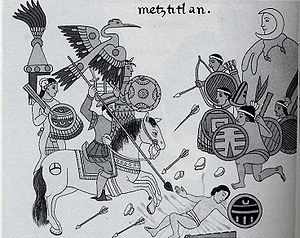
(Spanish & Mexica combat from History of Tlaxcala; source Wikipedia)

At the end of 1520, Cortes with his rejuvenated conquistadors, along with tens of thousands of Indian allies, re-entered the Valley of Mexico, seizing the shore towns of Mexica allies, laying siege to Tenochtitlan and then, in mid-June beginning a direct assault across the causeways to the city.  Desperate to preserve the city and its wealth, Cortes tried several times to negotiate with the Mexica but all attempts were refused.  With a decimated leadership and population, starving and surrounded by their Spanish and Indian enemies, the Mexica fought bravely and with incredible determination against overwhelming odds and it was not until August 13, 1521 that it was all over, leaving Cortes in possession of a ruined city.(Emperor Cuauhtemoc surrenders to Cortes from brittanica)

In the aftermath, many of the surviving Mexica nobility intermarried with the Castilians, who were rewarded with large landholdings and laborers tied to that land.  Some Mexica, like one of Moctezuma's daughters, became large landholders in their own right, and many of the other surviving children of the rulers in the Valley of Mexico did well, with one branch becoming the Counts of Moctezuma and surviving for many generations in Spain.  But for most of the populace it was simply trading one master for another along with the disruption of their cultures and traditions.

Cortes named his son with his Mayan interpreter Marina, Martin in honor of his father.  Marina later married one of the conquistadors.  Martin, along with the other bastard children of Cortes, was legitimised by Pope Clement VII.  After many years in Mexico, Cortes returned to Spain in the 1540s, dying there in 1547.  Martin Cortes inherited part of his large estate.


What was the significance of all this?

From a demographic perspective it was devastating for the inhabitants of Mexico.  The initial smallpox epidemic was followed by measles and other diseases to which the natives had no resistance.  The first census of Mexico was conducted in the 1560s, almost half a century after the conquest, and counted 2.6 million inhabitants.  The scholarship around the population of Mexico pre-conquest is still hotly argued and widely varying estimates but most are within the range of 8-10 million, so we see a 75% reduction over those first few decades (and the population continued to decline into the 17th century from further epidemics).  These epidemics fatally weakened the ability of the Indians of the Western Hemisphere, including the Incas of Peru who were ravaged by disease prior to Pizarro's arrival, to resist European conquerors and settlers.  As one example, further north disease brought by English and French fishermen to the coasts of New England at the beginning of the 17th century may have killed up to 90% of the local population leaving much open land and few natives when the Pilgrims and then Puritans landed a couple of decades later.

At first Cortes attempted to rebuild Tenochtitlan but eventually the lake on which it stood was drained and Mexico City rose atop the lake bed and ruined city, the result a city particularly susceptible to earthquakes because of its unsteady footing.  The Spanish also began importing African slaves, further changing the demographic landscape [the first large importation of African slaves into the Americas falls just outside this ten year time frame but will be touched on in Part 3 of this series].

The wealth and sophistication of Mexico was eye opening for the Castilians.  The amounts were  staggering.  In twelve years, from 1509 through 1521, the conqueror and ruler of Puerto Rico, Ponce de Leon, was able to extract 22,000 pesos from the island.  In his first three months in Tenochtilan, Cortes assembled a personal fortune worth officially 160,000 pesos and unofficially perhaps as much as 700,000 pesos.

But what that wealth inspired was even more important for the long term.  The tales of wealth and the glory of Cortes' conquest attracted even more adventurers from Spain to the New World.  Further conquests quickly followed to the south in the Yucatan and Central America while conquistadors constantly searched for another Mexico.  A decade later, Francisco Pizarro, a distant relative of Cortes, began an expedition that would bring treasure in an amount dwarfing that of Mexico - the conquest of the Inca Empire and most importantly of all, the discovery during the 1540s of the Silver Mountain of Potosi in what is now Bolivia.  In the later part of the 16th century, Potosi (elevation 13,420 feet) was the largest city in the Western Hemisphere with over 100,000 inhabitants.  Its silver flowed across the Atlantic to fill the coffers of the Spanish Hapsburgs as they engaged in war across Europe, funding the Armada against England in 1588, triggering massive inflation across the continent and ultimately leading to the decline of an overextended Spain.

The conquest of Mexico also made New Spain a center for global trade.  On September 20, 1519, as Cortes was entering Tlaxcala, Ferdinand Magellan set forth from Spain with five ships in an attempt to sail around the world.  In April 1521, as Cortes was fighting his way back to Tenochtitlan, Magellan was killed in an encounter with natives in the Philippines.  Finally, on September 6, 1522 one ship with eighteen starving and ragged crewman (of an original 237) staggered into a Spanish harbor.

Subsequent Spanish voyagers discovered trade routes from the Pacific Coast of Mexico to Manila in the Philippines and from there opened up trade with China, in which ships with silver from America would sail to Manila once a year, and be exchanged for silk, porcelain and other valuable Chinese goods.  After offloading at Acapulco, the Chinese goods would be transshipped to the Gulf coast and then sent on to Spain and the rest of Europe.

Along with goods, the route also became used by people, leading Charles C Mann, in his book 1493, to call the Mexico City of the late 16th century and 17th century the first true global city.  Chinese, Japanese, and Southeast Asians ended up in Mexico, and Mann claims the first Chinatown in the Americas was in Mexico City, centered around an Asian marketplace built upon atop the old city center of Tenochtitlan.  Samurai protected the trade caravans as they moved from Acapulco to Mexico City.  The ceramics industry started in Puebla, Mexico, probably employing Chinese workers who brought their designs along with them.

The standard 17th century text on China for Europeans, published in editions in many languages, was a History of the Most Notable Things, Rituals and Customs of the Great Kingdom of China composed by Juan Gonzalez de Mendoza, a Dominican in Mexico City, who describes an Easter Parade in the city:
"a company of soldiers . . . on horseback, and was preceded by mournful horn-players.  When the procession came to the royal palace, the Chinese and the [Franciscans] fought to be at the head of the line; they beat each other over the shoulders with clubs, and with their Crosses; and many were wounded."
We'll close with these words from 1493:
. . . Mexico City's multitude of poorly defined ethnic groups from Africa, Asia, Europe and the Americas made it the world's first truly global city . . . it was the place where East met West under an African and Indian gaze.  Its inhabitants were ashamed of the genetic mix even as they were proud of their cosmopolitan culture, perhaps none more so than the poet Bernard de Balbuena, whose Grandeza Mexicana is a two hundred page love letter to his adopted home. "In thee," he wrote addressing Mexico City,

Spain is joined with China
Italy with Japan, and finally
an entire world in trade and order.
In thee, enjoy the best of the treasures
of the West; in thee, the cream
of all luster created in the East.

Coming Soon - Part 2 in which Martin & Anne cause havoc in Europe.

Friday, January 9, 2015

Down By The River With Bradley Cooper

If the acting thing doesn't work out this guy has a future as an air guitarist.  It's Neil Young's Down By The River featuring the entire first guitar solo.  THC has not seen a lot of air guitar but this is the best he's seen; the man is a student of the song.  At the beginning you'll see Bradley gesturing to make the sound louder in precisely the same way Neil Young does in concert.  Watch the entire thing - it gets particularly surreal, while remaining accurate, around the 3:30 mark. 

Wednesday, May 14, 2014

The Mynah Birds

Neil Young and Rick James in the same band?  You mean Neil Young of Buffalo Springfield, Crosby Stills Nash & Young and a long solo career and Rick James, the master of funk and of the immortal tune Super Freak, one of the most frequently sampled songs of the past 30 years (and there's even a bluegrass version)?

Yep, sorta like Neil Young doing Sexy And I Know It!

In the summer of 1964 a young AWOL American sailor turned up in Toronto, Canada.  Rick James was an aspiring musician who loved the Rolling Stones and by August he'd put together the first lineup for The Mynah Birds.  Over the next two years, before being arrested by U.S. authorities for desertion and spending a year in prison, James had a rotating lineup for the band.  Included among his band mates were two musicians who later became part of Steppenwolf (Born To Be Wild), Nick St Nicholas and Goldy McJohn, and one of the founding members of Buffalo Springfield, bassist Bruce Palmer.  It was Palmer who in January 1966 introduced James to Neil Young, a Canadian guitar player.  Young joined The Mynah Birds who were signed by Motown Records as its first rock n roll act.

In early 1966 The Mynah Birds recorded an album for Motown but Rick's arrest led it to shelve the record.  Palmer and Young headed out to Los Angeles where they met Stephen Stills and Richie Furay, forming Buffalo Springfield later that year.

And here are The Mynah Birds with It's My Time co-written by James and Young which was to be the first single from the album.


THC was vaguely aware of this history but it was reading the recent post in Open Culture and the obsessively detailed story of the band as compiled by Nick Warburton that filled in the details.


Monday, July 8, 2013

Everybody Knows This Is Nowhere


But how do you find out where nowhere is?  Well, here's a handy guide to the most isolated areas in the lower 48 by the folks at Vizual Statistix!

No surprise on most of the nowheres - Nevada, Arizona, Idaho and the junction of the borders of Nevada, Oregon and Idaho.  In the Northeast you'll see one big area in Maine near the Canadian border - that's the Allagash Waterway.
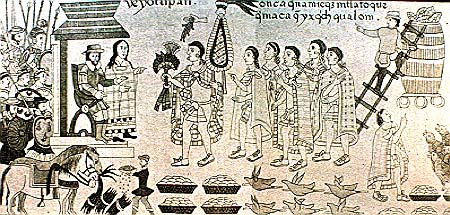
On the other hand, YOU ain't going nowhere.