Someday your children will tell their children that in the olden days people used to actually go into stores with thousands of square feet filled with large packages that contained music and they purchased these enormous discs upon which music resided. They also dressed really badly. The children will roll their eyes at the thought.
Verily, rest your eyes upon Tower Records on Sunset Boulevard in Los Angeles in 1971 as the employees unpack box after box of All Things Must Pass, the brand-new George Harrison solo album. Via Waxpoetics.com
Showing posts with label Music History. Show all posts
Showing posts with label Music History. Show all posts
Tuesday, September 9, 2014

Wednesday, August 20, 2014
Tom Petty: The Don Sutton Of Rock


Don Sutton is in the Baseball Hall of Fame. He won 324 games in a career that stretched from 1966 to 1988 and was always regarded as a very good pitcher but never a great pitcher. Don won 20 or more games only once in his career (21 in 1976) but won between 15 and 19 games in eleven season. He won 12 games in his rookie year and 15 games in his 21st season (1986). Don never led the league in most games won. He won the ERA title once in a season in which he won only 13 games (1980) and did not lead the league in any other major category. Don played with five different teams during his career, Dodgers, Astros, Brewers, A's and Angels. He was respected. He was not an overpowering pitcher but had good stuff, good control and could always be counted upon to be steady and reliable. Don was born in 1945 in Clio, Alabama, moved to Los Angeles when he joined the Dodgers as a rookie and maintained it as his residence. When he joined the Dodgers his teammates in the starting rotation were Sandy Koufax and Don Drysdale.
Tom Petty is in the Rock n Roll Hall of Fame. His recording career started in 1977 and is still going today but in Don Sutton terms the core of his career is from 1977 to 1995. THC always considered him a solid, reliable rocker and doesn't think that anyone else ever considered him one of the all time greats of rock. Never in my top five rockers at any point but always producing good rock n roll. He never had a #1 album or single until his most recent album, Hypnotic Eye, released on July 29, 2014, reached the top spot. He's played in five different recording configurations during his career, Tom Petty & The Heartbreakers, Traveling Wilburys, Mudcrutch, in collaboration with Stevie Nicks and as a solo artist. Tom was born in 1950 in Gainesville, Florida and moved to Los Angeles when his career took off and where he still lives. In the Traveling Wilburys his bandmates included George Harrison, Bob Dylan and Roy Orbison.
Let's take a deeper look at the highlights of Petty's long career:
1977
Breakdown becomes the first hit for Tom Petty & The Heartbreakers. Simple and with a catchy guitar hook.
American Girl. Catch the reference to Florida Route 441 which runs the length of the state.
1978
Listen To Her Heart with the band channeling The Byrds.
1979
Don't Do Me Like That with the Heartbreakers sounding like The Band.
1980
Refugee, which remains a standard on Classic Rock stations.
1981
Stop Draggin' My Heart Around with Stevie Nicks. Released on her solo album and written by Petty and Heartbreaker guitarist Mike Campbell.
The Waiting. One of my personal favorites with a title inspired by a conversation with Roger McGuinn, one of Petty's biggest influences (via The Byrds). THC saw Petty & The Heartbreakers play this live in July 1986 while on tour with Bob Dylan. The show had five segments; Petty opening, Dylan doing a set, Petty back for another set, Dylan returning and then Dylan and Petty closing together. Petty turned in a solid, enjoyable performance; Dylan was terrible. Found this live clip from the prior year of The Waiting and it is a much more dynamic version than the studio recording. Skip the first 1:30 of the video as Petty is just talking about nothing.
1982
You Got Lucky featuring an epically bad video from the early days of MTV. Good lyric with attitude though.
1985
Don't Come Around Here No More with its weird and unsettling video.
1988
As part of the Traveling Wilburys, Handle With Care (written by George Harrison) becomes a hit.
1989
End Of The Line by the Traveling Wilburys.
Petty releases his first solo album (Full Moon Fever) filled with strong tunes like Runnin' Down A Dream (which ends with a searing guitar solo by Mike Campbell), I Won't Back Down (with video featuring Ringo Starr and George Harrison; Harrison played on the recording, Starr did not), Free Fallin', A Face In The Crowd and an almost note for note recreation of I'll Feel A Whole Lot Better by The Byrds (to compare with the original click here). It's Tom Petty's 20-win season.
1991
Learning To Fly and Into The Great Wide Open.with Johnny Depp and Faye Dunaway appearing in ths video.
1993
A new goodie on the Heartbreaker's Greatest Hits CD, Mary Jane's Last Dance with a video that has nothing to do with the lyrics but features Kim Basinger. Smart lyrics and crunching guitar.
1994
You Don't Know How It Feels with Tom doing his Neil Young thing. From Petty's second solo album.
1995
You Wreck Me. Yes, you do.
2008
Scare Easy with his reunited first band, Mudcrutch, played over the closing credits of the movie Appaloosa. For more on the song and movie see the post Scare Easy.
Saturday, July 5, 2014
Long Live Rock n Roll!
Sixty years ago today, Elvis Presley walked into Sam Philips' Sun Studios in Memphis for his first recording session. After spending some time muddling around Elvis, Scotty Moore and Bill Black recorded That's All Right which quickly became a regional hit though Elvis would not break nationally until the release of Heartbreak Hotel in January 1956 (for the full story see That's All Right).

In the three years after that seminal Elvis recording session all the basic building blocks of rock n roll were put into place via the first hit songs of several artists. Before taking a look at the chronology, let's acknowledge two other 1954 recordings that helped start rock n roll - Shake Rattle n Roll by Big Joe Turner and Rock Around the Clock by Bill Haley & The Comets. The former reached #22 on the pop charts that year but while the latter had some chart success that year it did not become a mega-hit until it was re released in May 1955 after being featured on the soundtrack of the hit film Asphalt Jungle.
July 1955: Maybellene by Chuck Berry. The first Chuck Berry Guitar Solo (TM) though not quite as polished as some of his later efforts (for instance, Johnny B Goode from 1958). Berry deliberately and cannily targeted a white teenage audience with his songs, singing about cars, school, girls and just having fun, skillfully modulating the R&B sound in the process. From his Rock n Roll Hall of Fame induction:
In the live clip below you can watch Chuck doing his famous Duckwalk during the guitar solo. On the other hand, maybe he just learned everything from Marty McFly.
January 1956: Blue Suede Shoes by Carl Perkins. Rockabilly strikes! Covered by many other artists, including Elvis.
 (Photo from the-jime.dk)
January 1956: Heartbreak Hotel by Elvis Presley. Elvis becomes ELVIS! The followup single was a little toe-tapper called Hound Dog.
May 1956: I Walk The Line by Johnny Cash. The country sounds bleeds into the emerging rock era.
March 1957: Bye Bye Love by The Everly Brothers. Mixing pop and country with gorgeous harmonies which later influenced The Beatles.
 (Photo from Huffington Post)
May 1957: Whole Lotta Shakin' Goin' On by Jerry Lee Lewis. Jerry Lee shook up a lot of older folks with this and his followup hit Great Balls of Fire which were considered too raucous and overtly sexual.
May 1957: That'll Be The Day by Buddy Holly & The Crickets (originally recorded summer 1956). Melodic rock pioneer.
Suddenly, it was over. In late 1957, Little Richard announced that God had told him to repent of his secular music career and he enrolled in Oakwood College to study theology later becoming a minister before returning to rock n roll periodically over the years. On March 24, 1958 Elvis was inducted into the Army and disappeared for two years, returning to release a lot of schlock until reviving his career with a 1968 TV special. In May 1958 news of Jerry Lee Lewis' marriage to his 13-year old cousin became public and his career collapsed. Buddy Holly died (along with Richie Valens and the Big Bopper) in a February 1959 plane crash near Clear Lake, Iowa and in December of that year Chuck Berry was arrested, and later convicted, for alleged violations of the Federal Mann Act (transporting underage women for immoral purposes; THC can think of many comments to add here but has decided that prudent silence is the best course). Meanwhile, after two further hits in 1958, Johnny Cash disappeared from the pop charts for five years though he continued to have reach the country charts and Carl Perkins faded away after his initial success, though he retained his popularity in England and The Beatles were later to cover several of his songs. Only The Everly Brothers continued to churn out hits without changing their style.
The one essential artist who just misses this time period is Ray Charles. Starting in 1953, Ray had sixteen Top 10 hits on the R&B charts but had not cracked the pop chart Top 10 until the release of What'd I Say in July 1959 which introduced soul and R&B into the rock n roll mix.
A few of these pioneers are still around. Chuck Berry is 87 years old and only recently stopped touring. Little Richard is 81, Don Everly 77 and defying predictions Jerry Lee Lewis is alive and still playing at the age of 78.
In the three years after that seminal Elvis recording session all the basic building blocks of rock n roll were put into place via the first hit songs of several artists. Before taking a look at the chronology, let's acknowledge two other 1954 recordings that helped start rock n roll - Shake Rattle n Roll by Big Joe Turner and Rock Around the Clock by Bill Haley & The Comets. The former reached #22 on the pop charts that year but while the latter had some chart success that year it did not become a mega-hit until it was re released in May 1955 after being featured on the soundtrack of the hit film Asphalt Jungle.
July 1955: Maybellene by Chuck Berry. The first Chuck Berry Guitar Solo (TM) though not quite as polished as some of his later efforts (for instance, Johnny B Goode from 1958). Berry deliberately and cannily targeted a white teenage audience with his songs, singing about cars, school, girls and just having fun, skillfully modulating the R&B sound in the process. From his Rock n Roll Hall of Fame induction:
"while no individual can be said to have invented rock and roll, Berry arguably did more than anyone else to put the pieces together. As rock journalist Dave Marsh wrote, “Chuck Berry is to rock and roll what Louis Armstrong is to jazz.” On “Maybellene” – Berry’s first single, released in 1955 – he played country & western guitar licks over a base of rhythm & blues. The distorted sound of Berry’s guitar captured the rough, untamed spirit of rock and roll."
In the live clip below you can watch Chuck doing his famous Duckwalk during the guitar solo. On the other hand, maybe he just learned everything from Marty McFly.
While
no individual can be said to have invented rock and roll, Berry
arguably did more than anyone else to put the pieces together. As rock
journalist Dave Marsh wrote, “Chuck Berry is to rock and roll what Louis
Armstrong is to jazz.” On “Maybellene” – Berry’s first single, released
in 1955 – he played country & western guitar licks over a base of
rhythm & blues. The distorted sound of Berry’s guitar captured the
rough, untamed spirit of rock and roll. The song included a brief but
scorching solo built around his trademark double-string guitar licks. It
kicked off Berry’s career in style and paved the way for a steady
stream of classics over the next decade. - See more at:
http://rockhall.com/inductees/chuck-berry/bio/#sthash.4xIwFuhr.dpuf
November 1955: Tutti Frutti by Little Richard (aka Richard Wayne Penniman). Manic and unrestrained hollering from the wild man of rock n roll. Pat Boone had a couple of hits recording tamed versions of Little Richard tunes, including Tutti Frutti. Little Richard is relatively restrained in the video below.January 1956: Blue Suede Shoes by Carl Perkins. Rockabilly strikes! Covered by many other artists, including Elvis.
(Photo from the-jime.dk)January 1956: Heartbreak Hotel by Elvis Presley. Elvis becomes ELVIS! The followup single was a little toe-tapper called Hound Dog.
May 1956: I Walk The Line by Johnny Cash. The country sounds bleeds into the emerging rock era.
March 1957: Bye Bye Love by The Everly Brothers. Mixing pop and country with gorgeous harmonies which later influenced The Beatles.
(Photo from Huffington Post)May 1957: Whole Lotta Shakin' Goin' On by Jerry Lee Lewis. Jerry Lee shook up a lot of older folks with this and his followup hit Great Balls of Fire which were considered too raucous and overtly sexual.
May 1957: That'll Be The Day by Buddy Holly & The Crickets (originally recorded summer 1956). Melodic rock pioneer.
Suddenly, it was over. In late 1957, Little Richard announced that God had told him to repent of his secular music career and he enrolled in Oakwood College to study theology later becoming a minister before returning to rock n roll periodically over the years. On March 24, 1958 Elvis was inducted into the Army and disappeared for two years, returning to release a lot of schlock until reviving his career with a 1968 TV special. In May 1958 news of Jerry Lee Lewis' marriage to his 13-year old cousin became public and his career collapsed. Buddy Holly died (along with Richie Valens and the Big Bopper) in a February 1959 plane crash near Clear Lake, Iowa and in December of that year Chuck Berry was arrested, and later convicted, for alleged violations of the Federal Mann Act (transporting underage women for immoral purposes; THC can think of many comments to add here but has decided that prudent silence is the best course). Meanwhile, after two further hits in 1958, Johnny Cash disappeared from the pop charts for five years though he continued to have reach the country charts and Carl Perkins faded away after his initial success, though he retained his popularity in England and The Beatles were later to cover several of his songs. Only The Everly Brothers continued to churn out hits without changing their style.
The one essential artist who just misses this time period is Ray Charles. Starting in 1953, Ray had sixteen Top 10 hits on the R&B charts but had not cracked the pop chart Top 10 until the release of What'd I Say in July 1959 which introduced soul and R&B into the rock n roll mix.
A few of these pioneers are still around. Chuck Berry is 87 years old and only recently stopped touring. Little Richard is 81, Don Everly 77 and defying predictions Jerry Lee Lewis is alive and still playing at the age of 78.
Wednesday, May 28, 2014
Wrote A Song For Everyone

Wrote a song for everyone,
Wrote a song for truth.
Wrote a song for everyone
And I couldn't even talk to you.
For 2 1/2 years beginning in January 1969, Creedence Clearwater Revival, ignited by the songwriting, guitar playing and singing of John Fogerty (who had a voice that could peel paint), ruled the AM radio airways. CCR had a run of nine straight Top Ten singles:
CCR never had a #1 but four of its singles reached #2 - Proud Mary, Bad Moon Rising, Green River (THC's favorite) and the double-sided hit Traveling Band/Who'll Stop The Rain (Billboard changed its system in 1970 to count sales of both sides of a single together in putting together its charts)
A fifth single hit #3 - Down On The Corner; it's flip side Fortunate Son hit #14. This was in 1969 before Billboard changed its rules and it might have made #1 under the new rules.
Up Around The Bend/Run Through The Jungle hit #4, Sweet Hitch-Hiker #6 and Have You Ever Seen The Rain?/Hey Tonight was #8.
They also released five albums in 23 months all of which reached the Top Ten.
 (Green River album cover)
But today we'll focus on the lesser known songs of CCR, so we'll also skip over heavy FM playlist songs like Born On A Bayou, Keep On Chooglin' and Susie Q.
When THC first heard CCR he thought they had crawled out of the swamps of Louisiana but it turns out they're from suburban California and had scuffled for years (mostly playing as The Golliwogs) before achieving "overnight" success. Which brings us to our first song for today, Lodi.
If I only had a dollar, for ev'ry song I've sung.
And ev'ry time I've had to play
While people sat there drunk.
You know, I'd catch the next train back to where I live.
Oh ! Lord, I'm stuck in Lodi again.
CCR never played in Lodi, a town in California's Central Valley, but Fogerty liked the way the name sounded and it stood in for the endless procession of bars and clubs he'd played in over the years as a struggling musician. The lyrics catch the pathos of the singer wondering if he's doomed to play this circuit forever.
Next up is Bootleg which THC has featured before and should be taught in college as part of any Political Science curriculum for its astute analysis of public policy:
Take you a glass of water
Make it against the law.
See how good the water tastes
When you can't have any at all.
Our next tune is Penthouse Pauper featuring paint peeling guitar lines in addition to the paint peeling vocal. Listen to how Fogerty makes his guitar sound like a hacksaw when he signs "If I was a hacksaw, my blade'd be razor sharp".
We'll wrap this up with Wrote A Song For Everyone, the lyric featured at the top of this post. Written after a tiff with his wife over needing to spend more time with his young son, Fogerty wrote this about the clash between family and his profession. The reference in the lyric to "Richmond" is to Richmond, California a Bay Area town near his home.
If you'd like to hear how Fogerty sounds more recently on a non-Fogerty composed song this is Screamin' Jay Hawkins' I Put A Spell On You from a live show in the late 1990s. The drummer is Kenny Aronoff who hits the skins harder than anyone who isn't named John Bonham.
Wednesday, May 14, 2014
The Mynah Birds
Neil Young and Rick James in the same band? You mean Neil Young of Buffalo Springfield, Crosby Stills Nash & Young and a long solo career and Rick James, the master of funk and of the immortal tune Super Freak, one of the most frequently sampled songs of the past 30 years (and there's even a bluegrass version)?
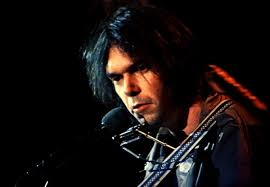
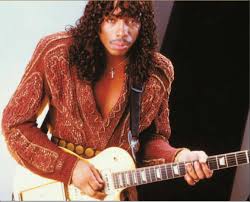
Yep, sorta like Neil Young doing Sexy And I Know It!
In the summer of 1964 a young AWOL American sailor turned up in Toronto, Canada. Rick James was an aspiring musician who loved the Rolling Stones and by August he'd put together the first lineup for The Mynah Birds. Over the next two years, before being arrested by U.S. authorities for desertion and spending a year in prison, James had a rotating lineup for the band. Included among his band mates were two musicians who later became part of Steppenwolf (Born To Be Wild), Nick St Nicholas and Goldy McJohn, and one of the founding members of Buffalo Springfield, bassist Bruce Palmer. It was Palmer who in January 1966 introduced James to Neil Young, a Canadian guitar player. Young joined The Mynah Birds who were signed by Motown Records as its first rock n roll act.
In early 1966 The Mynah Birds recorded an album for Motown but Rick's arrest led it to shelve the record. Palmer and Young headed out to Los Angeles where they met Stephen Stills and Richie Furay, forming Buffalo Springfield later that year.
And here are The Mynah Birds with It's My Time co-written by James and Young which was to be the first single from the album.
THC was vaguely aware of this history but it was reading the recent post in Open Culture and the obsessively detailed story of the band as compiled by Nick Warburton that filled in the details.
Yep, sorta like Neil Young doing Sexy And I Know It!
In the summer of 1964 a young AWOL American sailor turned up in Toronto, Canada. Rick James was an aspiring musician who loved the Rolling Stones and by August he'd put together the first lineup for The Mynah Birds. Over the next two years, before being arrested by U.S. authorities for desertion and spending a year in prison, James had a rotating lineup for the band. Included among his band mates were two musicians who later became part of Steppenwolf (Born To Be Wild), Nick St Nicholas and Goldy McJohn, and one of the founding members of Buffalo Springfield, bassist Bruce Palmer. It was Palmer who in January 1966 introduced James to Neil Young, a Canadian guitar player. Young joined The Mynah Birds who were signed by Motown Records as its first rock n roll act.
In early 1966 The Mynah Birds recorded an album for Motown but Rick's arrest led it to shelve the record. Palmer and Young headed out to Los Angeles where they met Stephen Stills and Richie Furay, forming Buffalo Springfield later that year.
And here are The Mynah Birds with It's My Time co-written by James and Young which was to be the first single from the album.
THC was vaguely aware of this history but it was reading the recent post in Open Culture and the obsessively detailed story of the band as compiled by Nick Warburton that filled in the details.
Tuesday, April 8, 2014
Respect Yourself
Otis Redding, Wilson Pickett, Sam & Dave, Booker T & the MGs (with Steve Cropper and Duck Dunn), Carla & Rufus Thomas, Eddie Floyd, Isaac Hayes, The Staple Singers, Luther Ingram
Over a period of about fifteen years, from 1960 to the mid-1970s, Stax Records had all these artists, pioneering a unique funk and soul sound and, in its early years blending white and black musicians and executives in the most unlikely of places, segregated Memphis, Tennessee.
The story is well-told by Robert Gordon in Respect Yourself: Stax Records and the Soul Explosion (2013) with a foreword by Booker T Jones. It's a story with a first act and a second act with the first act being the more compelling.
The store would be a way to gauge what shoppers were buying, would provide immediate customer response to new and developing songs, and would yield a working library so writers and musicians could keep current. The initial purpose was plain and simple: cash flow to help pay the rent.
At the time when there was no set template for the record industry or recording labels and to the extent there was any developing template Stax didn't follow it. There were no union studio musicians, no charts developed before recording sessions; they were making it up as they went along.
What's remarkable is how young everyone was. What became the core of the studio musical team, Booker T, Steve Cropper, Duck Dunn, The Bar-Kays and the Mar-Keys were all in high school when they started working at Stax and Booker T and Cropper, in particular, became executives, managing the recording process while still in their teens.
Steve Cropper:
He put a spark under Stax. No question about it . . . Otis Redding was the one artist that everybody looked forward to recording with.
 (Cropper)
Booker T:
Otis Redding seemed to be a person with a mission and we picked up that mission and it became all of ours. His intent was so strong and so powerful when we were recording that it translated to more than the music.
It was Redding who made the break through to a white audience at the Monterrey Pop festival in July 1967 and late that year he and Cropper wrote the song that he was certain would be his first Number One, (Sittin' On) The Dock of The Bay (for the full story see Sittin' In The Morning Sun). Here's Otis at Monterrey (and stick around for the last minute of the video):
And it was Redding's death (along with most of the Bar-Kays) when his plane crashed into Lake Mendota in Madison, Wisconsin in December 1967 that was the first of three events over six months that transformed Stax and signaled the closing of the curtain on its first act. Released soon after his death, The Dock of The Bay became one of the best selling singles of 1968.
The second was the revelation of the awful distribution agreement Jim Stewart had entered into with Atlantic Records back in 1965. Stewart had entered into it without consulting a lawyer. Jerry Wexler, the Atlantic producer claimed he didn't read it either but there is room for doubt. In any event, when Wexler and Ahmet Ertegun sold Atlantic it turned out that the contract gave Atlantic control of Stax's masters destroying the economic value of the Stax catalogue.
The third was the murder of Martin Luther King at the Lorraine Motel in April 1968. Throughout Respect Yourself, Gordon weaves the story of race relations in Memphis and, in particular, of the struggle of the black sanitation workers to gain respect and have their unionization efforts recognized by white politicians. This struggle, which had gone on for several years, was what brought King to Memphis.
 (King in Memphis)
Stax had been an oasis amidst the racial strife. The one place in Memphis where blacks and white could work together. Booker T and the MGs was unique, two black and two white musicians. In the introduction, Booker T writes of Jim Stewart's hiring of a black man, Al Bell, as an executive at Stax:
It was 1965 in Memphis, Tennessee, the heart of the American South. Throughout this wide region, race mixing was nothing short of an assault on the social realm. Inside Stax Records, whites and blacks had worked side by side for half a decade. People who couldn't publicly dine together were making beautiful music, that the public - black and white - loved to hear. Many times, however they'd step outside the studio and white cops would stop to check on the whites' safety, to hassle the blacks.
One telephone and one desk. While Al situated himself, Jim made a call. When he hung up, Al watched as Jim slid that phone across the desk, toward him.
(Al Bell & Jim Stewart)
Al Bell made his call. When done, like his boss, he slid the phone back across the desk. It was such a quotidian act, yet revolutionary in 1965. . . In Memphis, thirty three African American men had been recently fired from the sanitation department for fomenting strike talk . . . the City of Memphis defied integration orders by closing its public swimming pools - for two consecutive hot summers - rather than having blacks and whites share the same water.
"I was amazed to sit in the same room with this white guy who had been a country fiddle player", says Al . . . "The spirit that came from Jim and his sister Estelle Axton allowed all of us, black and white, to come off the streets, where you had segregation and the negative attitude, and come into the doors of Stax, where you had freedom, you had harmony".
King's death changed it all. The distrust and anger overwhelmed all of the city, including Stax. THC encountered the way attitudes were impact. About 20 years ago he managed a team based in Memphis and one of the group was a white Memphis native born in the 1930s who told THC that "things wouldn't be right in Memphis" until the day when everyone, white and black, who was there the day King was murdered had themselves died.
For Stax it meant changes in the working relationships, in the management and even in the sound of the music. Over time Estelle Axton and Steve Cropper left and Al Stewart was bought out and the management became explicitly focused on a black audience. There were some great successes, Isaac Hayes and the Staple Singers being two of the biggest, but Stax ultimately overexpanded, got out of financial control was finally went bankrupt. In a sad note, Jim Stewart, who had walked away with enough to make him financially sound for the rest of his life, came back at the end and pledged all his personal assets to help keep Stax afloat. When it went bankrupt he lost everything.
 (Isaac Hayes)
The second act of Respect Yourself is well told but it is essentially a sad and dreary story after the uplifting first act. But we all still have the music and we'll leave you with Hold On, I'm Coming by Sam & Dave, written by Isaac Hayes and David Porter and you can read Respect Yourself for the story of how the song ended up with its title.
(Isaac Hayes)
The second act of Respect Yourself is well told but it is essentially a sad and dreary story after the uplifting first act. But we all still have the music and we'll leave you with Hold On, I'm Coming by Sam & Dave, written by Isaac Hayes and David Porter and you can read Respect Yourself for the story of how the song ended up with its title. Wednesday, February 26, 2014
The British Invasion: Breakout
Part two of the series:
The second half of 1964 saw the breakout from the bridgehead established by The Beatles and the first wave of British artists. The music also gets more interesting as it quickly evolves.
Once again, it starts with The Beatles. On July 6, the movie and the song, A Hard Day's Night, premiered and by August 1 it was #1 in the U.S. With its unusual opening chord and sharper guitar sound it was a step forward for the band. Here's the song over the opening credits of the movie.
The next big British song was really different, The House Of The Rising Sun by The Animals which hit #1 in early September in the United States and was a global smash becoming one of the top five selling records worldwide for the entire year. A reworking of an old American folk song (click here to hear the first recorded version from 1933), there were several unusual aspects of the record:
A great record then and now. A couple of years later, the bass player, Chas Chandler, discovered a guy named Jimi Hendrix playing in a London club and went on to produce his first three albums.
Replacing The Animals on top of the American charts was a native-born son, Roy Orbison, with Oh, Pretty Woman. In an interesting twist from August 1963 to December 1964 Roy Orbison was the only American artist to top the British charts and he did it twice.
Meanwhile The Stones were still trying to break through with It's All Over Now. They didn't.
Next up was one of the great novelty songs of the year, Do Wah Diddy by the band Manfred Mann. The man, Manfred Mann, was a South African jazz pianist who played keyboards with the band Manfred Mann while the over the top vocal on the song is by Paul Jones who, two years earlier, turned down Keith Richards and Brian Jones when they asked him to be the lead singer in the band they were forming (Paul is currently President of the National Harmonica League of Britain - seriously). The tune was written by Americans Jeff Barry and Ellie Greenwich who also composed Da Doo Ron Ron, Be My Baby, River Deep, Mountain High and Leader of the Pack.
The next two big singles were groundbreaking and still sound great decades later.
You Really Got Me by The Kinks (for more than you will ever want to know about the band see Kinkdom) was an out of control rocker built around power chords and considered by some to be the first punk or heavy metal song. Despite persistent rumors that Jimmy Page played the guitar solo it was Dave Davies, brother of composer and lead singer Ray Davies, who performed the spasmodic, fractured and frantic solo.
Then there was She's Not There by The Zombies. All of a sudden we have a jazzy electric piano and syncopation. Where did that come from? And the breathy vocal. Very cool song.
Late in the year, The Rolling Stones finally scored their first top 10 in America with Time Is On My Side but their real breakthrough would not be until the release of Satisfaction in May 1965.
The year closed with three notable events. First was The Kinks followup hit, All Day And All Of The Night, essentially a reworking of You Really Got Me.
Second, the emergence of the third British wave with I'm Into Something Good by Herman's Hermits. Unfortunately, this third wave was not as innovative and pop definitely triumphed over rock as Herman's Hermits had a string of hits in 1965 and were joined by bands like Freddie & The Dreamers and Wayne Fontana & The Mindbenders.
The third was the release of the first Beatles single since A Hard Day's Night, an innovative recording called I Feel Fine, which starts with guitar feedback (the first hit single to feature it) and then slides into a snappy guitar riff, great harmonies and some good drum work by Ringo in the break. It reached #1 during the last week of 1964 while the B side, She's A Women also became a top 10 hit. During 1964 The Beatles had 30 different singles on the Billboard Hot 100 Chart.
The second half of 1964 saw the breakout from the bridgehead established by The Beatles and the first wave of British artists. The music also gets more interesting as it quickly evolves.
Once again, it starts with The Beatles. On July 6, the movie and the song, A Hard Day's Night, premiered and by August 1 it was #1 in the U.S. With its unusual opening chord and sharper guitar sound it was a step forward for the band. Here's the song over the opening credits of the movie.
The next big British song was really different, The House Of The Rising Sun by The Animals which hit #1 in early September in the United States and was a global smash becoming one of the top five selling records worldwide for the entire year. A reworking of an old American folk song (click here to hear the first recorded version from 1933), there were several unusual aspects of the record:
- The length of over four minutes at a time when a three minute song was considered long. Many AM stations played an edited version that was less than three minutes.
- The subject matter, considered very racy for the time.
- The raw vocal by Eric Burden. There may have been singing like this on some of the Chicago blues records of the 50s but those were not being played on mainstream AM radio and no white singer had sounded this way.
- The swirling, relentless organ arrangement by Alan Price which added to the feverish atmosphere of the recording.
A great record then and now. A couple of years later, the bass player, Chas Chandler, discovered a guy named Jimi Hendrix playing in a London club and went on to produce his first three albums.
Replacing The Animals on top of the American charts was a native-born son, Roy Orbison, with Oh, Pretty Woman. In an interesting twist from August 1963 to December 1964 Roy Orbison was the only American artist to top the British charts and he did it twice.
Meanwhile The Stones were still trying to break through with It's All Over Now. They didn't.
Next up was one of the great novelty songs of the year, Do Wah Diddy by the band Manfred Mann. The man, Manfred Mann, was a South African jazz pianist who played keyboards with the band Manfred Mann while the over the top vocal on the song is by Paul Jones who, two years earlier, turned down Keith Richards and Brian Jones when they asked him to be the lead singer in the band they were forming (Paul is currently President of the National Harmonica League of Britain - seriously). The tune was written by Americans Jeff Barry and Ellie Greenwich who also composed Da Doo Ron Ron, Be My Baby, River Deep, Mountain High and Leader of the Pack.
The next two big singles were groundbreaking and still sound great decades later.
You Really Got Me by The Kinks (for more than you will ever want to know about the band see Kinkdom) was an out of control rocker built around power chords and considered by some to be the first punk or heavy metal song. Despite persistent rumors that Jimmy Page played the guitar solo it was Dave Davies, brother of composer and lead singer Ray Davies, who performed the spasmodic, fractured and frantic solo.
Then there was She's Not There by The Zombies. All of a sudden we have a jazzy electric piano and syncopation. Where did that come from? And the breathy vocal. Very cool song.
Late in the year, The Rolling Stones finally scored their first top 10 in America with Time Is On My Side but their real breakthrough would not be until the release of Satisfaction in May 1965.
The year closed with three notable events. First was The Kinks followup hit, All Day And All Of The Night, essentially a reworking of You Really Got Me.
Second, the emergence of the third British wave with I'm Into Something Good by Herman's Hermits. Unfortunately, this third wave was not as innovative and pop definitely triumphed over rock as Herman's Hermits had a string of hits in 1965 and were joined by bands like Freddie & The Dreamers and Wayne Fontana & The Mindbenders.
The third was the release of the first Beatles single since A Hard Day's Night, an innovative recording called I Feel Fine, which starts with guitar feedback (the first hit single to feature it) and then slides into a snappy guitar riff, great harmonies and some good drum work by Ringo in the break. It reached #1 during the last week of 1964 while the B side, She's A Women also became a top 10 hit. During 1964 The Beatles had 30 different singles on the Billboard Hot 100 Chart.
Subscribe to:
Posts (Atom)