From Revolver on, John Lennon, who disliked his voice, insisted it be processed or altered, primarily through compression (called ADT), most famously on Tomorrow Never Knows when he instructed George Martin to make him sound like the Dalai Lama singing from a mountaintop. As someone who appreciated Lennon's vocals on the early Beatles albums, I did not like the production treatment of his vocals on the later records, which stripped out the fullness and warmth in his voice. Cry Baby Cry is from the White Album in 1968, a song I liked on a double album of uneven quality. However, this is Take 1 before Lennon's voice was altered and additional instruments added to the track and the vocal is superior to the final version.
Showing posts with label Beatles. Show all posts
Showing posts with label Beatles. Show all posts
Wednesday, July 15, 2026

Friday, February 9, 2024
Now And Then
The last song from The Beatles, released late last year. Simple and elegiac, based on a Lennon demo from the late 1970s, transformed into a tribute by Paul and Ringo to their missing mates. Tonight's the 60th anniversary of the band's US performance debut on The Ed Sullivan Show, watched by 73 million Americans, including almost 13 year old me. At the time, the outbreak of World War One seemed unfathomably distant to me, but it was much closer in time than today is to that night sixty years ago.
Tuesday, July 20, 2021
Think For Yourself
"We cannot chose our external circumstances, but we can always chose how to respond to them."
- Epictetus (Stoic philosopher, 50-135 AD)
"Why to we have to do this? Democrats are the party that demonstrate the dangers of when experts have lost their minds. Republicans demonstrate the dangers of a party that has lost all trust in expertise"
- Richard Hanania (2021)
"Think for yourself/cause I won't be there with you"
- George Harrison (1965)
Friday, April 9, 2021
All Things Must Pass
From the 2002 memorial tribute concert to George Harrison, organized by his friend Eric Clapton. This is a beautiful version of All Things Must Pass and Paul McCartney's vocal does it justice. That's George's son, Dhani, next to Paul. You can also see Ringo on drums and the late Billy Preston on piano. Also recognized Gary Brooker from Procol Harum on keyboards and Jeff Lynne and I'm sure there are some other well known names there.
Thursday, October 15, 2020
Cripple Creek
Let's feel good today! From the 1989 tour of Ringo Starr's All Starr Band, it's Up On Cripple Creek, from The Band's 1969 album which is that rarity, a perfect record that holds up over the years (here's my song by song breakdown) And it really is an all-star band. Levon Helm (vocals, drums) and Rick Danko (bass) from The Band, Ringo on drums, Joe Walsh (Joe and Ringo are now married to the Bach sisters) on guitar, Dr John and Billy Preston on keyboards, with Nils Lofgren,
from the E Street Band, on guitar.
Sunday, May 10, 2020
The Long And Winding Road Ends
I thinks this makes officially makes me old . . .
Fifty years ago tomorrow, May 11, 1970, The Beatles released their final single, The Long And Winding Road (for you kids, singles once had a physical manifestation). Like most of its predecessors it became #1 in the United States. It's one of my least favorite Beatles songs, suffering from Phil Spector's post-production layering on of strings and other instrumentation and much preferring the more stripped-down original version recorded (below) in early 1969 during the abortive Get Back recording sessions. The prior release, the classic Let It Be, should have been their farewell.
The Beatles hold and influence on pop music over a more than six-year period was phenomenal. The first six months of 1964 saw Beatlemania explode across the U.S. - in April, 13 of the top 100 singles were by the band and 65% of all records sold were by The Beatles. They had four #1's in that time frame (She Loves You, I Want To Hold Your Hand, Can't Buy Me Love, Love Me Do) along with two at #2 (Twist & Shout, Do You Want To Know A Secret) and Please, Please, Me reached Number 3. After that initial flurry of releases things calmed down to a more steady pace for the singles.
Though I'd seen their Ed Sullivan appearances in February and March of 1964 and occasionally heard them on our car radio, it was only in February 1965, when home sick, my parents gave me a radio to have next to my bed, that I became an avid listener, so the first single I distinctly remember debuting was Eight Days A Week, released on the 15th of that month. From then through the release of Get Back in April 1969 I still have memories attached to most of the singles though by the time Abbey Road was released that fall I was in college and my taste had turned to the rougher sound of the Stones who were reaching their peak (on December 5, Let It Bleed was released).
Of fifteen Beatles albums released in the U.S. between 1964 and 1970, thirteen topped the charts, the others being Something New (1964) which got to #2 but was blocked from the top spot by the soundtrack album for A Hard Day's Night, and the soundtrack for the movie Yellow Submarine, which also reached #2 in early 1969, blocked by the White Album, released only seven weeks earlier and which topped the charts for 9 weeks (and spent 186 weeks on the Billboard 200). The Beatles still hold the record for most cumulative weeks at #1 on the album chart with 132 weeks; second is Garth Brooks with 52. Since the beginning of the Billboard charts in the early 1950s the Beatles have more #1 albums than any other artist.
From July 13, 1964, with the release of A Hard Day's Night, through May 11, 1970, The Beatles released twenty U.S. singles of which 16 (including the final three) hit #1. The only exceptions were Nowhere Man (#3), Yellow Submarine (#2, though its B-side, Eleanor Rigby reached #11, so probably a #1 if you counted both sides), Lady Madonna (#4), and The Ballad of John & Yoko (#8) - released while Get Back was still #1, with only John and Paul appearing on the song.
The B-sides of four #1 singles were also hits - She's A Woman, the flip side of I Feel Fine, which was #4; Day Tripper, flip of We Can Work It Out, reaching #5; Strawberry Fields Forever the #8 flip of Penny Lane; and Revolution, hitting #12 as the flip of Hey Jude, The Beatles' best-ever selling single which topped the charts for eight weeks in the fall of 1968.
An oddity was the single released as a double A side in October 1969; Something and Come Together. At the time, Billboard counted each side of a single separately in reporting sales and charting but several weeks after its release Billboard announced it would start counting both sides of singles in calculating chart positions and The Beatles had another #1 as a result. It was also one of the few times the band released a single with songs appearing on an already released album (Sgt Pepper, Rubber Soul, and the White Album contained no singles).
The longest intervals between single releases were the 7 1/2 months between Hey Jude (8/26/68) and Get Back (4/11/69) and six months from Yellow Submarine (8/5/66) to Penny Lane (2/13/67). As teenagers we were well aware of both gaps, wondering what was up with the boys, and if Paul was dead.
During the 32 months between Yellow Submarine's release and that of Get Back, The Beatles released only five singles but finished with a flourish, releasing five more singles from April 1969 through May 1970.
As for staying power, 1, the Beatles album released in 2000 and containing all of the group's #1 singles in either the U.S. or U.K. was the best selling album of the first decade of the 21st century worldwide and the 4th best selling album in the U.S. over the past thirty years, with 31 million copies purchased to date.
And now our daughter plays lullaby versions of Beatles songs to help our 5 month old grandson fall asleep.
Fifty years ago tomorrow, May 11, 1970, The Beatles released their final single, The Long And Winding Road (for you kids, singles once had a physical manifestation). Like most of its predecessors it became #1 in the United States. It's one of my least favorite Beatles songs, suffering from Phil Spector's post-production layering on of strings and other instrumentation and much preferring the more stripped-down original version recorded (below) in early 1969 during the abortive Get Back recording sessions. The prior release, the classic Let It Be, should have been their farewell.
The Beatles hold and influence on pop music over a more than six-year period was phenomenal. The first six months of 1964 saw Beatlemania explode across the U.S. - in April, 13 of the top 100 singles were by the band and 65% of all records sold were by The Beatles. They had four #1's in that time frame (She Loves You, I Want To Hold Your Hand, Can't Buy Me Love, Love Me Do) along with two at #2 (Twist & Shout, Do You Want To Know A Secret) and Please, Please, Me reached Number 3. After that initial flurry of releases things calmed down to a more steady pace for the singles.
Though I'd seen their Ed Sullivan appearances in February and March of 1964 and occasionally heard them on our car radio, it was only in February 1965, when home sick, my parents gave me a radio to have next to my bed, that I became an avid listener, so the first single I distinctly remember debuting was Eight Days A Week, released on the 15th of that month. From then through the release of Get Back in April 1969 I still have memories attached to most of the singles though by the time Abbey Road was released that fall I was in college and my taste had turned to the rougher sound of the Stones who were reaching their peak (on December 5, Let It Bleed was released).
Of fifteen Beatles albums released in the U.S. between 1964 and 1970, thirteen topped the charts, the others being Something New (1964) which got to #2 but was blocked from the top spot by the soundtrack album for A Hard Day's Night, and the soundtrack for the movie Yellow Submarine, which also reached #2 in early 1969, blocked by the White Album, released only seven weeks earlier and which topped the charts for 9 weeks (and spent 186 weeks on the Billboard 200). The Beatles still hold the record for most cumulative weeks at #1 on the album chart with 132 weeks; second is Garth Brooks with 52. Since the beginning of the Billboard charts in the early 1950s the Beatles have more #1 albums than any other artist.
From July 13, 1964, with the release of A Hard Day's Night, through May 11, 1970, The Beatles released twenty U.S. singles of which 16 (including the final three) hit #1. The only exceptions were Nowhere Man (#3), Yellow Submarine (#2, though its B-side, Eleanor Rigby reached #11, so probably a #1 if you counted both sides), Lady Madonna (#4), and The Ballad of John & Yoko (#8) - released while Get Back was still #1, with only John and Paul appearing on the song.
The B-sides of four #1 singles were also hits - She's A Woman, the flip side of I Feel Fine, which was #4; Day Tripper, flip of We Can Work It Out, reaching #5; Strawberry Fields Forever the #8 flip of Penny Lane; and Revolution, hitting #12 as the flip of Hey Jude, The Beatles' best-ever selling single which topped the charts for eight weeks in the fall of 1968.
An oddity was the single released as a double A side in October 1969; Something and Come Together. At the time, Billboard counted each side of a single separately in reporting sales and charting but several weeks after its release Billboard announced it would start counting both sides of singles in calculating chart positions and The Beatles had another #1 as a result. It was also one of the few times the band released a single with songs appearing on an already released album (Sgt Pepper, Rubber Soul, and the White Album contained no singles).
The longest intervals between single releases were the 7 1/2 months between Hey Jude (8/26/68) and Get Back (4/11/69) and six months from Yellow Submarine (8/5/66) to Penny Lane (2/13/67). As teenagers we were well aware of both gaps, wondering what was up with the boys, and if Paul was dead.
During the 32 months between Yellow Submarine's release and that of Get Back, The Beatles released only five singles but finished with a flourish, releasing five more singles from April 1969 through May 1970.
As for staying power, 1, the Beatles album released in 2000 and containing all of the group's #1 singles in either the U.S. or U.K. was the best selling album of the first decade of the 21st century worldwide and the 4th best selling album in the U.S. over the past thirty years, with 31 million copies purchased to date.
And now our daughter plays lullaby versions of Beatles songs to help our 5 month old grandson fall asleep.
Wednesday, April 15, 2020
Yer Blues
A Lennon-McCartney tune from the White Album but this is a unique version from the Rolling Stone's Rock n Roll Circus in 1968. John Lennon on guitar and vocals, Eric Clapton on lead guitar, Keith Richards on bass, and Mitch Mitchell (of the Jimi Hendrix Experience) on drums.
Heck of a pick up band.
Tuesday, February 25, 2020
Baroque Rock
Perhaps "Classical" classic rock might be a better term but, in any event, the origins and brief heyday of this pop mode are in the mid-60s, when musicians began incorporating melodies, instrumentation, and arrangements from Baroque and the Romantic periods into popular music. I still enjoy the sound of these recordings.
It starts in the fall of 1965 with the near simultaneous release of Yesterday by The Beatles and Lovers Concerto by the Motown group, The Toys. Both became immediate smash hits - on the Billboard Hot 100 Chart for October 30, 1965, Yesterday is #1 and Lovers Concerto #2. Yesterday, featuring just Paul on vocals backed by a string quartet, was a startling departure for The Beatles and rock music in general. As for Lovers Concerto, while the instrumentation was pure Motown, the melody came directly from Minuet in G Major by Christian Penzold (1677-1733) a contemporary of Johann Sebastian Bach.
In December, The Beatles released Rubber Soul containing In My Life with its unusual harpsichord solo, a baroque instrument which began to see more use in pop songs. That same month, the Rolling Stones, at the beginning of their imitative Beatles phase and after, no doubt prodding by their panicked manager and producer, Andrew Loog Oldham, decided to mimic Yesterday by releasing a string sweetened version of As Tears Go By, originally written for, and released by, Marianne Faithful, the year before but with a more pop/folk arrangement.
July 1966 saw the release of what many regard as the quintessential baroque rock song, the melancholy Walk Away Renee by the Left Banke:
The month after Walk Away Renee was issued Revolver by The Beatles hit the airwaves with two entries in this category, the best known being Eleanor Rigby, recognized as a remarkable accomplishment at the time, along with For No One. The version below of Eleanor Rigby is a reimagining, using the original recorded tracks, created by Giles Martin (son of George) with the approval of Paul & Ringo for the Cirquedu Soleil show Love which is based upon the music of The Beatles.
1967 and early 1968 saw the last burst of the initial wave of baroque rock. May saw the release of Procol Harum's first single A White Shade of Pale, a monster worldwide hit with a majestic vocal from Gary Brooker and would reprise elements of the sound in 1969's A Salty Dog.
The end of the year saw the release of Harry Nilsson's album, Pandemonium Shadow Show (named in homage to the strange and disturbing traveling circus at the center of Ray Bradbury's Something Wicked This Way Comes) featuring, among other tunes, Without Her, with a wonderful arrangement of strings and woodwinds.
Child Is Father To The Man, the debut album of Blood, Sweat & Tears released in February 1968, produced by John Simon (who also produced the first two albums by The Band) and arranged by the band's founder Al Kooper, remains one of the best sounding albums of the 60s. Kooper put together a talented group of musicians to create a unique blend of rock, pop, blues, and jazz and had a great ear for new songwriters finding tunes by little known, at the time, composers Randy Newman, Harry Nilsson, and Tim Buckley, and he was also a good songwriter in his own right. Unfortunately, Al couldn't sing a lick and his stubborn insistence of being lead vocalist led, after the album's release, to a revolt by the other band members and eviction from his own group, after which they recruited David Clayton-Thomas as vocalist and went on to great commercial success, though in my estimate the first album with Kooper remains their finest despite his vocal limitations.
The result was an eclectic collection of songs with the oddest being a Kooper composition, The Modern Adventures of Plato, Diogenes, and Freud, with the string arrangement making an appropriate capstone to this era.
It starts in the fall of 1965 with the near simultaneous release of Yesterday by The Beatles and Lovers Concerto by the Motown group, The Toys. Both became immediate smash hits - on the Billboard Hot 100 Chart for October 30, 1965, Yesterday is #1 and Lovers Concerto #2. Yesterday, featuring just Paul on vocals backed by a string quartet, was a startling departure for The Beatles and rock music in general. As for Lovers Concerto, while the instrumentation was pure Motown, the melody came directly from Minuet in G Major by Christian Penzold (1677-1733) a contemporary of Johann Sebastian Bach.
In December, The Beatles released Rubber Soul containing In My Life with its unusual harpsichord solo, a baroque instrument which began to see more use in pop songs. That same month, the Rolling Stones, at the beginning of their imitative Beatles phase and after, no doubt prodding by their panicked manager and producer, Andrew Loog Oldham, decided to mimic Yesterday by releasing a string sweetened version of As Tears Go By, originally written for, and released by, Marianne Faithful, the year before but with a more pop/folk arrangement.
July 1966 saw the release of what many regard as the quintessential baroque rock song, the melancholy Walk Away Renee by the Left Banke:
Just walk away ReneeThe Left Banke followed this up with one more baroque single in late 1966 before breaking up, Pretty Ballerina with its gorgeous oboe solo.
You won't see me follow you back home
Now as the rain beats down upon my weary eyes
For me it cries
The month after Walk Away Renee was issued Revolver by The Beatles hit the airwaves with two entries in this category, the best known being Eleanor Rigby, recognized as a remarkable accomplishment at the time, along with For No One. The version below of Eleanor Rigby is a reimagining, using the original recorded tracks, created by Giles Martin (son of George) with the approval of Paul & Ringo for the Cirquedu Soleil show Love which is based upon the music of The Beatles.
1967 and early 1968 saw the last burst of the initial wave of baroque rock. May saw the release of Procol Harum's first single A White Shade of Pale, a monster worldwide hit with a majestic vocal from Gary Brooker and would reprise elements of the sound in 1969's A Salty Dog.
The end of the year saw the release of Harry Nilsson's album, Pandemonium Shadow Show (named in homage to the strange and disturbing traveling circus at the center of Ray Bradbury's Something Wicked This Way Comes) featuring, among other tunes, Without Her, with a wonderful arrangement of strings and woodwinds.
Child Is Father To The Man, the debut album of Blood, Sweat & Tears released in February 1968, produced by John Simon (who also produced the first two albums by The Band) and arranged by the band's founder Al Kooper, remains one of the best sounding albums of the 60s. Kooper put together a talented group of musicians to create a unique blend of rock, pop, blues, and jazz and had a great ear for new songwriters finding tunes by little known, at the time, composers Randy Newman, Harry Nilsson, and Tim Buckley, and he was also a good songwriter in his own right. Unfortunately, Al couldn't sing a lick and his stubborn insistence of being lead vocalist led, after the album's release, to a revolt by the other band members and eviction from his own group, after which they recruited David Clayton-Thomas as vocalist and went on to great commercial success, though in my estimate the first album with Kooper remains their finest despite his vocal limitations.
The result was an eclectic collection of songs with the oddest being a Kooper composition, The Modern Adventures of Plato, Diogenes, and Freud, with the string arrangement making an appropriate capstone to this era.
Wednesday, November 6, 2019
The Long One
Another track from the spectacular new version of Abbey Road which contains remastered versions of all the original songs plus another 25 tracks including studio demos (of which Harrison's Something is a highlight), tracks not included on the original album like Old Brown Shoe, alternate takes of many of the songs, some including studio dialogue (on one we can hear that the neighbors made a request for The Beatles to turn down during a late-night session), and the isolated string and horn tracks for Something and Golden Slumbers.
What is most remarkable is the clarity compared to the original and previously remixes - you can hear each instrument and vocal line (and I understood some lyrics for the first time!).
This is The Long One, an early mix of the medley which covers most of the second side of Abbey Road and starts with You Never Give Me Your Money, one of my favorite Beatles songs. You'll notice several differences from the final album version. Some of the vocals are slightly different; one song is in a different place than in the final, and in the latter portion the strings/horns are missing as well as some of the guitar solos and vocals. It is worth a listen with headphones or on a top-notch audio system.
One other note - Ringo's drumming is outstanding, particularly on You Never Give Me Your Money and She Came In Through The Bathroom Window.
What is most remarkable is the clarity compared to the original and previously remixes - you can hear each instrument and vocal line (and I understood some lyrics for the first time!).
This is The Long One, an early mix of the medley which covers most of the second side of Abbey Road and starts with You Never Give Me Your Money, one of my favorite Beatles songs. You'll notice several differences from the final album version. Some of the vocals are slightly different; one song is in a different place than in the final, and in the latter portion the strings/horns are missing as well as some of the guitar solos and vocals. It is worth a listen with headphones or on a top-notch audio system.
One other note - Ringo's drumming is outstanding, particularly on You Never Give Me Your Money and She Came In Through The Bathroom Window.
Thursday, October 3, 2019
It's All Right
Just lovely. A remastered version of Here Comes The Sun, released on the 50th anniversary of the Abbey Road album, the last recorded by The Beatles.
Thursday, July 11, 2019
Equanimity
Equanimity - The quality of being calm and even-tempered; composure.
It was March 7, 161 AD. Nearing 75 years of age, the ailing Emperor Antoninus Pius, the longest lived emperor since the Principate's second ruler, Tiberius, who died in 37 at the age of 79, retired for the evening, knowing he had not long to live. Earlier that day he'd summoned his Imperial Council and announced he was transferring power to his adoptive son. As he lay in bed, his guard asked for the customary password to be used by the night-watch this evening. Antoninus responded "AEQUANIMITAS" (equanimity in English). He died in his sleep that night. The password was an appropriate capstone to his life.
When the Empire in the West ceased to exist more than three centuries later, no ruler would have even reached the age of 70, except for Gordian I, who reigned for all of 21 days in 238 before committing suicide at 78 and Tacitus, who held the throne for nine months in 276.
Antoninus became emperor on July 11, 138. He is one of five Roman rulers popularly known, following the terminology of Edward Gibbon (author of The History of the Decline and Fall of the Roman Empire, published in the late 18th century), as the Good Emperors who governed from 96 to 180. Many later historians dispute the terminology, though Cassius Dio writing in the third century would not, characterizing the period afterwards as when "our history now descends from a kingdom of gold to one of iron and rust", but the reign of the five emperors undoubtedly represents Rome at its greatest geographical extent and prosperity.

The five were very different. Nerva (96-98) was an elderly senator elevated after the assassination of Domitian. As part of the deal surrounding his ascension he adopted Trajan as his son and successor.
After Nerva's brief reign, Trajan (born 56, reigned 98-117) became the first foreign born emperor (his Italian family had emigrated to Spain more than a century earlier). A warrior by temperament, Trajan destroyed and annexed the Dacian Kingdom, ancient enemies of Rome and located north of the Danube in modern day Romania. And then, dreaming of Alexander the Great, Trajan launched his greatest expedition in 114, annexing Armenia and attacking the Parthian Empire. Moving down the Tigris and Euphrates rivers he stormed the Parthian winter capital of Ctesiphon (near modern Baghdad) and then became the only Roman Emperor to stand on the shores of the Persian Gulf. Prevented from fulfilling his aspirations by continuing Parthian raids into Mesopotamia from their homeland base on the Iranian plateau and the need to quell major Jewish revolts in Egypt and Cyrenaica (modern Libya), Trajan returned to Antioch in 116. Falling ill, he died the next year, his recent conquests left in chaos.
According to Trajan's wife, the deceased emperor had named Hadrian as his successor and who was to vouchsafe her? Hadrian (born 76, reigned 117-38) was of a much different temperament than his predecessor. His was a reign of consolidation, not expansion. The emperor was highly intelligent, a man of culture, arrogant, and petty. Abandoning Trajan's middle east conquests, Hadrian returned to Rome. After stabilizing the political situation in the capital, he embarked on three lengthy tours of the empire, eight years in all, inspecting fortifications and legions on the frontiers. His most famous action in that respect was ordering the construction of what we now call Hadrian's Wall in the north of Britain. Reportedly he personally designed the wall; Hadrian took pride in his self-described architectural skills, also directing the rebuilding and design of the Pantheon in Rome and his astonishing villa in Tivoli.
(Map of Hadrian's travels)

Hadrian also took time to be a sightseer, most notably in Egypt and Greece, particularly Athens, where he spent three winters. It was Hadrian's love of Hellenic culture and his dislike of the Jewish (in the ancient world these were seen very much as opposites by both Hellenes and Jews) that sparked the greatest crisis of his regime. In 132 he ordered the construction of a Greek Temple on the Temple Mount in Jerusalem, a site that had laid abandoned since the destruction of the Second Temple by the Romans in 70 AD. The proposed defilement of the site triggered a massive Jewish revolt, led by Bar Kochba, which took three years and a third of Rome's entire army to subdue. In the aftermath, Hadrian banned Jews from Judea, placed a garrison on the site along with his temple, and renamed both the city (Aelia Capitolina) and the province (from Judea to Syria Palaestina). It's why while I enjoy reading about Hadrian I am not an admirer.
Like Trajan and Nerva, Hadrian was childless. As his health declined after 135 the matter of his planned succession became more important. His initial appointed successor died in 137 and he next turned to an older (born in 86) and highly regarded Roman senator, who became known as the Emperor Antoninus Pius, after Hadrian's death the following year. To ensure longer-term stability, as a condition of Hadrian's appointment, Pius, also childless, was required to adopt the sons of two prominent Roman families, the 17 year old Marcus Aurelius and 8 year old Lucius Verus.
Twenty three years later, Marcus Aurelius and Lucius Verus were to succeed Antoninus as co-emperors, with Marcus as the senior partner. Lucius died in 169 but Marcus soldiered on until 180. And soldiering is much of what they did. Lucius spent much of his reign in the east, fighting the Parthians, while Marcus was fully occupied taking on the barbarians who flooded across the Danube, posing the greatest threat to Italy in almost three centuries. Marcus spent his last years on the Danube, far from Rome, overseeing his legions and writing Meditations, musings based on the Stoic philosophy he followed. Unlike the prior four emperors, Marcus had a son (Commodus) to whom he unfortunately trusted the empire upon his death (for more on his death and Stocism read At Vindobona).
The reign of Antonius Pius was unlike that of the other four.
Unlike Nerva's two years governing the Principate, the twenty three years of Antoninus was the longest reign between Tiberius (14-37) and Constantine the Great (306-337).
Unlike Trajan he sought no expansion of the empire and did not embark upon wars of conquest.
Unlike Trajan (Trajan's Forum & Market) and Hadrian (Pantheon) he initiated no monumental construction projects in Rome.
Unlike Trajan and Hadrian, Antoninus never faced any violent revolts by the populace.
Unlike the wandering Hadrian, Antoninus never left Italy during his entire reign, preferring to spend his time outside of Rome at his nearby villas.
Unlike Marcus Aurelius he was not forced into desperate wars to protect the empire, and not faced with a financial crisis which reduced Marcus to auctioning furniture from the Imperial Palace to pay for those wars.
Unlike Marcus he faced no open revolts within his army.
And unlike Marcus he did not have to deal with the Antonine Pandemic which swept across the Roman world beginning in 165, a pandemic thought to be smallpox and which killed a significant portion of the empire's population.
His reign was tranquil and the most peaceful of any during the entire history of the Empire (31 BC - 476 AD). His only military adventure was early in his rule, an advance in Britain from Hadrian's Wall to a line between present day Glasgow and Edinburgh in Scotland, where an earthen wall was constructed and garrisoned for the next twenty years. Whether this was provoked by raids from Scottish tribes, or just an effort to garner prestige for the new regime remains unknown.
Within the empire he spent funds on roads and aqueducts but his greatest contribution was probably in the area of legal reforms. He enacted measurements making the freeing of slaves easier, punished killing of slaves by masters, requiring forcible sale of slaves if they were consistently mistreated and limiting the use of torture when obtaining testimony by slaves. He endorsed the principle that accused persons are not to be treated as guilty before trial and required that records of interrogations be kept to be available in the event of appeals of verdicts. Doesn't sound like much by modern standards but not bad for the second century.
His whole life had been quiet so his ruling style was not a surprise. Son of a Senatorial family from Nemausus (Nimes) in Gaul, and raised at Lanuvium in the Alban Hills outside Rome, he rose to prominence becoming counsel under Hadrian in 120, later one of four proconsuls for Italia, and finally taking the prestigious role of proconsul for Asia (today the western part of Turkey, adjacent to the Aegean, and one of the richest Roman provinces.
(Modern Lanuvium, 20 miles from Rome)

In 141, Antoninus' wife of thirty years, Faustina, died. By all accounts he was devoted to her and after her death had the Temple of Antoninus & Faustina built in the Roman Forum. The temple still stands today due to its conversion to a Christian church after the end of the empire - a similar conversion saved the Pantheon. At some point after his wife's death he began living with Galena Lysistrata, one of Faustina's freedwomen (former slave), and their relationship lasted until his death.
(Temple of Antoninus & Faustina today)
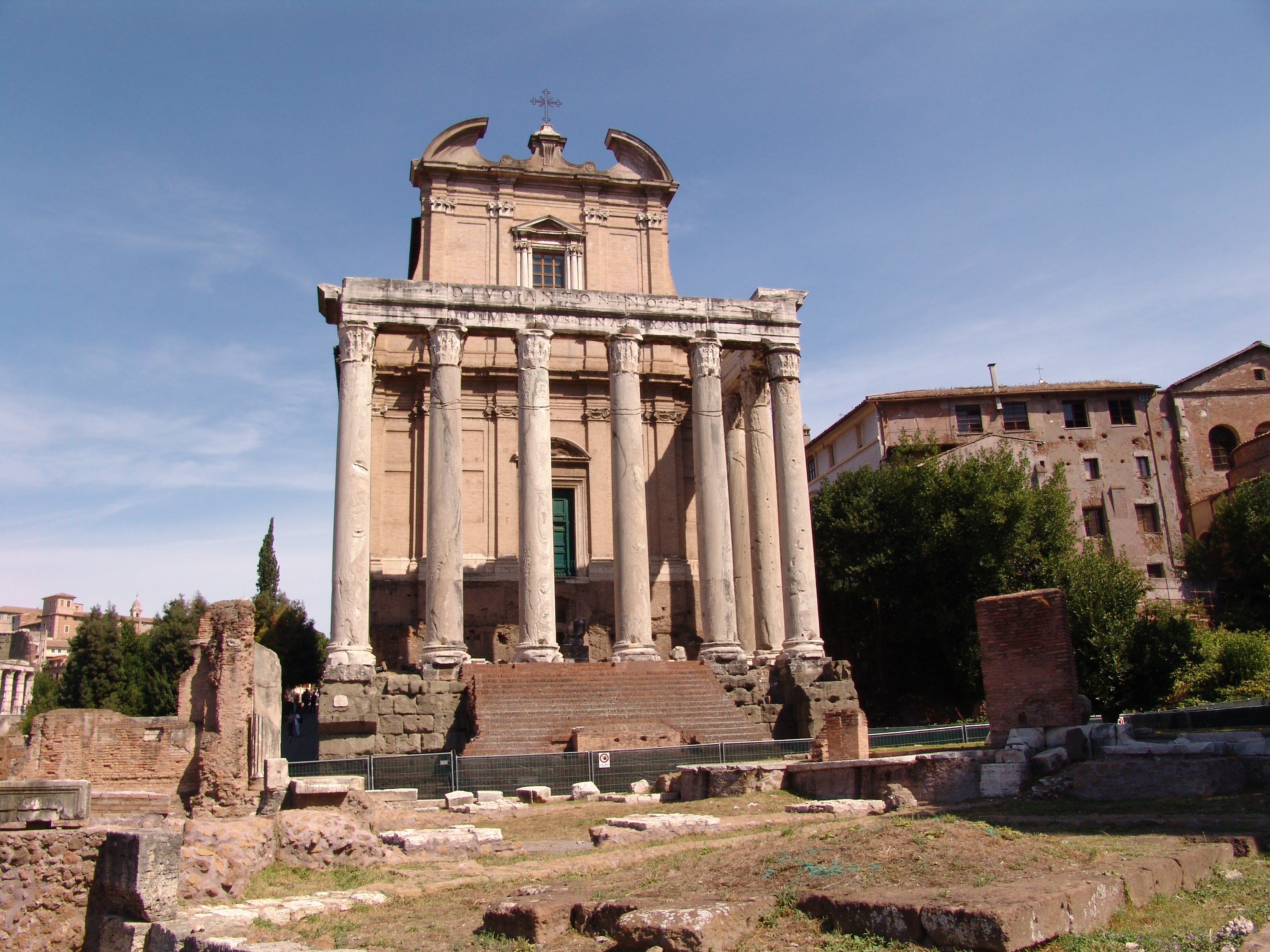
Amidst the usual tumult of war, conspiracy, murder, and unrest that surrounds most Roman emperors, Antoninus Pius stands out because nothing stands out about his rule other than its lack of exciting events.
And now, it's time to say goodnight to Antoninus, with equanimity.
It was March 7, 161 AD. Nearing 75 years of age, the ailing Emperor Antoninus Pius, the longest lived emperor since the Principate's second ruler, Tiberius, who died in 37 at the age of 79, retired for the evening, knowing he had not long to live. Earlier that day he'd summoned his Imperial Council and announced he was transferring power to his adoptive son. As he lay in bed, his guard asked for the customary password to be used by the night-watch this evening. Antoninus responded "AEQUANIMITAS" (equanimity in English). He died in his sleep that night. The password was an appropriate capstone to his life.
When the Empire in the West ceased to exist more than three centuries later, no ruler would have even reached the age of 70, except for Gordian I, who reigned for all of 21 days in 238 before committing suicide at 78 and Tacitus, who held the throne for nine months in 276.
Antoninus became emperor on July 11, 138. He is one of five Roman rulers popularly known, following the terminology of Edward Gibbon (author of The History of the Decline and Fall of the Roman Empire, published in the late 18th century), as the Good Emperors who governed from 96 to 180. Many later historians dispute the terminology, though Cassius Dio writing in the third century would not, characterizing the period afterwards as when "our history now descends from a kingdom of gold to one of iron and rust", but the reign of the five emperors undoubtedly represents Rome at its greatest geographical extent and prosperity.
The five were very different. Nerva (96-98) was an elderly senator elevated after the assassination of Domitian. As part of the deal surrounding his ascension he adopted Trajan as his son and successor.
After Nerva's brief reign, Trajan (born 56, reigned 98-117) became the first foreign born emperor (his Italian family had emigrated to Spain more than a century earlier). A warrior by temperament, Trajan destroyed and annexed the Dacian Kingdom, ancient enemies of Rome and located north of the Danube in modern day Romania. And then, dreaming of Alexander the Great, Trajan launched his greatest expedition in 114, annexing Armenia and attacking the Parthian Empire. Moving down the Tigris and Euphrates rivers he stormed the Parthian winter capital of Ctesiphon (near modern Baghdad) and then became the only Roman Emperor to stand on the shores of the Persian Gulf. Prevented from fulfilling his aspirations by continuing Parthian raids into Mesopotamia from their homeland base on the Iranian plateau and the need to quell major Jewish revolts in Egypt and Cyrenaica (modern Libya), Trajan returned to Antioch in 116. Falling ill, he died the next year, his recent conquests left in chaos.
According to Trajan's wife, the deceased emperor had named Hadrian as his successor and who was to vouchsafe her? Hadrian (born 76, reigned 117-38) was of a much different temperament than his predecessor. His was a reign of consolidation, not expansion. The emperor was highly intelligent, a man of culture, arrogant, and petty. Abandoning Trajan's middle east conquests, Hadrian returned to Rome. After stabilizing the political situation in the capital, he embarked on three lengthy tours of the empire, eight years in all, inspecting fortifications and legions on the frontiers. His most famous action in that respect was ordering the construction of what we now call Hadrian's Wall in the north of Britain. Reportedly he personally designed the wall; Hadrian took pride in his self-described architectural skills, also directing the rebuilding and design of the Pantheon in Rome and his astonishing villa in Tivoli.
(Map of Hadrian's travels)
Hadrian also took time to be a sightseer, most notably in Egypt and Greece, particularly Athens, where he spent three winters. It was Hadrian's love of Hellenic culture and his dislike of the Jewish (in the ancient world these were seen very much as opposites by both Hellenes and Jews) that sparked the greatest crisis of his regime. In 132 he ordered the construction of a Greek Temple on the Temple Mount in Jerusalem, a site that had laid abandoned since the destruction of the Second Temple by the Romans in 70 AD. The proposed defilement of the site triggered a massive Jewish revolt, led by Bar Kochba, which took three years and a third of Rome's entire army to subdue. In the aftermath, Hadrian banned Jews from Judea, placed a garrison on the site along with his temple, and renamed both the city (Aelia Capitolina) and the province (from Judea to Syria Palaestina). It's why while I enjoy reading about Hadrian I am not an admirer.
Like Trajan and Nerva, Hadrian was childless. As his health declined after 135 the matter of his planned succession became more important. His initial appointed successor died in 137 and he next turned to an older (born in 86) and highly regarded Roman senator, who became known as the Emperor Antoninus Pius, after Hadrian's death the following year. To ensure longer-term stability, as a condition of Hadrian's appointment, Pius, also childless, was required to adopt the sons of two prominent Roman families, the 17 year old Marcus Aurelius and 8 year old Lucius Verus.
Twenty three years later, Marcus Aurelius and Lucius Verus were to succeed Antoninus as co-emperors, with Marcus as the senior partner. Lucius died in 169 but Marcus soldiered on until 180. And soldiering is much of what they did. Lucius spent much of his reign in the east, fighting the Parthians, while Marcus was fully occupied taking on the barbarians who flooded across the Danube, posing the greatest threat to Italy in almost three centuries. Marcus spent his last years on the Danube, far from Rome, overseeing his legions and writing Meditations, musings based on the Stoic philosophy he followed. Unlike the prior four emperors, Marcus had a son (Commodus) to whom he unfortunately trusted the empire upon his death (for more on his death and Stocism read At Vindobona).
The reign of Antonius Pius was unlike that of the other four.
Unlike Nerva's two years governing the Principate, the twenty three years of Antoninus was the longest reign between Tiberius (14-37) and Constantine the Great (306-337).
Unlike Trajan he sought no expansion of the empire and did not embark upon wars of conquest.
Unlike Trajan (Trajan's Forum & Market) and Hadrian (Pantheon) he initiated no monumental construction projects in Rome.
Unlike Trajan and Hadrian, Antoninus never faced any violent revolts by the populace.
Unlike the wandering Hadrian, Antoninus never left Italy during his entire reign, preferring to spend his time outside of Rome at his nearby villas.
Unlike Marcus Aurelius he was not forced into desperate wars to protect the empire, and not faced with a financial crisis which reduced Marcus to auctioning furniture from the Imperial Palace to pay for those wars.
Unlike Marcus he faced no open revolts within his army.
And unlike Marcus he did not have to deal with the Antonine Pandemic which swept across the Roman world beginning in 165, a pandemic thought to be smallpox and which killed a significant portion of the empire's population.
His reign was tranquil and the most peaceful of any during the entire history of the Empire (31 BC - 476 AD). His only military adventure was early in his rule, an advance in Britain from Hadrian's Wall to a line between present day Glasgow and Edinburgh in Scotland, where an earthen wall was constructed and garrisoned for the next twenty years. Whether this was provoked by raids from Scottish tribes, or just an effort to garner prestige for the new regime remains unknown.
Within the empire he spent funds on roads and aqueducts but his greatest contribution was probably in the area of legal reforms. He enacted measurements making the freeing of slaves easier, punished killing of slaves by masters, requiring forcible sale of slaves if they were consistently mistreated and limiting the use of torture when obtaining testimony by slaves. He endorsed the principle that accused persons are not to be treated as guilty before trial and required that records of interrogations be kept to be available in the event of appeals of verdicts. Doesn't sound like much by modern standards but not bad for the second century.
His whole life had been quiet so his ruling style was not a surprise. Son of a Senatorial family from Nemausus (Nimes) in Gaul, and raised at Lanuvium in the Alban Hills outside Rome, he rose to prominence becoming counsel under Hadrian in 120, later one of four proconsuls for Italia, and finally taking the prestigious role of proconsul for Asia (today the western part of Turkey, adjacent to the Aegean, and one of the richest Roman provinces.
(Modern Lanuvium, 20 miles from Rome)
In 141, Antoninus' wife of thirty years, Faustina, died. By all accounts he was devoted to her and after her death had the Temple of Antoninus & Faustina built in the Roman Forum. The temple still stands today due to its conversion to a Christian church after the end of the empire - a similar conversion saved the Pantheon. At some point after his wife's death he began living with Galena Lysistrata, one of Faustina's freedwomen (former slave), and their relationship lasted until his death.
(Temple of Antoninus & Faustina today)
Amidst the usual tumult of war, conspiracy, murder, and unrest that surrounds most Roman emperors, Antoninus Pius stands out because nothing stands out about his rule other than its lack of exciting events.
And now, it's time to say goodnight to Antoninus, with equanimity.
Friday, June 22, 2018
Carpool Karoake With Paul McCartney
James Corden visits Liverpool with Paul McCartney. Corden's carpool karoake series is always great fun but this one is really special. Worth watching the entire 23 minutes.
Friday, March 16, 2018
George Songs 2
A continuation of yesterday's post with my favorite songs composed by George Harrison. The last post covered songs George did with The Beatles. Next up are the rest of my favorites, again in chronological order.
Badge (1968), written with Eric Clapton and released by Cream on its final album Goodbye. It turns out the title came from Clapton misreading George's handwriting on the lyric sheet and thinking the word "Bridge" denoting the middle section of the song was actually "Badge" and the song title.
Beware of Darkness from Harrison's solo triple album All Things Must Pass (1970). Strong lyric and beautiful melody. Clapton, Ringo, Billy Preston, and a slew of other rockers contributed to the album.
What Is Life, also from All Things Must Pass. I actually don't like the riff that introduces the song and the verse but the chorus is infectious. As long as we're on All Things Must Pass, this is a terrific take on Isn't It A Pity from the Concert for George, with Clapton and Billy Preston on vocals.
Photograph (1973), written with Ringo Starr and released as a Ringo single which hit #1. Here he is performing the song in 2009. Sounds pretty good!
All Those Years Ago (1981), originally written by George for Ringo who didn't like the lyrics. After John Lennon's murder in December 1980, George rewrote and recorded it. Ringo is on drums and Paul sings harmony. Here's the best sounding version but the one you want to watch is below:
Handle With Care (1988). George wrote this as a single for himself and enlisted Jeff Lynne to produce. Tom Petty, Roy Orbison, and Bob Dylan got pulled into the production and the The Traveling Wilburys were born!
End Of The Line (1988). Though all the Wilburys were credited with the composition, George composed most of it. The video was made after the sudden death of Roy Orbison in December 1988; that's why you see an empty rocking chair when Roy's voice is heard.
We'll let Ringo have the last word:
Badge (1968), written with Eric Clapton and released by Cream on its final album Goodbye. It turns out the title came from Clapton misreading George's handwriting on the lyric sheet and thinking the word "Bridge" denoting the middle section of the song was actually "Badge" and the song title.
Beware of Darkness from Harrison's solo triple album All Things Must Pass (1970). Strong lyric and beautiful melody. Clapton, Ringo, Billy Preston, and a slew of other rockers contributed to the album.
What Is Life, also from All Things Must Pass. I actually don't like the riff that introduces the song and the verse but the chorus is infectious. As long as we're on All Things Must Pass, this is a terrific take on Isn't It A Pity from the Concert for George, with Clapton and Billy Preston on vocals.
Photograph (1973), written with Ringo Starr and released as a Ringo single which hit #1. Here he is performing the song in 2009. Sounds pretty good!
All Those Years Ago (1981), originally written by George for Ringo who didn't like the lyrics. After John Lennon's murder in December 1980, George rewrote and recorded it. Ringo is on drums and Paul sings harmony. Here's the best sounding version but the one you want to watch is below:
Handle With Care (1988). George wrote this as a single for himself and enlisted Jeff Lynne to produce. Tom Petty, Roy Orbison, and Bob Dylan got pulled into the production and the The Traveling Wilburys were born!
End Of The Line (1988). Though all the Wilburys were credited with the composition, George composed most of it. The video was made after the sudden death of Roy Orbison in December 1988; that's why you see an empty rocking chair when Roy's voice is heard.
Maybe somewhere down the road aways
You'll think of me, wonder where I am these days
Maybe somewhere down the road when somebody plays
Purple haze
We'll let Ringo have the last word:
Thursday, March 15, 2018
George Songs
A couple of evenings ago I watched the Concert for George which was being broadcast by our local PBS station as part of its seemingly endless series of fundraisers. The show, which took place on November 29, 2002 in memory of George Harrison who had died the previous year, was much better than most of its type. George's longtime friend, Eric Clapton (such good friends they married the same woman!), was musical director and he evidently spent some time selecting songs and rehearsing the performers, who included Tom Petty, Ringo Starr, Paul McCartney, Jeff Lynne, Bill Preston, and Gary Booker, among others. George's son, Dhani, played guitar and sang harmony that night.
I'd forgotten how many good songs Harrison had written which prompted me to go back and compile my list of personal favorites for which I've done two posts. This first one consists of favorites from his time with The Beatles. There is, of course, one problem with embedding the songs, which is that The Beatles promptly take down from YouTube any posting of their songs unless they've done the posting so most of what is linked below are covers or live versions.
In chronological order:
If I Needed Someone from Rubber Soul (1965). Outstanding guitar sound and soaring harmonies. Which brings up an issue I had with George; his guitar playing. I liked the early rockabilly flavored style he employed (see, for instance, this cover of What Goes On) as well as the chiming, Byrds influenced guitar from 1965-66, but I never liked his slide guitar. Here's Harrison and Clapton playing it on a 1991 tour. And if you want to learn how to sing the harmonies, this guy in Bologna, Italy is your go-to man for all Beatles harmony singing.
Taxman from Revolver (1966). Cool and cynical lyric. I like a guy who doesn't like taxes. The guitar solo is by McCartney. Unfortunately, I can't even find a decent cover on YouTube but I did find the isolated guitar solo!
While My Guitar Gently Weeps from The White Album (1968). With Clapton on guitar. This is a live version from the 1980s with George, Eric, Ringo, Phil Collins, and Elton John. This is George's demo for the song (with the strings added in 2006 by George Martin), which gives the song a very different feel. Oh, and here's the 2004 version from the Rock n Roll Hall of Fame, with Prince's famous solo.
Long Long Long from The White Album. Very underrated song. Big booming drums from Ringo. Here's the best cover I could find.
Old Brown Shoe from Let It Be (recorded April 1969). This version from a cover band.
I want a love that's right
But right is only half of what's wrong
I want a short haired girl
Who sometimes wears it twice as long
Here Comes The Sun from Abbey Road (recorded July 1969). My favorite of his Beatles tunes. Another cover.
You may have noticed that many people's favorite George song, Something, is not on my list. Sorry, not a big fan of it, but The Concert for George featured a lovely version of the song, led by Paul McCartney on the ukulele, which I could not find but here's a shortened version from McCartney's 2002 concert tour.
Well, as long as I'm going down this path, here is a 2014 version of Something featuring Jeff Lynne, Joe Walsh, and Dhani Harrison (who looks and sounds strikingly like his dad). Paul and Ringo are in the audience. Joe Walsh's reference to being an extended member of The Beatles family is because he and Ringo are married to the Bach sisters.
I'd forgotten how many good songs Harrison had written which prompted me to go back and compile my list of personal favorites for which I've done two posts. This first one consists of favorites from his time with The Beatles. There is, of course, one problem with embedding the songs, which is that The Beatles promptly take down from YouTube any posting of their songs unless they've done the posting so most of what is linked below are covers or live versions.
In chronological order:
If I Needed Someone from Rubber Soul (1965). Outstanding guitar sound and soaring harmonies. Which brings up an issue I had with George; his guitar playing. I liked the early rockabilly flavored style he employed (see, for instance, this cover of What Goes On) as well as the chiming, Byrds influenced guitar from 1965-66, but I never liked his slide guitar. Here's Harrison and Clapton playing it on a 1991 tour. And if you want to learn how to sing the harmonies, this guy in Bologna, Italy is your go-to man for all Beatles harmony singing.
Taxman from Revolver (1966). Cool and cynical lyric. I like a guy who doesn't like taxes. The guitar solo is by McCartney. Unfortunately, I can't even find a decent cover on YouTube but I did find the isolated guitar solo!
While My Guitar Gently Weeps from The White Album (1968). With Clapton on guitar. This is a live version from the 1980s with George, Eric, Ringo, Phil Collins, and Elton John. This is George's demo for the song (with the strings added in 2006 by George Martin), which gives the song a very different feel. Oh, and here's the 2004 version from the Rock n Roll Hall of Fame, with Prince's famous solo.
Long Long Long from The White Album. Very underrated song. Big booming drums from Ringo. Here's the best cover I could find.
Old Brown Shoe from Let It Be (recorded April 1969). This version from a cover band.
I want a love that's right
But right is only half of what's wrong
I want a short haired girl
Who sometimes wears it twice as long
Here Comes The Sun from Abbey Road (recorded July 1969). My favorite of his Beatles tunes. Another cover.
You may have noticed that many people's favorite George song, Something, is not on my list. Sorry, not a big fan of it, but The Concert for George featured a lovely version of the song, led by Paul McCartney on the ukulele, which I could not find but here's a shortened version from McCartney's 2002 concert tour.
Well, as long as I'm going down this path, here is a 2014 version of Something featuring Jeff Lynne, Joe Walsh, and Dhani Harrison (who looks and sounds strikingly like his dad). Paul and Ringo are in the audience. Joe Walsh's reference to being an extended member of The Beatles family is because he and Ringo are married to the Bach sisters.
Sunday, February 25, 2018
Jude's Darkest Hour
Been waiting to post this for a year. Joe Wright, director of Darkest Hour, leads 450 MPs in a warmup sing of Hey Jude between takes. Gary Oldman as Churchill makes an entrance at the end.— Samuel West (@exitthelemming) January 12, 2018
Darkest Hour is released in the UK today. Hope you like it pic.twitter.com/UN6posK8zf
Saturday, June 10, 2017
Ranking Beatles Songs
Over at Vulture, Bill Wyman (not the metal detecting amateur archaeologist Bill Wyman) takes us through his personal ranking of all 213 songs by The Beatles, a fundamentally silly but entertaining exercise. In the process it becomes apparent he does not appear to actually like most Beatles songs. He particularly undervalues their songs from the post She Loves You and pre-Revolver era, with what I think is a deficient appreciation for the lovely melodies and harmonies of many of those tunes (unfortunately it is very difficult to find original Beatles on YouTube so no links on this post).
Here's the full list. Have a go at it yourself.
At the bottom end he makes some inexplicably bad choices. Ranked last at #213 is Good Day Sunshine; not top-flight but far from their worst, though he correctly puts the execrable She's Leaving Home from Sgt Pepper at 204.
I'll Be Back at 189? Listen to the harmonies. A gorgeous tune. The same with No Reply at 173.
And he then has I Don't Want To Spoil The Party and Yes It Is at 176 and 161, respectively. Both "minor" songs from the 1965 era, but both with beautiful harmonies, melodies and lyrics.
I'm A Loser is 146 on his list, an obvious mistake. It's one of the Top 50 Beatles songs.
Ranking Tell Me Why at 127 and calling it "a bit . . . eh" illustrates the difference between Wyman's taste and mine. I love Tell Me Why. The lyrics are trite but the sheer exuberance of the performance makes for exhilarating listening. Lennon's vocal is astonishing good and once again, we have great harmonies.
Wyman has the terrible Fool On The Hill at 107, higher than We Can Work It Out (109), another classic by the Fab Four, easily surpassing Fool with lyrics, melody, harmonies and arrangement.
On the flip side, I agree with many of his Top 50 with some exceptions. The Long And Winding Road (45) is lousy and bloated by Phil Spector's overproduction. Too bad it was their last single. And Your Bird Can Sing (33) is not terrible, but not top-notch. I Saw Her Standing There at 21 and Lovely Rita (19) leave me shaking my head. Nowhere Man (17) was one of their worst singles. George Harrison's Something (13) is quite good but doesn't come close to Here Comes The Sun (16) his best effort with the band.
The author ranks the Abbey Road medley as 22 through 29, but that's too easy. The second side contains brilliant songs like You Never Give Me Your Money, along with miserable pieces like Sun King, and several song fragments.
Here's his Top 10 with my comments.
10. Rain. Don't know if it's Top 10 but it is an under appreciated song and definitely Top 25.
9. Eleanor Rigby. Yes. And Giles Martin's re imagining the song for the Love album is even better.
8. Norwegian Wood. Good but not Top 10.
7. Here, There and Everywhere. One of my least favorite Beatles songs.
6. Dear Prudence. OK, but not great.
5. Please Please Me. Their second single and first #1 in the UK. It captures the excitement of the early Beatles. Great tune.
4. She Loves You. Nope.
3. Penny Lane. Catchy. Outstanding production and instrumentation. Not Top 10.
2. Strawberry Fields Forever. Yes, Yes, Yes.
1. A Day In The Life. As a 16-year old I would have said yes but don't feel it's held up well over the years. As a musical historical artifact it is a milestone but no longer a Beatles Top 10 for me.
I've never done my own formal ranking but a few years ago put together a playlist with the Beatles songs I most like listening to repeatedly. It has 52 songs so it's basically my top 25% of their songs. Here is the list chronologically from earliest to latest (with Wyman's rankings in parens):
Twist & Shout (43)
Please Please Me (5)
I Saw Her Standing There (21)
It Won't Be Long (133)
All I've Got To Do (159)
All My Loving (92)
Tell Me Why (127)
Things We Said Today (73)
I'll Cry Instead (37)
You Can't Do That (53)
I'll Be Back (189)
No Reply (173)
I'll Follow The Sun (122)
I'm A Loser (146)
I Feel Fine (63)
I Don't Want To Spoil The Party (176)
Every Little Thing (198)
What You're Doing (168)
Help! (36)
You're Going To Lose That Girl (57)
Ticket To Ride (18)
The Night Before (77)
Drive My Car (38)
Day Tripper (30)
We Can Work It Out (109)
What Goes On (174)
You Won't See Me (71)
If I Needed Someone (83)
Rain (10)
I'm Only Sleeping (84)
Eleanor Rigby (9)
Tomorrow Never Knows (12)
She Said She Said (11)
Doctor Robert (121)
For No One (34)
Strawberry Fields Forever (2)
With A Little Help From My Friends (86)
Fixing A Hole (150)
Lucy In The Sky With Diamonds (68)
Hey Bulldog (89)
Blackbird (31)
Back In the USSR (47)
Happiness Is A Warm Gun (110)
Revolution (56)
Long Long Long (147)
Everybody's Got Something To Hide, Except Me & My Monkey (144)
While My Guitar Gently Weeps (32)
Here Comes The Sun (16)
Mean Mr Mustard (24)
Polythene Pam (25)
You Never Give Me Your Money (22)
Let It Be (15)
Looking more closely at the list I realize 35 of 52 are from the pre-Sgt Pepper era (1963-66).
Now that I'm obsessing about Beatles songs, I went back through the entire list and identified those of their songs I do not like and am okay never hearing again. It totalled 74 tunes, including eleven covers, several singles (Lady Madonna, All You Need Is Love, Nowhere Man, Love Me Do, Yellow Submarine, Hello Goodbye, The Long and Winding Road, and The Ballad of John and Yoko), along with a bunch of Harrison songs (seven, to be exact). That leaves 139 songs I like and can listen to repeatedly or 65% of everything they recorded. A pretty good batting average.
Here's the full list. Have a go at it yourself.
At the bottom end he makes some inexplicably bad choices. Ranked last at #213 is Good Day Sunshine; not top-flight but far from their worst, though he correctly puts the execrable She's Leaving Home from Sgt Pepper at 204.
I'll Be Back at 189? Listen to the harmonies. A gorgeous tune. The same with No Reply at 173.
And he then has I Don't Want To Spoil The Party and Yes It Is at 176 and 161, respectively. Both "minor" songs from the 1965 era, but both with beautiful harmonies, melodies and lyrics.
I'm A Loser is 146 on his list, an obvious mistake. It's one of the Top 50 Beatles songs.
Ranking Tell Me Why at 127 and calling it "a bit . . . eh" illustrates the difference between Wyman's taste and mine. I love Tell Me Why. The lyrics are trite but the sheer exuberance of the performance makes for exhilarating listening. Lennon's vocal is astonishing good and once again, we have great harmonies.
Wyman has the terrible Fool On The Hill at 107, higher than We Can Work It Out (109), another classic by the Fab Four, easily surpassing Fool with lyrics, melody, harmonies and arrangement.
On the flip side, I agree with many of his Top 50 with some exceptions. The Long And Winding Road (45) is lousy and bloated by Phil Spector's overproduction. Too bad it was their last single. And Your Bird Can Sing (33) is not terrible, but not top-notch. I Saw Her Standing There at 21 and Lovely Rita (19) leave me shaking my head. Nowhere Man (17) was one of their worst singles. George Harrison's Something (13) is quite good but doesn't come close to Here Comes The Sun (16) his best effort with the band.
The author ranks the Abbey Road medley as 22 through 29, but that's too easy. The second side contains brilliant songs like You Never Give Me Your Money, along with miserable pieces like Sun King, and several song fragments.
Here's his Top 10 with my comments.
10. Rain. Don't know if it's Top 10 but it is an under appreciated song and definitely Top 25.
9. Eleanor Rigby. Yes. And Giles Martin's re imagining the song for the Love album is even better.
8. Norwegian Wood. Good but not Top 10.
7. Here, There and Everywhere. One of my least favorite Beatles songs.
6. Dear Prudence. OK, but not great.
5. Please Please Me. Their second single and first #1 in the UK. It captures the excitement of the early Beatles. Great tune.
4. She Loves You. Nope.
3. Penny Lane. Catchy. Outstanding production and instrumentation. Not Top 10.
2. Strawberry Fields Forever. Yes, Yes, Yes.
1. A Day In The Life. As a 16-year old I would have said yes but don't feel it's held up well over the years. As a musical historical artifact it is a milestone but no longer a Beatles Top 10 for me.
I've never done my own formal ranking but a few years ago put together a playlist with the Beatles songs I most like listening to repeatedly. It has 52 songs so it's basically my top 25% of their songs. Here is the list chronologically from earliest to latest (with Wyman's rankings in parens):
Twist & Shout (43)
Please Please Me (5)
I Saw Her Standing There (21)
It Won't Be Long (133)
All I've Got To Do (159)
All My Loving (92)
Tell Me Why (127)
Things We Said Today (73)
I'll Cry Instead (37)
You Can't Do That (53)
I'll Be Back (189)
No Reply (173)
I'll Follow The Sun (122)
I'm A Loser (146)
I Feel Fine (63)
I Don't Want To Spoil The Party (176)
Every Little Thing (198)
What You're Doing (168)
Help! (36)
You're Going To Lose That Girl (57)
Ticket To Ride (18)
The Night Before (77)
Drive My Car (38)
Day Tripper (30)
We Can Work It Out (109)
What Goes On (174)
You Won't See Me (71)
If I Needed Someone (83)
Rain (10)
I'm Only Sleeping (84)
Eleanor Rigby (9)
Tomorrow Never Knows (12)
She Said She Said (11)
Doctor Robert (121)
For No One (34)
Strawberry Fields Forever (2)
With A Little Help From My Friends (86)
Fixing A Hole (150)
Lucy In The Sky With Diamonds (68)
Hey Bulldog (89)
Blackbird (31)
Back In the USSR (47)
Happiness Is A Warm Gun (110)
Revolution (56)
Long Long Long (147)
Everybody's Got Something To Hide, Except Me & My Monkey (144)
While My Guitar Gently Weeps (32)
Here Comes The Sun (16)
Mean Mr Mustard (24)
Polythene Pam (25)
You Never Give Me Your Money (22)
Let It Be (15)
Looking more closely at the list I realize 35 of 52 are from the pre-Sgt Pepper era (1963-66).
Now that I'm obsessing about Beatles songs, I went back through the entire list and identified those of their songs I do not like and am okay never hearing again. It totalled 74 tunes, including eleven covers, several singles (Lady Madonna, All You Need Is Love, Nowhere Man, Love Me Do, Yellow Submarine, Hello Goodbye, The Long and Winding Road, and The Ballad of John and Yoko), along with a bunch of Harrison songs (seven, to be exact). That leaves 139 songs I like and can listen to repeatedly or 65% of everything they recorded. A pretty good batting average.
Thursday, March 2, 2017
Beatles Over The Years
I thought of tracking the musical development of The Beatles by looking at what they were recording or releasing on or around the same date every year of their recording career. I started with a mid-point, April 6, 1966, the day studio recording of Tomorrow Never Knows began. A note as we get started; it is increasingly difficult to find any original Beatles recordings on YouTube.
The Beatles first recording session was on June 6, 1962. Love Me Do, their first single came out of that session.
On April 11, 1963 From Me To You, their third single and second #1 in the U.K. was released.
Recording of A Hard Day's Night, the title song for their first movie, began on April 16, 1964. It featured the opening "mystery" chord and was more sophisticated than the 1962 or 1963 songs. John and Paul composed it over the prior two days. The song was completed in only nine takes.
A year later, on April 13, 1965 recording of Help!, the title song for their second movie, was underway. The song showcased a more introspective side of The Beatles. It took 12 takes to finish the song that day. This is a live version:
April 6, 1966 was the first day of recording for the album that was to be released on August 5 as Revolver. The song recorded that day was called Mark I, the working title of Tomorrow Never Knows. The song and its manner of recording was groundbreaking. The Beatles Recording Session: The Official Abbey Road Studio Session Notes describes Take One (not used in the final version as:
It was so different from anything previously done by the band that most people assumed it was the last song to be recorded for the album, particularly since it was positioned as the last song on the second side. The message for the listener was "wait until you see what's coming on the next record!".
In April 1967 The Beatles were in the midst of making Sgt Pepper's Lonely Hearts Club Band. The landmark album was released on June 1, 1966. April 3 saw the recording of George Harrison's Within You Without You, the weakest song on the record. No other Beatle was in the studio that day. George Martin took eight violinists and three cellists through a score he'd written based on Harrison's input. Later that evening, Harrison recorded his lead vocal.
The Beatles were not in the studio in March or April of 1968, but on May 30 they were at Abby Road to begin work on the project that became The White Album, released on November 22. That day they recorded 18 takes of Revolution, the rocking B side of Hey Jude (the biggest single in the group's history). The final take ran over 10 minutes and the last six were later carved off to become the basis for the bizarre Revolution 9.
By 1969 The Beatles were emeshed in tensions among the band members. Ringo had already briefly quit during the recording of The White Album the previous year and the presence of Yoko Ono in the studio created problems, particularly between John and Paul. But on April 14, the two of them got together to record The Ballad of John and Yoko. Paul played drums, bass, piano and did backing vocals, while John performed on guitar and lead vocals.
The final time the four Beatles were in the studio together was on August 20, 1969 for I Want You (She's So Heavy), the last song recorded for Abbey Road, released on September 26. The only other time more than one Beatle was in the studio for a recording or mixing session was January 3, 1970 when George, Ringo and Paul gathered to record Harrison's I Me Mine.
The Beatles first recording session was on June 6, 1962. Love Me Do, their first single came out of that session.
On April 11, 1963 From Me To You, their third single and second #1 in the U.K. was released.
Recording of A Hard Day's Night, the title song for their first movie, began on April 16, 1964. It featured the opening "mystery" chord and was more sophisticated than the 1962 or 1963 songs. John and Paul composed it over the prior two days. The song was completed in only nine takes.
A year later, on April 13, 1965 recording of Help!, the title song for their second movie, was underway. The song showcased a more introspective side of The Beatles. It took 12 takes to finish the song that day. This is a live version:
April 6, 1966 was the first day of recording for the album that was to be released on August 5 as Revolver. The song recorded that day was called Mark I, the working title of Tomorrow Never Knows. The song and its manner of recording was groundbreaking. The Beatles Recording Session: The Official Abbey Road Studio Session Notes describes Take One (not used in the final version as:
. . . a heavy metal recording of enormous proportion, with thundering echo and booming, quivering, ocean-bed vibrations.By the time recording ended, George Martin, engineer Greg Emerick, and the band had introduced Artificial Double Tracking (ADT) for vocals; utilization of tape loops (the sound achieved by tape saturation, by removing the erase head of a machine and then recording over and over again on the same loop), it's worth listening to the isolated tape loops; altering Lennon's vocal by feeding it through a rotating Leslie speaker, and Ringo's booming drum sound achieved by moving the bass drum microphone much closer to the drums, and running the sound through compressors. Eleven different mixes were made before it was complete.
It was so different from anything previously done by the band that most people assumed it was the last song to be recorded for the album, particularly since it was positioned as the last song on the second side. The message for the listener was "wait until you see what's coming on the next record!".
In April 1967 The Beatles were in the midst of making Sgt Pepper's Lonely Hearts Club Band. The landmark album was released on June 1, 1966. April 3 saw the recording of George Harrison's Within You Without You, the weakest song on the record. No other Beatle was in the studio that day. George Martin took eight violinists and three cellists through a score he'd written based on Harrison's input. Later that evening, Harrison recorded his lead vocal.
The Beatles were not in the studio in March or April of 1968, but on May 30 they were at Abby Road to begin work on the project that became The White Album, released on November 22. That day they recorded 18 takes of Revolution, the rocking B side of Hey Jude (the biggest single in the group's history). The final take ran over 10 minutes and the last six were later carved off to become the basis for the bizarre Revolution 9.
By 1969 The Beatles were emeshed in tensions among the band members. Ringo had already briefly quit during the recording of The White Album the previous year and the presence of Yoko Ono in the studio created problems, particularly between John and Paul. But on April 14, the two of them got together to record The Ballad of John and Yoko. Paul played drums, bass, piano and did backing vocals, while John performed on guitar and lead vocals.
The final time the four Beatles were in the studio together was on August 20, 1969 for I Want You (She's So Heavy), the last song recorded for Abbey Road, released on September 26. The only other time more than one Beatle was in the studio for a recording or mixing session was January 3, 1970 when George, Ringo and Paul gathered to record Harrison's I Me Mine.
Sunday, February 5, 2017
Hey Bulldog
One of the lesser known Beatles songs and one of my favorites, Hey Bulldog was composed and recorded in February 1968. WARNING: Contains barking. Whimsical sounding, but the lyrics are quite serious. Solid guitar riffs, catchy rhythms and fun interplay between Paul and John, particularly towards the end of the video.
Sheepdog, standing in the rain
Bullfrog, doing it again
Some kind of happiness is
Measured out in miles
What makes you think you're
Something special when you smileChildlike, no one understands
Jackknife, in your sweaty hands
Some kind of innocence is
Measured out in years
You don't know what it's like
To listen to your fearsYou can talk to me
You can talk to me
You can talk to me
If you're lonely, you can talk to meBig man, walking in the park
Wigwam, frightened of the dark
Some kind of solitude is
Measured out in you
You think you know me, but you haven't got a clue
Tuesday, September 27, 2016
The Beatles: Eight Days A Week
 (From mojo4music)
What was it like to be a Beatle during the height of Beatlemania? For the answer, go see The Beatles: Eight Days A Week - The Touring Years (1963-66) directed by Ron Howard (aka Opie and Richie Cunningham). Being about to turn 13 when they appeared on the Ed Sullivan show, and only 15 in 1966, when The Beatles stopped touring, I'd never really understood that decision. Watching this film, I finally realized why it had to end.
Eight Days A Week captures the craziness of their lives from late 1963 through August 1966 and the hysteria and tumult that surrounded them. The film footage includes a lot I'd never seen before as well as new interviews with Paul McCartney and Ringo Starr (who looks pretty good for a 76 year old) along with reflections on those years by George and John taken from old interviews.
The primitive state of touring and concert technology and organization is staggering. Even by the late 1960s it was immensely improved, but that was to be too late for the Fab Four. The Beatles had only three roadies on their first U.S tours! In one scene from a show in Washington DC, we watch Ringo, without assistance at first, trying to turn the platform on which his drum kit is sitting.
The sound equipment was miserable. For their 1965 U.S. tour, Vox made special 100-watt(!) amps for the band, which were no match for the wall of sound emitted by their fans. They had no special sound equipment for vocals. At Shea Stadium, with 56,000 screaming fans, their vocals were played through the public address system. Amidst the din of the screams, their fans could not hear them and The Beatles could not hear themselves. Ringo could only try to tell where the other three were in a song by watching their movements and the shaking of their heads.
One of the joys of the film is that Giles Martin, son of George Martin (1926-2016) reengineered and remastered the concert footage so we can hear what the band actually sounded like even with all the surrounding noise. They sound like a very tight rock n roll band. The irony is that the clarity of the movie soundtrack is not anything like what the audience and the band heard at the time.
The camaraderie of the four also comes through. They looked out for, and relied upon, each other, knowing no one else could understand what they were going through. In those days they shared rooms while touring; John and Paul wrote many of the one hundred songs they composed together between mid-1963 and the end of the recording for Revolver in June 1966, while on the road and in hotel rooms. The petty resentments, conflicting visions and desires that broke the band up only came to the fore after the touring ended.
Watching them is also a reminder of just how witty and quick they could be, with humor and cheekiness that stands up fifty years later. There are quite a few funny moments, along with stories even some of us who've been fans for many decades, had not heard.
So enjoy yourselves and look for the movie. It's only in limited release (only three theaters in CT are showing it), but it's worth driving a bit. It can also be found on Hulu, but you won't get the full impact of the sound track and visuals if you miss it on the big screen. And, if you see it in a theater, you might get lucky like we did - following the movie, they showed a remastered version of The Beatles concert at Shea Stadium (they only played for 30 minutes!).
Even if you are not old enough to remember them from the 60s, Eight Days A Week will give you a feel for why The Beatles were such a big deal at the time. And stick around to watch the credits until the end.
Friday, March 11, 2016
George Martin
It was through George Martin that my generation became aware of what a record producer could contribute to the sound of a band or musical artist. Lennon and McCartney were brilliant songwriters and the exuberance of the early Beatles recordings were unique for their times but it was the collaboration with Martin that created the Beatles sound as we will always remember it.
This is a remembrance of Martin, posted by Ringo Starr on his Facebook page.
We have created a beautiful tribute reel of 3-mins with many of the artists and producers from the series talking about Sir George. P&L R***
Posted by Ringo Starr on Wednesday, March 9, 2016
This was unthinkable before The Beatles and Martin.
Subscribe to:
Posts (Atom)