Monday, October 15, 2012

Ponytail Guy


Tomorrow night will be yet another Presidential debate, this one in a townhall format. I won't be watching, just as I haven't watched the prior debates, consistent with my plan to remain an uninformed voter but I wanted to take a moment and remember the time when this format contributed to the decline of Western civilization.

Let's go back to 1992 and the three sided race between George HW Bush, Bill Clinton and Ross Perot.  In that year's townhall debate a ponytailed social worker named Denton Walthall (google "ponytail guy" and you'll find the transcript) asked this question:

“The focus of my work as a domestic mediator is meeting the needs of the children that I work with, by way of their parents, and not the wants of their parents. And I ask the three of you, how can we, as symbolically the children of the future president, expect the two of you, the three of you to meet our needs, the needs in housing and in crime and you name it….”

“Could we cross our hearts; it sounds silly here, but could we make a commitment? You know, we’re not under oath at this point, but could you make a commitment to the citizens of the United States to meet our needs, and we have many, and not yours. Again, I have to repeat that, it’s a real need, I think, that we all have.” 
The decline is marked less by Mr Walthall's question than by the responses of the candidates.  Bill Clinton pandered, Bush looked annoyed, wondering what he was doing there, but agreed with the pledge and Perot said sure, fine with me.

I was yelling at the TV set wanting one of them to say:

"Grow up!  I am not your parent, you are not my child.  You are an adult capable of making decisions.  One of the decisions you need to make is who you want to hire to do this job for you for the next four years.  If adults feel that they are children waiting to be instructed and led then this country is in big trouble. " 

This is why I would not be a successful candidate for anything.

1912 World Series: Game 7

We're back in Fenway.  Smoky Joe Wood is starting on three days rest and more than 32,000 fans are jammed into the ballpark anticipating victory and a World Series championship for the Red Sox.

The late edition of the Boston Evening Transcript tells the sad story.  Under the heading "The Slaughter of Wood" readers see:

"Smoky Joe failed to smoke"

Wood gives up six runs in the top of the first and is pulled from the game.  The Giants go on to win 11-4 and the series is tied and going to an unprecedented eighth game.  A coin flip determines the game will be played at Fenway tomorrow.

Like Game 6, the real story is off the field.

Rumors circulate that in order to recoup their gambling losses from the Game 6 and get revenge on their owner, a number of Red Sox players bet against themselves and throw the game.  It is alleged that Joe Wood's brother lost a lot of money betting on the Sox in Game 6 and sees an opportunity to get even.  It is impossible to say whether the Sox really threw the game but it was widely suspected at the time.

Another theory was offered in the October 17 edition of The New York Times:

"It was said that Wood on the train coming from New York on Monday had accused O'Brian of deliberately giving his game to the Giants and that they had engaged in a fight which accounted for the inability of Wood to win his third victory." 

In those days gambling was intertwined with baseball and the link was not severed until the scandal of the 1919 Black Sox became public in 1920.  Both at the time, and in retrospect, questions have been raised about the integrity of several of the Series during the 1910s.

Another school of thought is that Wood just had a bad day and that the incident described below contributed to his poor showing.

Red Sox management made a decision that further soured the atmosphere in Boston.  McAleer now had his opportunity for a big payday and tickets were sold on a first come first served basis.  But he made a big mistake according to Rob Neyer:

"But the club, through stupidity or arrogance, neglected to inform its most passionate fans, the Royal Rooters, of that fact. The Rooters, a contingent of approximately five hundred led by Mayor John "Honey Fitz" Fitzgerald, [grandfather of John F Kennedy] habitually arrived at games in parade formation, marching on to the field and into their reserved seats. But on this day the seats were already occupied, and the Rooters were herded into a standing room area. They took this badly. A riot ensued. Mounted police were eventually summoned to contain the infuriated cranks.
 All this occurred as Wood tried to warm up. He stopped and retreated to the dugout, resuming half an hour later. Fred Lieb would claim that Wood's arm stiffened in the interval. Maybe so, for he was buffeted about like a bush leaguer, aided by a defense that butchered every ball it came in contact with."
 
The repercussions from this incident would reverberate in Game 8.

Game Summary from Baseball-reference.com

  Tuesday, October 15, 1912 at Fenway Park (Boston Red Sox)

                                 1  2  3    4  5  6    7  8  9     R  H  E
                                 -  -  -    -  -  -    -  -  -     -  -  -
    New York Giants              6  1  0    0  0  2    1  0  1    11 16  4
    Boston Red Sox               0  1  0    0  0  0    2  1  0     4  9  2

    PITCHERS: NYG - Tesreau
              BOS - Wood, Hall (2)

               WP - Jeff Tesreau
        LP - Smoky Joe Wood
             SAVE - none

   HOME RUNS: NYG - Doyle
              BOS - Gardner

  ATTENDANCE: 32,694

Sunday, October 14, 2012

1912 World Series: Game 6

This is the first "easy" game of the series.  The starters are a rematch from Game 3 - Rube Marquand and Buck O'Brien.

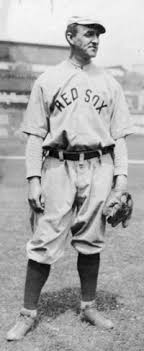
It's over in the bottom of the first.  O'Brien retires two of the first three Giants and there is a runner on first.  (Buck O'Brien)
And then:

- Murray singles.  Runners at first and third.
- O'Brien balks.  Runner on third goes home and runner on first to second.
- Fred Merkle doubles driving in another run.
- Herzog doubles driving in Merkle.
- Chief Meyers singles.  Runners on first and third.
- The Giants pull a double steal.  Buck Herzog is safe at home and Meyers ends up on third when the throw to second is wild. 
- Art Fletcher lays down a surprise bunt along the third base line and beats it out with Meyers scoring on the play.

Order is finally restored when O'Brien picks Fletcher off first base.

Giants lead 5-0.  O'Brien does not come out to pitch the second inning.

The Sox pick up two runs in the third and for a moment look like they'll make it a contest in the 4th.  Stahl singles and then Heine Wagner hits a drive to the deepest part of centerfield in the Polo Grounds (483 feet) but Fred Snodgrass runs it down making a spectacular catch.

The Giants win 5-2.  The Sox still lead the Series 3-2 with one tie.  We go back to Fenway for Game 7.

BUT the real story of this game is off the field.  The details are still shrouded in mystery a century later and they impact not just this game but very likely Game 7.  It is impossible to tell what the truth is but I'll lay out what a lot of informed observers thought at the time.

On the prior day, as the Sox took the train to New York, the players were overflowing with confidence that they'd wrap up the series the next day according to Fred Lieb (one of the best sportswriters of that age and a member of the Baseball Hall of Fame).  Joe Wood would make his third start of the Series and even though he would pitch on two days rest again he'd dominated the Giants so far.  But Wood was not to be the starter.

The Red Sox owner was Jimmy McAleer, a former ballplayer and not independently wealthy.  In those days the players got their share of World Series revenue based on the first four games.  The owners received 35% of the revenues for those games with the rest going to the players.  After the first four games the owners got 90% of the receipts.  McAleer saw the chance to get the series back to Boston for another game and a big box office.  He ordered manager Jake Stahl to start Buck O'Brien instead of Wood which Stahl did after arguing with his boss.
                                                                                                                       (Stahl & McAleer)
This move, in turn, created a new set of problems:

The Sox players believed that McAleer pulled this for his personal gain.  The players were already upset (on both teams) because after the tie in Game 2 baseball's National Commission ruled that the gate from that game would not be part of the player's share since it was a tie so the players would only get the gate from three games instead of four.

It may also have been that a number of Sox players, confident of victory in Game 6, laid down substantial bets on themselves and ended up losing money.  Certainly Fred Lieb and Tim Murnane (The Boston Globe sportswriter) believed this.

Finally, O'Brien did not know he would be starting until the morning of the game and had gone out drinking the night before after arriving in New York and was heavily hungover.   

So the Red Sox went into the game with a pitcher who felt terrible backed up by a crew of disgruntled players.

They were still disgruntled when they took the train back to Boston that night.


Game Summary from Baseball-reference.com

Monday, October 14, 1912 at Polo Grounds V (New York Giants)

                                 1  2  3    4  5  6    7  8  9     R  H  E
                                 -  -  -    -  -  -    -  -  -     -  -  -
    Boston Red Sox               0  2  0    0  0  0    0  0  0     2  7  2
    New York Giants              5  0  0    0  0  0    0  0  x     5 11  1

    PITCHERS: BOS - O'Brien, Collins (2)
              NYG - Marquard

               WP - Rube Marquard
        LP - Buck O'Brien
             SAVE - none

   HOME RUNS: BOS - none
              NYG - none

Saturday, October 13, 2012

Looper

We recently saw this new sci-fi flick starring Bruce Willis, Joseph Gordon-Levitt and Emily Blunt.  It's a time travel film.  Most of the movie is set in a rather rundown version of America in 2044.  It turns out that in the future time travel has been invented and promptly banned but the mob uses it clandestinely to send back guys it wants rub out from the year 2074 to 2044 where hired killers called "loopers" wait to execute them upon arrival.  Is that clear enough?

Gordon-Levitt plays a looper who lives in the Kansas of 2044 (trust me, if this movie is right you don't want to move to Kansas in the future and if you live there now, get out) and Bruce Willis is his older version sent from 2074 back to Levitt for execution.  So the plot has all your basic time travel conundrums for you.

Bruce Willis is just fine doing his Bruce Willis thing which you either like or don't like (I like) and Gordon-Levitt does a nice job of displaying Willis-like mannerisms in his role.  Plus Jeff Daniels does an enjoyable, but short, turn as an empathetic, yet brutal, mob boss.

While it is better than a lot of futuristic films (the coming attractions featured a couple and they were unwatchable) Looper is depressing.  I bet the director and writer, Rian Johnson, thought the ending was somewhat optimistic but if you take a minute to think through the plot it's not.  It falls in the category of movies I wanted to like more than I did.

I did enjoy how they cut through the usual convoluted explanation of how time travel works which often bogs down movies like this.
If you'd like to see a better Bruce Willis time travel movie take a look at Twelve Monkeys (1995), directed by Terry Gilliam and co-starring Madeleine Stowe and Brad Pitt.  Warning! - Like Looper it is not a feel-good movie.

Friday, October 12, 2012

1912 World Series: Game 5

It is Hugh Bedient's day to shine.

This cartoon appeared on page one of the Boston Globe on Oct. 13, 1912.From The Boston Globe, October 13, 1912

Jake Stahl surprises the crowd at Fenway by starting Bedient, instead of Ray Collins who started game two.  The word is that the Sox were reluctant to pitch Hugh because of his wildness. [NOTE:  Bedient only walked 55 and threw two wild pitches in 231 innings that year so I can't pin down the source for this story].  McGraw counters with Christy Mathewson, throwing on two days rest.  They proceed to pitch a joint masterpiece.(Bedient)

But it doesn't start out that way.  Bedient walks the first batter on four pitches before getting out of the inning.  In the bottom of the first, Christy gives up singles to two of the first three Sox batters putting runners on 1st and 2nd.  Duffy Lewis hits a hard grounder down the left field line which looks like it could be a double but Buck Herzog knocks it down behind third base and forces out the lead Sox runner at the bag.   Mathewson strikes out Gardner to end the threat.

Then, in the bottom of the third, Harry Hooper hits a triple down the left field line off of Mathewson.  On the next pitch, Steve Yerkes hits a triple to deep center scoring Hooper.  On the next pitch, Speaker hits a grounder which goes through Larry Doyle's leg scoring Yerkes.  Mathewson settles down and retires the last 17 Sox batters in the game but the Giants now trail 2-0.

New York attempts a comeback in the 7th.  Fred Merkle hits a ground-rule double and then scores on an error in the outfield but Bedient shuts down any further Giants rally.

The game ends in a 2-1 Red Sox win.  Bedient gives up three hits and three walks.  Mathewson allows five hits and doesn't walk a batter.

It's all over in one hour and forty three minutes.  The Sox now lead three games to one and look on the verge of wrapping up the series.

After five consecutive days with games, tomorrow is a day off.  We'll resume on the 14th back at the Polo Grounds.


Saturday, October 12, 1912 at Fenway Park (Boston Red Sox)

                                 1  2  3    4  5  6    7  8  9     R  H  E
                                 -  -  -    -  -  -    -  -  -     -  -  -
    New York Giants              0  0  0    0  0  0    1  0  0     1  3  1
    Boston Red Sox               0  0  2    0  0  0    0  0  x     2  5  1

    PITCHERS: NYG - Mathewson
              BOS - Bedient

               WP - Hugh Bedient
        LP - Christy Mathewson
             SAVE - none

   HOME RUNS: NYG - none
              BOS - none

  ATTENDANCE: 34,683

Thursday, October 11, 2012

She Don't Remember The Queen Of Soul

Hey nineteen
That's 'retha Franklin
She don't remember the Queen of Soul
Hard times befallen the soul survivors
She thinks I'm crazy, but I'm just growing old                                                                        (Hey Nineteen, Steely Dan)

This is my favorite 'retha song.  It's from her first Atlantic Records album "I Never Loved A Man The Way I Love You" and it's also the title of the song.  Aretha was originally signed by Columbia Records where she failed to find commercial success singing the pop tunes and Broadway show music that the label insisted she record.  When Columbia decided not to renew her contract, Jerry Wexler at Atlantic pounced and signed her with a plan was to tap her gospel music background to create a new brand of soul music. In January 1967 he brought Aretha to the recording studio in Muscle Shoals, Alabama.

They were having trouble figuring out an intro to the song when Aretha sat down at the electric piano and came up with the opening you hear on the record.

The single was released in March 1967 and became her first Top 10 hit.  The follow up release off the album was "Respect" (written by Otis Redding) and the rest is history.

Aretha's vocal is phenomenal.