Sunday, December 13, 2020

Oisk

He was known as "Oisk" to Brooklyn Dodgers fans.  Today is Carl Erskine's 94th birthday.  The last of the Boys of Summer still with us.  Happy birthday Mr Erskine!
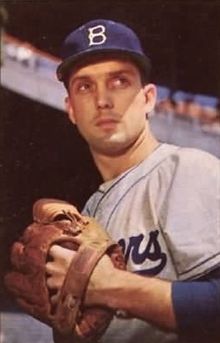
Carl Erskine.jpg

An Indiana boy, Carl joined the Dodgers in 1948 and remained with the team until his retirement in 1959.  A perpetually sore-armed hurler, Oisk got by on guile and "stuff".  He had a decent career, winning 122 games, peaking between 1951 and 1954, with 1953 his best season, winning 20 and striking out a then-record 14 Yankees in the third game of the World Series.  Along the way he also threw two no-hitters.  During his first 7 seasons, the Dodgers won the National League pennant five times and twice lost on the last day of the season; in 1950 to the Phillies and in 1951 when Bobby Thomson of the Giants hit the shot heard round the world.  Carl had been warming up in the bullpen along with Ralph Branca, when manager Charlie Dressen decided to bring Branca in to face Thomson.

But that's not why I'm writing about Carl Erskine.

I only became aware that Oisk was still around by reading Vin Scully's tweet on November 20, retelling a story about Carl.  And, yes, this fall, Vin Scully went on social media, Twitter and Facebook.  It's a joy to read and listen to him again.

Intrigued by Vin's story, I took a look at Carl's life and it is the story of a good man.

Erskine joined the Dodgers the year after Jackie Robinson broke the color barrier.

Indiana, where Carl was born in 1926, was a hotbed of KKK activity and racial prejudice at the time. His father was opposed to what was going on and did not want his sons growing up with hatred.  In The Boys of Summer, Carl tells this story:

“around 1930 there was a lynching 30 miles north of Anderson in a town called Marion. The day after it happened, Dad drove me up and showed me where it was. Two Negroes had been taken out of the jail and hung in the jail yard. I can still see that naked branch. There had been a scramble. People had made off with things as souvenirs. But there was a piece of rope. I saw a lynching rope before I was 10.”

He then went on to explain:

“One Negro boy grew up in my neighborhood, Johnny Wilson. We played grade school basketball together; he made All-State in high school and went onto the Harlem Globetrotters. He’s a high school coach today. Jumpin’ Johnny Wilson ate maybe as many meals at my home as he did at his own. With a background like that, the Robinson experience simply was no problem. It was really beautiful in a way.”

In 1946 Carl pitched on a Cuban League team managed by Negro League legend Martin Dhigo.  And after joining the Dodgers, he became one of the first major league players to have a black roommate on road trips (back in those days, players shared rooms while on the road).

From all accounts, Carl was a great teammate and a fan favorite because of his approachability, a characteristic he's retained to this day.

After the end of his baseball career, Carl returned to Indiana and became an insurance agent and eventually a bank president (he was also President of the Indiana Bankers Association in the early 90s).  He also coached baseball at a local college, winning four conference championships, and beloved by his players.

Carl's fourth child, Jimmy, was born with Downs Syndrome, leading to Erskine's long involvement with the Special Olympics.  Interviewed by Roger Kahn for The Boys of Summer , the author asked, “What do you think, your life would have been if you hadn’t been a pitcher?” Carl replied, “I don’t know. It’s like asking what my life would be without Jimmy. Poorer. Different. Who knows?

Carl & Jimmy


According to Wikipedia, 

Erskine also donated part of his land to the Anderson Community School System to build a new school, which was named Erskine Elementary. Erskine serves as a member of the advisory board of the Baseball Assistance Team, a 501(c)(3) non-profit organization dedicated to helping former Major League, Minor League, and Negro League players through financial and medical difficulties. 

Carl has also written several books, including What I Learned From Jackie Robinson (2005).

Oisk and his wife, Betty, have been married for more than 70 years.

A life well-lived.


Monday, December 7, 2020

Dark Star

On the anniversary of the day America was transformed from an interested observer to a direct participant in WW2, we''ll visit another aspect of that conflict.

I've just finished rereading Dark Star, the second of Alan Furst's evocative series of 15 novels, published between 1988 and 2019*, and set in Europe during the years from 1934 through 1942 (the only exception is the first, Night Soldiers, which extends its story until 1945).  Furst's tales are all set in a murky, twilight world of spies, provocateurs, and those caught up in their machinations, all facing terrible choices, during the era when "Europe is dying".  Though the settings of the novels cover much ground, Germany, Belgium, Switzerland, Spain, Poland, Lithuania, Romania, Greece and, of course, the Soviet Union, each one spends time in Paris, a city in which Furst lived, recreating with precision the sights, sounds, and smells of the streets, apartments, and cafes.

While British, French and Polish intelligence services make frequent appearances it is the rivalries and interaction within and between the German and Soviet services that are a constant presence.  Above all, until June 22, 1941 there is the "romance" as Furst refers to it, between Adolf Hitler and Josef Stalin as they seek, in fits and starts, to build a relationship.  Within the German service we see the tension between the intelligence services and elements in the foreign ministry opposed to Hitler, while the situation is even more complex on the Soviet side, with Stalin skillfully using different groups to eliminate each other during the Purges to aid in his consolidation of power and removing those elements likely to oppose his rapproachment with Hitler.  Many of the characters in the novels try to survive by maneuvering themselves through this labyrinth, at times not even sure which side they are serving.

Night Soldiers and Dark Star are big and sprawling, both in chronology and geography, setting the terms of reference for the rest of the novels which are more constrained in time and space.  Terms of reference also fits as those first novels indulge us with more exposition and backstory than the later books where so much is implied or very lightly sketched.

Night Soldiers tells the story of a Bulgarian teenager recruited by Soviet intelligence, trained in Moscow where he is introduced to the brutal ways of Stalin's system and then embarks on a series of missions across Europe.  Spanning from 1934 to 1945, one of the last scenes in the book takes place in April 1945 with a battle near Nitra, Czechoslovakia (now Slovakia).  I visited Nitra in 1994, shortly after the breakup of Czechoslovakia.  There was virtually nothing left of the pre-WW2 city but what was left were the only decent looking and constructed buildings in the city.  Everything post-war was "communist concrete" construction; shabby looking buildings, even more shabbily constructed. 

Dark Star takes place between 1937 and 1940.  It's the story of Andre Szara, a Jew from those land fought over for centuries between Poland and Russia, and foreign correspondent for Pravda, who occasionally assists Soviet intelligence and receives a request from his "friends" to do a little errand in Ostend, Belgium.  The errand plunges him into the middle of a life and death struggle between Jewish elements in the Soviet apparatus and the Georgians, linked with Stalin, who are preparing the final stage of the purges.  And that is only the beginning of the intrigues.

The novels that follow Dark Star are more detailed studies of characters and locales, almost pointillist in technique, each sentence and description indelibly placed to reveal a full portrait when complete.  Beautiful written episodes of a terrible and tragic time.  Furst's characters are not Americans or British with time and space to make decisions, for these characters the only options are bad or less bad.  Reading the books one constantly is confronted with the question - how would I act in these circumstances?


* The exception is Furst's latest, Under Occupation, published in 2019 after a much longer than usual period since his prior novel.  The reviews, of both critics and readers, have been disappointing.


Saturday, December 5, 2020

The Red Jacket

A slightly edited version of a piece I wrote last year on this date and am republishing today on the 100th anniversary of my father's birth.

(Dad & me, 1952)

My dad was born on December 5, 1920. Dad loved wearing red; shirts, sweaters, pants, hats, and for the last decade or so of his life, a bright red windbreaker jacket. Me, not so much. In fact I have always disliked wearing red and avoided it as much as possible.

Shortly after dad passed in 2014 my sister and I got together to go through his things. When we came across the red windbreaker I impulsively told her, “I’ll take it“. It was the only piece of his clothing I kept.

Now when we have cool mornings and evenings in Arizona (yes, we do occasionally get them) I often put on dad’s red jacket before going out and each time I smile and remember. I often think of my first memory of him when I was 3 or 4. We are in the car, dad’s driving and singing. Dad loved singing to my sister and I and he loved driving us around. His standard repetoire included I’ve Been Working On The Railroad, Skin a Marink a Dink, Take Me Out To The Ballgame, and all four military service songs. We learned each one, sang along and never tired of them. As I write this I can hear his soft and smooth singing voice. I’ve inherited his love of singing (I’m not very good but have a wider range of song selections) and, like him, enjoy going on drives with no particular destination in mind. And now my son has the same driving habits.

So I’ll continue to gladly make this exception to my aversion to red clothing. Just don’t ask me to wear anything else red.

And now we’re making new memories. Last December our first grandchild was born to our daughter and son-in-law. Made sure I was wearing the red jacket the first time I held my grandson at the hospital. Dad would appreciate that.

(Anders & Me, 2019)


Thursday, December 3, 2020

Gunsmoke

Over the past year, I've watched perhaps 15 episodes of Gunsmoke, the classic CBS Western series that ran for 635 episodes from 1955 through 1975.  Though I certainly knew about Gunsmoke growing up, I  didn't remember it clearly unlike a number of other TV Westerns I enjoyed as a kid.  Researching the background of the series it looks like the reason I didn't have a lot of memories was that for its first 12 seasons it ran at 10pm on Saturdays, too late for me as a child.  By the time it switched to 730 or 800pm on Mondays in 1967, I was older and too cool to watch what I considered an "old folks" western.

Until 1955, TV westerns were geared towards a children's audience with shows like Roy Rogers, The Cisco Kid and, my favorite, Hopalong Cassidy.  Then, in two weeks that fall, the first "adult" westerns premiered, The Life and Legend of Wyatt Earp (which ran for six seasons) and Gunsmoke.

Gunsmoke was immensely popular over the course of its 20 season run.  For the 18 years for which ratings are available it finished as the #1 show four times (all from 1957 to 1961) and in the top ten 13 seasons (1956-63, 1967-73).  It also had unusual stability in its cast with James Arness (US Marshal Matt Dillon) and Milburn Stone (Galen "Doc" Adams) in all 20 seasons, while Miss Kitty Russell (Amanda Blake) was there for the first 19.  Marshall Dillon's deputies, Chester B Goode (Dennis Weaver) and Festus Haggen (Ken Curtis) were there for 9 and 11 seasons respectively.

From 1955 through May 1961, Gunsmoke was a half hour show and after 1966 it was filmed in color.  All the shows I've watched are one hour black & white so between 1961 and 1966.

Watching it now, Gunsmoke reveals itself to be a much more complex and subtle show than I would have guessed.  Although its opening featured Matt Dillon drawing his gun on a bad guy, there has been relatively little gunplay in the shows I've seen. The scripts are strongly morally focused, but the characters and dialogue are not simple morality plays (watch for instance, two shows from 1964-5, Gilt Guilt and The New Society).  

Added: After initially posting this I watched a half-hour episode from the second season (1956-7), "Bloody Hands", which starts with Matt Dillon killing three outlaws, triggering what we would call PTSD today.  Unnerved, Matt rages that there will always be someone else he has to kill and decides he can no longer do it, resigning as Marshall and turning the job over to Chester.  A few days later Chester comes to find him, telling Matt a gunman has come into town, killed a bar girl, and no one can stand up to him other than Matt.  Dillon initially refuses and then comes this dialogue:

Chester: I been thinkin' lately a whole lot about all this and there's just somethin' that you been forgettin'!

Matt Dillon: That so.

Chester:  Yeah, that's so. It's men like Stanger and Brand, 'cause they got to be stopped! That's all. They gotta be! I'd do it if I could, but I can't. I just ain't good enough. Most men ain't, but you are. It's kinda too bad for ya that ya are, but that's the way it is and there ain't a thing in the world you can do about it.

The episode ends with Dillon putting on his gunbelt and riding back into Dodge. 

Many of the "bad" guys have a sympathetic side and some of the stories end in ambiguous ways, leaving the viewer to speculate on what happens next.  While it did not feature a recurring cast of characters like Gunsmoke, I found myself thinking of the similarities between Gunsmoke and The Twilight Zone, shot in similar black and white style, in the use of close-ups, and also telling stories with a point.  And just like Twilight Zone, there have been some unexpected twists near the end of some of the Gunsmokes.

Gunsmoke is also unsparing in its depiction of the inhabitants of Dodge City and, in particular, of the struggling settlers trying to carve out a living from the prairie, some honestly, some not so much.

The three main characters are strong and honorable, but they are not pushovers and totally unsuited for TV as it exists in the 21st century.  Matt Dillon always finds the right path but does not hesitate to use his size and fists to achieve it, even if involves bending, or sometimes ignoring, the law and remains stoic throughout, rarely giving way to sentiment.  Doc Adams is a cranky old guy who does not give an inch, while Miss Kitty, with whom Matt has a long-standing and ambiguous relationship, is the proprietor of a saloon and gambling hall with a hint of a shady past.  The lessons provided are delivered roughly with no sugar coating.  It is striking to compare it to modern TV which seems to know only two modes, providing gentle and trite lessons via one-dimensional characters or cynical, world weary observations.  Gunsmoke, by avoiding both, evokes an America that seems ever more distant in the past, but which might be helpful to revive.

Watching Gunsmoke prompted me to research the era of the TV western, an era I remember as a child, as it peaked during the years when I was between 5 and 15 years old (1956-66) and I watched a lot of them.  The peak was 1959, with thirty western series on the three networks and 8 of the top ten rated shows being of the genre.  Even Hollywood studios couldn't figure out why they were so popular.

Several of the shows provided career starters for actors who went on to become major movie and TV stars; Rawhide with Clint Eastwood practicing his squint, Maverick, with James Garner pioneering his brand of light comedy, and Wanted: Dead or Alive, starring Steve McQueen and his scattergun

Some of the others shows I watched:

The Lone Ranger, another big favorite, Wagon Train, with Ward Bond who played in so many John Ford and John Wayne films, Bonanza, the first color western, Have Gun - Will Travel, with Richard Boone (my parents considered this so adult I was only allowed to watch it a couple of times); Bronco, Sugarfoot, Cheyenne, with Clint Walker, and The Rifleman, with ex-Brooklyn Dodger Chuck Connors.

And let's not forget, Bat Masterson with Gene Barry, Death Valley Days, an anthology series running 18 years and 452 episodes, hosted by Ronald Reagan just before he became governor of California, Tales of Wells Fargo, Tombstone Territory, Zorro with Guy Williams, Laredo, Laramie, and Branded with Chuck Connors and its memorable theme song, a series portrayed somewhat fancifully in The Big Lebowski.


Along with Bat Masterson and Wyatt Earp, many other figures of the Old West were portrayed in series of at least 50 episodes including Wild Bill Hickok, Annie Oakley, Jim Bowie and Kit Carson.

There were also a number of hour-long successful "big" westerns, inspired by the success of Bonanza, which premiered in the fall of 1959 - The Virginian, The High Chapparal, and The Big Valley.  I didn't care for any of them, even on rewatching The Virginian and The Big Valley recently, though I've become a big fan of Barbara Stanwyck, who stars in The Big Valley, in her movie roles.

Tuesday, December 1, 2020

Modern Love

Well, not that modern.  Song is from the late 70s, after all.  Early in Peter Gabriel's solo career.  Wacky lyrics. But perhaps still timely!

I trusted my Venus was untouched in her shell
But the pearls in her oyster were as tacky as hell
For Lady Godiva I came incognito
But her driver had stolen her red hot magneto
Ooh the pain, modern love can be a strain