Showing posts with label Durham Report. Show all posts

Tuesday, May 7, 2024

The Durham Report: Part 4 - More Obstruction

My Part 2 post was entitled "Mueller's Obstruction of Justice".  The thesis was:

The Mueller Team Obstructs Justice & Deceptive Congressional Testimony

The Mueller Team deliberately obstructed a full investigation of Russian interference in the 2016 election

The Mueller Team lied about whether it had investigated the Steele Dossier

The Mueller Team perpetrated a fraud on the American public in an attempt to influence elections and interfere with the functioning of our democracy
 
 
I recently ran across a reminder of one of the elements of obstruction I'd forgotten about in a Yahoo News article from 2020.  In 2018 and 2019 the Inspector General (IG) of the Department of Justice conducted an investigation into the circumstances under which the FISA Warrant Application and its three renewals, the last two of which were submitted by the Mueller team, was put together and the facts asserted verified before submission to the FISA Court.  The Inspector General found there were twelve material errors or omissions in the applications, all of which overstated the strength of the evidence supporting issuance of the warrant.

What I'd forgotten is that at least 27 cell phones belonging to members of the Mueller Team were wiped clean before the Inspector General had a chance to review them.   Many of the Clinton-associated lawyers working for Mueller claim this happened accidentally, though I will leave you to judge how likely this is, given that, as far as I can tell from this and other similar articles, these constitute ALL the cell phones of the key members of the team.
 
We know from the Durham Report that Robert Mueller repeatedly lied to Congress when he stated the Steele Dossier was outside his purview; contrary to his statements Mueller, after beginning work in May 2017, set up a team specifically assigned to attempt to validate the allegations in the dossier.  When that effort failed, the validation team was disbanded in September 2017 and the cover story invented.  The cell phone data, including texts, which covered that critical period, were directly relevant to both the IG and Durham investigations.  Its unavailability was a major problem for both investigations.

The irony of Mueller's obstruction is highlighted in the last two paragraphs of the Yahoo News article:
In March of last year, Mueller submitted his final report to Attorney General William Barr on the investigation into Russian interference in the 2016 election. The report, a redacted version of which was released to Congress and the public the next month, concluded that the Trump campaign did not conspire with Russians to influence the election, but said investigators could not reach a conclusion on whether President Trump committed obstruction of justice.

Facing the Justice Department’s frustration that he left the question of obstruction open in his final report, Mueller said in May of last year that charging Trump with a crime was “not an option” since, per guidance issued by the Justice Department’s Office of Legal Counsel, a sitting president cannot be indicted.

There is an error in the article.  As AG William Barr noted at the time, although the DOJ guidance was that a sitting president cannot be indicted, he was expecting a finding and recommendation from Mueller, since such an indictment could be filed after the presidency ended.

My speculation is that there were three reasons for leaving the obstruction issue ambiguous in the report (in 2019 I wrote this post summarizing the obstruction section of the Mueller report).  The first was to give the otherwise disappointed Democratic party activists and its allied media something to chew on to keep the whole phony Russia collusion story alive.

The second was despite Trump's occasional rantings about the unfairness of the investigation, the White House had given unprecedented cooperation to Mueller, turning over more than one million documents and allowing White House Counsel to be interviewed, all without raising Executive Privilege arguments.   I think that happened because Trump believed the allegations to be wrong (and he was correct) and the matter would be quickly resolved.  Given that Durham concluded that none of the Steele Dossier allegations had ever been corroborated, Trump's occasional outbursts were understandable as those of an innocent man dragged through an outrageously rigged process.  Even a DC jury might have acquitted Trump of obstruction charges!

The third reason was the Mueller team knew about how false the allegations were and further legal proceedings might expose their whole effort.

I also think that when Mueller accepted the assignment as Special Counsel in May 2017 he thought there was very likely something to the allegations regarding Trump.  Though a long-time "moderate" Republican, I've no doubt he was appalled by Trump and voted for Clinton.  More importantly, Mueller's association with the FBI goes back to his Boston days in the 1980s.  His record demonstrates he believes whatever the FBI tells him and he believed the "evidence" he was shown and the "respectable media" coverage in 2017.  He was played as a sucker for years by the corrupt Boston FBI office in the 1980s and the same happened repeatedly during his stint as FBI Director.  He was also probably starting to suffer from the mental deterioration that was evident during the 2019 Congressional hearings and thus easily manipulated to hire, and then be guided by, the partisan Democratic lawyers and Clinton supporters who staffed the investigation.

Sunday, May 5, 2024

Justice

Of the many legal proceedings that Donald Trump is being subjected to there is only one, or rather a portion of one, that I find has some surface plausibility - the obstruction of justice charges in the Mar-a-Largo documents case (whether he is actually guilty of the charges is another matter).  I noted in Here We Go Again that the Mar-a-Lago case is another self-inflicted wound by Trump. The rest are politically motivated, with the New York cases the most egregious.

This article by Andrew McCarthy, no friend of Trump, explains how crazy the proceedings are in the current trial regarding the payments to Stormy Daniels, due to the deliberate malfeasance of the prosecutor and judge.

Understand, most criminal cases in the United States do not take two weeks to try. There are lots of long trials, too, but to get to this stage of the proceedings and still have the subject matter of the case unaddressed is . . . highly unusual.

That’s because the case is not about what the case is about. That’s why I’m not sure how effective Bove’s shrewd point was. Judge Merchan has helped prosecutors frame the trial as a “conspiracy” case – specifically, a conspiracy to steal the 2016 election by suppressing politically damaging information (allegations of extramarital affairs), supposedly in violation of federal campaign-finance law.

I don’t want to further belabor the record regarding how there is no conspiracy charge in the indictment, how there is no such conspiracy statute in New York law, how Bragg has no authority to enforce federal campaign law, how the statute actually charged in the indictment gives him no such authority under New York constitutional law, and how – even if Bragg arguably had jurisdiction to enforce federal campaign law – the so-called hush-money payments charged (based on lawful non-disclosure agreements (NDAs)) were not campaign expenditures for which that law mandated disclosure. These points may end up being more germane on appeal – which, if Trump gets convicted, could take a year or more to process.

Merchan is letting Bragg’s prosecutors present the case as if the charge were conspiracy to suppress politically damaging information, and he slaps down Trump’s lawyers when they try to object.

As McCarthy notes, any Trump conviction will be vulnerable on appeal due to the many procedural irregularities in this case.  But since this is a political prosecution it doesn't matter, since the goal is to achieve a conviction which can be used in the presidential campaign.  Whether it is overturned after the election is irrelevant.

The New York case is the clearest example of the political double standard at play in the various Trump prosecutions.

In 2016, the Clinton campaign and the Democratic National Committee hired FusionGPS, paying it more than $1 million to concoct the Steele Dossier, a fictitious set of allegations regarding a conspiracy between Trump and the Kremlin.(1)  The conspiracy to steal the 2016 election was an effort to divert attention from Hillary's email woes and to damage Trump during the campaign.  In inventing this allegation, the Clinton campaign utilized a series of agents who had contact with Russian intelligence and Kremlin-connected oligarchs.(2)  After the election, the FEC found that the campaign and DNC attempted to hide the purpose for which the expenditures were made and fined both a total of about $140,000.  There were no criminal charges filed regarding the conspiracy which after it failed to bring about Hillary's election was transformed into an effort to undermine the new administration of the duly elected president of the United States.

----------------------------------------------------------------------

(1)  The DOJ Inspector General report on the dossier and the FISA warrants on Carter Page implicitly found no basis for the allegations.  The Durham Report, issued in May 2023, explicitly found no support for the allegations.

 "Notably, not one of the damning allegations contained in the Steele reporting was ever corroborated: not the salacious allegations of events at the Ritz Carlton in Moscow, not the allegation of there being a 'well-developed conspiracy of co-operation' between Trump and the Russians, not the allegations of a secret meeting involving Page and certain sanctioned Russians (namely, Igor Sechin and Igor Divyekin), and not the allegation of Page serving as Manafort's conduit for information between the Russians and the Trump campaign.  This is true even after the FBI offered Steele $1 million or more for such corroboration and after Danchenko was signed up as an FBI CHS [Confidential Human Source] and paid more than $220,000 for information on other matters." (pages 236-7)

It was all a cleverly invented fiction. 

(2)  FusionGPS was, at the same time, working for a Kremlin oligarch, trying to get Congress to rescind sanctions.  Christopher Steele, hired by FusionGPS, was working for Oleg Deripaska, another Kremlin oligarch, currently under indictment in the U.S.  Steele's "major-sub-source" was Igor Danchenko, who had been subject to an unresolved U.S. counterintelligence investigation due to his connections with Russian intelligence, and one of Steele's other sources (and the source for the scandalous Moscow Ritz Carlton allegations), was Charles Dolan, a DC public relations guy who was working for the Russian Federation to improve its image in the U.S. in association with Putin's press secretary and the Kremlin's ambassador to the U.S.  Dolan had also been the Virginia Chairman for the Clinton-Gore campaign in 1992 and 1996, executive director of the Democratic Governor's Association, a senior advisor to Hillary in  the 2008 campaign and was supporting Clinton in 2016.  Dolan also authored emails asserting Danchenko was an FSB agent (the Russian successor to the Soviet KGB).  When FBI analysts identified Dolan as a source and recommended the Mueller team interview him, their request was denied and they were instructed to cease their investigation.

Thursday, April 25, 2024

One Party State

The report of John Durham, Special Counsel on "Matters Related to Intelligence Activities and Investigations Arising Out of the 2016 Presidential Campaigns", released on May 12, 2023, includes a section explaining the reasoning on whether and when to recommend criminal charges against individuals.(1)  Durham explains that one of the reasons for declining prosecution is that:

. . . in examining politically-charged and high-profile issues such as these, the Office must exercise - and has exercised - special care.  First, juries can bring strongly held views to the courtroom in criminal trials involving political subject matters, and those views can, in turn, affect the likelihood of obtaining a conviction, separate and apart from the strength of the actual evidence and despite a court's best efforts to empanel a fair and impartial jury." (p.5)

Let me put this in plain English.  Any prosecution filed in Federal Court by Durham would have had to be in the District of Columbia or the Eastern District of Virginia.  Durham recognizes that in a politically charged case in those districts you cannot convict anyone coded as anti-Republican.  In 2020, Biden won 95% of the vote in DC and 81% in Arlington County, Virginia.

The reality is that the Federal workforce and the consultant/lobbyist blob that lives in these areas are heavily Democratic and have grown more radical over the years.  This is a problem not just for the legal system, it goes to whether our democracy can work in a fair way.

It is entrenched and very astute on ways to preserve itself.  For many reasons, the current system needs to be disrupted.

Article 2, Section 1 of the U.S. Constitution states,

The executive Power shall be vested in a President of the United States of America.  

Because of the dominance of Democrats in federal service, a Democratic president can effectively implement their agenda, but a Republican president will not get deference from that same bureaucracy, which is protected by civil service and union rules and almost impossible to fire obstructionists.  A few years ago I was seated at a ball game next to a guy who had recently retired as a senior economist in the Department of Agriculture.  When I asked what his job involved, he replied, "making sure political appointees didn't make any important decisions."  During the Trump administration, the president encountered continual obstruction on implementing his policies.  Finally, and too late, like so many things he did, in October 2020 Trump issued an Executive Order creating created a new job category for federal employees in policy-related positions, dubbed Schedule F, that would exempt them from civil service protections and make them easier to remove.  After all, if the President is vested with the executive Power under the Constitution, why should he not be able to control the executive branch, instead of leaving the Power with unelected bureaucrats?

However, to ensure that the bureaucracy remains dominated by Democrats, the Biden administration's Office of Personnel Management just issued final regulations that according to Government Executive online:

The new regulation — which will be published in the Federal Register for public inspection on Thursday — seeks to provide 2.2 million federal employees with defined protections that would make it difficult for a future administration to re-apply the Trump policy, known as Schedule F.

Democrats understand how critical it is for the party to maintain control of the Federal government, regardless of which party controls the Presidency.  This is an undermining of the constitutional authority of the President and is a direct attack on our democracy.  It also ensures that those living in DC and surrounding districts will remain loyal to the party, with the consequences for our legal system outlined in the Durham Report.

In his hypocritical statement, released at the time of the OPM Rule, President Biden claimed:

"Today, my administration is announcing protections for 2.2 million career civil servants from political interference, to guarantee that they can carry out their responsibilities in the best interest of the American people," 

It is precisely because Democratic control of the bureaucracy allows the party to politically interfere with our democracy when a president of the opposing party is in office that the new rule is being promulgated.

For more on the danger of the administrative state, read this piece by Philip Hamburger of Columbia Law School and founder of the New Civil Liberties Alliance, an organization I support.

-----------------------------------------------------

(1) For my other posts on the Durham Report go here.

Saturday, February 10, 2024

The Durham Report: Part 3 - A Conspiracy So Immense

For Part 1 (The Kremlin Connections Of The Clinton Campaign)

For Part 2 (Mueller's Obstruction of Justice)

The Russia collusion story was a turning point for this country.  When Trump was elected in 2016, I had many concerns, one of which is that, over the years, he had been on every side of every issue (except trade).  For instance, he'd criticized Justice Scalia for his position on affirmative action and Mitt Romney in 2012 for being too tough on illegal immigration.  I had no idea what he would actually do in office but suspected he could be easily manipulated by the Democrats he'd spent so much time with for decades in New York.  Go look at the 1996 Democratic Platform and, with the exception of trade, it reads like Trump's positions in 2016.

That's also apparently what was on mind of New York Senator Chuck Schumer, who knew Trump well, in the immediate aftermath of the election.  Schumer knew that with the right combination of flattery and friendliness Trump would move in his direction and, for those first couple of days, the senator spoke of Trump as someone he could work with.

Then came an abrupt change in direction and Schumer changed his tune.  It was a combination of factors.  Hillary Clinton decided to make alleged collusion of Trump with the Russians a permanent issue and a couple of her key staffers were able to raise millions of dollars to set up a permanent organization to undermine Trump's presidency.  It helped that the Clinton campaign and its media accomplices managed to create an atmosphere of hysteria and panic about the incoming president among the most committed Democrats.  I read and heard about the brownshirt marches and imminent fascist measures that were going to be implemented.  And the intelligence community, now panicked that its efforts to defeat Trump would be uncovered in the wake of his unexpected victory, found a common interest with Democrats in destroying his presidency.

Instead of trying to manipulate Trump it was to be total war against him.  It wasn't limited to the Russia collusion story; for the first time in American history the opposition party in the Senate obstructed and held up the confirmation of even routine, otherwise non-controversial political appointments, in order to hamper the new administration.  But the collusion story was the beating heart of the opposition up until the release of the Mueller Report and Mueller's Congressional testimony in the summer of 2019.  And it would have continued for even longer if William Barr had not become Attorney General and finally called a halt to the nonsense.  The collusion investigation tied up Administration resources and understandably became a preoccupation of Trump, all the while generating a steady stream of what proved to be bogus stories to be reported by an all too willing media.

As a result, several things happened, none of them good for America.

First, we never got to see the alternative scenario where Schumer & Co schmoozed Trump, though we had one brief glimpse when Schumer and Pelosi charmed and flattered him into temporarily agreeing to an amnesty deal for 1.8 million illegals.  Schumer understood the truth about Trump.  He doesn't do policy, he does impulses.  He also does deals, but doesn't care that much about the substance of the deals.  His brand is as a great deal maker and what he most wanted to tell people when he was in business and when President, is that he got a great deal.  The deal itself is the victory, Trump's personal trophy.  What would that presidency have looked like?  Instead, a gullible and conspiratorial minded guy had a real conspiracy created against him.

Second, in their monomaniacal pursuit of Trump, the Democrats, the media, and many of our other institutions ended up degrading and discrediting themselves.  They disregarded the truth, exaggerated, and spread as much misinformation as Trump.  They proved themselves no better than their opponent. Every poll shows the credibility of every major American institution has declined since 2016.

Third, Trump's opponents helped Putin accomplish his goals of weakening the United States.  Hillary Clinton, the Intelligence Community, Adam Schiff, and the New York Times could not have helped Russia more if they'd been paid agents of the Kremlin.

Fourth, they empowered conspiracy theorists on the left and right.  I'm allergic to conspiracy theories.  If you had told me in 2016 or early 2017 the truth about what was actually going on with the Russia collusion story I would not have believed you.  That a conspiracy so immense could really exist was not credible to me back then.  But it happened.  It was real and proved much worse than I thought even after my first few months of digging into the source documents.

I've also dug into the Stop the Steal accusations.  They are nonsense, but I have a lot harder time persuading believers because they can point to the Russia collusion story and other excesses since 2016 and simply say, "these things DO happen".  Let's face it, if you really believe Trump is another Hitler, wouldn't you be justified in doing anything you could to prevent his reelection, including rigging the vote? Wouldn't it be immoral not to? And that there has still be no institutional or personal responsibility and accountability for the Russia collusion conspiracy only reinforces the beliefs of the conspiracy minded.(1)

It's why I've spent so much time on this since 2017.  We cannot come out of the dismal spiral the country is in until there is accountability for what happened, beginning with the Clinton campaign in 2016.


The Starting Point: HillaryLand

It all started with Hillary Clinton's private email server on which she conducted government business in violation of legal requirements.  That server, set up upon her becoming Secretary of State in early 2009, evaded government requirements in order to make it more difficult for anyone in the American public to obtain her communications under the Freedom of Information Act.  The downside was it increased the chances that outside parties, such as Russia or China, could access her communications.  Clinton apparently felt her desire for privacy from her fellow Americans was worth the risk of America's enemies accessing her emails.  Or perhaps, in determining priorities, she was confusing her fellow citizen with her enemies.  We need to start here because it was all the trouble the emails were causing Clinton in 2016 (along with the leak of internal Democratic Party emails) that led to her campaign deciding to construct a Russia collusion story around Donald Trump in order to distract the public from Hillary's problems.

One of Clinton's priorities on joining the Obama administration was to, in her words, "reset" the relationship with Russia.  During the campaign and after, Obama and Clinton blamed the deterioration on U.S.-Russia relations (in 2008, Russia invaded U.S. ally Georgia) solely on George W Bush.  For this reason, along with his hatred of John McCain, Putin openly backed Obama in the 2008 election.

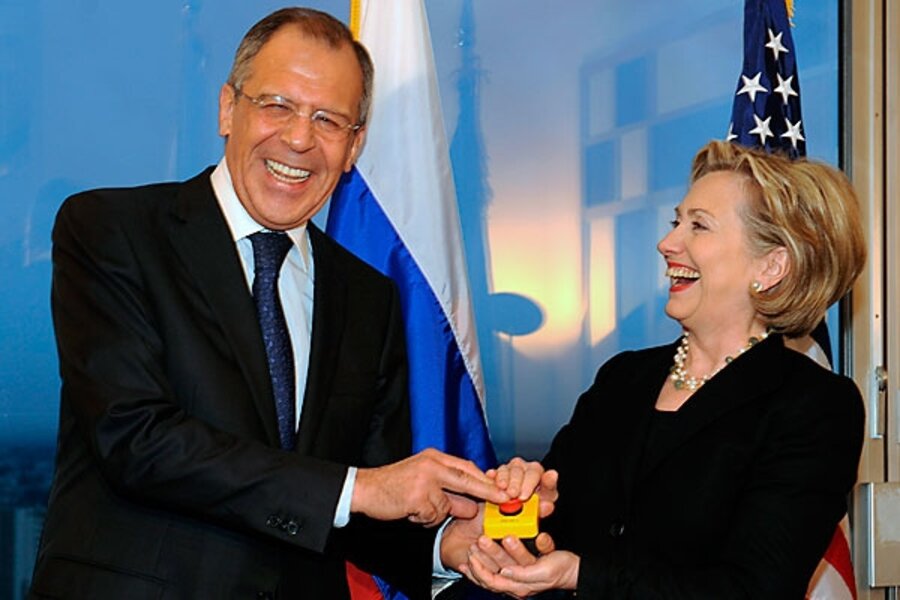
Announced with great fanfare, the reset was designed to open a new and cooperative era between America and the Kremlin.   Below, we see Clinton giving a "reset" button to Russian Foreign Minister Sergei Lavrov on March 5, 2009.  Lavrov is still Foreign Minister and a vocal supporter of Russia's invasion of the Ukraine.  The first act in the reset was NATO's restoration of relations with Russia, after they were suspended in the wake of the Georgia invasion the year before.

Meanwhile, during her time as Secretary of State, the Clinton Foundation received millions of dollars of contributions from Kremlin-connected oligarchs, and Bill Clinton was paid $500,000 for a speech in Moscow.  It was also during Obama's first administration that efforts to negotiate a nuclear compact with Iran began, and a improved relationship with Russia was seen as essential in accomplishing that role because of the Kremlin's good relations with the Mullahs.

As a result, the Kremlin, even more openly than in 2008, supported Obama in the 2012 election.  Putin must have enjoyed Obama's mocking of Mitt Romney's claim that Russia was our #1 enemy, and then the President was caught on an open mic with Soviet President Medvedev, asking him to "tell Vladimir" he'd "have more flexibility after the election".  This was a reference to the portion of the missile defense interceptor system to be based in Eastern Europe, a program announced by the Obama Administration in 2009.  However, in 2013 after Obama's re-election, the administration announced it was cancelling the SM-3 Block IIB program, to the dismay of Poland and Romania where it was to be installed, and to the joy of the Russians as it was the part of the interceptor program most vociferously objected to by the Kremlin.

In early 2013, Clinton left the Obama administration to prepare for her 2016 presidential run.  Once outside the administration, she displayed hostility to the Russian regime and Putin.  Meanwhile, in pursuit of the Iran deal, the Obama administration acquiesced in the Russian intervention in Syria and settled for a perfunctory protest, and weak sanctions, in the wake of Putin's 2014 takeover of the Crimea.

Awareness of the irregularities in Clinton's handling of the emails was an offshot of the Congressional Benghazi investigation and by early 2015, the Clinton email server began to make news, with CNN reporting in March that she wasn't publicly registered as the owner of the domain and server used to operate her personal email, making it difficult to trace the account back to her.  Accounts were registered in her aides' names, and she used a proxy company to shield her involvement.

A DOJ investigation began, along with others.  On January 4, 2016,  in a letter to congressional intelligence committees, Intelligence Community Inspector General I. Charles McCullough III wrote that emails on Clinton’s private server had been flagged for classified information, some of which was considered the highest “top secret” level of classification.

Meanwhile, in late 2014, the FBI learned from a "well-placed CHS [Confidential Human Source]" that a foreign government was planning to send a individual to contribute to Clinton campaign "as way to gain influence with Clinton".  Application for a FISA warrant "lingered" because, according to agent, "everyone was super more careful" "scared with the big name" and "pretty tippy-toeing around HRC because there was a chance she would be the next President" (Durham Report, p.69)(2).  The FISA was eventually approved, but on condition Clinton campaign get a defensive briefing.  Later, a similar incident from another country was discovered (p.74), and most startingly of all, the CHS made illegal contributions to the Clinton campaign that were not documented by FBI handlers. (p.76).

The Durham Report drew a number of contrasts between how the FBI handled these situations versus its approach in 2016 towards Trump.  Hillary's campaign was afforded a defensive briefing, in which it was made aware of the potential illegal contributions from a foreign government so it could be on the alert, while Trump's campaign was not given a defensive briefing.  Further:

"The FBI's and the Department's measured approach to these foreign influence allegations involving Clinton also stands in stark contrast to the speed with which the FBI undertook to include the Steele Report allegations in the FISA request . . . targeting [Carter] Page". (p.73)

"Contrasted with the FBI's rapid opening of CH [Crossfire Hurricane, the Trump investigation], the FBI appears to have made no effort to investigate the possible illegal campaign contribution (which allegedly was a precursor to the contribution of a significant sum of money) . . . on behalf of Foreign Government-30, or the Clinton campaign's purported acceptance of a campaign contribution that was made by the FBI's own long-term CHS on behalf of . . . ultimately, Foreign Government-3" (p.77)

In January 2016, three different FBI field offices opened investigations into "possible criminal activity involving the Clinton Foundation". (p.78)

"The reporting, which in itself is not proof of wrongdoing, was a narrative describing multiple funds transfers, some of which involved international bank accounts that were suspected of possibly facilitating bribery or gratuity violations.  The transactions involved occurred between 2012 and 2014, and totaled hundreds of thousands of dollars." (p.79)

On Feb 22, 2016 a meeting was chaired by Assistant Director McCabe to hear from field offices.  "McCabe initially direct field offices to close their cases, but following objections, agreed to reconsider the final disposition of the cases".  McCabe's approval would be needed before any further investigative steps taken and it was not granted. (p.79)

The FBI was beginning preparations to interview Hillary Clinton regarding the emails, prompting an email from FBI lawyer to Peter Strzok, Deputy Assistant Director of the FBI's Counterintelligence Division, who was leading the investigation into Clinton's emails, and later led the Crossfire Hurricane investigation.  Page and Strzok were having an affair, and she reminded him:

"One more thing: [Clinton] may be our next president. The last thing you need [is] going in there loaded for bear.  You think she's going to remember or care that it was more doj than fbi?"
Meanwhile, on March 2, Bryan Pagliano, the former Clinton staffer who helped set up her private email server, agreed to provide an interview with investigators and accepted an offer of immunity from the FBI and Justice Department, a highly irregular procedure since he had made no proffer of what we would testify to.

It is at this point that Trump emerged as the front runner for the GOP nomination, his campaign took steps to set up a foreign policy advisory board, and the timeline of relevant events in both campaigns begin to merge which will be covered in the next installment in this series. 

--------------------------------------------------------------

(1)  One of the few examples of "accountability" only reinforced the conspiratorial minded.  DOJ Inspector General reported that a junior DOJ lawyer, Kevin Clinesmith, deliberately altered a communication from the CIA to the FBI, regarding whether Carter Page had been a voluntary informant for the CIA regarding Russia.  The CIA notified Clinesmith that Carter Page had been approved by the CIA as an operational contact, but Clinesmith informed those putting together the FISA application on Page that the CIA said Page "was never a source".  As a result, the FISA application omitted material information that may have impacted whether the warrant was approved. (p.185).  Durham reports that a few days after the 2016 election, Clinesmith sent a email to a colleague proclaiming, "vive la Resistance".  Despite the lawyer deliberately lying in a matter that resulted in the issuance of a surveillance warrant for those close to the newly elected President, Clinesmith was only sentenced to 12 months probation.  The normal practice for the DC Bar Association is to automatically suspend convicted members.  However, in this instance, the DC Bar only did so after a reporter asked questions of it a couple of months after the conviction.  The DC Bar also requires those suspended to reapply for admission before they are reinstated.  However, in the case of Clinesmith it did so automatically without asking him to reapply.

(2)  In 2006 or 2007 I was in a meeting with the corporate communications team of the company I worked for.  The team told us that the Clinton Global Initiative (CGI) had requested our CEO appear at one of its events.  We were informed that our CEO did not want to attend, but we needed to provide someone senior for the event because "you know, she might be president some day".  The Clinton Foundation and CGI were always a "pay to play" scheme, with their viability to attract donor funds resting on Hillary's potential political future.  Do you think companies were paying Hillary $250,000 per speech because of her brilliant insights?

Friday, December 8, 2023

The Durham Report: Part 2 - Mueller's Obstruction Of Justice

Another installment of my analysis of the Durham Report, which confirmed that the Trump Russia Collusion story was a hoax conceived by the Clinton campaign and then turned to further use by the Intelligence Community, the Democratic Party, and the media after Trump's unexpected election (see Part 1).

In Part 1, I reported Durham's finding that "not one of the damning allegations contained in the Steele reporting was ever corroborated",  confirming what was already implicit in DOJ Inspector Horowitz's investigation released in 2019.

One of those allegations was the "pee tape" allegedly made when Trump was staying at the Ritz Carlton and invited prostitutes to his suite, a suite he demanded because President Obama had stayed there, an allegation that attracted a lot of media attention in early 2017.(1)  A recent article in the Daily Mail reminded me of how the Mueller team and his report were used as vehicles to try and reinforce this narrative despite a lack of proof.

The article reports on efforts by Georgian-American businessman Giorgi Rtskhiladze to repair his reputation by filing a defamation action against Mueller and the Justice Department.  A Federal District Court dimissed his lawsuit and his appeal was just argued in the DC Court of Appeals.  The lawsuit is based on a reference to Rtskhiadze in a footnote regarding the "pee tape" in the Mueller Report.  You can read about the lawsuit and the footnote here.

I'm less concerned about the legal merits than what it reveals about the Mueller investigation.  You see, by the time the Mueller report was released in 2019, Mueller and his team knew none of the allegations in the Steele Dossier could be corroborated.  Yet, without making reference to the Dossier itself, the report spent considerable time on the events it allegedly described.  Though Mueller could not prove anything it allowed his investigative team to release publicly all sorts of indirect inferences, abetted by the skillful use of adjectives and adverbs to imply things that simply were not true.  Whether it was Sergei Millian, Carter Page, Rtskhiladze, or Svetlana Lokhova the Mueller team didn't care what harm was done to reputations, though they knew the individuals to be innocent, as long as it enabled Mueller to create a narrative damaging to Donald Trump.

The collusion section of the Mueller Report contains no mention of the Steele Dossier and, at his Congressional testimony in July 2019, Mueller repeatedly stated, under oath, that investigation of the Dossier was "out of my purview".  It was clear the Special Counsel wanted to avoid any discussion of the Dossier.  Based on observing his testimony, Mueller appeared to have lost some of his mental capacity, but his staff certainly knew that his repeated statements were untrue and the Durham report provides the details.

The Mueller Team Obstructs Justice & Deceptive Congressional Testimony

The Mueller Team deliberately obstructed a full investigation of Russian interference in the 2016 election

The Mueller Team lied about whether it had investigated the Steele Dossier

The Mueller Team perpetrated a fraud on the American public in an attempt to influence elections and interfere with the functioning of our democracy

By the time Robert Mueller was appointed Special Counsel in May 2017, FBI investigators had discovered where they believed the "pee tape" allegation (and others contained in the Steele Dossier) originated.  It was with Charles Dolan, a DC lobbyist and PR guy, who worked for the Russian Federation on its public relations in the United States.  According to the Durham Report, Dolan:

". . . frequently interacted frequently with Russian government officials, including, most importantly, Dimitry Peskov, Press Secretary of the Russian Presidential Administration, and  Alex Pavlov, Deputy Press Secretary of the Russian Presidential Administration.  Peskov has often been described in media reports as President Putin's 'right-hand man'. . . . Additionally, Dolan maintained relationships with Sergei Kislyak, who served as Russian Ambassador to the United States from 2008-17, and Mikhail Kalugin, the head of the Russian Embassy's Economic Section . . " (p.139). 

Dolan also served as an advisor to the Valdai Club, where he attended several lunches with former Russian President and then-Prime Minister Dmitry Medvedev and was a frequent visitor to Moscow.  Durham describes the Valdai Club as:

"a Moscow based think tank that is closely associated with Russian President Putin and is viewed by many in the West as a vehicle for Russian propaganda" (p.142)

In emails obtained by Durham, Dolan described Igor Danchenko, the Russian national who served as Christopher Steele's "main subsource" for the Dossier as a "Russian agent" who he thought worked for the FSB [the Russian successor to the KGB]. (p.143&160)

The analysts also learned that in addition to Dolan's work for the Russian Federation he had an extensive background in Democratic politics, previously serving as:

"(i) Executive Director of the Democratic Governors Association, (ii) Virginia Chairman of former President Clinton's 1992 and 1996 presidential campaigns, and (iii) an advisor to Hillary Clinton's 2008 presidential campaign.  Moreover, beginning in 1997, President Clinton appointed Dolan to two four-year terms on the State Department's U.S. Advisory Commission on Public Diplomacy.  With respect to the 2016 Clinton campaign, Dolan described himself as a 'door to door' guy in New Hampshire who did not hold any significant position."(p. 138-9)

For the analysts it meant there was now a potential connection between the Clinton campaign and the Russians.  However, the analyst request that the FBI interview Dolan was denied.

When Mueller was appointed, the two FBI analysts were moved over to the Special Counsel's team to assist in its investigation.  They were assigned to a team working on investigating the allegations in the Steele Dossier.

Wait a minute!  Mueller told Congress the Dossier was not in his purview and his report makes no mention on efforts to verify it or any conclusions regarding the allegations.  What is going on?

Not only does the Durham Report state that such a team existed but, in the fall of 2022, at the trial of Igor Danchenko, the FBI analysts confirmed its existence in their trial testimony!

And now we come to the rest of the story.

The FBI analysts continued their research on Dolan and by August 2017 had prepared a briefing in which they proposed opening a formal investigation of Dolan and interviewing him, uploading their case file to the Special Counsel's computer system.  Several members of the Mueller team attended the briefing, including senior attorney Jeannie Rhee.  Rhee, like most of Mueller's team, was a Democratic operative.  A protege of Eric Holder, Rhee had recently represented Hillary Clinton in her email travails as well as representing ex-Obama National Security Adviser Ben Rhodes and the Clinton Foundation in a 2015 racketeering case. (p.167)

However, on September 7, 2017 the analysts supervisor ordered them to "cease all research and analysis related to Dolan".  Later that day, one of the analysts was informed they were being transferred to another team in the Special Counsel's office.  According to Durham, the analyst asked "for permission to continue researching Dolan before moving to 'Team M' but that her request was denied". (p.168)

Later in September, the analysts and other FBI personnel later interviewed by Dolan said they were told that all work "should cease on attempting to corroborate the Steele Reports".  One of the analysts "recalled that Rhee opined, in sum, that there was no longer a need to investigate the Steele Reports, because the Reports were not within the scope of the Mueller Special Counsel mandate", a position described as "curious" by Durham. (p.169).  Having read the scope letter issued to Mueller it is a ridiculous position to take if one were serious about investigating possible Russian interference with the 2016 election as the Special Counsel was authorized to do.

Durham was unable to find anyone who could provide the reasoning behind shutting down the research on Dolan and disbanding the effort to investigate the Steele information.  All Durham's interviews of the supervising agents revealed was a statement that it was a "higher level decision". (p.170)  The proposed case opening on Dolan that had been filed on the Special Counsel's computer system was ordered deleted. (p.170)

Durham notes that "The FBI interviewed hundreds of individuals through the course of the Crossfire Hurricane and Mueller Special Counsel investigations, and yet, they did not interview Dolan . . . " (p.172) 


What should we make of the Mueller team's deliberate avoidance of interviewing Charles Dolan, of its decision in September 2017 to shut down the investigation of the Steele Dossier, of the absence of any reference to it in the Mueller report, and of Mueller's adamant and repeated insistence to Congress that his investigation did not extend to the Dossier? 

Timing and contingency are important in understanding what happened and why.  When the Clinton campaign originated the Russia collusion narrative and Peter Strzok at the FBI was assuring Lisa Page that the agency would prevent Trump from becoming president, everyone assumed Hillary would win in November 2016 and whatever stratagems had been deployed by the campaign and the FBI would remain concealed and never investigated.  It was Trump's unexpected victory that disrupted those plans.  It was essential that the origins of the Russia collusion narrative remain obscure because of the potential damage to Democrats.

In retrospect, the strategy is clear.  From the start, the Special Counsel investigation was directed less at Russian interference and more in continuing an ongoing narrative for the media and Democrats against Donald Trump in order to, at a minimum, create an atmosphere to impede the operation of his administration, create a sense of illegitimacy around his presidency, impact the mid-term elections, and, if possible lure him into an obstruction of justice case.(2)  Prior to Mueller's appointment, Comey and his minions had failed to verify the Steele allegations.  In fact, when the FBI interviewed Danchenko, Steele's main source, in late January 2017, he told the FBI he was merely passing on gossip and stories he'd heard and had no idea if they were true or not.

The failure of the FBI investigation to uncover any confirmation of the Trump collusion narrative was evident by May 2017.  Peter Strzok, who, as Deputy Assistant Director of the agency's Counterintelligence Division, and outspoken opponent of Trump, was leading the investigation, was offered a position on the Mueller team but texted that month he was hesitant in joining, "in part, because of my gut sense and concern there's no big there there". (p.109)

When he started as Special Counsel, Mueller set up a team to further investigate Steele because it was the logical thing to do, but quickly concluded there was nothing that could be corroborated.  Worse, there were potentially embarrassing aspects for the Democrats now that they knew about Dolan's role, in addition to the Clinton campaign funding of the Steele Dossier.  Discovering Dolan's involvement leads to other questions:

Did the Mueller team know that FusionGPS was working for a Russian oligarch at the same time it was working for the Clinton campaign? 

Did the Mueller team know that Christopher Steele was working for yet another Russian oligarch at the same time as he was working for FusionGPS?

Did the Mueller team know that Steel's main source, Igor Danchenko, had been the subject of an unresolved FBI counterintelligence investigation? 

Did the Mueller team know that Danchenko had only managed to maintain his American visa after being firing by the liberal Brookings Institution for soliciting staff on behalf of Russian intelligence (and where he had been hired at the recommendation of later Trump opponent Fiona Hill), by virtue of Christopher Steele's arrangement to pay Danchenko using a cut-out, fraudulently evading American immigration laws?

Or, once they identified Dolan's role and political connections, did they decide not to open that can of worms?  Mueller already knew that Steele had been working for the Clinton campaign in 2016, though the public did not learn about it until October 2017, so it was potentially disruptive of the desired anti-Trump narrative.

The Special Counsel's authorization letter gave him authority to investigate Russian interference with the election.  Mueller and his team decided to ignore anything that did not potential implicate Trump.(3)  Instead, in the fall of 2017, Mueller decided on a two-track approach.  Internally, to quash any further investigation of the Steele allegations and avoid any embarrassing blow-back for Democrats.  Externally, not to say anything so they could continue to leak juicy tidbits to friends in the press and let the narrative continue to build around Steele, because those allegations were the emotional heart of the collusion allegations and best known to the public.

From a timing perspective, until William Barr finally blew the whistle and told Mueller to shut it down, the plan was to run the investigation right through the 2020 election, generating stories to thrill the press and ensuring Trump's defeat.  The last thing the Special Counsel team wanted was to have to write a report because they had nothing.

Forced to write a report sooner than anticipated, the Special Counsel team did the best they could given the lack of evidence.  The Mueller Report, released in March 2019, was divided into two parts.  The first was regarding collusion and Mueller reported that the investigation:

"did not establish that members of the Trump Campaign conspired or coordinated with the Russian government in its election interference activities"

Notice the carefully structured wording which implies that while they couldn't prove conspiracy or coordination, it definitely might have happened, rather than more accurately reporting that Mueller found no evidence to support the allegations.  The first section contained no references to Steele or his reports.  The discussion in this section goes into great detail on every potential interaction investigated and cleverly uses adjectives, adverbs, and colorful, but not relevant, assertions to make it seem like something really must have happened, but when you strip out the literary embroidery you realize there is nothing there.  For example, there is a lengthy narrative regarding the June 2016 Trump Tower meeting in New York which, while a stupid move by Fredo Trump Jr, was a nothingburger, something confirmed by Mueller within days of the public revelation of the meeting, when his team interviewed the respected and credible translator present at that meeting (a fact omitted in the Mueller report).  For my analysis of that meeting reading this. 

We see another example in the long discussion on the mysterious Josef Mifsud and his dealing with George Papadopolous in early 2016.  The Mueller Report makes a big deal about Mifsud's membership in the Valdai Club and its relationship with the Russian government as part of insinuating he was a Russian intelligence asset.  Yet when, as described above, the Mueller team learned the Clinton connected Charles Dolan was an advisor to the Valdai Club, they decided it was so immaterial that Dolan wasn't even worth interviewing and shut down any further research on him.

The second section concerned President Trump's potential obstruction of justice.  The Mueller report lists a number of incidents that might constitute obstruction but makes no recommendation, infuriating Attorney General Barr, who believed it Mueller's obligation to reach a conclusion.  Mueller's strategy was to make sure it was left as an open question.  And it is here we see another reason for Mueller to avoid the Steele Report.  It was the allegations in the Steele Report and, in particular, the extensive and sensationalized media coverage that outraged Trump.  His visible frustration and outbursts were prompted by his knowledge that the allegations were false.  

If the Mueller Report had acknowledged the truth about Steele, that his team investigated and could not corroborate any of the allegations, it would have made Trump's reaction to the investigation much more understandable, undermining Mueller's implied obstruction argument, and the media's ability to maintain its narrative.  That was the last thing the Mueller team wanted.  Better keep what they knew about Steele under wraps.  In 2019 I summarized the key aspects of the obstruction discussion in the Mueller Report.(4)

Given what we now know about the Mueller investigation, the Clinton campaign's involvement in structuring a false narrative about Trump, and Comey and the Intelligence Community's manipulation of the investigation, the reasons for Trump's frustration and outbursts are even more understandable.

Trump may be guilty of naivete, gullibility, ignorance, and a host of other shortcomings but he is not the villain in the Russian collusion story.  There are plenty of real villains including Hillary Clinton, James Comey, Robert Mueller, Adam Schiff, and much of the media.

. . . more to come on the Durham Report

---------------------------

(1)  Durham reports that while Trump did stay at the Moscow Ritz-Carlton in 2013, he did not, as the Steele Dossier claims, stay in the Presidential Suite once occupied by President Obama (a key element in the allegation), nor did he ever stay there on other visits to the city.

(2)  Mueller's Special Counsel remit from DOJ, while it mentioned allegations regarding the Trump administration, empowered him to look at all aspects of alleged Russian interference with the election.  It was a political choice by the Special Counsel to only look at allegations regarding Trump and ignore the evidence of connections between Hillary Clinton, her campaign, and the Kremlin, evidence that was at least as strong as any potential connection between Trump and the Russians.

(3) In 2018 the FBI learned about more potential Russian manipulation and quashed any further investigation.  According to Durham, the FBI learned that Russian access to "sensitive U.S. government information . . . would have allowed them to identify Steele's subsources" and that those subsources "could have been compromised by the Russians at a point in time prior to the date of the first Steele dossier report" (p.107-8).  In other words, Steele's project was likely known at the time by the Russians and the allegations reported by Steele could have been manipulated by them.  

The FBI team that identified the issue met with higher ups and were instructed "to be careful about what they were writing down because issues relating to Steele were under intense scrutiny". (p.108)  Two weeks later the team met with Deputy Assistant Director for Counterintelligence Dina Corsi who "directed them not to document any recommendations, context, or analysis in the memorandum they were preparing", instructions which the team described as "highly unusual" and "concerned the team because analysis is what analysts do". (p.108)

An FBI Office of General Counsel attorney was also at the same meeting and told Durham he was "shocked" by Corsi's directive.  His recollection was that "Corsi was speaking for FBI leadership".  The attorney said "what Corsi said was not right in any circumstance, and it was the most inappropriate operational or professional statement he had ever heard at the FBI." (p.108)

Whether the Mueller team learned of this information is unknown, though FBI analysts worked in support of the team.  The extent of the interaction between FBI leadership, which according to the Durham report was updated daily on the Crossfire Hurricane investigation, and leadership on the Mueller team is also unknown.  What is evident is that for both the FBI and Mueller, any information damaging to the credibility of Steele needed to be closely held and suppressed from further investigation.

(4)  The obstruction discussion in the Mueller report omits the remarkable extent of cooperation with the investigation by the White House, including production of millions of documents, and not asserting executive privilege, even allowing Trump's White House Counsel to be repeatedly interviewed by Mueller, an unprecedented event.  The only request denied was for an interview with Trump. 

Mueller also omits reference to Acting FBI Director McCabe's response to the question posed by Senator Rubio in a hearing in the days after the dismissal of James Comey:

Q.  Has the dismissal of Mr Comey in any way impeded, interrupted, stopped, or negatively impacted any of the work, any investigation, or any ongoing projects at the Federal Bureau of Investigation?

A.  There has been no effort to impede our investigation to date.

There is also the matter of President Trump's dinner with Comey on January 27, 2017.  According to Comey's own account:

The President brought up the Steele report that Comey had raised in the January 6, 2017 briefing and stated that he was thinking about ordering the FBI to investigate the allegations to prove they were false. Comey responded that the President should think carefully about issuing such an order because it could create a narrative that the FBI was investigating him personally, which was incorrect.

The President backed away from issuing the order after Comey's comment.  Isn't it curious that it is the President wanting the allegations investigated and the FBI Director trying to persuade him not to order it?  Perhaps not so curious when the FBI was investigating Trump personally and Comey had, by that time, twice certified that the allegations in the Steele Dossier was reliable enough for the FISA Court to issue search warrants, though Comey knew that certification to be false.

A final note - I've found it interesting that in the outbursts cited in the Mueller Report, Trump repeatedly complains that he needs an Attorney General like Robert Kennedy or Eric Holder to protect him.  Trump was accurate in his assessment of the role of Kennedy and Holder.  Their primary role was to protect their presidents, not to be chief law enforcement officer of the United States.  Holder even publicly bragged of being Obama's "wingman".  Sadly, Trump's assessment of the role of the AG in modern America is correct.  The President needs an AG looking out for him.

Thursday, October 19, 2023

The Durham Report: Part 1 -The Kremlin Connections Of The Clinton Campaign

 "Notably, not one of the damning allegations contained in the Steele reporting was ever corroborated: not the salacious allegations of events at the Ritz Carlton in Moscow, not the allegation of there being a 'well-developed conspiracy of co-operation' between Trump and the Russians, not the allegations of a secret meeting involving Page and certain sanctioned Russians (namely, Igor Sechin and Igor Divyekin), and not the allegation of Page serving as Manafort's conduit for information between the Russians and the Trump campaign.  This is true even after the FBI offered Steele $1 million or more for such corroboration and after Danchenko was signed up as an FBI CHS [Confidential Human Source] and paid more than $220,000 for information on other matters."

"When [the FBI] checked with another U.S. intelligence agency on matters relating to the Steele reporting, they received no corroborating information back.  As one long-time counterintelligence expert at that agency told [the Durham investigation], the Dossier contained unverified allegations from sub-sources who allegedly provided the information, information that the government could not obtain despite its vast intelligence resources and paying millions of dollars for intelligence.  Indeed, after the Steele Dossier was leaked and became public, that expert's reaction was to ask the FBI, 'You didn't use that, right?'".

From Report on Matters Related to Intelligence Activities and Investigations Arising Out of the 2016 Presidential Campaign (the Durham Report), submitted to Merrick B Garland on May 12, 2023 (pages 236-37)

It was all a fantasy, a cleverly designed fantasy, paid for and promoted by the Clinton campaign, masterminded by Fusion GPS and Christopher Steele, seized upon by the Intelligence Community, media, and others and converted over time for different uses by Donald Trump's opponents.  In an astonishing twist, it turns out that the narrative of Trump connections with the Kremlin was created by those who themselves had multiple connections with Russian intelligence services and oligarchs!  

FusionGPS, retained by the Clinton campaign to investigate Trump and Russia was, at the same time, working for a Russian oligarch on repealing Congressionally imposed sanctions.  Christopher Steele, the former British intelligence operative, hired by Fusion to compile the dossier was, at the same time, working for yet another Kremlin connected oligarch (currently under U.S. indictment).   Steele's main sub-source for the dossier was a Russian national, Igor Danchenko, of whom the FBI had earlier conducted a counterintelligence investigation because of his connections with Russian intelligence (only to incompetently lose track of him), allegations of which he was never cleared.  The source for the notorious alleged incident when, in 2014, Trump supposedly demanded President Obama's suite at the Moscow Ritz Carlton and had a group of prostitutes come to the room and urinate on the bed, was a DC lobbyist doing PR for the Kremlin, meeting regularly with Putin's spokesperson, who was also a long-time Clinton associate; a senior advisor to Hillary in 2008 and Virginia Chairman of the Clinton-Gore Campaigns in 1992 and 1996, along with being former Executive Director of the Democratic Governors Association!  Raising the question, who was playing whom in 2016?

It helped that they were dealing with a gullible and conspiratorial minded Donald Trump, around whom they created an actual conspiracy, and aided by candidate and President Trump's reckless rhetoric which played right into that narrative.

There has not been, and now appears there never will be, any personal or institutional accountability for the combination of deliberate and negligent actions taken to undermine the campaign of a Presidential candidate and then to obstruct and impede the normal proceedings of the Executive Branch after January 20, 2017, using a continued series of false claims in a conspiracy designed to defraud the American people and manipulate our election processes.  Hey, maybe someone could file some indictments based on that theory! (1)

I've written a lot about the Russian collusion story and my initial take that there might be something to it based on Trump's own statements and demonstrable ignorance of history and the basics of foreign policy.  By the fall of 2017, and with the revelation that the Clinton campaign was behind the Steele Dossier, I decided to spend more time examining the evidence and reading source documents, including the Intelligence Community Assessment, court filings and rulings, the Page-Strzok texts, the Mueller report, the DOJ Inspector General reports, the more than 5,000 pages of House Intelligence Committee witness transcripts suppressed by Adam Schiff for almost a year and a half, and finally the Durham Report.

The Russia Collusion Hoax is the greatest political scandal of my lifetime; a scandal much worse than Watergate with the added bonus that it was as if Watergate happened but the New York Times and Washington Post were taking the side of the Nixon Administration.

In a subsequent post I'll plunge into the details of the Durham Report and the story behind the conspiracy.

Since 2016 there has been a deliberate attempt to confuse two questions.  Did the Russians attempt to influence the 2016 elections?  Did the Trump campaign collude with the Kremlin on a plan to win the election?  As to the former, I have no doubt.  It's what they did as the Soviet Union and now do as Russia.  As to the latter, it's a definite no.  I'm addressing the latter.  My take on the former can be found in What Was Putin Up To In 2016?  The bottom line is that Putin was about sowing the maximum discord within America and weakening its institutions.  With the revelations since 2017 we now know that Clinton, Schiff, the Intelligence Community, the Democrats, the New York Times and Washington Post, were Putin's collaborators in sowing that discord, acting effectively as agents of the Kremlin.

One further point before plunging into the details.  Those who still believe in the Russia Collusion fantasy like to say that there was more to it than the Steele Dossier.  Actually, with only one exception that's not true.  The Dossier covers all the "greatest hits" - Moscow Ritz Carlton, Trump Tower Moscow, Deutsche Bank, Alfa Bank, the Republican Platform on Ukraine, meetings of Trump campaign officials with Russians and more.  The only significant event not in the dossier is the Trump Tower meeting in June 2016, about which I wrote here.  That fiasco was due to the stupidity of Fredo Trump Jr, who lacks the feral instincts and weird charisma of his father.  The Clinton Campaign knew how to do it right - when you deal with the Russians you do it through cut-outs.

. . . more to come

-------------------------------------------------

(1) This is a reference to Robert Mueller's disastrous failed prosecution of Russian entities, and Special Counsel ongoing criminal case against Donald Trump, both of which use this theory, a theory that could have been applied to the principals in the Clinton Campaign as well as against the 51 former Intelligence Community officials who signed the letter, coordinated by the Biden Campaign, stating the Hunter Biden laptop incident had "all the hallmarks" of a Russian disinformation operation.