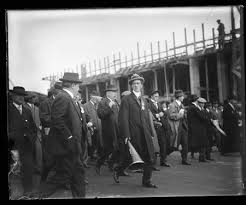
The sour atmosphere from Game 7 lingers on at the start of the game. The Boston morning papers savage the Red Sox management for their treatment of the Royal Rooters, who boycott the game. The articles, the public boycott by the Rooters (who protest outside Fenway), the rumors of unsavory conduct in prior games and the loss of the last
 (Royal Rooters)
 two games mean that only 17,000 fans showed up to watch the final game of the 1912 seasons.
But what a game they see!
Christy Mathewson is making his third start for the Giants and Hugh Bedient, who pitched so splendidly in Game 5, takes the mound for the home team.
The Giants score first in the 3rd when Josh Devore walks and then a routine double play grounder by Doyle is misplayed by Larry Gardner, his third error of the game (the Sox make five errors today). Gardner recovers in time to throw out Doyle at first but Devore ends up at second. Red Murray then strokes a double to drive in Devore.
The score remains 1-0 until the bottom of the 7th when Jake Stahl singles and Wagner walks. After Hick Cady pops out, Olaf Henriksen pinch hits for Bedient. Matty runs the count to 0-2 and then throws Henriksen (a left-handed batter) a low outside curve which fools Olaf but he still gets enough of his bat on it to hit a soft liner down the third base line which ends up as a double scoring Stahl, tying the game.
Smoky Joe Wood takes the mound, replacing Hugh Bedient. Joe lacks his best stuff but manages to retire the Giants without a run in the 8th and 9th. Matty does the same for his part and we go to extra innings.
In the top of the 10th, Red Murray doubles for the second time today and Fred Merkle follows with a clutch single giving the Giants a 2-1 lead. It looks like Wood will be a loser for the second straight day.
We're now in the bottom of the tenth. The great Matty is on the mound and the Giants are confident of victory. Clyde Engle leads off the inning by hitting a lazy fly to center field. Fred Snodgrass parks himself under the ball which nestles in his glove and then falls out. Engle ends up on second. Snodgrass would say later he dropped the ball "
because of over-eagerness, or over-confidence, or carelessness".
 (Fred Snodgrass)
The next batter, Harry Hooper, smashes a hard liner to center which Snodgrass chases down, making a lunging grab to prevent an extra base hit. Matty then walks Steve Yerkes. He later writes:
"I was guilty of a mistake in the 10th inning myself, which proved costly. I passed Yerkes trying to get him to bat at bad balls . . . It was not because I lacked control."
Tris Speaker, the most dangerous Sox hitter, strides to the plate. Matty gets him to hit an easy foul pop up near 1st base. The first baseman (Merkle), catcher (Chief Meyers) and Matty all converge on the ball. Merkle is closest to the ball and the slow-footed Meyers is furthest away but Matty calls for him to catch it. Meyers can't get there in time and the ball drops untouched to the ground. The three players walk together towards the mound as Matty makes "angry gestures". He's clearly rattled by the turn of events and given another chance, Speaker smacks a single, scoring Engle, and the game is tied.
McGraw directs that an intentional pass be given to Duffy Lewis, loading the bases and setting up a force out at each base. The strategy doesn't work. Larry Gardner lifts a fly to the outfield which is caught by Devore but it's deep enough to score Yerkes.

The next day, Tim Murnane
describes the scene in the Boston Globe:
"Words were never invented that could fully describe the outburst of insane enthusiasm that went thundering around Fenway Park yesterday afternoon as Steve Yerkes crossed the rubber with the winning run in the 10th inning. Men hugged each other, women became hysterical, youths threw their caps
in the air, one man in the bleachers fell in a dead faint, strong hearts
lost a beat and started off again at double time." (Larry Gardner)
"Mathewson, the baseball genius, was heartbroken and tears rolled down
his sun-burned cheeks as he was consoled by his fellow-players."
"In its frenzy the crowd could only see the victors, and yet the
defeated National League champions were no less worth of appreciation,
considered the game fight they put up from first to last in the most
remarkable series of games ever played."
The Red Sox win the game and the World Series. It's the first time a team has come from behind when on the verge of elimination in the final inning and it does not happen again until the Kansas City Royals rally to beat the St Louis Cardinals in the sixth game of the 1985 World Series.
 (Boston Globe, Oct 17, 1912
)
Christy Mathewson starts three games and loses two without a win despite posting an ERA of 0.94 (all six Sox runs in Game 2 are unearned) while Joe Wood appears in four games and has a record of 3-1 with an ERA of 4.50.
In 1913, Matty, nearing the end of a career that would see him win 373 games, leads the Giants back to the World Series where they lose again, this time to the Philadelphia Athletics. He retires in 1916 as perhaps the player most admired by the fans and his fellow players (basically the anti-Ty Cobb, see
Take Me Out Of The Ballgame). Serving in WWI he is accidentally exposed to mustard gas during a training exercise and is in ill-health for the rest of his short life. Sitting in the press box during the 1919 World Series he helps Hugh Fullerton identify suspicious plays by the White Sox who are throwing that year's Series. He dies in 1925 at Saranac Lake, NY where he has gone to try to regain his health.


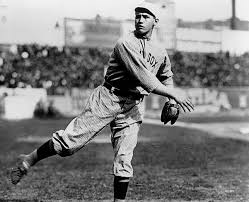
For 22 year old Joe Wood, the future looks limitless. Including the Series he's won 37 games. But the
next spring he breaks his hand trying to field a ball, hurts his arm when trying to rush his recovery and is never the same again. Unlike Matty, he leads a long life, becoming the baseball coach at Yale for two decades and dying in 1985 at the age of 95 (see
Smoky Joe Versus The Big Train).
The machinations of Jimmy McAleer do not go unnoticed in the American League front office where its powerful president, Ban Johnson, is already feuding with the Red Sox owner. Johnson finally pressures McAleer to sell the Sox at the end of the 1913 season.
Fred Snodgrass takes the public blame for the loss even though the biggest mistake of the inning was the misplay on Speaker's foul ball for which Mathewson is to blame. It was Matty's responsibility to call for a fielder to take the pop up and it should have been Merkle's ball. The
New York Times article on the game carries the banner headlines:
"SOX CHAMPIONS ON MUFFED FLY"
"SNODGRASS DROPS EASY BALL, COSTING TEAMMATES $29,514"
The story starts with these words:
"Write in the pages of world series baseball history the name of Snodgrass. Write it large and black. Not as hero; truly not."
After retiring from baseball, Fred Snodgrass returns to his native California and becomes a successful rancher, banker, city councilman and mayor in Oxnard. But he is never allowed to forget his "muff".
In 1940 Snodgrass relates (see
SABR Baseball Biography Project):
“Hardly a day in my life, hardly an hour, that in some manner or other
the dropping of that fly doesn’t come up, even after 30 years. On the
street, in my store, at my home . . . it’s all the same. They might
choke up before they ask me and they hesitate–but they always ask.”
When Snodgrass dies in 1974 at the age of 86 the headline on the NY Times obituary reads:
"Fred Snodgrass, 86, Dead. Ball Player Muffed 1912 Fly."
Game Summary from
Baseball-reference.com
Wednesday, October 16, 1912 at Fenway Park (Boston Red Sox)

                                 1  2  3    4  5  6    7  8  9   10     R  H  E
                                 -  -  -    -  -  -    -  -  -    -     -  -  -
    New York Giants              0  0  1    0  0  0    0  0  0    1     2  9  2
    Boston Red Sox               0  0  0    0  0  0    1  0  0    2     3  8  4

    PITCHERS: NYG - Mathewson
              BOS - Bedient, Wood (8)

               WP - Smoky Joe Wood
        LP - Christy Mathewson
             SAVE - none

   HOME RUNS: NYG - none
              BOS - none

  ATTENDANCE: 17,034
 (Armstrong & Glaser)
