From Kevin Killeen, of KMOX in St Louis:
February is the worst month of the year and this man is wonderful pic.twitter.com/vV73ZF2Qn4
— Alexis Benveniste (@apbenven) February 4, 2022
From Kevin Killeen, of KMOX in St Louis:
February is the worst month of the year and this man is wonderful pic.twitter.com/vV73ZF2Qn4
— Alexis Benveniste (@apbenven) February 4, 2022
MLB and the Player's Union seemed committed to their mutual suicide pact. For the third consecutive year, it looks like spring training will be messed up and perhaps the regular season. More disturbing is that the issues over which the owners and players are squabbling have little to do with problems most critical to the future of the game - the ever increasing length and slow pace and the non-stop growth of strikeouts and home runs, making for a less interesting game whether watching in person or on TV, or listening on the radio, and a firm deterrent to creating a new generation of fans, leaving just us old guys to talk about the old days. For those of us who love the game and wish to see it have a continued future as well as a treasured history, the short-term view of those who run the sport is distressing.
All that was prompted by reading a post from one of my favorite bloggers, Assistant Village Idiot, in which he linked to a 2020 post on his visit to the Negro Leagues Baseball Museum in Kansas City. AVP was troubled to find himself the only visitor to this outstanding museum:
Along about the Rube Foster exhibit I teared up over it all. One can't make people like things, and desert is not a measure of personality, and it is sad that this is always going to be an enterprise held afloat by outside help for symbolic reasons, rather than for its considerable intrinsic merit.
It's worth it on it's own merit. One could teach the history of race relations 1860-1960 with this as the framework. And it's got both stories and statistics, as baseball always does.
As it turns out AVP's visit was in 2014, the same year I and my friend visited it while on one of our annual ballpark tour jaunts. While the museum was not devoid of visitors there were few, apart from us. In my report on the trip I wrote this about the museum:
Best Non-Ballpark Attraction: The Negro Leagues Baseball Museum in Kansas City. Go. Kansas City was home of the Monarchs, one of the most successful Negro League teams and also where, in 1920, the first independent Negro Baseball League was organized. The museum is small (you can see the whole thing in 90 minutes) but extremely well done taking you through the entire history of African-Americans in baseball from the Civil War through the first decade after Jackie Robinson integrated the sport in 1947 (for more see 42 and, by the way, did anyone else notice Jackie's widow, Rachel, who turns 92 next week, sitting with Bud Selig at Tuesday night's All-Star Game?) which means it tells the larger story of African-Americans in American society during those years. It honors the accomplishment of those who played in the Negro Leagues and leaves you wondering how Josh Gibson, Oscar Charleston, Cool Papa Bell, Judy Johnson, Martin Dihigo, Satchel Paige (of whom you can read more in Don't Look Back and The 1935 Bismarck All Stars) and others would have fared if given the opportunity to play in the Major Leagues during their prime. It was an odd period when black players couldn't play in the Majors but at the same time Paige was barnstorming with white pitchers Dizzy Dean (who vocally supported integrating baseball) and Bob Feller throughout the 1930s and 1940s on tours to which they drew black and white fans in numbers that exceeded the attendance of most major league games.
.JPG)
.JPG)
.JPG)
I purchased a Kansas City Monarchs jersey at the museum which became my favorite T-shirt. I finally wore it out and discovered that the museum no longer sold it. Thankfully, Mrs THC came to my rescue and was able to find and purchase two shirts which she recently gave to me!
So, owners and players, get your act together and address the real problems of the game. And readers, if you are in the Kansas City area, make sure to visit the Negro Leagues Baseball Museum.
Part of the Forgotten Americans series. This is a reedited and revised version of a post previously published. I decided to republish the post because of developments in recent years. Senator Elizabeth Warren of Massachusetts recently wrote an op-ed calling for the packing of the Supreme Court after denouncing current justices for voting against "widely held public opinion"(1), an echo of Teddy Roosevelt's views during the campaign of 1912, views which prompted his friend and long time political ally Elihu Root to break with him and support Taft. Until recently I was confident that Root's argument remained applicable today, but though I would like to think it does, for the first time in my life I am questioning it. Will his view of America's general principles survive? Or, are they no longer relevant in our current circumstances?
“Democratic absolutism is just as repulsive, and history has shown it to be just as fatal, to the rights of individual manhood as is monarchical absolutism.“ - Elihu Root (1913)
"No anecdotes are told of Elihu Root" - James Morrow (1914)
Today Elihu Root is a Forgotten American, but in the early 20th century he was one of America’s most prominent public figures. The story of his political split with his friend Theodore Roosevelt in 1912 remains relevant to understanding the political conflicts of 21st century America and the danger of the recent ascendancy of viewpoints contrary to traditional American principles that would spell the end of our republic and our democracy should they triumph.
Born in 1845, Elihu Root became a successful New York City lawyer with clients including Jay Gould, Andrew Carnegie and Chester A Arthur (who appointed him US Attorney for the Southern District of New York after becoming President in the early 1880s).
Active in the Republican Party, he served as Secretary of War from 1899 to 1904 under Presidents McKinley and Theodore Roosevelt, during his tenure restructuring the National Guard, enlarging West Point, creating the Army War College, while overseeing the suppression of the Filipino insurrection and establishing the governance structure for this new American acquisition.
After briefly returning to law practice Root rejoined the second Roosevelt Administration in 1905 as Secretary of State, supporting the building of the Panama Canal, and negotiating 24 international arbitration treaties for which he received the Nobel Peace Prize in 1912.
With the end of the Roosevelt administration in 1909, Root was appointed as Senator from New York, serving until 1915. During and after his term he was also the first president of the Carnegie Endowment for International Peace, leading it until 1925. After WWI he helped design the World Court and was one of the founders of the Council for Foreign Relations. Root died in 1937. And James Morrow was correct, I found no anecdotes about him.
But what prompted me to write this post was Root's political split with Teddy Roosevelt in 1912, the resulting chaos at the Republican Convention that year, and the underlying reasons for that split. Edmund Morris wrote about this episode in the third, and final, volume of his entertaining Roosevelt biography: Colonel Roosevelt. Morris is wonderful at capturing personalities along with their actions and adventures (his recounting of Roosevelt's African safari and the daring, life altering, expedition down the River of Doubt in Brazil are worth the price of the book). He's also enthralled by political machinations, but has little interest in political theory, ideas, philosophy, or governance, which is what prompted the Roosevelt-Root dispute and gets short shrift in his book, leaving readers with little understanding of why Roosevelt provoked such opposition (it also explains the great failure of his biography of Ronald Reagan who was, above all, a man of ideas, while having a difficult to penetrate personality).
Roosevelt and Root had been political allies and friends. Root shared Roosevelt's political progressive beliefs and supported his legislative program, but between the end of his presidency in 1909 and the presidential nominating campaign in 1912, Teddy had come to believe that the next stage of the progressive legislative program could only succeed if linked with a progressive constitutional reform program including the broad use of referendums, initiatives, recall of judges, and popular vote overriding of judicial decisions. At its core was the desire to replace indirect republican representative government with direct democracy or, as Roosevelt put it, "people themselves must be the ultimate makers of their own Constitution". Elihu Root believed this change would be devastating to the American political system because it meant the majority could change the fundamental meaning of the Constitution, avoiding the amending procedures of Article V, and endangering the minority protections embedded in its provisions. For Root it was one thing to advocate for progressive legislation consistent with the Constitution, it was another to attempt to radically change the constitution itself.
It was for the same reason that Root opposed the proposed 17th Amendment providing for the direct election of Senators, arguing the Constitution's framers had grasped that "the weakness of democracy is the liability to continual change; they realized that there needed to be some guardian of the sober second thought; and so they created the Senate" with longer terms and indirect election. A Senate directly elected by the people, would be less likely to "protect the American democracy against itself".
In the view of Root, the essentials of human nature remained unchanged, and the insight of Classical philosophers regarding the tendency of all forms of government to degenerate over time:
Monarchy to Absolutism
Aristocracy to Oligarchy
Democracy to Tyranny
- remained a valid critique. Root recognized that the mechanisms of the Constitution were designed to try to correct these defects in the newly created democratic republic.
Roosevelt's decision to challenge his protege and the sitting president, William Howard Taft, for the 1912 Republican nomination forced Root to make a hard choice. At the time, he remarked to a friend:
"I care more for one button on Theodore Roosevelt's waistcoat than for Taft's whole body."
Nonetheless, he felt compelled to support Taft because of the principles involved. It was a wrenching personal decision (and even more so for Senator Henry Cabot Lodge who had been a very close friend of Teddy since college days). Root was elected Chairman of the Convention in a hotly contested election and oversaw its tumultuous course, helping to ensure the renomination of President Taft. In his convention keynote speech he reminded delegates that the Republican Party was "born in protest against the extension of a system of human slavery approved and maintained by majorities."
After losing the nomination, Roosevelt ran on the Progressive Party ticket, losing the election to Woodrow Wilson but ensuring that Taft would not be reelected. Despite Taft's defeat, Root (and Lodge) were satisfied that Roosevelt had not taken over the Republican Party:
"This has not seemed to me to make any difference in our duty to hold the Republican Party firmly to the support of our constitutional system. Worse things can happen to a party than to be beaten."
The following year, Root gave two lectures at Princeton University, subsequently published as Experiments In Government And The Essentials Of The Constitution. Only thirty pages in length it is worth reading today because the views Root expresses are timeless and not dependent on the specific historical circumstances of the early 20th century.
Root starts by reaffirming his belief in the need for new laws to meet modern industrial conditions:
"It is manifest that the laws which were entirely adequate under the conditions of a century ago to secure individual and public welfare must be in many respects inadequate to accomplish the same results under all these new conditions"
"Many interferences with contract and with property which would have been unjustifiable a century ago are demanded by the conditions which exist now and are permissible without violating any constitutional limitation."
He then makes an important distinction between the process of devising new laws to meet new conditions and modifying the principles upon which government is based.
According to Root, we must recognize (echoing Madison's sentiments in Federalist 51) that
"Human nature does not change very much. The forces of evil are hard to control now as they always have been. It is easy to fail and hard to succeed in reconciling liberty and order."
In order to achieve this the Constitution provides for limits on government power in order to preserve individual rights. America was the first polity to take this approach as "The ancient republics, however, put the state first and regarded the individual only as a member of the state . . . they did not think of individuals as having rights independent of the state, or against the state".
Root goes on to say that "It is impossible to overestimate the importance of the consequences which followed from these two distinct and opposed theories of government". The theory of the ancient republics was behind the French Revolution of 1789 and its heirs which:
"followed the French Declaration of the Rights of Man, with the negation of those rights in the oppression of the Reign of Terror, the despotism of Napoleon, the popular submission of the second empire and the subservience of the individual citizen to official superiority which still prevails so widely on the continent of Europe."
Or, as Margaret Thatcher more pungently put it, the French Revolution produced "a pile of corpses and a tyrant" while the American Revolution gave us George Washington and the Constitution. One wonders what Root would have said in the wake of the European rise of Fascism, Communism and National Socialism?
According to the theory of American constitutionalism:
"it is the very soul of our political institutions that they protect the individual against the majority. [The inalienable rights cited in the Declaration] are not derived from any majority. They are not disposable by any majority. They are superior to all majorities. The weakest minority, the most despised sect, exist by their own right. The most friendless and lonely human being on American soil holds his right to life and liberty and the pursuit of happiness, and all that goes to make them up by title indefeasible against the world, and it is the glory of American self-government that by the limitations of the constitution we have protected that right against even ourselves. That protection cannot be continued and that right cannot be maintained except by jealously preserving at all times and under all circumstances the rule of principle which is eternal over the will of majorities which shift and pass away."
"Democratic absolutism is just as repulsive, and history has shown it to be just as fatal, to the rights of individual manhood as is monarchical absolutism."
Root asks for humility in considering what government can, and cannot, accomplish pointing out that:
"A very large part of the litigation, injustice, dissatisfaction, and contempt for law which we deplore, results from ignorant and inconsiderate legislation with perfectly good intentions."
"Law cannot give to depravity the rewards of virtue, to indolence the rewards of industry, to indifference the rewards of ambition, or to ignorance the rewards of learning . . . We know all this, but when we see how much misery there is in the world and instinctively cry out against it, and when we see some things that government may do to mitigate it, we are apt to forget how little after all it is possible for any government to do . . ."
"The chief motive power which has moved mankind along . . . has been the sum total of intelligent selfishness in a vast number of individuals, each working for his own support, his own gain, his own betterment. It is that which has cleared the forests and cultivated the field . . . made the discoveries and inventions, covered the earth with commerce, softened by intercourse the enmities of nations and races . . . gradually, during the long process, selfishness has grown more intelligent, with a broader view of individual benefit from the common good and gradually the influences of nobler standards of altruism, of just and human sympathy have impressed themselves . . . but the complete control of such motives will be the millennium. Any attempt to enforce a millennial standard now by law must necessary fail."
Moreover, an unbridled democratic government will ultimately undermine that which it seeks to protect:
"When government undertakes to give the individual citizen protection by regulating the conduct of others towards him in the field where formerly he protected himself by his freedom of contract, it is limiting the liberty of the citizen whose conduct is regulated and taking a step in the direction of paternal government. While the new conditions of industrial life make it plainly necessary that many such steps shall be taken, they should be taken only so far as they are necessary and effective. Interference with individual liberty by government should be jealously watched and restrained, because the habit of undue interference destroys that independence of character without which in its citizens no free government can endure . . . Weaken individual character among a people by comfortable reliance upon a paternal government and a nation soon becomes incapable of free self-government and fit only to be governed."
A nation governed by referendum, initiative and the ability to overrule judicial rulings by popular vote cannot sustain itself because:
"If there be no general rules which control particular action, general principles are obscured or set aside by the desires and impulses of the occasion. Our knowledge of the weakness of human nature and countless illustrations from the history of legislation in our own country point equally to the conclusion that if governmental authority is to be controlled by rules of action, it cannot be relied upon to impose those rules upon itself at the time of action, but must have them prescribed beforehand"
The Constitution attempts to do this by limiting the powers of government, distributing those limited powers among the three branches of government, establishing a federal system, and allowing for the validity of laws to be judged by the courts.
With his defeat in 1912, the reforms proposed by Teddy Roosevelt and other progressives did not come to pass as Root and others feared, but a version of the progressive vision was put into place starting with the New Deal Supreme Court which effectively modified the principles of our government without Constitutional amendment by narrowing the definition of liberty, tearing down the walls separating the branches of government, and allowing the growth of the administrative state. The modern progressive cult of The Living Constitution would further erode remaining constitutional protections, converting the courts into just another legislative body for enacting policy preferences.
In the 21st century, the Progressive move towards majoritarian rule has taken a new turn with the movement towards a national popular vote and the effective political elimination of the states, a movement more recently intertwined with identity politics and other academic theories, along with a growing scorn for, and desire to repress, any speech they find objectionable, in a way earlier Progressives would have found repulsive and un-American, raising the possibility of a hybrid majoritarian state in which certain groups, elevated under the rules of intersectionality and with the guidance of an Elite Vanguard, would hold the trump cards.
This raises a fundamental question. America works to the extent the large majority of its citizens, no matter how they may differ, generally accept common process outcomes or "sometimes you win, sometimes you lose, sometimes it rains" (yes, I'm quoting Bull Durham). This aspirational belief in neutral processes, supported by freedom of conscience and speech, along with equality under the law and due process rights, is the only way Root's vision can be sustained.
I use the term "aspirational" because none of the elements described above will ever work perfectly, but without those aspirations, what is there to guide us? If, as the dominant institutions are now telling us, these beliefs are really artifacts by which white supremacy is maintained and that power, not ideas, are all that matters, where does that leave us? What is the future of a country with more than 300 million citizens, of varied races, ethnic groups and religions if everything is based on the power relationships of those groups?
Moreover, the idea of common accepted neutral processes, only works if it rests upon a bed of common accepted values. Those values may be very broad but as long as they are generally accepted, disputes about how to best achieve and preserve those values can fit within a process driven system. But what happens when those common accepted values disappear, as may have happened in today's America? At that point do those neutral processes potentially become weapons?
Can we confront and defeat the enemies of liberal democracy merely by using the traditional Constitutional tools to achieve the aspirations set forth in that document? Do we now face the scenario written of by Frank Herbert in Children of Dune:
When I am Weaker than you, I ask you for Freedom because that is according to your principles; when I am Stronger than you, I take away your Freedom because that is according to my principles.
Having effectively used our concept of tolerance (as something we owe each other) to seize control of institutions, these forces now seek to destroy the mutuality inherent in that concept and return to the older, medieval meaning of tolerance, as something bestowed by rulers and revocable at their discretion.(2)
Can we effectively oppose them using these long standing general principles, neutral processes and reliance on the Constitutional protections enunciated by Root or does that strategy lead to inevitable defeat if large portions of society refuse to play by the same rules? Does it mean adopting the same techniques in order to defeat those who seek to embed these dangerous principles into our government and culture? If so, how does one ensure that in doing so, we do not become what the enemies of American principles have become? A decade ago, I never thought this question would arise and would certainly have objected to straying from those principles. I underestimated what was happening within those institutions and am no longer certain as to the right answer; an answer that will determine if we will govern ourselves or be governed by others.
For a thorough discussion of Roosevelt's intellectual background and the extent to which it deviated from the views of the Founders and Lincoln, see Jean Yarbrough's book Theodore Roosevelt And The American Political Tradition.
----------------------------------------------------------------------------------------------------
1. The reality is that when Senator Warren refers to "widely held public opinion" what she is referring to is public opinion in her hometown of Cambridge, Massachusetts. Having worked in Cambridge for twelve years and lived in the Boston area for two decades, I can assure you that public opinion in that city bears no resemblance to opinion in most of the United States. What Warren is counting on is that the new judges appointed to pack the Court, trained in law schools that have become increasingly ideological (including, unfortunately my alma mater), and imbued with the notion that judges should act as legislators, devoted to enacting their favorite policies in support of social justice, will vote exactly the way she would.
2. The perplexing aspect of our current situation is that those pushing the New Racism and an authoritarian society are not supported by the majority of Americans (at least according to every public poll I've seen). Yet they have an inordinate impact because of the private and public institutions they control, and their methods, which are designed to disguise what their ultimate goals are and their tactics to cut off any discussion by labeling dissenters as racist, fascist, transphobic et. When it is made clear, they inevitably lose, but they've made the costs of opposition in terms of endangering educational and job opportunities enormous. An example: in 2020 the California ballot included a proposition to remove the provision of the state constitution banning discrimination. The proposition was supported by Progressives, the tech oligarchs, and public employee unions which outspent opponents of the proposition 17-1. Yet the same California voters who by 2-1 supported Biden over Trump, voted 57-43 against the ballot proposition, because they knew it was simply wrong. That result is just one of many reasons the authoritarians are seeking to repress opposition speech in a desperate search for a way to obtain a permanent majority. And a permanent majority is what they seek and what they need. King Abdullah of Jordan told of a meeting with President Erdogan of Turkey, at which Erdogan told him, "Democracy is like a bus, when it gets to my stop, I get off". That is what we face; and many liberals, progressives, and even socialists recognize that danger and are warning against it.
On this date in 1943 the last frozen and exhausted remnants of the German Sixth Army surrendered to the Red Army amid the ruins of Stalingrad, ending a battle that started in the last week of August 1942. Of the 320,000 soldiers in the Sixth Army, 91,000 were still alive to surrender of whom only 5,000 ultimately survived to return to Germany, most released after Stalin's death in 1953, eight years after the war ended. Germany's Italian, Hungarian, and Romanian allies lost another 300-400,000 dead, wounded and captured. As many as a half million Soviet soldiers may have died in the battle; including wounded and missing, Red Army casualties exceeded one million.
Historians still argue over the turning point of World War Two, and specifically of the Eastern Front - was it the Battle of Moscow in December 1941? Stalingrad? Or Kursk in July 1943? At the time, Stalingrad was seen as the symbolic and psychological turning point by both sides.
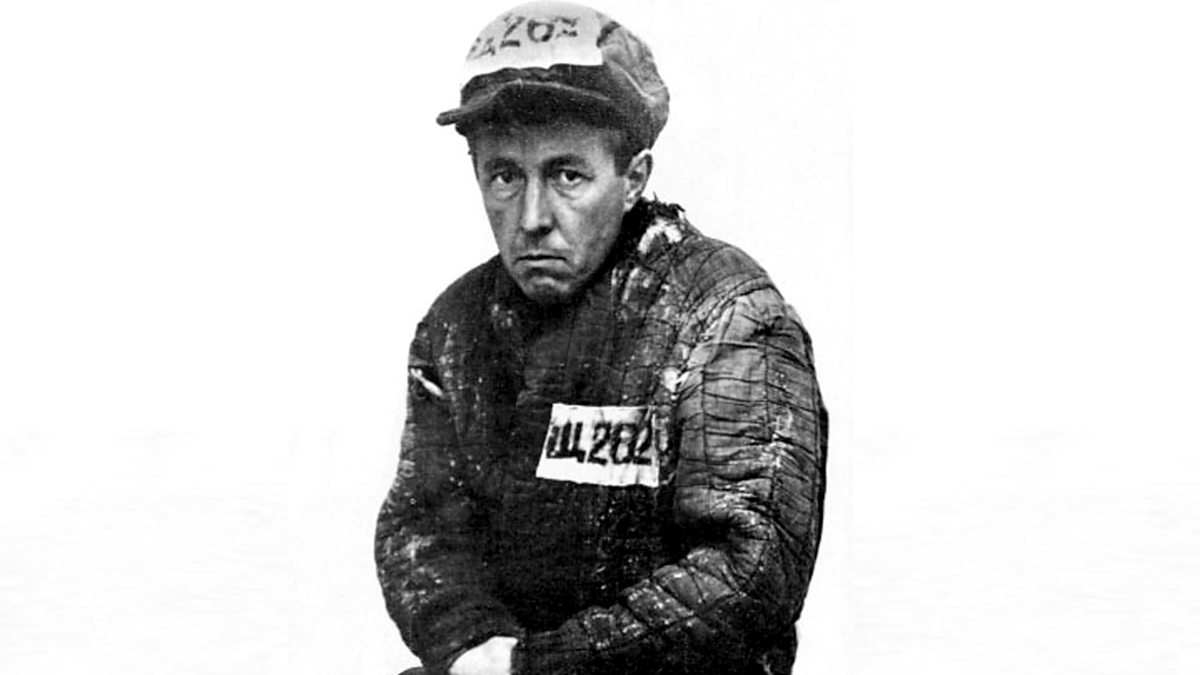
The finest pop song about an historical event is undoubtedly Roads To Moscow, composed and recorded by Al Stewart, which I saw performed in the fall of 1974 at the Orpheum Theater in Boston while Stewart toured in support of his new album Past, Present, and Future. The performance was both musically and visually striking, as Stewart and his band played backed by three enormous video screens stretching across the entire stage showing war footage and ending with a picture of Alexander Solzhenitsyn on all the screens; The Gulag Archipelago had been published in December 1973 and Solzhenitsyn expelled from the Soviet Union in February 1974.
The events described in Roads To Moscow began more than 80 years ago as Operation
Barbarossa, the German surprise attack on the Soviet Union, triggering
the worst of the many conflicts that made up World War Two. By its end in May 1945, 4.3
million Germans were dead, mostly military personnel (along with three quarters of a million of its Italian, Hungarian, Romanian, and Finnish allies), and perhaps up to
27 million Russians, two thirds of them civilians (German pre-war plans called for the starvation of 30 million Russian civilians in order to free up food supplies for civilians and military and to allow for German immigration to the occupied territories). Horror upon horror piled up. Soviet secret police routinely executed all imprisoned political prisoners in cities from which the Red Army was retreating in 1941 and upon the Soviet occupation of Eastern Europe in 1944-45 more imprisonments and executions followed - the Soviets had already executed 15-20,000 captured Polish officers in 1940. When they reached Germany, Soviet forces were unleashed and encouraged by commanders to engage in an orgy of murder and rape. It was in the wake of the German attack in 1941 that the first Nazi organized and systematic killing of Jews took place with roaming units executing more than a million in mass shootings. The beginning of Barbarossa also saw the start of planning for the Final Solution, culminating in the Wannsee Conference of January 1942 which set as its goal the extermination of the eleven million Jews in Europe.
Stewart's song balances a vivid, poignant, brilliantly constructed, and historically accurate
lyric with a striking melody, a Russian influenced chorus, and an
evocative and emotional arrangement. He tells the story of a Soviet
soldier, one of tens of millions of people caught in the horrific
tragedy caused by two of the most brutal regimes to ever be inflicted
upon the human race - Nazi Germany, led by Adolph Hitler, and the
Communist Soviet Union of Josef Stalin. It's a world of spiritual
darkness and limited and terrible choices for the people trapped
by those events, a dilemma also brought to life by Alan Furst in his
splendid series of novels set in the same time period - particularly Night Soldier and Dark Star. Most of those in Eastern Europe who opposed both Nazis and Communists ultimately suffered a tragic fate (see, for instance, the astonishing and inspiring story of Witold Pilecki, the man who volunteered for Auschwitz).
Let's look at the lyrics and explore the song in more detail.
They cross over the border the hour before dawnAt about 315am on the morning of June 22, 1941, the German army launched Operation Barbarossa. The attack, including 14 Finnish and 13 Romanian divisions, involved 3.8 million soldiers, 3,400 tanks, 3,500 aircraft and 700,000 horses. Facing the onslaught were about 2.5 million frontline Soviet troops (the Red Army had about 4 million men under arms in total in the European part of the country).
Moving in lines through the dayThe Luftwaffe destroyed over 2,000 Soviet aircraft on the ground that first day, losing only 35 planes in its attacks. More than 3,900 Soviet planes were destroyed in the first three days, giving the Germans overwhelming air superiority.
Most of our planes were destroyed on the ground where they lay
Waiting for orders we held in the woodIn those first days and weeks many Soviet troops found themselves isolated behind the rapidly advancing Germans and often without orders amidst the command chaos. "The Front" refers not to the front lines where the soldiers were, but to the organization of Russian armies into "Fronts", equivalent to American Army Groups on the Western Front. In other words, they heard nothing from the High Command.
Word from the Front never came
By evening the sound of the gunfire was miles away
Ah, softly we move through the shadows, slip away through the trees
Crossing their lines in the mists in the fields on our hands and our knees
And all that I ever, was able to see
The fire in the air glowing red, silhouetting the smoke on the breeze
All summer they drove us back through the UkraineIn this passage, the narrator uses the terms "us" and "we" in reference not to his personal location but rather to the overall plight of the Red Army.
Smolensk and Vyazma soon fell
By autumn we stood with our backs to the town of Orel

Closer and closer to Moscow they come
Riding the wind like a bell
General Guderian stands at the crest of a hill
On November 15, the Germans began their final push on Moscow. General Heinz Guderian (1888-1954), commander of the Second Panzer Army, is considered one of the finest tank generals of the war, performing brilliantly during the Poland invasion and then leading the armored spearheads in the 1940 French campaign. Guderian's task was to approach the Soviet capital from the southwest and encircle it. Though he made some advances, his overextended forces were halted short of the capital and left in vulnerable defensive positions. On December 26, 1941 he would be dismissed from command because of a dispute with his superiors (including Hitler) over how to respond tactically to the recently launched Soviet offensive. Recalled to duty by Hitler in 1943 after the disaster at Stalingrad, he was charged with rebuilding the army's panzer capabilities. On July 21, 1944, the day after the failed assassination attempt against Hitler, Guderian was appointed Army Chief of Staff. Though often arguing with Hitler about tactical decisions, he remained a faithful supporter of the Fuehrer until the end of the war.
(Guderian)

Winter brought with her the rainsIn this section, two weather periods are mixed together. From late October until mid-November came a period of cold rain, turning the primitive Soviet road network into a sea of mud. Then came freezing temperatures, making the roads stable and more passable. The final German push was launched in this window before the onset of brutal cold and snow made offensive operations much more difficult.
Oceans of mud filled the roads
Gluing the tracks of their tanks to the ground
While the sky filled with snow

And all that I ever was able to seeNow the red is silhouetting "the snow on the breeze" rather than "the smoke on the breeze" of the first verse, signaling the passage of time from the warmth, sun, and disaster of June to the bitter cold, snow, and hope of December.
The fire in the air glowing red silhouetting the snow on the breeze
In the footsteps of Napoleon the shadow figures stagger through the winter
The German offensive continued until December 5 under increasingly
taxing conditions with heavy snow and temperatures plunging to well
below zero. Counting on achieving complete victory by the end of fall,
German soldiers had not been issued winter clothing, nor were tanks,
assault guns, and motor vehicles designed and equipped to operate in
these conditions. At these temperatures the recoil fluid, lubricating
oil and firing pins on German artillery, anti-tank, and machine guns
failed, tank turrets would not turn and trucks had to be kept constantly
running, using precious fuel. And all these troubles were amplified by the
already overstressed German supply system collapsing in the
winter conditions.
Yet despite these difficulties, isolated German units got within 15
miles of the Kremlin, while to the northwest the main German forces were
within 25 miles of the city.

A German officer wrote of conditions during the advance:
It is icy cold . . . To start the engines, they must be warmed by lighting fires under the oil pan. The fuel is partially frozen, the motor oil is thick, and we lack antifreeze to prevent the cold water from freezing.On December 3, the commander of Fourth Panzer Group reported its offensive combat power "has run out" because of "physical and moral over-exertion, loss of a large number of commanders, inadequate winter equipment".
The remaining limited combat strength of the troops diminish further due to the continuous exposure to the cold. It is much too inconvenient to shelter the troops from the weather . . . In addition, the automatic weapons of the groups and platoons often fail to operate, because the breeches can no longer move.
Falling back before the gates of Moscow
Standing in the wings like an avenger
What kept the German high command pressing ahead for so long despite the
casualties and exhaustion of men and equipment was the persistent
belief the Russians had exhausted their reserves and were on the verge
of collapse. It was a massive miscalculation and demonstrated the
complete failure of German intelligence assessments. They
underestimated the willingness of Stalin to move troops from the Soviet
Far East as well as the capability of the brutal and ruthless Soviet
system to mobilize an almost endless number of reserves (unlike Hitler,
who resisted fully mobilizing the German economy and populace until
1944, Stalin immediately took such measures). Between June 22 and
December 31, the Soviets lost 4 million men, the equivalent of its entire army on June 22, yet
still had 4 million under arms at the end of the year. It is hard to
believe any other society surviving with that magnitude of human loss in such a
short time.
Less than 24 hours after the German offensive halted, the Soviets began
launching their own attacks, designed to push back and isolate the
German forces near Moscow. In a series of actions lasting until the
beginning of March 1942, the exhausted Germans were forced back more
than 100 miles, permanently eliminating the threat to Moscow.
With the exception of the British medium and heavy tanks which reached the Soviet Union before the Moscow offensive, Western ally aid played a small part in stopping the German advance. However, the scale of British, and particularly American, aid became enormous as the war progressed and without it the speed and scale of the Soviet advances in 1943-44 would not have been possible. For more detail see Footnote 1 at the end of this piece.
While Soviet soldiers were somewhat better equipped for the weather, the
winter conditions still took a toll, a toll only enhanced by Soviet
commanders still favoring frontal assaults. Thus, despite its success,
the tactical shortcomings of the Red Army can be seen in the disparity
in casualties during its three month offensive - 1.6 million for the
Soviets versus 262,000 for the Germans.
And far away behind their lines the partisans are stirring in the forestThough not a major factor in 1941, by the following year the partisan threat became a major problem for the extended supply lines of the German army. Partisan warfare in Russia was on a completely different, and larger, scale than in most of the rest of Europe, involving huge numbers, and semi-organized and large scale assaults on German rear lines. Big chunks of the Soviet countryside behind enemy lines remained out of German control throughout the war, forcing many troops to be diverted to fighting partisans.
Coming unexpectedly upon their outposts, growing like a promise
You'll never know, you'll never know
Which way to turn, which way to look, you'll never see us
As we're stealing through the blackness of the night
You'll never know, you'll never hear us
And the evening sings in a voice of amber, the dawn is surely coming
Using "amber" in this context is very interesting. Amber is a
fossilized tree resin, valued as a gemstone. From 1500 BC there was an
Amber Road by which this material was moved in trade from the shores of
the Baltic to the Mediterranean. The leading source of amber was near
what used to be the city of Konigsberg in Prussia, now known as
Kaliningrad and part of Russia since 1945.
The famous Amber Room was
initially constructed in Konigsberg and gifted in 1716 by the Prussian
King to Peter the Great of Russia. Installed in a palace outside of
Petersburg (later Leningrad), the room was expanded, eventually covering
590 square feet and containing over 6,000 pounds of amber on panels
backed with gold leaf and mirrors.
(The Amber Room)

During the war the German Army dismantled the Amber Room and transported
it back to Konigsberg. Disappearing at the end of the war, its
location remains unknown, one of the last mysteries of the conflict.
The voice of amber is soothing - its message that things will get better. The next lines tell us how:
The morning road leads to StalingradWe've moved ahead several months to the late summer of 1942. Unlike 1941, when the German Army was powerful enough to attack the Soviets from across its entire front, the Nazis summer offensive would be more limited in scope.
And the sky is softly humming
 On
June 28, the Germans attacked in the south, aiming for the oil fields
of the Caucasus region and the heavy industrial town of Stalingrad. The
Germans advanced quickly, nearly reaching the Caspian Sea, but became
bogged down in Stalingrad, with an increasingly obsessed Hitler
insistent upon its capture. The fighting lasted for almost six months
ending in catastrophe for the Nazi regime with the destruction of the
Sixth Army and the allied Hungarian and Romanian armies, along with
heavy losses in other German units. The cost of victory was staggering for the
Red Army - another 1.1 million dead, wounded or captured.
On
June 28, the Germans attacked in the south, aiming for the oil fields
of the Caucasus region and the heavy industrial town of Stalingrad. The
Germans advanced quickly, nearly reaching the Caspian Sea, but became
bogged down in Stalingrad, with an increasingly obsessed Hitler
insistent upon its capture. The fighting lasted for almost six months
ending in catastrophe for the Nazi regime with the destruction of the
Sixth Army and the allied Hungarian and Romanian armies, along with
heavy losses in other German units. The cost of victory was staggering for the
Red Army - another 1.1 million dead, wounded or captured.
Two broken Tigers on fire in the night
Flicker their souls to the wind
We wait in the lines, for the final approach to begin
It's been almost four years, that I've carried a gun
At home it'll almost be spring
The flames of the Tigers are lighting the road to Berlin
The lyrics here are very cleverly structured. The first line tells us of "two broken Tigers" followed by a reference to "the final approach" but we don't know where or when it is. The next line tells us it's been "almost four years that I've carried a gun",
placing us in 1945, but still not giving us a location as Soviet armies
are fighting from the Baltic to Hungary. Then it's revealed that the
flaming Tigers are also "lighting the road to Berlin", creating a vivid and precise word picture.
The Tiger was the heaviest and most powerful tank produced by Germany
during the war. Like much German equipment it was over engineered,
overly complex to manufacture and required high level maintenance to
keep operational. The Tiger I was produced from 1942 to 1944 and the
Tiger II from 1944 on, but fewer than 2,000 made it to the army. When
it was available and running the Tiger proved devastatingly effective.
(Tiger II)
It's now April 16, 1945. The Red Army is less than 50 miles from
Berlin. Much has transpired since the German surrender at Stalingrad in
February 1943. In July 1943 Hitler attempted his last major attack on
the Eastern Front near the city of Kursk. It quickly proved
unsuccessful, the Soviets counterattacked, and from then until the end
of the war the Red Army conducted a series of attacks. The German siege
of Leningrad ended and most of the Ukraine was reconquered by the end
of 1943. In June 1944, the Soviets crushed Army Group Center and drove
the Germans out of Russia, advancing into Poland where by late July they
were on the outskirts of Warsaw. Then followed another of the
countless tragedies of the war when the Polish Home Army rose up to
evict the Germans. Stalin, who opposed the anti-communist Poles,
ordered the Red Army to stand by while the Nazis crushed the uprising,
killing 200,000 Poles and razing the city (for more on the uprising read
Warsaw Does Not Cry).
In late 1944, the Soviets advanced into the Balkans, causing Romania and
Bulgaria to switch sides and reaching the borders of Hungary.
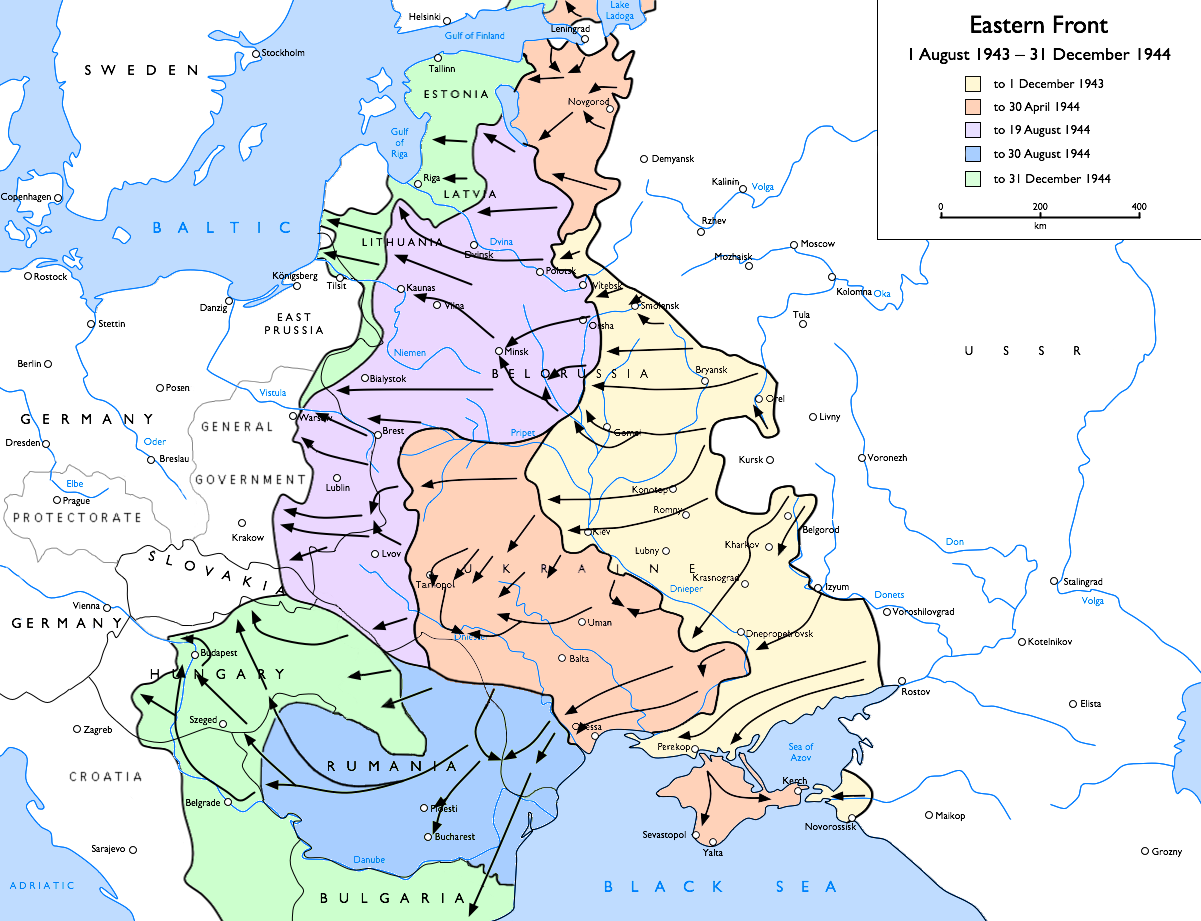
On January 12, 1945 the Russians renewed their attack on the Polish
front, sweeping away the Germans quickly advancing to the Oder River
near Berlin, where they paused to regroup for the final assault.
Ah, quickly we move through the ruins that bow to the ground
The old men and children they send out to face us, they can't slow us down
All all that I ever, was able to see
The eyes of the city are opening now, it's the end of a dream
The Berlin campaign lasted from April 16 through May 2. Though the assault contributed to the "ruins that bow to the ground"
much of the city was already ruined by American and British air
raids, some consisting of more than 1,000 bombers striking the city.
The reference to "old men and children" refers to the Volksstrum
("People's Storm"), a national militia consisting of all men between 16
and 60 capable of bearing arms, formed in October 1944, as the manpower
needs of the crumbling Third Reich became ever more desperate (even boys of 14 and 15 would see service by the end). Poorly armed and
trained, the Volkssturm units were of varying effectiveness and took
heavy casualties.
Notice the contrast with the opening verse of the song. In 1941, the
narrator speaks of defeat, confusion, and retreat; four years later he
is moving triumphantly forwards to victory.
(Berlin 1945)

Despite the claim that "old men and children . . . they can't slow us down",
the Volkssturm and remaining regular Wehrmacht units imposed heavy
losses on the Red Army - 79,000 dead and 270,000 wounded in less than
three weeks, a per day toll higher than any the Soviets had suffered
since the dark days of 1941. The human cost was made higher by Stalin's
cynical move to place Marshals Zhukov and Koniev in competition to be
first to Berlin, relentlessly mocking and scolding them, leading to
reckless frontal assaults, particularly by Zhukov (for more on him read The Secret of Khalkin Gol).
And, with the encouragement of Stalin and the Red Army command, the
victorious soldiers took a terrible vengeance on German civilians.
I'm coming home, I'm coming home
Now you can taste in the wind, the war is over
And I listen to the clicking of the train wheels as we roll across the border
The lyric brims with optimism. Against all odds, our narrator has
survived and looks forward to being reunited with his family. In
reality the odds were low that any soldier on the front line on June 22,
1941 would be alive and healthy enough to be in the Berlin fighting.
8.6 million Red Army personnel died in the war; effectively the original
1941 army was killed twice over. In comparison, the United States
suffered 296,000 battlefield deaths with another 100,000 dead due to
accidents and illnesses.
Nor were all the Russian dead solely the responsibility of the German
army. Life for the Red Army soldier during the war was brutal. Commanders
employed tactics that wasted countless lives. If you died, particularly
early in the war, it was unlikely your family would be notified. Any
infraction, real or imagined, was subject to harsh discipline and
extreme punishment. During the first 18 months of the war (the only
period for which we have figures), 160,000 Soviet soldiers were executed
for cowardice or desertion. By comparison, only one American was
executed for these offenses during the entire war. For those not
summarily executed there were the Punishment Battalions and Companies to
which officers and soldiers were sentenced to be used, in Stalin's
words, at "the most difficult parts of the front, to give them the possibility to redeem their crimes against their country with blood".
The Punishment units were deployed for tasks such as suicidal frontal
assaults and the clearing of minefields by marching through them, making
it no surprise that an estimated 400,000 died in the process. Their
existence was such an embarrassment to the Soviets after the war that
the existence of the units was officially denied.
In Stalingrad: The Fateful Siege, Antony Beevor tells the tale
of a Soviet lieutenant caught in this madness. Captured by the Germans
in August 1942, he manages to escape and rejoin the Red Army, where he
is promptly arrested, charged as a deserter, and sentenced to a
Punishment Company. Realizing his sentence is an effective death
penalty, he deserts to the Germans! We don't know his fate but it is
unlikely he had a happy ending.
And then there were the Red Army's blocking detachments formed to shoot down retreating soldiers - retreating Red Army soldiers. In this clip from the movie Enemy At The Gates,
which takes place in Stalingrad, you can watch (about 2 minutes in) a
blocking detachment in action (the first 20 minutes of the movie are
stunning and accurate, after that it falls apart). You'll also notice that some of the Soviet soldiers start the attack unarmed. In the early stages of the battle, there were not enough rifles for every soldier, so those without arms were instructed to charge with their comrades and pick up their rifles when they were shot.
The optimism of those that survived extended beyond the relief of being
alive and reuniting with family. The memoirs and recollections of
returning soldiers and officers are filled with belief and hope that
conditions in the Soviet Union would be improved. There was a feeling
that the common Soviet citizen had proven to
Stalin they could be trusted, that the regime need not fear them, that
the fear of being subject to arbitrary justice would end, a new start for the Soviet people and a new and more cordial
relationship with their government. It was not to be.
And now they ask me of the timeIn his account of the German-Soviet struggle, Absolute War, author Chris Bellamy writes, "the Red Army was the only one in the world where being taken prisoner counted as desertion and treason". Stalin believed any soldier who allowed himself to be captured was a traitor and potential counter-revolutionary, and Russians exposed to Westerners for any length of time, a danger to the Soviet state. Bellamy adds:
That I was caught behind their lines and taken prisoner
"They only held me for a day, a lucky break", I say
They turn and listen closer
I'll never know, I'll never know
Why I was taken from the line and all the others
To board a special train and journey deep into the heart of Holy Russia
And it's cold and damp in this transit camp
And the air is still and sullen
And the pale sun of October whispers
The snow will soon be coming
The Soviet government and military command had absolutely no interest in what happened to Soviet people in German captivity. When prisoners of war who survived were released at the end of the war [3 of the 4 million POWs died due to the German policy of exposing them to the elements and leaving them to starve, though a small number survived long enough to serve as guinea pigs for the initial testing of the newly constructed gas chambers at Auschwitz], they were usually sent to the Gulag or shot, and the same fate even befell many who had fought and crawled their way out of German encirclements during the war.Our narrator falls into this last group. His years of valiant service and suffering are to no avail.
And I wonder when I'll be home again and the morning answers, "Never"I find these the saddest lines in music and no matter how often I hear them they affect me as powerfully as the first time. They represent the betrayal of the hopes and dreams of people caught up in a horrible time, who thought they'd survived the worst, only to find themselves condemned to death, exile, and lives of continued fear and hopelessness.
And the evening sighs and the steely Russian skies go on forever
Mounds of human heads
Are wandering into the distance
I dwindle among them
Nobody sees me
 (Secret Police photo of Mandelstam. He died of typhoid fever on December 27, 1938. His body lay unburied along with others who died that winter, until all were thrown into a mass grave dug in the spring.)
(Prisoner 282, Solzhenitsyn)
-------------------------------------------------------------------------------
Footnote 1
US and British material shipments to the Soviet Union during the war included:
400,000 Jeeps/trucks (1/3 of all Soviet motor vehicles)
14,000 airplanes
13,000 tanks
8,000 tractors
2.7 million tons of petrol
55% of all Soviet aviation fuel
1/3 of all Soviet explosives
2,000 locomotives
15 million pairs of boots
4.5 million tons of food
55% of all aluminum used by Soviets
80% of all copper used by Soviets
35,000 radio stations
380,000 field telephones
956,000 miles of telephone cable
"That is not only not right; it is not even wrong."
- Wolfgang Pauli (1900-58)
The quote refers to something being asserted or claimed that is not only
in error, but demonstrates such complete misunderstanding and ignorance
by the person making the claim that it would be a waste of time to
seriously discuss. I am sure many readers can identify ideas and people
falling into that category though it seems to be the frequency of such claims and assertions seems to be increasing in recent years.
Pauli, one of many European theoretical physicists who immigrated to the
United States after 1933, was known for his blunt comments. The closest
contemporary description of a version of the quote is from a
colleague's remarks shortly after his death:
Quite recently, a friend showed him the paper of a young physicist which he suspected was not of great value but on which he wanted Pauli’s views. Pauli remarked sadly ‘It is not even wrong.’Pauli was awarded the Nobel Prize in Physics for his discovery of what is known as the Pauli Exclusion Principle, which should not be confused with the Principle By Which Paulie Was Excluded.
I miss you more than Michael Bay missed the mark
When he made Pearl Harbor
I miss you more than that movie missed the point
And that's an awful lot
This gross deficiency in reasoning is also touched upon by the commentator in the epic and touching saga of young Billy Madison.
Phoenix Mountains and Camelback from our home this morning. Estrella Mountains in the distance. Downtown Phoenix is in between.


