Saturday, June 11, 2022

Why America Can't Build

Interesting article from the online magazine Palladium, Why America Can't Build.  The author is Brian Balkus who has experience in the large project management field.  It poses the question of why do large infrastructure projects take longer to build and cost considerably more per unit than similar projects, not just in Asia, but in Western Europe where just about everything else costs more than in America.

The subject is actually broader than large projects and has become in recent years the subject of much study, often referred to as The Cost Disease; why does the cost of certain things, like electronics/computers, go down, while others, like healthcare/construction, go up?

In the case of large projects, Balkus starts with a Los Angeles freeway expansion that the company he worked for at the time, Kiewit, was managing and then extends the discussion to other examples like the fiasco of California's proposed high speed rail line, which California voters approved in 2008 and which now, fourteen years later, is $44 billion over budget, with very line actual work done.

The reasons specific to large projects identified by Balkus include:

- Environmental review requirements, including the use of litigation by opponents to slow projects down.  As Balkus notes:

The NEPA/CEQA process incentivizes the public agencies to seek what is often termed a “bulletproof” environmental compliance document to head off future legal challenges. This takes time, with the average EIS taking 4.5 years to complete. Some have taken longer than a decade. A cottage industry of consultants is devoted to completing these documents, earning themselves millions in fees.

- The lack of in house expertise at the agencies overseeing these projects, forcing reliance on outside contractors who often have interests other than speeding along a project.  Balkus writes:

These consultants were well paid, with the primary consultant compensation for HSR at $427,000 per engineer, compared with the Authority’s in-house cost of $131,000 per engineer. This structure creates a principal-agent problem where they are incentivized to maximize their billable hours. As a California State Auditor assessment of the project noted, consultants “may not always have the state’s best interest as their primary motivation.”

- Unionization, or more specifically how unions operate in the U.S., since as Balkus points out all of the European countries that do public projects at less cost also have unions working on the projects:

The fundamental problem isn’t unions per se, but rather the way that unions operate within parts of the U.S. system. The Netherlands has strong unions, but the Port of Rotterdam has been automated to an extent that has proven impossible in the U.S. due to union resistance . . . There are too many layers of permission needed to innovate, including groups whose interests run counter to innovation.

The result is that innovation is inhibited by both labor resistance and a decentralized government bureaucracy that has neither the incentives nor the capability of driving real change. Perhaps it should not be shocking that U.S. construction productivity has fallen by half since the 1960s . . .

According to Balkus, things are posed to get even worse:

President Biden has signed executive orders strengthening construction unions and increasing the stringency of NEPA requirements. 

As a counterexample, the author writes of Madrid's successful project to expand its subway system, which it did for a fraction of the per mile cost of similar projects in the U.S.  He also points out to exceptions in the U.S., including my home state of Arizona.

However, not every building environment in the U.S. is the same. Roughly 40 percent of U.S. megaprojects are in New York, California, or Texas. While megaprojects run into issues everywhere, the Texas projects have a significantly better track record than either of its coastal peers.

Other states have learned from their example. Arizona explicitly studied lessons learned from Texas when building the largest public works project in its history, the $1.7 billion Loop 202 South Mountain Freeway Project. By using a non-standard project delivery approach, this project was completed in 2019 in fewer than 1,000 days, an estimated three years earlier than what would normally be expected. Early coordination between the contractor and engineer ensured that the design issues that appeared on Sepulveda or HSR were avoided, saving the project an estimated $100 million.

Maybe that's why so much of America's new industrial capacity is being built in those two states. 

One objection to this type of critical review is that it is a legitimate choice to favor environmental and regulatory process concerns, and to preserve high paying union jobs.  I agree.  But those who do favor that approach also seem to be constantly harping on our need to improve infrastructure without any seeming awareness of the difficulties in undertaking such projects and why they cost so much.  It's a choice.  You can't have both.  Decide what your priorities are.

A few years ago I wrote a post about a video Rachel Maddow and Spike Lee did at the Hoover Dam about the need to do big projects like that in America, funded by the government, without any awareness of why it is so difficult to do projects like this in 21st century America.  The Hoover Dam project was approved by Congress in 1928, construction started in 1931 and was completed in 1936.  How many decades would it take to do this same project if it started now?  What are the odds it would even be approved?

Deciding on priorities will become even more important as we look to greatly expand solar, wind, and batteries over the coming decades.  The amount of metals and rare earths required for these technologies is staggering.  Unless we want to become dependent upon China for our future, this will require legal and regulatory changes to facilitate enormous increases in mining and metal processes.

It's not just mega projects that are subject to extended times.  Regarding just the regulatory review process, in the 1990s, at the company I worked for, we conducted a comparative study of how long it would take to get a new production line approved by environmental regulators at our plants in the U.S., France, and Australia.  All these countries were heavily regulated and the pollution control requirements very similar yet it took twice as long (several months) to get approval in the U.S.

Wednesday, June 8, 2022

Elegy From Gump Worsley

My dad took me to a couple of New York Rangers games in the early 1960s.  At the time the Rangers were a mediocre entry in the six team National Hockey League (NHL), a league in which only Canadians played.

We had tickets rink-side, protected by the clear plastic barrier.  The Rangers' star was Andy Bathgate, and I remember being startled when he skated by us, only a couple of feet away, opened his mouth and he had maybe three teeth!

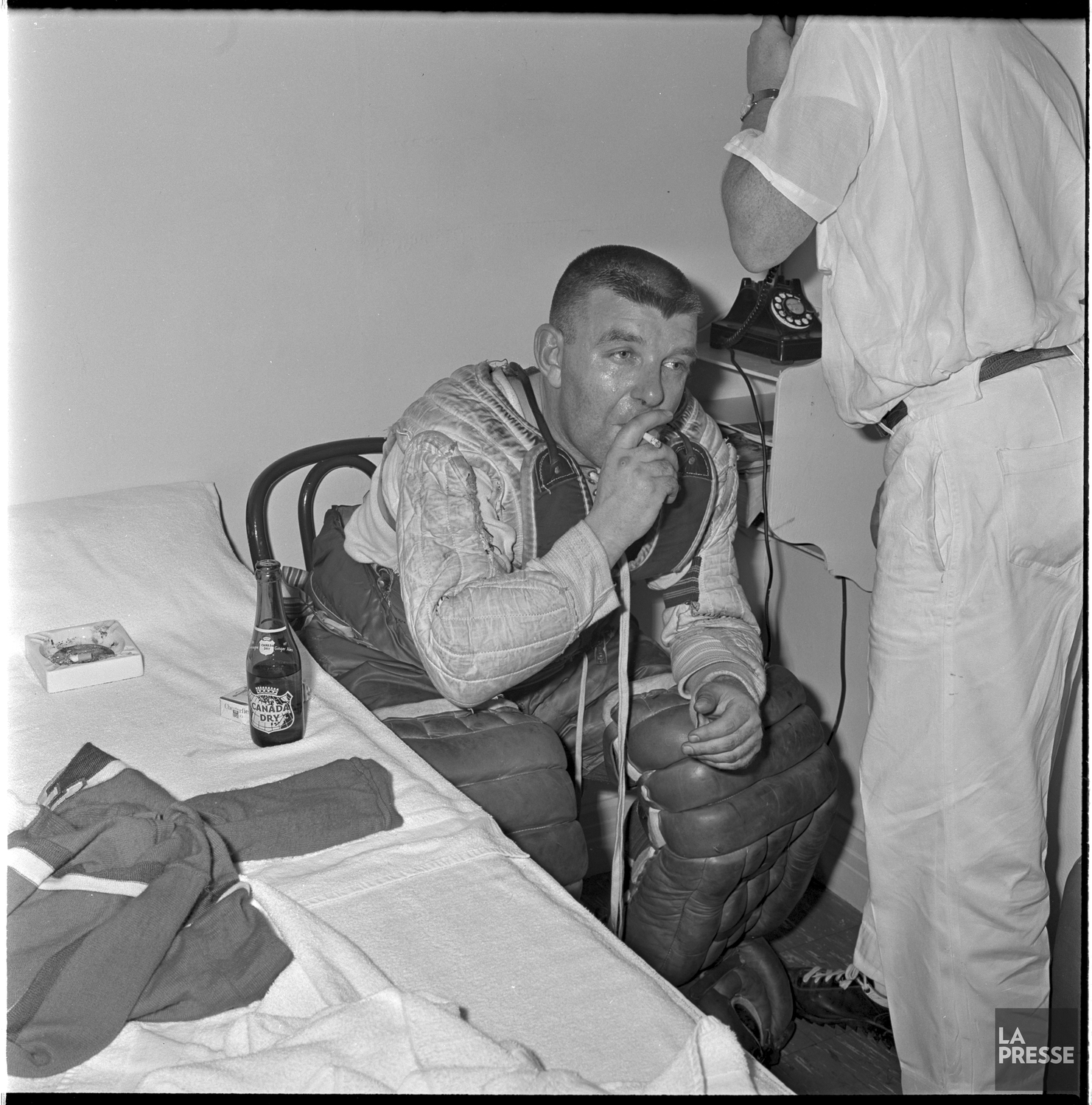
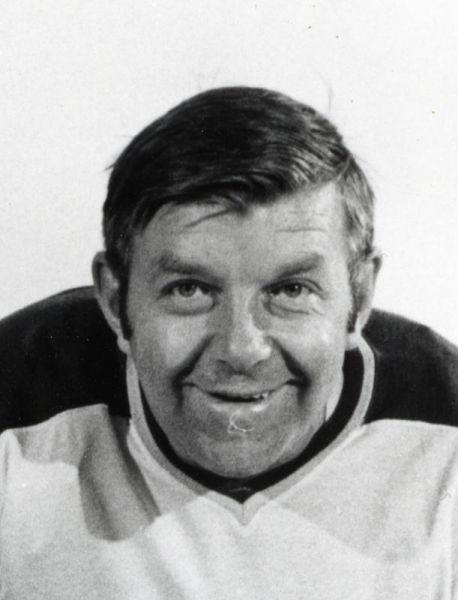
The goalie for the New York team was Lorne John "Gump" Worsley.  The Rangers were so bad that when Gump was asked "which team gives you the most trouble" he answered "The New York Rangers".  I also distinctly remember him because in those days goalies did not wear masks so you could see their faces.  Years later when Worsley became the last goalie not to wear a mask he was asked why and responded, "My face is my mask".(1)

Lorne 'Gump' Worsley Hockey Stats and Profile at hockeydb.com 

Gump enjoying a smoke:


Gump had a long career, entering the NHL in 1952 and not retiring until 1974, with his best years from 1964 to 1969 as goalie for the Montreal Canadians.  Gump had some outstanding seasons and developed quite a fan base because of his wit but most of all because he just looked like some guy who came off the street and got put in to be a goaltender.

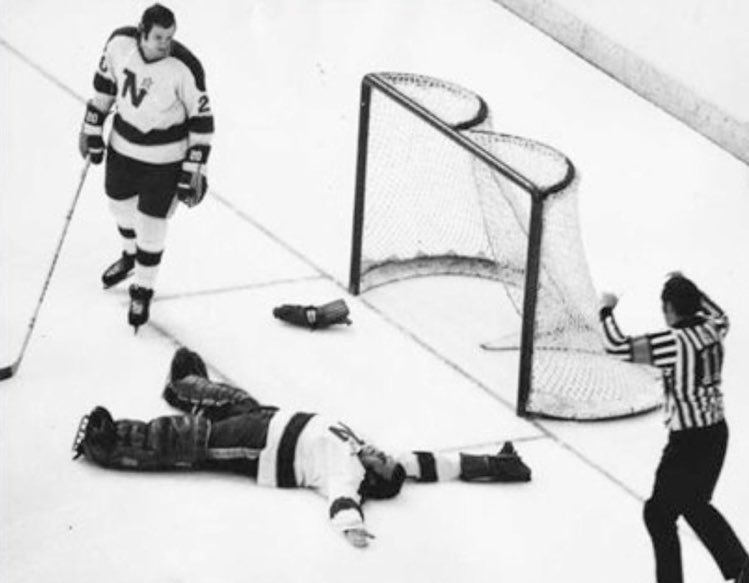
It's tough playing without a mask.  That's Gump knocked out after taking a puck to the head.

Image

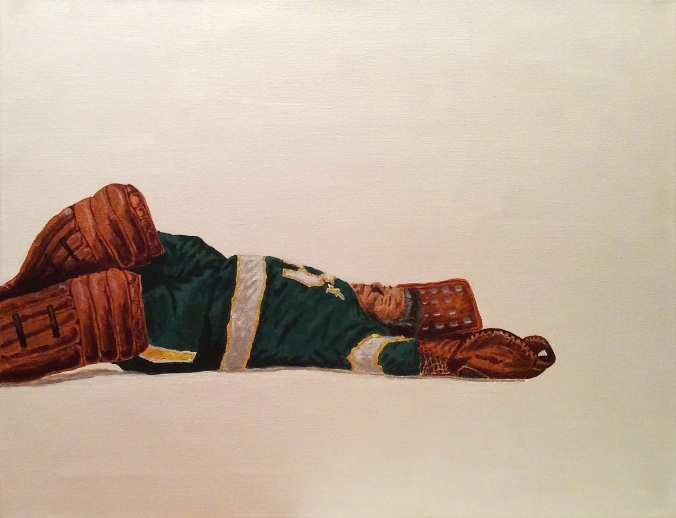
That's not the only time:

image1-version-2

When Gump passed in 2007, Canadian band The Weakerthans recorded a tribute which I came across recently and quite enjoyed.  The lyric:

He looked more like our fathers, not a goalie, player, athlete period. Smoke, half ash, stuck in that permanent smirk, tugging jersey around the beergut, “I’m strictly a whiskey man” was one of the sticks he taped up and gave to a nation of pudgy boys in beverage rooms. Favourites from Plimpton’s list of objects thrown by Rangers fans: soup cans, a persimmon, eggs, a folding chair and a dead rabbit. The nervous breakdown of ’68-’69 after pant-crap flights from LA, the expansion, “the shrink told me to change occupations. I had to forget it.” He swore he was never afraid of the puck. We believe him. If anyone asks, the inscription should read, “My face was my mask.”


--------------------------

(1)  The first NHL goaltender to wear a mask was Jacques Plante of the Montreal Canadians who, on November 1, 1959, donned a fiberglass mask after suffering a badly cut nose and lip from a first-period shot by, yes, Andy Bathgate of the Rangers. 

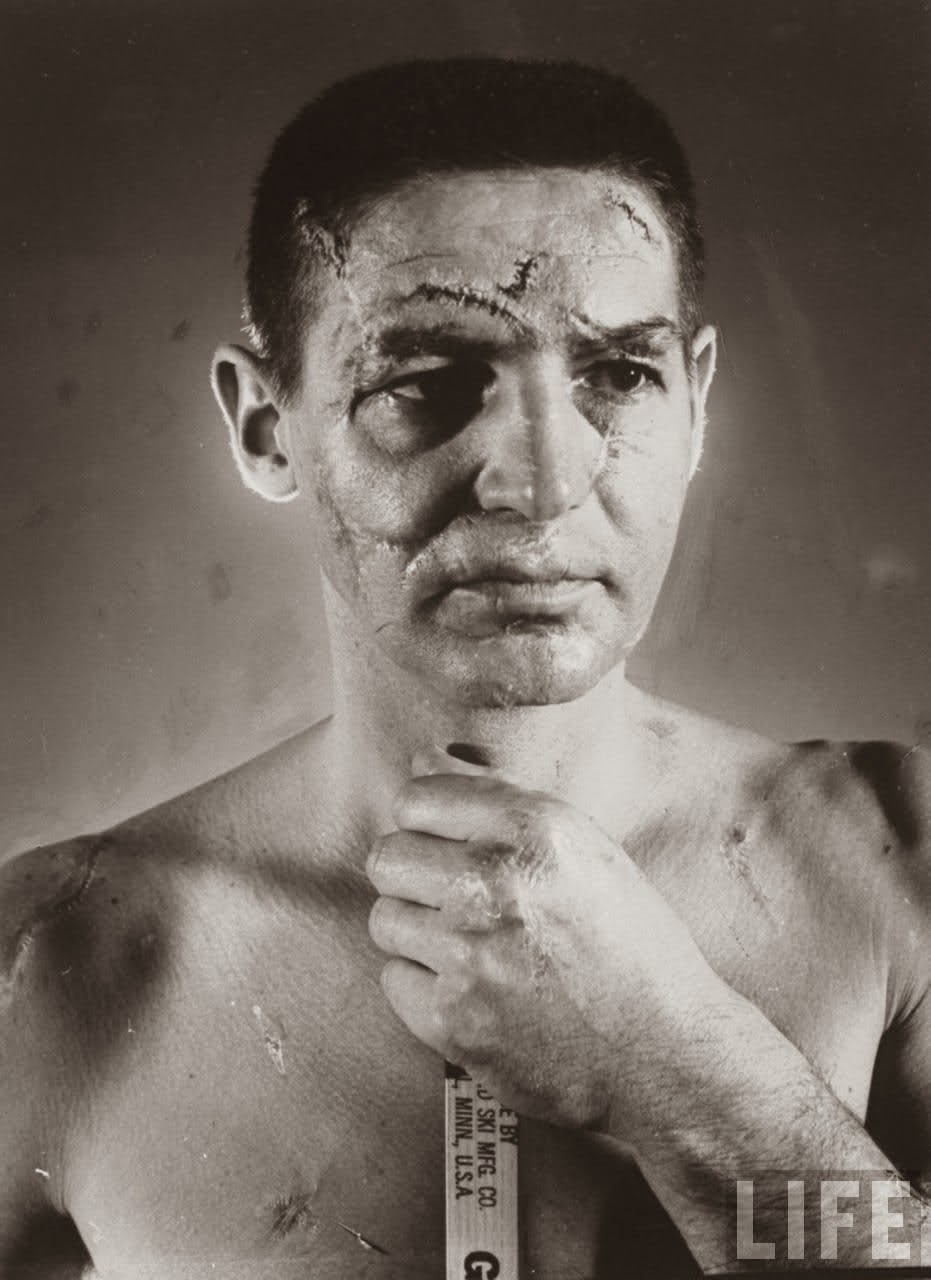
This is Detroit goaltender Terry Sawchuk, a contemporary of Gump's.

Terry Sawchuk The face of a hockey goalie before masks became standard game  equipment, 1966 – La boite verte

True Social Justice

In 2019 I wrote of my disgust with the election of Chesa Boudin (see San Francisco Elects The Joker As District Attorney).  He proved so horrible in the job that San Francisco voters just ejected him from office in a special recall election.  Though Boudin denounced Republicans and billionaires for his recall, the truth is that the GOP has been moribund for decades in San Francisco, and Boudin's election campaign was supported by billionaire George Soros, who has funded the campaigns of a number of pro-criminal district attorneys across the United States.  It was the progressive voters of San Francisco, fed up with Boudin's sympathy for criminals and the continued deterioration of their city, who voted him out.

My congratulations to the voters of San Francisco.  This was true social justice in action.

There are still a worrying number of voters who really support what Boudin was selling, but encountering the reality of his policies sobered up many others.  The biggest problem we face was pointed out by The End Times:

"the heart of the problem is that well-meaning people have not confronted that fact that these causes have been hijacked by people with profoundly different moral beliefs than they have, and who use the same words to mean very different things."

Once enough voters of good intent come to this realization I hope more such events will occur.  We'll see.

Tuesday, June 7, 2022

Night And Day

 Our rental in Domme.  


Tiny Dancer

Been writing this thing for over a decade and never featured Elton John, the reason being I don't care for most of his stuff, but early in his career he released three singles that were quite good and a fourth that is a classic; Your Song (1970), and before and after his greatest song, Levon (1971) and Rocketman (1972) - the latter the subject of a fascinatingly weird cover by William Shatner.  By far, the song I like best is Tiny Dancer (1972) with its glorious chorus.  The lyrics are very specific and don't seem to have anything to do with my life, but I've always found the song very moving.

Like almost all of John's songs, the lyrics are by Bernie Taupin with music by Elton.  According to this article, some of the lyrics were inspired by Bernie's then-wife, Maxine, who had been into ballet when she was younger and sewed patches on Elton's jeans and jackets when he was starting out.

Tiny Dancer is also the latest installment of Rick Beato's "What Makes This Song Great" series which takes you deeper into the arrangement and structure of the tune.  I'd been aware there was a pedal steel on the recording but until Rick isolated the track had not appreciated just how good it was.

The song is also featured in one of my favorite films, Cameron Crowe's Almost Famous, based on his experiences as a 15-year old writer for Rolling Stone magazine (read Cool and Uncool for one of my prior posts on the movie).

Monday, June 6, 2022

One More Appeal


On June 2, 1944 King George V wrote a final appeal to his Prime Minister, Winston Churchill, asking him not to take ship in order to observe the D-Day landings in Normandy which were to take place four days later.

Full text:

Buckingham Palace
GR- Royal crest/stamp June 2nd 1944


My Dear Winston,
I want to make one more appeal to you not to go to sea on D day. Please consider my own position. I am a younger man than you, I am a sailor, & as king I am the head of all three services. There is nothing I would like better than to go to sea but I have agreed to stay at home; is it fair that you should then do exactly what I should have liked to do myself?

You said yesterday afternoon that it would be a fine thing for the King to lead his troops into battle, as in old days; if the King cannot do this, it does not seem to me right that his Prime Minister should take his place.

Then there is your own position. You will see very little, you will seem a considerable risk, you will be inaccessible at a critical time when vital decisions might have to be taken, & however unobtrusive you may be, your very presence on board is bound to be a very heavy additional responsibility to the Admiral & Captain.

As I said in my previous letter, your being there would add immeasurably to my anxieties, & your going without consulting your colleagues in the Cabinet would put them in a very difficult position which they would justifiably resent.

I ask you most earnestly to consider the whole question again, & not let your personal wishes which I very well understand lead you to depart from your own high standard of duty to the State.

Believe me,

Your very sincere friend,

George R. I. (signed by hand)

Churchill's determination to personally observe the landing induced angst across the Allied leadership, with General Dwight Eisenhower also adding his strong objections. 

For the Prime Minister his desire was merely a continuation of his life long adventurous streak which saw him put his life at risk many times; on the Northwest Frontier of India; as a participant in the famed (and unnecessary) cavalry charge against the Dervishes at the Battle of Omdurman in the Sudan; as a reporter taken prisoner and then making his escape during the Boer War, all at the turn of the century; as a battalion commander in the trenches of the Western Front during WWI, an assignment he volunteered for after resigning his ministerial position in the wake of the Dardanelles debacle.

A reluctant Churchill finally agreed to remain home during the invasion.  The Prime Minister finally made it to Normandy six days after the landings.

On the other hand, Yogi Berra was present on D-Day as a gunner's mate on a fire support ship off Utah Beach!