This monument is in Domme and memorializes those who died in WW2. Affixed to a larger monument erected in honor of those who died in WW1. Along with the size, there are other differences between the two. 54 citizens of Domme are memorialized on the WW1 monument, an enormous toll on a commune of only about a thousand inhabitants. Only 21 names appear on the WW2 roll. They include what appears to be two sets of brothers. And, if you compare those names with those named on the WW1 monument, you realize it is likely some fathers and sons died in the two wars.

There is another difference how the dead are described. Those of WW1 are all listed with no distinctions while those of WW2 are broken into three categories; those deported and perished; those killed in combat; and those "fusilles" - shot by the Germans. There are two names added after the monument was originally constructed, one on the lower left who died in North Africa while in the army and, on the lower right, a person who died after being deported to the Mauthausen concentration camp.
Those listed as "fusilles" probably died during the terrible days of May and June 1944, when the area between the Lot (the river valley south of the Dordogne) and Limoges (about 100 miles north of Domme), became the scene of hard fighting and brutal reprisals between the German army and the French Resistance.
This area was one of the strongholds of the Resistance. Both Germans and French were aware that sometime that summer of 1944, the Allied invasion would occur though where and when was unknown. German forces stationed around the area began sweeps against the various Resistance groups and these continued until July. Violence escalated with news of the Normandy landings on June 6, when partisans came out of hiding and attacked German formations moving north through the area as they attempted to reach the Allied landing areas.
The list of encounters is long and bloody; here are a few.
On May 21 in the little village of Frayssinet-Le-Gelat, twenty miles south of Domme, the Germans, in retaliation for the death of an SS officer, killed 15 hostages; ten young men from one-child families and five young women.
On June 21 in another retaliatory action in response to frequent Resistance attacks, the village of Moutyedier was attacked and burned to the ground; 65 civilians and Resistance fighters were killed.
Less than five miles down the road from where we are staying is a plaque in memory of Marie Delteil, aged 80, who "fell victim to Nazi barbarism" on June 26.
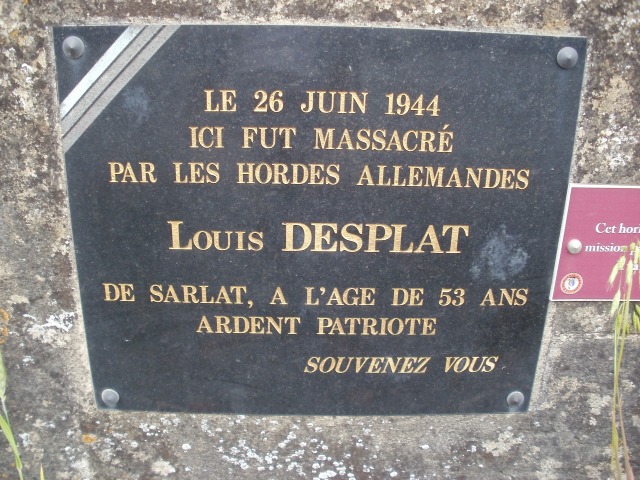
This plaque is on the bridge across the Dordogne, just down the hill from Domme. It is in memory of Louis Desplat "killed here by the German hordes", also on June 26. The red plate next to it says he was a clock-maker and a member of the resistance, who was
captured and then tortured by the Germans during a mission, but
would not talk. He was taken to the bridge, shot, and his body dumped into the river.
However, the worst occurred in the first week after the D-Day landings.
In early 1944, one of Hitler's elite formations, the 2nd SS Panzer Division Das Reich, was withdrawn from the Eastern Front for rest and refitting in the area near Toulouse, south of Dordogne.
With word of the Allied landings, Das Reich began moving north through Dordogne and the Limoges area while the lightly armed partisans made efforts to block the narrow roads. Fighting took place in many locations, as well as German reprisals. On June 8, at Grolejac, the town immediately east of Domme, seven Resistance fighters were killed, while another four died in Carsac, across the river from Grolejac.
That same day another Das Reich column stopped at a bakery in the village of Rouffillac (10 miles from Domme) and demanded the proprietress make them crepes. When she refused, she and 15 other civilians were locked in the bakery which the Nazis then burned down.
Fighting also occurred that day in Cressensac, Noailles, Gabaudet, and in other towns and villages.
On June 7, upon receiving news of the Allied landings, partisans attacked and overwhelmed a small German garrison in Tulle, a town about 60 miles from Domme. Two days later, Das Reich arrived and retook the town. In those battles 37 Germans were killed along with 50-100 French fighters. In retaliation, the Germans arrested all men between the ages of 16 and 60, hanged 99 of them, and deported another 149, of whom 101 died at Dachau.
The climax occurred on June 10 at the small town of Oradour-sur-Glane, near Limoges, when Das Reich murdered 642 men and women, including 247 children, and burned the village. Most of the men were machine-gunned, while the women and children were locked in a church which was set afire. Charles de Gaulle ordered the destroyed village preserved eternally as a memorial, leaving everything as it was that day and as it remains in 2022.
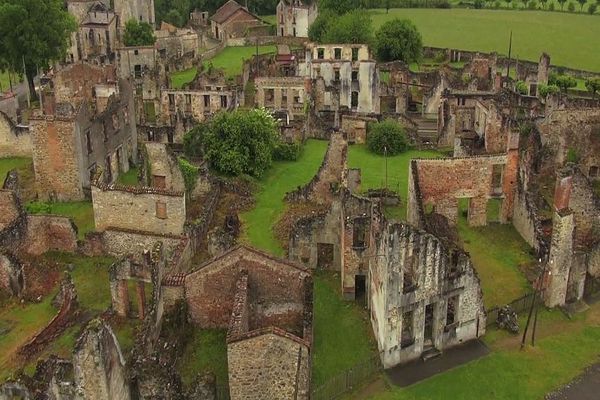
The classic 1970s BBC series, The World At War, told the story of that day, narrated by Laurence Olivier:
Down this road on a summer day in 1944, the soldiers came. Nobody lives
here now. They stayed only a few hours. When they had gone, the
community, which had lived for a thousand years, was dead. This is
Oradour-sur-Glane, in France. The day the soldiers came, the people were
gathered together. The men were taken to garages and barns, the women
and children were led down this road, and they were driven into this
church. Here, they heard the firing as their men were shot. Then they
were killed too. A few weeks later, many of those who had done the
killing were themselves dead, in battle. They never rebuilt Oradour. Its
ruins are a memorial. Its martyrdom stands for thousands upon thousands
of other martyrdoms in Poland, in Russia, in Burma, China, in a world
at war.


.jpg)


.jpg)


