Let Lalo Salamanca give you some tips on making the perfect taco.
Two lines of dialogue from Breaking Bad mention Lalo and Nacho, who are never mentioned again and never appear in the series, but later become major characters in Better Call Saul; the charming and extremely lethal Lalo Salamanca, and soulful and tragic Nacho Varga.
Amazing how only a few seconds of context in Breaking Bad gave us 2 of the best characters in Better Call Saul pic.twitter.com/Gi4aIeGx5i
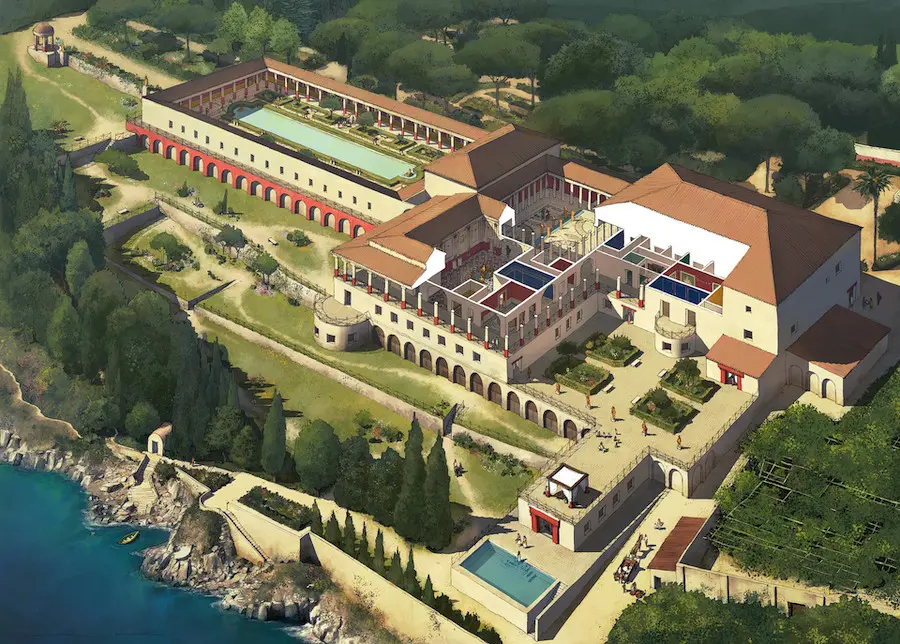
Great progress has been made on reading the carbonized scrolls found at the Villa of the Papyri at Herculaneum. It's required some amazing applications of new technologies to do so and you can read more about the details here and here.
And now you have a chance to participate as the team has just posted an opening for a full time annotation specialist paying up to $40 an hour!
Rick Beato has been on a roll lately, recently interviewing the elusive David Gilmour of Pink Floyd and then, a few days ago, Jeff "Skunk" Baxter, lead guitarist for Steely Dan and The Doobie Brothers, and session player for many other famous artists. Rick is the best music interviewer going. He focuses on the music, not on anything else, asks good questions and gives interviewees the space to talk. Even when I don't understand all the musical details I still enjoy it. Skunk comes across as a true gentleman and it was wonderful to listen to his stories about the Dan, the Doobies, as well as Segovia, Hendrix, Slash, and others. Hendrix and Jeff Beck are on his Mt Rushmore of guitarists.
Skunk features on the first three Steely Dan albums, before Fagen and Becker decided to stop performing as a live act, and he then moved seamlessly into the Doobies and was the guy responsible for later bringing Michael McDonald, who'd been a backup singer on Dan albums, into the Doobies.
Rick gets Skunk to talk about two of his most famous solos for the Dan, My Old School and Rikki Don't Lose That Number. Another favorite solo (not mentioned in the video) is in The Boston Rag, starting about 3 minutes in. We also learn that his favorite instrument is the pedal steel guitar. There wasn't much call for that in Steely Dan, but it does show up in a couple of their tunes, most notably Fire In The Hole, where Skunk adds a tasty solo at the end (the song also features outstanding piano parts).
Beginning in the 1980s, Skunk developed a parallel second career as an expert on defense technologies. Here's how Wikipedia explains it:
Baxter fell into his second profession almost by accident. In the
mid-1980s, his interest in music recording technology led him to wonder
about hardware and software originally developed for military use,
specifically data compressionalgorithms and large-capacity storage devices.
His next-door neighbor was a retired engineer who had worked on the Sidewinder missile program. This neighbor bought Baxter a subscription to Aviation Week
magazine, provoking his interest in additional military-oriented
publications and missile defense systems in particular. He became
self-taught in this area, and at one point wrote a five-page paper that
proposed converting the ship-based anti-aircraft Aegis missile into a rudimentary missile defense system.
He gave the paper to California Republican Congressman Dana Rohrabacher, and his career as a defense consultant began.
Baxter received a series of security clearances so he could work with classified information. In 1995, Pennsylvania Republican Congressman Curt Weldon,
then the chairman of the House Military Research and Development
Subcommittee, nominated Baxter to chair the Civilian Advisory Board for
Ballistic Missile Defense.
"We thought turntables were for playing records until rappers began to use them as instruments, and we thought airplanes were for carrying passengers until terrorists realized they could be used as missiles,"
Baxter has said. "My big thing is to look at existing technologies and
try to see other ways they can be used, which happens in music all the
time and happens to be what terrorists are incredibly good at."
Baxter has also appeared in public debates and as a guest on CNN and Fox News advocating missile defense. He served as a national spokesman for Americans for Missile Defense, a coalition of organizations devoted to the issue.
While Beato does not cover the military side of Skunk's career, American security remains important to him. In the interview, when discussing his friendship with Jimi Hendrix, Baxter mentions Jimi's service in the 101st Airborne and refers to him as a "patriot".
This is an interview where Skunk shares his thoughts about Ringo Starr (very complimentary) as well as a bit on his military career.
Today is the 83rd anniversary of the Japanese surprise attack on Pearl
Harbor. A tragic day for America, with more than 2,400 servicemen dying
and, longer-term, a disaster for Japan.
On December 8, 1941 President Franklin D Roosevelt asked
Congress to declare that since the prior day a state of war had existed
between the Empire of Japan and the United States. In his "day of infamy" speech you can
hear the anger and outrage in his voice, reflecting that Japanese peace
negotiators were in the US Capital, even as Japanese carriers launched
their air strike on Pearl Harbor. You can also hear his recital of the
other attacks simultaneously carried out by Japan across the Pacific
which conveys the massive scale of the assault. For an edited, but very
high quality audio and picture, versionclick here.
Something
often missed is that the US did not declare war on Germany on December
8. This created a dilemma for American policy and military planners who
believed American involvement in WWII was inevitable and who viewed
Germany as the greater threat. In fact, it had already been agreed that
in the event of war with both Germany and Japan that 85% of America's
resources would be devoted to defeating the Nazis. Hitler solved the
American dilemma by declaring war on the US (for reasons that are still
debated today) on December 11.
Over the decades there
have been suggestions that FDR knew of the planned attack on Pearl
Harbor and let it proceed in order to draw the US into WWII. I've read
quite a lot about these accusations and believe them to be utterly
without merit as do most historians who've reviewed the documents.
In
1941 was FDR seeking a way to get the US to intervene in the war? Yes,
but it was on the side of Britain against Germany. War with Japan
would interfere with that goal.
There have also been
exhaustive studies of the intelligence (particularly via code-breaking)
that the US had available to it in the weeks leading up to Pearl
Harbor. During those last days, FDR and our military were tracking
Japanese naval forces and believed an attack was imminent with the
likely targets being the British and Dutch colonies in Southeast Asia
and/or the Kingdom of Siam along with a lesser probability that American
forces in the Philippines would be attacked. There were only very
scattered references to Pearl Harbor amongst a blizzard of intelligence
from the broken codes.
As is often the case I'll let Winston Churchill have the last word with his reaction to Pearl Harbor:
"No American will think it wrong of me if I proclaim that to have the United States at our side was to me the greatest joy . . . So we had won after all! . . . We should not be wiped out. Our history would not come to an end . . . I thought of a remark which Edward Grey had made to me more than thirty years before - that the United states is like 'a giant boiler. Once the fire is lighted under it there is no limit to the power it can generate'. Being saturated and satiated with emotion and sensation, I went to bed and slept the sleep of the saved and thankful."
Japan's decision to wage war against America was a monumental miscalculation. There were many within the Japanese military who had misgivings; one was the Emperor Hirohito's brother, Rear Admiral Takamatsu Nobuhito who told his brother a week before Pearl Harbor;
"The navy cannot afford to fight. There is a feeling that, if possible, the navy would want to avoid a Japanese-American war. If we pass up this opportunity [for peace], war will be impossible to avoid".
Relinked here are my posts Japan Decides On War, along with Dereliction of Duty,
on America's military escalation in Vietnam. Both are examples of how
bad decisions can be made, despite the misgivings of many of those
involved. Useful lessons to keep in mind, particularly with war, the
weightiest of human endeavors.
"Explanation:
If you could stand on Mars -- what might you see?
You might look out over a
vast orange landscape covered with rocks under a dusty orange sky,
with a blue-tinted
Sun over the horizon,
and odd-shaped water clouds hovering high overhead.
This was just
the view captured last March by NASA's rolling explorer,
Perseverance.
The orange coloring is caused by
rusted iron in the Martian dirt,
some of which is small enough to be
swept up by winds into the atmosphere.
The blue tint near the rising Sun is caused by
blue light being preferentially scattered out from the
Sun by the floating dust.
The light-colored clouds on the right are likely composed of
water-ice and appear high in the
Martian atmosphere.
The shapes of some of these clouds are
unusual for Earth and remain a topic of research."