Today is Remembrance Day in France. On May 8, 1945 the Second World War in Europe ended. As we drove though the countryside today, we passed commemorations being held in several village centers, mostly attended by older folks.
In Domme, where we are staying for a month, the memorial to the war dead was decorated with flags and flowers. The WW2 side of the memorial has many fewer names than the WW1 side. It's not the only difference. The WWI dead were all in the French army when they perished, but the WW2 side shows seven dead in combat, six dead deportees, and six civilians shot by the Germans in local actions. The latter were members of the Resistance or civilians killed in the summer of 1944. Partially obscured in the lower right is a later addition marking the death of a resident at the Mauthausen concentration camp.
Yesterday, Mrs THC and I drove two hours north to Oradour-sur-Glane, a somber and disturbing visit.
On Saturday morning June 10, 1944, Oradour was crowded. Though the commune had a population of about 1,400, the central village contained only 330, but on that morning almost 700 were in the village. It was a school day so children from outlying farms were there as well as farmers who came into town to get their monthly tobacco allowance. A half-dozen cyclists were also passing through the village.
Oradour was a prosperous community, in a green setting near the river Glace, only a few miles from the large city of Limoges. Before the war it was a popular place for Limoges residents to take the tram line to Oradour and picnic by the stream.
In early afternoon about 200 soldiers from the SS 2nd Panzer (Das Reich) Division arrived, sealed off the town, and ordered everyone present to assemble in a field behind the village. Some 20 to 30 inhabitants realized something was wrong and escaped into the woods but more than 650 people were left in the field. The Germans separated the 195 men from the 453 women and children, with the latter moved into the small village church.
The men, including the cyclists, were further separated into five groups, taken to buildings and close by farms, shot, and the men and the buildings set afire. Five men, all wounded, managed to survive.
The Germans set off an incendiary device within the church, which filled with smoke. As women and children tried to escape they were fired upon by machine guns. It was death by gunfire, smoke, and flame. Only one women survived; with both her daughters dead she plunged out a window. Shot five times she managed to crawl into nearby woods where she was found two days later. Marguerite Rouffanche would spend a year in hospital recovering physically. She would pass in 1988. The last survivor, Robert Hebras, died in 2023. Hebras, then 18, was slightly wounded in the head, chest, and thigh and survived by remaining under a pile of bodies in one of the barns. His mother and two sisters were killed in the church. After the war Hebras became an advocate for reconciliation between French and Germans.
After the killing spree every building in the village was set afire.
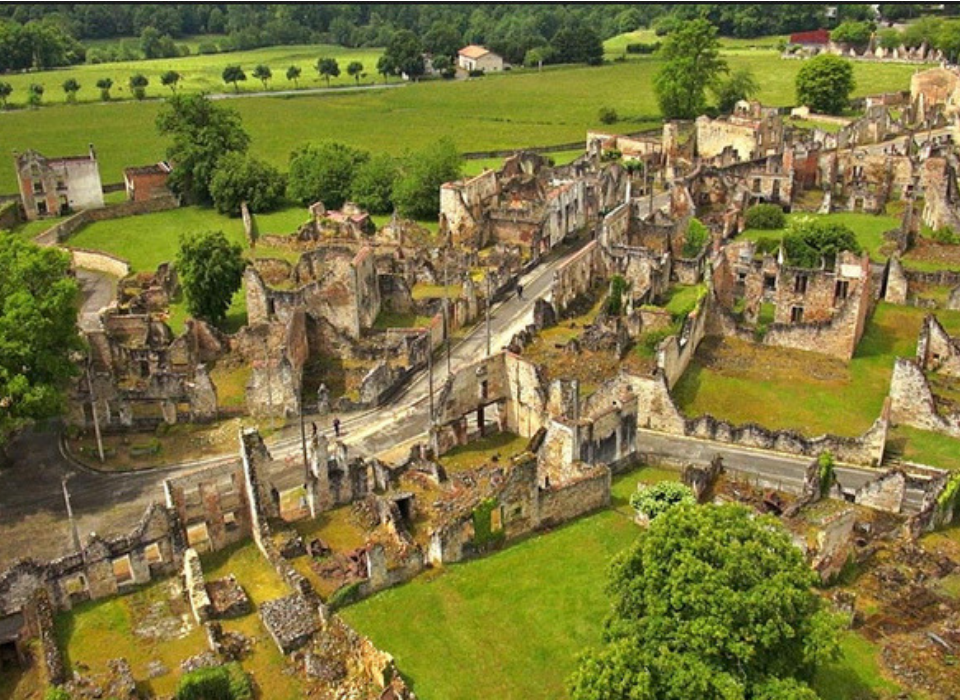
By order of Charles de Gaulle, Oradour was never demolished or rebuilt. It was left as it was on the evening of June 10, as a permanent memorial to the martyrs. A new Oradour was built several hundred yards away.
Most of the German officers involved were killed before the war ended.
Below are several photos I took of our visit. We went into the small church but I felt so overwhelmed thinking about the 246 women and 207 children crammed inside and of the havoc and terror unleashed upon them, I could not take any photos. Oradour is more than ruined buildings, as you walk around you see sewing machines and cooking pots sitting as they were in 1944. On the floor of the church are the remains of a baby carriage. We did not see everything in the village. I'd watched videos, seen photos, and read about Oradour, but the experience of actually walking the streets was much more powerful and after a while we decided we needed to leave.
This is an aerial view of the village:
The classic early 1970s 26-part BBC series, The World At War, opened with photos of Oradour and this narration by Laurence Olivier:
Down this road on a summer day in 1944, the soldiers came. Nobody lives
here now. They stayed only a few hours. When they had gone, the
community, which had lived for a thousand years, was dead. This is
Oradour-sur-Glane, in France. The day the soldiers came, the people were
gathered together. The men were taken to garages and barns, the women
and children were led down this road, and they were driven into this
church. Here, they heard the firing as their men were shot. Then they
were killed too. A few weeks later, many of those who had done the
killing were themselves dead, in battle. They never rebuilt Oradour. Its
ruins are a memorial. Its martyrdom stands for thousands upon thousands
of other martyrdoms in Poland, in Russia, in Burma, China, in a world
at war.
This is video explains in more detail what happened that day. It tells why the Das Reich Division was in the area and its movement north from the area around Toulouse. The German columns had to pass through the Dordogne, a stronghold of Resistance fighters determined to slow down the Nazi move towards the Allied landings in Normandy. Two of the towns mentioned where fighting occurred, Groljeac and Carsac, are next to Domme.
Both Germans
and French were aware that sometime in the summer of 1944 the Allied
invasion would occur. In May, German forces
stationed around the area began sweeps against the various Resistance
groups and these continued into August. Violence escalated with news of
the Normandy landings on June 6, when partisans came out of hiding and
attacked German formations moving north through the area as they
attempted to reach the Allied landing areas.
The list of encounters is long and bloody; here are a few.
On
May 21 in the little village of Frayssinet-Le-Gelat, twenty miles south
of Domme, the Germans, in retaliation for the death of an SS officer,
killed 15 hostages; ten young men from one-child families and five young
women.
With
word of the Allied landings, Das Reich began moving north through
Dordogne and the Limoges area while the lightly armed partisans made
efforts to block the narrow roads. Fighting took place in many
locations, as well as German reprisals. On June 8, at Groljeac, seven Resistance fighters were killed,
while another four died in Carsac, across the river from Groljeac.
That
same day another Das Reich column stopped at a bakery in the village of
Rouffillac (10 miles from Domme) and demanded the proprietress make
them crepes. When she refused, she and 15 other civilians were locked
in the bakery which the Nazis then burned down.
Fighting also occurred that day in Cressensac, Noailles, Gabaudet, and in other towns and villages.
On
June 7, upon receiving news of the Allied landings, partisans attacked
and overwhelmed a small German garrison in Tulle, a town about 60 miles
from Domme. Two days later, Das Reich arrived and retook the town. In
those battles 37 Germans were killed along with 50 to 100 French fighters.
In retaliation, the Germans arrested all men between the ages of 16 and
60, hanged 99 of them, and deported another 149, of whom 101 died at
Dachau.
Fifty four (52 hostages and 2 fighters) were executed at Mussidan on June 11.
On June 12 the Germans shot twelve hostages, including the entire Frydman family.
On June 21 the village of Moutyedier was attacked and
burned to the ground; 65 civilians and Resistance fighters were killed.
More fighting occurred in Cenac and Domme on June 26-27. This was part of a larger wave that included the neighboring towns and villages of Sarlat, La Roque Gageac, Castlenaud, Vitrac, and Vezac where the SS murdered 93 year old Raymond Lespinasse.
Less
than three miles from where we are staying is a plaque in
memory of Marie Delteil, aged 80, who "fell victim to Nazi barbarism" on
June 26.
A couple of hundred yards away from the Delteil memorial is another plaque, on the bridge across the Dordogne at Cenac,
just down the hill from Domme, in memory of Louis Desplat "killed
here by the German hordes", also on June 26. A clock-maker and member of the resistance, Desplat was captured and tortured by the Germans, but
would not talk. He was taken to the bridge, shot, and his body dumped
into the river.
Memorial to Marie Delteil
Memorial to 12 members of the Resistance, including one unknown victim, executed on June 26. This is on the road up to Domme. The two Marx brothers were refugees from elsewhere in France.
Memorial affixed to the wall of the former hospital in Domme. Jose Duerto Mendoza was a Spaniard who fled to France after Franco's victory in the Spanish Civil War and then joined the French Resistance, as did two of those named on the plaque above. Mendoza was wounded in the action on the 26th, made it to the Domme hospital, was found there the next day by the Germans who shot him.

On June 30, twelve hostages taken at Domme and Cougnac on June 26-28 were executed by the side of the road to Gourdon.
The mayor of St-André-d'Appelles was executed on July 7 for having placed a tricolor flag on the remains of a resister.
Fighting in the region continued into August. It was only with Operation Dragoon, the Allied landing in the south of France on August 15 and their rapid advance, that German troops withdrew from southwestern France, ending the occupation.
.jpeg)
.jpeg)


.jpg)


