From Russell Crowe, answering a question about which of his films young men should watch. His responses; Gladiator, Master and Commander, and Cinderella Man. Each one cited for specific reasons.
Gladiator has a pretty ridiculous plot but a very good film and the finest part is Crowe's embodiment of the stoic mentality. For more on the reality behind the movie read The Real Maximus. In Master and Commander he's the real Jack Aubrey. Cinderella Man is the tale of underdog James Braddock's, a down on his luck fighter, as he seeks the heavyweight title.
Crowe has a very positive, good-natured twitter feed.
Without a doubt, the most wholesome thing I’ve seen all month is @russellcrowe answering which of his films young men should watch.
It is such an earnest, thoughtful answer, framed around timeless virtues like honor, loyalty, family, and perseverance. pic.twitter.com/O0ndy7k3Xu
On this date in 1969 the initial withdrawal of American troops from South Vietnam began as ordered by President Nixon a few weeks earlier. This first phase involved 25,000 troops from the approximately 540,000 currently in that country. By the fall of 1971 troop levels were down to about 190,000. The last American forces left by early 1973. South Vietnam fell to the North Vietnam communists in April 1975, ending a thirty year civil war.
Excerpts from address by President Calvin Coolidge, Address on the Celebration of the 150th anniversary of the Declaration of Independence, Philadelphia, July 5, 1926.
It is not so much, then, for the purpose of undertaking to proclaim new
theories and principles that this annual celebration is maintained, but
rather to reaffirm and reestablish those old theories and principles
which time and the unerring logic of events have demonstrated to be
sound. Amid all the clash of conflicting interests, amid all the welter
of partisan politics, every American can turn for solace and consolation
to the Declaration of Independence and the Constitution of the United
States with the assurance and confidence that those two great charters
of freedom and justice remain firm and unshaken. Whatever perils appear,
whatever dangers threaten, the Nation remains secure in the knowledge
that the ultimate application of the law of the land will provide an
adequate defense and protection.
But the conviction is inescapable that a new civilization had come, a
new spirit had arisen on this side of the Atlantic more advanced and
more developed in its regard for the rights of the individual than that
which characterized the Old World. Life in a new and open country had
aspirations which could not be realized in any subordinate position. A
separate establishment was ultimately inevitable. It had been decreed by
the very laws of human nature. Man everywhere has an unconquerable
desire to be the master of his own destiny.
But the preponderance of all those who occupied a position which took
on the aspect of aristocracy did not approve of the Revolution and held
toward it an attitude either of neutrality or open hostility. It was in
no sense a rising of the oppressed and downtrodden. It brought no scum
to the surface, for the reason that colonial society had developed no
scum. The great body of the people were accustomed to privations, but
they were free from depravity. If they had poverty, it was not of the
hopeless kind that afflicts great cities, but the inspiring kind that
marks the spirit of the pioneer. The American Revolution represented the
informed and mature convictions of a great mass of independent, liberty
loving, God-fearing people who knew their rights, and possessed the
courage to dare to maintain them.
It was not because it was proposed to establish a new nation, but
because it was proposed to establish a nation on new principles, that
July 4, 1776, has come to be regarded as one of the greatest days in
history.
This is especially true of the principles laid down in the Declaration
of Independence. Three very definite propositions were set out in its
preamble regarding the nature of mankind and therefore of government.
These were the doctrine that all men are created equal, that they are
endowed with certain inalienable rights, and that therefore the source
of the just powers of government must be derived from the consent of the
governed.
A spring will cease to flow if its source be dried up; a tree will
wither if it roots be destroyed. In its main features the Declaration of
Independence is a great spiritual document. It is a declaration not of
material but of spiritual conceptions. Equality, liberty, popular
sovereignty, the rights of man - these are not elements which we can see
and touch. They are ideals. They have their source and their roots in
the religious convictions. They belong to the unseen world. Unless the
faith of the American people in these religious convictions is to
endure, the principles of our Declaration will perish. We can not
continue to enjoy the result if we neglect and abandon the cause.
About the Declaration there is a finality that is exceedingly restful.
It is often asserted that the world has made a great deal of progress
since 1776, that we have had new thoughts and new experiences which have
given us a great advance over the people of that day, and that we may
therefore very well discard their conclusions for something more modern.
But that reasoning can not be applied to this great charter. If all men
are created equal, that is final. If they are endowed with inalienable
rights, that is final. If governments derive their just powers from the
consent of the governed, that is final. No advance, no progress can be
made beyond these propositions. If anyone wishes to deny their truth or
their soundness, the only direction in which he can proceed historically
is not forward, but backward toward the time when there was no
equality, no rights of the individual, no rule of the people. Those who
wish to proceed in that direction can not lay claim to progress. They
are reactionary. Their ideas are not more modern, but more ancient, than
those of the Revolutionary fathers.
Ours is a government of the people. It represents their will. Its
officers may sometimes go astray, but that is not a reason for
criticizing the principles of our institutions. The real heart of the
American Government depends upon the heart of the people. It is from
that source that we must look for all genuine reform. It is to that
cause that we must ascribe all our results.
It was in the contemplation of these truths that the fathers made
their declaration and adopted their Constitution. It was to establish a
free government, which must not be permitted to degenerate into the
unrestrained authority of a mere majority or the unbridled weight of a
mere influential few. They undertook to balance these interests against
each other and provide the three separate independent branches, the
executive, the legislative, and the judicial departments of the
Government, with checks against each other in order that neither one
might encroach upon the other. These are our guarantees of liberty. As a
result of these methods enterprise has been duly protected from
confiscation, the people have been free from oppression, and there has been an ever-broadening and deepening of the humanities of life.
No other theory is adequate to explain or comprehend the Declaration of
Independence. It is the product of the spiritual insight of the people.
We live in an age of science and of abounding accumulation of material
things. These did not create our Declaration. Our Declaration created
them. The things of the spirit come first. Unless we cling to that, all
our material prosperity, overwhelming though it may appear, will turn to
a barren scepter in our grasp. If we are to maintain the great heritage
which has been bequeathed to us, we must be like-minded as the fathers
who created it. We must not sink into a pagan materialism. We must
cultivate the reverence which they had for the things that are holy. We
must follow the spiritual and moral leadership which they showed. We
must keep replenished, that they may glow with a more compelling flame,
the altar fires before which they worshiped.
The 2015 post, Belisarius Enters Rome, discussed the decline and slow rise of the city of Rome from the 4th to the 19th centuries. Most prominent of the sources cited for the late Empire and early Medieval periods was Richard Krautheimer's Rome: Profile of a City, 312-1308, published in 1980. Krautheimer's work is still highly regarded but over the past 40+ years a great deal of new archeological work in Rome on its formerly neglected medieval period has been conducted, along with a reanalysis of the written sources, and the findings change some of the picture we'd previously had, and which is reflected in my earlier post. In particular, the timing of the key periods of transition from the city of the Caesar's to today's city has changed from the "traditional" explanation of why when looking at the ancient monuments, a visitor is often looking down into an excavated area ten or more feet below street level.
I prefer the cover of Krautheimer's book!
I find it fascinating when reading, or visiting Rome, to realize how many layers of history are present both visible and below our feet.
The Making of Medieval Rome and Belisarius Enters Rome have the same starting place. Dey reminds us that from the 2nd century BC through the 4th century AD, Rome "was the most populous city outside of China that the world had ever seen" and that until the 18th century no European city would rival it in size and population. He then notes that a Roman from 200 AD would, in 600 AD, see "a place transformed beyond recognition, and wept to see it".
For centuries the city was dominated by ruins, its inhabitants living, around, within, and on top. New buildings, including churches, were built from recycled stones, bricks, columns, and fragmented marble. The lime for the mortar needed for construction was created by melting marble and limestone blocks from the imperial era.
The inhabitants, who for a thousand years never amounted to more than 5-10% of the number during the imperial era, were scattered across the landscape within the Aurelian Walls.
Although the city's population had begun to decline in the 4th century and further after its sack by the Goths in 410, there was some rebound after the sack with the population by mid-5th century at perhaps 350,000. Dey dates the tipping point of steep decline to the aftermath of the Vandal sack of 455, after which there is evidence of an accelerated pace of building abandonment and decay. The ability to recover was also degraded as the inflow of taxes from the rest of the Empire, along with grain from North Africa and the steady flow of immigrants into the city all ceased. By the end of the century the population may have been reduced to 50,000. From then, until at least the 15th century, Dey estimates the population never exceeded 50-60,000 and may, at times, have been a low as 20-30,000.
Though the situation was somewhat stabilized during the reign of Theodoric the Great (489-526) there was awareness that the days of glory were past. Theodoric's chancellor Cassiodorus marveled:
It is clear how great Rome's population must have been, the vast enclosure of the city walls, the sprawling embrace of the spectacle buildings, the marvelous size of the baths, the numerousness of the grain mills specifically dedicated to feeding the people.
But, as Krautheimer noted in his book;
Try as Cassiodorus might, his efforts to halt the erosion were in vain.
Sewers were in need of repairs. So were aqueducts . . . The public
granaries had 'collapsed through old age'. . . Bronze statues all over
were being looted '. . nor are they mute; the ringing sound they give
forth under the blows of thieves . . . wakes the dozing watchman.'
Marble, lead, and brass were looted from public buildings . . . Temples,
Cassiodorus complains, 'have been handed over to spoliation and ruin' .
. . Many of the great mansions, too, had been abandoned . . .
In the wake of the Gothic Wars of 535-554, which saw the Byzantine reconquest of Italy, Dey disagrees with Krautheimer, about the strength of the role of the papacy in governing the city. According to Dey, it was the Byzantine civil administration which controlled the city, though the papacy was becoming stronger during that period. The Byzantine state owned the city's public architecture and was responsible for its maintenance and that of the public works, including the aqueducts.
While the pace of construction, reconstruction, and maintenance was less than that of earlier centuries, the quality of the work by a still functioning building industry continued until the last decades of Byzantine rule in the mid-8th century.
In Belisarius Enters Rome I wrote:
A transformed city emerged from the wreckage of the Gothic Wars in the
later 6th century, with a much diminished population concentrated along
the Tiber River, particularly on the former Campus Martius on the east
bank, and in the Travestere and the area that later became the Vatican
on the west bank, where water was more readily available (referred to as
the abitato). Large tracts of the ancient city,
including the Forums, the hills (including the Palatine on which the
Imperial Palace was sited), and the area around the Colosseum, were
mostly abandoned except for the farms and vineyards that had sprung up
among the ruins and for the churches and monasteries scattered among the
ruins, most prominently the Lateran in the far southeast of the walled
city, which until the 15th century was the seat of the Papacy; an area
known as the disabitato.
In contrast, Dey reports the concentration of population within what Krautheimer referred to as the abitato occurred no earlier than the 11th century. For the five hundred years after the Gothic Wars, the much diminished population was scattered more broadly across the city's landscape. Dey writes:
There is now broad consensus that Rome's remaining tens of thousands of inhabitants tended to collect in settled 'islands" scattered across much of the intramural area and separated by more or less vacant stretches of abandoned buildings and ruins, some of which sprouted gardens and orchards and pastures. . . . Proximity to main roads was desirable . . . Running water from surviving aqueducts was also important.
Dey goes on to note that the excavations of the past forty years have revealed that during the Byzantine period the population was not as impoverished as previously thought. Mediterranean trade routes still operated, there is significant evidence of imported tableware and ceramic, and of still-existing local manufacturing capabilities.
The significant change came in the 8th century with Byzantine support reduced as the empire came under more pressure from the Arab onslaught and the end of the Mediterreanan trade with the Arab conquest of North Africa. It was only that then Rome became a state ruled by the popes, and the papacy began investing more in public buildings and infrastructure.
Later in the 8th century, wealth began to flow back into the city, much from donations from the Frankish kingdom and from the agricultural lands and cities outside Rome acquired by the papacy. With these resources the papacy, between 772 and 816, undertook infrastructure improvements including repairing the Aurelian Wall and restoring four aqueducts to working condition. This revival continued into the mid-9th century. Even with these activities new surfaces for roadbeds consisted of poorer and less stable materials than the pavers used in antiquity and the drains and sewers ceased to be cleaned and maintained over the course of the century. Two large earthquakes hit the city during the 9th century destroying more of the ancient structures.
It was also during this period that the structures in the imperial forum area began to be demolished for reuse in Church-sponsored building projects. According to Dey, the travertine pavement in the Forum of Caesar was removedf as while as the white marble revetment from the walls in the Forums of Trajan and Peace. The white marble from Trajan's was burned to produce 7,000 tons of lime to be used in construction elsewhere. The pavements of the Trajan, Augustus, and Nerva forum were removed during this period, as small structures, buildings, and animal pens began to appear within.
Such dwellings are basically urban farmhouses that resemble actual rural residences . . . such that even members of the nobility lived among domestic animals, and gardens and orchards.
It was during this time of Papal supremacy that once building materials were removed from the imperial forum area, the Church opened the area to private landowners.
Despite this, Dey claims the central forum area well into the 9th century still looked, from a distance, much as it had at the end of the Empire. However, from late in that century into the mid-11th, the power of the papacy declined and that of local families rose, resulting in a loss of central authority within the city.
The restoration of the Aurelian Wall around 850 would be the last for three centuries. No significant civic monument or infrastructure was built for two centuries. The last repair of the aqueducts was carried out around 860 and by the 11th century, all but one had gone out of service. The failure of the aqueducts would have led to the abandonment of the neighborhoods dependent on their water supply.
Indicators across the city point to the 11th century as the inflection point when Rome's previously diffuse settlement landscape began to contract into a denser nucleus in the low-lying plains between the slopes of the Capitoline Hill and the Tiber in the west, leaving the hills in the eastern half of the intramural area mostly uninhabited.
It was during this period that dirt, rubbish, and sediment began to accumulate in the area of the Forum, as well as the Pantheon.
But it is the period from the mid-11th century to the 13th century that Dey dates the real visible and topographic transformation from ancient to medieval Rome. It is during this era that we see Roman nobles living in fortified complexes with walls and towers; the population clusters in the lower lands of the Campus Martius, and when;
. . . thick deposits of soil and rubble covered widely separated areas of low-lying terrain raising the ground across parts of the [Forums and Colosseum areas], the southern Campus Martius, Trastevere, and elsewhere several meters above late ancient and early medieval levels.
Until the excavations of recent decades it had been thought the submersion of ancient Rome's low-lying areas by fifteen feet or more below current street levels had incurred incrementally over centuries due to soil washed from the hills, Tiber floods, and disposed wastes. It now appears to have occurred in a matter of decades in;
. . . a coordinated series of interventions on a massive scale, involving the systematic infilling of low-lying areas with vast quantities of earth and rubble . . .
New religious and domestic architecture would no longer take shape in and among the blasted wrecks of a bygone age, but rather safely atop them. The thousand-year-old ruins that until then had threatened collapse, damaged buildings and blocked streets when they did collapse, and trapped swampy pools of muck undrained by long-blocked sewers, became the solution to the problem. By razing and/or leveling off ruins and spreading the rubble evenly, the masterminds behind this feat of urban engineering created a solid base for future urban development. Atop the fill, new roads and churches and residential neighborhoods took shape, less exposed to flooding and, for the first time, largely independent of the contours of the ancient city now buried beneath them.
This topographical transformation were lasting. Since the 12th century, ground levels have increased by less than 0.5 meters (1.5 feet) in Rome. This project appears to have been undertaken by a revitalized Papacy.
An edited and updated version of a post from the past about the finest pop song about an historical event, Al Stewart's Roads To Moscow. It seems appropriate for today as not only is it the 85th anniversary of the state of Operation Barbarossa, the start of the titanic struggle between two evil regimes but because it appears the reputation of both the Communism and Nazism is seeing a revival, including in the United States - as seen with people like Tucker Carlson and the current mayor of New York City, Zorhan Mamdani (1). This development is stunning to see and represents a failure of our political, cultural, and educational systems.
We are also seeing the fading of historical memory so that the full context of this song is lost on many who might hear it today. An indicator of this loss of historical knowledge came when looking at
YouTube videos of Roads to Moscow using war footage to illustrate its
lyrics and watching recent videos of people reacting to the song.
All of them got the references to the horrors of war and how bad the
Nazis were but none understood the significance of the final
verses of Roads To Moscow nor the horrors of the Soviet regime before the war.
For over a decade before Barbarossa, the Nazis and Communists alternately collaborated and competed, with Hitler and Stalin carefully watching and, by some accounts, taking tactical inspiration from each other. The parallels between Hitler and Stalin are made explicit in Vasily Grossman's towering novel, Life and Fate, written in the 1950s and 60s, but suppressed in his Soviet homeland and not published until the manuscript was smuggled to the West in the 1980s.
Although Nazis and Communists clashed at times in Germany during the years before Hitler came to power in January 1933, both made their priority the weakening of Weimar democracy, each believing they would be its successor. Stalin specifically issued instructions making Weimar the communist target more so than the Nazis, even as that regime was in its death throes. Stalin's directive was part of a more general Soviet doctrine, in place until the summer of 1934, that democratic socialists and fascists were "twins" and thus the common enemy of communists.
While Hitler only became Chancellor in 1933, Stalin had been the leading figure in the Soviet Union since Lenin's death in 1924, achieving complete control by 1929, cleverly outmaneuvering all of his opponents within the Communist Party. Stalin then launched his agricultural collectivization program utilizing direct repression as well as starvation as tactics to break any opposition. Though the Holodomor in Ukraine has attracted the most attention, a huge toll was also taken in other Soviet republics, resulting in five to ten million deaths. The grain taken from starving peasants was sold in other countries to generate the foreign exchange necessary for Stalin to finance his plans to build a massive heavy manufacturing industrial complex during his Five Year Plan. Financed by peasants and Gulag slaves, Soviet industrialization in the 1930s was dependent on the expertise of American and British companies and engineers. Despite continued reliance on central planning, the Soviet economy was to fall further behind in the decades after the war as it was never able to innovate and update its civilian manufacturing infrastructure. For more on this failure see Khrushchev Reflects.
Soon after coming to power, the Nazis opened the first concentration camps to house, and occasionally murder, political opponents. In June 1934, Hitler purged his internal opposition, including within the Nazi Party and German Army, in the Night of the Long Knives, with perhaps a thousand being killed in that episode.
In the summer of 1934, Stalin's policy changed to that of urging a United Front alliance against fascism, both to defeat the fascist threat and to facilitate the subversion of anti-fascist groups by communists (as was to happen during the Spanish Civil War). Stalin continued this policy until abruptly entering into his alliance with Hitler in 1939. The original suggestion for the change in policy came from Georgi Dimitrov, a Bulgarian and head of the international Comintern. The Comintern, headquartered in Moscow and under Stalin's direction, was the tool for spreading communist revolution worldwide. Dimitrov died in 1949, likely poisoned at Stalin's direction.
On December 1, 1934, Sergei Kirov, head of the Communist party in Leningrad, and the other Bolshevik leader approaching Stalin's popularity, was assassinated. It is still a subject of debate whether Stalin arranged the murder or merely capitalized on the event to launch the Great Terror. Starting in 1936, Stalin began a massive purge of the Communist Party, the military(2), and of foreign residents within the country. Millions more were arrested and the final death toll remains unknown.
An example of the depths to which the Communists descended occurred in 1937-8 when provincial party
officials were given numerical quotas by Moscow for Category One (to be
shot) and Category Two (to be deported to Gulag camps) with the first round of
quotas collectively amounting to precisely 386,798 in Category One and
767,397 in Category Two. The quotas, if not fulfilled, subjected
provincial officials to purging by the security apparatus. To prove
their efficiency and loyalty, the provinces exceeded their quotas and
asked for more, even though that failed to save many of these same
officials who were caught up in the subsequent waves of the purge.
The foreign residents caught up in the Terror included thousands of Americans, some who came to the Soviet Union seeking work as the Depression in the U.S. reached its peak, some true believers in communism, some who came under contract to supervise construction of the USSR's industrial infrastructure. All came under suspicion in the late 1930s, with many being shot and others sent to the Gulag where a few survived to tell their stories years later. You can read more about their fate in The Forsaken: An American Tragedy in Stalin's Russia by Tim Tzouliadis.
During this phase Stalin took the opportunity to purge many of those with Jewish ancestry from the ranks of the party and security apparatus. At the same time, the Nazis were promulgating the Nuremberg Laws, revoking citizenship of German Jews, and accelerating the expulsion of Jews from society and commerce.
In March 1938, Hitler seized Austria and in the fall took possession of the Sudetenland portion of Czechoslovakia, with the acquiescence of Britain and France.
Then, in November 1938, following Stalin's purge of the military the previous year, Hitler removed, using a trumped up sex scandal as pretext, the top leaders of the German
Army who had opposed his Czechoslovakia strategy, allowing the Fuhrer to
take direct control of the Wehrmacht and have its soldiers swear a
direct oath of allegiance to him. While Stalin executed most of those purged, Hitler let the purged officers of 1938 live, though some were ultimately executed after the failed assassination plot of July 1944.
In March 1939, Hitler occupied the remainder of Czechoslovakia and then launched preparations for an attack on Poland, setting a date of September 1 for the beginning of the war.
The world was shocked when, on August 24, the signing of the Nazi-Soviet Nonaggression Treaty occurred (the treaty was backdated to August 23). While the public parts of the treaty set forth a ten year non-aggression pact, it was the secret provisions, only revealed years later, that were the significant aspects of the agreement. The Nazis and Communists agreed on how to divide up Poland between them. They also further defined spheres of influence with the three Baltic states falling to the communists, who occupied them in June 1940 and proceeded to execute or deport anyone who might object to their rule. For more on the treaty, read The Pact.
At the time of the signing of the Nonaggression agreement, the USSR was in the midst of a large battle with Japan in Manchuria. Japan's defeat in that undeclared war, led to that country's decision to expand south into the Pacific and Southeast Asia, rather than north into Siberia as Japan's military leaders had been advocating. For more on those events read The Secret of Khalkin Gol.
Finland and the Bessarabia region of Romania also fell within the Soviet orbit. The latter was occupied the Soviets in 1940, while in late 1939, the Red Army initiated a surprise attack on Finland. While the early part of the war was an embarrassing disaster for the Soviets, the greatly outnumbered Finns were finally worn down and agreed to cede some of their territory.
The occupation of Bessarabia (along with the smaller province of Bukovina) posed a threat to Germany as it brought the Soviets close (within 150 miles) to the Romanian oilfields at Ploesti, the major fuel source for Germany's army. In addition, the main rail route used for conveying fuel from Ploesti to Germany ran through Bessarabia, placing German access at the discretion of the Soviets.
Poland was dismembered. Along with placing the Jewish population in ghettos (the extermination camps were to begin operation in 1942), the Germans executed about 60,000 Polish bureaucrats, intellectuals, and priests in a program to eliminate what they deemed the most capable elements within Poland. Meanwhile, the Soviets were conducting a similar program of executions and deportations in their portion of that country.
From the signing of the Pact until Operation Barbarossa, the Soviet Union was Germany's primary external supplier of war materials, supplies that enabled the Nazi assaults on Norway, the Netherland, Belgium, France, and Britain in 1940 and on Yugoslavia and Greece in 1941. Stalin also ordered Communist Parties in Western Europe to undermine their governments attempts to prosecute the war against Germany, while directing communists in the United States to campaign against any American assistance to, or involvement with, Britain and France, an effort that party members like Pete Seeger and Dalton Trumbo wholeheartedly supported.
Stalin anticipated the Germans would become bogged down in a prolonged campaign in the West and was startled by the quick defeat of France in 1940, prompting him to accelerate the already frantic campaign to rebuild the Red Army, quadrupling its size, and building a network of air bases near the new Soviet-German border. The Soviet economy was already on a war footing, aided by the construction of factories using the assembly line techniques pioneered by Americans (and with American engineers overseeing the construction) while German manufacturing remained customized, though of excellent quality. The Red Army was also developing offensive doctrines consistent with Stalin's belief that war with Germany was inevitable. While the Soviet Union was still under prepared in 1941 it actually had six times the number of operational tanks available to the Germans. There is a very controversial theory that Stalin actually planned to attack the Germans later in the summer of 1941. Having not examined the underlying evidence I can't make my own assessment as to that theory's validity.
The original start date for Barbarossa was May 15, 1941 but it was delayed for five weeks due to the final escalation in tensions. In preparation for the invasion, the Germans had protected their flank and ensured support by all of the Balkan states (Hungary, Romania, Bulgaria, Yugoslavia). However, in early April a coup, supported by the Soviets, occurred in Yugoslavia overthrowing the pro-German government and installing a regime opposing the alliance with the Nazis. Hitler ordered prompt retaliation and the resulting invasion of Yugoslavia, and subsequently Greece, led to a quick German victory but also the resulting delay in launching Barbarossa.
War was coming between Germany and the Soviet Union, the only questions being of timing and who would initiate.
And now we come to Roads to Moscow . . .
I saw Roads to Moscow performed
in the fall of 1974 at the Orpheum Theater in Boston when Stewart toured in
support of his new album Past, Present, and Future.
The performance was both musically and visually striking, as Stewart
and his band played backed by three enormous video screens stretching
across the entire stage showing war footage and ending with a picture of
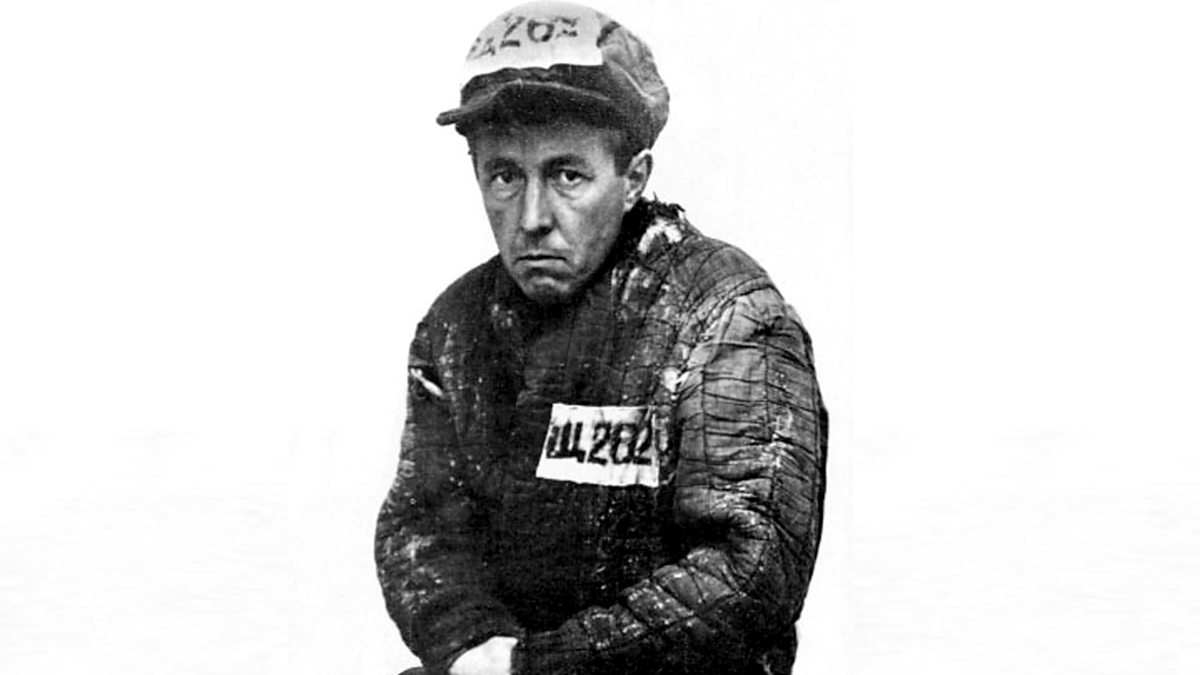
Alexander Solzhenitsyn on all the screens; The Gulag Archipelago had
been published in December 1973 and Solzhenitsyn expelled from the
Soviet Union in February 1974.
The events described in the song began on June 22, 1941 as Operation
Barbarossa, the German surprise attack on the Soviet Union, triggering
the worst of the many conflicts that made up World War Two. By its end
in May 1945, 4.3
million Germans were dead, mostly military personnel (along with three
quarters of a million of its Italian, Hungarian, Romanian, and Finnish
allies), and perhaps up to
27 million Russians, two thirds of them civilians (German pre-war plans
called for the starvation of 30 million Russian civilians in order to
free up food supplies for civilians and military and to allow for German
immigration to the occupied territories). Horror upon horror piled
up. Soviet secret police routinely executed all imprisoned political
prisoners in cities from which the Red Army was retreating in 1941 and
upon the Soviet occupation of Eastern Europe in 1944-45 more
imprisonments and executions followed - the Soviets had already executed
15-20,000 captured Polish officers in the spring of 1940 (which they tried to blame on the Germans). When they reached Germany,
Soviet forces were unleashed and encouraged by commanders to engage in an orgy of murder and rape in revenge for the monstrous atrocities committed by the Nazis against Soviet civilians. It was in the wake of the German attack in
1941 that the first Nazi organized and systematic killing of Jews took
place with roaming units, often assisted by local collaborators executing an estimated 1.5 to 2 million in mass
shootings (many of them in the region from which my ancestors fortunately emigrated decades earlier). The beginning of Barbarossa also saw the start of planning
for the Final Solution, culminating in the Wannsee Conference of January 1942 which set as its goal the extermination of the eleven million Jews in Europe.
Stewart's song balances a vivid, poignant, brilliantly constructed, and historically accurate
lyric with a striking melody, a Russian influenced chorus, and an
evocative and emotional arrangement. He tells the story of a Soviet
soldier, one of tens of millions of people caught in the horrific
tragedy caused by two of the most brutal regimes to ever be inflicted
upon the human race - Nazi Germany, led by Adolph Hitler, and the
Communist Soviet Union of Josef Stalin. It's a world of spiritual
darkness and limited and terrible choices for the people trapped
by those events, a dilemma also brought to life by Alan Furst in his
splendid series of novels set in the same time period - particularlyNight Soldierand Dark Star.
Most of those in Eastern Europe who opposed both Nazis and Communists
ultimately suffered a tragic fate (see, for instance, the astonishing
and inspiring story of Witold Pilecki, the man who volunteered for Auschwitz).
Let's look at the lyrics and explore the song in more detail.
They cross over the border the hour before dawn
At about 315am on the morning of June 22, 1941, the German army launched
Operation Barbarossa. The attack, including 14 Finnish and 13 Romanian
divisions (the Italians and Hungarians joined later), involved 3.8 million soldiers, 3,400 tanks, 3,500 aircraft
and 700,000 horses. Facing the onslaught were about 2.5 million
front line Soviet troops (the Red Army had about 4 million men under arms
in total in the European part of the country).
Though Hitler and Stalin had been allies since the August 1939 signing
of the Nazi-Soviet Nonaggression Treaty, which divided Poland and the
Baltic States between them, they were long-term ideological enemies and a
conflict was inevitable at some point. However, the specific timing of
the German attack was dictated by Hitler's desire to remove what he
viewed as Britain's last hope for support in the war, the same motive
that drove Napoleon's disastrous invasion of Russia in 1812 (for more on
this read Bonapartaroo Barbarossa).
While Hitler and Napoleon had similar motives for unleashing their wars, there was a significant difference in how each waged the campaign. While some advised Napoleon to mobilize Russian peasants against the Czar by promising to abolish serfdom, Napoleon was not interested in occupying Russia or unseating the Czar, his goal being to force Russia back into the Continental System designed to ruin Britain, so he declined to incite a peasant uprising.
In contrast, once Hitler decided upon war, ideological considerations drove Nazi decisions as to how the war would
be conducted. The Soviet regime was to be unseated, or at least driven behind the Urals, and the European portion of the country permanently occupied. The inhabitants of the occupied portions were to be starved, driven out, or left as slave labor for German
settlers, captured Red Army communist commissars executed, roving extermination squads (Einsatzgruppen) would murder Jews who came under German occupation, and captured Red Army personnel corralled and left to die of disease and starvation. Many of the nationalities repressed by the Communists, like the Ukrainians were initially receptive to the German invasion but the brutalities visited upon them led many to eventually join the partisans fighting the Germans.
In the months leading to the attacks, Stalin dismissed multiple warnings
from his own intelligence services as well as from Churchill and
Roosevelt, claiming they were provocations designed to entice him into a
war with Germany that would only benefit the Western capitalist
powers. As late as the night of June 21-22 he ordered the execution of
German defectors who entered Soviet lines to warn of the imminent
attack. The result was that Red Army troops were left deployed in
forward positions near the border, in vulnerable formations ill-suited
to defense.
The Soviet Army was still recovering from Stalin's 1937-38 purge of senior
military leadership in which at least 75% were killed,
and its poor performance in the 1939-40 Winter War with Finland gave
the German military what proved to be unwarranted confidence that the
Russians would be quickly defeated. This was on top of the events of the prior year when Germany defeated the French army, considered the best in Europe, in six weeks. This overconfidence also
contributed to the inexplicable lack of attention by the Germans to the
logistical challenges of a massive campaign designed to penetrate deeply
into the Soviet Union, challenges that were ultimately to doom
Barbarossa.
The border referred to in the lyric was different from the 1939 Soviet
border. With the 1939 pact, Stalin was able to occupy half of Poland,
all of the Baltic States and the Romanian province of Bessarabia. By
advancing the border, he gained strategic depth against attack, while
also arresting, murdering, and deporting hundreds of thousands of
citizens of those countries who he believed might oppose his plans (a
sordid tale told in disturbing detail in Timothy Snyder's Bloodlands; I had a friend whose parents, Polish Jews, met after being deported to Central Asia).
In addition, with his surprise attack on Finland in October 1939 he
gained buffer room for Leningrad and for the crucial northern port of
Murmansk, through which much American and British military aid was later to flow.
Moving in lines through the day Most of our planes were destroyed on the ground where they lay
The Luftwaffe destroyed over 2,000 Soviet aircraft on the ground that
first day, losing only 35 planes in its attacks. More than 3,900 Soviet
planes were destroyed in the first three days, giving the Germans
overwhelming air superiority.
Waiting for orders we held in the wood Word from the Front never came By evening the sound of the gunfire was miles away Ah, softly we move through the shadows, slip away through the trees Crossing their lines in the mists in the fields on our hands and our knees And all that I ever, was able to see The fire in the air glowing red, silhouetting the smoke on the breeze
In those first days and weeks many Soviet troops found themselves
isolated behind the rapidly advancing Germans, often left without orders amidst
the command chaos. "The Front" refers not to the front lines where the
soldiers were, but to the organization of Russian armies into "Fronts",
equivalent to American Army Groups on the Western Front. In other
words, they heard nothing from the High Command. Until the German invasion the Soviet equivalent of western ally Army Groups were called Military Districts. Between June 22 and June 25 all of the Military Districts were redesignated as Fronts.
While many isolated or surrounded soldiers surrendered (3 million
by the end of 1941, 75% of whom would die in German captivity) many
thousands were eventually able to find their way back through gaps
between the rapidly advancing German Panzer units and the slower
infantry following behind, to rejoin their comrades, our narrator being
one of those. Others remained free but behind enemy lines,
becoming the core of partisan units that would harass the Germans
for years (and which make an appearance later in the lyrics).
All summer they drove us back through the Ukraine Smolensk and Vyazma soon fell By autumn we stood with our backs to the town of Orel
In this passage, the narrator uses the terms "us" and "we" in reference not to his personal location but rather to the overall plight of the Red Army.
The German attack was divided into three army groups. Army Group North
advanced through the Baltic States towards Leningrad, while Army Group
South drove the Soviets, "back through the Ukraine", culminating in
September with a great encirclement near Kiev in which more than 700,000
Soviets were killed or captured.
The third, and initially most powerful, group was Army Group Center,
taking the road to Moscow along which Smolensk, Vyazma, and Orel were
located. The Battle of Smolensk lasted from July 10 to September 10,
with the Red Army losing nearly a half million soldiers dead, wounded,
or captured. The battle was prolonged because in its early stages
Hitler diverted panzer units to the south for the Kiev encirclement.
The delay in capturing Smolensk may have fatally delayed the German
drive on Moscow. The above map, particularly of the first three phases of Barbarossa through September 9, is deceptive and illustrative of the problems encountered by the Germans. The phases portray neat solid front lines achieved by Germans as of those dates with the lands behind them conquered and occupied but that impression is misleading. The front was not solidly held from the Black Sea to the Baltic with gaps between the panzer groups leading the German advance. And behind those lines there were often fifty to one hundred mile gaps between the panzers and the infantry units following on foot with supplies pulled by horses. Furthermore, the German advances were confined to main roads with large areas between untouched, leaving time and space for bypassed Soviet personnel to regroup. The Germans simply did not have enough troops to occupy all of the lands they passed through.
Moreover, the condition of the roads and the wear and tear on troops and equipment meant that by a month into the operation, the German army was running short of supplies and soldiers becoming exhausted. The model the German military had in mind was that of May 1940, when its armored forces, moving on France's paved roads, advanced the 175 miles from Sedan to the English Channel in a week. In 1941 it was 425 miles from the German-Soviet border to Smolensk and another 240 miles from Smolensk to Moscow, almost all of it on unpaved roads that were by turns dry and dusty or wet and muddy.
With the panzers returning to Army Group Center, the advance on Moscow
resumed in late September, racing against the onset of winter. During
October, the Germans pulled off two more giant encirclements at Vyazma
and Bryansk, in which another million Soviet soldiers were killed or
captured. Orel fell on October 3 to General Guderian's tanks.
Closer and closer to Moscow they come Riding the wind like a bell General Guderian stands at the crest of a hill
On November 15, the Germans began their final push on Moscow. General
Heinz Guderian (1888-1954), commander of the Second Panzer Army, is
considered one of the finest tank generals of the war, performing
brilliantly during the Poland invasion and then leading the armored
spearheads in the 1940 French campaign. Guderian's task was to approach
the Soviet capital from the southwest and encircle it. Though he made
some advances, his overextended forces were halted short of the capital
and left in vulnerable defensive positions. On December 26, 1941 he
would be dismissed from command because of a dispute with his superiors
(including Hitler) over how to respond tactically to the recently
launched Soviet counter-offensive. Recalled to duty by Hitler in 1943 after the
disaster at Stalingrad, he was charged with rebuilding the army's
panzer capabilities. On July 21, 1944, the day after the failed
assassination attempt against Hitler, Guderian was appointed Army Chief
of Staff. Though often arguing with Hitler about tactical decisions, he
remained a faithful supporter of the Fuehrer until the end of the war.
(Guderian)
Winter brought with her the rains Oceans of mud filled the roads Gluing the tracks of their tanks to the ground While the sky filled with snow
In this section, two weather periods are mixed together. From late
October until mid-November came a period of cold rain, turning the
primitive Soviet road network into a sea of mud. Then came freezing
temperatures, making the roads stable and more passable. The final
German push was launched in this window before the onset of brutal cold
and snow made offensive operations much more difficult.
(Mud season, November 1941)
And all that I ever was able to see The fire in the air glowing red silhouetting the snow on the breeze
Now the red is silhouetting "the snow on the breeze" rather than "the smoke on the breeze"
of the first verse, signaling the passage of time from the warmth, sun,
and disaster of June to the bitter cold, snow, and hope of December.
In the footsteps of Napoleon the shadow figures stagger through the winter
The German offensive continued until December 5 under increasingly
taxing conditions with heavy snow and temperatures plunging to well
below zero. Counting on achieving complete victory by the end of fall,
German soldiers had not been issued winter clothing, nor were tanks,
assault guns, and motor vehicles designed and equipped to operate in
these conditions. At these temperatures the recoil fluid, lubricating
oil, and firing pins on German artillery, anti-tank, and machine guns
failed, tank turrets would not turn, and trucks had to be kept constantly
running, using precious fuel. And all these troubles were amplified by the
already overstressed German supply system collapsing in the
winter conditions.
Yet despite these difficulties, isolated German units got within 15
miles of the Kremlin, while to the northwest the main German forces were
within 25 miles of the city.
A German officer wrote of conditions during the advance:
It is icy cold . . . To start the engines, they must be warmed by
lighting fires under the oil pan. The fuel is partially frozen, the
motor oil is thick, and we lack antifreeze to prevent the cold water
from freezing.
The remaining limited combat strength of the troops diminish further due
to the continuous exposure to the cold. It is much too inconvenient to
shelter the troops from the weather . . . In addition, the automatic
weapons of the groups and platoons often fail to operate, because the
breeches can no longer move.
On December 3, the commander of Fourth Panzer Group reported its offensive combat power "has run out" because of "physical and moral over-exertion, loss of a large number of commanders, inadequate winter equipment".
Finally recognizing the reality of the brutal conditions and the
disintegration of offensive capabilities Hitler and the High Command
issued a halt order on December 5.
References to Napoleon were also a constant theme of Soviet propaganda
which constantly reminded German troops of the fate of the last western
invader, whose myth of invincibility, along with his army, disappeared
in the Russian winter.
Falling back before the gates of Moscow Standing in the wings like an avenger
What kept the German high command pressing ahead for so long despite the
casualties and exhaustion of men and equipment was the persistent
belief the Russians had exhausted their reserves and were on the verge
of collapse. It was a massive miscalculation, demonstrating the
complete failure of German intelligence assessments. They
underestimated the willingness of Stalin to move troops from the Soviet
Far East as well as the capability of the brutal and ruthless Soviet
system to mobilize an almost endless number of reserves (unlike Hitler,
who resisted fully mobilizing the German economy and populace until
1944, Stalin immediately took such measures). Between June 22 and
December 31, the Soviets lost 4 million men, the equivalent of its entire army on June 22, yet
still had 4 million under arms at the end of the year. It is hard to
believe any other society surviving with that scale of human loss in such a
short time.
Less than 24 hours after the German offensive halted, the Soviets began
launching their own attacks, designed to push back and isolate the
German forces near Moscow. In a series of actions lasting until the
beginning of March 1942, the exhausted Germans were forced back more
than 100 miles, permanently eliminating the threat to Moscow.
With
the exception of the British medium and heavy tanks which reached the
Soviet Union before the Moscow offensive, Western ally aid played a
small part in stopping the German advance. However, the scale of
British, and particularly American, aid became enormous as the war
progressed and without it the speed and scale of the Soviet advances in
1943-44 would not have been possible (3).
While Soviet soldiers were somewhat better equipped for the weather, the
winter conditions still took a toll, enhanced by Soviet
commanders still favoring frontal assaults. Thus, despite its success,
the tactical shortcomings of the Red Army can be seen in the disparity
in casualties during its three month offensive - 1.6 million for the
Soviets versus 262,000 for the Germans.
And far away behind their lines the partisans are stirring in the forest Coming unexpectedly upon their outposts, growing like a promise
You'll never know, you'll never know Which way to turn, which way to look, you'll never see us As we're stealing through the blackness of the night You'll never know, you'll never hear us
Though not a major factor in 1941, by the following year the partisan
threat became a major problem for the extended supply lines of the
German army. Partisan warfare in Russia was on a completely different,
and larger, scale than in most of the rest of Europe, involving huge
numbers, with organized large scale assaults on German rear lines.
Big chunks of the Soviet countryside behind enemy lines remained out of
German control throughout the war, forcing many troops to be diverted
to fighting partisans.
And the evening sings in a voice of amber, the dawn is surely coming
Using "amber" in this context is very interesting. Amber is a
fossilized tree resin, valued as a gemstone. From 1500 BC there was an
Amber Road by which this material was moved in trade from the shores of
the Baltic to the Mediterranean. The leading source of amber was near
what used to be the city of Konigsberg in Prussia, now known as
Kaliningrad and part of Russia since 1945.
The famous Amber Room was
initially constructed in Konigsberg and gifted in 1716 by the Prussian
King to Peter the Great of Russia. Installed in a palace outside of
Petersburg (later Leningrad), the room was expanded, eventually covering
590 square feet and containing over 6,000 pounds of amber on panels
backed with gold leaf and mirrors.
(The Amber Room)
During the war the German Army dismantled the Amber Room and transported
it back to Konigsberg. Disappearing at the end of the war, its
location, or whether it was destroyed, remains unknown, one of the last mysteries of the conflict.
The voice of amber is soothing - its message that things will get better. The next lines tell us how:
The morning road leads to Stalingrad And the sky is softly humming
We've moved ahead several months to the late summer of 1942. Unlike 1941,
when the German Army was powerful enough to attack the Soviets from
across its entire front, the Nazis summer offensive would be more
limited in scope. On
June 28, the Germans attacked in the south, aiming for the oil fields
of the Caucasus region and the heavy industrial town of Stalingrad. The
Germans advanced quickly, nearly reaching the Caspian Sea, but became
bogged down in Stalingrad, with an increasingly obsessed Hitler
insistent upon its capture. The fighting lasted for almost six months
ending in catastrophe for the Nazi regime with the destruction of the
Sixth Army and the allied Hungarian and Romanian armies, along with
heavy losses in other German units.
(Russian soldiers, Stalingrad)
On February 2, 1943 the last frozen and exhausted remnants of the
German Sixth Army surrendered to the Red Army amid the ruins of
Stalingrad, ending a battle that started in the last week of August
1942. Of 320,000 soldiers in the Sixth Army, 91,000 were still
alive to surrender, of whom only 5,000 ultimately survived to return to
Germany, most released after Stalin's death in 1953, eight years after
the war ended. Germany's Italian, Hungarian, and Romanian allies lost
another 300-400,000 dead, wounded and captured. As many as a half
million Soviet soldiers may have died in the battle; including wounded
and missing, Red Army casualties exceeded one million.
In a military sense the failure to knock the Soviets out by the fall of
1941 was the turning point in the war, the point where unconditional
victory by Germany became impossible, but Stalingrad was the symbolic
turning point of the war and both Stalin and Hitler were aware of its
symbolism at the time. The horror of the battle from the Russian
perspective is captured best inLife and Fateby
Vassily Grossman, one of the greatest works of 20th century literature,
in a section recounting the struggle of an isolated Red Army squad to
hold a
ruined building amidst the rubble of the city. Of course, being a
Russian novel, everyone dies. Grossman, a Red Army newspaper
correspondent during the war, had been present for months at Stalingrad, spending time in a building on the front lines like that described in the novel,
and later accompanied the troops who discovered the Nazi extermination
camps in Poland (of which he wrote the first accounts). The wartime and
immediate post-war experience transformed him, and for years he
secretly worked on Life and Fate, a novel portraying Nazism and
Communism as equivalent. When he attempted to publish the book during
the years of the Khrushchev "thaw" in the early 1960s, the party reacted
by sending the KGB to seize the manuscript as well as the typewriter
and ribbon on which it had been written. Fortunately, one copy survived
and in the early 1980s, years after Grossman's death, it was smuggled
to the West and finally published.
After Stalingrad, German military leaders no longer believed the war
could be won, the question being whether it would be lost.
Two broken Tigers on fire in the night Flicker their souls to the wind We wait in the lines, for the final approach to begin It's been almost four years, that I've carried a gun At home it'll almost be spring The flames of the Tigers are lighting the road to Berlin
The lyrics here are very cleverly structured. The first line tells us of "two broken Tigers" followed by a reference to "the final approach" but we don't know where or when it is. The next line tells us it's been "almost four years that I've carried a gun",
placing us in 1945, but still not giving us a location as Soviet armies
are fighting from the Baltic to Hungary. Then it's revealed that the
flaming Tigers are also "lighting the road to Berlin", creating a vivid and precise word picture.
The Tiger was the heaviest and most powerful tank produced by Germany
during the war. Like much German equipment it was over engineered,
overly complex to manufacture, requiring high level maintenance to
keep it in the field, and well-maintained roads and bridges to support its weight. The Tiger I was produced from 1942 to 1944 and the
Tiger II from 1944 on, but fewer than 2,000 made it to the army. When
it was available and running the Tiger proved devastatingly effective.
(Tiger II)
It's now April 16, 1945. The Red Army is less than 50 miles from
Berlin. Much has transpired since the German surrender at Stalingrad in
February 1943. In July 1943 Hitler attempted his last major attack on
the Eastern Front near the city of Kursk. It quickly proved
unsuccessful, the Soviets counterattacked, and from then until the end
of the war the Red Army was on the offensive. The siege
of Leningrad ended and most of the Ukraine was reconquered by the end
of 1943. In June 1944, the Soviets crushed Army Group Center and drove
the Germans out of Russia, advancing into Poland where by late July they
were on the outskirts of Warsaw. Then followed another of the
countless tragedies of the war when the Polish Home Army rose up to
evict the Germans. Stalin, who opposed the anti-communist Poles,
ordered the Red Army to stand by while the Nazis crushed the uprising,
killing 200,000 Poles and razing the city (for more on the uprising read
Warsaw Does Not Cry).
In late 1944, the Soviets advanced into the Balkans, causing Romania and
Bulgaria to switch sides and reaching the borders of Hungary.
On January 12, 1945 the Russians renewed their attack on the Polish
front, sweeping away the Germans quickly advancing to the Oder River
near Berlin, where they paused to regroup for the final assault.
Ah, quickly we move through the ruins that bow to the ground The old men and children they send out to face us, they can't slow us down All all that I ever, was able to see The eyes of the city are opening now, it's the end of a dream
The Berlin campaign lasted from April 16 through May 2. Though the assault contributed to the "ruins that bow to the ground"
much of the city was already ruined by American and British air
raids, some consisting of more than 1,000 bombers striking the city.
The reference to "old men and children" refers to the Volksstrum
("People's Storm"), a national militia consisting of all men between 16
and 60 capable of bearing arms, formed in October 1944, as the manpower
needs of the crumbling Third Reich became ever more desperate (even boys
of 14 and 15 would see service by the end). Poorly armed and
trained, the Volkssturm units were of varying effectiveness and took
heavy casualties.
Notice the contrast with the opening verse of the song. In 1941, the
narrator speaks of defeat, confusion, and retreat; four years later he
is moving triumphantly forwards to victory.
(Berlin 1945)
Despite the claim that "old men and children . . . they can't slow us down",
the Volkssturm and remaining regular Wehrmacht units imposed heavy
losses on the Red Army - 79,000 dead and 270,000 wounded in less than
three weeks, a per day toll higher than any the Soviets had suffered
since the dark days of 1941. The human cost was made higher by Stalin's
cynical move to place Marshals Zhukov and Koniev in competition to be
first to Berlin, relentlessly mocking and scolding them, leading to
reckless frontal assaults, particularly by Zhukov, the victor at Khalkin Gol in 1939.
And, with the encouragement of Stalin and the Red Army command, the
victorious soldiers took a terrible vengeance on German civilians, with uncounted murders and an estimated two million rapes.
I'm coming home, I'm coming home Now you can taste in the wind, the war is over And I listen to the clicking of the train wheels as we roll across the border
The lyric brims with optimism. Against all odds, our narrator has
survived and looks forward to being reunited with his family. In
reality the odds were low that any soldier on the front line on June 22,
1941 would be alive and healthy enough to be fighting in Berlin nearly four years later.
8.6 million Red Army personnel died in the war; effectively the original
1941 army was killed twice over. In comparison, the United States
suffered 296,000 battlefield deaths with another 100,000 dead due to
accidents and illnesses.
Nor were all the Russian dead solely the responsibility of the German
army. Life for the Red Army soldier during the war was brutal. Commanders
employed tactics that wasted countless lives. If you died, particularly
early in the war, it was unlikely your family would be notified. Any
infraction, real or imagined, was subject to harsh discipline and
extreme punishment. During the first 18 months of the war (the only
period for which we have figures), 160,000 Soviet soldiers were executed
for cowardice or desertion. By comparison, only one American was
executed for these offenses during the entire war. For those not
summarily executed there were the Punishment Battalions and Companies to
which officers and soldiers were sentenced to be used, in Stalin's
words, at "the most difficult parts of the front, to give them the possibility to redeem their crimes against their country with blood".
The Punishment units were deployed for tasks such as suicidal frontal
assaults and the clearing of minefields by marching through them, making
it no surprise that an estimated 400,000 died in the process. Their
existence was such an embarrassment to the Soviets after the war that
the existence of the units was officially denied.
In Stalingrad: The Fateful Siege, Antony Beevor tells the tale
of a Soviet lieutenant caught in this madness. Captured by the Germans
in August 1942, he manages to escape and rejoin the Red Army, where he
is promptly arrested, charged as a deserter, and sentenced to a
Punishment Company. Realizing his sentence is an effective death
penalty, he deserts to the Germans! We don't know his fate but it is
unlikely he had a happy ending.
And then there were the Red Army's blocking detachments formed to shoot down retreating soldiers - retreating Red Army soldiers.
The optimism of those that survived extended beyond the relief of being
alive and reuniting with family. The memoirs and recollections of
returning soldiers and officers are filled with belief and hope that
conditions in the Soviet Union would be improved. There was a feeling
that the common Soviet citizen had proven to
Stalin they could be trusted, that the regime need not fear them, that
the fear of being subject to arbitrary justice would end, it would be a new start for the Soviet people and a new and more cordial
relationship with their government. It was not to be.
And now they ask me of the time That I was caught behind their lines and taken prisoner "They only held me for a day, a lucky break", I say They turn and listen closer I'll never know, I'll never know Why I was taken from the line and all the others To board a special train and journey deep into the heart of Holy Russia And it's cold and damp in this transit camp And the air is still and sullen And the pale sun of October whispers The snow will soon be coming
In his account of the German-Soviet struggle, Absolute War, author Chris Bellamy writes, "the Red Army was the only one in the world where being taken prisoner counted as desertion and treason".
Stalin believed any soldier who allowed himself to be captured was a
traitor and potential counter-revolutionary, and Russians exposed
to Westerners for any length of time, a danger to the Soviet
state. Bellamy adds:
The Soviet government and military command had absolutely no interest in
what happened to Soviet people in German captivity. When prisoners of
war who survived were released at the end of the war [3 of the 4 million
POWs died due to the German policy of exposing them to the elements and
leaving them to starve, though a small number survived long enough to serve as
guinea pigs for the initial testing of the newly constructed gas chambers at
Auschwitz], they were usually sent to the Gulag or shot, and the same fate even befell many who had fought and crawled their way out of German encirclements during the war.
Our narrator falls into this last group. His years of valiant service and suffering are to no avail because of the one day he spent within an enemy encirclement.
Also subject to this treatment were civilians who either volunteered or
been seized and taken to Germany as slave laborers. Bellamy estimates
that up to 1.8 million returning Soviet citizens were sent to Gulag
camps or shot.
To their disgrace, both Britain and America contributed to this
horror. In 1945 and 1946, the two countries forcibly repatriated
over a million Russians who did not want to return to the Soviet Union.
While it was the British who insisted on honoring agreements made with
Stalin during the course of the war, the United States eventually went
along. The returnees were sent to the Gulag or shot.
For those escaping the Gulag or execution, optimism proved misplaced. Stalin believed that after the "laxity"
of the war years, Soviet discipline needed to be reimposed to prevent any
sliding back from the pre-war accomplishments of the state. The
post-war years proved grimly repressive with further waves of purges and
the elimination of those tiny, fragile zones of personal autonomy some
had carved out during the war. Stalin even ordered the removal of
crippled and disabled war veterans from the streets of Moscow because he
felt their presence demoralizing. It was in this atmosphere that a
young returning officer, Alexander Solzhenitsyn, found himself sentenced
to ten years in the Gulag for telling a joke about Stalin.
And I wonder when I'll be home again and the morning answers, "Never" And the evening sighs and the steely Russian skies go on forever
I find these the saddest lines in music and no matter how often I hear
them they affect me as powerfully as the first time. They represent the
betrayal of the hopes and dreams of people caught up in a horrible
time, who thought they'd survived the worst, only to find themselves
condemned to death, exile, and lives of fear and hopelessness.An estimated 18 million people were imprisoned in Gulag camps between 1929 and 1953, with 2.4 million still in the camps when Stalin, who was planning another massive purge at the time, mostly directly at the Jewish population, died in 1953.
We take leave of our narrator as he disappears into the mist beneath the
steely Russian skies passing to an unknown fate, like so many other
millions. These lines from the poet Osip Mandlestam
(1891-1938), who himself died in a Gulag transit camp in Siberia for committing "counter-revolutionary activities" consisting of writing a
poem mocking Stalin, provide the tombstone for those souls.
Mounds of human heads
Are wandering into the distance
I dwindle among them
Nobody sees me
(Secret
Police photo of Mandelstam. He died of typhoid fever on December 27,
1938. His body lay unburied along with others who died that winter, their frozen corpses piled on the ground, until all were thrown into a mass grave dug after the spring thaw.)
(1) Mayor Mamdani is a leader of the Democratic Socialists of America (DSA), which is also fielding many candidates this year for national, state, and local offices. Despite its name, the DSA is not a democratic socialist group, it is a communist organization dedicated to the destruction of the United States. The U.S. has had socialist organizations that were actually democratic such as Norman Thomas' Socialist Party in the 1930s which was fiercely anti-communist, as was the DSA when it was founded.
In October 2023, Maurice Isserman resigned from the Democratic
Socialists of America (DSA), the organization that Mamdami and
Representative Alexandria Ocasio-Cortez remain members of. In 1982
Isserman was a founding member of the DSA, the lead founder being the
late Michael Harrington. Isserman and Harrington actually were Democratic Socialists.
I believe Harrington was mistaken in many of his political ideas but he
was a decent and moral person, unlike the current leadership of the
DSA. The DSA is another of the many institutions in America that carry
the same name from decades ago but have been subverted from within and
are now completely different in substance. The current DSA is a
authoritarian communist organization heavily seasoned with
settler-colonist ideology. It is an enemy of civilization.
Isserman, an academic who has written favorably about the history of the American Communist Party, resigned for several reasons, including:
- The DSA's failure to denounce what he described as the "anti-Jewish
pogrom" by Hamas on October 7, which he characterized as "politically
and morally bankrupt".
- The capture of the DSA by groups like Red Star, Marxist Unity Group, and the Communist Caucus—which value ideological purity over democratic socialist values. He described these groups as "entryists", writing, "In left-wing parlance, the term refers to tightly organized groups who,
without sharing the beliefs of larger and more loosely organized
bodies, join and proceed to either wreck or, where possible, capture
them for ends at odds with the spirit and purpose of the original
members".
(2) Scholars have cited several potential reasons for the military purge, with some believing that German intelligence played a role by inserting false information about a Red Army military conspiracy against Stalin into the Soviet intelligence network, triggering Stalin's actions.
(3) US and British material shipments to the Soviet Union during the war included:
400,000 Jeeps/trucks (1/3 of all Soviet motor vehicles)
Towards the beginning of this year I began listening to Richard Elliott Friedman's 29 hour long lectures on the Hebrew Bible. I'd never done anything like this regarding the Bible but ran across an intriguing reference to the Friedman lectures, decided to give it a try, and ended up, to my initial surprise, listening to all of them (which you can easily find by searching on his name on YouTube). Since then, I've read two of Friedman's books, Who Wrote The Bible? and The Exodus: How It Happened and Why It Matters, thoroughly enjoying both.
Friedman taught for many years at University of California, San Diego and is currently Professor of Jewish Studies at the University of Georgia.
The lectures address the historicity of the Bible using both text and archaeology. Friedman, who reads nine languages, including Assyrian, Aramaic, Greek, and ancient Hebrew and is conversant in recent archaeological investigations in the Middle East provides an easily understandable guide. After some general scene setting he proceeds chronologically through the narrative books of the Bible skipping, for instance, Psalms, Proverbs, and Job. Along the way he addresses who authored the Bible, the relationship between Israel and other Middle Eastern cultures, and when and how the transition from paganism to monotheism occurred. I very much like his informative and casusal style, often interspersed with "Dad" jokes (in fact he starts the first lecture with one), though by the end I'd heard some of them two or three times. Who Wrote The Bible? provides a more in depth analysis of his lecture discussions, while The Exodus is his attempt to reconcile Biblical accounts with history and archeology about whether and how that pivotal event occurred.
I am not knowledgeable about biblical scholarship so can't evaluate his work in relation to other scholars but I like that when he explains how he reached his views he also acknowledges those who differ in their interpretations and is open about when his conclusions are not aligned with those of most other scholars.
It is natural to feel nostalgic for what the Empire was, just as one might regret the gentle light of oil lamps, the splendor of the fleet at sail and the charm of the temps des equipages [ship's crew]. But so what? There is no policy worth anything outside of realities.
- French President Charles de Gaulle, August 1960, speaking on the ongoing war in Algeria.
Quoted by Richard Vinen in his recent book, The Last Titans: How Churchill and de Gaulle Saved Their Nations and Transformed the World. Vinen goes on to write of de Gaulle, ". . . de Gaulle was a reactionary . . . this made him unsentimental. He looked back with regret but there was almost a playful self-conciousness about any suggestion that the past could be revived."
This is an account by Harold Macmillan of an afternoon spent with De Gaulle in Algiers in 1943:
"After that lunch [with King George VI and Giraud], de Gaulle asked me what I planned to do with my afternoon. I thought of driving to Tipasa to go swimming. He asked if he could accompany me, alone.
That is how I spent three and a half hours driving, strolling through the ruins, and in ceaseless discussion with this strange man—captivating and yet impossible. We talked about every imaginable subject, politics, religion, philosophy, the classics, ancient and modern history, etc. Everything more or less related to the problems preoccupying his mind.
Macmillan himself was a fascinating character. At the time he was British Resident Minister at Allied Headquarters in North Africa, representing his government's political interests. Like Winston Churchill, he came from an upper class family with a British father and American mother. He was a classics graduate of Balliol College. Enlisting in the army in 1914, Macmillan saw extensive action, being wounded at Loos in 1915, after returning to the front lines he was severely wounded at the Somme in September 1916, where he lay in a shell hole for 12 hours before being rescued. Spending the next two years in hospital, he was left with a limp due to a hip wound, and a weak grip in his hand which also affected his handwriting.
Elected to Parliament in 1924 as a Conservative member, in the 1930s he became an advocate for a mixed economy (government and private ownership). In 1940 he voted against the government in the Norway debate, a vote which precipitated the resignation of Neville Chamberlain and the appointment of Winston Churchill.
Returning to Parliament in 1945 he became Housing Minister in 1951 when the Conservatives returned to power under Churchill, later serving as Minister of Defence, Foreign Secretary, and Chancellor of the Exchequer, before ending his political career as Prime Minister, serving from 1957 until 1963. As Prime Minister, Macmillan had a close relationship with President Kennedy and accelerated Britain's decolonization in Africa.
Substack has become a valuable resource for me. While already familiar with some authors, I've also discovered many others writing on a wide variety of topics. Highly recommended are the book reviews at Mr and Mrs Psmith's Bookshelf. Some of the reviews are jointly authored, others by either Mr or Mrs. What makes them particularly valuable is that, along with reviewing the book, the reviews often serve as the launchpad for deep, interesting, and provocative discussions.
Some of my favorites:
Xenophon's Anabasis and The Education of Cyrus
An Amish Paradox: Diversity and Change in the World's Largest Amish Community
Further Arguments Against Jared Diamond (author of Guns, Germs, and Steel)
The Greatest Knight: The Remarkable Life of William Marshal
Leap of Faith (about the Iraq War and a book I've also written about)
The Wizard and the Prophet
The Verge
Sick Societies
Boyd: The Fighter Pilot Who Changed The Art of War
Sad news today. Gordon S Wood, the great historian of early America, died when hit by a car in the parking lot of a Shaw's supermarket in Rhode Island. Though 92, Wood remained active, attending and speaking at conferences this year.
I've read his books Empire of Liberty, Power and Liberty, and Friends Divided: John Adams and Thomas Jefferson and have The Radicalism of the American Revolution on my reading list for this summer. Empire of Liberty is the story of the democratization of the new republic in its first 4 decades to an extent unanticipated by the Founders, and probably unwanted as to at least some of them.
Wood trained at Harvard under the eminent historian Bernard Bailyn. I've read several of Bailyn's books; The Barbarous Years: The Peopling of British North America (which I wrote about here), Atlantic History: Concepts and Contours, and Illuminating History: A Reflection of Seven Decades. Another Bailyn book, The Ideological Origins of the American Revolution, is also on my summer reading list.
In 2019, when the New York Times published the ridiculously ahistorical 1619 Project, the World Socialist Web Site, a Trotskyite organization, published the first extensive critique of the project when it interviewed liberal, progressive, and socialist historians of early America, who unanimously panned the publication, including Wood who characterized it as "so wrong in so many ways" (his full interview is here).
In the Declaration of Independence,
the 250th anniversary of which we are celebrating this year, the
Founders put down five significant words that came to define America’s
culture — “all men are created equal.” No phrase could have been more
radical, more momentous. Even the French Declaration of the Rights of
Man and the Citizen in 1789, with its statement that “men are born and
remain free and equal in rights,” does not have the same power and
significance.
Equality was based on a new understanding of people’s capacity to
transform themselves. Educated people in the late 18th century came to
believe — it was the basic premise of all enlightened thinking — that
people were not born to be what they might become.
Many enlightened American slaveholders (but, alas, not Jefferson)
assumed that at birth they were no different from their black slaves;
they had all started with the same blank slate. William Byrd, a wealthy
slaveholder and learned member of the Royal Society, was as much of an
aristocrat as Virginia was ever to know, yet he sincerely believed that
“the principal difference between one people and another proceeds only
from the differing opportunities of improvement.” Lieutenant Governor
Francis Fauquier of Virginia, Jefferson’s dining and music partner, made
the point more bluntly: “White, Red, or Black, polished or unpolished,”
he declared in 1760, “Men are Men.” James Boswell, Dr. Johnson’s great
biographer, during his tour to the Hebrides in 1773, was surprised to
find a black African servant in the north of Scotland whose manners were
no different from those of a white servant from Bohemia. But then he
realized that he had forgotten the modern presumption that culture was
man-made. “A man is like a bottle,” he observed, “which you may fill
with red wine or with white.”
Education, which had been important only to New England Puritans, suddenly became an American obsession.
And not just the education of elites but of all the people. The
Northwest Ordinance of 1787 put it best, decreeing that “religion,
morality and knowledge being necessary to good government and the
happiness of mankind, schools and the means of education shall forever
be encouraged.
Americans now began creating numerous learned academies and historical
societies and flooded their society with printed matter designed to
inform the new republican citizenry. Three-quarters of all the books and
pamphlets published in America between 1637 and 1800 appeared in the
last 35 years of the 18th century. Between 1786 and 1795, 28 learned and
gentlemanly magazines were established, six more in these few years
than in the entire colonial period. By 1810, Americans were buying more
than 20 million copies of 376 newspapers annually — even though half the
population was under the age of 16 and one-fifth was enslaved and
generally prevented from reading. This was the largest aggregate
circulation of newspapers of any country in the world.
But the most important humanitarian organizations of the revolution
focused on slavery. Hereditary chattel slavery — one person owning the
life and labor of another person and that person’s heirs — is virtually
incomprehensible to those living in the West today, even though there
may be millions of people in the world presently still enslaved.
Slavery existed in a multitude of cultures for thousands of years
without substantial criticism — until the late 18th century and the
American Revolution. Although many modern historians have called the
Revolution’s inability to free all the slaves its greatest failure, they
have committed the great sin of anachronism by assuming that everyone
in the past must have known that slavery was an evil. These historians
therefore have not fully appreciated that the Revolution defied a world
that for millennia had taken slavery for granted. It was the Revolution
that for the first time in history made slavery a problem, and it led to
the first instance of states’ abolishing the practice. Not only did
eight Northern states abolish slavery in the aftermath of the
Declaration of Independence, but slaveholders in the Southern states
were thrown on the defensive and, for the first time, had to justify an
institution that they hitherto had taken for granted. They fell back on
the alleged racial deficiencies of blacks. The antislavery movement that
arose out of the Revolution inadvertently fostered an ideology of
racism in America.
The meaning of these five words in the Declaration of Independence was
expanded in the succeeding decades to the point where every white man
felt he was equal to every other such American. Once invoked, the idea
of equality could not be stopped, and it tore through American culture
and society with awesome power. It became what Herman Melville in 1851
called “the great God absolute! The centre and circumference of all
democracy!” The “Spirit of Equality” did not merely cull the “selectest
champions from the kingly commons,” but it spread “one royal mantle of
humanity” over all Americans and brought “democratic dignity” to even
“the arm that wields a pick or drives a spike.”
I came across this beautiful piece, The Things He'll Never Say, by former student C Bradley Thompson. Wood was scheduled to come to Clemson on July 24, where Thompson would interview him. At the end of the essay, Thompson lists some of the questions he had prepared. Thompson also includes links to a number of videos featuring Wood.

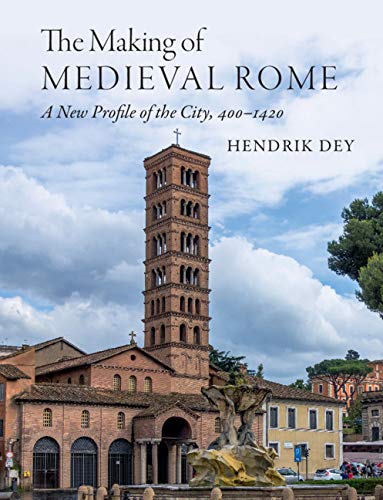


/https://tf-cmsv2-smithsonianmag-media.s3.amazonaws.com/filer/79/23/792317f5-018d-404c-b156-26360f6fa0f6/andrey_zeest_-_amber_room_2_autochrome.jpg)
 On
June 28, the Germans attacked in the south, aiming for the oil fields
of the Caucasus region and the heavy industrial town of Stalingrad. The
Germans advanced quickly, nearly reaching the Caspian Sea, but became
bogged down in Stalingrad, with an increasingly obsessed Hitler
insistent upon its capture. The fighting lasted for almost six months
ending in catastrophe for the Nazi regime with the destruction of the
Sixth Army and the allied Hungarian and Romanian armies, along with
heavy losses in other German units.
On
June 28, the Germans attacked in the south, aiming for the oil fields
of the Caucasus region and the heavy industrial town of Stalingrad. The
Germans advanced quickly, nearly reaching the Caspian Sea, but became
bogged down in Stalingrad, with an increasingly obsessed Hitler
insistent upon its capture. The fighting lasted for almost six months
ending in catastrophe for the Nazi regime with the destruction of the
Sixth Army and the allied Hungarian and Romanian armies, along with
heavy losses in other German units. 

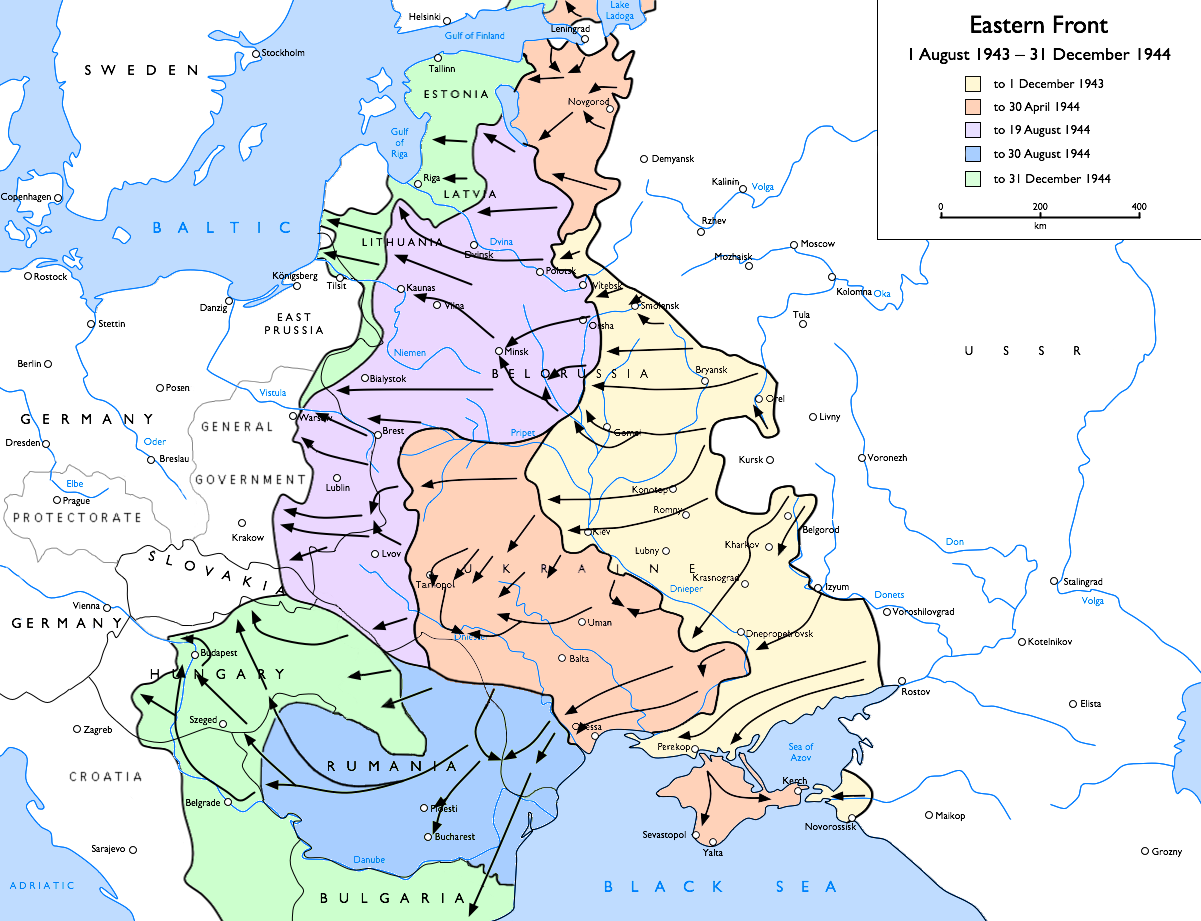


 (Secret
Police photo of Mandelstam. He died of typhoid fever on December 27,
1938. His body lay unburied along with others who died that winter, their frozen corpses piled on the ground, until all were thrown into a mass grave dug after the spring thaw.)
(Secret
Police photo of Mandelstam. He died of typhoid fever on December 27,
1938. His body lay unburied along with others who died that winter, their frozen corpses piled on the ground, until all were thrown into a mass grave dug after the spring thaw.)