Showing posts with label Race. Show all posts

Monday, July 6, 2026

What To NPR Is Propaganda?

After completing my July 4 post on President Coolidge's speech on the 150th anniversary of the Declaration of Independence, I went on to read and listen to a couple of other historic speeches celebrating America's independence.  One of these was Frederick Douglass' magnificent 1852 oration What To The Slave is The Fourth of July?  While doing so I came across on YouTube an NPR presentation of the speech, produced in 2020 and recited by descendants of Douglass.  It is highly edited to be deliberately simplistic and misleading in order to ensure NPR listeners miss the point more than Michael Bay missed the mark when he made Pearl Harbor.  As a reminder, at the time, NPR still received taxpayer funding so you paid for this piece of agitprop.  Since then NPR has continued its descent into madness, naming authoritarian Katherine Maher as its CEO (for more on Maher read The "Real Trouble").

I've written of Douglass several times over the years; about his relationship with President Lincoln as well as the misuse to which he's been subjected to by our current educational system (Lincoln Douglass); on his Freedman's Monument Speech in 1876; as part of a prior July 4 post (citing to his 1852 speech); after reading his first autobiography (see Readings On Slavery).  Douglass was a courageous and thoughtful man who could eloquently express complex and provocative ideas.  His story should be known to all Americans.

The 1852 speech had two purposes. One is a lengthy, searing, and accurate indictment of American slavery and the complicity of white American society in its horror.  It is to this topic that the NPR edited version of the speech, which has 1.6 million views and 2,700 comments, is exclusively devoted to (the NPR version also contains a coda, the reflections of Douglass' descendants regarding today's America, a topic to which I will return to after discussing the speech).  The second, ignored by NPR, is Douglass' case that the Constitution is a "glorious liberty document . . . entirely hostile to the existence of slavery".  The reverence with which Douglass regards the Constitution (and the Declaration, as he states elsewhere in the speech) would undermine what NPR is trying to accomplish.  It also decontextualizes the speech though it is important to understand why Douglass is making this argument.  And it adds a false contextualization placing it as somehow linked to the death of George Floyd and the riots and protests that occurred in its aftermath.

The speech was given on July 5, 1852 at the Corinthian Hall in Rochester, NY, the city Douglass moved to in 1847, an event organized by the Rochester Ladies' Anti-Slavery Society.  Two years before, slavery became "nationalized" with the passage of the Fugitive Slave Act as part of the Compromise of 1850, heightening sectional disputes over slavery, as many in the free states who had not been engaged in the slavery issue now felt they had been made complicit by the passage of the Act.  More importantly for purposes of the 1852 speech, Douglass had split with the mainstream of the abolition movement and its leader and his former mentor, William Lloyd Garrison, over the interpretation of the Constitution.  Garrison's organization, the American Anti-Slavery Society, the leading abolitionist group, had taken the view that the Constitution was a pro-slavery document and the only solution was to dissolve the Union and for the free states to form a New Union under a new Constitution. In 1851 the Anti-Slavery Society passed a resolution denouncing any paper opposing this belief.  

After escaping slavery Douglass initially agreed with Garrison but as he studied the Constitution and the Declaration came to the conclusion they were anti-slavery documents and had broken with Garrison and started his own newspaper the North Star to promote his views.  It was to address this controversial dispute within the abolitionist movement that Douglass spent so much of his speech on this topic.  In the Coda to the NPR version one of the young people asserts that Douglass was speaking to those who already agreed with  him but, in fact, the purpose of the Constitutional argument was to persuade a divided audience.  For more on contemporaneous views of the Constitution consistent with Douglass' reading see Freedom National: The Destruction of Slavery in the United States 1861-1865 by James Oakes and Natural Law and the Antislavery Constitutional Tradition by Justin Buckley Dyer.

Douglass' speech can be broken into three parts.

The first section expresses hope that America, as a young nation, can find the correct course of action and to express admiration for the Founding generation.

The second to highlight contradictions and hypocrisy regarding white Americans and slavery.  The excerpts in the YouTube video are only a sampling of the examples given by Douglass.

The final section expresses his belief that the Constitution is a glorious liberty document that provides the blueprint for the end of slavery.

At the end of the post you will find excerpts from the first and third sections. 

As you can see all of the excerpts in the NPR video are from the second section with the exception of one passage from the conclusion of the speech;  "Allow me to say, in conclusion, notwithstanding the dark picture I have this day presented, of the state of the nation, I do not despair of this country".  The following sentences are not included; "There are forces in operation, which must inevitably, work the downfall of slavery. “The arm of the Lord is not shortened,” and the doom of slavery is certain."  The video contains nothing from Douglass' conclusion explaining why he does not despair, because it would undercut what NPR is trying to sell you.

And that brings me to the context in which the video was made and the significance of the coda portion. 

The video was posted on YouTube on July 3, 2020 and it was specifically linked to the death of George Floyd several weeks before.  NPR's description reads:

In the summer of 2020, the U.S. commemorated Independence Day amid nationwide protests for racial justice and systemic reforms in the wake of George Floyd’s death. That June, we asked five young descendants of Frederick Douglass to read and respond to excerpts of his famous speech, “What to the Slave is the Fourth of July?”. It's a powerful, historical text that reminds us of the ongoing work of liberation.  

The description notes that the video consists of excerpts but the title of the video and the description if you do a Google search implies it is the full text.  The description also pulls a sleight of hand.  Douglass' speech is about slavery and its relation to the Constitution but NPR links it to the "ongoing work of liberation".  Like the video, NPR never directly states what that work is, nor its relation to Douglass' speech and the propositions set forth there.  Instead the description and the video artfully avoids any discussion of Douglass' proposition as it must because NPR's viewpoint is that the U.S. was defective from its founding.  The video is edited and put together in support of the thesis of the infamous 1619 Project, while the opening and closing of Douglass' speech are a refutation of its thesis. That Douglass' argument is both a refutation of the argument of the 1619 Project as well as of the similar historical arguments of John C Calhoun and Alexander Stephens, Southern politicians who argued that slavery was a "positive good", illustrates that we have entered into a world of strange ideological alliances in 21st century America.(1)

The video was released in the midst of not just "protests" but also in the midst of riots and violence that resulted in thirty deaths in the short term and the most property damage (much of it to minority owned businesses) of any riots in American history.(2)  The impacts were worse longer term.  As it turned out that large cities governed for decades by NPR-type Progressives were hotbeds of racism, those mayors and city councils withdrew police and let loose their paramilitary wings.  Prosecutors resisted filing charges or reduced charges against those causing violence and destruction and leftist groups raised bail and paid for lawyers to defend the perpetrators.  One result was a massive increase in violence in minority areas.  The increase in black homicide victims of violence over baseline of recent years for the period from May 2020 to the end of 2022 amounted to more than the total number of black lynching victims from 1882 to 1968 (for more on that tragic history read Strange Fruit).  In what way was that liberation?  How did the protests and violence contribution to any positive solutions? In what way is the current situation of Black Americans similar to that of the slaves Frederick Douglass was discussing?  None of that is addressed.  It is simply implied that they are the same.(3)

And that is the saddest thing in the video - the coda. These young people seem to believe nothing has changed since Douglass' speech.  But why?  They've clearly absorbed in their upbringing and education the notion of oppression, one even saying "pessimism is a tool of white oppression".  We have a 20 year old claiming he is "exhausted" and near the end another says "we are still slaves to the notion that it will never get better".  That last remark is double-edged.  In the context of the video I think he's saying it has not gotten any better since Douglass's speech but we shouldn't lose hope it will get better.  I also see it as a warning to everyone in that video that they have been slaves to that notion even though objectively things are much better than 1852.  

For decades we've lived in a country where opportunities for minorities are plentiful and, in fact, privileged in education, government employment and contracts, and the corporate world.  The "system" which did once work to maintain white supremacy is gone and had been for many years.  The "system" now works the other way.  Yet the very education system which is part of those growing opportunities, teaches the opposite - that things haven't changed and further, those same educational system at the K-12 levels in cities with large minority populations is failing those populations, failing to generate the pipeline of students who can take advantage of those opportunities.  More than 40 years ago, Eddie Murphy parodied this attitude on Saturday Night Live:

But what use is it to teach children that the deck is stacked against them, when they, in fact, have opportunities if they can seize them? 

In doing research for this post, I came across a 2014 article by a history professor who has studied Frederick Douglass in which he complains that the version of What To A Slave Is the Fourth of July? being used to teach in our schools is the same as that presented by NPR.  In other words, a deliberately truncated version, omitting Douglass' context and view of the Constitution.  It is part of an effort to undermine the very foundations of this country and to indoctrinate the next generation that an end to the U.S. as we know it is the only solution.  Knowing that Douglass held the Declaration and Constitution and those who wrote those documents in such high regard is too dangerous for students.  They might draw incorrect conclusions.

The technique here is to keep everything vague, except to instill the feeling of massive racism and oppression.  The discussions we need are "what are the specific problems we are trying to solve" and "how would proposed solutions specifically help to solve them".  And that is always avoided, instead we are flooded with generalities and statements built upon false assumptions.

Excerpts from opening section of the speech: 

The eye of the reformer is met with angry flashes, portending disastrous times; but his heart may well beat lighter at the thought that America is young, and that she is still in the impressible stage of her existence. May he not hope that high lessons of wisdom, of justice and of truth, will yet give direction to her destiny? Were the nation older, the patriot's heart might be sadder, and the reformer's brow heavier. Its future might be shrouded in gloom, and the hope of its prophets go out in sorrow. There is consolation in the
thought, that America is young. 

To say now that America was right, and England wrong, is exceedingly easy. Everybody can say it; the dastard, not less than the noble brave, can flippantly discant on the tyranny of England towards the American Colonies. It is fashionable to do so; but there was a time when, to pronounce against England, and in favor of the cause of the colonies, tried men's souls. They who did so were accounted in their day, plotters of mischief, agitators and rebels, dangerous men. To side with the right, against the wrong, with
the weak against the strong, and with the oppressed against the oppressor! here lies the merit, and the one which, of all others, seems un fashionable in our day. 

Pride and patriotism, not less than gratitude, prompt you to celebrate and to hold it in perpetual remembrance. I have said that the Declaration of Independence is the RINGBOLT to the chain of your nation's destiny; so, indeed, I regard it. The principles contained in that instrument are saving principles. Stand by those principles, be true to them on all occasions, in all places, against all foes, and at whatever cost.

Fellow Citizens, I am not wanting in respect for the fathers of this republic. The signers of the Declaration of Independence were brave men. They were great men too—great enough to give fame to a great age. It does not often happen to a nation to raise, at one time, such a number of truly great men. The point from which I am compelled to view them is not, certainly the most favorable; and yet I cannot contemplate their great deeds with less than admiration. They were statesmen, patriots and heroes, and for the good they did, and the principles they contended for, I will unite with you to honor their memory.

They loved their country better than their own private interests; and, though this is not the  highest form of human excellence, all will concede that it is a rare virtue, and that when it is exhibited, it ought to command respect. He who will, intelligently, lay down his life for his country, is a man whom it is not in human nature to despise. Your fathers staked their lives, their fortunes, and their sacred honor, on the cause of their country. In their admiration of liberty, they lost sight of all other interests.

They were peace men; but they preferred revolution to peaceful submission to bondage. They were quiet men; but they did not shrink from agitating against oppression. They showed forbearance; but that they knew its limits. They believed in order; but not in the order of tyranny. With them, nothing was “settled” that was not right. With them, justice, liberty and humanity were “final;” not slavery and oppression. You may well cherish the memory of such men. They were great in their day and generation. Their solid manhood stands out the more as we contrast it with these degenerate times 

[Douglass begins the transition to the present day and the plight of slaves.] 

How unlike the politicians of an hour! 

My business, if I have any here today, is with the present. The accepted time with God and his
cause is the ever-living now. 

Closing section of speech:

And instead of being the honest men I have before declared them to be, they were the veriest imposters that ever practiced on mankind. This is the inevitable conclusion, and from it there is no escape; but I differ from those who charge this baseness on the framers of the Constitution of the United States. It is a slander upon their memory, at least, so I believe.

Fellow-citizens! there is no matter in respect to which, the people of the North have allowed themselves to be so ruinously imposed upon, as that of the pro-slavery character of the Constitution. In that instrument I hold there is neither warrant, license, nor sanction of the hateful thing; but interpreted, as it ought to be interpreted, the Constitution is a GLORIOUS LIBERTY DOCUMENT. Read its preamble, consider its purposes. Is slavery among them? Is it at the gateway? or is it in the temple? it is neither. While I do not intend to argue this question on the present occasion, let me ask, if it be not somewhat singular that, if the
Constitution were intended to be, by its framers and adopters, a slave-holding instrument, why neither slavery, slaveholding, nor slave can anywhere be found in it. 

Now, take the constitution according to its plain reading, and I defy the presentation of a single proslavery clause in it. On the other hand it will be found to contain principles and purposes, entirely hostile to the existence of slavery.

Allow me to say, in conclusion, notwithstanding the dark picture I have this day presented, of the state of the nation, I do not despair of this country. There are forces in operation, which must inevitably, work the downfall of slavery. “The arm of the Lord is not shortened,” and the doom of slavery is certain.

I, therefore, leave off where I began, with hope. While drawing encouragement from “the Declaration of Independence,” the great principles it contains, and the genius of American Institutions, my spirit is also cheered by the obvious tendencies of the age. Nations do not now stand in the same relation to each other that they did ages ago. No nation can now shut itself up, from the surrounding world, and trot round in the same old path of its fathers without interference. The time was when such could be done. Long established customs of hurtful character could formerly fence themselves in, and do their evil work with social
impunity. Knowledge was then confined and enjoyed by the privileged few, and the multitude walked on in mental darkness. But a change has now come over the affairs of mankind. Walled cities and empires have become unfashionable. The arm of commerce has borne away the gates of the strong city. Intelligence is penetrating the darkest corners of the globe. It makes its pathway over and under the sea, as well as on the earth. Wind, steam, and lightning are its chartered agents. Oceans no longer divide, but link nations together. From Boston to London is now a holiday excursion. Space is comparatively annihilated. Thoughts expressed on one side of the Atlantic, are distinctly heard on the other. 

------------------------------------------------------

(1)  The 1619 Project essentially wrote Douglass out of history and most of the time the only excerpt from his speeches and writings that we hear is the misleading section of his 1852 speech.  Martin Luther King also gets downplayed because he's too positive about the American Founding in 1776 instead of 1619.  In the 1963 March on Washington Speech he echoes Douglass in calling for America to cash the promissory note issued in the Declaration and Constitution.

(2)  An example from Nellie Bowles, recounting her time at the New York Times:

Image 

(3)  The cluelessness of white progressives can be seen in the interview given by Tim Walz's wife to a Minneapolis TV station in the wake of the riots.  She is sitting on her back porch proudly telling the interviewer of how her family left their windows open during the rioting so they could smell the burning and the rightousness of it all, oblivious to the fact it was minority owned businesses primarily being burned and innocent people killed and injured. 

Tuesday, June 9, 2026

Forgotten Americans: William Wirt


The Constitution established the structure of the federal government, but the implementation and development was a different matter.  The Office of Attorney General was created by Congress on September 24, 1789 in the Judiciary Act (the Department of Justice was not established until 1870). The AG's role was to advise the President and represent the United States in cases at the Supreme Court.  Wirt would transform the Office of Attorney General.

William, born in 1772, was the youngest son of Swiss and German immigrants who ran a tavern in Maryland.  In a pattern common in those times, by the time the young boy was eight he was an orphan and he got some schooling by assistance from an uncle and family friend.  He took up the study of law as a teenager, moving to Virginia where he was admitted to the bar, shortly thereafter marrying the daughter of Thomas Jefferson's physician and moving to the Charlottesville area where he also became acquainted with James Monroe.

After his wife's death in 1799, William moved to Richmond, first coming to prominence in 1800 by defending the notorious James Callendar, a Jefferson supporter (and later critic) against prosecution under the Alien and Sedition Act.  Marrying for a second time in 1802, five years later President Jefferson asked Wirt to serve a prosecutor in former Vice-President Aaron Burr's trial for treason.

In 1817, Wirt was nominated by President Monroe as Attorney General and he was confirmed by the Senate.  The Office he inherited was nothing like it is today.  In a Spring 2001 article from Duke Law School, H Jefferson Powell noted in "William Wirt & the Invention of the Public Lawyer":

Wirt stood at the intersection of a number of cross-cutting forces in the development of American law and American society more generally.

“[W]hen I had the honor of receiving the appointment,” he wrote the chairman of the House Judiciary Committee a few months later, “I asked for the documents belonging to the Office … but my inquiries resulted in the discovery that there  was not to be found … any trace of a pen indicating, in the slightest manner, any one act of advice or opinion which had been given by any one of my predecessors, from the first foundation of the federal government to the moment of my inquiry.”

It was under Wirt that the Office of the AG began to systematically organize opinions and briefs for future reference and he regularized the representation provided by the office.  The prestige of the AG rose in concordance with these improvements.

Powell also notes "Wirt's mature view of the role of law in American society" as;

. . . encapsulated in a letter he wrote to President Monroe in 1823, urging that the Republican Monroe consider appointing the distinguished New York judge – and well-known Federalist – James Kent to the United States Supreme Court. Wirt conceded that Kent’s appointment “would, at first, produce considerable excitement” (by which he plainly meant protest by Republicans offended at the choice of a Federalist) but argued that the short-term cost was far outweighed by the long-term advantage to the nation of appointing a judge of Kent’s stature and character to the high Court. “The Constitution is the public property of the United States,” Wirt reminded Monroe, not the instrument of a political faction, and in addressing issues of constitutional moment “a President of the United States should look to the good of the whole country, to their great and permanent interests.” This concern for the law as a means
of expressing and safeguarding political community pervades Wirt’s legal opinions as Attorney General as well and distinguishes his understanding of public law from the more adversarial views that seem predominant today. 

Along with his reforms of the AG's Office, Wirt participated in most of the major Supreme Court cases of his era including McCulloch v Maryland, Dartmouth College v Woodward, and Gibbons v Ogden.  In 1824, Wirt issued an opinion holding the South Carolina Negro Seaman Act of 1822 to be unconstitutional as an infringement on the federal government's exclusive power to regulate interstate and foreign commerce.  The South Carolina statute had been enacted in the wake of Denmark Vesey's plan to initiate a slave uprising (there is some debate as to what extent this plan actually existed).  It required that any free black seaman on a ship coming into a South Carolina port was to be imprisoned until such time as the ship left port.  Despite Wirt's opinion and federal court rulings against the act, South Carolina continued to enforce it until the Civil War.

Wirt is recorded as owning several slaves at various points in his life.  There is an intriguing passage in John P Kennedy's 1850 book, Memoirs of the Life of William Wirt, Attorney General of the United States: 

"To test the theory that there was no natural inferiority of intellect in the negro, compared with the white man, he had one of his own servant boys and one of his nephews both educated exactly alike. I believe, however, that neither of them did much credit to their teacher." 

The Attorney General's reputation as an orator, in an age when that skill was much prized, was such that the House of Representatives selected him to give the principal address at a service in memory of John Adams and Thomas Jefferson shortly after they both passed on July 4, 1826. 

After leaving office, Wirt's last great legal battle was representing Cherokee Nation against federal and state attempts to remove them from lands granted to the tribe by treaty with arguments in state and federal courts, including the Supreme Court.  From the Wikipedia summary: 

. . . before the US Supreme Court Wirt argued, in Cherokee Nation v Georgia, that the Cherokee Nation was "a foreign nation in the sense of our constitution and law" and was therefore not subject to Georgia's jurisdiction. Wirt asked the Supreme Court to void all Georgia laws extended over Cherokee territory on the grounds that they violated the US Constitution, United States–Cherokee treaties, and United States intercourse laws. Although the Court determined that it did not have original jurisdiction in this case, the Court held open the possibility that it yet might rule in favor of the Cherokee. Wirt therefore waited for a test case to again resolve the constitutionality of the laws of Georgia. On March 1, 1831, Georgia passed a law aimed at evicting missionaries, who were perceived as encouraging the Cherokee resistance to removal from Cherokee lands. TheAmerican Board of Commissioners for Foreign Missions, an interdenominational missionary organization, hired Wirt to challenge the new law. On March 3, 1832, the decision in Worcester v Georgia authored by Chief Justice Marshall, held that the Cherokee Nation was "a distinct community, occupying its own territory, with boundaries accurately described, in which the laws of Georgia can have no force, and which the citizens of Georgia have no right to enter but with the assent of the Cherokees themselves or in conformity with treaties and with the acts of Congress".  
Despite the legal victories, the Jackson Administration and State of Georgia prevailed as a practical matter. 

Powell's article reflects on the toll Wirt's years as AG took on him as well as the fact that today, unlike the 19th century, he remains little remembered despite his contributions to the young Republic:

Wirt’s preoccupation with his career subjected his marriage and his family to extraordinary stress: the Five years he lived after leaving Office were largely devoted to what was in effect a reconciliation with Elizabeth. Furthermore . . .  the fame for which Wirt sacrificed so much time and energy proved ephemeral: despite his historical significance, Wirt has no place in twenty-first-century Americans’ general picture of our past, and scarcely any greater prominence among contemporary lawyers. That is a matter for regret, and not merely because we know that it would disappoint Wirt: both in his life and through his legal views Wirt helped to create the legal universe in which we still live.

He was an affectionate, empathetic and sociable person who prized the creation and maintenance of warm human relationships. Wirt’s inability to undertake sustained political activity was in large measure due to his deep dislike of personal conflict and animosity. At the bar, in contrast, Wirt usually found it possible to remain on friendly terms even with lawyers against whom he litigated.

One of the things Wirt left behind when he took on the AG role was a thriving literary career.  Where in legal matters, Wirt prized dispassionate objectively, he was considered a passionate and engaging writer.  His works include Letters of the British Spy (1803), The Old Bachelor (1812), and Sketches of the Life and Character of Patrick Henry (1817).  This last volume constitutes much of what we know about the text of Henry's speeches, no record of which was kept during his lifetime.  Wirt interviewed those still alive who knew Henry and witnessed his speeches, through which Wirt attempted to reconstruct the text.  His efforts remain controversial among historians. 

Monday, June 8, 2026

Empire Of Liberty

Sad news today.  Gordon S Wood, the great historian of early America, died when hit by a car in the parking lot of a Shaw's supermarket in Rhode Island.  Though 92, Wood remained active, attending and speaking at conferences this year.

I've read his books Empire of Liberty, Power and Liberty, and Friends Divided: John Adams and Thomas Jefferson and have The Radicalism of the American Revolution on my reading list for this summer.  Empire of Liberty is the story of the democratization of the new republic in its first 4 decades to an extent unanticipated by the Founders, and probably unwanted as to at least some of them.

Wood trained at Harvard under the eminent historian Bernard Bailyn.  I've read several of Bailyn's books; The Barbarous Years: The Peopling of British North America (which I wrote about here), Atlantic History: Concepts and Contours, and Illuminating History: A Reflection of Seven Decades.  Another Bailyn book, The Ideological Origins of the American Revolution, is also on my summer reading list.

In 2019, when the New York Times published the ridiculously ahistorical 1619 Project, the World Socialist Web Site, a Trotskyite organization, published the first extensive critique of the project when it interviewed liberal, progressive, and socialist historians of early America, who unanimously panned the publication, including Wood who characterized it as "so wrong in so many ways" (his full interview is here).

Earlier this year, Wood published his thoughts on America's 250th anniversary in National Review, "The Five Greatest Words in the Declaration".  Some excerpts:

In the Declaration of Independence, the 250th anniversary of which we are celebrating this year, the Founders put down five significant words that came to define America’s culture — “all men are created equal.” No phrase could have been more radical, more momentous. Even the French Declaration of the Rights of Man and the Citizen in 1789, with its statement that “men are born and remain free and equal in rights,” does not have the same power and significance.

Equality was based on a new understanding of people’s capacity to transform themselves. Educated people in the late 18th century came to believe — it was the basic premise of all enlightened thinking — that people were not born to be what they might become. 

Many enlightened American slaveholders (but, alas, not Jefferson) assumed that at birth they were no different from their black slaves; they had all started with the same blank slate. William Byrd, a wealthy slaveholder and learned member of the Royal Society, was as much of an aristocrat as Virginia was ever to know, yet he sincerely believed that “the principal difference between one people and another proceeds only from the differing opportunities of improvement.” Lieutenant Governor Francis Fauquier of Virginia, Jefferson’s dining and music partner, made the point more bluntly: “White, Red, or Black, polished or unpolished,” he declared in 1760, “Men are Men.” James Boswell, Dr. Johnson’s great biographer, during his tour to the Hebrides in 1773, was surprised to find a black African servant in the north of Scotland whose manners were no different from those of a white servant from Bohemia. But then he realized that he had forgotten the modern presumption that culture was man-made. “A man is like a bottle,” he observed, “which you may fill with red wine or with white.”

Education, which had been important only to New England Puritans, suddenly became an American obsession.

And not just the education of elites but of all the people. The Northwest Ordinance of 1787 put it best, decreeing that “religion, morality and knowledge being necessary to good government and the happiness of mankind, schools and the means of education shall forever be encouraged.

Americans now began creating numerous learned academies and historical societies and flooded their society with printed matter designed to inform the new republican citizenry. Three-quarters of all the books and pamphlets published in America between 1637 and 1800 appeared in the last 35 years of the 18th century. Between 1786 and 1795, 28 learned and gentlemanly magazines were established, six more in these few years than in the entire colonial period. By 1810, Americans were buying more than 20 million copies of 376 newspapers annually — even though half the population was under the age of 16 and one-fifth was enslaved and generally prevented from reading. This was the largest aggregate circulation of newspapers of any country in the world.

But the most important humanitarian organizations of the revolution focused on slavery. Hereditary chattel slavery — one person owning the life and labor of another person and that person’s heirs — is virtually incomprehensible to those living in the West today, even though there may be millions of people in the world presently still enslaved.

Slavery existed in a multitude of cultures for thousands of years without substantial criticism — until the late 18th century and the American Revolution. Although many modern historians have called the Revolution’s inability to free all the slaves its greatest failure, they have committed the great sin of anachronism by assuming that everyone in the past must have known that slavery was an evil. These historians therefore have not fully appreciated that the Revolution defied a world that for millennia had taken slavery for granted. It was the Revolution that for the first time in history made slavery a problem, and it led to the first instance of states’ abolishing the practice. Not only did eight Northern states abolish slavery in the aftermath of the Declaration of Independence, but slaveholders in the Southern states were thrown on the defensive and, for the first time, had to justify an institution that they hitherto had taken for granted. They fell back on the alleged racial deficiencies of blacks. The antislavery movement that arose out of the Revolution inadvertently fostered an ideology of racism in America.

The meaning of these five words in the Declaration of Independence was expanded in the succeeding decades to the point where every white man felt he was equal to every other such American. Once invoked, the idea of equality could not be stopped, and it tore through American culture and society with awesome power. It became what Herman Melville in 1851 called “the great God absolute! The centre and circumference of all democracy!” The “Spirit of Equality” did not merely cull the “selectest champions from the kingly commons,” but it spread “one royal mantle of humanity” over all Americans and brought “democratic dignity” to even “the arm that wields a pick or drives a spike.”  

I came across this beautiful piece, The Things He'll Never Say, by former student C Bradley Thompson.  Wood was scheduled to come to Clemson on July 24, where Thompson would interview him.  At the end of the essay, Thompson lists some of the questions he had prepared.  Thompson also includes links to a number of videos featuring Wood.

Wednesday, May 6, 2026

Willie In The Neighborhood


It's 95 years since Willie Mays was born in Alabama on May 6, 1931. Willie, who passed at 93, began his major league career with the Giants when they were in New York.  After the 1957 season, the Giants relocated to San Francisco and Willie and his wife, Marghuerite went house hunting in the city that fall.  In November they found a three bedroom home with a view of the Pacific Ocean at 175 Miraloma Drive in the Sherwood Forest neighborhood of San Francisco.  Offering the full asking price of $37,500, all in cash, they were shocked to find their offer rejected, after initially being accepted, with the owner stating, "neighborhood pressures made him fear he would lose work if he went through with the deal."

A neighbor told the newspaper, "Certainly I objected. I happen to have quite a few pieces of property in that area and I stand to lose a lot if colored people move in."\

An outraged Marghuerite said, "Down in Alabama where we come from you know your place, and that's something, at least. But up here it's all a lot of camouflage. They grin in your face, and then deceive you." 

After an outcry, the owner relented and agreed to sell the property to Mays.

According to this article:

A year and a half after the sale, a bottle crashed through the front window of 175 Miraloma. The bottle contained a racial hate note. Marghuerite made it clear she wasn't happy in the new neighborhood. The couple soon sold the house and moved back to New York.  

After a divorce, Willie moved back to San Francisco in 1963, though according to the linked article, he was still not welcomed by everyone.

Friday, July 18, 2025

Day Of Glory

Army Sgt. William H. Carney 

On this date in 1863 occurred the Union assault on Fort Wagner near Charleston, SC, an event depicted in the movie Glory.  If you saw the film you'll certainly remember the scene when the character portrayed by Denzel Washington grabs the Union colors from the color guard of the 54th Massachusetts to prevent them from falling to the ground and is then shot as he rallies his fellow soldiers.

Meet William Carney.  Born in 1840 into slavery in Virginia.  His family was eventually freed and moved to Massachusetts.  When the 54th Massachusetts was organized as the first official black unit (designated as United States Colored Troops) in the Union army, Carney enlisted.  Promoted to sergeant, on July 18 he found himself among the leaders of the assault on the Confederate held fort.  Reaching the ramparts he saw the unit's color guard mortally wounded and grabbed the colors to prevent them from falling to the ground.

Wounded several times, Carney kept the flag flying as he rallied his men until finally collapsing from loss of blood.  Unlike Denzel Washington's character, Carney recovered from his serious wounds, and received the Medal of Honor on May 23, 1900.  His citation reads:

When the color sergeant was shot down, this soldier grasped the flag, led the way to the parapet, and planted the colors thereon. When the troops fell back he brought off the flag, under a fierce fire in which he was twice severely wounded. 

Some accounts call him the first black recipient of the Medal, but other black soldiers received the Medal before Carney.  However, the events for which Carney received the Medal preceded all of the others.

Carney returned to Massachusetts after being discharged, married, and became a mail carrier.  He died in 1908.  

For an account of a battle a month prior to Fort Wanger in which black soldiers, who had been slaves just weeks previously, resisted an Confederate assault read Milliken's Bend.

Army Sgt. William H. Carney 


Thursday, February 27, 2025

The Cooper Union Address

On this date in 1860, Abraham Lincoln spoke in New York City at Cooper Union Hall.  Lincoln had come to national attention through his series of debates with Stephen Douglas in 1858, though he ultimately lost the race to become United States Senator from Illinois, but it was his speech at Cooper Union that made him a viable candidate for the Republican nomination for President in 1860.

The speech was sponsored by the Young Men's Central Republican Union and was the third in a series, the first two given by Francis Blair, a founder of the Republican party and later advisor to President Lincoln, and Cassius M Clay, an abolitionist Republican from Kentucky.

Cooper Union, private college in Manhattan, was founded the previous year by Peter Cooper.  Lincoln spoke on a snowy night, in the Great Hall, located in the basement of the Union building, to an audience of 1,500.

His address was one of the longest speeches he ever gave.  It lacks the soaring eloquence and memorable  quotable sections of many of his other remarks but it was rhetorically effective for its purposes, designed as a political speech to help his campaign for the nomination, though this is never mentioned in the address.

The speech consists of three parts.  The first, reviewing the historical evidence regarding whether the federal government had the power to ban slavery in the territories, the second addressed to those in the South, with the final section a message to Republicans.

Lincoln starts by defining the question he seeks to answer:

Does the proper division of local from federal authority, or anything in the Constitution, forbid our federal government to control as to slavery in our federal territories?

Lincoln has a threefold purpose in answering the question.  First, to convincingly make the case that nothing forbids the federal government from controlling slavery in the territories; second to convey his personal belief in the wrongness of slavery, and third, concluding that the Constitution does not allow the federal government to interfere with slavery within the states where it already exists.  It is not an abolitionist speech.

The speech was also made in the context of the Supreme Court's Dred Scott decision, three years earlier, in which Chief Justice Taney declared that blacks, whether free or slave, were not citizens of the United States, and raised the possibility that the Court could eventually declare state constitutions banning slavery to be unconstitutional.(1)

In the first section, Lincoln reviews in detail the actions by the Continental Congress in banning slavery in the Northwest Territories, of the actions and inactions of the Constitutional Convention regarding slavery, and of the early Congressional sessions with regard to the treatment of the territories, with a particular emphasis on the role of those who had previously served in the Continental Congress and Constitutional Convention, in the course of which Lincoln rebuts Taney's fanciful history lesson in Dred Scott.(2) 

Here's an example of Lincoln's methodology:

In 1789, by the first Congress which sat under the Constitution, an act was passed to enforce the ordinance of ’87, including the prohibition of slavery in the Northwestern Territory. The bill for this act was reported by one of the “thirty-nine,” Thomas Fitzsimmons, then a member of the House of Representatives from Pennsylvania. It went through all its stages without a word of opposition, and finally passed both branches without yeas and nays, which is equivalent to a unanimous passage. In this Congress there were sixteen of the thirty-nine fathers who framed the original Constitution. They were John Langdon, Nicholas Gilman, Wm. S. Johnson, Roger Sherman, Robert Morris, Thos. Fitzsimmons, William Few, Abraham Baldwin, Rufus King, William Paterson, George Clymer, Richard Bassett, George Read, Pierce Butler, Daniel Carroll, James Madison.

This shows that, in their understanding, no line dividing local from federal authority, nor anything in the Constitution, properly forbade Congress to prohibit slavery in the federal territory; else both their fidelity to correct principle, and their oath to support the Constitution, would have constrained them to oppose the prohibition.

Again, George Washington, another of the “thirty-nine,” was then president of the United States, and as such approved and signed the bill; thus completing its validity as a law, and thus showing that, in his understanding, no line dividing local from federal authority, nor anything in the Constitution, forbade the federal government to control as to slavery in federal territory.

He begins his second section in this manner:

And now, if they would listen—as I suppose they will not—I would address a few words to the southern people.

In speeches before this, and during the war, Lincoln uses language much more conciliatory towards the south.(3)  But here, speaking to a Republican audience as he seeks to become the party's presidential nominee, he's being a little more snarky. 

He goes on to chastise the south for its references to "Black Republicans", and refutes their accusation that Republicans are a sectional party.  Lincoln then moves on to turn the southern argument that they are the conservatives and Republicans the revolutionaries on its head, asserting that it is the south that is revolutionary while Republicans take the same position as the Founders.

But you say you are conservative—eminently conservative—while we are revolutionary, destructive, or something of the sort. What is conservatism? Is it not adherence to the old and tried, against the new and untried? We stick to, contend for, the identical old policy on the point in controversy which was adopted by “our fathers who framed the government under which we live”; while you with one accord reject, and scout, and spit upon that old policy, and insist upon substituting something new.

Lincoln closes this section:

But you will break up the Union rather than submit to a denial of your constitutional rights.

That has a somewhat reckless sound; but it would be palliated, if not fully justified, were we proposing, by the mere force of numbers, to deprive you of some right, plainly written down in the Constitution. But we are proposing no such thing.

When you make these declarations, you have a specific and well-understood allusion to an assumed constitutional right of yours to take slaves into the federal territories, and to hold them there as property. But no such right is specifically written in the Constitution. That instrument is literally silent about any such right. We, on the contrary, deny that such a right has any existence in the Constitution, even by implication.

Your purpose, then, plainly stated, is that you will destroy the government unless you be allowed to construe and enforce the Constitution as you please, on all points in dispute between you and us. You will rule or ruin in all events.

Lincoln starts the final section; 

A few words now to Republicans. It is exceedingly desirable that all parts of this great confederacy shall be at peace, and in harmony, one with another. Let us Republicans do our part to have it so. Even though much provoked, let us do nothing through passion and ill temper. Even though the southern people will not so much as listen to us, let us calmly consider their demands, and yield to them if, in our deliberate view of our duty, we possibly can. Judging by all they say and do, and by the subject and nature of their controversy with us, let us determine, if we can, what will satisfy them. 

The question recurs, what will satisfy them? Simply this: We must not only let them alone, but we must somehow, convince them that we do let them alone. 

But while the federal government cannot interfere with slavery in the existing states, Lincoln emphasizes that the price of convincing the south that Republicans will act consistently with the Constitution is too high because it would require ceasing "to call slavery wrong, and join them in calling it right."  He then elaborates:

And this must be done thoroughly—done in acts as well as in words. Silence will not be tolerated—we must place ourselves avowedly with them. Senator Douglas’ new sedition law must be enacted and enforced, suppressing all declarations that slavery is wrong, whether made in politics, in presses, in pulpits, or in private. We must arrest and return their fugitive slaves with greedy pleasure. We must pull down our free state constitutions. The whole atmosphere must be disinfected from all taint of opposition to slavery before they will cease to believe that all their troubles proceed from us.

Lincoln ends with these words:

Let us be diverted by none of those sophistical contrivances wherewith we are so industriously plied and belabored—contrivances such as groping for some middle ground between the right and the wrong, vain as the search for a man who should be neither a living man nor a dead man—such as a policy of “don't care” on a question about which all true men do care—such as Union appeals beseeching true Union men to yield to disunionists, reversing the divine rule, and calling not the sinners but the righteous to repentance—such as invocations to Washington, imploring men to unsay what Washington said, and undo what Washington did.

Neither let us be slandered from our duty by false accusations against us, nor frightened from it by menaces of destruction to the government nor of dungeons to ourselves. LET US HAVE FAITH THAT RIGHT MAKES MIGHT, AND IN THAT FAITH, LET US, TO THE END, DARE TO DO OUR DUTY AS WE UNDERSTAND IT.

You can find the entire speech here. 

----------------------------

(1)  In the wake of the Scott decision, the Department of State ceased issuing passports to free blacks, a practice quickly reversed by Lincoln after he became president. 

(2)  Taney's opinion is perhaps the first great example of the application of the legal philosophy of a living constitution along with a rejection of what we would call today originalism.  In his dissent, Justice Curtis wrote:

[W]hen a strict interpretation of the Constitution, according to the fixed rules which govern the interpretation of laws, is abandoned, and the theoretical opinions of individuals are allowed to control its meaning, we have no longer a Constitution; we are under the government of individual men, who for the time being have power to declare what the Constitution is, according to their own views of what it ought to mean.”

(3) You can bookend Lincoln's political career with these more understanding sentiments.  First, from his 1854 Peoria Speech, marking his return to politics prompted by the Kansas-Nebraska Act, and second, from his Second Inaugural Address, March 4, 1865.

When southern people tell us they are no more responsible for the origin of slavery, than we; I acknowledge the fact. When it is said that the institution exists; and that it is very difficult to get rid of it, in any satisfactory way, I can understand and appreciate the saying. I surely will not blame them for not doing what I should not know how to do myself. If all earthly power were given me, I should not know what to do, as to the existing institution. 

If we shall suppose that American slavery is one of those offenses which, in the providence of God, must needs come, but which, having continued through his appointed time, he now wills to remove, and that he gives to both North and South this terrible war, as the woe due to those by whom the offense came, shall we discern therein any departure from those divine attributes which the believers in a living God always ascribe to him?


Tuesday, February 25, 2025

Black And Blue

It was in 1929 that Louis Armstrong became a pop star, breaking through to white audiences.  Over the prior five years he'd been recognized by jazz aficionados and fellow musicians as a unique talent with such pioneering recordings as West End Blues, but his records were released and marketed in the "race music" category.  It was with the release of Ain't Misbehavin', marketed as popular music, that he begin to reach a larger audience.

That same year, the Broadway musical Hot Chocolates premiered.  The musical included Black and Blue, with music by Fats Waller and Harry Brooks and lyrics by Andy Razaf, a song about race and discrimination.  Allegedly it was at the insistence of the play's financier, mobster Dutch Schultz, that the song was composed.

Armstrong recorded Black and Blue later that year and it was a standard part of his concerts for many years thereafter.  With an Armstrong solo in the intro and his affecting vocal.

I'm in the middle of reading Ricky Riccardi's recent three volume biography of Armstrong.  Coming from a truly terrible upbringing in a very rough New Orleans neighborhood it is not only his musical genius that is remarkable but the positive and open attitude he had towards life and humanity.

How will it end? Ain't got a friend 
My only sin is in my skin
What did I do to be so black and blue?

Saturday, September 21, 2024

What We Say, And Don't Say

Yesterday, I read a piece by Joseph Epstein in the Wall Street Journal, "Maybe It's Time for Jewish Self-Segregation", prompted by the increase in American anti-semitism, some from elements on the Right and institutionally on the Left, mainstreamed by academic theory as I've described before.

I was startled to see this anecdote which Epstein recounted as occurring when he was five.

My father asked me what I had learned in school one day, and I told him the poem "Eenie, Meenie, Miney, Moe", which I began to recite.  When I came to the n-word - before "tiger" had been substituted as a more appropriate alternative - my father angrily stopped me and told me I was never to use the word again, especially since our people, like the Negroes (as they were called then), had been long persecuted and called all sorts of terrible names.

Epstein was born in 1937 so this occurred in 1942.  What caught my attention is that I had a very similar experience with my father when I was probably six, in 1957, when attending a summer day camp for the first time.  I had already learned the version of Eenie, Meenie with "tiger" but that day a camper told me there was another version, though he did not explain why, and recited it to me. I had no idea what the n-word meant. Either that day or the next I was sitting next to my dad while he drove and I recited the version using the n-word as something new I'd learned.  Like Epstein's father, my dad angrily stopped me, explained why it was a bad word, and told me never to say it again.  I can't remember if he also, like Epstein's dad, referenced the Jewish experience, but he did at other times, telling me of what it was like growing up and encountering prejudice as a member of the only Jewish family in a small Connecticut town in the 1920s and 30s.

I'm 73 now, dad passed a decade ago, and I've not said that word since that day.  It wasn't only what he told me - he lived his life in a way that I could see by how he treated people and who he had as friends that this meant a great deal to him, and so it did to me.


Saturday, August 17, 2024

The Barbarous Years

Bernard Bailyn, one of the leading scholars of colonial America was 89 when The Barbarous Years: The Peopling of British North America: The Conflict of Civilizations, 1600-1675 was published in 2012.  He would pass in 2020 at the age of 97.

Why "The Barbarous Years"?  Here's Bailyn's explanation in the introduction:

"All the people involved - native Americans, Europeans, latterly Africans - struggled for survival with outlandish aliens, rude people, uncultured in what mattered.  All  . . . felt themselves dragged down or threatened with descent into squalor and savagery.  All sought to restore the civility they once had known."

"Later generations, reading back into the past the outcome they knew, would gentrify this early passage in the peopling of British North America; but there was nothing genteel about it.  It was a brutal encounter - brutal not only between the Europeans and native peoples . . . and between European and Africans, but among the Europeans themselves . . ."

It is, indeed, a tale filled with violence, famine, harsh weather, crop failures, dangerous voyages, exploitation, constant infighting and outbreaks of violence within each settler group, along with daring, courage, sacrifice, and occasional attempts at understanding across the divides. 

The natives were not a peaceable lot at the time.  Baily describes the Iroquois, the leading northern confederacy in these terms:

 "Fierce warriors perpetually organized for war, whose savage treatment of captives created terror wherever it was known, the Iroquois were the scourge of their neighbors and rivals.  The Western Abenakis' panic fear of the Iroquois tribe closest to them, the Mohawks, has been described as 'almost psychotic'; the Hurons might realistically have anticipated that one day the neighboring Iroquois would utterly destroy them."  

"They were at war with a succession of Algonquian, Montagnais, and Huron peoples . . . and at the same time they were driving the Susquehannocks . . . farther and farther to the south . . . they mounted lesser campaigns for similar reasons against the Western Abenakis in Vermont . . . and in scattered forays far to the south, across some of the backcountry tribes of Virginia and the Carolinas.

To the south, in Virginia, the leading chief was Powhatan who created a "brutally expansive empire", turning on a neighboring tribe, the Chesapeakes "with fury and obliterated the entire community", even as the Jamestown fleet set sail from Britain.

In advance of the arrival of European settlers, many of the tribes, particularly along the coast, were already suffering from the devastating onslaught of diseases brought by the early Atlantic traders, so that on occasion, the earliest settlers found the land almost deserted.

Bailyn discusses the Pilgrim and Puritan founders of New England, the Dutch in the New Netherlands, and the small Swedish and Finnish(1) colonies along the lower Delaware River, but spends the most time on the Virginia and Maryland settlements, and it's on those colonies, particularly the risks faced by the earlier settlers, and the introduction of indentured servitude and slavery that I'll focus on.

It's often forgotten that for 17th century Englishmen, their primary reference point for colonialization and attitudes towards indigenous peoples was Ireland and the Irish.  Ireland had been England's fastest growing colony for a century.  And what did the English think of the "wild" Irish?

Bailyn provides quotes from leading Irish colonizers, many of whom later journeyed to the New World.

"They 'blaspheme, thei murder, commit whoredom, hold no wedlocke, ravish, steal, and commit all abomination without scruple . . . matrimonie emongs them is no more regarded . . . than conjunction between unreasonable beasts, perjurie, robberie and murder counted alloweable'"

". . . more uncivil, more uncleanly, more barbarous, and more brutish in their customs . . . then in any other part of the world"

This attitude carried over to the natives in the New World.  One of the first governors of Jamestown, Sir James Dale, who launched the first war against native tribes in Virginia,  is described in these terms:

"a participant in the ruthless slaughter of noncombatants in Ireland on the ground that 'terror . . . made short Warrs'" 

Bailyn cites the leading historian of that English-Indian war regarding the tactics of that struggle:

"translated England's ad terrorem tactics from the Irish wars of the late sixteenth century - specifically the use of deception, ambush, and surprise, the random slaughter of both sexes and all ages, the calculated murder of innocent captives, and the destruction of entire villages . . ."

Whether in peace or war, the mortality toll on the Virginia settlers is astonishing.  Malnutrition, disease, the heat and humidity, along with Indian attacks was unceasing.  The original settlers landed in Jamestown in May 1607.  By September only 58 of the 104 were still alive, and of that group only six were able-bodied men capable of labor.  By January 1608, twenty more had died.

By May 1610, after the arrival of more settlers, only about 60 of 400 were still alive after a starvation winter, the survivors "so leane that they looked lyke [skeleton], cryeinge owtt, We are starved."

Eight hundred more arrived later in 1610, but six months later more than a third "had sickened and died or were killed by the Indians."

By the end of 1611 more than 1,500 settlers had arrived since 1607 but only 450 were alive.  By 1616 more than 2,000 had reached the Virginia colony but the population was only 351. Of the deceased more than 350 were killed in Indian encounters.

After the first decade, larger and more isolated plantations were established but the deadly toll continued to mount.  Half of the 280 sent in 1619 to Martin's Hundred were dead by the end of 1621. A year after 34 men arrived at Berkeley Hundred, 31 were dead.  Of 120 men and boys sent to Bennett's Welcome in 1621 only 10 were alive by the end of 1623.

And just getting to Virginia involved a perilous voyage taking two to three months, during which waves of sickness would pass through the passengers in their crowded quarters.  In one instance, the colony lost valuable skills and workers when "Most of the carefully recruited ironworkers were lost on a single voyage".   

In a notorious incident, of a shipload of 180 religious dissenters, only 50 survived the voyage; "they had been 'packed together', it was reported, 'like herrings; they had amongst them the flux, and also want of fresh water".

Following the early conflicts, English policy changed regarding the natives.  In 1621, Governor Yeardley was told that "no injurie or oppression bee wrought by the English against any of the natives of that countrie wereby the present peace may be disturbed" and "to converse" and "labor amongst them . . . that therby they may growe to a likeing and love of civillty and finallie bee brought to the knowledge and love of God and true religion."  Yardley was instructed to set 10,000 acres aside for the building of schools and living quarters for the Indians.

But Yardley's attempts to improve relations were too late, as the local tribes had already begun planning for a surprise assault on the colonists.  On March 22, 1622 more than 300 English men, women, and children were killed.  Over the next few months the colonists were to prevail and the surviving natives driven into the interior, but because of the inability to plant crops, perhaps another 1,000 settlers died on malnutrition and disease in 1622 and 1623.

In total, about 8,000 settlers arrived in Virginia between 1607 and 1624.  A census the following year found only 1,218 still alive. 

Many of those 1,218 were indentured servants, bonded for a set period of years, usually seven, to their masters.  Bailyn reports that during the 17th century at least 70%, and perhaps up to 85%, of migrants to Virginia's tobacco coast were indentured servants.  

Those servants were not just adults.  Many were vagrant and orphaned children rounded up by the authorities and sent to Virginia.  For instance, between 1618 and 1620, from Bridewell Hospital in London, a detention center and jail for vagrant children, "idle wastrels, petty theives, and dissolute women" sent at least 337 to Virginia as apprentices;  by 1624 more than 4,000 vagrants were transported to the colony.

As the decades progressed, Bailyn tells us:

"Increasingly there were Irish among them, despite the fact that in the West Indies, where Irish laborers had been recruited in large numbers, they had proved to be difficult, unreliable, and often rebellious, largely as a consequence of their resistance to the vicious treatment they received from the English planters, who despised them." 

Until freed, servants were under the absolute control of their masters being, "bought and sold, pledged as security on debts, even risked in gambling . . . [T]heir worth was closely calculated, upon sale or in estate inventories".

Even later in the century, the excessive settler mortality continued for both planters and servants. 

"Between 15 and 30 percent of male immigrants to Maryland at midcentury died within the first 'seasoning' year of their residence."

In Virginia's Middlesex County "only a minority lived to the end of their service and joined the ranks of the free", while among landowning families the mortality rate was such that households were "complex, jumbled, unstable, at times bizarre." 

The 1625 census counted 23 Africans "of indeterminate legal status", among the 1,218 inhabitants.  For the first half-century of the colony that indeterminate status continued with a number of Africans acquiring freedom.  That was to change.

By the 1670s decreasing immigration from Europe, and the cost of those immigrants, was becoming an increasing problem for the small group of plantation planters, who were expanding acreage and facing an growing need for labor.  In 1670, Africans comprised about 9% of Maryland's population and there were 2,000 in Virginia, but there was not yet wholesale importation.  At the time most Africans came from British owned Barbados, the Dutch possessions in the Caribbean, or from Spanish settlements on the American mainland, not directly from Africa.

It was towards the end of the period covered by Bailyn that the legal structure began to be put in place to clearly define and manage Africans, and planned importation directly from across the Atlanta became large scale.  The change was also prompted by broader societal changes:

"By 1675 the stress lines in Chesapeake society had become clear.  A restive, footloose, unsettled population of land-hungry former servants exposed to Indian assaults pressed against an established population of small-scale planters and farmers active in the local courts and, through their deputies, in the Burgesses.  They in turn were sensitive to pressure from increasingly aggressive gentry families intent on creating great estates that required demanding personal management. . .  And feverish land speculation was driving up land values, to the spectacular benefit of some but for many a keen sense of real and relative deprivation."  

With regards to slavery we can see the stress lines statistically.  Two of every three officeholders in Virginia and Maryland owned slaves, while only one of every 16 non-officeholders were slaveowners.  The majority of tobacco farmers did not own slaves.  The result, according to Bailyn was that:

"The record of the growth and distribution in the ownership of slaves reflects the emergence of a racist, patriarchal culture.  But in the 1670s it was newly formed, strange, uncertain, and taut with inner tensions."

For the politically powerful planters:

"The question was not what the moral limits of slavery might be but how it might best be elaborated and defined in law for maximum use in the Chesapeake, and how it might related to differences in race".

It's Bailyn's reminder that from the planter perspective, slavery had always existed in one form or another; the default mode of societal organization.   What is the exception, is the abolition movement that arose in the second half of the 18th century in Britain and its colonies in America, as discussed in Christopher Leslie Brown's history of the abolition movement in Britain, Moral Capital.

----------------------------------------

(1)  The author believes the Finnish settlers were the most compatible with the natives, as their lifestyle and culture was the most similar of all the Europeans.


Thursday, June 27, 2024

Caring For Each Other

File:Lucy Higgs Nichols Original.jpg

In a sea of white male faces in what looks like a late 19th century photo stands, in the center of the second row, a black woman.  What is going on here?  

The woman is Lucy Higgs Nichols, and the photo was taken Indiana in 1898.

Lucy Higgs, along with her very young daughter, escaped slavery in late June of 1862, traveling 30 miles before finding refuge with the 23rd Indiana Infantry Regiment near Bolivar, Tennessee.  She served with the regiment throughout the rest of the war as a nurse, cook, laundress, and forager, marching with the regiment in the Grand Review that took place in Washington DC in late May of 1865.  The 23rd saw hard fighting during the war, seeing action at Shiloh, the Vicksburg campaign, the Atlanta campaign, the March to the Sea, and on Sherman's Carolinas campaign.  Seventy two soldiers died in combat or from wounds, and 145 from disease.

The 1898 photo shows her with veterans of the 23rd, along with some veterans of the recent Spanish-American War.  They are celebrating the award of a $12 a month pension to Lucy, a pension obtained through the petitions of the regimental veterans.  Obtaining the pension became a national news story at the time.

Higgs was born into slavery in 1838.  The year after joining the 23rd, her daughter died during the Vicksburg siege and the regiment conducted her funeral.  At the invitation of the veterans, she returned with the regiment after the war to New Albany, Indiana, across the Ohio River from Louisville, Kentucky.  She worked for several of the officers and continued nursing sick veterans.  When she, in turn, became ill, the soldiers would nurse Lucy.  She was a member of the local Grand Army of the Republic (GAR) post(1), participating in all regimental reunions and marching in the annual Memorial Day parade. Among the former officers Lucy worked for was General Walter Gresham who commanded the 53rd Indiana during the war.  Gresham would go on to serve as Postmaster General in the cabinet of President Chester Arthur and as Secretary of State under President Grover Cleveland.  When Gresham's daughter married, Lucy, who by that time was considered a member of the family, attended the wedding in Chicago.

After the war, Lucy married John Nichols who had lived as a freedman in Tennessee before the war.  John passed in 1910 and Lucy Higgs Nichols died in 1915.

-------------------------------------------------

(1)  Though emancipation had occurred, there was still social segregation in much of the North.  However, recent research has revealed that most GAR posts admitted black veterans of the Civil War.  The shared experience of soldiering overcame the racial prejudice that existed in much of the Northern population.

Sunday, May 26, 2024

John Robert Fox

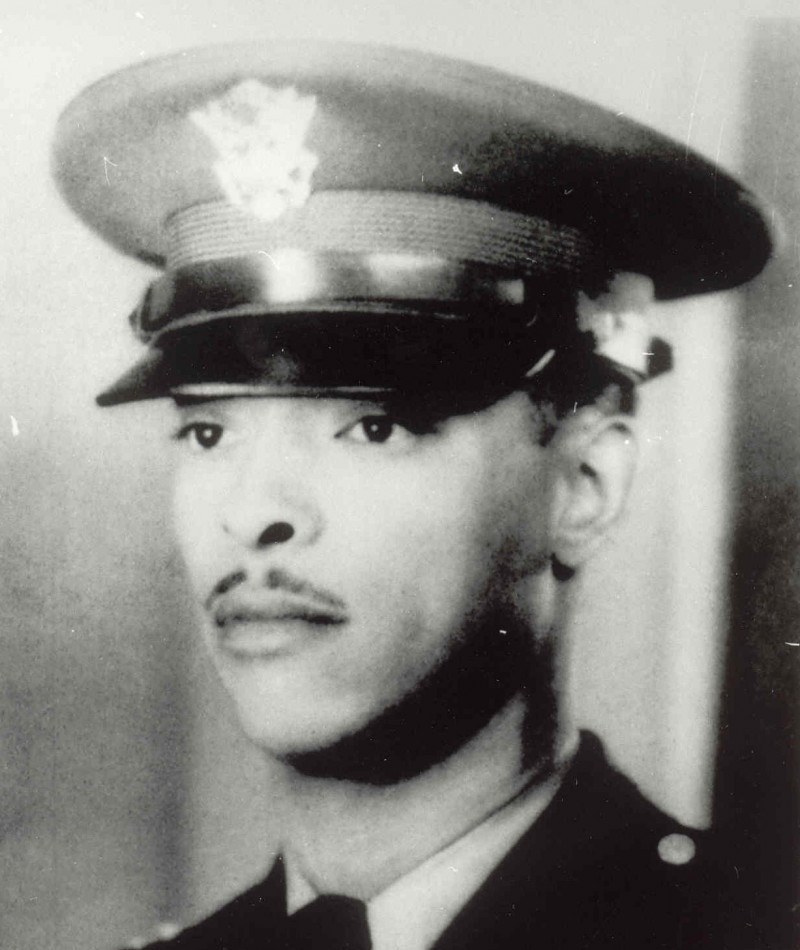
Medal of Honor Recipient John R. Fox John Robert Fox received the Medal of Honor for his actions on December 26, 1944.  Fox was a 29 year old first lieutenant and a forward artillery observer.  He was stationed, along with eight Italian partisans, in the small Italian mountain town of Sommocolonia, when it was overrun by German soldiers.  Calling in artillery as the enemy drew closer, he finally called in a strike directly on his position, despite the risk to his own life.  The resulting barrage killed Fox and the partisans, along with about 100 Germans.  His citation is below.

Negro soldiers, as they were called then, were denied Medal of Honor consideration during World War Two.  It was only in the 1990s that an Army review commission recommended several soldiers for our country's highest honor.  In 1997 President Clinton presented the Medal of Honor to seven recipients.  For six, including Fox, the award was posthumous and presented to family members.

For conspicuous gallantry and intrepidity at the risk of his life above and beyond the call of duty: First Lieutenant John R. Fox distinguished himself by extraordinary heroism at the risk of his own life on 26 December 1944 in the Serchio River Valley Sector, in the vicinity of Sommocolonia, Italy. Lieutenant Fox was a member of Cannon Company, 366th Infantry, 92d Infantry Division, acting as a forward observer, while attached to the 598th Field Artillery Battalion. Christmas Day in the Serchio Valley was spent in positionswhich had been occupied for some weeks. During Christmas night, there was a gradual influx of enemy soldiers in civilian clothes and by early morning the town was largely in enemy hands. An organized attack by uniformed German formations was launched around 0400 hours, 26 December 1944. Reports were received that the area was being heavily shelled by everything the Germans had, and although most of the U.S. infantry forces withdrew from the town, Lieutenant Fox and members of his observer party remained behind on the second floor of a house, directing defensive fires. Lieutenant Fox reported at 0800 hours that the Germans were in the streets and attacking in strength. He called for artillery fire increasingly close to his own position. He told his battalion commander, "That was just where I wanted it. Bring it in 60 yards!" His commander protested that there was a heavy barrage in the area and the bombardment would be too close. Lieutenant Fox gave his adjustment, requesting that the barrage be fired. The distance was cut in half. The Germans continued to press forward in large numbers, surrounding the position. Lieutenant Fox again called for artillery fire with the commander protesting again, stating, "Fox, that will be on you!" The last communication from Lieutenant Fox was, "Fire It! There's more of them than there are of us. Give them hell!" The bodies of Lieutenant Fox and his party were found in the vicinity of his position when his position was taken. This action, by Lieutenant Fox, at the cost of his own life, inflicted heavy casualties, causing the deaths of approxamately 100 German soldiers, thereby delaying the advance of the enemy until infantry and artillery units could by reorganized to meet the attack. Lieutenant Fox's extraordinarily valorous actions exemplify the highest traditions of the military service.

Tuesday, February 13, 2024

Great Moments In History

Going through my old books I came across Great Moments in History by Samuel Nisenson and Alfred Parker.  Published in 1932, Great Moments had been my mother's book (her maiden name is inscribed) and I remember reading, and loving, it as a child of 9 or 10.  It consists of 150 "Moments" described in one page, illustrated, and vividly written vignettes, beginning with The Exodus from Egypt (1285-1250 BC) and The First Olympic Games (776 BC) and concluding with Lindbergh's Transatlantic Flight (1927).  It is heavily weighted towards American history.

Samuel Nisenson wrote a series of similar books, primarily in the 1930s but continuing into the 1950s with titles like Minute Biographies, Minute Sketches of Great Composers, Great Moments in Catholic History, Great Moments in Baseball, History's 100 Greatest Events, and a 1934 biography of Franklin Roosevelt.

Written for general audiences and published by Grosset & Dunlap, one of the big publishing houses of the day, the books provide an insight into the America of that era.  I thought it would be interesting to see how and whether events related to race in America are portrayed almost a century ago.

One of the "Great Moments" is "The Introduction of Slavery in America: The Beginning of the Powerful Institution that was Nearly to Disrupt America" (August 1619), pictured below.  The narrative provides a pretty good summary of the origin and growth of slavery in the Western Hemisphere and concludes:

The spread of the institution of slavery had far-reaching and disastrous effects on the social history of the United States.  It created a sharp line of division between the northern manufacturers who did not need slaves and the southern planters who depended on them, a division that ultimately precipitated the American War Between the States in 1860.

Doesn't appear the authors had any doubts about the cause of the Civil War.

The next relevant Moment is in 1793, "The Invention of the Cotton Gin: The Remarkable Machine that Changed the History of America", pictured below.  We are given an account of the invention by Eli Whitney along with its impact on the economics of cotton.  This page concludes:

Between 1791 and 1801, the exports of cotton, now a cheap commodity, instead of a luxury, increased 100-fold, and slavery became an important industrial factor in the Southern states.  The South was soon a country of vast cotton plantations, while the slave system grew into a powerful institution that threatened to disrupt the Union and ultimately brought on the Civil War.

 The Capture of John Brown: The End of the Raid that Startled the Country! (Oct 18, 1859) is next up.

With the coming of the Civil War the next entry on the subject is"The Freeing of the Slaves: The Proclamation that made All Men Free and Equal in America!" (January 1, 1863), pictured below.

Unlike the prior entries, this narrative has serious flaws.  It states that Lincoln "freed all the slaves by his Emancipation Proclamation".  The effect of the Proclamation was much more limited, being restricted to slaves still held in areas controlled by the Confederacy on that date.  Non secessionist slave states, and slave holding areas already occupied by Union troop were not included.

The narrative concludes:

"Although the liberation of the Negroes at first threw the South into chaos, the gradual readjustment, after the war, placed the Negro on an equal footing with the White man and fulfilled the words of the Declaration of Independence that 'All Men are Created Equal'"

That is not what happened and, in the former slave states, the "readjustment" took the form of Jim Crow laws which began to be adopted in the final two decades of the 19th century.


The final Moment dealing with race in America is "The Reconstruction of the South" (1867-1876) and it goes badly awry.  We read of Northern "carpetbaggers", the Southern white "scalawags" who joined in their corrupt schemes, and government "completely into the hands of the Negroes".  It only ends when "the people finally rose and drove them out".  Once the states were readmitted "the Union was once more intact and a new industrial South replaced the broad plantation with its black slaves."

We find no mention of the Black Codes, instituted by southern states in 1865-66, or of the spree of violence by Whites against newly freed Blacks, actions which triggered the 1867 Reconstruction Act.


Great Moments in History was published in 1932 at the height of the influence of the Dunning School interpretation of the Civil War and Reconstruction.  William Dunning was a professor of history and political philosophy at Columbia University.  Extremely influential, Dunning taught and wrote that Reconstruction was a disaster, that freedmen were incapable of self-government, Blacks should not be allowed to vote or hold office, and segregation necessary; the military occupation of the South had been a mistake; and that the Reconstruction state governments had been corrupt and incompetent, a gross mischaracterization, particularly given the armed resistance they faced from recalcitrant Whites.  This caricature of reconstruction governments was prevalent for decades - I remember references to this in my middle school history book in the early 1960s, though by high school I think it was gone.

It is interesting that the greatest diversion between the text and the real history is in its most recent entry, illustrating the failure of post-Civil War America to find a way to assimilate Blacks at the same time it was successfully assimilating millions of immigrants.

This book was written during a period that some historians consider the nadir of the post-Civil War experience for Black Americans, the era between the World Wars (see Strange Fruit for more details), and it is a reflection of its times.

Monday, January 15, 2024

Catto

 An edited reprint of a prior Things Have Changed post

I've spent some time exploring the early history of professional baseball in America (I wrote about the origins of the pre-professional game in Madame Blatavsky and the Birth of Baseball).  The still-amateur game exploded in popularity in the Northeast and Midwest in the years after the Civil War with clubs being established in many cities and towns.  Coming across a discussion of the Pythian Base Ball Club of Philadelphia, a black ball team led by Octavius Catto, which mentioned that Catto died at the age of 32 in 1871 piqued my curiosity and I found a biography had been published at the website of the Society for American Baseball Research (SABR) Bioproject, which revealed Catto had been a significant public figure, known for much more than his baseball career.  More recently I've been making my way through a very long and very detailed biography of Catto, which exhaustively investigates his family background and race relations in Philadelphia, "Tasting Freedom: Octavius Catto and the Battle for Equality in Civil War America".  Catto's life and death are a reminder that while the white post-war South may have instituted legal (de jure) discrimination, and introduced a reign of terror to control the newly freed people, the de facto discrimination in Northern states also proved effective in resisting attempts at assimilation by blacks, sometimes with deadly consequences.

Octavius Catto

(Right, Catto from SABR Bioproject)

Catto was born in Charleston, South Carolina; his mother a free black woman and his father, born a slave but later freed by his master and becoming a Presbyterian minister.  In 1848 Reverend Catto moved his family to Philadelphia, the northern city with the largest black population, and during the 1850s young Octavius attended the Institute for Colored Youth (ICY), the city's only high school for blacks, where he was class valedictorian. In 1859 he was hired as a teacher at ICY in English, mathematics, Latin, and Greek.

During the Civil War, Catto actively led recruitment drives that raised several regiments of U.S. Colored Troops for the Union. With the end of the war he plunged into a leadership role, campaigning for passage of the 13th, 14th and 15th amendments, as well as undertaking direct actions, such as a campaign to allow blacks to ride on Philadelphia streetcars, which ultimately, with the help of his wife, succeeded.  The SABR biography provides a concise account of his impressive efforts to obtain full civil rights for the black community.

Even in baseball he was a pioneer, co-founding the Pythians in 1866 and becoming the team's star infielder.  According to the SABR biography:

". . . many of the players belonged to the Knights of Pythias Lodge, and thus they became the Pythians (derived from a mythical priestess at the Greek Temple of Apollo). Besides Catto, the Pythian leadership included other prominent blacks who emerged from Underground Railroad families. Club president James W. Purnell worked with abolitionists John Brown and Martin Delany, and vice president Raymond W. Burr was descended from American revolutionary Aaron Burr and was the son of a prominent black activist."

Catto saw baseball as promoting black self-improvement and an opportunity to press for integration.  In 1869 the Pythians played the first documented game between black and white teams, but while continuing to play such contests, the Pythian application to join the National Association of Base Ball Players was voted down.  Though, for a few years, black ball players were to occasionally play in the professional leagues, a firm color line was established by the late 1880s which remained in place until 1947 when Jackie Robinson joined the Brooklyn Dodgers.(1)

Catto led another campaign to get black voters to the polls in the Philadelphia mayoral election in 1871, despite white intimidation; the night before the election, two blacks were beaten and shot (one fatally), by whites.  The next day, Catto purchased a six-shot revolver and was on his way home to get the ammunition he had purchased when confronted by two white men who had been searching for him.  One of the men, Frank Kelly, pulled a revolver and shot Catto three times, killing him.  Kelly was eventually tried for murder, but despite the testimony of six eyewitnesses (three white and three black), all of whom stated the unprovoked Kelly shot Catto, he was acquitted by the all-white jury.

W.E.B. DuBois later wrote of Catto, 

"And so closed the career of a man of splendid equipment, rare force of character, whose life was so interwoven with all that was good about us, as to make it stand out in bold relief, as a pattern for those who have followed after.”

According to the SABR biography:

Even whites were outraged at Catto’s murder in his quest for civil rights. His funeral procession was the largest since Lincoln’s assassination and unprecedented for a black man. Over the three-mile route, tens of thousands of black and white Philadelphians watched in reverence for a fallen hero, as more than 125 carriages paraded by, containing Congressmen, military leaders, local politicians, students, colleagues, soldiers, ballplayers, and fellow civil rights activists.

Memory of Octavius Catto and his legacy faded over the years.  Over the past twenty years, he has received renewed recognition for his pioneering efforts.  In 2017, a 12-foot bronze statue of Catto was dedicated and erected in front of Philadelphia City Hall. 

------------------------------------------------------------

(1) The integration of Major League Baseball in April 1947, at a time when baseball was the most popular sport in America, was one of two significant events signaling a change in attitudes towards blacks in the late 1940s.  The other event was President Truman's July 1948 Executive Order mandating the desegregation of the military services.  For eight decades after the Civil War, white America resisted efforts by black Americans to assimilate into the life of this country, even while we were successfully assimilating millions of immigrants.  These two actions were turning points for America.