Showing posts with label Movies. Show all posts

Saturday, August 1, 2026

Sound Advice

From Russell Crowe, answering a question about which of his films young men should watch.  His responses; Gladiator, Master and Commander, and Cinderella Man.  Each one cited for specific reasons.

Gladiator has a pretty ridiculous plot but a very good film and the finest part is Crowe's embodiment of the stoic mentality. For more on the reality behind the movie read The Real Maximus.  In Master and Commander he's the real Jack Aubrey.  Cinderella Man is the tale of underdog James Braddock's, a down on his luck fighter, as he seeks the heavyweight title.

Crowe has a very positive, good-natured twitter feed. 


Tuesday, June 23, 2026

The Secret To His Success

 He's done pretty well for a guy with no grade point average


Bruce McGill.  Daniel Simpson Day or D-Day from Animal House, the guy with no grade point average at Faber College.  Animal House in 1977 was Bruce's second credited film.  Since then he's appeared in more than 70 theatrical films, 20 TV films, 4 miniseries, and over one hundred TV episodes.

He was Sheriff Dean Farley in 1992's My Cousin Vinny, Walter Hagen in 2000's The Legend of Bagger Vance, and Secretary of War Edwin Stanton in 2012's Lincoln. And he's still working.

In 1985 he guest starred as retired police officer Hank Weldon in one of Miami Vice's classic episodes, "Out Where The Buses Don't Run".  Weldon left the force after having a breakdown when a case he meticulously built against drug lord Tony Arcaro fell apart when Arcaro walked on a technicality. Arcaro is supposedly still around but Crockett and Tubbs have trouble finding him.  This is the final scene.  As usual Miami Vice has a great soundtrack, this time it's Brothers In Arms from Dire Straits. 

Thursday, April 2, 2026

Thoughts For Another Day

 "If we want things to stay as they are, things will have to change.  Do you understand?"

- The young Tancredi to his uncle and guardian, the Prince of Salina, explaining why he is joining the rebels seeking to unite Italy in the 1860s.  From The Leopard, the masterpiece by Giuseppe Tomasi di Lampedusa which I am currently reading for the second time. (1958)

The quote is well-known.  What is less known are the passages just before and after Tancredi's remark:

Before:

"You're mad, my boy, to go with those people! They're all in the maffia, all troublemakers.  A Falconeri should be with us for the King."

"The eyes began smiling again. 'For the King, yes, of course.  But which King?'" 

After: 

"What a boy!  Talking rubbish and contradicting it at the same time. . . . The Prince jumped up  . . . and rummaged in a drawer.  'Tancredi, Tancredi, wait!'.  He ran after his nephew, slipped a roll of gold pieces into his pocket, and squeezed his shoulders." 

"On his way downstairs, he suddenly understood that remark of Tancredi's, 'If we want things to stay as they are . . .'  Tancredi would go a long way: he had always thought so."  

----------------------------- 

There's nothing in the streets
Looks any different to me
And the slogans are replaced, by-the-bye
And the parting on the left
Is now parting on the right
And the beards have all grown longer overnight

Meet the new boss
Same as the old boss
 
- Pete Townshend, Won't Get Fooled Again by The Who (1971)
------------------------------- 
 
"Sometimes you win, sometimes you lose, sometimes it rains" 
 
-  Rookie Ebby Calvin "Nuke" Laloosh in Bull Durham (1988), explaining to a reporter about what  a good friend told him of the common understanding required of citizens in order to preserve stability in a democracy; the necessity of accepting occasional defeats along with a lot of muddling through.

Friday, March 20, 2026

We Remember

 Best comedies of the 2000s - Dodgeball, Tropic Thunder, The Hangover


And the man who saved Sly Stallone and The Expendables

Monday, February 2, 2026

I Like Me

The THC Son and I recently watched I Like Me, the documentary on the life of John Candy.  A funny and poignant reflection on a man who died at such a young age - 43.  Full of commentary by his fellow comedians and actors, Steve Martin, Eugene Levy, Bill Murray, Dan Ackroyd, Tom Hanks, Martin Short, Mel Brooks among them.  McCauley Caulkin, who was in Uncle Buck with Candy, speaks very perceptively about Candy and Hollywood. Also featured is Catherine O'Hara, whose wonderful eulogy at Candy's funeral is shown.  We watched I Like Me a couple of hours after hearing of O'Hara's passing.

I'd not been aware of Candy's father passing of a heart attack at the age of 35, nor of the crippling anxiety he experienced in the three years before his death in 1994.  Interviews with his wife, son, and daughter explore that side of his life.

Watching the comedy and film clips reminds the viewer of not just how fine a comedian Candy was but how good he could be as a dramatic actor.  The film's title is taken from one of his greatest dramatic scenes in Trains, Planes, and Automobiles.  

Saturday, January 17, 2026

The Autumn Of John Ford

Came across this reprint of an article Peter Bogdanovich (before becoming a director) wrote about John Ford, one of my favorite directors, for the April 1964 edition of Esquire.

Bogdanovich perfectly captures Jimmy Stewart's speech pattern here:

“I love ’im. That’s ... that’s first of all,” he began. “And that is, of course, intermixed with respect and….” He pursed his lips and nodded twice. “Admiration.” Stewart leaned forward in his chair. “He’s just ... he’s a genius. The way he’ll do a script. Gets it across visually. Hates talk. I just wish there were more people like him.” Stewart shook his head and pursed his lips. “Everybody’s always talkin’ about the Ford stock players, y’know.... I think it’s a helluva good idea! Wish everybody’d do it. The people know how to work together. They don’t have to … each film doesn’t have to be the first time. And a lotta directors … y’know … it’s a barrel a laughs on the set and ya have fun and … and then you see the picture and you say, ‘Where is it? Where’s the….’ But Ford gets it on the screen. And he’s a real leader. I think he is the best man doing the job.” He nodded vehemently.

Some other excerpts:

Monument Valley lies within the Navajo Indian Reservation, straddling the Arizona-Utah state line. The red cathedral-like buttes and mesas that form its landscape were created by erosion and are named for their shapes: The Mittens, The Big Hogan, Three Sisters; from minute to minute the shadows change their appearance. There is a timelessness to the country that makes it as remarkable a natural wonder as the Grand Canyon, but far more dramatic. John Ford has made several movies there, the most recent of which is Cheyenne Autumn, which tells a true story of the heroic flight of three hundred Cheyenne men, women and children from an Oklahoma reservation (where, because of neglect, they faced death from starvation and disease) to their native Yellowstone country, some fifteen hundred miles away. Pursued all the way by the Cavalry, only eighty survived to see their homeland.

Harry Goulding, the tall, aging Westerner who owns the lodge in Monument Valley, was standing nearby, watching. He shook his head once and spoke with a deep Western twang. “Certainly is somethin’, isn’t it,” he said quietly. Goulding was the person who first introduced John Ford to the valley, in 1938 when the director was searching for a location on which to film Stagecoach. “I didn’t know if I was goin’ inta the studio or inta the jail,” he said, grinning shyly. “The Navajos’d been hit pretty bad by the Depression an’, by God, if an Indian’d walked into our store an’ put a dollar on the counter, why Mrs. Goulding an’ I’d a fainted.” He shook his head. “So I got inta the studio and I showed a whole stack a pictures to Mr. Ford an’ three days later there was a score a jobs for the Navajos and a lotta lives was saved.” He took off his hat, ran his hand over his head, and replaced the hat. “Then you heard ’bout the Hay Lift,” Goulding went on. “In 1949, just after Mr. Ford’d finished shootin’ She Wore a Yellow Ribbon here, we had a blizzard that left the valley covered with ’bout twelve feet a snow. Army planes dropped food in. Thanks to that an’ the hundred fifty-two hundred thousand dollars he’d left behind, why, another tragedy was prevented.” Goulding looked off across the river. “An’ this year, he heard his friends was gonna have too little t’eat, an’ here he is again.”

“Now this thing,” he said, nodding at the script of Cheyenne Autumn lying on the table. “I’ve wanted to make this for a long time. Y’know. I’ve killed more Indians than Custer, Beecher and Chivington put together.” He raised his arm and pulled the sleeve down again. “People in Europe always wanta know about the Indians. They just see them ride by, or they’re heavies. I wanted to show what they were like. I like Indians very much,” he said warmly. “They’re ... they’re a very moral people. They have a literature. Not written. But spoken. They’re very kindhearted. They love their children and their animals. And I wanted to show their point of view for a change.” Ford pulled down on his cheeks. “S’amazing....” He paused. “It is amazing, working with them, how quickly they catch on despite the language barrier.” He rubbed his mouth with the handkerchief.

The article is packed with captivating stories about a talented man who liked to make things difficult and enjoyed it all the while.   

Sunday, December 21, 2025

I Meant To Say Cheerio

The final scene from Local Hero.  I've loved this movie since seeing it with Mrs THC more than 40 years ago.  The soundtrack by Mark Knopfler is an integral part in creating the unique feel of the film.  During the early 80s Scottish director Bill Forsythe made a magical trio of small budget offbeat films - Gregory's Girl, Local Hero, Comfort & Joy.

Monday, December 15, 2025

All Those Moments Lost In Time

The title of an essay by David Polansky, a favorite of mine, in praise of 80s movies, a decade in which Mr and Mrs THC went to the movies a lot, back when that was a thing.  According to the author, 80s cinema has a branding problem compared to the 70s and 90s;

But if there is one thing that does define ‘80s cinema even as it defies attempts to neatly characterize it, it is sheer variety. Indeed, the decade can be broken down into several categories, which in the aggregate resulted in an impressive volume of cinema of lasting if underappreciated value. 

He goes on to break down The Old Masters; Around The World; Independent Americana; Peak Genre; and The Late, Great Middlebrow Movie.

That last category, which no longer exists, encompasses twenty films, of which we saw 15 or 16 in the theater during that decade.  In light of last night's news I note that three were directed by Rob Reiner; Stand By Me, When Harry Met Sally, and The Princess Bride, all of which we saw and greatly enjoyed, the last being a classic that I've watched many times. And let's not forget another Reiner classic, 1984's This Is Spinal Tap.

We were very upset to hear about Reiner's death along with that of his wife and of the family tragedy behind it; one child a murderer and another child left to find the bodies of her parents.  We thank Rob for the enjoyment he gave us and hope that he and Michelle may rest in peace. 

The title of Polansky's essay is from another classic 80s film

Monday, August 25, 2025

Moonlight Graham

Archibald Wright Graham died on this date, sixty years ago in Chisholm, Minnesota.  Graham, better known to most as Moonlight and in Chisholm as Doc, came to wide attention as a character in WP Kinsella's novel Shoeless Joe, and the 1989 film based on his book, Field of Dreams.

Moonlight Graham.jpg(Archibald "Moonlight" Graham, from wikipedia)

I recently caught Field of Dreams on TV.  It remains highly rewatchable.  If you haven't seen it, I won't describe the plot because it makes the movie sound ridiculous, while it is really wonderful (and ridiculous at times).  The last scene always moves me. And it is about much more than baseball.
 

I already knew that the real Archie Graham played in the outfield for two innings in a June 1905 game after being called up from the minors to join John McGraw's New York Giants.  It was his only major league appearance and he never got a chance to bat.  Graham (Burt Lancaster) tells the story in Field of Dreams.  In the 1970s, author WP Kinsella ran across a mention of Graham while perusing the Baseball Encyclopedia, was captured by his brief career and nickname, and included him as a character in Shoeless Joe.  Graham reportedly garnered the nickname Moonlight because he was "fast as a flash".

What I had not realized was how closely the fictionalized version of Moonlight Graham in the book and movie was to the real Archibald Graham.

In the movie, Graham's one appearance with the Giants takes place in 1922.  He later retires from baseball and moves to Chisholm, Minnesota, becoming a doctor and dying in 1972.  Doc Graham, as he is known, is a beloved figure in that small town, with a sterling reputation, and devoted to his wife Alicia, who always wears blue.  Doc always walks with an umbrella.  In one scene, Terrence Mann (James Earl Jones) interviews older townsfolk about Doc Graham and they tell endearing stories of him.  Terrence and Ray Kinsella (Kevin Costner) also go to the local newspaper where a reporter reads to them from Doc Graham's obituary.

It turns out the real Archibald Graham was a college graduate, unusual in baseball in those days, and received his medical degree from the University of Maryland in 1905, the same year he played for the Giants.  After a couple of more years in the minor leagues he moved to Chisholm in 1909, because he was suffering from a respiratory condition and heard the climate in the Iron Range mining town could help him.  The town immediately to the south of Chisholm is Hibbing, where Robert Zimmerman (Bob Dylan) grew up.  Graham opened a medical practice, a few years later becoming the school system doctor, a role he remained in until 1960, along with being the team doctor for all of the school sports teams. He married Alicia Madden, who always wore blue, and he always carried an umbrella.  Doc Graham died in 1965 and Alicia in 1981. The anecdotes used in the movie are from the life of the real Graham, and the reporter in the film is reading from his actual obituary.

From the Chisholm Free Press & Tribune (1965)

"And there were times when children could not afford eyeglasses or milk or
clothing. Yet no child was ever denied these essentials because in the
background there was always Dr. Graham. Without any fanfare or publicity,
the glasses or the milk or the ticket to the ballgame found their way into
the child's pocket." [This was the portion read in Field of Dreams]

From a 2005 article in the Minneapolis Star-Tribune:

While still new in Chisholm, he grew sweet on Alicia Madden, a
schoolteacher. She was a farmer's daughter from Rochester, and they married
in 1915.

They never had children. Instead, they showered their affection on every
child in town -- he as the full-time doctor for the public schools for more
than 40 years, she as the director of countless community plays.

They built a house that still stands in southeast Chisholm, on the fringe of
a neighborhood known as Pig Town, for the livestock kept by the hardscrabble
immigrant miners' families.

"That was Doc," said Bob McDonald, who grew up in Chisholm and has coached
high school basketball there for 44 years. "He and Alicia could have lived
up with the high and mighty on Windy Hill, but they chose to be among the
common people."

McDonald remembers a wiry, athletic man, dapper in an ever-present black hat
and black trench coat, walking everywhere and always swinging an umbrella.
Yes, he said, Alicia did always wear blue.

On the opening night of all of her plays, Graham would sit in the same seat
in the back of the high school auditorium, a dozen roses in his lap,
Ponikvar said.

People were poor, but schools used mining company taxes to meet needs. Under
Doc's care, kids got free eyeglasses, toothbrushes and medical care. He
lectured them on nutrition, inoculated them, rode their team buses, made
20-year charts of their blood pressure, swabbed their sore throats, made
house calls if they stayed home sick.

He bought apartment houses but charged rock-bottom rents, and no rent to a
single mother and her eight children, Ponikvar remembers.
"Doc became a legend," she wrote when he died. "He was the champion of the
oppressed. Never did he ask for money or fees."

Below is a preview (narrated by Vin Scully!) of a Mayo Clinic film about Doc Graham's collaboration with the clinic on a groundbreaking study of blood pressure in children.


Tuesday, July 15, 2025

Gee Baby, Ain't I Good To You

A lot of us are most familiar with this song from The Mask (1994), where it's "sung" by Tina (Cameron Diaz in her movie debut) at the Coco Bongo Room.  Diaz is lip synching, it's Susan Boyd doing the singing.

Gee Baby, Ain't I Good To You was composed in 1929 by Andy Razaf and Don Redman but didn't become a hit until recorded by the Nat King Cole Trio in 1943.  Redman was a well-known arranger who contributed to the development of swing music.

Razaf is a fascinating character.  His birth name was Andriamanantena Paul Razafinkarefo. Andy was was the son of Henri Razafinkarefo, nephew of Queen Ranavalona III of Madagascar, and Jennie Razafinkarefo (née Waller), daughter of John L Waller, the first African American consul to Madagascar.  When Henri was killed in the French invasion of the kingdom, the pregnant Jennie fled to the U.S. where Andy was born in Washington DC in 1895 and raised in Harlem.  Razaf collaborated extensively with Fats Waller and wrote the lyrics for many songs, including Ain't Misbehavin', Honeysuckle Rose, and (What Did I Do To Be So) Black and Blue (all of which have been featured on THC). 

Thursday, July 10, 2025

Scopes At 100

On this date a century ago, the trial of John Scopes began in Clarksville, Tennessee.  The Scopes Monkey Trial, as it became known, was a national sensation at the time, given fodder for many books, and was the source material for the play, and later film, Inherit The Wind.  How the case is now remembered in many ways erases the nuances and complexity of the issues and people involved.

I first wrote about the case in 2015, with an update in 2022.  At the time of the 2015 post there were still some efforts to insert creationism into public school curriculum.  Those efforts seems to have ceased, but evolutionary biology now appears under assault from different quarters, it seems an appropriate date on which to post again.

------------------------------------------------------
Rather than the often repeated adage that the victors write the history of an event, the story of anything is actually determined by the unswerving adoption of one version of it, and the telling of that version by a determined cadre of writers. In time, the version with the most persistent adherents becomes the “truth.” – David & Jeanne Heidler in Henry Clay: The Essential American (2010)
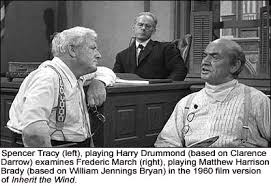
I still recall the family getting in the car for the drive to Hartford, Connecticut. It was the late 1950s, and my father was taking us to pick up a monkey. He had a small role as an Italian organ-grinder in a play put on by a local community theater group. The director wanted to use a prop monkey, but dad insisted on the real thing. We housed that monkey for the next week; I remember it as nasty and mean-tempered, but the audience loved it, as well as dad in his bit part (he always had a knack for showmanship). The play was Inherit The Wind, based on a 1925 event in Tennessee that became popularly known as the Scopes Monkey Trial.

Seeing the play and, later, the movie, I accepted its narrative of the forces of enlightenment, reason, heroism, and tolerance (represented by Spencer Tracey in the movie, playing a character based on Clarence Darrow) against the forces of narrow-mindedness, mean-spiritedness, repression, and unthinking old-fashioned religion (represented by Frederic March playing a character based on William Jennings Bryan); a morality play of liberal versus conservative written during the McCarthy years. The play is still staged frequently by regional theaters (here’s a recent Wisconsin production), has gone through several Broadway revivals, most recently in 2007, with Christopher Plummer and Brian Dennehy. There was even a London production, in 2009, with Kevin Spacey. In most cases, it is widely accepted by audiences as historically accurate.

It was only years later, prompted by reading Edward Larson’s Summer For The Gods and doing related research that I appreciated how much more complex and interesting the real story was. American history is much more fascinating and instructive when you don’t try to neatly shoehorn it into boxes labeled “liberal,” “conservative,” “progressive,” and “reactionary” as Inherit The Wind did, aided by influential mid-20th century historians and literary critics such as Richard Hofstadter. Throughout our history, you’ll see prominent people with constellations of political views that are unrecognizable in today’s categories (see Sam Houston as an example).  I support the teaching of evolutionary theory but the full story behind the Scopes Trial is more interesting than the caricature of Inherit The Wind and, as I learned, the main character in this drama, William Jennings Bryan, would not neatly fit into any political classification in modern-day America.

The Background
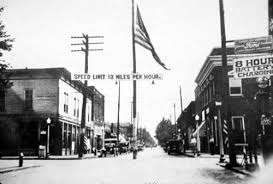
Dayton in 1925

The early 20th century saw an explosion in the growth of public high schools. In 1890, there were fewer than 200,000 public high-school students nationwide; by 1920, more than two million. In Tennessee, fewer than 10,000 in 1910, but more than 50,000 by 1920. What were they to be taught?

At the same time, battles were heating up between Darwinists and some religious denominations over the teaching of evolution. State legislative fights over its inclusion in educational curriculum became common.

Legislative efforts barring the teaching of evolutionary theory were successful in a small number of states, including Tennessee, which passed its law in early 1925. It was part of a larger package of laws in a massive education reform bill that laid the foundation for state-supported public schools. It was signed into law by progressive Governor Peay. Violation of the ban on teaching evolution carried a $100 fine, but no jail. Bryan supported the bill, but unsuccessfully lobbied against having any fine attached to violating the evolution provision, though no one at the time expected any prosecutions under the statute.
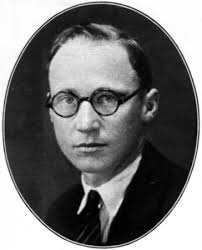
John Scopes

Looking for a test case, the American Civil Liberties Union placed advertisements in Tennessee papers offering to defend anyone prosecuted under the Act. Leading citizens of the town of Dayton decided to take them up on it. While some were interested in challenging the law, many others just saw it as a good opportunity to create publicity and generate business for the town. Rather than showcasing a contentious, divided populace, as portrayed in the play, the actual trial took place in a festive atmosphere, according to reporters like H.L. Mencken. The key players in Dayton recruited John Scopes, a young, part-time schoolteacher, to be the defendant and agreed to pay any penalty imposed on him.

Dayton was a small town in East Tennessee, and part of the only Republican enclave in the state. Bryan won every southern state in each of his three presidential runs, but never carried Rhea County where Dayton was located. The town was also heavily Methodist in a state dominated by Baptists (the Baptist Convention, meeting in Memphis just before the trial, refused to add an anti-evolution plank to the denomination’s statement of faith).

Once the ACLU came into the case, Bryan — the country’s leading opponent of the teaching of evolution — agreed to become part of the prosecution’s team. And through some very complicated machinations, Clarence Darrow, the most famous criminal defense lawyer in America, joined the defense team. When this happened, the trial became the biggest story in the country, and was also followed heavily in Europe. A deluge of reporters descended on Dayton.

Why Evolution? Why Bryan?
 
In 1925, 65-year-old William Jennings Bryan was well known to every American, having run unsuccessfully three times as the Democratic Party’s presidential candidate (1896, 1900, and 1908). A remarkable orator — his “Cross of Gold” speech at the 1896 convention secured him the nomination — he is considered to be the first populist to run for President. In 1913, Woodrow Wilson appointed him Secretary of State, a post he resigned in 1915 when the pacifist Bryan became convinced Wilson was maneuvering the country into entering the First World War.

Bryan campaigned successfully in support of four constitutional amendments: direct election of senators, the Federal income tax, women’s suffrage, and Prohibition.  So why, in the 1920s, did he undertake leadership of the crusade against the teaching of Darwinism, and why did he think it was consistent with his other views?  From today's perspective, it doesn't seem to make sense.

Bryan believed in “popular sovereignty", always campaigning against big business and the banks and on behalf of the common people. When the Supreme Court overturned some of the early progressive labor laws, Bryan supported (unsuccessful) legislation to limit judicial review, and backed the Progressive use of popular referendums. He believed the people were entitled to what they wanted, and saw the evolution issue in the same way. According to Bryan:
It is no infringement on their freedom of conscience or freedom of speech to say that, while as individuals they are at liberty to think as they please and say what they like, they have no right to demand pay for teaching that which parents and the taxpayer do not want taught.
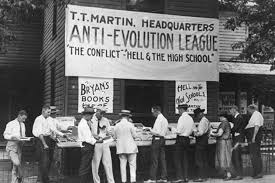
The deeper reason was Bryan’s concerns about the implications of Darwinism. Bryan was a committed Christian and pacifist. He rejected evolutionary theory as a matter of religious faith, but also believed Darwinism and its doctrine of “survival of the fittest” threatened the dignity and perhaps even the very existence of the weakest of the human flock. Bryan saw a direct connection between the excesses of capitalism and militarism — which he had denounced throughout his career — and Darwinism, which, as early as 1904, he had called “the merciless law by which the strong crowd out and kill off the weak.”

The concerns Bryan raised in 1904 were reinforced by recent events. The slaughter of WWI appalled Bryan. He saw German militarism as Darwinian selection in action; this was a common view at the time, as reflected in the words of Vernon Kellogg in his book Headquarters Nights: “Natural selection based on violent and fatal competitive struggle is the gospel of the German intellectuals.”

Bryan saw the modernist wing of the Progressives, led by Woodrow Wilson, willing to go down the same road. It is striking to see how much Darwinism was in the air of politics at the time. Wilson’s key 1912 campaign speech, “What is Progress?” espoused a Darwinian approach to American government:
Now, it came to me, as this interesting man talked, that the Constitution of the United States had been made under the dominion of the Newtonian Theory. You have only to read the papers of the The Federalist to see that fact written on every page. They speak of the “checks and balances” of the Constitution, and use to express their idea the simile of the organization of the universe, and particularly of the solar system — how by the attraction of gravitation the various parts are held in their orbits; and then they proceed to represent Congress, the Judiciary, and the President as a sort of imitation of the solar system. …
Living political constitutions must be Darwinian in structure and in practice. Society is a living organism and must obey the laws of life, not of mechanics; it must develop. All that progressives ask or desire is permission — in an era when “development” “evolution,” is the scientific word — to interpret the Constitution according to the Darwinian principle; all they ask is recognition of the fact that a nation is a living thing and not a machine. [emphasis added]
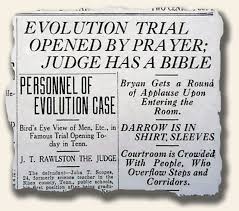
The new science of eugenics greatly troubled Bryan. The high school textbook used by John Scopes was A Civic Biology by George William Hunter, which defined eugenics as “the science of improving the human race by better heredity.” Hunter wrote,
If such people were lower animals, we would probably kill them off to prevent them from spreading … Humanity will not allow this, but we do have the remedy of separating the sexes in asylums or other places and in various ways preventing intermarriage and the possibility of perpetuating such a low and degenerate race.
The prior edition of Hunter’s textbook had contained language specifically citing biological deficiencies of African races.

Eugenics had many scientist adherents in the United States and England who believed that the human race could be made better via selective breeding to create a better and more progressive world. One of those scientists, A.E. Wiggam, expressed the connection between the teaching of evolution and eugenics:
“until we can convince the common man of the fact of evolution … I fear we cannot convince him of the profound ethical and religious significance of the thing we call eugenics.”
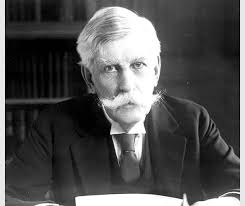
Holmes

During the 1920s and 30s, the eugenics movement gained momentum. By 1935, more than 30 states had laws mandating sexual segregation and sterilization of persons regarded as eugenically unfit. The most notorious expression of support for eugenics came in 1927 from the leading Social Darwinist on the Supreme Court, Oliver Wendell Holmes, Jr., who, in his opinion for the Court upholding Oklahoma’s sterilization law, exclaimed “three generations of imbeciles is enough.” The only dissenting vote was cast by Pierce Butler, the lone Catholic on the Court.

Within a few years, WWII and the revulsion against Nazi law and experimentation would put an end to the eugenics movement (though a revival of eugenics under another name seems to be arising based upon  modern advances in biology and genetics). The heyday of the eugenics movement and the rise of anti-evolutionary forces led to the Dayton trial in 1925. Bryan expressed his pithy view of the whole matter when commenting on the latest discovery of purported early human remains: “Men who would not cross the street to save a soul have traveled across the world in search of skeletons.”  In his closing argument at trial, Bryan explained that evolutionary theory:
". . . if taken seriously and made the basis of a philosophy of life, it would eliminate love and carry man back to a struggle of tooth and claw."
The Trial and its Aftermath
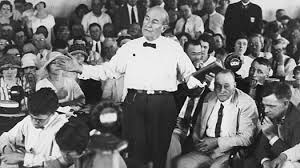
The ACLU and Darrow differed on trial strategy. The ACLU considered it a free speech case, but that was not Darrow’s interest.  As a militant atheist who did not believe in free will, he wanted to use the trial as an opportunity to directly assault Christianity and its beliefs about the creation of the universe and the human race. This discomfited many ACLU supporters, but — through a complicated series of maneuvers — Darrow seized control of the defense strategy and was cleverly able to lure Bryan to the stand, where he cross-examined him viciously on Biblical inconsistencies. (Darrow might have been a terrible person, but you’d want him defending you if you were on trial). This prompted a Congregational Church official who supported the legal challenge to send a note to the ACLU: 
“May I express the earnest opinion that not five percent of the ministers in this liberal denomination have any sympathy with Mr Darrow’s conduct of the case.”
Edwin Mims of Vanderbilt University, another supporter of the ACLU, wrote:
 “When Clarence Darrow is put forth as the champion of the forces of enlightenment to fight the battle for scientific knowledge, one feels almost persuaded to become a Fundamentalist.”
The jury quickly returned a verdict finding Scopes guilty. Bryan offered to pay the $100 fine, and the local school board offered to renew his contract for another year, but Scopes decided to go to graduate school, attending the University of Chicago and becoming a petroleum engineer.  The fine was ultimately rescinded and the Butler Act was repealed in 1967.

Five days after the end of the trial, William Jennings Bryan passed away while taking his afternoon nap.
 
In today's Wall St Journal, playwright David Mamet has a piece with observations on Inherit The Wind, noting that: 
The play and film were intended as ripostes to the House Un-American Activities Committee’s persecution of those accused of communist sympathies.
As such, the play had to tailor the story from 1925 into a narrative usable for a 1950s audience. It also reflects intellectual currents of the mid-century: 
"Inherit the Wind” paints the contest between reason and religion as zero-sum. Religion is a metaphysical concept. It can’t be observed as part of the physical world. But a little reflection must suggest that reason is equally metaphysical. Where does it exist save for in the human mind, which can be inaccurate, uninformed, depraved or plain wrong, and in which “the reasonable” changes through maturity and over time. 
The truth is both are necessary.  
The factors potentially mitigating the horrors wrought by our corruptible human feelings, and our equally defective reason are two. One is religion, which is to say our avowal of our imperfection. The other is the law, the attempt to codify religious intuition mechanically. There will always be an unresolved remainder in an arbitration between justice and fairness, reason and folly. This dissatisfaction is the human condition, the subject of the actual drama, and that which differentiates it from pageant, propaganda or mere entertainment. The hero of “Inherit the Wind” is Darrow but at the play’s end, he has learned nothing. And, so, neither have we.  
As Mamet points out, reason and faith operate in different ways.  I've read articles in which it is said that Saint Aquinas should be read to understand how faith and reason can be reconciled.  I don't think they need to be as each stand on their own.  They may overlap at times but they also exist parallel to each other.  One can understand a reasoned analysis and nonetheless have faith in a certain outcome.  I don't feel any need to reconcile those aspects.  They just exist. 

Wednesday, July 9, 2025

Vanity

What you got ain't nothing new. This country's hard on people. Can't stop what's coming. Ain't all waiting on you. That's vanity. 

- Cousin Ellis to Sheriff Ed Tom Bell, No Country For Old Men 

When I saw No Country For Old Men during its 2006 theatrical run, I came away believing it was a great film but one I never wanted to see again.  Over the years I've come to change my mind and even read the Cormac McCarthy novel on which it is based.  Maybe it's because I'm now an old man.

I've written about the novel and Sheriff Ed Tom Bell's musing on the times in "What Is To Come" and "Carryin' Fire",  the terrifying and tense coin flip scene, "Friendo", and Anton Chigurh's probing inquiry about the use of following rules in Au Contraire.  In the scene below, Sheriff Bell (Tommy Lee Jones) goes to see his Cousin Ellis (Barry Corbin), also a lawman and one crippled by a criminal, at his isolated mobile home in West Texas.

Sheriff Bell is struggling with the evil he sees growing around him, feeling unable to contain it, and has decided to retire.  He's come to his cousin seeking answers though he is not sure what the questions are. The sheriff feels overwhelmed and overmatched by what he is witnessing in the world.  Bell expresses his disappointment with God while acknowledging God's disappointment with him, causing Ellis to wave his hand dismissively, saying "you don't know what he thinks".

Everything about this scene is superb and reinforces the nature of the conversation.  The casting and cinematography are outstanding and Jones and Corbin convey so much with their faces, looks, and pauses.  They start with casual banter and only slowly get down to the matter at hand.  Watch Jones' eyes at 1:00 and at 3:00.  

There is no music in this movie.  Other than the actor's voices the only thing you hear are the ambient sounds of West Texas.  

Sunday, June 29, 2025

Stagecoach

John Ford's 1939 film, Stagecoach, made John Wayne a star and got Ford an Academy Award nomination for Best Director.  It's also the first of Ford's many films set in Monument Valley on the Navajo Reservation along the Arizona-Utah border.  This shot from the movie captures the spectacular setting, which I have visited twice and plan on returning to again.


(2019)


Saturday, June 28, 2025

Mark It 8, Dude

Image 

I missed it when Smokey turned 80 on May 6 (hat tip to Traces of Texas).  Smokey is Jimmie Dale Gilmore, a singer-songwriter from Texas who has been performing with the Flatlanders since 1972 and been nominated for three Grammys.

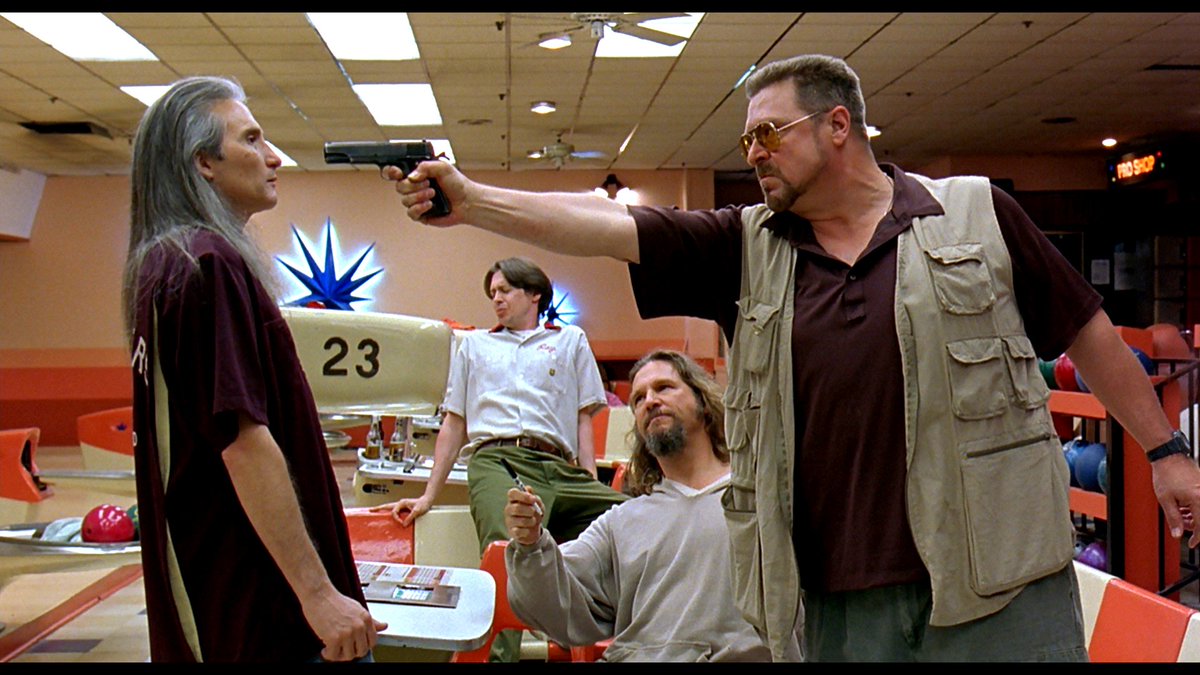
For most of us, however, Jimmie is best known as Smokey in The Big Lebowski, his only acting role (other than playing himself in a couple of films).  Playing an aging, pacifist bowler he is drawn into a dispute with Walter Sobchak about whether his foot slipped over the line.  Smokey's request that the Dude mark his score as 8 triggers a response from Walter, in which the latter prevails and the Dude marks it zero.  It is Jimmie's only scene in the movie and it is quite memorable. 

Saturday, March 15, 2025

Funny Stories

 Kevin Pollak tells great stories about Don Rickles and Walter Matthau.

Saturday, March 8, 2025

The Workingman's Eddie Coyle

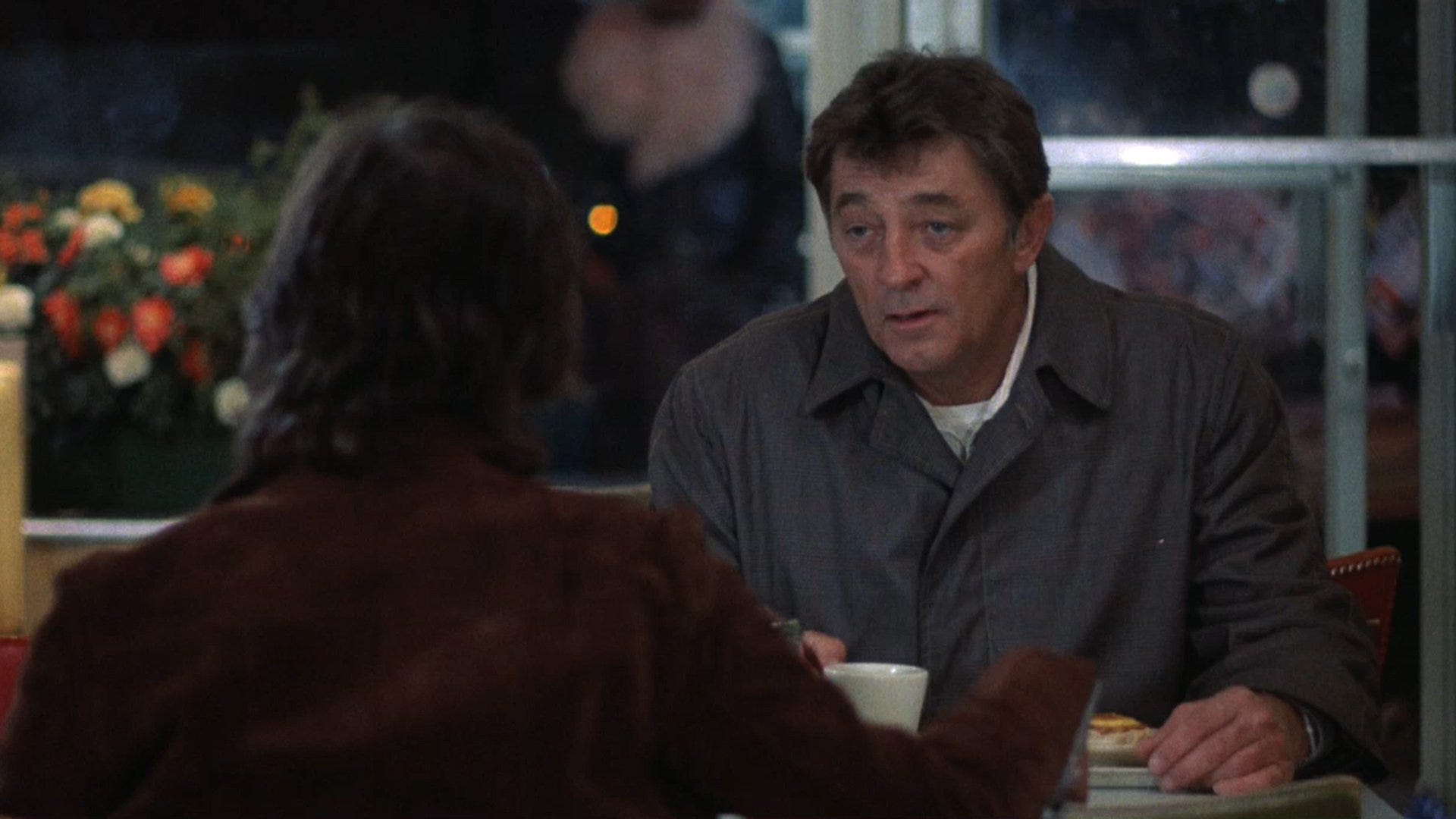
The Friends of Eddie Coyle (1973)

(Robert Mitchum as Eddie Coyle)

Back in 2014, I wrote Eddie Coyle's Friend, about a novelist I greatly admire, George V Higgins.  I probably worked harder on that post than on anything else I've written, figuring Higgins deserved it.

I just came across an appreciation of the novel and movie, The Friends of Eddie Coyle by Daniel Moran, writing on Substack and found it quite perceptive and worth a read. Here are some excerpts:

This kind of dialogue may seem easy to write, but anyone who has ever tried knows it’s almost impossible. Here, we get everything we need to know about these two guys and the rules of their worlds in a handful of near-grunts.

I was an English major—sure, things like Eddie Coyle were fun to read, but shouldn’t I be reading more Keats, James, and Shakespeare? I didn’t know that the music found in the works of these writers could also be heard (if faintly) in a book like this one. I’ve since read it several times and I’m always amazed by how the book carries its reader along in a series of conversations that move so quickly yet reward close-reading. The book reads itself to you like a criminal nanny.

Everyone loved the realism, but a more accurate word is “realism.”(1) I have no idea if actual gunrunners are as interesting as the people in these pages or if their dialogue is worth overhearing. I’d bet that it’s not. What’s absolutely realistic, however, about Eddie Coyle is how everybody in it—just like the reader—is constantly negotiating to just get to the next step of what he needs by the end of the day. . . His story—the real realism—is about going to work and being someone in middle management who has to answer to all kinds of people and wants to just get his part of the process complete so he can move on to the next thing. It’s about the guy in Purchasing who won’t sign the form you need so that you can tell the client that yes, everything is in motion, because that guy in Purchasing thinks that you’ve cozied up to the Senior Vice President of Acquisitions for a job that he’s had his eye on for months. It’s about having to speak in a conciliatory tone when trying to wrangle a favor from the guy in the next cubicle.

Peter Yates’s 1973 film is an object lesson in how to faithfully adapt a novel to the screen. It stands with John Huston’s The Maltese Falcon and the Coens’ True Grit as an example of a screenwriter (in this case, Paul Monash) sitting with the novel propped open on his desk so he can type the dialogue word-for-word in screenplay format. Huston’s version of Falcon was the third attempt to adapt it for the screen and the Coens’ True Grit was the second; both of their versions are superior to their predecessors because they knew what was great about the novels and transferred that greatness to the screen.     

I have not seen the earlier versions of the Maltese Falcon, but as much as I enjoyed John Wayne in True Grit, the Coen's True Grit is superior.

Coming across this post led me to read more of Moran's work and it is quite good.  He's got that thing.

---------------------------------------

(1)  In my Higgins post I wrote:

The dialogue Higgins wrote was realistic but it wasn't real.  Very few people actually talk like that, or at least they don't talk like that for so long and, at times, he could venture dangerously near Damon Runyon territory.  But mostly, Higgins had a knack for cadence, ambiance and simplicity that rang true even if it wasn't actually true. 

Saturday, March 1, 2025

The Drive In


The town I grew up in had a drive in.  Saw several movies there with my parents.  The first one that comes to mind was The Outsider starring Tony Curtis, a biopic about Ira Hayes, the Pima Indian who was one of the flag raisers on Iwo Jima that I recently wrote about.  The film was released in December 1961 saw I probably saw it in the spring of '62 when I was eleven.

Wednesday, January 1, 2025

A Complete Unknown

Exhilarating was THC's reaction.  THC hadn't planned to see A Complete Unknown when he first heard about it but was persuaded to take a chance after reading some reviews by people he respected.  Glad he did so and is certain to see it again at some point.

Never saw Timothee Chalamet before.  The kid is spot-on playing Dylan in all his mumbling, passive-aggressive glory and is very good performing the music.  In fact, the staging of all the music scenes is done very well, including those of Joan Baez, played by the talented and charismatic Monica Barbaro, another actor new to THC.(1)   Elle Fanning as Sylvie Russo, a version of Dylan's early 60s girlfriend Suze Rutolo, is also outstanding.

All of the casting hits the mark.  Edward Norton is a pitch-perfect Mr Rogers as folk singer Pete Seeger(2), Boyd Holbrook is hilarious as Johnny Cash, while Dan Fogler's Albert Grossman, and Scoot McNairy as the dying Woody Guthrie are also well done.

The movie recounts the beginning of Dylan's career, covering the period from 1961, when he arrives in New York City, becomes the star of the folk music revival period, and then goes electric in 1965, climaxing with his appearance at the Newport Folk Festival that year.  THC recently wrote about the significance of the turn in Dylan's music in Dylan 15.  

The film captures the marvel of Dylan's musical creative process (though the essence remains unknown) and stage presence, both acoustic and electric.  The quality and quantity of his output is staggering.  Dylan 15 focused on three albums from 1965 and 1966, but A Complete Unknown reminds one the avalanche of memorable original compositions on his three albums from 1963 and 1964.  Here's a partial list (songs heard, at least in part, in A Complete Unknown, indicated with asterisk):

Blowin' In The Wind*
Girl From The North Country*
Masters of War*
A Hard Rain's a-Gonna Fall*
Don't Think Twice It's All Right*
The Times They Are A-Changin'*
One Too Many Mornings
Boots of Spanish Leather
Restless Farewell
All I Really Want To Do*
Chimes of Freedom
My Back Pages
It Ain't Me Babe *

From his two 1965 albums we also hear Like A Rolling Stone, Maggie's Farm, Subterranean Homesick Blues, It's All Over Now Baby Blue, It's Alright Ma (I'm Only Bleeding), It Takes A Lot To Laugh It Takes a Train To Cry, Highway 61 Revisited.
 
While conveying Dylan's musical genius the film is not a hagiography.  At various times, Dylan is portrayed as snide, remote, elusive, egocentric, infuriating, and a fabulist.  During the course of the movie, Baez calls Dylan an asshole and a jerk, both of which are accurate descriptions (though who knew that singing Blowin' In the Wind and Masters of War would serve as a chick magnet, at least where Baez was concerned!).  He's also very funny. At the personal level all you see is Dylan's surface; what's inside remains enigmatic, as he has deliberately done throughout his life.  Dylan's autobiography, Chronicles: Volume One, is the finest of any musician from the 60s and 70s, but a reader is often left wondering how much is invented by Dylan.  He's been a careful curator of his myth for decades, while rejecting any attempt by others to define or control him, a characteristic accurately portrayed in the movie.  This is not a traditional biopic where the main character's personality transforms over the course of the movie and he triumphs over all obstacles. Dylan's music changes, but his personality does not in A Complete Unknown.

The heart of the film is around what was seen by the leaders of the new folk revival of the late 50s and early 60s as Dylan's betrayal.  He was seen as the figure who could transcend the mere folkie label and his move to electric was bitterly resented by some and indeed turned out to be a death blow to the folk revival.  That theme puts a different spin on some of his folkie songs just before his transition to electric.  In the context of the movie, these lyrics from The Times They Are A Changin' struck THC as a warning to those folkies who were resisting the oncoming wave of rock, though his audience heard them much differently at the time:
Come mothers and fathersThroughout the landAnd don't criticizeWhat you can't understandYour sons and your daughtersAre beyond your commandYour old road is rapidly agin'Please get out of the new oneIf you can't lend your handFor the times they are a-changin'
As did this lyric from It's All Over Now, Baby Blue, which Dylan plays to close his '65 Newport Folk Festival set:
Well, strike another matchYeah, go start new, go start new'Cause it's all over now, baby blue
Like all movies, A Complete Unknown plays around with facts and chronology.  The sequence of the composition of Dylan's acoustic songs is rearranged, his relationship with Sylvie was over by the time of the '65 Newport Folk Festival, some other events portrayed didn't happen or, at least, didn't happen that way, and the fierceness of the resistance to Dylan's Newport performance is over-dramatized.  The relationships with Baez and Sylvie play a significant part, but by early 1965 Dylan was involved with Sara Lownds who he was to marry that November.  I assume Lownds is not in the movie because since their divorce in 1978, Lownds, with whom Dylan had four children, has remained silent on their marriage and Dylan, who commented on and approved the script, probably wanted to keep her out it.

Go see the film; like Dylan's autobiography it is a well-done and enjoyable mix of fact and myth.

Another towering figure, Bill James, gives some insight into Dylan here.
 
Dylan also wrote THC's favorite book of 2023, The Philosophy of Modern Song.


 -----------------------------------------------------------------------------------------

(1) Baez had a beautiful voice but I never cared for her singing because its lack of dynamics and declarative stridency made it sound like she was delivering a lecture.

(2) Imagine Mr Rogers, and, indeed, Seeger had a very sunny personality, as also being a Stalinist (as Seeger also was in real life).

Monday, December 30, 2024

Hacksaw Ridge

 The story of Desmond Doss during WW2 is something I'd been unaware of until a few years ago, did not see Hacksaw Ridge when it was released in 2016, but the THC Son suggested we watch it when he was visiting last week.  It is a very powerful movie.  Like any film portraying real events there is a good deal of fictionalizing, but the core of the tale is faithful to the essence of Desmond Doss.  And faith is the core of the story, as Doss was the first conscientious objector in our nation's history to receive the Congressional Medal of Honor.  If anything, the movie understates his exploits and heroism.

The power of Desmond's religious conviction is conveyed honestly and I think director Mel Gibson's ability to convey intense faith, as demonstrated in his previous directorial efforts, is a perfect match for the subject matter.  The movie was filmed in Australia with mostly Aussie actors except for Doss (Andrew Garfield) and his sergeant (Vince Vaughn).

The power of the movie is enhanced at the end by brief excerpts of late in life interviews with Doss, and his company commander, who initially tried to get Doss removed from his command.  Doss passed in 2006 at the age of 87. 

The events portrayed at Hacksaw Ridge on Okinawa in late April and May of 1945 actually took place over a three week period.  Omitted from the movie is Desmond's service as a combat medic in the 1944 assaults on Guam and Leyte, for which he received two Bronze Stars for his bravery.

After the war, Doss spent 5 1/2 years being treated for tuberculosis, contracted on Leyte, during which he had a lung and five ribs removed before being discharged in 1951 on a 90% disability.

Below is the full text of his Medal of Honor citation.

He was a company aidman when the 1st Battalion assaulted a jagged escarpment 400 feet high. As our troops gained the summit, a heavy concentration of artillery, mortar, and machine-gun fire crashed into them, inflicting approximately 75 casualties and driving the others back. Pfc. Doss refused to seek cover and remained in the fire-swept area with the many stricken, carrying them one by one to the edge of the escarpment and there lowering them on a rope-supported litter down the face of a cliff to friendly hands. 

On 2 May, he exposed himself to heavy rifle and mortar fire in rescuing a wounded man 200 yards forward of the lines on the same escarpment; and two days later he treated four men who had been cut down while assaulting a strongly defended cave, advancing through a shower of grenades to within eight yards of enemy forces in a cave's mouth, where he dressed his comrades' wounds before making four separate trips under fire to evacuate them to safety. 

On 5 May, he unhesitatingly braved enemy shelling and small-arms fire to assist an artillery officer. He applied bandages, moved his patient to a spot that offered protection from small-arms fire, and, while artillery and mortar shells fell close by, painstakingly administered plasma. Later that day, when an American was severely wounded by fire from a cave, Pfc. Doss crawled to him where he had fallen 25 feet from the enemy position, rendered aid, and carried him 100 yards to safety while continually exposed to enemy fire.

On 21 May, in a night attack on high ground near Shuri, he remained in exposed territory while the rest of his company took cover, fearlessly risking the chance that he would be mistaken for an infiltrating Japanese and giving aid to the injured until he was himself seriously wounded in the legs by the explosion of a grenade. Rather than call another aidman from cover, he cared for his own injuries and waited five hours before litter bearers reached him and started carrying him to cover. The trio was caught in an enemy tank attack and Pfc. Doss, seeing a more critically wounded man nearby, crawled off the litter and directed the bearers to give their first attention to the other man. Awaiting the litter bearers' return, he was again struck, this time suffering a compound fracture of one arm. With magnificent fortitude he bound a rifle stock to his shattered arm as a splint and then crawled 300 yards over rough terrain to the aid station. 

Through his outstanding bravery and unflinching determination in the face of desperately dangerous conditions Pfc. Doss saved the lives of many soldiers. His name became a symbol throughout the 77th Infantry Division for outstanding gallantry far above and beyond the call of duty.

Tuesday, November 19, 2024

Ruggles Of Red Gap

undefined

On the 162nd anniversary of Lincoln's speech at the dedication of the National Cemetery at Gettysburg, Pennsylvania, here's Charles Laughton's recitation of the Address from the 1935 film, Ruggles of Red Gap, a clip I've posted before.  Laughton plays an English butler, Marmaduke Ruggles, won by an American in a poker game, who comes to the States and discovers a new way of life, ultimately deciding to make his way on his own.