Etta James is probably best known for At Last, but as good as she is on that record released in 1960, this live 1975 performance of I'd Rather Go Blind is peak. Her raspy voice and performance delivers an emotional wallop.
Showing posts with label 70s Music. Show all posts
Showing posts with label 70s Music. Show all posts
Monday, July 27, 2026

Wednesday, June 24, 2026
End Of The Line
Dr John's take on the Traveling Wilbury's hit from 1989. The original was primarily composed by George Harrison though the other Wilbury's, Dylan, Petty, Orbison, and Lynne, also received writing credit.
Dr John's version was released in 2022 on his final album, Things Happen That Way, recorded just before his death in 2019. Also featured on vocals for End Of The Line are the Dr's fellow contemporary New Orleans musician Aaron Neville and young Katie Pruitt, a Nashville singer-songwriter. Willie Nelson appears on another album track.
New Orleans musician Mac Rebennack Jr, reinvented himself as Dr John The Night Tripper, in connection with the release of his first album, Gris-Gris, in 1968. Gris-Gris included the songs Gris-Gris Gumbo Ya Ya along with the hallucinatory and mesmerizing I Walk On Guilded Splinters. This 17-year old had never heard anything like it.

In the early 1970s, Dr John achieved mainstream popularity with singles like Iko Iko, Right Place Wrong Time, and Such A Night (this version from The Last Waltz with The Band). Dr John released more than 30 studio albums and appeared as a guest artist on a slew of other records.

Aaron Neville, now 85, broke out as an artist in 1966 with the gorgeous Tell It Like It Is, featuring his smooth, gentle tone with his trademark vibrato. He's had a successful career as a solo artist, in multiple collaborations, most notably with Linda Ronstadt, and as along with brothers Art, Charles, and Cyril as part of the Neville Brothers. Aaron has also twice performed the national anthem at the Super Bowl, the second time accompanied on keyboards by Dr John.
Well it’s all right, even if they say you’re wrongIt’s all right, sometimes you gotta be strongIt’s all right, as long as you got somewhere to layWell it’s all right, every day is Judgment DayMaybe somewhere down the road aways (End of the line)You’ll think of me, wonder where I am these days (End of the line)Maybe somewhere down the road somebody plays (End of the line)Purple Haze
Monday, June 22, 2026
The Annotated Roads To Moscow
An edited and updated version of a post from the past about the finest pop song about an historical event, Al Stewart's Roads To Moscow. It seems appropriate for today as not only is it the 85th anniversary of the state of Operation Barbarossa, the start of the titanic struggle between two evil regimes but because it appears the reputation of both the Communism and Nazism is seeing a revival, including in the United States - as seen with people like Tucker Carlson and the current mayor of New York City, Zorhan Mamdani (1). This development is stunning to see and represents a failure of our political, cultural, and educational systems.
We are also seeing the fading of historical memory so that the full context of this song is lost on many who might hear it today. An indicator of this loss of historical knowledge came when looking at YouTube videos of Roads to Moscow using war footage to illustrate its lyrics and watching recent videos of people reacting to the song. All of them got the references to the horrors of war and how bad the Nazis were but none understood the significance of the final verses of Roads To Moscow nor the horrors of the Soviet regime before the war.
For over a decade before Barbarossa, the Nazis and Communists alternately collaborated and competed, with Hitler and Stalin carefully watching and, by some accounts, taking tactical inspiration from each other.
Although Nazis and Communists clashed at times in Germany during the years before Hitler came to power in January 1933, both made their priority the weakening of Weimar democracy, each believing they would be its successor. Stalin specifically issued instructions making Weimar the communist target more so than the Nazis, even as that regime was in its death throes.
While Hitler only became Chancellor in 1933, Stalin had been the leading figure in the Soviet Union since Lenin's death in 1924, achieving complete control by 1929, cleverly outmaneuvering all of his opponents within the Communist Party. Stalin then launched his agricultural collectivization program utilizing direct repression as well as starvation as tactics to break any opposition. Though the Holodomor in Ukraine has attracted the most attention, a huge toll was also taken in other Soviet republics, resulting in five to ten million deaths. The grain taken from starving peasants was sold in other countries to generate the foreign exchange necessary for Stalin to finance his plans to build a massive heavy manufacturing industrial complex during his Five Year Plan. Financed by peasants, Soviet industrialization in the 1930s was dependent on the expertise of American and British companies and engineers. Despite continued reliance on central planning, the Soviet economy was to fall further behind in the decades after the war as it was never able to innovate and update its civilian manufacturing infrastructure. For more on this failure see Khrushchev Reflects.
Soon after coming to power, the Nazis opened the first concentration camps to house, and occasionally murder, political opponents. In June 1934, Hitler purged his internal opposition, including within the Nazi Party and German Army, in the Night of the Long Knives, with perhaps a thousand being killed in that episode.
On December 1, 1934, Sergei Kirov, head of the Communist party in Leningrad, and the other Bolshevik leader approaching Stalin's popularity, was assassinated. It is still a subject of debate whether Stalin arranged the murder or merely capitalized on the event to launch the Great Terror. Starting in 1936, Stalin began a massive purge of the Communist Party, the military(2), and of foreign residents within the country. Millions more were arrested and the final death toll remains unknown.
An example of the depths to which the Communists descended occurred in 1937-8 when provincial party officials were given numerical quotas by Moscow for Category One (to be shot) and Category Two (to be deported to Gulag camps) with the first round of quotas collectively amounting to precisely 386,798 in Category One and 767,397 in Category Two. The quotas, if not fulfilled, subjected provincial officials to purging by the security apparatus. To prove their efficiency and loyalty, the provinces exceeded their quotas and asked for more, even though that failed to save many of these same officials who were caught up in the subsequent waves of the purge.
The foreign residents caught up in the Terror included thousands of Americans, some who came to the Soviet Union seeking work as the Depression in the U.S. reached its peak, some true believers in communism, some who came under contract to supervise construction of the USSR's industrial infrastructure. All came under suspicion in the late 1930s, with many being shot and others sent to the Gulag where a few survived to tell their stories years later. You can read more about their fate in The Forsaken: An American Tragedy in Stalin's Russia by Tim Tzouliadis.
During this phase Stalin took the opportunity to purge many of those with Jewish ancestry from the ranks of the party and security apparatus. At the same time, the Nazis were promulgating the Nuremberg Laws, revoking citizenship of German Jews, and accelerating the expulsion of Jews from society and commerce.
In March 1938, Hitler seized Austria and in the fall took possession of the Sudetenland portion of Czechoslovakia, with the acquiescence of Britain and France.
Then, in November 1938, following Stalin's purge of the military the previous year, Hitler removed, using a trumped up sex scandal as pretext, the top leaders of the German Army who had opposed his Czechoslovakia strategy, allowing the Fuhrer to take direct control of the Wehrmacht and have its soldiers swear a direct oath of allegiance to him. While Stalin executed most of those purged, Hitler let the purged officers of 1938 live, though some were ultimately executed after the failed assassination plot of July 1944.
In March 1939, Hitler occupied the remainder of Czechoslovakia and then launched preparations for an attack on Poland, setting a date of September 1 for the beginning of the war.
The world was shocked when, on August 24, the signing of the Nazi-Soviet Nonaggression Treaty occurred (the treaty was backdated to August 23). While the public parts of the treaty set forth a ten year non-aggression pact, it was the secret provisions, only revealed years later, that were the significant aspects of the agreement. The Nazis and Communists agreed on how to divide up Poland between them. They also further defined spheres of influence with the three Baltic states falling to the communists, who occupied them in June 1940 and proceeded to execute or deport anyone who might object to their rule. For more on the treaty, read The Pact.
At the time of the signing of the Nonaggression agreement, the USSR was in the midst of a large battle with Japan in Manchuria. Japan's defeat in that undeclared war, led to that country's decision to expand south into the Pacific and Southeast Asia, rather than north into Siberia as Japan's military leaders had been advocating. For more on those events read The Secret of Khalkin Gol.
Finland and the Bessarabia region of Romania also fell within the Soviet orbit. The latter was occupied the Soviets in 1940, while in late 1939, the Red Army initiated a surprise attack on Finland. While the early part of the war was an embarrassing disaster for the Soviets, the greatly outnumbered Finns were finally worn down and agreed to cede some of their territory.
The occupation of Bessarabia (along with the smaller province of Bukovina) posed a threat to Germany as it brought the Soviets close (within 150 miles) to the Romanian oilfields at Ploesti, the major fuel source for Germany's army. In addition, the main rail route used for conveying fuel from Ploesti to Germany ran through Bessarabia, placing German access at the discretion of the Soviets.
Poland was dismembered. Along with placing the Jewish population in ghettos (the extermination camps were to begin operation in 1942), the Germans executed about 60,000 Polish bureaucrats, intellectuals, and priests in a program to eliminate what they deemed the most capable elements within Poland. Meanwhile, the Soviets were conducting a similar program of executions and deportations in their portion of that country.
From the signing of the Pact until Operation Barbarossa, the Soviet Union was Germany's primary external supplier of war materials, supplies that enabled the Nazi assaults on Norway, the Netherland, Belgium, France, and Britain in 1940 and on Yugoslavia and Greece in 1941. Stalin also ordered Communist Parties in Western Europe to undermine their governments attempts to prosecute the war against Germany, while directing communists in the United States to campaign against any American assistance to, or involvement with, Britain and France, an effort that party members like Pete Seeger and Dalton Trumbo wholeheartedly supported.
Stalin anticipated the Germans would become bogged down in a prolonged campaign in the West and was startled by the quick defeat of France in 1940, prompting him to accelerate the already frantic campaign to rebuild the Red Army, quadrupling its size, and building a network of air bases near the new Soviet-German border. The Soviet economy was already on a war footing, aided by the construction of factories using the assembly line techniques pioneered by Americans (and with American engineers overseeing the construction) while German manufacturing remained customized, though of excellent quality. The Red Army was also developing offensive doctrines consistent with Stalin's belief that war with Germany was inevitable. While the Soviet Union was still under prepared in 1941 it actually had six times the number of operational tanks available to the Germans. There is a very controversial theory that Stalin actually planned to attack the Germans later in the summer of 1941. Having not examined the underlying evidence I can't make my own assessment as to that theory's validity.
War was coming between Germany and the Soviet Union, the only questions being of timing and who would initiate.
And now we come to Roads to Moscow . . .
I saw Roads to Moscow performed in the fall of 1974 at the Orpheum Theater in Boston when Stewart toured in support of his new album Past, Present, and Future. The performance was both musically and visually striking, as Stewart and his band played backed by three enormous video screens stretching across the entire stage showing war footage and ending with a picture of Alexander Solzhenitsyn on all the screens; The Gulag Archipelago had been published in December 1973 and Solzhenitsyn expelled from the Soviet Union in February 1974.
The events described in the song began on June 22, 1941 as Operation
Barbarossa, the German surprise attack on the Soviet Union, triggering
the worst of the many conflicts that made up World War Two. By its end
in May 1945, 4.3
million Germans were dead, mostly military personnel (along with three
quarters of a million of its Italian, Hungarian, Romanian, and Finnish
allies), and perhaps up to
27 million Russians, two thirds of them civilians (German pre-war plans
called for the starvation of 30 million Russian civilians in order to
free up food supplies for civilians and military and to allow for German
immigration to the occupied territories). Horror upon horror piled
up. Soviet secret police routinely executed all imprisoned political
prisoners in cities from which the Red Army was retreating in 1941 and
upon the Soviet occupation of Eastern Europe in 1944-45 more
imprisonments and executions followed - the Soviets had already executed
15-20,000 captured Polish officers in the spring of 1940 (which they tried to blame on the Germans). When they reached Germany,
Soviet forces were unleashed and encouraged by commanders to engage in an orgy of murder and rape in revenge for the monstrous atrocities committed by the Nazis against Soviet civilians. It was in the wake of the German attack in
1941 that the first Nazi organized and systematic killing of Jews took
place with roaming units executing perhaps a million in mass
shootings (many of them in the region from which my ancestors fortunately emigrated decades earlier). The beginning of Barbarossa also saw the start of planning
for the Final Solution, culminating in the Wannsee Conference of January 1942 which set as its goal the extermination of the eleven million Jews in Europe.
Stewart's song balances a vivid, poignant, brilliantly constructed, and historically accurate
lyric with a striking melody, a Russian influenced chorus, and an
evocative and emotional arrangement. He tells the story of a Soviet
soldier, one of tens of millions of people caught in the horrific
tragedy caused by two of the most brutal regimes to ever be inflicted
upon the human race - Nazi Germany, led by Adolph Hitler, and the
Communist Soviet Union of Josef Stalin. It's a world of spiritual
darkness and limited and terrible choices for the people trapped
by those events, a dilemma also brought to life by Alan Furst in his
splendid series of novels set in the same time period - particularly Night Soldier and Dark Star.
Most of those in Eastern Europe who opposed both Nazis and Communists
ultimately suffered a tragic fate (see, for instance, the astonishing
and inspiring story of Witold Pilecki, the man who volunteered for Auschwitz).
Let's look at the lyrics and explore the song in more detail.
They cross over the border the hour before dawn
At about 315am on the morning of June 22, 1941, the German army launched
Operation Barbarossa. The attack, including 14 Finnish and 13 Romanian
divisions (the Italians and Hungarians joined later), involved 3.8 million soldiers, 3,400 tanks, 3,500 aircraft
and 700,000 horses. Facing the onslaught were about 2.5 million
front line Soviet troops (the Red Army had about 4 million men under arms
in total in the European part of the country).
Though Hitler and Stalin had been allies since the August 1939 signing
of the Nazi-Soviet Nonaggression Treaty, which divided Poland and the
Baltic States between them, they were long-term ideological enemies and a
conflict was inevitable at some point. However, the specific timing of
the German attack was dictated by Hitler's desire to remove what he
viewed as Britain's last hope for support in the war, the same motive
that drove Napoleon's disastrous invasion of Russia in 1812 (for more on
this read Bonapartaroo Barbarossa).
While Hitler and Napoleon had similar motives for unleashing their wars, there was a significant difference in how each waged the campaign. While some advised Napoleon to mobilize Russian peasants against the Czar by promising to abolish serfdom, Napoleon was not interested in occupying Russia or unseating the Czar, his goal being to force Russia back into the Continental System designed to ruin Britain, so he declined to incite a peasant uprising.
In contrast, once Hitler decided upon war, ideological considerations drove Nazi decisions as to how the war would
be conducted. The Soviet regime was to be unseated, or at least driven behind the Urals, and the European portion of the country permanently occupied. The inhabitants of the occupied portions were to be starved, driven out, or left as slave labor for German
settlers, captured Red Army communist commissars executed, roving extermination squads (Einsatzgruppen) would murder Jews who came under German occupation, and captured Red Army personnel corralled and left to die of disease and starvation. Many of the nationalities repressed by the Communists, like the Ukrainians were initially receptive to the German invasion but the brutalities visited upon them led many to eventually join the partisans fighting the Germans.
In the months leading to the attacks, Stalin dismissed multiple warnings
from his own intelligence services as well as from Churchill and
Roosevelt, claiming they were provocations designed to entice him into a
war with Germany that would only benefit the Western capitalist
powers. As late as the night of June 21-22 he ordered the execution of
German defectors who entered Soviet lines to warn of the imminent
attack. The result was that Red Army troops were left deployed in
forward positions near the border, in vulnerable formations ill-suited
to defense.
The Soviet Army was still recovering from Stalin's 1937-38 purge of senior
military leadership in which at least 75% were killed,
and its poor performance in the 1939-40 Winter War with Finland gave
the German military what proved to be unwarranted confidence that the
Russians would be quickly defeated. This was on top of the events of the prior year when Germany defeated the French army, considered the best in Europe, in six weeks. This overconfidence also
contributed to the inexplicable lack of attention by the Germans to the
logistical challenges of a massive campaign designed to penetrate deeply
into the Soviet Union, challenges that were ultimately to doom
Barbarossa.
The border referred to in the lyric was different from the 1939 Soviet
border. With the 1939 pact, Stalin was able to occupy half of Poland,
all of the Baltic States and the Romanian province of Bessarabia. By
advancing the border, he gained strategic depth against attack, while
also arresting, murdering, and deporting hundreds of thousands of
citizens of those countries who he believed might oppose his plans (a
sordid tale told in disturbing detail in Timothy Snyder's Bloodlands; I had a friend whose parents, Polish Jews, met after being deported to Central Asia).
In addition, with his surprise attack on Finland in October 1939 he
gained buffer room for Leningrad and for the crucial northern port of
Murmansk, through which much American and British military aid was later to flow.
Moving in lines through the dayThe Luftwaffe destroyed over 2,000 Soviet aircraft on the ground that first day, losing only 35 planes in its attacks. More than 3,900 Soviet planes were destroyed in the first three days, giving the Germans overwhelming air superiority.
Most of our planes were destroyed on the ground where they lay
Waiting for orders we held in the woodIn those first days and weeks many Soviet troops found themselves isolated behind the rapidly advancing Germans, often left without orders amidst the command chaos. "The Front" refers not to the front lines where the soldiers were, but to the organization of Russian armies into "Fronts", equivalent to American Army Groups on the Western Front. In other words, they heard nothing from the High Command. Until the German invasion the Soviet equivalent of western ally Army Groups were called Military Districts. Between June 22 and June 25 all of the Military Districts were redesignated as Fronts.
Word from the Front never came
By evening the sound of the gunfire was miles away
Ah, softly we move through the shadows, slip away through the trees
Crossing their lines in the mists in the fields on our hands and our knees
And all that I ever, was able to see
The fire in the air glowing red, silhouetting the smoke on the breeze
While many isolated or surrounded soldiers surrendered (3 million by the end of 1941, 75% of whom would die in German captivity) many thousands were eventually able to find their way back through gaps between the rapidly advancing German Panzer units and the slower infantry following behind, to rejoin their comrades, our narrator being one of those. Others remained free but behind enemy lines, becoming the core of partisan units that would harass the Germans for years (and which make an appearance later in the lyrics).
All summer they drove us back through the UkraineIn this passage, the narrator uses the terms "us" and "we" in reference not to his personal location but rather to the overall plight of the Red Army.
Smolensk and Vyazma soon fell
By autumn we stood with our backs to the town of Orel
The German attack was divided into three army groups. Army Group North advanced through the Baltic States towards Leningrad, while Army Group South drove the Soviets, "back through the Ukraine", culminating in September with a great encirclement near Kiev in which more than 700,000 Soviets were killed or captured.
The third, and initially most powerful, group was Army Group Center, taking the road to Moscow along which Smolensk, Vyazma, and Orel were located. The Battle of Smolensk lasted from July 10 to September 10, with the Red Army losing nearly a half million soldiers dead, wounded, or captured. The battle was prolonged because in its early stages Hitler diverted panzer units to the south for the Kiev encirclement. The delay in capturing Smolensk may have fatally delayed the German drive on Moscow.

With the panzers returning to Army Group Center, the advance on Moscow resumed in late September, racing against the onset of winter. During October, the Germans pulled off two more giant encirclements at Vyazma and Bryansk, in which another million Soviet soldiers were killed or captured. Orel fell on October 3 to General Guderian's tanks.
Closer and closer to Moscow they come
Riding the wind like a bell
General Guderian stands at the crest of a hill
On November 15, the Germans began their final push on Moscow. General Heinz Guderian (1888-1954), commander of the Second Panzer Army, is considered one of the finest tank generals of the war, performing brilliantly during the Poland invasion and then leading the armored spearheads in the 1940 French campaign. Guderian's task was to approach the Soviet capital from the southwest and encircle it. Though he made some advances, his overextended forces were halted short of the capital and left in vulnerable defensive positions. On December 26, 1941 he would be dismissed from command because of a dispute with his superiors (including Hitler) over how to respond tactically to the recently launched Soviet counter-offensive. Recalled to duty by Hitler in 1943 after the disaster at Stalingrad, he was charged with rebuilding the army's panzer capabilities. On July 21, 1944, the day after the failed assassination attempt against Hitler, Guderian was appointed Army Chief of Staff. Though often arguing with Hitler about tactical decisions, he remained a faithful supporter of the Fuehrer until the end of the war.
(Guderian)

Winter brought with her the rainsIn this section, two weather periods are mixed together. From late October until mid-November came a period of cold rain, turning the primitive Soviet road network into a sea of mud. Then came freezing temperatures, making the roads stable and more passable. The final German push was launched in this window before the onset of brutal cold and snow made offensive operations much more difficult.
Oceans of mud filled the roads
Gluing the tracks of their tanks to the ground
While the sky filled with snow
(Mud season, November 1941)

And all that I ever was able to seeNow the red is silhouetting "the snow on the breeze" rather than "the smoke on the breeze" of the first verse, signaling the passage of time from the warmth, sun, and disaster of June to the bitter cold, snow, and hope of December.
The fire in the air glowing red silhouetting the snow on the breeze
In the footsteps of Napoleon the shadow figures stagger through the winter
The German offensive continued until December 5 under increasingly
taxing conditions with heavy snow and temperatures plunging to well
below zero. Counting on achieving complete victory by the end of fall,
German soldiers had not been issued winter clothing, nor were tanks,
assault guns, and motor vehicles designed and equipped to operate in
these conditions. At these temperatures the recoil fluid, lubricating
oil, and firing pins on German artillery, anti-tank, and machine guns
failed, tank turrets would not turn, and trucks had to be kept constantly
running, using precious fuel. And all these troubles were amplified by the
already overstressed German supply system collapsing in the
winter conditions.
Yet despite these difficulties, isolated German units got within 15
miles of the Kremlin, while to the northwest the main German forces were
within 25 miles of the city.

A German officer wrote of conditions during the advance:
It is icy cold . . . To start the engines, they must be warmed by lighting fires under the oil pan. The fuel is partially frozen, the motor oil is thick, and we lack antifreeze to prevent the cold water from freezing.On December 3, the commander of Fourth Panzer Group reported its offensive combat power "has run out" because of "physical and moral over-exertion, loss of a large number of commanders, inadequate winter equipment".
The remaining limited combat strength of the troops diminish further due to the continuous exposure to the cold. It is much too inconvenient to shelter the troops from the weather . . . In addition, the automatic weapons of the groups and platoons often fail to operate, because the breeches can no longer move.
Finally recognizing the reality of the brutal conditions and the disintegration of offensive capabilities Hitler and the High Command issued a halt order on December 5.
References to Napoleon were also a constant theme of Soviet propaganda which constantly reminded German troops of the fate of the last western invader, whose myth of invincibility, along with his army, disappeared in the Russian winter.
Falling back before the gates of Moscow
Standing in the wings like an avenger
What kept the German high command pressing ahead for so long despite the
casualties and exhaustion of men and equipment was the persistent
belief the Russians had exhausted their reserves and were on the verge
of collapse. It was a massive miscalculation, demonstrating the
complete failure of German intelligence assessments. They
underestimated the willingness of Stalin to move troops from the Soviet
Far East as well as the capability of the brutal and ruthless Soviet
system to mobilize an almost endless number of reserves (unlike Hitler,
who resisted fully mobilizing the German economy and populace until
1944, Stalin immediately took such measures). Between June 22 and
December 31, the Soviets lost 4 million men, the equivalent of its entire army on June 22, yet
still had 4 million under arms at the end of the year. It is hard to
believe any other society surviving with that scale of human loss in such a
short time.
Less than 24 hours after the German offensive halted, the Soviets began
launching their own attacks, designed to push back and isolate the
German forces near Moscow. In a series of actions lasting until the
beginning of March 1942, the exhausted Germans were forced back more
than 100 miles, permanently eliminating the threat to Moscow.
With
the exception of the British medium and heavy tanks which reached the
Soviet Union before the Moscow offensive, Western ally aid played a
small part in stopping the German advance. However, the scale of
British, and particularly American, aid became enormous as the war
progressed and without it the speed and scale of the Soviet advances in
1943-44 would not have been possible (3).
While Soviet soldiers were somewhat better equipped for the weather, the
winter conditions still took a toll, enhanced by Soviet
commanders still favoring frontal assaults. Thus, despite its success,
the tactical shortcomings of the Red Army can be seen in the disparity
in casualties during its three month offensive - 1.6 million for the
Soviets versus 262,000 for the Germans.
And far away behind their lines the partisans are stirring in the forestThough not a major factor in 1941, by the following year the partisan threat became a major problem for the extended supply lines of the German army. Partisan warfare in Russia was on a completely different, and larger, scale than in most of the rest of Europe, involving huge numbers, with organized large scale assaults on German rear lines. Big chunks of the Soviet countryside behind enemy lines remained out of German control throughout the war, forcing many troops to be diverted to fighting partisans.
Coming unexpectedly upon their outposts, growing like a promise
You'll never know, you'll never know
Which way to turn, which way to look, you'll never see us
As we're stealing through the blackness of the night
You'll never know, you'll never hear us
And the evening sings in a voice of amber, the dawn is surely coming
Using "amber" in this context is very interesting. Amber is a
fossilized tree resin, valued as a gemstone. From 1500 BC there was an
Amber Road by which this material was moved in trade from the shores of
the Baltic to the Mediterranean. The leading source of amber was near
what used to be the city of Konigsberg in Prussia, now known as
Kaliningrad and part of Russia since 1945.
The famous Amber Room was
initially constructed in Konigsberg and gifted in 1716 by the Prussian
King to Peter the Great of Russia. Installed in a palace outside of
Petersburg (later Leningrad), the room was expanded, eventually covering
590 square feet and containing over 6,000 pounds of amber on panels
backed with gold leaf and mirrors.
(The Amber Room)/https://tf-cmsv2-smithsonianmag-media.s3.amazonaws.com/filer/79/23/792317f5-018d-404c-b156-26360f6fa0f6/andrey_zeest_-_amber_room_2_autochrome.jpg)
During the war the German Army dismantled the Amber Room and transported it back to Konigsberg. Disappearing at the end of the war, its location, or whether it was destroyed, remains unknown, one of the last mysteries of the conflict.
The voice of amber is soothing - its message that things will get better. The next lines tell us how:
The morning road leads to Stalingrad
And the sky is softly humming
We've moved ahead several months to the late summer of 1942. Unlike 1941,
when the German Army was powerful enough to attack the Soviets from
across its entire front, the Nazis summer offensive would be more
limited in scope.  On
June 28, the Germans attacked in the south, aiming for the oil fields
of the Caucasus region and the heavy industrial town of Stalingrad. The
Germans advanced quickly, nearly reaching the Caspian Sea, but became
bogged down in Stalingrad, with an increasingly obsessed Hitler
insistent upon its capture. The fighting lasted for almost six months
ending in catastrophe for the Nazi regime with the destruction of the
Sixth Army and the allied Hungarian and Romanian armies, along with
heavy losses in other German units.
On
June 28, the Germans attacked in the south, aiming for the oil fields
of the Caucasus region and the heavy industrial town of Stalingrad. The
Germans advanced quickly, nearly reaching the Caspian Sea, but became
bogged down in Stalingrad, with an increasingly obsessed Hitler
insistent upon its capture. The fighting lasted for almost six months
ending in catastrophe for the Nazi regime with the destruction of the
Sixth Army and the allied Hungarian and Romanian armies, along with
heavy losses in other German units.
(Russian soldiers, Stalingrad)

On February 2, 1943 the last frozen and exhausted remnants of the
German Sixth Army surrendered to the Red Army amid the ruins of
Stalingrad, ending a battle that started in the last week of August
1942. Of 320,000 soldiers in the Sixth Army, 91,000 were still
alive to surrender, of whom only 5,000 ultimately survived to return to
Germany, most released after Stalin's death in 1953, eight years after
the war ended. Germany's Italian, Hungarian, and Romanian allies lost
another 300-400,000 dead, wounded and captured. As many as a half
million Soviet soldiers may have died in the battle; including wounded
and missing, Red Army casualties exceeded one million.
In a military sense the failure to knock the Soviets out by the fall of
1941 was the turning point in the war, the point where unconditional
victory by Germany became impossible, but Stalingrad was the symbolic
turning point of the war and both Stalin and Hitler were aware of its
symbolism at the time. The horror of the battle from the Russian
perspective is captured best in Life and Fate by
Vassily Grossman, one of the greatest works of 20th century literature,
in a section recounting the struggle of an isolated Red Army squad to
hold a
ruined building amidst the rubble of the city. Of course, being a
Russian novel, everyone dies. Grossman, a Red Army newspaper
correspondent during the war, had been present for months at Stalingrad, spending time in a building on the front lines like that described in the novel,
and later accompanied the troops who discovered the Nazi extermination
camps in Poland (of which he wrote the first accounts). The wartime and
immediate post-war experience transformed him, and for years he
secretly worked on Life and Fate, a novel portraying Nazism and
Communism as equivalent. When he attempted to publish the book during
the years of the Khrushchev "thaw" in the early 1960s, the party reacted
by sending the KGB to seize the manuscript as well as the typewriter
and ribbon on which it had been written. Fortunately, one copy survived
and in the early 1980s, years after Grossman's death, it was smuggled
to the West and finally published.
After Stalingrad, German military leaders no longer believed the war
could be won, the question being whether it would be lost.
Two broken Tigers on fire in the night
Flicker their souls to the wind
We wait in the lines, for the final approach to begin
It's been almost four years, that I've carried a gun
At home it'll almost be spring
The flames of the Tigers are lighting the road to Berlin
The lyrics here are very cleverly structured. The first line tells us of "two broken Tigers" followed by a reference to "the final approach" but we don't know where or when it is. The next line tells us it's been "almost four years that I've carried a gun",
placing us in 1945, but still not giving us a location as Soviet armies
are fighting from the Baltic to Hungary. Then it's revealed that the
flaming Tigers are also "lighting the road to Berlin", creating a vivid and precise word picture.
The Tiger was the heaviest and most powerful tank produced by Germany
during the war. Like much German equipment it was over engineered,
overly complex to manufacture, requiring high level maintenance to
keep it in the field, and well-maintained roads and bridges to support its weight. The Tiger I was produced from 1942 to 1944 and the
Tiger II from 1944 on, but fewer than 2,000 made it to the army. When
it was available and running the Tiger proved devastatingly effective.
(Tiger II)

It's now April 16, 1945. The Red Army is less than 50 miles from Berlin. Much has transpired since the German surrender at Stalingrad in February 1943. In July 1943 Hitler attempted his last major attack on the Eastern Front near the city of Kursk. It quickly proved unsuccessful, the Soviets counterattacked, and from then until the end of the war the Red Army was on the offensive. The siege of Leningrad ended and most of the Ukraine was reconquered by the end of 1943. In June 1944, the Soviets crushed Army Group Center and drove the Germans out of Russia, advancing into Poland where by late July they were on the outskirts of Warsaw. Then followed another of the countless tragedies of the war when the Polish Home Army rose up to evict the Germans. Stalin, who opposed the anti-communist Poles, ordered the Red Army to stand by while the Nazis crushed the uprising, killing 200,000 Poles and razing the city (for more on the uprising read Warsaw Does Not Cry).
In late 1944, the Soviets advanced into the Balkans, causing Romania and
Bulgaria to switch sides and reaching the borders of Hungary.
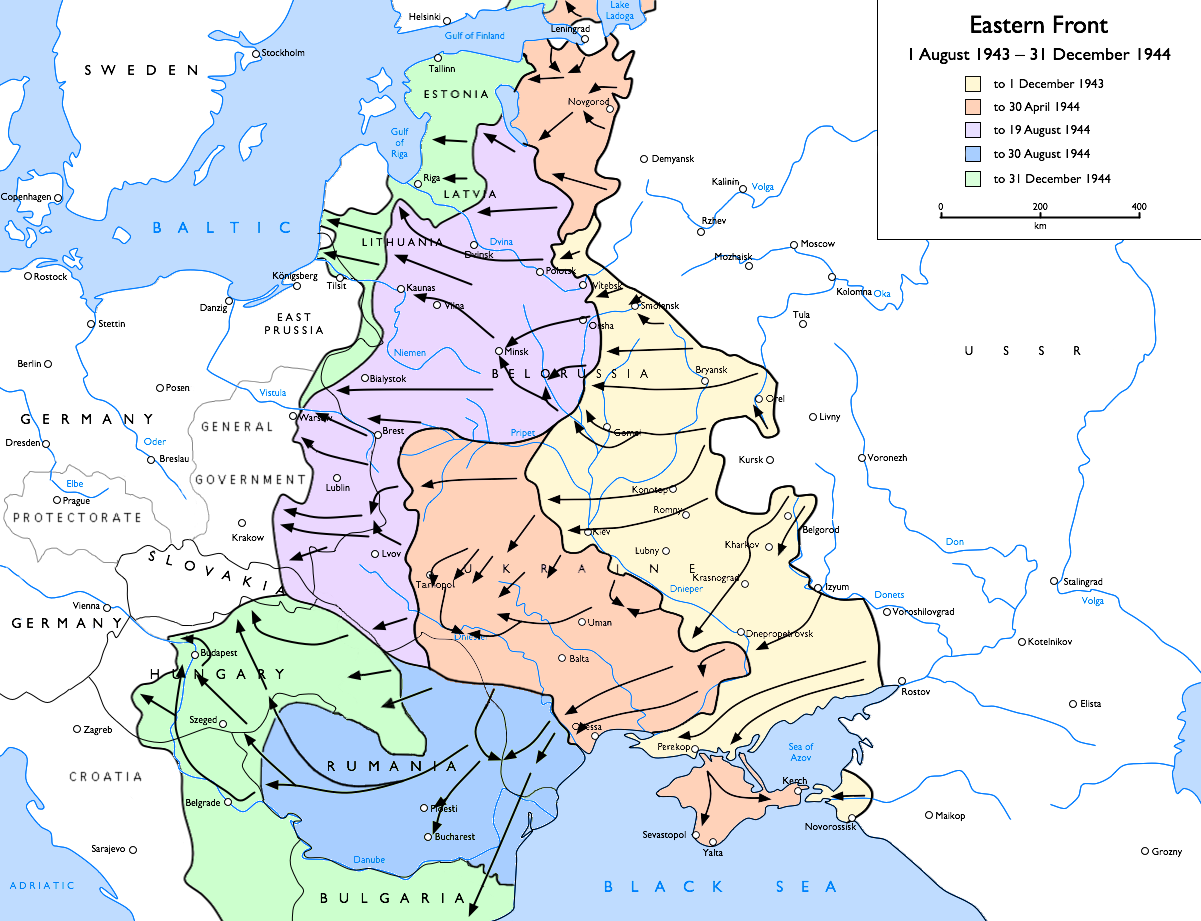
On January 12, 1945 the Russians renewed their attack on the Polish
front, sweeping away the Germans quickly advancing to the Oder River
near Berlin, where they paused to regroup for the final assault.
Ah, quickly we move through the ruins that bow to the ground
The old men and children they send out to face us, they can't slow us down
All all that I ever, was able to see
The eyes of the city are opening now, it's the end of a dream
The Berlin campaign lasted from April 16 through May 2. Though the assault contributed to the "ruins that bow to the ground"
much of the city was already ruined by American and British air
raids, some consisting of more than 1,000 bombers striking the city.
The reference to "old men and children" refers to the Volksstrum
("People's Storm"), a national militia consisting of all men between 16
and 60 capable of bearing arms, formed in October 1944, as the manpower
needs of the crumbling Third Reich became ever more desperate (even boys
of 14 and 15 would see service by the end). Poorly armed and
trained, the Volkssturm units were of varying effectiveness and took
heavy casualties.
Notice the contrast with the opening verse of the song. In 1941, the
narrator speaks of defeat, confusion, and retreat; four years later he
is moving triumphantly forwards to victory.
(Berlin 1945)

Despite the claim that "old men and children . . . they can't slow us down",
the Volkssturm and remaining regular Wehrmacht units imposed heavy
losses on the Red Army - 79,000 dead and 270,000 wounded in less than
three weeks, a per day toll higher than any the Soviets had suffered
since the dark days of 1941. The human cost was made higher by Stalin's
cynical move to place Marshals Zhukov and Koniev in competition to be
first to Berlin, relentlessly mocking and scolding them, leading to
reckless frontal assaults, particularly by Zhukov, the victor at Khalkin Gol in 1939.
And, with the encouragement of Stalin and the Red Army command, the
victorious soldiers took a terrible vengeance on German civilians, with uncounted murders and an estimated two million rapes.
I'm coming home, I'm coming home
Now you can taste in the wind, the war is over
And I listen to the clicking of the train wheels as we roll across the border
The lyric brims with optimism. Against all odds, our narrator has
survived and looks forward to being reunited with his family. In
reality the odds were low that any soldier on the front line on June 22,
1941 would be alive and healthy enough to be fighting in Berlin nearly four years later.
8.6 million Red Army personnel died in the war; effectively the original
1941 army was killed twice over. In comparison, the United States
suffered 296,000 battlefield deaths with another 100,000 dead due to
accidents and illnesses.
Nor were all the Russian dead solely the responsibility of the German
army. Life for the Red Army soldier during the war was brutal. Commanders
employed tactics that wasted countless lives. If you died, particularly
early in the war, it was unlikely your family would be notified. Any
infraction, real or imagined, was subject to harsh discipline and
extreme punishment. During the first 18 months of the war (the only
period for which we have figures), 160,000 Soviet soldiers were executed
for cowardice or desertion. By comparison, only one American was
executed for these offenses during the entire war. For those not
summarily executed there were the Punishment Battalions and Companies to
which officers and soldiers were sentenced to be used, in Stalin's
words, at "the most difficult parts of the front, to give them the possibility to redeem their crimes against their country with blood".
The Punishment units were deployed for tasks such as suicidal frontal
assaults and the clearing of minefields by marching through them, making
it no surprise that an estimated 400,000 died in the process. Their
existence was such an embarrassment to the Soviets after the war that
the existence of the units was officially denied.
In Stalingrad: The Fateful Siege, Antony Beevor tells the tale
of a Soviet lieutenant caught in this madness. Captured by the Germans
in August 1942, he manages to escape and rejoin the Red Army, where he
is promptly arrested, charged as a deserter, and sentenced to a
Punishment Company. Realizing his sentence is an effective death
penalty, he deserts to the Germans! We don't know his fate but it is
unlikely he had a happy ending.
And then there were the Red Army's blocking detachments formed to shoot down retreating soldiers - retreating Red Army soldiers.
The optimism of those that survived extended beyond the relief of being
alive and reuniting with family. The memoirs and recollections of
returning soldiers and officers are filled with belief and hope that
conditions in the Soviet Union would be improved. There was a feeling
that the common Soviet citizen had proven to
Stalin they could be trusted, that the regime need not fear them, that
the fear of being subject to arbitrary justice would end, it would be a new start for the Soviet people and a new and more cordial
relationship with their government. It was not to be.
And now they ask me of the timeIn his account of the German-Soviet struggle, Absolute War, author Chris Bellamy writes, "the Red Army was the only one in the world where being taken prisoner counted as desertion and treason". Stalin believed any soldier who allowed himself to be captured was a traitor and potential counter-revolutionary, and Russians exposed to Westerners for any length of time, a danger to the Soviet state. Bellamy adds:
That I was caught behind their lines and taken prisoner
"They only held me for a day, a lucky break", I say
They turn and listen closer
I'll never know, I'll never know
Why I was taken from the line and all the others
To board a special train and journey deep into the heart of Holy Russia
And it's cold and damp in this transit camp
And the air is still and sullen
And the pale sun of October whispers
The snow will soon be coming
The Soviet government and military command had absolutely no interest in what happened to Soviet people in German captivity. When prisoners of war who survived were released at the end of the war [3 of the 4 million POWs died due to the German policy of exposing them to the elements and leaving them to starve, though a small number survived long enough to serve as guinea pigs for the initial testing of the newly constructed gas chambers at Auschwitz], they were usually sent to the Gulag or shot, and the same fate even befell many who had fought and crawled their way out of German encirclements during the war.Our narrator falls into this last group. His years of valiant service and suffering are to no avail because of the one day he spent within an enemy encirclement.
Also subject to this treatment were civilians who either volunteered or been seized and taken to Germany as slave laborers. Bellamy estimates that up to 1.8 million returning Soviet citizens were sent to Gulag camps or shot.
To their disgrace, both Britain and America contributed to this horror. In 1945 and 1946, the two countries forcibly repatriated over a million Russians who did not want to return to the Soviet Union. While it was the British who insisted on honoring agreements made with Stalin during the course of the war, the United States eventually went along. The returnees were sent to the Gulag or shot.
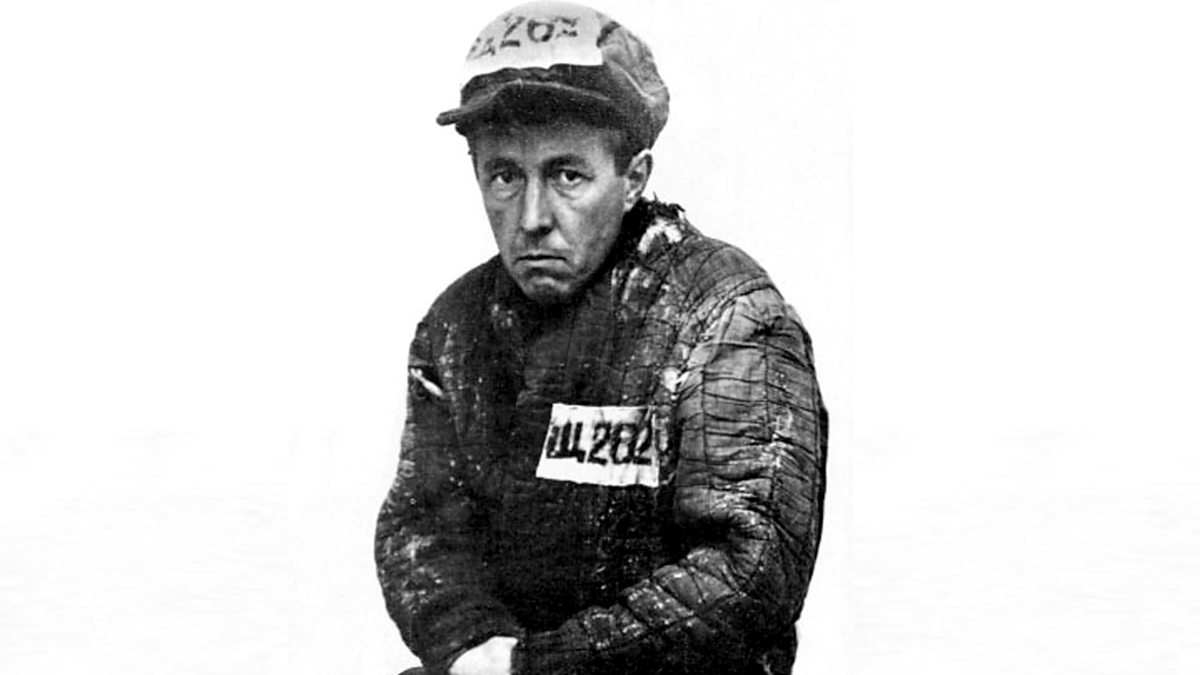
For those escaping the Gulag or execution, optimism proved misplaced. Stalin believed that after the "laxity" of the war years, Soviet discipline needed to be reimposed to prevent any sliding back from the pre-war accomplishments of the state. The post-war years proved grimly repressive with further waves of purges and the elimination of those tiny, fragile zones of personal autonomy some had carved out during the war. Stalin even ordered the removal of crippled and disabled war veterans from the streets of Moscow because he felt their presence demoralizing. It was in this atmosphere that a young returning officer, Alexander Solzhenitsyn, found himself sentenced to ten years in the Gulag for telling a joke about Stalin.
And I wonder when I'll be home again and the morning answers, "Never"I find these the saddest lines in music and no matter how often I hear them they affect me as powerfully as the first time. They represent the betrayal of the hopes and dreams of people caught up in a horrible time, who thought they'd survived the worst, only to find themselves condemned to death, exile, and lives of fear and hopelessness. An estimated 18 million people were imprisoned in Gulag camps between 1929 and 1953, with 2.4 million still in the camps when Stalin, who was planning another massive purge at the time, mostly directly at the Jewish population, died in 1953.
And the evening sighs and the steely Russian skies go on forever
We take leave of our narrator as he disappears into the mist beneath the steely Russian skies passing to an unknown fate, like so many other millions. These lines from the poet Osip Mandlestam (1891-1938), who himself died in a Gulag transit camp in Siberia for committing "counter-revolutionary activities" consisting of writing a poem mocking Stalin, provide the tombstone for those souls.
Mounds of human heads
Are wandering into the distance
I dwindle among them
Nobody sees me

 (Secret
Police photo of Mandelstam. He died of typhoid fever on December 27,
1938. His body lay unburied along with others who died that winter, their frozen corpses piled on the ground, until all were thrown into a mass grave dug after the spring thaw.)
(Secret
Police photo of Mandelstam. He died of typhoid fever on December 27,
1938. His body lay unburied along with others who died that winter, their frozen corpses piled on the ground, until all were thrown into a mass grave dug after the spring thaw.)
(Prisoner 282, Solzhenitsyn)
-------------------------------------------------------------------------------
(1) Mayor Mamdani is a leader of the Democratic Socialists of America (DSA), which is also fielding many candidates this year for national, state, and local offices. Despite its name, the DSA is not a democratic socialist group, it is a communist organization dedicated to the destruction of the United States. The U.S. has had socialist organizations that were actually democratic such as Norman Thomas' Socialist Party in the 1930s which was fiercely anti-communist, as was the DSA when it was founded.
In October 2023, Maurice Isserman resigned from the Democratic Socialists of America (DSA), the organization that Mamdami and Representative Alexandria Ocasio-Cortez remain members of. In 1982 Isserman was a founding member of the DSA, the lead founder being the late Michael Harrington. Isserman and Harrington actually were Democratic Socialists. I believe Harrington was mistaken in many of his political ideas but he was a decent and moral person, unlike the current leadership of the DSA. The DSA is another of the many institutions in America that carry the same name from decades ago but have been subverted from within and are now completely different in substance. The current DSA is a authoritarian communist organization heavily seasoned with settler-colonist ideology. It is an enemy of civilization.
Isserman, an academic who has written favorably about the history of the American Communist Party, resigned for several reasons, including:
- The DSA's failure to denounce what he described as the "anti-Jewish pogrom" by Hamas on October 7, which he characterized as "politically and morally bankrupt".
- The capture of the DSA by groups like Red Star, Marxist Unity Group, and the Communist Caucus—which value ideological purity over democratic socialist values. He described these groups as "entryists", writing, "In left-wing parlance, the term refers to tightly organized groups who, without sharing the beliefs of larger and more loosely organized bodies, join and proceed to either wreck or, where possible, capture them for ends at odds with the spirit and purpose of the original members".
(2) Scholars have cited several potential reasons for the military purge, with some believing that German intelligence played a role by inserting false information about a Red Army military conspiracy against Stalin into the Soviet intelligence network, triggering Stalin's actions.
(3) US and British material shipments to the Soviet Union during the war included:
400,000 Jeeps/trucks (1/3 of all Soviet motor vehicles)
14,000 airplanes
13,000 tanks
8,000 tractors
2.7 million tons of petrol
55% of all Soviet aviation fuel
1/3 of all Soviet explosives
2,000 locomotives
15 million pairs of boots
4.5 million tons of food
55% of all aluminum used by Soviets
80% of all copper used by Soviets
35,000 radio stations
380,000 field telephones
956,000 miles of telephone cable
Friday, May 29, 2026
Orpheum Theater

Sunday, May 3, 2026
Firth Of Fifth
And so with gods and men, the sheep remain inside their penUntil the shephard leads his flock awayThe sands of time were eroded byThe river of constant change
1970s progressive rock took a lot of well deserved abuse for becoming bloated and pretentious, but Firth Of Fifth, from Selling England By The Pound, the 1973 album by Genesis, is prog rock at its pinnacle, a gorgeous journey, musically and lyrically.
Firth starts with the beautiful solo piano of Tony Banks, before the verses kick in with Peter Gabriel singing. We have a flute solo by Gabriel and then a lush extended guitar piece by Steve Hackett. Close your eyes while gliding along with the guitar. And all underpinned by Mike Rutherford's intricate bass and Phil Collins' drumming. Collins' later success as a singer and solo artist has tended to detract from his brilliance as one of the finest prog rock drummers,
Genesis remain my favorite prog rock band with this album and 1971's Nursery Cryme as their finest efforts. With Gabriel leaving in 1975, Phil Collins taking over vocals, and Steve Hackett leaving after the first post-Gabriel album Trick of the Tail, Genesis became a completely different type of act.
Wednesday, April 29, 2026
Cosmic Slop
Sometimes it get weird with George Clinton's Funkadelic. Well, actually, it gets weird very frequently with anything George Clinton does. From 1973, this is Cosmic Slop, and I think that's George in whiteface. Although it is definitely weird, it is also pretty representative of New York City in the early 70s. Also, I swear I've never been at a party like this.
For all the craziness it's a sobering lyric:
I was one of five born to my motherAn older sister and three young brothersWe've seen it hard, we've seen it kind of roughBut always with a smile, she was sure to try to hideThe fact from us that life was really tough
The weirdness, seriousness at times, and musicianship is what makes Funkadelic, Parliament, and Parliament/Funkadelic memorable.
Features Garry Shider on vocals and guitar, Ron Bykowski on lead guitar, Tyrone Lampkin on drums, and bass by Boogie Mosson.
Thursday, April 9, 2026
If You Want Me To Stay
From Fresh, Sly and the Family Stone's 1973 album. That bass line is by Rustee Allen, who replaced long time band bassist Larry Graham (see Fat Bass). The group's final album would be released the following year as Sly descended into drug induced madness. The grove and Sly's vocal are so good I can listen to it ten times in a row.
Thursday, April 2, 2026
Thoughts For Another Day
"If we want things to stay as they are, things will have to change. Do you understand?"
- The young Tancredi to his uncle and guardian, the Prince of Salina, explaining why he is joining the rebels seeking to unite Italy in the 1860s. From The Leopard, the masterpiece by Giuseppe Tomasi di Lampedusa which I am currently reading for the second time. (1958)
The quote is well-known. What is less known are the passages just before and after Tancredi's remark:
Before:
"You're mad, my boy, to go with those people! They're all in the maffia, all troublemakers. A Falconeri should be with us for the King."
"The eyes began smiling again. 'For the King, yes, of course. But which King?'"
After:
"What a boy! Talking rubbish and contradicting it at the same time. . . . The Prince jumped up . . . and rummaged in a drawer. 'Tancredi, Tancredi, wait!'. He ran after his nephew, slipped a roll of gold pieces into his pocket, and squeezed his shoulders."
"On his way downstairs, he suddenly understood that remark of Tancredi's, 'If we want things to stay as they are . . .' Tancredi would go a long way: he had always thought so."
-----------------------------
There's nothing in the streets
Looks any different to me
And the slogans are replaced, by-the-bye
And the parting on the left
Is now parting on the right
And the beards have all grown longer overnightMeet the new boss
Same as the old boss
- Pete Townshend, Won't Get Fooled Again by The Who (1971)
-------------------------------
"Sometimes you win, sometimes you lose, sometimes it rains"
-
Rookie Ebby Calvin "Nuke" Laloosh in Bull Durham (1988), explaining to a
reporter about what a good friend told him of the common understanding
required of citizens in order to preserve stability in a democracy; the
necessity of accepting occasional defeats along with a
lot of muddling through.
Wednesday, March 25, 2026
Apeman
To note the recent death of Paul Ehrlich, it seemed appropriate to reference Apeman, a song from The Kinks 1970 album Lola Versus Powerman and the Money Go Round, Part One (for my ridiculously compulsive exploration of a little known period in The Kinks discography read Kinkdom). It was the lyrics in the first two verses that made me think of Ehrlich and gave me an excuse to show the band playing the entire song.
I think I'm sophisticated'Cause I'm living my lifeLike a good homo sapiensBut all around meEverybody's multiplyingAnd they're walking round like flies, manSo I'm no better than the animalsSitting in the cages in the zoo, man'Cause compared to the flowersAnd the birds and the treesI am an apemanI think I'm so educatedAnd I'm so civilized'Cause I'm a strict vegetarianAnd with the over populationAnd inflation and starvationAnd the crazy politiciansI don't feel safe in this world no moreI don't want to die in a nuclear warI want to sail away to a distant shoreAnd make like an apeman
The Population Bomb, Ehrlich's enormous best seller, was published in 1968, a book in which he predicted mass famine by the end of the 1970s and global environmental deterioration. He had a distinguished academic career at Stanford University and received countless awards and recognition over the decades for his work.
The problem is that Ehrlich was wrong, incredibly wrong, but it never seemed to impair his academic credibility. I read The Population Bomb during my freshman year of college (1969-70) and, in my naivete, was impressed with his thesis, though even at the time, found some of his language overwrought. By the end of the 70s it was clear to me Ehrlich was wrong and became baffled by the continuing respect accorded him and those who adopted his views.
The most dramatic evidence of Ehrlich's wrongness was his 1980 bet with economist Julian Simon, summarized by Wikipedia:
The economist Julian Simon argued in 1980 that overpopulation is not a problem as such and that humanity will adapt to changing conditions. Simon argued that eventually human creativity will improve living standards, and that most resources were replaceable.[50] Simon stated that over hundreds of years, the prices of virtually all commodities had decreased significantly and persistently.[51] Ehrlich termed Simon the proponent of a "space-age cargo cult" of economists convinced that human creativity and ingenuity would create substitutes for scarce resources and reasserted the idea that population growth was outstripping the Earth's supplies of food, fresh water and minerals.[8]
This exchange resulted in the Simon–Ehrlich wager, a bet about the trend of prices for resources during a ten-year period that was made with Simon in 1980.[8] Ehrlich was allowed to choose ten commodities that he predicted would become scarce and thus increase in price. Ehrlich chose mostly metals, and lost the bet, as their average price decreased by about 30% in the next 10 years.
Ehrlich's prognostication failings reminds me of the quote attributed to Nobel Prize winning physicist Wolfgang Pauli after reviewing the paper of a young physicist, "That is not only not right, it is not even wrong".
I never met Ehrlich but did have the opportunity to sit with one of his acolytes (they'd co-authored papers and was involved in setting up the Ehrlich-Simon bet), Paul Holdren, at a small dinner in Cambridge, Massachusetts in 2008. Like his mentor, Holdren has had a distinguished academic career with positions at Harvard and Berkeley and receiving a MacArthur Foundation "genius" Fellowship. In 2009, President Obama appointed Holdren as his chief science advisor and director of the White House's Office of Science & Technology, a role he served in both of Obama's administrations.
While I don't remember most of the details of the dinner discussion, my overall impression was Holdren fit the pattern found in Harvard academics in encounters during my twelve years working in Cambridge and, for a decade after, being a frequent visitor; they tended to be close-minded, provincial, and intolerant of dissenting opinions, not something I would have predicted when I began working in the city in 1980. Most found it incomprehensible that anyone would disagree with their political opinions or general thoughts on the world out of anything other than ignorance and/or bigotry, and automatically devalued the views of anyone lacking the "right" credentials.
In the wake of Ehrlich's death I came across a tweet he'd sent on January 3, 2023 after a 60 Minutes appearance, which explains how he and Holdren maintained their academic reputations. It is quite an indictment of academia:
"60 Minutes extinction story has brought the usual right-wing out in force. If I'm always wrong so is science, since my work is always peer-reviewed, including the POPULATION BOMB and I've gotten virtually every scientific honor."
Notice one of the tactics he, and many other academics, employs is to call any criticism "right-wing" thus casting those criticizing him into the outer darkness where the substance of the criticism can be completely disregarded. The funny thing is I came across the quote in a tweet from Roger Pielke Jr, a traditional liberal and critic of Ehrlich. Pielke wrote a longer piece, Gravediggers of Science, on Ehrlich in his substack, relating his encounter with Ehrlich in 2010, in which Ehrlich and the scurrilous climate scientist Michael Mann engaged in their favorite smearing tactic and making completely false allegations.
Ehrlich and others employ these tactics because in the circles they swim in it works. There is no price to pay for being wrong or for trying to destroy others with false innuendo and worse. In fact, they are rewarded for doing so.
Rereading The Population Bomb and some of Ehrlich's other work one is struck by what a miserable and misanthropic view of humanity he holds.(1) It probably explains his desire of widespread sterilization and a powerful world government to enforce his views.
I'll give the last word to this summary from The Free Press. They are unfortunately correct that his worldview has infected society:
Imagine getting almost everything wrong and still transforming the world with your ideas. That, more or less, is what happened to economist and professional eco-pessimist Paul Ehrlich, who died this week at 93. Ehrlich shot to fame in 1968 with his bestseller The Population Bomb. It predicted an explosion in humankind, draining the planet’s resources and triggering a near apocalypse.
Thankfully, Ehrlich would be proven wrong—stunningly wrong—by events. But even if Ehrlich lost the argument, his Malthusian mindset still won him award after award and, in many ways, became conventional wisdom.
Today, we’re bringing you two pieces on Ehrlich’s ideas and why they matter.
Up first, the British science writer Matt Ridley details the callous policy proposals Ehrlich’s thinking led him to support—including forced sterilization programs that Ehrlich called “coercion in a good cause”—and the policymakers who listened to him.
Up next, Larissa Phillips. She was born to parents beholden to Ehrlich’s theories. In fact, she says, she almost wasn’t born because of them: Her parents were trying to model their own family planning on his prescription for zero population growth. Thankfully, they didn’t quite get it right. Ehrlich’s death caused Larissa to contemplate not just the impact of his ideas on her family but also where the line falls—where idealism becomes pretentious, or pessimistic, or harmful.
----------------------------------------------------
(1) In that regard, Ehrlich reminds me of the leaders of the AI crowd. Though Ehrlich preached scarcity and the AI dudes abundance, at heart they are all anti-humanists. If AI can perform better than humans, of what use are people? The AI leaders have clearly said this and don't care about the implications. In February 2025 I summarized Elon Musk's worldview but it can be said for all of the AI proponents:
Musk and a small group of "creatives" run society, with robots operating our factories, and AI, using Musk-designed algorithms, running everything else. Enough wealth is created to fund a Universal Basic Income for the rest of Americans, who live in a ketamine and cannabis induced haze.
Saturday, February 14, 2026
My Funny Valentine
Let's celebrate the day with a tune from the Great American Songbook. Composed in 1937 by Richard Rogers and Lorenz Hart, this chilling rendition by Elvis Costello is from 1979.
Wednesday, December 17, 2025
Forever Young
Bob Dylan recorded Forever Young in December 1973 and it appeared the following month on the album Planet Waves. One of his best known songs, he released another version in 2023 on the album Shadow Kingdom. Dylan was 32 when he wrote and recorded the song. He was 82 when he recorded it for the second time. It hits differently. I know it did for me listening to it at 72. The original is a song of aspiration and hope for his young ones. Fifty years later he knows how it turned out and it shows in his voice and informs how we react.
Dylan married Sarah Lownds in 1965 and four children were born between 1966 and 1969 (3 boys, one girl), while Bob also adopted his wife's daughter from a prior marriage. He had last toured in 1966, using the excuse of his injuries from a motorcycle accident that fall to stop his hectic recording and touring schedule. While releasing several albums in the following years he only played a couple of one-off concerts and become a mysterious, remote figure.
In his eccentric and revealing autobiography, Chronicles Vol. 1, Dylan describes the reasons for his withdrawal in two passages. The first in a conversation with The Band's Robbie Robertson while driving around Woodstock:
He says to me, 'Where do you think you're gonna take it?" I said, "Take what?". "You know, the whole music scene." The whole music scene! . . . No place was far enough away. I don't know what everybody else was fantasizing about, but what I was fantasizing about was a nine-to-five existence, a house on a tree-lined block with a white picket fence, pink roses in the backyard. That would have been nice. That was my deepest dream.
The second in which he writes of moving several times to avoid the plague of reporters seeking him out:
Even if these reporters had been allowed in the house, what would they find? A whole lotta stuff - stacking toys, push and pull toys, child-sized tables and chairs - big empty cardboard boxes - science kits, puzzles and toy drums.
Whatever the counterculture was, I'd seen enough of it. I was sick of the way my lyrics had been extrapolated, their meaning subverted into polemics and that I had been annointed as the Big Bubba of Rebellion, High Priest of Protest [etc] . . . What the hell are we talking about? Horrible titles any way you want to look at it . . . What mattered to me most was getting breathing room for my family.(1)
The lyrics, written for his young children:
May God bless and keep you always
May your wishes all come true
May you always do for others
And let others do for you
May you build a ladder to the stars
And climb on every rung
May you stay forever young
Forever young, forever young
May you stay forever young.
May you grow up to be righteous
May you grow up to be true
May you always know the truth
And see the lights surrounding you
May you always be courageous
Stand upright and be strong (Chorus)
May your hands always be busy
May your feet always be swift
May you have a strong foundation
When the winds of changes shift
May your heart always be joyful
And may your song always be sung (Chorus)
Bob and Sarah divorced in 1977 (she is now 86 and has never spoken publicly about the marriage). I don't know anything about their children, but son Jacob said in a 2005 interview, "My father said it himself in an interview many years ago: 'Husband and wife failed, but mother and father didn't.' My ethics are high because my parents did a great job." (2)
Forever Young also reflects a different viewpoint than that expressed in some of his earliest recordings. From 1962 through 1964 Dylan developed a reputation as a "protest singer", a label he bitterly resented and ultimately rebelled against. Though he is still sometimes called the "voice of his generation", Dylan never spoke publicly about the Vietnam War, either in opposition or support, despite it being the rallying point of protest in the second half of the 60s into the early 70s.
The song that marked that transition was My Back Pages from Another Side of Bob Dylan, released in August 1964, with lyrics acknowledging that issues and life were more complicated than he had previously portrayed.
Half-wracked prejudice leaped forth
"Rip down all hate, " I screamed
Lies that life is black and white
Spoke from my skull, I dreamed
Romantic facts of musketeers
Foundationed deep, somehow
Ah, but I was so much older then, I'm younger than that nowIn a soldier's stance, I aimed my hand
At the mongrel dogs who teach
Fearing not I'd become my enemy
In the instant that I preach
My existence led by confusion boats
Mutiny from stern to bow
Ah, but I was so much older then, I'm younger than that now
A self-ordained professor’s tongue
Too serious to fool
Spouted out that liberty
Is just equality in school
“Equality,” I spoke the word
As if a wedding vow
Ah, but I was so much older then
I’m younger than that now
Yes, my guard stood hard when abstract threats
Too noble to neglect
Deceived me into thinking I had something to protect
Good and bad, I define these terms
Quite clear, no doubt, somehow
Ah, but I was so much older then, I'm younger than that now
Bringing It All Back Home (March 1965) would be his first album containing no songs that could be classified as "protest".
When Dylan sings "may you stay forever young" he circles back to the chorus of My Back Pages, "I was so much older then, I'm younger than that now". In Back Pages, he is saying that he is dropping the posed sophistication of someone pretending to be a wiser and older man in exchange for becoming the young man with still a lot to learn. Ironically, Dylan is wise enough to know he needs to be younger, or perhaps, as young as he actually is, a lesson many of his compatriots failed to learn.
Eight years later, with four young children, when he sings "may you stay forever young" it means always being open to learning and gaining wisdom, not closing themselves off or thinking that they know it all. What Dylan is driving it is revealed in this lyric, "May you have a strong foundation/ When the winds of changes shift". He knows that things change (as does THC), in October 1963 having recorded The Times They Are-a-Changin'. But that powerful anthem contains these lyrics:
And you better start swimmin'Or you'll sink like a stoneFor the times they are a-changin'Your old road is rapidly agin'Please get out of the new oneIf you can't lend your handFor the times they are a-changin'
The song was written at the time of a great moral crusade, the need to admit black Americans to the full panoply of rights afforded to other American citizens. But moral crusades are few and far between, though many mistake other issues for crusades. In Times They Are-a-Changin', Dylan warns everyone to support the change or be swept away.
Ten years later, a wiser Dylan sings of the importance of a "strong foundation" because all "winds of change" are not necessarily good, each requiring careful evaluation against a moral framework, recognizing it takes great internal moral strength to withstand those winds. Lacking a strong foundation leaves one vulnerable to manipulative charismatic leaders, too easily swayed by peers, public opinion, or media, or blindly willing to follow the lead of credential wielding experts.
--------------------------------------------------------
(1) While rereading some of Chronicles in preparation for writing this post I came across another passage which explained something else I've written about - how terrible Dylan was in concert with Tom Petty during the 80s, the only time I've ever seen him perform in person:I'd been on an eighteen month tour with Tom Petty and The Heartbreakers. It would be my last. I had no connection to any kind of inspiration. . . . Tom was at the top of his game and I was at the bottom of mine. . . My own songs had become strangers to me. I didn't have the skill to touch their raw nerves, couldn't penetrate the surfaces. It wasn't my moment of history anymore. There was a hollow singing in my heart and I couldn't wait to retire and fold the tent. One more big payday with Petty and that would be it for me. I was what they called over the hill. If I wasn't careful I could end up ranting and raving in shouting matches with the wall.
I had written and recorded so many songs, but it wasn't like I was playing many of them. I think I was only up to the task of about twenty or so. The rest were too cryptic, too darkly driven, and I was no longer capable of doing anything radically creative with them. It was like carrying a package of heavy rotten meat. I couldn't understand where they came from. The glow was gone and the match had burned right to the end. I was going through the motions.
(2) Dylan wrote at least two songs about his marriage; Sad Eyed Lady of the Lowlands from Blonde On Blonde (1966) and Sara from Desire (1977), the latter as his marriage was collapsing, and which includes the lyric "Staying up for days in the Chelsea Hotel/Writing "Sad Eyed Lady of the Lowlands' for you". Sara is searing and emotionally wrenching. On the other hand, Dylan makes a lot of stuff up, so did he really write Sad Eyed Lady for Sara, or did he make it up as part of his last ditch appeal to his wife?
Monday, October 6, 2025
Harvest Moon
Tonight is the Harvest Moon so it's time to listen to Leon Redbone performing Shine On Harvest Moon.
Sunday, August 31, 2025
The Cisco Kid Goes To War
The Cisco Kid was a half hour TV series broadcast from 1950 to 1956 of which I have a vague recollection watching as a youngster. Starring Duncan Renaldo as the Kid and Leo Carrillo as his sidekick Pancho, as Robin Hood-type outlaws, it was based on a 1907 short story by O. Henry. Apparently it was the first TV series to be filmed in color though, at the time, I didn't know it because we, like everyone else, had a black and white TV (I never owned a color set until the mid-1980s).
The Cisco Kid is also the title of a million selling hit song from 1973 by the band War, which commenced with these lyrics:
The Cisco Kid was a friend of mineThe Cisco Kid was a friend of mineHe drink whiskey, Poncho drink the wine
War began as a group of musicians in Southern California. Linking up with singer Eric Burdon (formerly of The Animals) they produced the hit, Spill The Wine, in 1970. Splitting from Burdon the following year, War went out to have a series of hit albums and singles during the 1970s.
The Cisco Kid is from The World Is A Ghetto, the best selling album of 1973, which also contains the beautiful title song. War had a very tight rhythm section, which with catchy melodies and lyrics, resulted in a lot of chart success.
Other songs worth a listen by War include Slippin' Into Darkness, Low Rider, and Why Can't We Be Friends (with the immortal lyric, "I know you're working for the CIA/They wouldn't have you in the MAF-I-A").
A lot of the riffs and rhythms in War's songs have been covered and sampled by many other artists and used in movies and other shows.
Subscribe to:
Posts (Atom)