Showing posts with label New Mexico. Show all posts

Tuesday, December 21, 2021

Pie Town

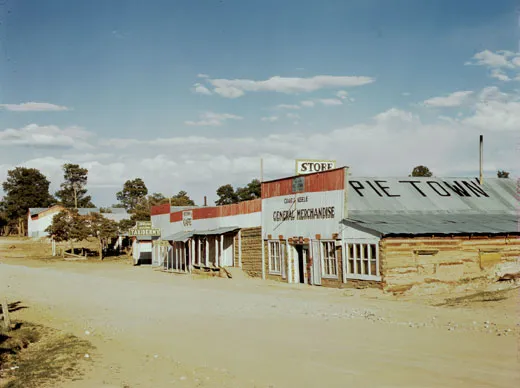
 In October 2020 we drove through the Very Large Array in New Mexico on our way from Maine to Arizona.  About thirty five miles further west on Route 60, while crossing the Continental Divide, we passed through a curious little outpost called Pie Town.  I recently came across this photo of Pie Town, taken in June 1940 by Russell Lee for the Farm Security Administration, at the Shorpy Archive and decided to find out more about the town.

Pie Town is an unincorporated community with a population of about 180, founded in the 1920s, and the subject of a feature article in the February 2005 edition of Smithsonian Magazine.  It turns out Russell Lee took about 600 photos of the town and its inhabitants which are preserved in the Library of Congress archives.  The town was primarily settled by Dust Bowlers in the 1930s and during its peak in that and the next decade, was home to about 250 families.  By the 1950s the climate had become drier and a place always tough to live in became even tougher and folks started moving away.  The Smithsonian article, by Paul Hendrickson, tells how the remaining inhabitants survive.  He also describes how the name came about:

The town had been around as a settlement since at least the early 1920s, started, or so the legend goes, by a man named Norman who’d filed a mining claim and opened a general store and enjoyed baking pies, rolling his own dough, making them from scratch. He’d serve them to family and travelers. Mr. Norman’s pies were such a hit that everybody began calling the crossroads PieTown. Around 1927, the locals petitioned for a post office. The authorities were said to have wanted a more conventional name. The Pie Towners said it would be PieTown or no town.

The Daily Pie Cafe was still operating in 2005, and we saw it last year on our drive.  Hendrickson writes of it:

And then there was the Daily Pie. I’ve been to some restaurants where a lot of desserts were listed on the menu, but this was ridiculous. The day’s offerings were scrawled in a felt-tip pen on a big “Pie Chart” above my head. In addition to regular apple, there was New Mexican apple (laced with green chili and piñon nuts), peach walnut crumb, boysen berry (that’s the spelling in Pie Town), key lime cheesecake (in Pie Town it’s a pie), strawberry rhubarb, peanut butter (it’s a pie), chocolate chunk crème, chocolate walnut, apple cranberry crumb, triple berry, cherry streusel, and two or three others that I can no longer remember and didn’t write down in my notebook. The Pie Chart changes daily at the Daily Pie, and sometimes several times within a day. A red dot beside a name meant that there was at least a whole other pie of that same kind back in the kitchen.

When we back our trip to see the Very Large Array we'll definitely be making a stop in Pie Town.

From Smithsonian:


Monday, January 11, 2021

Very Large Array


In October we drove from Maine to Arizona.  I always like taking different routes so instead of following I-40 into Arizona from New Mexico as we usually do, we took a left at Albuquerque and headed south on I-25.  Exiting at Socorro our plan we to take US 60 into Arizona and stay in Show Low that evening.

US 60 in New Mexico takes you through very sparsely inhabited areas, a mixture of plains with expansive views and mountains.  About 40 miles west of Socorro we came over a pass and beginning our descend to a large flat plain noticed some very odd-looking structures scattered in the distance across the landscape.  Coming closer we realized they were radiotelescopes and the highway went right through the center of them.  We stopped and took the photos you see here.

A quick check told us we were in the midst of the Very Large Array (VLA) of the National Radio Astronomy Observatory.  As we drove from Socorro I'd noticed occasional small roadside signs announcing "VLA 30 Miles", "VLA 20 Miles," but had no idea what they meant.  Now I did.

At an altitude of 6,790 feet, the precise name of the facility is the Karl G Jansky Very Large Array, which is part of the NRAO (itself headquartered in Virginia).  Built in the 1970s, though modified extensively since, the VLA consists of 27 radio telescopes in a Y array over a large area.  Designed to detect radio emissions from quasars, pulsars, supernova remnants and black holes as well as search for powerful signals from any advanced civilizations, the VLA evokes its own aura of mystery standing in its remote location.

It was also used as one of the settings for the 1997 film Contact, starring Jodie Foster, about our first encounter with an advanced civilization.  According to Wikipedia:

"Shooting at the VLA was, of course, spectacular but also one of the most difficult aspects of our filming", producer Steve Starkey said. "It is a working facility, so in order for us to accomplish shots for the movie, we had to negotiate with the National Science Foundation for 'dish control' in order to move the dishes in the direction we needed to effect the most dramatic shot for the story."

The VLA also appeared in Terminator Salvation (2009) as an evil Skynet facility. 

The facility is usually open for tourists and has regularly scheduled guided tours but is closed now due to covid.  We plan on returning when it reopens.


Friday, August 10, 2012

Pueblo Revolt

August 10, 1680 was the start of a little known episode which became the most successful American Indian revolt against European settlers in what is now the United States.  It took place in what is now the State of New Mexico.

Nuevo Mexico was founded as a province of New Spain in 1598 with its capital at Santa Fe, years before the English settlements at Jamestown (1607) and Plymouth (1620). In the 1520s Cortez had conquered the Aztec empire based in Mexico City and by the 1540s Coronado was leading an expedition to the Southwest and Great Plains searching for the mythical cities of gold.  It was the further search for gold that brought the Spanish to the Rio Grand valley at the end of the century.  Nuevo Mexico became an isolated outpost for the Europeans with several hundred miles separating its southernmost settlement from the northernmost towns in the rest of New Spain.