Sunday, September 27, 2015
(Listen To) The Flower People
From the early days of Spinal Tap just after the boys changed their name from The Thamesmen and their first drummer had an unfortunate accident. Many of you may know their later work better due to the famous rockumentary made of one of their tours.

Friday, September 25, 2015
Loos
It is true that we’ve seen reports about the use of chlorine in bombs that have the effect of chemical weapons. Chlorine itself, historically, has not been listed as a chemical weapon, but when it is used in this fashion can be considered a prohibited use of that particular chemical.
President Barack Obama, May 14, 2015, responding to reports that the Syrian military under control of President Bashir Assad have used chlorine gas
On this date a century ago the British Army attacked German trench lines near the town of Loos, southwest of the city of Lille in France's coal mining region. The attack marked the first use of poison chlorine gas by the British but
 it was not the first use of poison gas in the First World War. On April 22, 1915 the Germans dispersed chlorine against the British during the Second Battle of Ypres. They followed up with further chlorine use on April 24, May 2 and 5 and then deployed it on the Eastern Front against the Russians on August 6.
At Ypres the Germans released 168 tons of chlorine from over 5,000 cylinders. What quickly proved critical in effectiveness of poison gas was properly gauging wind conditions. From a defensive perspective it was quickly found that running while exposed to gas was more dangerous than staying in place as it led to more inhalation and that those on the top of the trenches were safer than those staying in the bottom since the gas sank.
Loos was an unlikely place for a British attack. The only significant topography, small hills and slag heaps, were occupied by the German and any British advance would have to be over an open plain with no cover. The British command determined that the use of gas would provide the needed advantage to overcome the factors favoring the defendants.
 (Loos, slag heaps occupied by Germans, battlefield in flat area in front from webmatters)
The use of chlorine at Loos was a fiasco. With 140 tons of chlorine from 5,000 cylinders the British miscalculated the wind direction so most of the gas ended up in no-man's land or blown back into the trenches incapacitating their own soldiers. Compounding the mess was that some of the cylinders failed to work and when hit by German artillery further gas was released within the British lines.
 (British infantry at Loos, advancing through their own gas)
After beginning with that disaster, Loos followed the typical pattern for Western Front battles. The British assaults were ineffective but nonetheless continued until October 25 with 60,000 British soldiers killed or wounded, along with 26,000 German troops.
The Loos Memorial, constructed after the war, lists the names of 20,610 British and Commonwealth soldiers killed during the battle and who have no known graves
As for gas, worse was to come. The Germans introduced phosgene in December 1915 and mustard gas in July 1917.
Thursday, September 24, 2015
Yogi's Gone
Yogi Berra passed away yesterday at the age of 90. THC wrote this in 2013 as part of his series on Baseball Nicknames.
"Yogi" Berra
We are used to it now after almost 70 years, but how unusual it must have been at the time for Lawrence Peter Berra, growing up in The Hill, an Italian neighborhood in St Louis during the 1930s, to be called Yogi. He got the name from his childhood friend Bobby Hofman who had seen a movie about an Indian snake charmer and thought his buddy resembled "the yogi".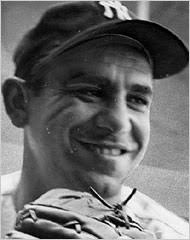
Today, Yogi is 87 and often best remembered for looking rather funny, his Aflac commercials and his various Yogiisms ("it ain't over till it's over", "when you come to a fork in the road, take it" etc), some of which he said and some of which he didn't, including "I really didn't say everything I said" which apparently he did say. Most of what he did say sounds odd at first but usually makes sense when you think about it. As Nolan Ryan said "if Yogi had gone to college, they would have made him talk clearer, but not better".
What sometimes gets lost amidst all the funny stories is that Yogi Berra was one of the three best catchers in major league history (I'll leave it to you to argue among yourselves about where within those three he ranks). Bill James wrote that it was not a coincidence the Yankees achieved their greatest success, five consecutive world championships, when Yogi was in his prime.
Birdie Tebbetts, then the manager of the Cleveland Indians, told of asking Casey Stengel in the early 1960s (Casey was the Mets' manager by then) how he achieved his incredible success with the Yankees. Tebbetts wrote that Casey responded:
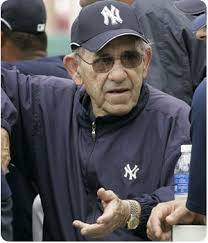 You'll also enjoy visiting the Yogi Berra
Museum & Learning Center on the grounds of Montclair State University in New Jersey. Yogi and his wife, Carmen, have lived in the neighborhood since the late 1940s.
And this link takes you to a post from May 18 of this year when Jackie Robinson's widow, Rachel, visited Yogi on his 90th birthday.
"Yogi" Berra
We are used to it now after almost 70 years, but how unusual it must have been at the time for Lawrence Peter Berra, growing up in The Hill, an Italian neighborhood in St Louis during the 1930s, to be called Yogi. He got the name from his childhood friend Bobby Hofman who had seen a movie about an Indian snake charmer and thought his buddy resembled "the yogi".
Today, Yogi is 87 and often best remembered for looking rather funny, his Aflac commercials and his various Yogiisms ("it ain't over till it's over", "when you come to a fork in the road, take it" etc), some of which he said and some of which he didn't, including "I really didn't say everything I said" which apparently he did say. Most of what he did say sounds odd at first but usually makes sense when you think about it. As Nolan Ryan said "if Yogi had gone to college, they would have made him talk clearer, but not better".
What sometimes gets lost amidst all the funny stories is that Yogi Berra was one of the three best catchers in major league history (I'll leave it to you to argue among yourselves about where within those three he ranks). Bill James wrote that it was not a coincidence the Yankees achieved their greatest success, five consecutive world championships, when Yogi was in his prime.
Birdie Tebbetts, then the manager of the Cleveland Indians, told of asking Casey Stengel in the early 1960s (Casey was the Mets' manager by then) how he achieved his incredible success with the Yankees. Tebbetts wrote that Casey responded:
I had the privilege of meeting Yogi a couple of years ago and while he's slowed down he is still funny and a class act.
'Birdie, I never play a game without my man in the lineup' . . .I'm thinking he's talking about DiMaggio, he's talking about Mantle, he's talking about this guy and that guy, and suddenly I realize he's talking about Yogi Berra.
Museum & Learning Center on the grounds of Montclair State University in New Jersey. Yogi and his wife, Carmen, have lived in the neighborhood since the late 1940s.
And this link takes you to a post from May 18 of this year when Jackie Robinson's widow, Rachel, visited Yogi on his 90th birthday.
Tuesday, September 22, 2015
The Band By The Band
 (The Band)
 There are periodic outbursts of musical creativity in the rock n roll era. August through October of 1969 was one of those moments when a slew of albums now considered classic were released including Led Zeppelin II (featuring Whole Lotta Love and Heartbreaker); Stand Up, the album that established Jethro Tull; Arthur, another esoteric gem from The Kinks; what many consider, for better or worse, the first progressive rock album, In The Court Of The Crimson King by King Crimson; Green River from Creedence Clearwater Revival; Santana's first album; Janis Joplin's first solo effort; Blind Faith's first, and only, album, and, on September 26, Abbey Road, the last album recorded (though not the last released) by The Beatles. THC discussed an earlier such period in Six Months in Rock.
On September 22, 1969, four days before Abbey Road, The Band released its second album titled "The Band". It's the best of the bunch and the only oneTHC still listens to regularly.
The music is difficult to categorize. It's not exactly rock, it's not really country, it's sort of, but not quite, old-timey music. Americana is the label sometimes applied which is funny since four of the five band members were Canadians yet they had the sensibility required to capture the sound and feel of an America that had disappeared well before 1969. If one were to try to describe the time and place in which the songs are set it'd be from the end of the Civil War through the Depression with locales primarily in the South but also including the Great Plains and Midwest and mostly in rural white America. The Band sounds of the time about which they are singing about and it's a collection of songs by turn witty and bawdy, poignant and knowing, sympathetic and hopeful, nostalgic and fun.
The five members of the group (Robbie Robertson, Rick Danko, Richard Manuel, Garth Hudson and the lone American, Levon Helm) originally came together in 1960 as the backing band for Canadian rockabilly singer Ronnie Hawkins (here they are doing Bo Diddley's Who Do You Love?). Becoming known as Levon & The Hawks they came to Bob Dylan's attention when he was looking for a band to tour with in 1965 as he made the transition from folk to electric music. The Hawks toured with Dylan into 1966 when he had his still mysterious motorcycle accident and stopped recording and touring.
 (Levon & The Hawks; from L to R, Danko, Manuel, Helm, Hudson, Robertson; from tumblr)
A year later, Dylan invited the Hawks to join him in the Woodstock, New York area where in the fall of 1967 they recorded what became known as The Basement Tapes in the ranch house the band was living in, which they had named Big Pink (see Chest Fever). Available at first only in limited bootleg editions, with a select group of songs officially released in 1975 and the full collection not available until 2014, The Basement Tapes are a collection of more than 100 songs, some Dylan originals (Tears Of Rage; You Ain't Goin' Nowhere; This Wheel's On Fire - co-written with Rick Danko) and others traditional country, folks and blues tunes (for a full list go here).
After working with Dylan, the group embarked on recording its first album and renamed itself as The Band. Released in July 1968, Music From Big Pink was a critical and commercial success and contained what would become their most famous song, The Weight.
At the end of the year they went to Los Angeles to begin recording their next album which was to become The Band.
The Band was unusual in two respects - there wasn't one lead singer; there were three, Danko, Helm and Manuel and, with the exception of Robertson, they all played multiple instruments. On The Band this was the instrumental lineup:
Danko: Bass, fiddle, trombone
Helm: Drums, mandolin, guitar
Hudson: Organ, clavinet, piano, accordion, melodica, soprano, tenor & baritone saxophone, trumpet
Manuel: Piano, drums, baritone saxophone, harmonica
Robertson: Guitars
Perhaps THC should add a third distinctive aspect - their distinctively ragged harmonies.
And ably assisted by engineer John Simon who also contributed tuba, piano, tenor saxophone and horns as well as doing a fine job on the production. In addition to producing The Band's first album, Simon had done Cheap Thrills, the debut album from Big Brother & The Holding Company, the spectacularly good even fifty years later debut of Blood, Sweat & Tears (The Child Is Father To The Man) as well as working with Simon & Garfunkel and Leonard Cohen.

Let's walk through the record. The songs are great but as an album it holds together and works best listening to the tunes in the order intended. Links are provided to each song.
SIDE ONE
Across The Great Divide
(Lead Vocal: Manuel)
Standin' by your window in pain
A pistol in your hand
And I beg you, dear Molly, girl,
Try and understand your man the best you can
Across the Great Divide
Just grab your hat, and take that ride
Get yourself a bride
And bring your children down to the river side
Rag Mama Rag
(Lead Vocal: Helm)
A rollicking, barnburner of a song. "Hailstones beatin' on the roof, the bourbon is a hundred proof". Manuel, Danko and Helm switched instruments with Richard on drums (listen to his clever playing behind the lyric "we could be relaxing in my sleeping bag"), Rick on fiddle and Levon on mandolin. Listen to Garth's rinky-tink piano interlude starting at 1:45 and John Simon contributes the underlying tuba part that holds the whole thing together (now there's a phrase you don't often hear in connection with rock music).
The Night They Drove Old Dixie Down
(Lead Vocal: Helm)
Along with The Weight and Up On Cripple Creek this became a concert highlight for the group and one of its most covered songs. In the America of 2015 will anyone ever sing it again? Here's a perspective from 1978 by Jonathan Taplin, the Band's tour manager at the time (later a Hollywood film producer and currently Director of the Annenberg Innovation Lab at the University of Southern California Annenbergy School for Communication and Journalism).
It was May and they'd just finished it the night before. They said it'd come out fast and hard and clean. It was just the most moving experience I'd had for, God, I don't know how long. Because for me, being a Northern liberal kid who'd been involved in the Civil Rights movement and had a whole attitude towards the South, well I loved the music but I didn't understand where white Southerners were coming from. And to have it all in just three and a half minutes, the sense of dignity and place and tradition, all those things … Well, the next day after I'd recovered, I went to Robbie and asked him, "How did that come out of you?" And he just said that being with Levon so long in his life and being in that place at that time … It was so inside him that he wanted to write the song right at Levon, to let him know how much those things meant to him.Quote is from The Band website.
Like my father before meA nice touch to use the name Cain in a song about a civil war.
I will work the land
And like my brother above me
Who took a rebel stand
He was just 18, proud and brave
But a Yankee laid him in his grave
I swear by the mud below my feet
You can't raise a Cain back up
When he's in defeat
Here's the studio version but THC prefers this live version from The Last Waltz with an even better vocal from Levon.
When You Awake
(Lead Vocal: Danko)
Love the opening of this tune.
And it contains much useful advice:
Ole showed me the fork in the road
You can take to the left or go straight to the right,
Use your days and save your nights
Be careful where you step, and watch what ya eat,
Sleep with a light and you got it beat
Ole warned me, it's a mean old world,
The street don't greet ya, yes, it's true
But what am I supposed to do
Read the writing on the wall
I heard it when I was very small
You may be right and you might be wrong
I ain't gonna worry all day long
Snow's gonna come and the frost gonna bite
My old car froze up last night
Ain't no reason to hang my head
I could wake up in the mornin' dead
And if I thought it would do any good
I'd stand on the rock where Moses stood.
Up On Cripple Creek
(Lead Vocal: Helm)
The best known song from the album and the one that got the most airplay at the time. A takeoff on Cripple Creek, an old folk/bluegrass tune.
All the way from Lake Charles, Louisiana:
Now there's one thing in the whole wide world, I sure would like to seeThat weird frog-like croaking sound you hear throughout the song is Garth Hudson playing a clavinet through a wah-wah pedal, a technique he pioneered and which was used on a lot of funk records in the 1970s (Stevie Wonder used it frequently; listen to Superstition). For more on the use of the clavinet on Cripple Creek and Levon's drumming technique watch this.
That's when that little love of mine, dips her doughnut in my tea (hee-hee)
Whispering Pines
(Lead Vocal: Manuel)
In 1969 this was the song THC liked least on the album. Today it's one of his favorites. The haunting melancholy voice of Richard Manuel, Garth's ethereal meandering organ and Robertson's lyrics make for an unforgettable combination that stays with the listener even as it ends on a tentative but hopeful note.
If you find me in a gloom, or catch me in a dream
Inside my lonely room, there is no in between
Whispering pines, rising of the tide
If only one star shines
That's just enough to get inside
I will wait until it all goes 'round
With you in sight, the lost are found
Foghorn through the night, calling out to sea
Protect my only light, 'cause she once belonged to me
Let the waves rush in, let the seagulls cry
For if I live again, these hopes will never die
I can feel you standing there
But I don't see you anywhere
Standing by the well, wishing for the rains
Reaching to the clouds, for nothing else remains
Drifting in a daze, when evening will be done
Try looking through a haze
At an empty house, in the cold, cold sun
I will wait until it all goes round
With you in sight, the lost are found
SIDE TWO
Jemima Surrender
(Lead Vocal: Helm)
A man on a mission. And a very funny song.
Jemima surrender, I'm gonna give it to you,
Ain't no pretender, wanna see my tattoo?
Rockin' Chair
(Lead Vocal: Manuel)
Touching. I'm gonna sit for a spell with Willie and enjoy the time we have left.
Hang around, Willie boy,
Don't you raise the sails anymore
It's for sure, I've spent my whole life at sea
And I'm pushin' age seventy-three
Now there's only one place that was meant for me:
Slow down, Willie boy,
Your heart's gonna give right out on you
It's true, and I believe I know what we should do
Turn to stern and point to shore,
The seven seas won't carry us no more
Hear the sound, Willie boy,
The Flyin' Dutchman's on the reef
It's my belief
We've used up all our time,
This hill's to steep to climb,
And the days that remain ain't worth a dime
Oh, to be home again,The only song on the album with no drums. Levon Helm sings harmony and plays mandolin. In the video below you can see and hear commentary about The Band's vocal style on Rockin' Chair.
Down in old Virginny,
With my very best friend,
They call him Ragtime Willie
I can't wait to sniff that air,
Dip that snuff, I won't have no care,
That big rockin' chair won't go nowhere
Look Out Cleveland
(Lead Vocal: Danko)
Better take shelter or, as the The Rolling Stones would state more emphatically later that same year; Gimme Shelter.
Look Out, Cleveland, the storm is comin' through,
And it's runnin' right up on you.
Jawbone
(Lead Vocal: Manuel)
The tale of a dedicated small-time thief who keeps landing in jail but loves his work, all told in 12/8 time.
Oh, Jawbone, when did you first go wrong?
Oh, Jawbone, where is it you belong?
A three-time loser, you'll never learn,
Lay down your tools before you burn
Ya keep on runnin' and hidin' your face,
Spreadin' your heat all over the place
I'm a thief, and I dig it!
I'm up on a reef, I'm gonna rig it!
I'm a thief, and I dig it!
The Unfaithful Servant
(Lead Vocal: Danko)
THC would still like to know the answer to these questions:
Unfaithful servant, I hear you're leavin' soon in the mornin'
What did you do to the lady, that she's gonna have to send you away?
Unfaithful servant, you don't have to say you're sorry,Rick Danko's voice conveys the mutual regrets of servant and master, but the song's ultimate meaning always hovers just out of reach with its Biblical echoes and closing with its gentle benediction:
If you done it just for the spite, or did you do it just for the glory?
Unfaithful servant, you'll learn to find your placeThat segues into a subtle guitar part from Robertson and then ends with the loopy horns (which first appear at about 1:30 earlier in the song) from Hudson, Danko, Manuel and John Simon.
I can see it in your smile, and, yes, I can see it in your face
The mem'ries will linger on,
But the good old days, they're all gone
Oh, lonesome servant, can't you see,
We're still one and the same
Just you and me
This video provides some background on the recording of the song.
King Harvest (Has Surely Come)
(Lead Vocal: Manuel)
There's a carnival at the edge of town.
THC's favorite and a great choice to close the album. Lyrics and music come together perfectly with an unusual structure where the chorus is subdued but the verse raucous. Listen to the drum patterns and accents Levon employs, Robertson's guitar at the end (one of his rare solos) and Manuel's pleading vocal:
A dry summer, and then come fall,
Which I depend on most of all
Hey, rainmaker, can't you hear the call?
Please let these crops grow tall!
"Some of the lyrics came out of a discussion we had one night about the times we’d seen and all had in common. It was an expression of feeling that came from five people. The group wanted to do one song that took in everything we could muster about life at that moment in time. It was the last thing we cut in California, and it was that magical feeling of ‘King Harvest’ that pulled us through." (Levon Helm from The Band website)Here's the studio version. Below is a live cut.
Sunday, September 20, 2015
C'etait un rendez-vous
A short film made in 1976 by Claude Lelouch, best known for his 1966 movie A Man And A Woman. Come along on a very fast early morning drive through Paris.
The car is a Mercedes 6.9 but the engine sound is from a Ferrari 275GTB which gave a grittier tone than the Mercedes on which a gyroscopic camera was mounted. The driver is Lelouch himself. No permission was granted for the filming which was done in August because in those days Paris became almost deserted for the month long vacation period. The route is entirely on the Right Bank, starting near the Bois de Boulogne and ending in Montmartre at Sacre Coeur.
Friday, September 18, 2015
Cubs Hot Streak Ends
 (From wikimedia)
 On this date in 1906 the last place Boston Braves beat the league leading Chicago Cubs and their ace pitcher Mordecai "Three Finger" Brown 6-4.
We've written of baseball hots streaks before, most notably of 1914's epic turnaround in The Boston Braves Are In Last Place, when that woebegone franchise found itself in last place on July 4 before rallying to take 68 of their last 87 contests to win the pennant and then sweep the defending champion Philadelphia Athletics in the World Series.
What was unusual about 1906 was that the Cubs lost at all. It was the year the Chicago team set a baseball record by winning 116 games and losing only 36. They were dominant both at home (56-21), and the road (60-15) where they outscored opponents by more than 2 to 1, but embedded within that triumphant season was an even hotter streak.
On August 4, Chicago pitcher Jack Taylor lost to Giants ace Christy Mathewson leaving the Cubs with a 68-30 record and a lead of 4 1/2 games over the New Yorkers. The Cubs then won 37 of 39 games before the loss on September 18, bringing their record to 105-32 and expanding their lead over the second place Giants to 17 1/2 games. During that stretch the team had winning streaks of 11, 14 and 12 games.
Before stumbling across this streak, THC believed the best 40 game streak in the majors since 1901 was by the Detroit Tigers who started the 1984 season winning 35 of their first 40 games. We also checked the 1916 New York Giants who set a major league record with 26 consecutive wins but found they went 6-8 in the proceeding fourteen games and at the end of the streak lost 4 of the remaining five games in the season, finishing in 4th place. Since the Cubs lost a game at either end their 40 game record was 37-3.
 (Mordecai Peter Centennial "Three Finger" Brown from unsportsmanlikecomment)
 (Why his nickname was "Three Finger" from cbs)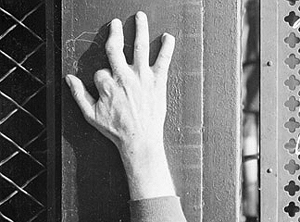
During the 39-game span the Cubs outscored opponents 195 to 68 and their hurlers threw twelve shutouts, held the opposition to one run on eight occasions and two runs in ten games. Chicago used six starting pitchers, Brown (9 starts and 26-6 for the year), Taylor (9 and 12-3), Ed Ruelbach (8 and 19-4), Jack Pfeister (7 and 20-8)), Orval Overall (5 and 12-3) and Carl Lundgren (1 and 17-6). On August 9, Taylor threw the last of his record 187 consecutive complete games, a streak that started in 1901. Not that the Cubs used many pitchers at any point in the season, having only eight on their roster most of the year. It helped that the starters threw 125 complete games, or perhaps THC has cause and effect reversed.
In that era teams didn't use many position players either with only 14 making appearances for the Cubs that year and even that is misleading because three players had only 5 at-bats collectively so effectively the team used only eleven position players. Of course those players were pretty good. The double play combo was Joe Tinker (SS), Johnny Evers (2B) and player-manager Frank Chance (1B) along with catcher Johnny Kling, Harry Steinfeldt at third and an outfield of Jimmy Sheckard, Jimmy Slagle and Fred Schulte.
 (Frank Chance; 1B & Manager, "The Peerless Leader" from vintage baseball)
Most of those position players are little known today and their stats may not look impressive by the standards of 2015 but in the context of 1906 this was a terrific lineup. Arguably, four of the eight regulars could be considered the best in the league at their positions; Chance, Evers, Kling and Sheckard while Tinker wasn't the best only because the incomparable Honus Wagner played shortstop for the Pirates. The lineup led the league in runs scored and by modern measures their defensive efficiency was substantially better than any other team that year.
By golly, wouldn't you know it there's a YouTube video introducing the team and its home park (Wrigley Field had not yet been built).
Oddly, one of the Cub wins was by forfeit in a game with the New York Giants. The circumstances were certainly strange so we'll let Paul Doherty who wrote an article on forfeits for the SABR Research Journal explain:
The second forfeit game that didn't start was scheduled for the Polo Grounds August 7, 1906 with the Chicago Cubs the visitors. During the game of the day before, umpire Jimmy Johnstone had made some decisions that aroused both teams against him. When Johnstone and Bob Emslie reached the ball park Johnstone was told he could not enter the grounds The Giants didn't want him as an umpire after his performance of the day before. Emslie's entrance was not barred so he went inside a short distance then retreated, refusing to take part in the game if his partner was refused admittance. Then Johnstone forfeited the game to the Cubs.Baseball was certainly different in 1906!
Inside the grounds McGraw wanted the game run his way with each team picking a player to form an umpire team. He talked this over with Frank Chance the Chicago manager. McGraw picked his utility man, Sam Strang, to be one of the arbiters, but Chance, after talking to Charles Murphy, president of the Chicago Cubs, who was in the stands, declined to appoint a Cub player to work with Strang. He said the forfeit had already been announced and he took his players off the field to the clubhouse.
Strang, McGraw's umpire, forfeited the game to the Giants on McGraw's orders. Now both teams claimed the forfeit. The next day, National League President Harry Pulliam upheld Johnstone's forfeit decision giving the game to the Cubs because the New York club wouldn't let the umpire in the park. The Giants appealed this decision, but it was a waste of time.
The only Cub losses during this period were on August 19 when Taylor lost to Hooks Wiltse of the Giants (a day after Three Finger Brown beat Christy Mathweson) and on September 2 with Jack Pfeister getting bested by the St Louis Cardinals. During the streak the Cubs beat every one of the other teams in the league though they played the last place Boston Braves only three times in those 39 games, and going 7-0 against both Brooklyn and Cincinnati.
The entire season is full of ridiculously good Cubs streaks. The team split its first 12 games and then went 110-30 thereafter and also won 86 of their last 107 games. Chicago had one ineffective pitcher, Bob Wicks, who managed to go 3-5 before being traded on June 2 so the Cubs were 113-31 in games in which he did not get a decision. Chicago also won 11 of 12 games against the two other 90-win teams in the league, New York and Pittsburgh during their 39 game blitz.
Even with the loss on September 18 the Cubs still finished the season playing well, winning 48 of their last 54 games. Unfortunately it didn't carry over to the World Series which they entered as heavy favorites but lost to their crosstown rivals the Chicago White Sox, also know as The Hitless Wonders, in six games.
 (Baseball-almanac)
Their regular season dominance didn't end with the 1906 season. In 1907 the Cubs started off 47-12 giving them 95 wins in their last 113 regular season games and went on to win the World Series. The Chicago team's best consecutive 154 games performance during 1906-7 resulted in a 122-32 record! The 1908 and 1909 Cubs squads also put on strong closing runs finishing their seasons 40-9 and 37-14 respectively while the pennant winning 1910 team had a mid-season burst in which it won 66 of 90 contests. The windy city team went to the World Series every year except 1909.
A good case can be made that the 1906-10 Chicago Cubs, with an average season record of 106-47, were the best team in National League history. You can read the case for it in this interesting piece at SABR.
Subscribe to:
Posts (Atom)