Sunday, August 14, 2022

The Leopard

 If we want things to stay as they are, things will have to change.

In 2013 I wrote a post after reading Guiseppi Tomasi de Lampedusa's magnificent and melancholic novel, The Leopard.  Set in Sicily in the 1860s during the unification of Italy, it tells the story of Don Fabrizio Corbera, Prince of Salina, as he maneuvers to provide for his family's survival amid the turmoil, even as he knows the era of the aristocrats is fading.  It is the Prince's nephew, Tancredi, a volunteer in Garibaldi's revolutionary army, who gives him the advice quoted above.

I finally got around to watching the 1963 film version of the book, directed by Luccino Visconti and starring Burt Lancaster, Claudia Cardinale, and Alain Delon.  The film was an award winning hit in Europe but was not well received in the U.S., where a half hour was cut before being shown in theaters.  The version I watched was the restored European cut of the film - the only annoying part is that Lancaster is dubbed in Italian.

The film is quite good and a visual feast.  This video essay explores its main themes.

I was quite struck by how The Leopard must have influenced the making of The Godfather I and II a decade later.  The music for all three films was composed by Nino Rota and has obvious similarities.  The look of the Sicilian countryside and towns prefigures the Sicilian scenes in both Godfathers; some of the hillsides and street scenes look identical.  And the figure of the Prince, as embodied in Lancaster, bears a resemblance, in his dignity, reserve, perceptiveness, and intelligence, to Marlon Brando's Don Corleone.

Saturday, August 13, 2022

Thursday, August 11, 2022

Manual

A lament by Ian Bogost on the looming extinction of manual auto transmissions.  Manuals now constitute less than 3% of new cars sold in the U.S., some European car makers are completely phasing them out in the next few years, and electric cars don't even have gearboxes.

I learned to drive on a stick shift in 1967 and drove manuals exclusively until the mid-80s, when I finally gave in and got an automatic.  But then, in 2003, I began driving a 6-gear Nissan 350Z and rediscovered the joys of real driving, and continued to do so until 2016, even taking it out on the Lime Rock track in CT, an exhilarating and exhausting experience.  During our occasional Europe trips I'd always rent a manual with the highlight being mastering the coastal road on the Amalfi Coast with its blind corners and clearances of an inch or so between you and cars going the opposite direction (don't forget to fold in your side view mirrors!).

On our recent France trip I once again rented a manual.  Finding out on our first day I had Covid, I was concerned about getting so sick I could not drive, and Mrs THC, while she'd driven manuals on the hills of San Francisco decades ago, was no longer comfortable doing so, prompting me to try in vain to rent something automatic but finding nothing available, other than large panel trucks not suitable for where we'd be.  Fortunately my very mild symptoms abated within 24 hours (and the Mrs never got it) and was able to enjoy a month of shifting on constricted, winding country roads and navigating through the narrow alleys, in the little town in which we were staying.

From Bogost's piece:

I drive a stick shift. It’s a pain, sometimes. Clutching and shifting in bumper-to-bumper traffic wears you out. . . And when I’m at the wheel, I can’t hold a cold, delicious slushie in one hand, at least not safely. But despite the inconvenience, I love a manual transmission. I love the feeling that I am operating my car, not just driving it.  

But the manual transmission’s chief appeal derives from the feeling it imparts to the driver: a sense, whether real or imagined, that he or she is in control. According to the business consultant turned motorcycle repairman turned best-selling author Matthew Crawford, attending to that sense is not just an affectation. Humans develop tools that assist in locomotion, such as domesticated horses and carriages and bicycles and cars—and then extend their awareness to those tools. The driver “becomes one” with the machine, as we say. 

The manual transmission’s impending disappearance feels foreboding not (just) because shifting a car is fun and sensual, but also because the gearshift is—or was—a powerful cultural symbol of the human body working in unison with the engineered world.

To lament the end of the manual transmission is to eulogize much more than shifting gears. When the manual dies, little about driving will fall away that hasn’t already been lost. But we’ll lose something bigger and more important: the comfort of knowing that there is one essential, everyday device still out there that you can actually feel operating.

Saturday, August 6, 2022

Dear Comrades!

 Dear Comrades!, a 2020 film by Russian director Andrei Konchalovsky, is about the events of early June 1962 in the Soviet city of Novocherkassk.  A Moscow directive raising the price of meat and milk, combined with a reduction of pay in a city factory, led to worker protests, which were suppressed when KGB snipers fired on unarmed demonstrators in a city square.  Accurate information on the events was also suppressed until the last years of the Soviet Union.  The bodies of those killed were buried secretly in unmarked graves at undisclosed locations.  It was only in 1994 that relatives were notified of the location of the burials.

The Novocherkassk massacre also serves as the climax of one of the finest books I've read, and written about twice - Red Plenty and Khrushchev Reflects - a book which should be required reading in college.

The movie is focused on Lyudmila (Julia Vysotskaya, Konchalovsky's wife), a member of the Communist Party City Committee, an absolute believer in the Party who stridently expresses her views and support of the party line. When her daughter becomes a participant in the protests and then can't be found in the aftermath of the shootings in the city square, Lyudmila begins a frantic search to find if she is dead or alive, during which she learns how the Party is literally covering up the extent of the carnage.

Filmed in striking black and white, Dear Comrades! is a movie made in outrage and anger, but it also shows the psychological confusion induced in Soviet citizens, and particularly among Party members when, after a lifetime of immersion in Communist education and sloganeering, they are faced with its brutal reality.  If all their beliefs and sacrifices meant nothing in the end, what is left?  They had no other context, no other reference points, having been so isolated from the rest of the world, and any counter viewpoints within their country silenced - for Lyudmila it is either Stalin or Khrushchev; the striking workers carry posters portraying Lenin.  At one point, Lyudmila, thinking her daughter is dead, laments that if only Stalin were still alive this would not be happening, an echo of those who, in the midst of the Great Terror in the 1930s would say, "if only Stalin knew!" when hearing of yet another random arrest and somehow disassociating the Great Leader from the act, believing he would intervene to stop it, though the truth was Stalin knew very well and, indeed, was its director.

Recommended.

Friday, August 5, 2022

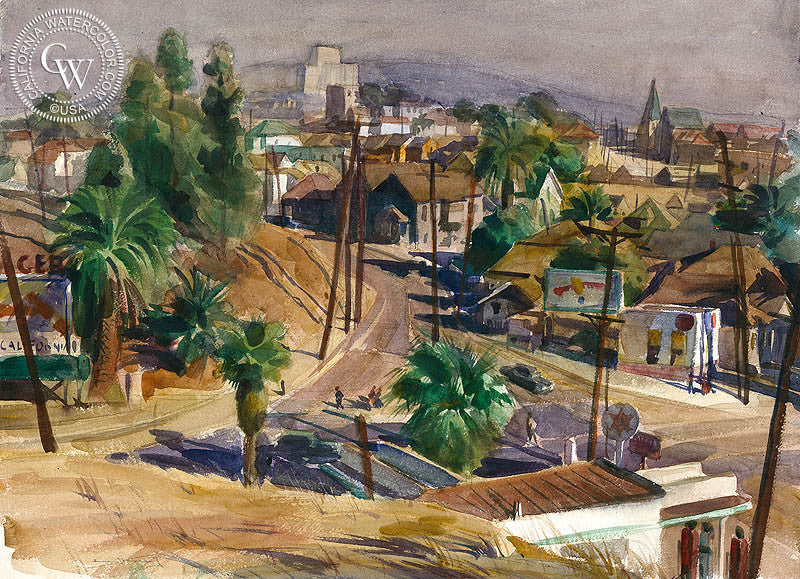
California Scene Painting


Junction at Acton, a limited edition lithograph by Emil Kosa Jr.. Rare vintage art print for sale at CaliforniaWatercolor.com - original California paintings, & premium giclee prints for saleCalifornia Scene Painting is defined in Wikipedia as "a form of American regionalist art depicting landscapes, places, and people of California. It flourished from the 1920s to the 1960s."

One of its leading practitioners was Emil Kosa Jr, whose paintings are featured in this post.  Born in 1903 in Paris, his family moved to the U.S. and then to Czechoslovakia in 1912.  Returning to the U.S. in 1921, Kosa moved to California where, in 1933, he joined the newly formed special effects department at 20th Century Fox where he was soon named art director, a position he held until his death in 1968.

In 1964, Kosa won the Academy Award for Best Visual Effects for his work on Cleopatra and is credited with designing the famous logo of 20th Century Fox.

20th Century Fox Logo PNG Transparent & SVG Vector - Freebie Supply

Emil Kosa, Jr. (1903-1968). Telegraph Hill, San Francisco. Oil on Canvas, 25 x 30 in. The Irvine Museum.Welcome to California, c. 1940's, watercolor art by Emil Kosa Jr. –  California WatercolorEmil Jean Kosa Paintings & Artwork for Sale | Emil Jean Kosa Art Value  Price Guide

Thursday, August 4, 2022

Ain't Misbehavin'

On this date in 1901, Louis Armstrong was born in New Orleans.  I've done a bunch of posts on Louis which you can find by clicking on the tag at the bottom.  Let's celebrate with his 1929 recording of Ain't Misbehavin', featuring that phenomenal closing horn solo in which he musically quotes Rhapsody In Blue (the man loved every type of music from jazz to classical, pop to opera).  Armstrong was to record this tune several more times, but this was his first attempt.

It was this recording that broke Armstrong to a wider audience and set him on the path to stardom.


</