I spent last Thursday and Friday at the
Antietam National Battlefield with Larry - no, not
that Larry, this Larry:
The
battle of Antietam was fought on September 17, 1862 in and around the town of Sharpsburg, Maryland, about 10 miles north of Harpers Ferry (then Virginia, now West Virginia). That single day saw 23,000 soldiers, North and South, killed or wounded (about 10x the number of American casualties on Omaha Beach during D-Day) and it forced Robert E Lee to abandon his plans to invade Pennsylvania and led to the withdrawal of the Confederate Army (the Army of Northern Virginia) south of the Potomac River. It reversed a series of Union military disasters, allowing President Lincoln to declare a Union victory and giving him the political justification for issuing the preliminary Emancipation Proclamation on September 22.
Antietam may not have been a tactical victory for the Union but it was a strategic victory and one of the decisive moments of the Civil War. In September 1862 a successful rebel invasion of Pennsylvania and defeat of the Union army might have triggered diplomatic recognition of the Confederacy by Britain and France - an action under serious consideration in both countries at the time. Once the Emancipation Proclamation was issued it made the chance of foreign recognition negligible.
We took four battlefield tours during the two days. For two of the tours our guide was Ed Bearss (pronounced "bars" as in "I kilt some bars"). This is Ed Bearss.
Ed Bearss is 89. Ed was with the National Park Service (NPS) from 1955 through 1994, serving for the last thirteen of those years as the Chief Historian of the NPS. In 1995 he became Chief Historian Emeritus of the NPS, a position he still holds. If you watched Ken Burns'
The Civil War you saw Ed. The state of most of our military historic sites was very poor 50-60 years ago and Ed played a vital role in the preservation of these sites and the expansion of the parks. Ed Bearss enlisted in the Marines in WWII and fought at Guadalcanal and New Britain, where he was severely wounded spending 26 months in military hospitals. The physical effects of his wounds are still visible today.
A tour with Ed is quite an experience. You are watching a performance. The man knows how to tell a story and he's told it many times before. According to Wikipedia, a Washington Post reporter likened Ed's style to "Homeric monologues". His voice is still commanding and his stamina amazing.
 (Ed in 2005)
 While he was commanding us to move quickly and stay hydrated, he never slowed down and never took a drink himself even on a three hour walk in the area of The Cornfield in the heat and humidity of summer in Maryland. As a bonus, on our bus Ed regaled us with the inside stories of the NPS so we know about some of the interesting personal characteristics of past park superintendents at Antietam and Gettysburg.
Ed still spends up to 200 days a year giving battlefield tours and it was a privilege for us to be able to have this experience and to thank him for what he has done for preserving America's heritage.
We also toured hospital sites in the area around the battlefield. When the battle ended there were 18,000 wounded soldiers around Sharpsburg, a town with 1500 people.
 (Sharpsburg during the Civil War)
 For the townspeople the day of the battle was not the end of their involvement. There were more than 80 hospital sites established in the area for the wounded and the last of them did not close until January 1863. All five of the town's churches became hospitals and two of them had to be demolished and rebuilt because of the damage. We visited a Lutheran church which has a beautiful stained glass window donated in 1894 by the survivors of a Connecticut regiment who had been cared for in the church.
The fourth, and best, tour was with Dennis Frye (the guy in white above), Chief Historian at
Harpers Ferry National Historic Park. Dennis grew up in the Sharpsburg area and has studied the battle since he was a child 40 years ago. He's developed his own compelling presentation style for his tours. Dennis took us on a tour of decisive turning points (some of which were several miles from the battlefield) and had a very non-traditional perspective on the battle. Most historians excoriate the Union commander, George McClellan, for losing a unique opportunity to destroy Lee and his army and end the war. Frye, while not a McClellan fan, makes the case that many of his decisions made more sense in the context of the time than he is given credit for today. Of course, he did drive Lincoln crazy with his "slows" and despite the President's visit to Sharpsburg in early October (see photo) McClellan would not advance leading the President to relieve him in November.
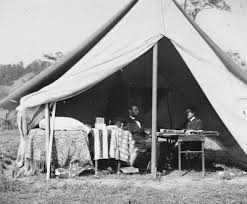 Lincoln and McClellan. Lincoln's the tall guy.
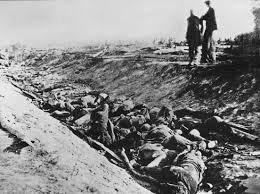
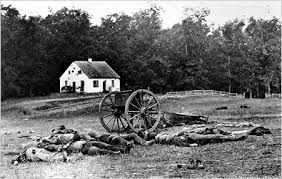
Antietam was also the first battlefield where we have photographs of the dead after a battle. These had quite an impact when published bringing home the reality of the war to the general public for the first time. Below left is a picture of Confederate dead in Bloody Lane (below it is a photograph of the Dunker Church, a key focal point of the battle.) Below right is Bloody Lane as it looks today.
Even if you are not interested in the battle, the
Sharpsburg area is worth a visit. The countryside is beautiful and there has been very little commercial development in the area (unlike Gettysburg). On our tours we went on a lot of small country roads through rolling hills with 19th century stone bridges still intact. The battlefield itself has no development on it. This picture above looks north over The Cornfield. A peaceful setting but within the area covered by this picture (with some additional area on both sides) 8,000 soldiers were killed or wounded in three hours on the morning of September 17.
The tour we were on was conducted by the
Chambersburg Civil War Seminars. These seminars, started in 1989 and sponsored by the Chambersburg, PA Chamber of Commerce, occur three times a year and bring together military historians, authors and the National Park Service experts. I'll do it again.
To read about another significant Civil War battle of 1862
go here.


.JPG)
.JPG)


 The answer turns out to be “a lot of things”, and they all happen
very quickly, and it doesn’t end well for the batter (or the pitcher). I
sat down with some physics books, a Nolan Ryan action figure, and a
bunch of videotapes of nuclear tests and tried to sort it all out.
The answer turns out to be “a lot of things”, and they all happen
very quickly, and it doesn’t end well for the batter (or the pitcher). I
sat down with some physics books, a Nolan Ryan action figure, and a
bunch of videotapes of nuclear tests and tried to sort it all out.