Patti Smith in Boston on Monday night. One of the greatest singles in rock history. Co-written with Bruce Springsteen and released in 1978. Patti is now 67. This song still gets to me.
Found via Maggie's Farm.
Friday, November 30, 2012

Let's Hope So
. . . Regarding both possibilities raised in the last paragraph below (I am trying to be optimistic).
From Arnold Kling's askblog:
From Arnold Kling's askblog:
The Left’s Post-Election Self-Examination?
Brad DeLong writes,
Until the election, this sort of question had only been asked by conservative economists.
Perhaps this is an early example of the pattern of self-examination that I thought might take place after the election. When it comes to their policy portfolios, the Republicans will be second-guessing themselves in terms of political positioning. Meanwhile, the Democrats may be second-guessing themselves in terms of feasibility.
Massachusetts has been walking down this exchange-and-public-program-expansion road for six years now, since Mitt Romney signed RomneyCare. Massachusetts has been vacuuming up doctors and nurses from Costa Rica and elsewhere and still has been finding that the cost of treating your state population is higher when 97% are insured than it was when 88% were insured. And there aren’t enough loose doctors and nurses in the rest of the world for the ACA to vacuum up enough of them to meet the needs of not 1 state but 50 states.
…What is your guess as to what will happen if the ACA works for access, works for quality, works for coverage–but the extra health-care workforce needed isn’t there, and the lines start to get longer?Pointer from Tyler Cowen.
Until the election, this sort of question had only been asked by conservative economists.
Perhaps this is an early example of the pattern of self-examination that I thought might take place after the election. When it comes to their policy portfolios, the Republicans will be second-guessing themselves in terms of political positioning. Meanwhile, the Democrats may be second-guessing themselves in terms of feasibility.
Thursday, November 29, 2012
Where Is The Real Mona Lisa?
If you thought it's in the Louvre in Paris, think again. DaVinci's masterpiece is really in a private home in Queens, New York. It's true - I saw it in a movie - The Freshman, a 1990 film starring Marlon Brando and Matthew Broderick, directed by Andrew Bergman who wrote the original screenplay for Blazing Saddles.
Matthew Broderick plays a kid from Vermont who has just arrived in New York to start his first year of college at NYU. Marlon Brando plays - well, just watch the trailer for the movie and I think you can tell who he's playing, except that in this film they call him Carmine Sabatini and he plays the role impeccably.
Also in the cast are Penelope Ann Miller as Carmine's daughter, "the lovely Tina", Bruno Kirby, and Maximilian Schell as Larry London, the operator of a very unusual gourmet eating experience. Also featured is Paul Benedict as Professor Fleeber, a teacher of film history who is fixated on (what else?) The Godfather.

A very funny and eccentric movie with a star turn by a Komodo Dragon.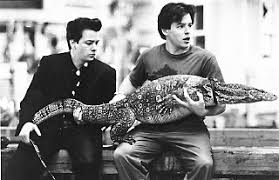
And here's a little more Brando from the film.
Matthew Broderick plays a kid from Vermont who has just arrived in New York to start his first year of college at NYU. Marlon Brando plays - well, just watch the trailer for the movie and I think you can tell who he's playing, except that in this film they call him Carmine Sabatini and he plays the role impeccably.
Also in the cast are Penelope Ann Miller as Carmine's daughter, "the lovely Tina",
A very funny and eccentric movie with a star turn by a Komodo Dragon.
And here's a little more Brando from the film.
Wednesday, November 28, 2012
Boogie Fever
We're going to go backwards in time to explore the boogie.
First up is Chris Isaak with Baby Did A Bad Bad Thing from 1995. The production is top-notch. The bass plus Isaak's voice and then the rockabilly guitar kicking in make it something special. And it certainly does sound bad, whatever that thing was, which you can confirm by watching the MTV video.
Next is LaGrange by the boys from ZZ Top (1973) who are still rocking in this more recent clip. And you can't beat that sophisticated lyricism:
This is John Lee Hooker with Boom Boom from the early 1960s on British TV. You can hear where ZZ Top got its vocal stylings. I saw Hooker play at a club in Worcester, Massachusetts in the 1970s. The man had a groove. And now you can hear where ZZ Top and Chris Isaak got the beat. This is John Lee Hooker again doing Boogie Chillen - it's a 1992 live version. The circle is unbroken!
First up is Chris Isaak with Baby Did A Bad Bad Thing from 1995. The production is top-notch. The bass plus Isaak's voice and then the rockabilly guitar kicking in make it something special. And it certainly does sound bad, whatever that thing was, which you can confirm by watching the MTV video.
Next is LaGrange by the boys from ZZ Top (1973) who are still rocking in this more recent clip. And you can't beat that sophisticated lyricism:
Rumour spreadin' a-'round in that Texas town
'bout that shack outside La Grange
And you know what I'm talkin' about.
Just let me know if you wanna go
To that home out on the range.
They gotta lotta nice girls ah.
This is John Lee Hooker with Boom Boom from the early 1960s on British TV. You can hear where ZZ Top got its vocal stylings. I saw Hooker play at a club in Worcester, Massachusetts in the 1970s. The man had a groove. And now you can hear where ZZ Top and Chris Isaak got the beat. This is John Lee Hooker again doing Boogie Chillen - it's a 1992 live version. The circle is unbroken!
Tuesday, November 27, 2012
Master And Commander
Their first encounter was on a warm evening in 1800 in the music-room of the Governor's House at Port Mahon, Minorca in the Balearic Islands off the coast of Spain where both had gone to hear a performance of Locatelli's C major quartet.
That first meeting between Jack Aubrey and Stephen Maturin did not go well. Maturin chastised Aubrey for beating time with his hand upon his knee leaving Jack with "the strongest inclination to snatch up his little gilt chair and beat the white-faced man down with it; but he gave way with a tolerable show of civility".
Shortly thereafter circumstances draw them together and it is the start of, as Humphrey Bogart said to Claude Rains, "a beautiful friendship".
It is also the start of the twenty volume Aubrey-Maturin series written by the English novelist Patrick O'Brian (1914-2000), a series referred to by a New York Times reviewer as "the best historical novels ever written". In this instance I am very happy to find myself in agreement with the Times.
O'Brian was a modestly successful (and very secretive) writer who finally found broader success with the publication of the first novel in the series, Master And Commander, in 1970 with the last volume being published around the time of his death. I first heard of the books in the late 1980s, around the time they began to be published in the United States, and was immediately drawn into their world.
The novels are set in the world of the British navy during the Napoleonic Wars but they are much more than an account of battles. They tell one long, coherent story and can be viewed as early 19th century "novels of manners" set mostly at sea (though a couple of the books are set entirely on land without any naval engagements).
Most historical fiction, even the best, contains some element of a modern-day worldview or consciousness in its writing. O'Brian's novels are written as though he is living in 1805. Perhaps it helped that from 1949 until his death, he and his wife lived in a small, isolated Catalan village in southern France.
Jack Aubrey, the ambitious captain we meet in the first book has the sensibility of his time while Stephen Maturin, the Irish-Catalan surgeon and naturalist (and spy for the British Admiralty) is a character who could simply not exist in today's world.
Full of arcana about 19th century sailing and warships, food and nature the books spawned a cottage industry of ancillary publications. There are books explaining its lexicon (A Sea Of Words), a cookbook based on its recipes, studies of the British navy (Jack Aubrey Commands) and biographies on the characters upon which Aubrey is based.
The series also inspired one of the finest film adaptations of a historical novel, Master And Commander, released in 2003 and starring Russell Crowe as Jack Aubrey, which was nominated for ten Academy Awards. Despite being named for the first book in the series, it is actually a combination of parts of the stories from three of the novels. This YouTube video by a fan of the series captures the spirit of the film.
In Peter Weir, the film had a director who matched the sensibilities of the novel. Like O'Brian he builds an entirely self-contained 19th century world. Weir is an Australian director who started in the late 1970s making "new wave" Aussie films such as Picnic At Hanging Rock and Gallipoli (with Mel Gibson). In 1983 he made The Year Of Living Dangerously with Gibson and Sigourney Weaver which is set in 1965 Indonesia during the run up to the revolt that overthrew President Sukarno (definitely worth seeing). In the U.S. his first big hit was Witness with Harrison Ford.
Russell Crowe is perfect as Jack Aubrey.
Weir recreates life on a British warship with all its cramped quarters, class distinctions, discipline and superstitions and even the smaller roles are well-cast. David Threlfall, as Preserved Killick, Aubrey's steward is as cranky as in the books and James D'Arcy as young Lt. Tom Pullings is as if he jumped out of one of the novels.
The other actor of note is young Max Pirkis who plays Midshipman William Blakeney. The British navy often had boys between nine and twelve years old serving on its ships and Blakeney and his compatriots are major characters.
Whether it is day to day life on ship, the intimacy of the officers' dinner, battles with their French nemesis, the Archeron, plunging through stormy, wintry seas or a quieter sojourn in the Galapagos, the film conveys a sense of realism about its time rarely found in such movies and it bears repeated viewing.
Monday, November 26, 2012
Why Don't You Do Right
Peggy Lee with Benny Goodman on clarinet along with his orchestra. This was Peggy's breakout hit in 1942, reaching #4 on the charts and selling over one million copies. Composed by Kansas Joe McCoy.
Subscribe to:
Posts (Atom)