Sunday, June 30, 2019

Two Museums

Yesterday's post referenced my recent visit to two WW2 Museums, the National WW2 Museum in New Orleans and the National Museum of the Pacific War in Fredericksburg, Texas.  We spent a day and a half at each and both are worth visiting though they provide very different experiences.

Let's start with the setting; the better known of the two, the National WW2 Museum, is in the tourist mecca of New Orleans, a city I don't care for, while the Pacific War museum is in a small town in the Texas hill country an hour and a half from Austin and San Antonio.  It's no surprise the New Orleans museum has many more visitors.

The focus is broader in New Orleans, covering America's global participation in the war (both museums focus on America's role, with minimal attention to our allies), while Fredericksburg is exclusively about the Pacific Theater.  Frederickburg is the birthplace of Admiral Chester Nimitz, commander of the Pacific Fleet in WW2, which explains its location and focus.  The town was founded by German settlers in the 1850s and today the main street is filled with German restaurants, breweries, and wine tasting shops (the surrounding area is covered with vineyards).  And Luckenbach Texas where you can sit in the shade, relax, have a beer, and listen to some country music.


New Orleans is flashier with more active visuals, including movies such as Beyond All Boundaries, narrated by Tom Hanks, which we found to be the only disappointing aspect of either museum.  The Pacific War exhibits are more text heavy and for pure history buffs I thought superior.  Perhaps because of the different nature of the exhibits and fewer visitors I found Fredericksburg more somber.

New Orleans is designed around a narrative of the triumph of democracy and the sacrifices of our soldiers and those on the home front while Fredericksburg is a campaign narrative as we slog through the Pacific on our way to Japan.

Both museums stress the staggering scope of America's industrial ramp up and production during the war though New Orleans does a more comprehensive job.  We simply could not do this much, this quickly, today.  We built a titanic manufacturing complex and created the atomic bomb in three years.  In the 21st century we'd be litigating over environmental impact statements, rights of way, and a multitude of other issues for decades.

Both museums also address the uncomfortable issues of segregation in the armed forces and the detention of American citizens of Japanese ancestry, and do so in a fair manner.  However, there is one puzzling omission in New Orleans, particularly as the museum casts the war as a struggle between democracy and dictatorship - the role of our ally, the Soviet Union, without which Germany might not have been defeated or, if defeated, at a much greater cost to the United States.  While I think we made the right decision in WW2, there is no doubt that having as our ally a murderous dictatorship which ended up occupying half of Europe complicates the simple narrative presented by the museum and visitors would have benefited by having to confront this.  While this aspect was also ignored in Fredericksburg it's understandable since the Soviet Union was neutral in that conflict until its final weeks.  Even with that, the Pacific War museum notes that hundreds of thousands of Japanese civilians perished during the Soviet occupation of Manchuria.

Perhaps because of its narrower scope, the Pacific War museum captures some aspects of its theater of war that were absent in New Orleans, emphasizing how Japanese racial supremacy, its ongoing conflict with, and contempt for, China, and America's attempt to intervene on behalf of China, triggered Japan's attack on the U.S. 

The Fredericksburg museum has a unique aspect, an outdoor two acre recreation of Japanese defenses on a Pacific island.  Throughout the year they run special programs at this location.  If we return, we'll coordinate to make sure we are there during one of those programs.

Both museums understate the degree of conflict about strategy among America's military services and, at times, with FDR, during the course of the war (not to mention the disagreements with the British).  The Pacific War museum does touch on Admiral Halsey falling for Japanese deception plans at Leyte Gulf and Admiral Nimitz's decision to proceed with the Pelilieu invasion despite updated intelligence undercutting the value of taking the island, while at New Orleans the terrible decision by General Hodges and Bradley to launch the Hurtgen Forest battle is indirectly criticized, though other major controversies are ignored, such as Mark Clark's inept handling of the Anzio landing and his later decision to seek personal glory by occupying Rome instead of cutting off retreating German forces.

It is a very emotional experience going through both museums, reflecting on the sacrifices and the costs of the war on millions.  The toughest moments for me were at Fredericksburg - reading Mrs Sullivan's letter (of which I wrote yesterday) and listening to the reminiscences of a medic who served at Okinawa about how over the decades he has remembered a Marine sergeant and a sailor who died while he was caring for them.



Saturday, June 29, 2019

The Saddest Letter

Last week my friend LDC (for his pithy words of wisdom read the right sidebar) and I visited two WW2 Museums.  The better known is the National WW2 Museum in New Orleans, while the lesser known National Museum of the Pacific War is located in the lovely small town of Fredericksburg in the Texas hill country west of Austin.

It was at the Pacific War Museum I found myself in a small alcove reading the letter below, an inquiry from Mrs Alleta Sullivan of Waterloo, Iowa to the Bureau of Naval Personnel, inquiring about a rumor she'd heard regarding her five sons serving on the light cruiser USS Juneau.  The combination of her humble apologetic inquiry ("I hated to bother you") and my knowledge of the fate of her boys made it very distressing to read.  I barely made it through.  As a child I learned about the Sullivan brothers from seeing the 1944 movie The Fighting Sullivans on TV but had never seen Mrs Sullivan's letter.


Thomas and Alleta Sullivan had six children.  Five boys, George (27), Frank (26), Joe (24), Matt (23) and Al (22), and a daughter, Genevieve.  George and Frank had already served in the navy and been discharged when Genevieve's boyfriend, also a sailor, was killed at Pearl Harbor.  All five brothers enlisted on January 3, 1942.  At their request, they were allowed, despite Navy discouragement of the practice, to serve on the same ship.  Al was married and had a child while Frank and Joe were engaged.
The Sullivan brothers, Joseph, Francis, Albert, Madison, and George, are pictured on board USS Juneau (CL 52) at the time of her commissioning at the New York Navy Yard, Feb. 14, 1942. All were lost with the ship following the Nov. 13, 1942, Battle of Guadalcanal.

In November 1942, the five brothers were on the USS Juneau, a new light cruiser, on station in the Solomon Islands.  From August through the end of that year, the US and Japanese navies fought a series of fierce engagements, triggered by the American landing on Guadalcanal, actions in which both services suffered severe losses.

In the early morning hours of November 13 the Juneau was damaged by a torpedo.  Late that morning as it limped back to base a Japanese submarine fired a torpedo which struck the ammunition storage area of the cruiser.  The ensuing explosion was so huge that the Navy determined there could be no survivors and did not even perform a search.  Eight days later a Navy plane spotted ten survivors.  It turned out that perhaps 100 of the 697 man crew may have survived the initial explosion but only the ten rescued eight days later made it.  All of the Sullivan boys were gone; at least one survived for a while after the sinking.

However, because the Navy hoped more survivors would be found, the affected families were not notified for some time.  Which explains Mrs Sullivan's letter.

Thomas and Alleta Sullivan displayed remarkable resilience in the face of this terrible news with Alleta, in particular, making enormous contributions to the war effort.  Alleta, her husband, and daughter spoke to employees at more than 200 plants and shipyards across America and appeared in support of war bond rallies.  By war's end they had spoken to more than 1 million workers in person and millions more through radio broadcasts.

Here's Mrs Sullivan with Marlene Dietrich serving servicemen at the Hollywood Canteen in 1944:
Alleta Sullivan, left, mother of the five Sullivan brothers who lost their lives in the sinking of the cruiser USS Juneau, works alongside actress Marlene Dietrich as they serve servicemen in the USO Hollywood Canteen, Calif., Feb. 9, 1944.

On September 30, 1943 Mrs Sullivan christened a new destroyer, USS The Sullivans, the first American navy ship named for more than one person.  The Sullivans saw heavy action in the Pacific during 1944 and 1945, remaining in service until 1965.  Alleta Sullivan's grandson served on the ship in its last years.  The Sullivans can still be found on station at the Buffalo and Erie County Naval and Servicemen's Park.

In 1997, a new USS The Sullivans was commissioned and present for the event was Alleta Sullivan's great granddaughter, Kelly Sullivan Loughran.  The Sullivans remains in service.  In early 2000, while at port in Yemen, Al Qaeda unsuccessfully tried to attack The Sullivans but its overloaded boat sank.  Later that year, Al Qaeda succeeded in its attack on USS Cole in the same harbor.

According to Kelly:
"the story that sticks with her the most is that long after the war, after the movie, the media and the ceremonies had faded, Alleta would receive house calls from Sailors that either knew her sons or who just wanted to stop by and extend their condolences. Kelly said her great-grandmother would often cook them a hot meal and offer them a place to stay for the evening or the weekend."
Thomas Sullivan passed in 1965, Alleta in 1972.  On March 17, 2018 Paul Allen's exploration team located the wreckage of USS Juneau at a depth of 13,800 feet.


Friday, June 28, 2019

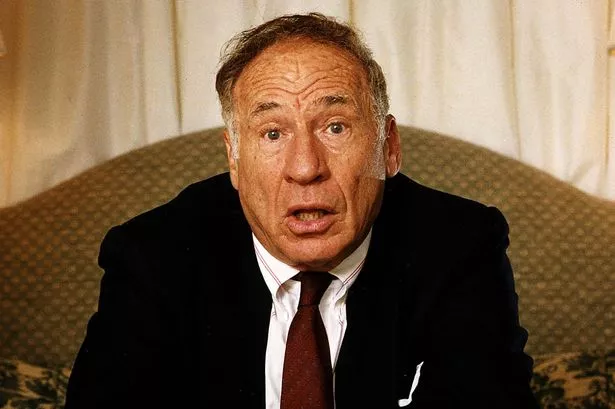
Happy Birthday, Mel Brooks!

Image result for mel brooks

Mel turns 93 today.  Here he is on why he's still alive and full of energy:
"Look, I really don't want to wax philosophic, but I will say that if you're alive, you got to flap your arms and legs, you got to jump around a lot, you got to make a lot of noise, because life is the very opposite of death.  And, therefore, as I see it, if you're quiet you're not living.  I mean you're just slowly drifting into death.  So you've got to be noisy, or at least your thoughts should be noisy and colorful and lively.  My liveliness is based on an incredible fear of death.  In order to keep death at bay, I do a lot of "Yah! Yah! Yah!".  And death says, "All right.  He's too noisy and busy.  I'll wait for someone who's sitting quietly, half asleep.  I'll nail him.  Why should I bother with this guy?  I'll have a lot of trouble getting him out the door."  There's a little door they gotta get you through. "This will be a fight", death says. "I ain't got time". "
As a kid I'd heard the 2,000 Year Old Man routines with Carl Reiner (who he met in 1952 and with whom, at least as of a couple of years ago, had dinner with most nights) but it was seeing The Producers in 1968, the first film written and directed by Brooks, that made me a fan.  Zero Mostel and Gene Wilder from one of my favorite scenes:


In a telling commentary on 21st century America, Blazing Saddles, satirizing bigots and racists, would not be made today.  Here's a sample with Brooks as the Yiddish speaking Indian chief:

Tuesday, June 25, 2019

Crossfire

Stevie Ray Vaughan at his peak in 1989 on a nameless TV show.  Without his band Double Trouble but backed by a terrific house band playing Crossfire.  What a groove and listen to his guitar tone!
I am stranded, caught in the crossfire

Friday, June 21, 2019

The Medal

On Memorial Day, we published a post on Johnnie D Hutchins, whose actions in the South Pacific saved his crew and ship at the cost of his life, actions for which he posthumously received the Medal of Honor.

Yesterday we visited the National WW2 Museum in New Orleans.  On display was Hutchins' Medal of Honor.


Thursday, June 20, 2019

Take On Me

A worldwide hit from 1985 by the Norwegian band A-ha.  Played endlessly on MTV because of its innovative video, which has now accumulated over 900 million views. This is their acoustic version from 2008.  As one of the comments on YouTube says, "Basically every 80s song played slowly becomes the saddest song ever."  And the first time I'd ever listened to the lyrics.