— Saul Goodman ⚖ (@itsSaulGoodman) April 21, 2024
Lalo, Gus, Mike, and Howard. They're all gone now. Lalo shot Howard. Gus killed Lalo. Mike buried Howard and Lalo, and then Walt killed Gus and Mike.
— Saul Goodman ⚖ (@itsSaulGoodman) April 21, 2024
Lalo, Gus, Mike, and Howard. They're all gone now. Lalo shot Howard. Gus killed Lalo. Mike buried Howard and Lalo, and then Walt killed Gus and Mike.
. . . in examining politically-charged and high-profile issues such as these, the Office must exercise - and has exercised - special care. First, juries can bring strongly held views to the courtroom in criminal trials involving political subject matters, and those views can, in turn, affect the likelihood of obtaining a conviction, separate and apart from the strength of the actual evidence and despite a court's best efforts to empanel a fair and impartial jury." (p.5)
Let me put this in plain English. Any prosecution filed in Federal Court by Durham would have had to be in the District of Columbia or the Eastern District of Virginia. Durham recognizes that in a politically charged case in those districts you cannot convict anyone coded as anti-Republican. In 2020, Biden won 95% of the vote in DC and 81% in Arlington County, Virginia.
The reality is that the Federal workforce and the consultant/lobbyist blob that lives in these areas are heavily Democratic and have grown more radical over the years. This is a problem not just for the legal system, it goes to whether our democracy can work in a fair way.
It is entrenched and very astute on ways to preserve itself. For many reasons, the current system needs to be disrupted.
Article 2, Section 1 of the U.S. Constitution states,
The executive Power shall be vested in a President of the United States of America.
Because of the dominance of Democrats in federal service, a Democratic president can effectively implement their agenda, but a Republican president will not get deference from that same bureaucracy, which is protected by civil service and union rules and almost impossible to fire obstructionists. A few years ago I was seated at a ball game next to a guy who had recently retired as a senior economist in the Department of Agriculture. When I asked what his job involved, he replied, "making sure political appointees didn't make any important decisions." During the Trump administration, the president encountered continual obstruction on implementing his policies. Finally, and too late, like so many things he did, in October 2020 Trump issued an Executive Order creating created a new job category for federal employees in policy-related positions, dubbed Schedule F, that would exempt them from civil service protections and make them easier to remove. After all, if the President is vested with the executive Power under the Constitution, why should he not be able to control the executive branch, instead of leaving the Power with unelected bureaucrats?
However, to ensure that the bureaucracy remains dominated by Democrats, the Biden administration's Office of Personnel Management just issued final regulations that according to Government Executive online:
The new regulation — which will be published in the Federal Register for public inspection on Thursday — seeks to provide 2.2 million federal employees with defined protections that would make it difficult for a future administration to re-apply the Trump policy, known as Schedule F.
Democrats understand how critical it is for the party to maintain control of the Federal government, regardless of which party controls the Presidency. This is an undermining of the constitutional authority of the President and is a direct attack on our democracy. It also ensures that those living in DC and surrounding districts will remain loyal to the party, with the consequences for our legal system outlined in the Durham Report.
In his hypocritical statement, released at the time of the OPM Rule, President Biden claimed:
"Today, my administration is announcing protections for 2.2 million career civil servants from political interference, to guarantee that they can carry out their responsibilities in the best interest of the American people,"
It is precisely because Democratic control of the bureaucracy allows the party to politically interfere with our democracy when a president of the opposing party is in office that the new rule is being promulgated.
For more on the danger of the administrative state, read this piece by Philip Hamburger of Columbia Law School and founder of the New Civil Liberties Alliance, an organization I support.
-----------------------------------------------------
(1) For my other posts on the Durham Report go here.
Vanilla Fudge doing their cover of The Supremes' You Keep Me Hangin' On, a #1 hit for the Motown group in 1966. This is from the Ed Sullivan Show on January 14, 1968. For the full nearly 7-minute album version listen here. One of the great covers in rock. Fudge specialized in slowed-down versions of rock and pop songs. I listened to a lot of their stuff. Drummer Carmine Appice is the best-known member, going on to play with Rod Stewart and many others, along with authoring a popular training book for drummers. Three of the four original band members, including Appice, toured as recently as 2022.
I may write this guy in.
We have quite a choice ahead of us deciding between Trump and Biden. Here are my thoughts on whom to vote for. pic.twitter.com/kB2yhdw3Pe
— Frank J. Fleming (@IMAO_) March 19, 2024
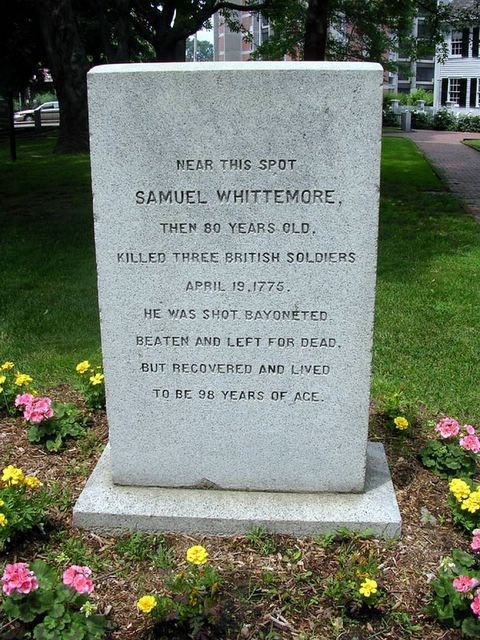
What were the 70 men gathered on the Lexington Green before dawn thinking as the sky began to brighten? They knew the Regulars were coming - they weren't called the British because that word included those gathered on the Green. They would have heard the approach of the Redcoat column coming up the road and then the voices of the officers. Within a few minutes seven would be dead. April 19, 1775.
The British moved on to Concord where they met disaster and then had to fight their way back to Boston. Retracing their steps from Lincoln to Concord along what is now known as Battle Road and taking casualties all the way, they entered Arlington. Nearing Arlington's border with Cambridge at Alewife Brook, the Redcoats encountered 78 year old Samuel Whittemore. Whittemore was a farmer with extensive military experience, fighting in both King George's War (1744-48) and the Seven Years War (1756-63). He was also quite prolific in his personal life having, by 1775, more than 180 direct descendants, most living in the same area.
Whittemore, with his home directly along the road of British retreat, decided he needed to do his part. Taking his musket and pistols, he waited until the Redcoat column approached, rose up from behind his stone wall and fired his musket, killing a soldier. As the British advanced on him, Whittemore drew his pistols and killed two more. With that the British were upon him and he was shot in the face, bayoneted somewhere between 6 and 13 times, clubbed in the head with a musket, and left for dead.
Several hours later, neighbors noticed Samuel was still moving and brought him to the town doctor who proclaimed there was nothing to be done for him other than dressing his wounds and waiting for Whittemore to die. They waited 18 years, as Samuel Whittemore died in 1793 at the age of 96.
The engraving on the marker in the picture is inaccurate as he was only 78 at the time. The house seen to the right of the marker is Whittemore's home, which still stands. For a decade I worked just on the other side of Alewife Brook on Whittemore Avenue in Cambridge. You can read more about the British retreat from Concord in The Road Back.
Today is the 249th anniversary of the start of the American Revolution. Next year will be the 250th and the year after that the 250th anniversary of the Declaration of Independence. Time will tell if that nation, conceived in liberty, will continue to endure.
