Showing posts with label 50s Music. Show all posts

Monday, January 22, 2024

Without A Song

Without a song, the day would never end
My first Perry Como post!  I became aware of this song when it was singled out by Bob Dylan in The Philosophy of Modern Song, one of my favorite books of the past few years.

The most unhip guy I remember on TV from my childhood (other than Lawrence Welk).  This is how Dylan got me to listen:

Perry Como was the anti-Rat Pack, like the anti-Frank; wouldn't be caught dead with a drink in his hand, and could out-sing anybody.  His performance is just downright incredible.  There is nothing small you can say about it.

Perry is also the anti-American Idol.  He is anti-flavor of the week, anti-hot list and anti-bling.  He was a Cadillac before the tail fins; a Colt .45, not a Glock; steak and potatoes, not California cuisine.  Perry Como stands and delivers.  No artifice, no forcing one syllable to spread itself thin across many notes.

Perry Como lived in every moment of every song he sang. . .  When he stood and sang, he owned the song and he shared it and we believed every single word.  What more could you want from an artist?

The song was recorded by Perry a month before I was born in 1951, and composed in 1929 with music by Vincent Youmans and lyrics from Billy Rose and Edward Eliscu.  Now I love listening to it.

Thursday, November 16, 2023

The Archivist

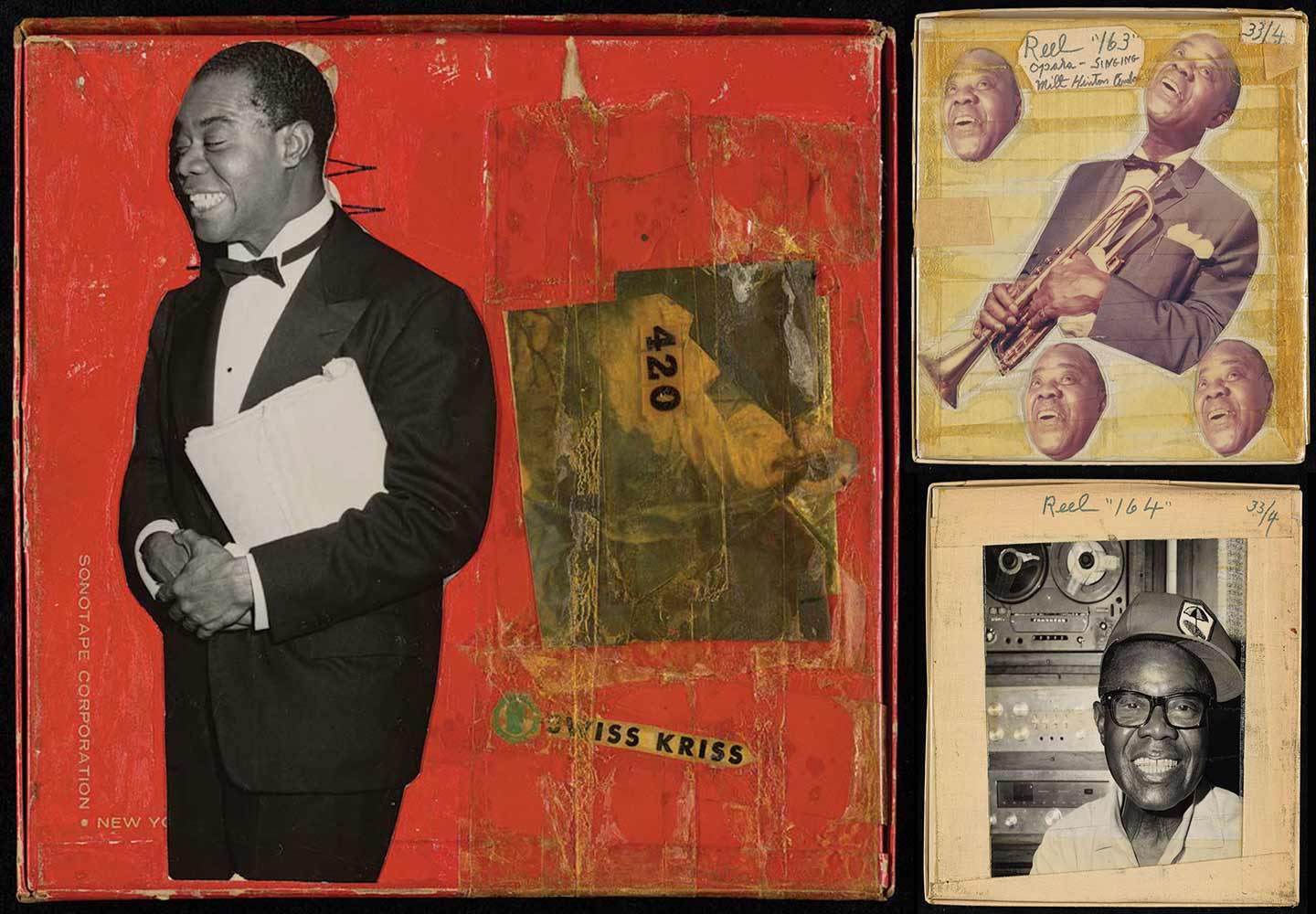
Armstrong made his own collages, cut from photos and magazine pages, as covers for his tape recordings.

A sweet article from The Nation on Louis Armstrong and his legacy.  The photo above is from a collage made by Armstrong for the cover of one of the many boxes used to store his hundreds of hours of tapes.

The author, Ethan Iverson, writes about Armstrong's tapes:

Already an inveterate letter writer, Armstrong started recording home audiotapes in 1950. On the road during that decade, doing hundreds of one-nighters a year, Armstrong toted around a custom-made steamer trunk with two tape recorders and a record player. He would record anybody and everybody while goofing off in his hotel room.

While he slowed down the relentless taping for a time in the 1960s, Armstrong came back for a last act from 1969 until his death in 1971, partly because Lucille bought him two state-of-the-art Tandberg reel-to-reel machines. Armstrong spent hours and hours in his study, creating roughly 200 mix tapes on the Tandbergs and writing down annotated playlists.

The total collection in the Louis Armstrong Archive numbers more than 60,000 items, including books, records, tapes, photos, letters, and scores.  

Iverson provides a warm appreciation of Armstrong's place in American musical history.  More than a place actually, Louis was a pivotal figure.  Read the article and enjoy some time with the great man.

I visited his home, now a museum, in the Corona neighborhood of Queens, a few years ago and highly recommend it.  Earlier this year, the Louis Armstrong Center opened across the street so another visit may be in order.

I also learned that in 2012 the only film of an Armstrong recording session was discovered in a storage facility.  From 1959, it's I Ain't Got Nobody.  Accompanying musicians are Danny Barcelona (drums), Mort Herbert (bass), Billy Kyle (piano), Trummy Young (trombone), and Peanuts Hucko (clarinet).  The song was composed in 1915 by Roger Graham and Spencer Williams.  You can find all my Armstrong posts by clicking on the Armstrong tag at the bottom.

Monday, November 13, 2023

Stars Fell On Alabama

 It's been a while since we've heard from Frank Sinatra.  This is from his peak in the 50s, Stars Fell On Alabama, music composed by Frank Perkins, lyrics by Mitchell Parish, and featuring a Nelson Riddle arrangement.  The song was apparently inspired by a November 12, 1833 meteor shower in Alabama though what the connection was with Perkins, born in Salem, Massachusetts, and Parish, real name Michael Hyman Pashelinsky and born in Lithuania, I don't know.

This was the THC Daughter's favorite song when she was little so it brings back wonderful memories anytime I listen to it.

Monday, July 31, 2023

It Ain't Necessarily So

Ella Fitzgerald and Louis Armstrong have fun deconstructing this Gershwin tune from Porgy & Bess.

Saturday, October 22, 2022

Lush Life

A song that could only have been written in that brief interval between 1945 and the end of mid-century America in November 1963.  The opening:

I used to visit all the very gay places
Those come-what-may places
Where one relaxes on the axis
Of the wheel of life
To get the feel of life
From jazz and cocktails

And those ending lines:

I'll live a lush life
In some small dive
And there I'll be
While I rot with the rest
Of those whose lives are lonely, too

Composed by Billy Strayhorn, Duke Ellington's frequent collaborator.

Vocal by Ella Fitzgerald, who effortlessly handles the difficult melody.  Oscar Peterson on piano.

Thursday, April 7, 2022

It's Alright With Me

It's the wrong time
And the wrong place
Though your face is charming 
It's the wrong face
Composed by Cole Porter for the 1950s musical Can Can and performed by the magnificent Ella Fitzgerald.


Wednesday, December 29, 2021

By The Numbers

Does anyone know what time it is?

The Mamas & The Papas with a song featured on the soundtrack of Once Upon A Time in Hollywood, though Tarantino's vision of the young girls coming to the canyon is a lot scarier than that of the M&Ps.

11 O'Clock Tick Tock.  Sonic treats from The Edge. 

Does anyone know what year it is?

From Harry Nilsson's first album.  The only person to work with all four Beatles on their solo projects.

Do you remember when 1999 seemed so far in the future?  It's longer from 1999 to now than from when the song came out to 1999.

Who ya gonna call?

For Mr Wilson Pickett please call 634-5789; for Jenny 867-5309.

THE COUNTDOWN

Chrissie Hynde and the Pretenders go the extra 2000 miles.

Like to dance?  Mr Pickett is here once again to help - he knows a thousand.

A little frenzy from the Hundred Mile High City.  From the movie Lock, Stock, and Two Smoking Barrels 

If 99 and a half just won't do, and you got to have a 100, once again please consult the Wicked Pickett.

You try crying precisely 96 tears.

From the rock n roll years of REM.

Strange things going on out on Highway 61.

The number for Toots & The Maytals is 54-46.

The first 48 Funks weren't good enough.  But wait till you hear #49!

Variations on the theme of 45 from Elvis Costello.

34 Ghosts IV from Trent Reznor of Nine Inch Nails.  The source of the irresistible riff in Old Town Road by Lil Nas X.

The problems of 20th Century Man may have carried over to this century.

Too many dismal, dull affairs caused the 19th Nervous Breakdown.

I was 18 once.  So was Alice Cooper.

Where'd the klezmer band come from?

I'm doing fine on Cloud 9.  You?

"Power lines have floaters so the airplanes won't get snagged" 

I thought there were only seven days in a week.

The title is 7 And 7 Is but they never tell you what it adds up to.

From the fantasy years of Genesis.

If 6 was 9, I'm gonna live my life, the way I want to.

Take a few minutes to be cool with Dave Brubeck.

Shane Victorino's walk-up music in 2013.

Two heads can be good together.  And Jefferson Airplane should know.

And two hearts can beat as one. 

Aimee Mann tells us one is the loneliest number.

Sinatra agrees.  Particularly at a quarter to three.

But U2 is not completely sold on the concept.

3/5 of a mile in 10 seconds is 216 miles an hour.

And now we get into negative numbers.  Appropriately so.

----------------------------------------------------

All songs from my music library. 

Monday, November 16, 2020

What Is This Thing Called Love?

Sinatra at his finest, from his 1955 album of torch songs, In The Wee Small Hours.  Composed by Cole Porter.  Impeccable arrangement by Nelson Riddle.


Thursday, July 2, 2020

Just One Of Those Things

A gem from Cole Porter.  Often performed in a light, upbeat style, Frank Sinatra's interpretation is different.  First up is from the 1950s movie Young At Heart, followed by a very slowed down, saloon song version live from The Sands in Vegas in 1961.  You'll notice a suppleness in Sinatra's voice in the 50s that was gone by the 60s.

Saturday, May 9, 2020

Monday, March 11, 2019

I Got The Right To Sing The Blues

Last month via the blog of Ann Althouse I learned about Ethel Ennis who recently died (Ann linked to her obituary in the New York Times), a singer I'd never heard of.  It turns out in the late 1950s and early 1960s she was considered one of the finest young jazz singers in America, even drawing comparisons to Ella Fitzgerald.  Ms Ennis effectively retired in the early 60s, unwilling to put up with the demand, including sexual ones, required if she were to succeed at a higher level.

Listening to a few of her recordings she really does remind me of Ella, with her seeming effortless voice at different registers and her precise and light tone.  Here she is singing I Got A Right To Sing The Blues with the Benny Goodman Orchestra in 1958.  The song, composed in 1932, with lyrics by Ted Koehler and music by Harold Arlen (who also did the music for Over The Rainbow).


Monday, February 18, 2019

Angel Eyes

The greatest of Frank Sinatra's Torch Songs (yes, even surpassing One For My Baby, In The Wee Small Hours of the Morning, and Only The Lonely), Angel Eyes was composed in 1946 by Matt Dennis and Earl Brent.  Recorded many times by many artists but none match this 1958 version from the album Frank Sinatra Sings For Only The Lonely, which hit #1 and spent 120 weeks on the charts.  With its vivid, confessional lyrics, blues tinged melody, Nelson Riddle's perfect arrangement (listen for the harp at the end), combined with Sinatra at the peak of his interpretive powers, this is American popular music at its finest.

First up below is the recorded version, followed by Sinatra performing the song live.  It's in the live version you can see how the song matches Sinatra's theatrical sense - watch him walk away from the mic into the darkness as he tosses off the last lyric.
Hey drink up all you people
And order anything you see
Have fun you happy people
The drink, and the laughs on me

Try to think that love's not around
Still it's uncomfortably near
My old heart ain't gainin' any ground
Because my Angel Eyes ain't here

Angel Eyes, that old devil sent
They glow unbearably bright
Need I say that my love's misspent
Misspent with Angel Eyes tonight

So drink up, all of you people
And order anything you see
Have fun you happy people
The drink, and the laugh's on me

Pardon me, but I gotta run
The fact's uncommonly clear
I gotta find who's now The Number One
And why my Angel Eyes ain't here

'Scuse me, while I disappear


Friday, June 1, 2018

They Can't Take That Away From Me

Written by George and Ira Gershwin and first performed by Fred Astaire in the Astaire/Rogers film Shall We Dance, my favorite version is by Frank Sinatra, arranged by Nelson Riddle.

Friday, February 23, 2018

Fever X 2

Just about everyone knows Peggy Lee's Fever, a smash hit from 1958, a song that has endured in American culture.  Her sultry voice, smart lyrics, and spare arrangement (courtesy of Ms Lee herself) make it instantly recognizable.  What is less well known is that Fever was originally a #1 R&B hit that sounded quite different.
Image result for peggy lee(Peggy Lee, 1940s)

Fever was composed in early 1956 by Eddie Cooley and Otis Blackwell.  While Cooley had limited success with other tunes, Otis Blackwell is one of the great figures in early R&B songwriting, writing hits for Jerry Lee Lewis ("Great Balls of Fire") and Elvis Presley ("Return to Sender", "Don't Be Cruel", "All Shook Up").
Black and white promo photo of Otis Blackwell(Otis Blackwell)

The story is that a reluctant Little Willie John had to be persuaded to record the song on March 1, 1956.  William Edward "Little Willie" John was born in Arkansas in 1937 and raised in Detroit.  Signed to King Records in 1955, Little Willie (he was very short), had a string of fourteen Billboard Hot 100 records over the next several years, including several million sellers, including Fever.  Little Willie's version rose to #1 on the R&B charts, to be followed two years later by Peggy Lee's take on the song.
File:Little Willie John.jpg(Little Willie)

Unfortunately, Little Willie was also a violent guy with an alcohol problem.  Dropped by his label in 1963, John was convicted of manslaughter shortly thereafter and died in Washington State Penitentiary at Walla Walla in 1968.

Tuesday, August 1, 2017

Turnaround And Hot Streaks

As of May 23, 2017 it certainly looked like Andrew McCutchen, the star outfielder for the Pittsburgh Pirates, was trending down in his career performance.  From 2012 through 2015 McCutchen was considered one of the best players in baseball, accumulating a slash line (batting average/on base %/slugging % of .313/.404.523, winning one MVP award and finishing in the top five the other three seasons.
https://cdn.vox-cdn.com/thumbor/SnxLdflDnK_KaILg7sHvLWUA254=/0x0:4000x2649/1200x800/filters:focal(1223x655:1863x1295)/cdn.vox-cdn.com/uploads/chorus_image/image/55968601/824546804.0.jpg

Andrew finished the 2015 season on a bit of a down note, hitting only .211 in his last 17 games, but it seemed like the typical funk any batter goes through in the course of a season.  Then came 2016 season.  It was a miserable year from start to finish.  McCutchen's slash line was .256/.336/.430 and his range in the outfield was diminished.

When he started 2017 it was even worse.  Through his first 45 games the slash was .200/.271/.359.  Going back to his slump at the end of 2015, McCutchen was hitting .242 in 822 at-bats.  This looked like something more than just a temporary slump.  It looked like he'd established a permanent, and lower, level of performance.

Since May 23 something has happened.  Over the past 57 games he's batted .389.  Where he had walked 17 times and struck out 34 in 187 plate appearances before that date, he's walked 37 times and struck out 36 in 227 plate appearances since then, with a Ted Williams-style on base percentage of .489.  The outfielder had 14 extra base hits in 170 at bats as of May 23; he's amassed 30 in 190 at bats since then, with a slugging percentage of .721.

Is the current McCutchen just someone on a hot streak who will revert to his performance of earlier in the season?  Has he made some adjustment at the plate?  What is going on here?  Or is it just one of those things?

________________________________________________

And then we have Jose Altuve, Houston's diminutive second baseman, who is not recovering from a down period but simply getting hot..  Last year, Jose was batting .311 on May 27, before embarking on a 73 game span through August 20 during which he hit .402 (a streak I wrote about at the time).
http://www.mlb.com/assets/images/6/6/8/240077668/cuts/original_u1uc9efq_n2r3henc.jpg(Altuve with Aaron Judge)

This year Jose was at .291 on May 26.  In the 53 games since he's hit at a .430 pace (with .485 on base and .655 slugging), including a 24 game streak where he average .510 (52 for 102).  Hitting safely in 49 of 53 games, Altuve's had 15 contests with 3 or 4 hits, and smacked two hits in another  15 games.  Let's see how long he can keep it up.


Tuesday, April 25, 2017

Ella

Today's the 100th birthday of the incomparable Ella Fitzgerald.  Ella was so good she could even intimidate Frank Sinatra, who thought her the premiere vocalist of the time and would not record with her because he felt he could not measure up.  The purity of her voice and tonal control across her broad vocal range remains remarkable.

Two songs for today.  The first is Bill Strayhorn's Lush Life with its difficult melody.  On this version the great Oscar Peterson is on piano.  The second is the upbeat They All Laughed.

Saturday, March 18, 2017

It's Gotta Be Rock 'n Roll Music

If you tried to give rock and roll another name, you might call it "Chuck Berry" - John Lennon
He was there at the beginning. Maybelline (1955), Roll Over Beethoven (1956), Too Much Monkey Business (1956), School Days (1957), Rock and Roll Music (1957), Sweet Little Sixteen (1958), Johnny B Goode (1958) with the most seminal guitar riff in rock:


For covers of Johnny B Goode by The Stones, Elvis, AC/DC, Prince, The Grateful Dead, Green Day, George Thorogood, The Sex Pistols, Buck Owens, Judas Priest, The Who, Coldplay, Jimi Hendrix and The Killers listen here.


And let's not forget Carol (1958) and Little Queenie (1959).  The most influential of rock's early pioneers.

Chuck Berry gone at the age of 90.

Here he is torturing Keith Richards in the 1986 film Hail! Hail! Rock n Roll, for which Keith served as musical director for the notoriously prickly Berry, preparing for a concert on his 60th birthday.   Once they get rolling it's pretty good. 
Chuck Berry & Keith Richards - Oh Carol from Music Management USA on Vimeo.

Monday, November 21, 2016

Mose Allison

https://i.ytimg.com/vi/uGAYeRcfiW8/hqdefault.jpg
[Pete Townshend]
Uh... we'd like to carry on now, and play a song originally recorded by Mose Allison, who's really a jazz musician, and I did read something on one of his record covers which said he was a "jazz sage." And, uh, quite what that means, I don't know, but, uh—

[Keith Moon]
Just play the tune

[Pete Townshend]
(laughing) And, anyway, we've picked up quite a number of his songs, "Eyesight To The Blind," which is on the Tommy album, we picked up from him, and also this song, which I think has got to be one of his best. It's one of his own compositions, which he wrote when he was about forty—

[Keith Moon]
A teenager!

[Pete Townshend]
Just a mere teenager, and he called it, "Young Man Blues."
- From "Live At Leeds" (1970) 

Mose Allison passed away at his home in Hilton Head, SC, last Tuesday at the age of 89.   Allison inhabited the world of jazz and blues while transmitting his sensibility to the rock generation, through his reinterpretations of blues standards as well as his own compositions.  Along with The Who, his songs have been covered by Bonnie Raitt, Cactus, Leon Russell, Robert Palmer, The Clash, Van Morrison, The Yardbirds and The Bangles, among others.

Let's listen to some of his music.  First up, is his version of Bukka White's delta blues, Parchman Farm, which served as an inspiration for covers by John Mayall & The Blues Breakers and Blue Cheer.


Next up is I'm Not Talking, best know as done by The Yardbirds.

Here's Bonnie Raitt's version of Everybody's Cryin' Mercy. And this is Mose doing Sonny Boy Williamson's, Eyesight To The Blind:

We'll wrap with Mose doing The Seventh Son, which became a hit for Johnny Rivers in the 1960s.

Tuesday, September 13, 2016

Miss Otis Regrets

Miss Otis regrets
She's unable to lunch today
A very odd little song.  Composed by Cole Porter in 1934; this version, by Ella Fitzgerald, is from the 1950s.

Saturday, July 23, 2016

News You Can Use

Fulfilling our commitment to provide useful information to our devoted readers . . . .

Want to know the #1 song on the day you were born?  There's a website for that!

Mine was The Tennessee Waltz, sung by Patti Page and composed by Pee Wee King and Redd Stewart.  It was a massive hit, covered by others many times since.