Showing posts with label History. American History. Show all posts

Friday, March 17, 2023

The Kid Meets Ben-Hur

Lew Wallace - Notable Hoosiers - Indiana Historical Society Digital ImagesBilly The Kid – Teenage Outlaw of the Southwest – Legends of America

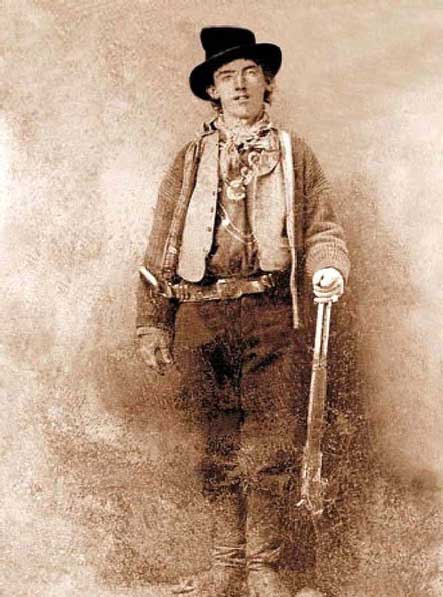
Evening.  March 17, 1879.  A short and slim young man makes his way quietly through the outskirts of Lincoln, New Mexico and knocks softly on the door of the house of JB Wilson.  A voice answers "come in".  Slowly entering the room with his rifle in one hand and pistol in the other, the young man recognizes Wilson and sees a bearded man sitting at a table.  The man stands up and says, "I am Governor Wallace".

William Bonney (born Henry McCarty, aka "Kid", "Kid Antrim", and later "Billy the Kid") and Lew Wallace, Territorial Governor of New Mexico, noted Civil War General, and author of Ben-Hur, which he was writing at the time, begin their meeting.

The events leading to this remarkable encountered resulted from the Lincoln County War, a series of bloody clashes between rival factions in southeast New Mexico.  I won't go through all the complicated details.  Suffice it to say that whether you were nominally on the side of "the law" or not, you were a bad guy to some degree.  

Though his reputation as a man-killer has grown over the years, it is likely that Billy killed perhaps six men.  One of those was probably Lincoln County Sheriff William Brady (a criminal himself), killed in an ambush in Lincoln in April 1878 and the main reason Billy sought the meeting with Wallace.

Billy's road to the Wilson home began with his birth in New York City in 1859.  His immigrant Irish widowed mother moved the family, first to Indiana and then, in 1870, to Wichita, Kansas.  Three years later, after remarrying, the family headed west, eventually settling in Silver City, a mining town in the southwest mountains of the New Mexico Territory.  After scrapes with the local law, Billy fled Silver City, crossed the Rio Grande to the southeast part of the territory and ended up in the area around Lincoln.

By the end of 1877, Billy was working for a local rancher, John Tunstall, a young English-born gentleman.  Billy grew to idolize Tunstall who treated him well. Tunstall and his partner, Alexander McSween, were rivals of another business group led by Lawrence Murphy and James Dolan.  That rivalry devolved into the violence that seemed endemic across much of the territory.

In February 1878, a posse, acting on dubious legal grounds and led by Sheriff Brady, an ally of Murphy and Dolan, murdered Tunstall, triggering the Lincoln County War, with Billy becoming a member of the self-proclaimed Regulators, seeking revenge and justice for Tunstall's death.

A series of violent clashes ensued, reaching a climax in July when a large gang of Regulators took over much of Lincoln for several days only to be driven out by the Murphy-Dolan faction with support of troopers from the nearby Army post.

Following the Battle of Lincoln, Billy and three others were indicted (probably wrongly) for the killing of the bookkeeper at the Mescalero Indian Agency in August.

Lew Wallace's path to Lincoln was very different.  His father was governor of Indiana and later congressman, and young Lewis served in the Mexican War, going on to become a prominent lawyer in the state.  When the war broke out he was asked to raise a regiment and by early 1862 was a general commanding a brigade.  He performed outstandingly in the capture of Fort Donelson in February 1862, but at the Battle of Shiloh two months later his actions became controversial both during and after the war, and also led to US Grant becoming an enemy and sidetracking his further rise in the army.  However, in July 1864 at Monocacy, Maryland he led his outnumbered forces in turning back Confederate General Jubal Early's raid which threatened Washington DC.  Grant, who continued to be critical of Wallace's actions at Shiloh, was gracious in his memoirs about Monocacy, writing:

If Early had been but one day earlier, he might have entered the capital before the arrival of the reinforcements I had sent. ... General Wallace contributed on this occasion by the defeat of the troops under him, a greater benefit to the cause than often falls to the lot of a commander of an equal force to render by means of a victory.

In 1865 Wallace served as one of the eight military commissioners at the trial of the accused assassins of Abraham Lincoln and on the commission that sentenced Henry Wirz, commandant of the Andersonville POW camp, to death.

Going to Mexico he served as a military advisor to Benito Juarez in his successful campaign to oust the Emperor Maximillian.  Returning to the U.S. and resuming his law practice, Wallace was named by President Hayes, whom he had campaigned for, as territorial governor, taking office in late September of 1878.

This was not a particularly prestigious appointment, Wallace preferring an important diplomatic position, and he must have wondered what he had gotten himself into when he arrived in Santa Fe.  The entire territory was in turmoil, with the Lincoln County War and Apache raids being the worst of it.

Shortly after arriving, Wallace was informed by the U.S. Marshall that he held warrants for several men, including "William H. Antrim, alias Kid, alias Bonny" but was unable to execute them "owing to the disturbed condition of affairs in that county, resulting from the acts of a desperate class of men".

In November, the governor issued an amnesty proclamation for anyone involved in the war, excepting those under indictment or convicted, which meant the Kid was still an outlaw.   And, despite, the amnesty, violence continued.

On February 13, 1879, the Kid was back in Lincoln, where he witnessed the killing of Huston Chapman, an attorney hired by the widow of McSween (killed in the Battle of Lincoln), by one of gunmen of the Murphy-Dolan faction.  Billy managed to escape and went into hiding.

Governor Wallace was determined to finally get the county under control, arriving in Lincoln on March 5 with a detachment of soldiers.  On March 11 he ordered the army detachment to arrest 34 men from both sides, including the Kid, prompting the Kid to come up with his own plan.

On March 13 he wrote Wallace, offering to provide information on Chapman's killer in return for dropping the indictments against him.  The letter was headed:

To his Excellency the Governor
General Lew Wallace
Dear Sir, 
 And contained this:
I was present When Mr. Chapman was murdereded and know who did it and if it were not for those indicements I would have made it clear before now. if it is in your power to Annully those indictments I hope you will do so as to give me a chance to explain. . . . I have no wish to fight any more indeed I have not raised an arm since Your proclamation.
 
Waiting for an annser I remain Your Obedeint Servant
W.H. Bonney
 Desperately needing a witness against Chapman's murderers, Wallace responded on the 15th:
. . . I have authority to exempt you from prosecution, if you will testify to what you say you know.
 
. . . To do that the utmost secrecy is to be used.  So come alone.  Don't tell anybody - not a living soul - where you are coming or the object.
Two days later the Kid and Wallace met.  What must have been going through the governor's mind that night, a man who had been an Army general, knew the current and former presidents, an acquaintance of the president of Mexico, sitting down with a 19 year old outlaw?
 
Whatever Wallace was thinking, the two men quickly agreed on a plan.  Billy agreed to a staged arrest by Lincoln Sheriff George Kimbrell, who would keep him safe in custody for his own protection for the upcoming court session in April.  In return, Wallace pledged "I will let you go scot-free with a pardon in your pocket for all your misdeeds". 

Within days, the continued unrest unsettled Billy and he became worried he would not be safe even in custody.  On March 20 he wrote Wallace:
Sir, I will keep the appointment I made but be Sure and have men come that You can depend on.  I am not afraid to die like a man fighting but I would not like to be killed like a dog unarmed.
The planned arrest occured on March 23, and Billy was confined in an outbuilding in Lincoln.  That night, Wallace sat down with Billy, listening and writing down what the Kid told him.  According to Billy The Kid: El Bandido Simpatico by James Mills (from which this quote and most others in this post are taken), which contains much of Billy's statement, it was much more extensive than just Chapman's killings, "regarding a host of his long-time enemies and the relentless violence and theft throughout the region.  Billy would not, however, provide an ounce of information regarding any of his amigos or former fellow Regulators."

A few nights later, Wallace heard music with Spanish lyrics, went outside and saw a group of Hispanos gathered at Billy's window and playing for his enjoyment.  The governor didn't realize that Billy had close ties with the Hispano community, being one of the few Anglo cowboys who spoke fluent Spanish and enjoyed their company.  Indeed, the Kid was to spend most of the last two years of his life living in Hispano communities, where his friends would shelter him from the law.  His captor, Sheriff Kimbrell was brother in law of Billy's friend Martin Chavez, so it was a friendly confinement he was enduring.

As an indication of his continued concern,Wallace wrote President Hayes on March 31 requesting he place Lincoln County under martial law, a request Hayes denied.

Court convened in Lincoln on April 14.  Over the next two weeks over 200 indictments were issued against fifty men, mostly from the Dolan faction.  By that time, Wallace had departed, leaving on April 18 after meeting with new district attorney William Rynerson, who, as it turned out, faked his enthusiasm for Wallace's arrangements.  While the Kid testified against Dolan and two others regarding Chapman's murder, the widow McSween's new lawyer grew concerned about the D.A. writing Wallace on April 20,
I tell you Gov that the prosecuting officer of this Dist is no friend to the enforcement of the law.  He is bent on going for the Kid & notwithstanding he know how it is proposed to destroy his testimony & influence he's bent on pushing him to the wall.  He is a Dolan man and he's defending him by his conduct all he can.
Four days later the McSween lawyer was the object of an unsuccessful attempt to shoot him, as was Kimbrell's deputy.

Rynerson refused to consent to Billy's release for turning State's evidence, refused to drop the charges for the Brady killing, and successfully obtained a change of venue to neighboring Dona Ana County, where Dolan had firm control.  If that trial occurred, Billy would be convicted and hanged.

But Wallace, now back in Santa Fe, did not act, failing to issue the pardon even after Billy testified in another trial.  The reasons for this remain unclear.  Billy grew increasingly wary and, realizing there would be no pardon, and he faced certain death after a trial, took matters into his own hands.  On the evening of June 17 he announced he was leaving his confinement.  Sheriff Kimbrell made no attempt to stop him as the Kid saddled his horse and rode off into the night.

The smartest thing for Billy to do would have been to leave the territory, but he didn't, a decision that sealed his fate.  A wanted man, he was involved in further violent incidents, including one killing definitely by the Kid and another possible mortal shooting, eventually being captured on December 23, 1880, by a posse led by Pat Garrett.  The imprisoned Kid sent several letters to Wallace, seeking clemency, but they went unanswered.
 
In April 1881, Billy was convicted of the killing of Sheriff Brady and sentenced to hang on May 13.  In perhaps his most daring exploit, on April 28 the Kid escaped from the jail in Lincoln where he was under guard, killing two deputies in the process, one of whom, Bob Olinger, was a pretty bad man himself.

Garrett, who had treated Billy well while he was in his custody, resumed the manhunt, tracking the Kid to the Fort Sumner area, where, on the night of July 14, he shot and killed Billy.  He was 21. And the legend began.

As for Lew Wallace, he left New Mexico in 1881 to take on a new role as U.S. Minister to the Ottoman Empire, where he was a great success.  When he resigned in 1885, the Sultan tried to get him to accept a role as the Ottoman minister to England or France, but Wallace declined, returning to Indiana, living an active life and continuing his writing.

While in New Mexico, Wallace completed his novel, Ben-Hur: A Tale of the Christ, published in November 1880.  By 1900 it had passed Uncle Tom's Cabin as the best selling American novel of the 19th century and the book remains in print.

Wallace died in 1905 at the age of 77.

Saturday, October 8, 2022

The Peshtigo Fire

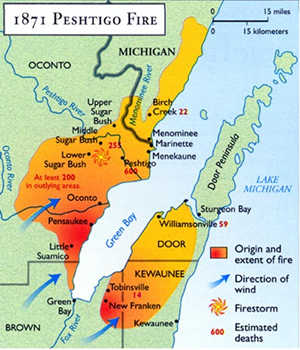
On the night of October 8, 1871, a long dry spell ended as strong depression and wild winds spread across the Midwest.  There were two large fires that night.  One was in Chicago where, as the tall-tale would have it, Mrs O'Leary's cow supposedly kicked over a lantern, starting a massive fire that ultimately killed 300 people.  The Great Chicago Fire remains famous.  The other fire is remembered less frequently; centered on the logging town of Peshtigo, Wisconsin, north of Green Bay, that fire burnt out an area the size of Delaware and killed between 1,200 and 2,500 people, the largest loss of life in any fire in American history.

Map of fireThe logging industry left discarded wood and timber everywhere in the area, which served as kindling.  Though the source of the fire is unknown, once started, the strong winds aided its development and spread, creating a firestorm.  Approximately half the population of Peshtigo perished (500-800 people), while at least a dozen other settlements were burned to the ground.  Peshtigo burned in less than an hour, with many of the survivors seeking refuge in the nearby river, along with panicked domestic and wild animals.  

Because of the remoteness of the region, it took days for help to arrive.

This article, published by the local paper on the 50th anniversary of the fire, contains more details.

The short video below provides a good summary of that horrible night.


Thursday, September 2, 2021

The Birmingham Speech

The Presidency of Warren G Harding (R) is regarded by many historians as one of the worst in American history.  Elected in a landslide in November 1920, he died in the summer of 1923 just as a notorious financial scandal involving several of his cabinet members was becoming front page news.

I think that ranking unfair as Harding's steadfast approach helped America quickly recover from a sharp recession after the end of the First World War and there is another little known aspect of his Presidency that reflects well upon him - his unusual, for the times, stance on race.  He's still not a top-tier executive but should not be at the bottom of the list.

On October 26, 1921 President Harding visited Birmingham, Alabama to give a speech as part of the city's celebration of the 50th anniversary of its founding.  More than 100,000 people lined the streets as his motorcade made its way to where the presidential address would be delivered - a park recently named after Harding's predecessor, President Woodrow Wilson (D), a fervent racist who had resegregated the federal civil service.

The President's speech started out conventionally, reviewing the history of Birmingham in glowing terms and speaking of its critical role in helping the South recover from the Civil War, but then took an unexpected term to focus on race for its last two thirds:

“If the Civil War marked the beginnings of industrialism in a South which had previously been almost entirely agricultural, the World War brought us to full recognition that the race problem is national rather than merely sectional.”  

The President went on to describe what we call "The Great Migration" during the War of blacks from South to North (until that time 95% of America's blacks lived in the former slave states), pointing out:

"it has made the South realize its industrial dependence on the labor of the black man and made the North realize the difficulties of the community in which two greatly differing races are brought to live side by side.”

 "I should say that it has been responsible for a larger charity on both sides, a beginning of better understanding; and in the light of that better understanding perhaps we shall be able to consider this problem together as a problem of all sections and of both races, in whose solution the best intelligence of both must be enlisted."

He then referenced our recent war experience, contrasting the lack of racism faced by black soldiers serving in Europe:

"In another way the World War modified the elements of this problem. Thousands of black men, serving their country just as patriotically as did the white men, were transported overseas and experienced the life of countries where their color aroused less of antagonism than it does here."

"These things lead one to hope that we shall find an adjustment of relations between the two races, in which both can enjoy full citizen- ship, the full measure of usefulness to the country and of opportunity for themselves, and in which recognition and reward shall at last be distributed in proportion to individual deserts, regardless of race or color." 

Harding then went on to make a radical proposal in the context of the times:

“I would insist upon equal educational opportunity for [blacks and whites]. This does not mean that both would become equally educated within a generation or two generations or ten generations. Even men of the same race do not accomplish such an equality as that. They never will. The Providence that endowed men with widely unequal capacities and capabilities and energies did not intend any such thing.”

In the midst of what must have been a disturbing speech for his mostly white audience, the President emphasized:

"Men of both races may well stand uncompromisingly against every suggestion of social equality. Indeed, it would be helpful to have that word " equality " eliminated from this consideration ; to have it accepted on both sides that this is not a question of social equality, but a question of recognizing a fundamental, eternal, and inescapable difference. We shall have made real progress when we develop an attitude in the public and community thought of both races which recognizes this difference."

Though he did not advocate integration of schools he wanted better schools for blacks.

“I would accent that a black man can not be a white man, and that he does not need and should not aspire to be as much like a white man as possible in order to accomplish the best that is possible for him. He should seek to be, and he should be encouraged to be, the best possible black man, and not the best possible imitation of a white man.”

And stressed the importance of economic equality:

"When I suggest the possibility of economic equality between the races, I mean it in precisely the same way and to the same extent that I would mean it if I spoke of equality of economic opportunity as between members of the same race. In each case I would mean equality proportioned to the honest capacities and deserts of the individual."

The President directly addressed the overriding issue in the South - the disenfranchisement of black voters:

"I would say let the black man vote when he is fit to vote: prohibit the white man voting when he is unfit to vote."

Harding went on to express his desire for a common American heritage without separation into classes and groups, a battle many of us thought won with the Civil Rights Movement but now threatened by the New Racism of the Woke:

"Coming as Americans do from many origins of race, tradition, language, color, institutions, heredity; engaged as we are in the huge effort to work an honorable national destiny from so many different elements; the one thing we must sedulously avoid is the development of group and class organizations in this country. There has been time when we heard too much about the labor vote, the business vote, the Irish vote, the Scandinavian vote, the Italian vote, and so on. But the demagogues who would array class against class and group against group have fortunately found little to reward their efforts. That is because, despite the demagogues, the idea of our oneness as Americans has risen superior to every appeal to mere class and group. And so I would wish it might be in this matter of our national problem of races." 

"Just as I do not wish the South to be politically entirely of one party; just as I believe that is bad for the South, and for the rest of the country as well, so I do not want the colored people to be entirely of one party. I wish that both the tradition of a solidly Democratic South and the tradition of a solidly Republican black race might be broken up. Neither political sectionalism nor any system of rigid groupings of the people will in the long run prosper our country. I want to see the time come when black men will regard themselves as full participants in the benefits and duties of American citizenship ; when they will vote for Democratic candidates, if they prefer the Democratic policy on tariff or taxation, or foreign relations, or what-not; and when they will vote the Republican ticket only for like reasons. We can not go on, as we have gone for more than a half century, with one great section of our population, numbering as many people as the entire population of some significant countries of Europe, set off from real contribution to solving our national issues, because of a division on race lines."

"Is it not possible, then, in the long era of readjustment which we are entering for the Nation to lay aside old prejudices and old antagonisms and in the broad, clear light of nationalism enter upon a constructive policy in dealing with these intricate issues? Just as we shall prove ourselves capable of doing this Ave shall insure the industrial progress, the agricultural security, the social and political safety of our whole country regardless of race or sections and along the line of ideals superior to every consideration of groups or class, of race or color or section or prejudice."

By our 21st century standards certainly President Harding's address falls short in several respects but in the context of its time and in the context of the place where it was given it is remarkable and that feature was recognized by both whites and blacks.

The largely white audience had applauded frequently at the start of the speech but that slowly dwindled as Harding expounded at length on his thoughts on race.  It was reported that the state officials and legislators on the platform with the President sat in "stony silence" during the latter part of his speech while he received "thunderous applause" from the blacks sitting in their segregated section. 

This article summarizes some of the other white reaction:

The Birmingham Post called the speech an “untimely and ill-considered intrusion into a question of which he evidently knows little.” Mississippi Senator Pat Harrison said, “If the President’s theory is carried to its ultimate conclusion, then that means that the black man can strive to become President of the United States.” Georgia Senator Thomas E. Watson declared Harding had planted “fatal germs in the minds of the black race.” The junior senator from Alabama, Thomas Heflin, said, “So far as the South is concerned, we hold to the doctrine that God Almighty has fixed the limits and boundaries between the two races and no Republican living can improve upon His work.”

As to the black reaction:

Marcus Garvey, head of the separatist Universal Negro Improvement Association, sent a telegram to the President “on behalf of four hundred million negroes of the world.” He wrote: “All true negroes are against social equality, believing that all races should develop on their own social lines. Only a few selfish members of the negro race believe in the social amalgamation of black and white.”

W.E.B. Dubois had misgivings about Harding’s repeated emphasis that he was not calling for social equality or racial amalgamation, but he wrote: “the sensitive may note that the President qualified these demands somewhat, even dangerously, and yet they stand out so clearly in his speech that he must be credited with meaning to give them their real significance. And in this the President made a braver, clearer utterance than Theodore Roosevelt ever dared to make or than William Taft or William McKinley ever dreamed of. For this let us give him every ounce of credit he deserves.”

This was the NY Times coverage:

New York Times’s coverage of Harding’s speech, published October 27, 1921

President Harding also took other actions (again in the context of a much smaller federal government and constitutional role than today's behemoth administrative state), sponsoring legislation which would have made lynching a federal crime, which passed the House but was blocked in the Senate.  He also appointed several blacks to federal posts which Wilson had refused to do. 

Nor was Birmingham the first time the President spoke on race.  In his acceptance speech at the 1920 Republican Convention, Harding declared:

“No majority shall abridge the rights of a minority.  I believe the Negro citizens of America should be guaranteed the enjoyment of all their rights, that they have earned their full measure of citizenship bestowed, that their sacrifices in blood on the battlefields of the republic have entitled them to all of freedom and opportunity, all of sympathy and aid that the American spirit of fairness and justice demands.”

Earlier in 1921, Harding accepted an offer to give the commencement speech at Lincoln University in Pennsylvania, the nation's first degree granting historically black college.  It turned out that the commencement took place only three days after the end of the Tulsa riot and massacre which saw that city's black community destroyed.  The President proclaimed:

“Despite the demagogues, the idea of our oneness as Americans has risen superior to every appeal to mere class and group. And so, I wish it might be in this matter of our national problem of races.”

Addressing the events at Tulsa he added, “God grant that, in the soberness, the fairness, and the justice of this country, we never see another spectacle like it.”

He then shook each graduate's hand.

There is some additional interesting context to all of this.  For all of Harding's life there had been rumours that he had some black ancestry and this even became part of the campaign against him in 1920.  I have not spent time looking at the evidence so have no opinion but these rumours were something Harding was well aware of.

-------------------------------------------------------------------------------------

After the speech, Harding returned to his hotel for a banquet.  In his remarks at the banquet he made an observation that still resonates today:

“Men who are really worthwhile are simpler than they are appraised, and vastly greater than many partisans have measured them.”