Cool calculation would make it appear that the attempt to take Valdivia is madness. This is one reason why the Spaniards will hardly believe us in earnest, even when we commence. And you will see that a bold onset, and a little perseverance afterwards, will give a complete triumph.
-
Thomas, Lord Cochrane, 10th Earl of Dundonald (February 1820)
Lord Dundonald is seventy-nine years of age; and though his energies and faculties are unbroken, and though, with his accustomed courage, he volunteers for the Service, yet, on the whole, there is reason to apprehend that he might deeply commit the Force under his command in some desperate enterprise, where the chance of success would not countervail the risk of failure and of the fatal consequences, which might ensure. Age has not abated the adventurous spirit of this gallant officer, which no authority could restrain; and being uncontrollable it might lead to the most unfortunate results. The Cabinet, on the most careful review of the entire question, decided that the appointment of Lord Dundonald was not expedient.
- Sir James Graham, First Lord of the Admiralty on Lord Dundonald's request for appointment as Commander in Chief of Britain's Baltic Fleet during the Crimean War (February 1854).

(
Cochrane in 1807 from Wikipedia)
Thomas, Lord Cochrane,
Vice-Admiral of Chile, and Commander-in-Chief of the Naval Forces of the Republic of Chile succeeded in taking the well-fortified Spanish stronghold of Valdivia in support of the Chilean War of Independence against the Spanish Empire, employing, as he often did, a combination of audacity, daring, deception and bluff to triumph against a superior force.
Several months later Cochrane found himself outside Callao, Peru one of the remaining Spanish strongholds along South America's Pacific Coast, leading a small force from his ship the
O'Higgins, named after
Bernardo O'Higgins, one of the leaders of the Chilean revolutionaries. Callao was defended by 300 shore cannon, a strong boom across the harbor entrance, twenty seven gunboats and several armed block-ships (as described in
Donald Thomas' entertaining biography
Cochrane: Britannia's Last Sea-King (1978)). More importantly, Callao harbor contained the 44 gun frigate
Esmeralda, the most powerful ship in Spain's South American fleet. Typically, Cochrane decided to capture or "cut out", in naval parlance, the
Esmeralda rather than destroy it.

(
Commemorative Chilean Stamp issued on 200th anniversary of Cochrane's birth)
In the late night hours of November 5, 1820, fourteen small boats set off from the
O'Higgins with Cochrane in the lead boat and each sailor armed with a pistol and cutlass. Cochrane's boat reached
Esmeralda undetected but as he raised himself up to deck level he was clubbed by a sentry's musket falling into the boat below, landing on a wooden pin anchoring an oar and puncturing his back near the spine. Despite this he quickly climbed to the
Esmeralda and shot the same sentry. A vicious fight ensued as the sailors from
O'Higgins stormed
Esmeralda and Cochrane was injured yet again, shot in the thigh, but ultimately the Spanish captain surrendered. By this time the Spanish shore batteries and ships in the harbor were alerted and began firing at the
Esmeralda as Cochrane and his crew sailed the ship out of the harbor. He made it out using a clever stratagem involving the two neutral British and American warships hovering near the entrance to the harbor, ordering his crew to hoist night lights like those of the neutral ships and confusing the Spanish gunners who, worried about triggering an international incident, ceased firing. With the addition of the
Esmeralda to the Chilean Navy the balance of sea-power on the Pacific Coast was drastically altered, Spain was left impotent at sea and Chilean independence assured.
All in all it was not a particularly extraordinary incident in Cochrane's career.
Lord Cochrane (1775-1860) was the inspiration for "
Lucky" Jack Aubrey, the hero of
Patrick O'Brian's magnificent Aubrey-Maturin novels (see
Master And Commander). Cochrane's adventures, daring, recklessness and courage, usually against overwhelming odds along with his resurrection from political disgrace to become an honored figure at Queen Victoria's court is like something from the perfect Victorian boy's novel and indeed he was a quite well-known figure in 19th century Britain. It's why the 1854 letter from Sir Graham about the 79-year old petitioner is concerned not with whether the elderly gentleman is "
up to the job" but rather that despite his age, his energy and impetuousness remain the same and that he is no more controllable than he was 50 years before. Cochrane became much forgotten in the 20th century when Nelsonian heroics became unfashionable, until rescued by O'Brian's novels and the Thomas biography. O'Brian's novels, the first of which was published in 1970 only attained widespread acclaim with the republication of the early books in 1989. Since then they have sold several million copies worldwide. Written in a style much closer to
Jane Austin than
Horatio Hornblower they place the reader back in the Britain of Napoleonic times without a hint of any anachronisms.
While Cochrane was the clear inspiration for many of the events in the O'Brian novels, the author was careful to distinguish between the characters of Cochrane and Aubrey, writing in the third novel, H.M.S. Surprise, when Aubrey's great friend Dr Stephen Maturin reflects on the captain's outstanding characteristics and to whom he might be compared:
Off-hand, he could not think of more than a dozen out of the hundreds he had met: Dundas, Riou, Seumour, Jack, perhaps Cochrane; but no, Cochrane ashore was too flamboyant to be typical, too full of himself, too conscious of his own value, too much affected by that Scottish love of a grievance, and there was that unfortunate title handing around his neck, a beloved millstone. There was something of Cochrane in Jack, a restless impatience of authority, a strong persuasion of being in the right; but not enough to disqualify him, not nearly enough . . .
What makes Cochrane's career fascinating was that as brilliant, innovative and successful as he was in single ship actions he never achieved higher command in the British Navy because of his outspokenness and independence which, combined with his political views and naivete, created powerful enemies in both the Royal Navy and in politics who eventually stalled and then destroyed his career. His son later characterized his father's difficulties in temperament; "
He made enemies where a cautious man might have made friends" and an acquaintance spoke of Cochrane's "
unfortunate readiness to convert the championship of a cause into a personal enmity".
Even a brief list of the highlights of Cochrane's career make it sound like he was invented by, rather than an inspiration to, a writer (and THC assures the reader this is only a limited selection of highlights):
Born into a Scottish noble family his father squandered a fortune pursuing eccentric inventions.
Entered the Navy over his father's objections as an 18 year-old in 1793.
Court-martialed in 1798 for showing disrespect to a superior officer, a trait which was to continue throughout his career and earn him many enemies in the senior ranks of the British Admiralty.
Given command of the small sloop
HMS Speedy in 1800 he avoids capture by a French frigate by flying the Danish flag and informing them the plague has broken out onboard. Later on he escapes from another French ship at night by placing a ship's lantern on a barrel floating away from the
Speedy (an episode recreated in the movie
Master And Commander you can watch it
here, dubbed in French).
Later that year the 14-gun S
peedy with a 48-man crew takes on the 32 gun Spanish frigate
El Gamo with 300 sailors. Cochrane gains victory by charging the
Gamo and getting in so close that the Spanish ship can not depress its guns enough hit the much smaller
Speedy. Cochrane leads his crew in a boarding action and captures the Spanish ships resulting in one of the most renowned single ship actions of the Napoleonic Wars, and another episode recreated in the Aubrey-Maturin series.

(
Capture of El Gamo from Wikipedia)
During its 13 month cruise the
Speedy captured, burned or drove ashore 53 enemy ships.
Elected to Parliament in 1806 as a reformer his attacks on corruption in the government and particularly the Admiralty gain him many powerful enemies. The corruption and venality of the British Admiralty of this era is so astounding that it is almost miraculous that its Navy could defeat the French fleet so thoroughly.
Sailing the
HMS Pallas near Bordeaux (1806), Cochrane attacks and defeats six enemy ships, sinking three and capturing one.
Occupying the fortress of Mongat on the Spanish Coast with a small force he delays an entire French army for a month.
At the town of Rosas and its nearby Fort Trinidad along the Catalonian coast of Spain in late 1808, Cochrane and a small force fight an astounding delaying action on land against a much larger French force, an episode which deserves its own THC post which will happen next month.
In command of the
HMS Imperieuse at the
Battle of Basque Roads in 1809, Cochrane leads, at the request of the Admiralty, a dangerous fire ship attack on a French fleet anchored near La Rochelle on the French Atlantic Coast. Despite the refusal of British Admiral Gambier to commit his fleet in support, Cochrane's attack shatters the enemy squadron, sinking or ground nine warships but the opportunity to destroy the entire French force is lost. Cochrane brings charges resulting in a court-martial proceeding against the Gambier who is acquitted using tampered evidence and Cochrane's Royal Navy career ends.

(
Basque Roads)
In 1812 he elopes to Scotland with 16-year old
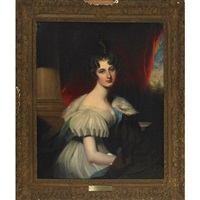
Katherine (Kitty) Barnes where they are married in a civil ceremony over the objection of his rich uncle who disinherits him. Because he and Kitty go through two other marriage ceremonies (Anglican in 1818 and Church of Scotland in 1825) confusion over the right of his eldest son to inherit the Earldom is not resolved until the 1860s. Kitty accompanies him on all his adventures outside of Britain, including being on deck during sea battles in South America.

(
Kitty Barnes Cochrane from artnet)
His enemies finally bring him down as part of the
Great Stock Exchange Fraud of 1814. While relatives of Cochrane were certainly involved, the consensus of historians is that Thomas was innocent and the account of his trial is appalling in its lack of fairness. After his conviction he is expelled from Parliament, stripped of his Knighthood in a ceremony in Westminster Abbey which culminated in his banner being ripped down and kicked down the steps of the Abbey.
Engineering two escapes from jail; in 1812 after being jailed for
"insulting" the Admiralty Court in Malta, he files through the bars of
his third story cell and climbs down a rope making way to his ship
and returning to Britain and denouncing the Court in the House of
Commons; and on March 6, 1815 from the upper floors of King's Bench State House in London
where he is serving a one -year sentence for his conviction in
the Stock Exchange Fraud Case, an escape described by
Thomas in his biography:
Then he coiled the
rope and climbed out of the window, scaling upward to the roof of the
State House building . . . To one who was so accustomed to ropes and
climbing, it was not too difficult, even by night, to throw a running
noose over the spikes which topped the outer wall. Far more dangerous
was the journey, hand over hand, handing from the thin rope between the
State House roof and the wall, with the dark and lethal drop below him .
. . Cochrane reached the outer wall . . . paid out another length of
rope outside the wall and made it fast at the top. He began his
descent, but he was still 20 feet above the ground when the thin rope
snapped in his hands and he fell heavily on his back, knocking himself
unconscious . . . . Though there were no bones broken, he was badly
bruised and sprained, managing only to crawl to the house of a former
servant of the family before daybreak.
It should come as no surprise that having made his escape, two weeks later Cochrane appeared in the House of Commons, to which his Westminster constituents had reelected him despite his conviction, demanding his right to speak and from which he was forcibly removed by the King's Constables who carried him out of Commons and into a windowless, unventilated punishment cell at the King's Bench prison where he served the remainder of his sentence.
Disgraced in England he accepts an invitation to support the
Chilean rebels and becomes commander of the new nation's navy from 1818 to 1822 winning victories at Valdivia and Callao.
Though he spent many years opposing
Napoleon (who referred to Cochrane as "The Sea Wolf") remains an admirer of the man and may have hatched a plot to spring the deposed Emperor from his lonely captivity on St Helena in the South Atlantic and install him as Emperor of a new South American kingdom, a scheme thwarted only by Napoleon's death in 1821.
Leaving Chile, he accepts an invitation to command Brazil's navy in its independence struggle with Portugal. During his command he again takes a very small naval force and with bluff and skill drives the Portuguese fleet and army out of the northern coastal provinces and preserving Brazil's independence.
After a brief return to England he goes to Greece in 1827 to command its navy in its fight of freedom against the Ottoman Empire. Though the Greeks win their independence it is the only adventure in which he does not have striking success.
In 1831 his father dies and Thomas Cochrane becomes 10th Earl of Dundonald. A year later he is granted a pardon regarding his 1814 conviction, reinstated as a Rear-Admiral and in 1847 his Knighthood is personally restored by
Queen Victoria over the objections of senior British politicians.
From 1848 to 1851 Lord Cochrane serves as Commander-in-Chief of the British fleet in the North Atlantic and West Indies.
In 1859 and 1860 his books,
Narrative of Services in the Liberation of Chile, Peru and Brazil and
Autobiography of a Seaman, become best sellers and complete the rehabilitation of his reputation for the duration of the Victorian era.
On the day before his funeral at Westminster Abbey in 1860,
Queen Victoria orders, over the objection of Prime Minister Palmerston, that Cochrane's banner and insignia be restored to the Abbey. Representatives from Chile, Brazil and Greece along with a throng of English admirers jam the building but no Cabinet members attend the service.
In 1876 the House of Commons votes to give his grandson 40,000 pounds in compensation for his grandfather's unjust conviction.