Showing posts sorted by relevance for query 53 Transcripts. Sort by date Show all posts

Sunday, May 10, 2020

53 Transcripts: The Forrest Gump Of Campaigns

Earlier this week the House Intelligence Committee finally released transcripts of 53 interviews (of 49 witnesses) it conducted in 2017-18.  Though the Committee had voted in November 2018 to release the transcripts after national security reviews for classified information, incoming chairman Adam Schiff refused to do so for what are now obvious reasons - he had repeatedly lied to the media and public about what was said in those interviews and the release of the transcripts would demonstrate that.

Under pressure from Acting DNI Richard Grenell, who publicly announced release was fine from a national security perspective and threatened to release the transcripts himself, Schiff finally relented.

I'm in the process of reading all 5,000 pages of the interviews, have completed 18 of the 53, and will write at more length when finished but wanted to pass along some fascinating quotes (it'll come as no surprise but there is absolutely no evidence in what I've read so far of any collusion between the Trump campaign or Trump personally with the Russians).

The first quote is from the February 27, 2018 interview with Hope Hicks, Trump's press secretary during the campaign and then communications director for the first couple of years of his presidency.  It's in response to questions about collusion with the Russians:
"Not to say that Russia's interference wasn't something to be taken seriously, but that our involvement in that was sort of laughable, given that we were like the Forrest Gump of campaigns.  We couldn't spell the address to our Iowa field office right and yet we colluded with Vladimir Putin to steal the election.  It was sort of a hilarious narrative to us." (p.155)
In the interview with Hicks and others, like Corey Lewandowski, the ramshackle, improvised nature of the Trump campaign comes through over and over again.  They made amateurish mistakes and were incapable of the pulling off a coordinated campaign of collusion.  The Democrats on the panel must have been thinking, "how could we have lost to these clowns?".

Earlier in her interview, Hicks was asked about Trump's private comments about the Russia issues and she responded, "his private comments echo his public comments".  I think we all now know this to be true, for better and for worse.  The President says the same stuff to us as he does to his staff.

On June 22, 2017, Dan Coats, then Director National Intelligence and former Senator was interviewed by the committee.  Coats was not personally close to Trump before or after his nomination to become DNI but he recounted an extraordinary moment when, in a private meeting with the President after couple of days after his inauguration, an upset Trump suddenly started talking about Comey's briefing of him on January 6, during which he was informed of the dossier and his alleged romp with prostitutes in a Moscow hotel room. According to Coats, the President said;
"I want to - I swear to you on the soul of my son, I had nothing to do with the prostitution.  And for them to take me aside and raise this issue and then have it leaked, he said, how would you like it if - how do you go home and talk to your wife when it is plastered all over the place that you were using prostitutes in Russia and you are having your family hear that and having you son hear that?". (p.13)
Today we all know what Trump knew then - the allegation was false - we can imagine the anguish it must have caused him at the time.

Wednesday, May 13, 2020

53 Transcripts: Inventing Stories

I’ve now waded through 34 of the 53 transcripts. Still no evidence of collusion or conspiracy. You can read my prior post on the transcripts, The Forrest Gump of Campaigns.

The media and progressive echo chamber works and has power in the public imagination, primarily based on people repeating the same things to each other over and over again and converting their fantasies into reality. Reading the transcripts provides yet another example. The interview of Evelyn Farkas (June 26, 2017) has already made news, at least in non-progressive circles (it appears to have been blacked out elsewhere). Ms. Farkas is a Democrat, a long-time national security policy person and a staff member of Senate Armed Service Committee and Deputy Asst Secretary of Defense for Russia, Ukraine, and Eurasia during the Obama Administration, and is now running for Congress in New York. Like so many Obama refugees she became a commentator, in her case, on MSNBC. In March 2017, she made headlines by urging all her former colleagues to get out all the information they had, even if classified, on Russian election interference and implied she had evidence of collusion with the Trump campaign.

Conservative commentary has focused on her responses to questions at the Intelligence Committee interview that she actually had no information regarding any collusion or conspiracy by the Trump campaign with Russia (see page 12 of transcript). In other words, she knew nothing of substance despite her claims on MSNBC. She even went further, telling the committee, “Russia has not interfered in our elections in the past” (p.16) despite the Intelligence Community Assessment of January 2017 which stated Russia had interfered in the past.

But what really caught my eye was this back and forth between Rep Trey Gowdy and Farkas (p.27):
Gowdy: You also didn’t know whether or not anybody in the Trump campaign had colluded with Russia, did you?
Farkas: I didn’t.
G: When then, why did you say what you said?
F: Because I had a strong suspicion.
G: Based on what?
F: Based on the media reports –
G: Dr Farkas.
F: – and reporters calling me.
. . .
G: What did you know at the time?
F: I knew what the public knew from reading the newspaper.
That is how it works. Someone is hired with the correct political views and credentials but who does not know anything more than the public. People inside the government leak things about their enemies and friendly media, with no interest in investigating accuracy, act as stenographers, and once one publication prints or airs it everyone else jumps in, and then the “credentialed expert” can act like it is real news. Soon, everyone is just repeating the same story to each other, and because that’s all they hear, it becomes the obvious truth. Economists talk about the multiplier effect of spending but this is the real multiplier effect in action.

The success around these narratives can be seen in the interviews of several witnesses regarding the alleged “softening” of the Republican Party platform on Ukraine, in order to supposedly appease Russia, a story that was an obsession with the minority members of the committee. It’s simply fake news that was planted in the media and became the accepted truth to such an extent the FBI referenced newspaper reporting on it as part of the Carter Page FISA warrant application, a subject I wrote about in January.

Unfortunately, the price of fake news can be heavy. Jeffrey (JD) Gordon, a member of the Trump campaign, and the staffer at the heart of the alleged Ukrainian platform controversy testified on July 26, 2017, “It’s an urban legend that the Trump campaign changed the platform . . . it was false” (p.83) as can be proved by examining the language as I did in my January post. Nonetheless, Gordon went on to say that his life had been destroyed by the allegations. Because of the investigations he had been unable to get a position in the administration, his reputation was damaged, and career prospects limited.

We cannot ignore the power wielded by the media, particularly the New York Times and the Washington Post which set the agenda and tone for much of the rest of the media. If you haven't lived in the Northeast it is easy to underestimate the impact their coverage has on everyone. Even Jared Kushner in his testimony (July 25, 2017), spoke of his father-in-law’s attention to the Times:
“I’d have discussions almost every day with the candidate saying, look: If the New York Times mattered you’d be at 1 percent”. (p.70)

Wednesday, May 27, 2020

53 Transcripts: Different Worlds, Part 1

Having completed reading the 53 transcripts recently released House Permanent Select Committee on Intelligence (which you can find here) as well as earlier reading many other relevant documents such as the IG and Mueller reports I can assure you there is no evidence showing collusion or conspiracy between the Trump campaign and Russia during the 2016 elections, despite the continued insistence of Adam Schiff to the contrary.

Adam Schiff is the 21st century equivalent of Senator Joseph McCarthy yelling about the non-existent evidence he has of 205 card-carrying communists in the State Department.  Though, as I write this, an alternative way to think about it is Robert Mueller as the addled McCarthy-like frontman for an unethical, ambitious, and partisan lawyer, with Andrew Weissman as the modern version of Roy Cohn.

It's all part of the greatest political scandal of my lifetime and I look forward to the results of the Durham/Barr probe.

And please, will somebody finally tell me who Josef Mifsud was working for???

I'll use this post to reflect on some important background to the collusion allegations and investigation and over the next couple of weeks continue with the series of posts focused on specific aspects of the transcripts.

Reading the transcripts was like wading through Rachel Maddow's Greatest Hits.  Here are the various conspiracy theories covered by the committee (those I've written about or intend to write about are in boldface):
George Papadopolous, Josef Mifsud, and the alleged damaging information on Hillary

Carter Page as key link in collusion

Trump Tower Meeting

Trump Tower Moscow

Miss Universe Moscow and the "salacious allegations" (Fake news, but relevant because Russians.)

Russian Financiers of Trump Org (except there weren't any, but relevant because Russians)

Russian Condo Buyers (after Trump Tower was built, which contains condos separate from the office space, some of the original condo purchasers resold their unit to Russian buyers.  The Trump Organization was not involved but somehow this was relevant because Russians.)

Russian Buying Florida Mansion (Trump bought a Florida mansion and sold it a few years later to a Russian and made tens of millions.  Relevant because Russians.)

Deutsche Bank (so stupid even the D's on the committee gave up on this one.)

Alfa Bank  (Russian owned bank with its servers allegedly connected directly with Trump Org.  Fake news, but relevant because Russians)

Ukraine Plank on GOP Platform

Paul Manafort.  (Supposed co-mastermind behind it all.  Not.  Targeted by Ukrainians working with Hillary Campaign in 2016).

Michael Flynn & The Ruskies

Peter Smith (An eccentric 80 year old GOP supporter who had been trying to find Hillary hacked emails via the Dark Web and who had contact with Michael Flynn.  In 2017, Smith committed suicide after speaking to a reporter from the Wall St Journal which subsequently published an article on his quest.)

The Hacks (DNC, DCCC, John Podesta)

Wikileaks (Bumbling clowns Roger Stone and Jerome Corsi try to get info from Assange but fail).

Michael Cohen in Prague.  (And, according to Steele Dossier, co-mastermind with Manafort of collusion.  I was surprised and impressed with Cohen's testimony - precise, knows the real estate world, impassioned rebuttal of the Steele Dossier, and refused to be pushed around by Schiff and Swalwell.)

Cambridge Analytica.  (Bad because it used data from Facebook, unlike the Obama people in 2012 who were good because they used data from Facebook.)

The 53 interviews cover 5,571 pages and are of 49 individuals (Corey Lewandowski, Steve Bannon, John Podesta, and David Kramer were interviewed twice).  The interviews began in June 2017 and extended into March 2018 with 39 of the 53 in the period from late September to mid-January (and 17 between Dec 4 and 22).  Two witnesses, both with FusionGPS, took the 5th so gave no testimony: Peter Fritsch and Thomas Catan.

Witnesses included 6 of the 8 participants in the Trump Tower meeting of June 2016, Keith Schiller, head of security for the Trump Organization and Trump's personal bodyguard, and Rhona Graff, Trump's administrative assistant since 1987, along with 13 others who worked on the Trump campaign, including three of the four campaign senior advisors or managers (Roger Stone, Corey Lewandowski, Steve Bannon) along with Jared Kushner and Donald Trump Jr.

Eleven of the transcripts contain redactions so, at times, it is difficult to understand the context of the unredacted materials.  For instance in two of the interviews there is reference to intelligence received by FBI Director Comey in the summer of 2016 that led him to decide to make the decision on the Clinton email investigation himself, but the details are redacted.  The heaviest redacted transcripts were of Susan Rice, Loretta Lynch, James Clapper, Andrew McCabe, and an unidentified FBI Special Agent.  Interviews with fewer redactions were of Samantha Power, Mary McCord (DOJ), John Carlin (DOJ), Evelyn Farkas (DoD), Dan Coats, and Matthew Tait (formerly of UK Intelligence).

Regarding the unidentified FBI Special Agent.  This individual was the original contact for Christopher Steele regarding the dossier (he'd previously met Steele, who was a paid FBI source, in 2009).  He was responsible for getting Steele in touch with the appropriate offices within the FBI.  Other than passing Steele on, he had no involvement in verification of the dossier contents, nor in the FISA warrant application.  The agent heard back from FBI HQ in late September that "information in the Steele dossier corroborated an investigation they had opened previously . . ." (p.36) (1)  He had no knowledge of the connection with the Clinton Campaign, was appalled to find out Steele had been briefing reporters, and expressed his strong support for terminating him.  Came across as professional and credible.

Some of the transcripts were fascinating, some boring, and a few quite funny and entertaining, particularly Corey Lewandowski, Rob Goldstone (the music promoter who set up the Trump Tower meeting) and Felix Sater, the real estate promoter working with Michael Cohen on the Trump Tower Moscow project.

The committee conducted more than 53 interviews.  It previously released its November 14, 2017 interview with Glenn Simpson of FusionGPS which is a conspiracy theory fantasy.  There are also references to additional interviews which the committee did not vote to release.  In addition, other Congressional committees were conducting interviews around the same time, notably of James Comey by the Senate Intelligence Committee on June 8, 2017 and of George Papadopolous by the House Judiciary Committee on October 25, 2018.

The title of this post, "Different Worlds" is a twofold reference.  First to the different political world in which the interviews took place, 2017 is very different from 2020.  Second, the different worlds of real estate promoter BS and that of political operative BS.  They are both BS worlds but so different in their orientation it contributed to the Democratic belief that Trump was a creature from another planet and to the bafflement of the Democrats on the committee as they tried to understand the very unconventional Trump campaign and the financial world of Trumpdom (to be covered in Part 2).

The Political Landscape in 2017

When the Intelligence Committee began its interviews in June 2017 things looked very different than they did in 2019 and 2020.  The Committee was focused on four issues:
Russia's actions with respect to the 2016 election cycle
With whom, if anyone, in the United States did they work with?
The US government response during that period
The role of masking, unmasking in the dissemination of classified information
Though the Republicans controlled the House, the Intelligence Committee was without the services of its chairman, Devin Nunes (R-CA) until the end of the year.  In a clever maneuver, Democrats filed an ethics complaint against Nunes in March 2017, claiming he had leaked classified information in order to help Donald Trump, meaning the first Republican on the committee to smell something was seriously wrong was neutralized.  Nunes was not cleared until the end of 2017, so GOP leadership on the committee fell upon Mike Conaway (R-TX) who, along with Trey Gowdy (R-SC) and Tom Rooney (R-FL) were the most active Republican questioners.  Gowdy and Rooney left Congress in 2018, while Conaway is not running for reelection this year.  Of the other active questioners, Ileana Ros-Lehtinen (R-FL) retired in 2018 and Peter King (R-NY) retiring this year, leaving Chris Stewart (R-Utah) and Brad Wenstrup (R-OH) as the only GOP questioners who will be left in January 2021.  In contrast, only one of the seven active Democrats during the interviews will have left.

Though today most Republicans in Congress are solidly, though some reluctantly, behind President Trump; that was not true in 2017.  The change came about for three reasons:
1.  With the Mueller Report, the IG Report and a flood of other documentation, the extent of the conspiracy against Trump is now evident, the recklessness of agency bureaucrats, the complicity of the media, along with 3+ years of unprecedented obstruction by Democrats in Congress.
2.  The Kavanaugh hearings made it clear that all Republicans will be attacked just like Trump, no one is immune.
3.  The power of Trump with the GOP electorate making Senators and Representatives worried about getting on his wrong side.
But in 2017, Trump's relations with Congress were frayed, his behavior erratic and one never knew where he stood on his own proposals.  Whatever they said publicly, a significant percentage were unhappy he was President.

And on Russia, the President's own behavior made them fear there might be something to the collusion allegations.  The President had commented favorably on Putin, but more than that had put America on the same relative moral plane as Russia.  He had, in his view, merely joked about Hillary's emails but it didn't seem so funny when hacked Democratic emails started showing up in the midst of the campaign (2).   Dark stories about Russian connections were floating around about Carter Page, George Papadopolous, and Paul Manafort and then came the Michael Flynn stories and his resignation.  January saw the publication of the Steele Dossier, about which no one knew the origins.  In May came the firing of Comey, and then the capper, when the President could not stay on script and contradicted the reasons for the firing in his interview with Lester Holt and then gloated to the Russian Ambassador about the firing.  It looked terrible.  And then, three weeks after the committee's first interview (Dan Coats), came news about the Trump Tower meeting which occurred in June 2016.  And let's face it, how many of us are confident that if Trump had actually been presented with a quid pro quo arrangement with Putin that he would have refused?

The truth about the Steele Dossier, that the Clinton campaign paid for it and that there was a direct link between that campaign and Russian intelligence sources, did not begin to emerge until late October 2017 and even then the Democrats managed to muddy the water for a while longer, falsely claiming FusionGPS was just continuing opposition research work it had been doing for a Republican donor (3).

I don't think all the GOP members of the committee knew where the investigation was going to end up when it started and the existence of the Mueller investigation further concerned and constrained them.

While there were interviews focused on the unmaskings and the Obama administration response they were not particularly revealing, except as to the extent of the unmaskings.  As to the response, or lack of it, the line by the Democratic interviewees is that the Obama administration worried that if it made a big deal of Russian interference during the campaign it might backfire and be seen as a political intervention.  Left unsaid was that they feared the intervention might hurt Hillary and there was no need to take that risk since they all expected Hillary to easily win.

That left the Democrats free to play a lot of offense, though many of the Republican members were able to effectively help witnesses.  The leading Democrat questioners were Adam Schiff and Eric Swalwell.  Schiff was a very skillful questioner.  In contrast, Swalwell acted like he was always on the verge of asking the one question that would unravel the entire conspiracy and evidenced a very high opinion of his own abilities.  I think Schiff realized fairly quickly the Democrats were drilling a dry hole in the search for a conspiracy but understood the political advantage of continuing the charade.  Swalwell was dumb enough he may really have been a true believer.
-------------------------------------------------------------------------------------------

(1) So, with the twisted reasoning we've seen elsewhere in this investigation, the FBI used a dossier that it was never able to corroborate, in order to corroborate the accuracy of the investigation it had previously opened.

(2) In her testimony, Hope Hicks, Trump’s communications director spoke to that specific incident:
“I did make him aware that there were some that were taking this sort of facetious comment to be literal and that we needed to make sure people understood that it was intended to mock those that were suggesting he could possibly be involved with the hack.”
She said Trump, “expressed sort of disbelief that anybody could possibly take it seriously”. (p.60)

(3) On December 12, 2017 the committee interviewed Michael Goldfarb, publisher of the Washington Free Beacon, a conservative publication funded by Paul Singer who backed Marco Rubio for the GOP nomination.  Goldfarb hired FusionGPS to do research on the financial history of the Trump organization (he hired other firms to do oppo research on Hillary).

In April 2016, once Trump seemed assured of the GOP nomination, Goldfarb had FusionGPS end its research and it was at this point Glenn Simpson of Fusion approached the Clinton campaign offering to continue the research.  Steele was not hired until June.

Goldfarb was furious, not just about the dossier when he learned about it, saying "I thought it was bullshit" (p.36), but upon finding out that Fusion was working with a Russian oligarch to overturn the Magnitsky Act, while Goldfarb had worked closely with Michael Browder, the main proponent of the Act.

Monday, May 16, 2022

What Remains To Be Known

Today marks the trial of lawyer Michael Sussman began in Federal District Court in DC.  It's alleged he made a false statement to the government, in the form of General Counsel of the FBI, regarding Donald Trump's links to Alfa Bank.  I am not following the trial because my interest is not in whether Sussman made a false statement in the course of raising the issue - he is alleged to have said he was not representing a client when, in fact, he was representing the Clinton campaign.  My interest is in coming to a better understanding of the two threads of the Russia collusion scandal.

The first is the one Sussman was involved with and that originated with the Clinton campaign in 2016.  Built upon scraps of figments of possible scenarios and abetted by Donald Trump's own reckless statements during the campaign, the campaign wove a story believed credulously by the FBI, at least initially (1), and swallowed whole by a media ready to believe anything that would help defeat Trump and then, after his election, anything that would bring him down.

That it was all a mirage is now evident.  Apart from the failure to verify the allegations in the Steele Dossier, a document promoted by FusionGPS, an outfit working at the same time for a Putin connected Russian oligarch to overturn American sanctions, a failure we've known about since 2019, it now turns out that much of the dossier was the product of gossip between a couple of Russians, one in Cyprus, one in America, and of an American lobbyist and Clinton supporter!  And what wasn't the product of gossip was fed by FusionGPS to Christopher Steele who put it into the dossier.  There was no there there.(2)

But there was a second, parallel, thread that has gotten little attention recently; the efforts of the Intelligence Community to derail the Trump candidacy and then his presidency.  This goes all the way back to a character I've written about before, Josef Mifsud, and his mysterious visit to, and conversation with, George Papadopolous in March 2016.  We need to know why Mifsud made his approach - was it on his own initiative, or at the request of one of the Western intelligence agencies he was so entwined with?  And why did the senior Australian diplomat and intelligence official, Alexander Downer, who also had connections with the Clinton Foundation, initiate a meeting with Papadopolous in May 2016 to allegedly extract the information Mifsud had passed on?  For more on Mifsud and Downer, read Footnote 2 of this post.

It was no secret at the time that DNI Clapper, CIA Director Brennan, and FBI Director Comey, along with several Western intelligence agencies were alarmed by Trump.  How far did they take this alarm?(3)  It's also now evident that the taking out of NSA Michael Flynn in late January 2017 was planned because he both understood the intelligence community bureaucracy, wanted to reform it, had Trump's confidence and, if he had remained in the role, would have triggered the legal requirement to be briefed by the intelligence agencies on their Russia collusion investigation, which would have revealed the plot.  Their only interest was in getting Flynn out of the administration, once that was done they had no further agenda with him.  It was only when the Muller gang got going and decided to try to squeeze Flynn that the criminal investigation began.

In January 2017, Senator Chuck Schumer warned President-elect Trump that, “Let me tell you, you take on the intelligence community, they have six ways from Sunday at getting back at you.”(4)  That is a frightening statement about where a senior U.S. senator thinks power resides in the federal government.  The intelligence community thread needs to be thoroughly investigated or Schumer will be proven correct about who our real rulers are.  Is Durham willing to do it?

Let's also not forget the lives and reputations ruined along the way by the reprehensible actions of the Clinton campaign, the intelligence community, and its willing accomplices in the media; Svetlana Lokhova, Serge Millian, Jeffrey Gordon, Michael Caputo, and Carter "The Most Innocent Man in America" Page, among others.  They deserve justice.(5)

------------------------------------------------------------------------------

(1) Filings by Sussman's lawyers in this case indicate that one of his defenses is that the FBI knew all along he was representing the campaign!

(2) The revelations of the past year have also led me to question some assumptions I'd made during 2018 and 2019 about Russia collusion.  For instance, my inclination had been to believe the official conclusion that the Russians carried out the three hacks of Democrat IT systems in 2016 (see 53 Transcripts: The Hacks).  Given that the involvement of the Clinton campaign in creating the Russia collusion hoax was even more complex that I thought then, I simply don't know what to think about the hacks now.

(3) Along with Mifsud and Downer, Stefan Halper was also used in this effort, managing to smear Flynn, destroy the career of Svetlana Lokhova, and serving as a Confidential Human Source for the FBI regarding Carter Page.

(4) Schumer made his pronouncement on the MSNBC show of Rachel Maddow, who went on to spout all kinds of ridiculous nonsense about Russia and Trump for the next three years.

(5) And speaking of justice, every time I go back and reread my 53 Transcripts posts, I grow more outraged about Rep. Adam Schiff.  For three years, Schiff emerged from these hearing room sessions and lied repeatedly about what was being said, and what was being learned.  He always lied, as became evident when Acting DNI Grenell forced his hand and made him release the actual transcripts in the spring of 2020.  Should the GOP regain control of the House, I hope its leadership has the guts to bar Schiff from serving on any House Committee.

Saturday, June 6, 2020

53 Transcripts: The Hacks

Unlike my other summaries of the 53 transcripts recently released by the House Intelligence Committee, there is a lot about this subject I simply don't know enough about to have an informed opinion, other than sticking for now to my default view that the hacks were Russian linked and that the Trump campaign had nothing to do with them. 

The 2016 election campaign hack story can be confusing because there were three different hacks and releases by Wikileaks and a fourth possible hack, which would have occurred earlier, and provides essential context.

The Hacks

John Podesta (Chairman of Clinton campaign) - March 2016 with Wikileaks release on October 7, 2016.

Democratic Congressional Campaign Committee (DCCC) - April 2016 with Wikileaks release in late August.

Democratic National Committee (DNC) - April 2016 with Wikileaks release beginning on July 22, 2016.

The fourth possible hack is of the Hillary Clinton emails from her time as Secretary of State (2009-13) when she maintained a private server which did not meet government security standards.  These include 33,000 emails she had destroyed in an effort to obstruct justice.  It is possible that foreign powers, including Russia and/or China, may be obtained these emails.  The missing emails and the possibility of a foreign unfriendly power having them was being publicly discussed well before public knowledge of the three hacks described above.

Interviews

Those interviewed by the committee with knowledge relevant to the hacks:

John Podesta
Andrew Brown (Technology Director, DNC)
Marc Elias (Perkins Coie, counsel for DNC and Clinton Campaign)
Michael Sussman (Perkins Coie)
Shawn Henry (Crowdstrike)
Yared Tamed (IT Contractor, DNC)

Podesta and Brown had nothing of value to say.  Podesta's hack was very simple.  He clicked on a link in an email sent to him which allowed someone access to his emails.  The summary below will focus on the DNC hack along with some discussion of the DCCC hack.

The Testimony

Yared Tamed worked as a fulltime IT contractor for the DNC since 2013, reporting to Andrew Brown.  In September 2015 she was notified by the FBI that its cybersecurity unit had identified a possible penetration of the DNC servers by a foreign entity.  She and her team looked but could not find anything.  Tamed continued periodically speaking but the "Information FBI was providing honestly was frustrating in how redacted it was". (p.15)

In April 2016, the FBI requested logs (metadata from email which was sent on the 29th), but the day before her team found unusual activity on the network leading them to a hacker.  They subsequently found a second hacker using tools provided by CrowdStrike once it was brought into the matter.

Tamed testified she provided requested images to CrowdStrike which provided them to the FBI.

Marc Elias of Perkin Coie became aware of the DNC hack in April 2016 and reached out to his firm's cybersecurity law expert, Michael Sussman, a former DOJ lawyer.  Sussman hired Crowdstrike, with whom he had not worked before, on the recommendation of others at the firm, but testified the FBI told him it was Russian hackers even before CrowdStrike was hired.

Although James Comey testified the FBI was denied access to the servers, Sussman testified he told the FBI they could have access to anything they wanted, including the servers, but they never asked for access.

Shawn Henry, President of CrowdStrike, joined the company after retiring from the FBI in 2012.  According to Henry what they saw after being hired "was consistent with what we'd seen previously and associated with Russian Government". (p.25)

Henry explained that the two hackers were (1) Russian intelligence (known as Cozy Bear) and (2) Russian military intelligence (known as Fancy Bear).  Cozy Bear had been monitoring email and communications channels at the DNC since July 2015.  Fancy Bear got into the DCCC opposition research and candidate files in early April 2016 and was able to migrate from there into the DNC servers on April 11 where, later that month, it was discovered by Tamed's team.  According to Henry, CrowdStrike did not "have any reason to believe they actually were coordinating with each other." (p.49)

Regarding the issue of data exfiltration which received some media attention when the transcripts were released, Henry stated:
"We have indicators that data was exfiltrated.  We did not have concrete evidence that data was exfiltrated from the DNC . . . it appears it was set up to be exfiltrated, but we just don't have the evidence that says it actually left". (p.32)
However, Henry said there was clear evidence data was exfiltrated from the DCCC.

Marc Elias made an intriguing remark about the DCCC hack:
"I would dare say that not even every member of the committee would, if give the - was able to hack either the [DCCC] or [NRCC] would have the level of sophistication to pick out the kinds of records that were picked out and put online.  And certainly, it seemed to me unlikely that a foreign adversary sitting in Moscow did that" (p.57)
He later speculated regarding the leaked swing House district opposition research, that while it was plausible Russians did the hacking they would not have understood the value of the information.

These observations were not followed up during the committee questioning.  My guess is Elias made them to try to give creedence to the idea that the Trump campaign was coordinating with the Russians and providing the expertise to interpret the documents.  I find that absurd, given how little political expertise (and time) the Trump campaign staff had, along with the fact there is not one bit of concrete evidence of such collaboration.

Under questioning Sussman testified to something not directly relevant to the hacks but of interest as to the Russia collusion story.  Prior to the election, Sussman's former colleague at DOJ and then General Counsel of the FBI, Jim Baker, passed on to him information about contacts to Russian entities and the Trump organization which he then passed on to the New York Times, Washington Post, and Slate.

All of those associated with the Trump campaign who testified denied any involvement with or knowledge of any of the hacks.  They thought it was a bad joke when the accusations were made and dismissed Trump's remarks during the campaign about Hillary's emails as the candidate's typical riffing off the cuff. 

During his testimony Steve Bannon was asked if there had been any discussions about the hacking.  He said it only came up in the debate prep, when the discussion was how, if the question was asked, to pivot to the topic of Clinton corruption which Trump was hammering away on.

Tuesday, January 10, 2023

Right Move

New House Speaker McCarthy announced that Adam Schiff would not be allowed a spot on the House Intelligence Committee which he chaired in the last two sessions of Congress.  The right move.  

In June 2017 the Committee began hearings on Russian interference in the 2016 election, which continued until March 2018.  Though Representative Schiff was only the ranking minority member of the committee at the time, he effectively ran the hearings, as gutless wonder Paul Ryan had given into a bogus Democratic complaint regarding Chairman Devin Nunes which removed him from the hearing. Transcripts were submitted to the Director of National Intelligence for review before being released to the public because officials such as Susan Rice and Samantha Power were among those testifying.  The transcripts were cleared for release at the beginning of 2019 but by that time the Democrats had taken control of Congress and Schiff refused to release them until, finally, DNI Grenell threatened to do so on his own initiative, leading to their release in May 2020.

So, for nearly three years, Schiff was able to leave the hearings and make pronouncements about the dire, indeed criminal activities unearthed in the testimony (the committee also had access to witness emails and telephone records).  He provided a series of juicy stories to his accomplices in the media, all of whom promoted the Trump collusion narrative.  The problem was that everything Schiff said was a lie including, to quote Mary McCarthy's take on Lillian Hellman, "even 'and' and 'the'.

How do I know this?  Once the 5,977 pages of transcripts were released I read them all, unlike the media stenographers reporting Schiff's every word.  It's all there, Alfa Bank, Deutsche Bank, Trump in Moscow, the Trump Tower meeting in NYC, the Ukraine platform at the GOP convention, etc, and there was nothing there.  Schiff knew it all along, and just lied, knowing well his audience and knowing he would never be held accountable.   I wrote up my conclusions in the 53 Transcripts series.

Adam Schiff, along with Hillary Clinton, the Intelligence Community, the New York Times, and the Washington Post could not have done more damage to this country and trust in its institutions if they had been paid agents of the Kremlin.  The same goes for Donald Trump based on his actions since the November 2020 election.

Tuesday, May 19, 2020

53 Transcripts: Flynn Flam

I've now finished reading all 53 transcripts (5,571 pages) and will begin writing posts trying to put it together but wanted to write on Michael Flynn in light of new developments in his case and how it ties into the testimony in the transcripts.

Catherine Herridge of CBS News has the full unredacted version of Susan Rice's famous "by the book" memo, written to herself, on January 20, 2017 regarding the January 5, 2017 meeting involving President Obama, VP Biden, herself, Sally Yates, Comey, Clapper, and Brennan. [CORRECTION: Clapper & Brennan were not at this meeting.  They attended the meeting immediately prior regarding the Intelligence Community Assessment regarding Russian interference in the 2016 election.] The existence of the memo has been known since 2018 but one paragraph had been completely redacted.  It is now available:
Director Comey affirmed that he is proceeding "by the book" as it relates to law enforcement. From a national security perspective, Comey said he does have some concerns that incoming NSA Flynn is speaking frequently with Russian ambassador Kisylak. Comey said that could be an issue as it relates to sharing sensitive information. President Obama asked if Comey was saying the NSC should not pass sensitive information related to Russia to Flynn. Comey replied "potentially". He added that he has no indication thus far that Flynn has passed classified information to Kisylak but he noted "the level of communication was unusual".
My guess is the memo went through several careful drafts before reaching its final version.
I believe its purpose fourfold.

(1) Justify withholding of sensitive information during the last two weeks of the transition.

(2) Creating an "I told you so" if it turned out Flynn was compromising national security (Obama warned Trump against appointing Flynn)

(3) Justifying Comey's continued investigation of Flynn.

(4) Making sure Comey was the fall guy if it all went wrong.

It was no secret the intelligence community and President Obama had no use for General Flynn after  he left the administration in 2014.  He'd had major policy disagreements with the President and been public about his opinion of the quality of the intelligence agencies work product and leadership and having him as NSA meant their shortcomings would become public and the current organizational structure and embedded careerists threatened.

It is evident that from the time he left government service the intelligence community (including friendly foreign intelligence services) were keeping an eye on Flynn and he did himself no favors by miscues such as accepting payment from RT TV to attend a December 2015 dinner in Moscow where he was seated next to Putin.

How widespread the surveillance of Flynn was is still unknown.  According to a story that broke yesterday a whistleblower at the Treasury Dept claims officials there were improperly tracking Flynn's finances as far back as 2015. While we only have the anonymous source at this point it is worth investigating to see if the story can be confirmed.

In addition, in early 2017, just after Flynn's resignation, a story broke, first in the U.K. and then in the U.S., that Flynn was having an affair with a Russian emigre and academic at Cambridge who was allegedly a intelligence operative for the Kremlin. What is of particular significance is that while the story only became public in 2017, I learned from reading the recently released House Intelligence Committee transcripts, that David J Kramer, an associate of Senator McCain, was told in September 2016 by Christopher Steele about the alleged affair (p.57) meaning the story was already in circulation in intelligence circles and part of a planned operation to destroy Flynn's reputation. The Russian in question is Svetlana Lokhova, who quite strongly, with documentation and, I think, convincingly, denied having an affair and being a Russian operative and has had her career destroyed as a result of the story.  It is astonishing to see how the conspirators converted a dinner with several academics into a passionate affair by Flynn with a Russia agent.  Moreover, the Mueller Report does not confirm the story and, as we know well, if it had the tiniest scrap of evidence otherwise it would have played it up.

Flynn was frequently in contact with Kisylak during the transition. In fact, Rice testified to the House Intelligence Committee, that in late November 2016, the head of Trump's National Security Council transition team, Marshall Billingslea, expressed concerned to her and her staff about Flynn's frequent conversations with Kisylak and asked for background on the ambassador, "that he seemed to want to use to persuade General Flynn that perhaps he should scale back the contacts". (p.44) [CORRECTION: Billingslea did not express his concern directly to Rice; Rice was informed of his concern via her chief of staff Susie George.  Billingslea was also removed as head of this transition team at some point during the transition.]

This incident involving Billingslea became public in early May 2017 as part of the avalanche of press reports about the alleged collusion of the Trump campaign and administration with Russia.  Here's a typical example.  All of the stories contain the same note regarding sources;
"based on interviews with 11 current and former U.S. officials, including seven with key roles in the Obama administration."
That implies four of the sources did not have key roles in the Obama Administration.  Whether they were officials in that administration who did not have key roles or served in the Bush administration or were now in the Trump administration cannot be determined.  And they are collectively cited as sources for the article which contains information beyond the Billingslea incident.

Billingslea has never publicly commented on the matter.   He is currently Assistant Secretary for Terrorist Financing at the Treasury Dept. and on May 4 was nominated to be Under Secretary of State for Arms Control and International Security Affairs.  During the Bush administration, Billingslea held a number of senior positions at the Department of Defense.

However, as Rice's memo notes, as of January 5, Comey had no evidence Flynn shared classified information with the Russians. Moreover, the dislike of Flynn had another basis beyond the mutual disdain between he and the intelligence community - there was a basic policy disagreement. Flynn thought China a bigger threat than Russia; the Obama administration thought the opposite.
In her House Intelligence Committee testimony of September 8, 2017 Rice complained:
"We spent a lot more time talking about China in part because General Flynn's focus was on China as our principal overarching adversary. He had many questions and concerns about China. And when I elicited - sought to elicit his perspective on Russia, he was quite, I started to say dismissive, but that may be an overstatement. He downplayed his assessment of Russia as a threat to the United States. He called it overblown. He said they're a declining power, they're demographically challenged, they're not really much of a threat, and then reemphasized the importance of China." (pp.46-47)
Rice's statement is ironic, coming from the administration which ridiculed Mitt Romney in 2012 for his claim that Russia was our #1 adversary (Mitt was wrong, by the way) while at the same time President Obama was caught on mic with Medvedev telling him to pass on a message to Putin that he'd have more flexibility after the election to screw our allies in Eastern Europe.  And it was President Obama who appeased Russia's ambitions in the Middle East in order to get them to help with Putin's Iranian allies.

Let's not forget the operation to "get" Michael Flynn had two sequentially independent components. The first was to remove Flynn as NSA, a position where he could do damage to the intelligence community bureaucracy and the legacy of the Obama administration. That was accomplished when he resigned in February 2017 and the conspirators had no further interest in pursuing him. After that, Comey and McCabe were relaxed enough to admit in testimony that the interviewing FBI agents had not thought Flynn lied in his interview.

Things changed when the Mueller gang arrived on the scene. They wanted to pursue Flynn in a criminal investigation to pressure him to turn on Donald Trump. When he refused to do so, they pursued an alternative course, bringing a criminal prosecution to provide added fodder for the Russia collusion narrative to be used by the media in order to help the Democratic Party in the 2018 midterms.

My view is that Flynn was correct on the policy issue.  Russia is not our friend and Putin would like to see a hobbled and weakened America (the media and the Democratic Party have helped him in that respect) but the biggest threat to American security and the rest of the free world is China.  The challenge for America today is to develop a strategy, with other countries, to contain China and as part of that to find if there is a path to move Russia away from being China's junior partner.  I also think he was also correct on the need for massive reform and cleaning out of our intelligence agencies.  Flynn's lack of discipline in the RT TV matter, the Turkish government lobbying, and in not minimizing contacts with the Russian ambassador during the transition period, particularly when he knew the security apparatus was gunning for him, contributed to his own downfall.  The criminal prosecution however, is a disgrace, should never have been filed, and should be dismissed.

Monday, March 29, 2021

53 Transcripts: Real Estate Promoters

In May and June of last year I wrote a series of posts (53 Transcripts) after reading the nearly 6,000 pages of testimony given to the House Intelligence Committee in 2017 and early 2018 regarding alleged Russian interference with the 2016 presidential election.  This testimony had been suppressed for nearly a year and a half by Representative Adam Schiff after the Democrats seized control of the House because it debunked their theories of Trump collusion with the Russians and exposed Rep Schiff as a serial liar.  I recently discovered one last post that mistakenly was left in draft form and wanted to post it to complete the series.

Before doing so a couple of summary comments on what has proven to be the Russian Collusion Hoax and the greatest political scandal in American history; a concerted attempt to remove an elected President by the opposition party, entrenched federal bureaucrats and supported by supposedly non-partisan media.  The post Election Tampering sums up my views and you can read all the Russia Collusion posts here.

I initially thought there might be something to the allegations regarding Trump based on his own statements during the campaign and after the election.  I was wrong.(1)

There were two pillars upon which the investigation rested.  The first was the Steele Dossier, which proved to be a creation of the Clinton campaign and Russian intelligence, a fact so embarrassing to the Mueller investigation that all mention of the dossier was excised from the collusion section of its final report.  The second was the March 2016 conversation between Professor Joseph Mifsud and junior Trump foreign policy wannabe George Papadopolous.  What was said remains in dispute.  Mifsud, interviewed by the FBI in February 2017, denied making any statements regarding Russian possession of damaging information regarding Hillary Clinton and the Mueller team never charged Mifsud with making a false statement.  What appears to be the case as of now is that Mifsud was not a Russian intelligence asset and not working for the FBI.  But what was he?  If, as I suspect he was tasked by a friendly foreign intelligence service to approach Papadopolous it puts an entirely different light on the beginnings of this affair.  I hope that Special Counsel John Durham's investigation will reveal whatever the truth is about Mifsud.  For more background on Mifsud see Footnote 2 of this post.

Looking back it is also revealing the depths to which the Democrats and their allies stooped to conspiracy mongering.  Just as we have QAnon, we also have what some have aptly referred to as BlueAnon, and the Russian Collusion Hoax was the starting point for an unending wave of conspiracy theories from the Left.

Russian Collusion was a conspiracy theory and it had many sub-components.  As a reminder here are some of them (ones I wrote about as part of the 53 Transcript series are in bold):

Carter Page as key link in collusion

Trump Tower Meeting

Trump Tower Moscow

Miss Universe Moscow and the "salacious allegations" (Fake news, but relevant because Russians.)

Russian Financiers of Trump Org (except there weren't any, but relevant because Russians)

Russian Condo Buyers (after Trump Tower was built, which contains condos separate from the office space, some of the original condo purchasers resold their unit to Russian buyers.  The Trump Organization was not involved but somehow this was relevant because Russians.)

Russian Buying Florida Mansion (Trump bought a Florida mansion and sold it a few years later to a Russian and made tens of millions.  Relevant because Russians.)

Deutsche Bank (so stupid even the D's on the Intelligence Committee gave up on this one.)

Alfa Bank  (Russian owned bank with its servers allegedly connected directly with Trump Org.  Fake news, but relevant because Russians)

Ukraine Plank on GOP Platform

Paul Manafort.  (Supposed co-mastermind behind it all.  Not.  Targeted by Ukrainians working with Hillary Campaign in 2016).

Michael Flynn & The Ruskies (this one completely fell apart with revelations later in 2020)

The Hacks (DNC, DCCC, John Podesta)

Wikileaks (Bumbling clowns Roger Stone and Jerome Corsi try to get info from Assange but fail).

Michael Cohen in Prague.  (And, according to Steele Dossier, co-mastermind with Manafort of collusion.  I was surprised and impressed with Cohen's testimony - precise, knows the real estate world, impassioned rebuttal of the Steele Dossier, and refused to be pushed around by Schiff and Swalwell.)

Cambridge Analytica.  (Bad because it used data from Facebook, unlike the Obama people in 2012 who were good because they used data from Facebook.  More recent information indicates this was a phony story from the start).

This doesn't even include the continuing barrage of "fake news" stories from major media outlets.  For three examples just from one week in December 2017 read Footnote 4 from this post.

Real Estate Promoters

The Democrats on the Intelligence Committee were fixated on the attempt to build a Trump Tower in Moscow based on a complete misunderstanding of how the Trump Organization operated and developed and financed its projects.

There were two primary witnesses on this subject, Felix Sater and long-time Trump Organization lawyer Michael Cohen.

By the time he testified Felix Sater was being portrayed in the press as a Russian asset who was loyal to Putin.  He gave a lengthy opening statement refuting these allegations.  Sater, who was a U.S. citizen after emigrating from Russia with his family at the age of seven, started:

"I was born in 1966 in Moscow, Soviet Union, with the word 'Jew" stamped on my passport under nationality, not Russian, as has been reported about me". 

Sater had previously been the promoter for the Trump SoHo project in Manhattan and had known Michael Cohen since they were both teens.  In discussing some of his emails and his claims regarding contacts with the Russian government as he pursued the Trump Tower project he was unabashed about the fact he would say anything to get a deal done.
"Guys, I'm a real estate promoter.  Until the bank writes the check, it's all salesmanship and promotion to try to get many, many parties towards the center to try to get the deal done." 

Reading this in light of the Trump presidency and, in particular, the debacle he created between the 2020 election and the inauguration, it is clear how much of Trump's political strategy derived from his real estate experience.  The Trump projects were transactional and one-time events.  Each stood alone.  Trump never had to think about longer-term strategy and it hampered him as President.  After the election he employed his real estate techniques, making outlandish and insupportable statements about election fraud, specifically the Dominion software allegations.  He simply didn't care if they were true or not as long as he got enough of his supporters to believe they were.  He would say anything, regardless of longer-term consequences, if it could get him the deal.

Sater was an independent contractor.  If he could put together the deal and the parties in an acceptable form the Trump Organization could agree to proceed with his proposal.  There was never any need for he or anyone else to talk with the Trump Org or banks about financing because the Trump Org only did licensing deals, it provided its brand name and management skills if a project proceeded, that was it - there was no need for financing, so all the talk about being dependent on Russian banks for financing was fake news.
 
It was Sater and Michael Cohen working on the Trump Tower Moscow project and it was only if it came together that it would go to Trump for approval.  Cohen confirmed the contingent nature of Sater's efforts, telling the committee that in a real estate deal, "the loyalty is to who brings the check first."  
 
Sater stated he was ambivalent about Trump entering the presidential campaign because its potential effect on the deal was uncertain:
"I had a concern both that if we won and the project couldn't move forward, because maybe he couldn't do it as the President . . . or if he lost and the other side would lose interest in financing it".  
Cohen testified he discounted some of Sater's email claims and never discussed them with Trump.
"What Mr Sater is is a salesman, and he uses very colorful language".
Cohen went on to say the deal failed because partner could never establish control of property and "I had lost confidence in the licensee [Sater]" by January 2016. 
 
In general, Cohen's testimony demonstrated the complete lack of business knowledge by the Democrats on the committee.
 
He also testified the only time Donald Trump spoke with him regarding Putin was to ask, "Did you see that President Putin said some really nice things about me?", underscoring Trump's lack of interest in the details of foreign policy as well as his belief that if you say nice things about him he will say nice things about you.
-----------------------------------------------------------------------------

(1) In this, as in other instances, Trump was his own worst enemy.  His statements about Putin and Russia during the campaign and during his Presidency were often terrible and frequently embarrassing.  I wrote that at his 2018 Helsinki summit with Putin, the president sounded like a starstruck teenage girl.  This contrasted with his actions, including sanctioning additional Russian oligarchs, authorizing the attack that killed 200 Russian mercenaries in Syria, the unprecedented American-Swedish-Finnish military exercises in the Baltic aimed at Russia, sanctions halting the Nordstream 2 gas pipeline from Russia to Germany, and an energy policy damaging to the Russian economy.

It's the exact opposite of the Biden Administration so far.  Biden talks very tough about Russia and Putin but, so far, he's given Putin everything he wants.  Trump had refused to extend the Intermediate Nuclear Missile Treaty with Russia unless Russia improved compliance and unless China, which is now a bigger threat, became a party.  For Putin this was a problem because if the treaty was not extended it would place enormous economic pressure on Russia.  Biden immediately announced a five year extension with no additional conditions and without China joining.  Biden has also effectively withdrawn sanctions on Nordstream 2 and with his domestic energy policy he is driving a reduction in U.S. output and an increase in oil prices which suits Putin just fine.  Little noticed in the January 2017 Intelligence Community Assessment on Russian election interference was a mention in the appendix that the undisputed conclusion was that the Kremlin was supporting American environmental groups trying to block fracking and energy production because it would create favorable conditions for the sale of Russian fossil fuels.
 

Saturday, May 23, 2020

53 Transcripts: Heads I Win, Tails You Lose

On July 25, 2017 Jared Kushner testified at the House Intelligence Committee and his testimony is one of the recently released transcripts.  Kushner was completely cooperative with the committee and stated several times his willingness to stay until all of the committee's questions were answered.  Finally, Rep Trey Gowdy (R-SC) told him:
"I appreciate your willingness to stay until my friends run out of questions.  But I also have to let you know.  That's never going to happen.  The longer you stay in here, the narrative will be how important and significant a witness you were, hence the fact that they kept you in here all day long".
On the other hand:
"If you do what any reasonable person would do" [cut it off at some point] "then they will say that you left before you answered all the questions . . . you cannot win, regardless of what you do". (p. 100).
The same pattern happened with several witnesses.  And the Democrats even leaked as these supposedly confidential interviews were occurring.  In the middle of his testimony on December 14, 2017, Alexander Nix (CEO of Cambridge Analytica) complained he had just learned the fact he was being interviewed and a summary of his testimony so far had been leaked to Reuters, which had just published a story!

Saturday, April 22, 2023

Images

I like words, but images are more powerful.  Particularly if you are mass communicating.

I've spent a lot of time on the Russia Collusion story, the biggest political scandal of my lifetime.  Hillary Clinton, Adam Schiff, the Intelligence Community, the New York Times, and the Washington Post could not have harmed the stability of our democracy and trust in institutions more if they'd been paid agents of the Kremlin (the same can be said about Donald Trump for his behavior since the 2020 election).   Think of it as Watergate, but with the Times and Post on the side of the Nixon administration.

To do my investigation I did not watch any TV or cable news; I read.  I read the Department of Justice IG Reports, the Mueller Report, all four of the Carter Page warrant applications, the Intelligence Community assessment, released publicly in January 2017.  And the hundreds of pages of the Strozk - Page texts, the Confidential Human Source transcript regarding George Papadopolous, various litigation filings and FISA Court decisions, and the 5000+ pages of House Intelligence Committee interviews with 53 people, pages suppressed by Adam Schiff for more than a year until his hand was forced by DNI Grenell, who threatened to release them on his own (for more, read the 53 Transcripts series). 

Here's what you can learn just from reading source documents about the most recent public event, the trial of Igor Danchenko.  I predicted his acquittal, which I think the right result, but based on his own filings and the testimony of FBI agents at trial, this is what we also learned:

In the fall of 2016, the FBI offered Christopher Steele $1 million if he could substantiate the allegations in his dossier.  Steele never responded. 

The FBI agent handling Danchenko testified that Danchenko was responsible for 80% of the factual allegations and 50% of the analysis in the Steele dossier. (Correction, June 9, 2023; Reading the Durham report, this is Danchenko's personal assessment with which Durham concurs, but it is not that of the FBI agent).

The FBI Supervisory Intelligence Analyst, serving as the direct contact with Danchenko, confirmed the agency was never able to corroborate Danchenko's claims.

Danchenko's successful defense was based on his contention that when interviewed by the FBI, beginning in late January 2017, he told them that he was merely passing on gossip and stories he'd heard and did not stand behind the accuracy of any of it.  Further, he did not know Steele would use the information as he did in the dossier.  And, finally, he contended the FBI's questions were so vague and open-ended that his responses did not constitute false statement.

The FBI learned from Danchenko that Charles Dolan was the source of the allegation that during Donald Trump's pre-presidential Moscow visit he specifically requested the same hotel room President Obama had stayed in, and Trump then cavorted with prostitutes whom he asked to urinate on the bed.  (This was the one allegation FBI Director Comey made sure to mention to Trump when he first briefed the president-elect on the dossier on January 6, 2017, and was highlighted in media coverage when the existence of the dossier became public).

Charles Dolan is a Democrat associated lobbyist in Washington who had served as Executive Director of the Democratic Governor's Association.  He was Virginia State Chairman of the Clinton-Gore Campaign in 1992 and 1996, served as an advisor on Hillary Clinton's 2008 campaign, and was a Clinton supporter in 2016.  At the same time, Dolan also turns out to have represented the Kremlin in its public relations in the United States and was regularly meeting with Vladimir Putin's head of communications.  [This was not the only Clinton-Kremlin connection in 2016; FusionGPS, the firm hired by Clinton's lawyers at Perkins Coie, which, in turn hired Christopher Steele to compile the dossier was, at the same time, representing a Putin-connected Russian oligarch in an effort to get Congress to repeal the Magnitsky Act which imposed sanctions on a number of Russian oligarchs.  And Christopher Steele was working for yet another Kremlin connected oligarch at the time!]

We learned that after the interviewing FBI agents found out about Dolan's role, they recommended to their superiors that he be interviewed, a recommendation that was rejected.

Later, after these agents were assigned to Special Counsel Mueller's investigation, they again recommended interviewing Dolan, and again their recommendation was rejected (no surprise as Mueller's investigation was staffed by Clinton supporting lawyers).

The FBI agents also testified that Mueller had a team devoted to investigating the claims in the Steele Dossier, yet in his Congressional testimony in 2019, Mueller repeatedly asserted that investigating the dossier was "beyond his purview" and refused to discuss the topic. The Special Counsel was not being truthful.  Turns out Mueller's team, like the FBI could not confirm the allegations in the dossier, and wanted to avoid admitting the truth, so they could keep the dossier story alive in the sympathetic mass media.

After determining Danchenko's role in the dossier, the FBI (and later the Mueller team) made him a Confidential Human Source (CHS), paying him $200,000 over the next two years, only terminating his status when the Mueller investigation ended.  The effect of making him a CHS was to hide his identity and role and make it more difficult for anyone to find information damaging to the credibility of the collusion hoax.

On top of all this, it turns out Danchenko, a Russian citizen and U.S. resident, had been the subject of a counterintelligence investigation by the FBI from 2009 to 2011.  At the time, Danchenko was working at the Brookings Institution, a liberal DC think tank, to which he'd been recruited by Fiona Hill, later a vocal opponent of Trump.  The investigation started after Danchenko reportedly told two Brookings co-workers that they could "make a little extra money” if they were to "get a job in the government and had access to classified information"; the investigation was upgraded when the FBI learned Danchenko had prior contacts with known Russian intelligence agents.  The FBI ended the investigation when it erroneously believed Danchenko had fled the country.

To repeat, these are not the prosecution allegations - these are admissions in Danchenko's own filings and from the testimony of FBI agents at trial.

But that's a lot of words, isn't it?  And it's only a small portion of the relevant evidence.   If I have enough time, and you have enough patience, I think I can persuade you that my views on this are correct.  But that's a lot of time and a lot of words to a very small audience.  As Pappy O'Daniel (1) says in the link above, I'm merely "one at a timing", not mass communicating.

Now, let's do images.

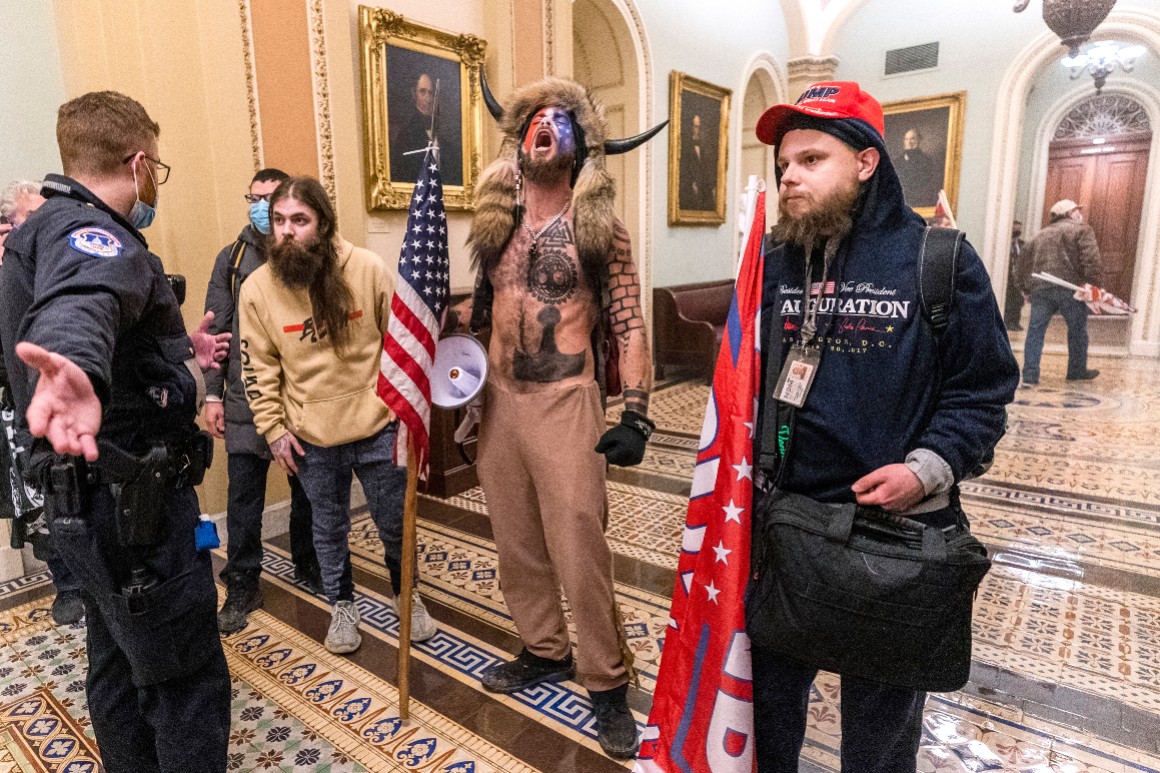
Arizona man who wore horns in riot pleads guilty to felony - POLITICOCapitol Riot of Jan. 6, 2021 | The First Amendment EncyclopediaConspiracy theories paint fraudulent reality of Jan. 6 riot | PBS News  Weekend  Those images are powerful, immediately recognizable to most Americans, and they stay with you.  No words needed.

I hate looking at them and being reminded of that day.(2)  It doesn't require you believe this was an insurrection.  I don't, but I do believe it was a riot and a disgraceful day for America.  And brought to you courtesy of Donald Trump.  Do I believe Trump planned it?  No, Trump doesn't do planning, but his reckless rhetoric fired up his most gullible supporters over what was a ceremonial event, the counting of electoral votes.  And, once it happened, while his aides frantically spent hours trying to persuade him to say something publicly to quell the rioters, he was watching it all on TV.

I envision Trump watching it just like Laurie (Vera Miles) watches her suitors fighting over her in The Searchers. Laurie didn't plan it, but she sure likes that they care enough to fight for her.

Trump and his acolytes loved trolling to "own the libs" but ended up creating the greatest political "self-own" of my lifetime.  January 6 was only the culmination of a series of Trump appearances and Trump influenced events that created indelible images - like his out of control presence at the Covid press conferences.

Unless you are a hard-core "stop the steal" person you find the photos above to be repulsive.  That's why it was another self-own when the full tapes of the riot were released and featured extensively on right-wing media.  Do I think some of those arrested have been charged and sentenced excessively?  Yes, but that's not the issue here.  When the full video is being used to argue that the narrative about January 6 is misleading, all I can say, over and over again, if I'm a Democrat, is "don't throw me in that briar patch".  If you want to argue that a bare-chested painted guy wearing a buffalo head roaming around Congress is the good guy and represents Trump and the GOP you are really bad at politics, and every time you show these images you are pushing away anyone other than your hard-core supporters. 

The very real damage Trump did by his actions leading to the creation of those images is that the real danger to American democracy is today's Democratic Party.  The Biden administration is the most radical in American history, devoted to undermining the foundations of this country, rewriting its history, and the most race-obsessed administration since that of Woodrow Wilson.  Trump's disorganized, impulsive rabble has no institutional foothold, and, like Trump himself, is simply incapable of doing long-term strategic thinking and planning, unlike the progressive New Racist warriors who now dominate American institutions.

But with January 6 and those easily remembered and accessible images, Donald Trump gave the Democrats their Reichstag moment, their great opportunity to effectively cast Republicans as the true threat to democracy, a threat justifying limits on speech, limits on conduct, and denying educational and job opportunities to those who dissent.  Any time those images are seen, and every time someone tries to justify aspects of that riot, it just reinforces the Democratic message.

We've already seen the effects in the actions and Executive Orders of the administration.  That it wasn't worse in terms of Congressional action during the first two years of the administration is only because of Sinema and Manchin in the Senate.  We were left dependent on those two Democrats after Trump, in classic passive-aggressive campaign mode, undermined the two GOP Senate candidates in the special election of January 2021.  After all, if they had won it would have undermined his claims about the alleged steal of the Georgia election in November.

Happy to talk with you about Russia Collusion or you can read the links above, but I think Donald Trump's images are much more influential. 

----------------------------------------------------

(1) Pappy O'Daniel really existed, though he was governor of Texas, not Mississippi as portrayed in O Brother, Where Art Thou?  W. Lee ("Pappy") O'Daniel rose to fame as a singer in a band he put together to promote the flour company he worked for.  Eventually O'Daniel started his own company, Hillbilly Flour, and formed a new and very popular group, Pat O'Daniel and his Hillbilly Boys.  After two terms as governor, in 1941 O'Daniel won a special election for the U.S. Senate.  In a close race, Pappy defeated Lyndon Baines Johnson by using the time-honored Texas Democrat tradition of withholding voting returns from certain Rio Grande districts until LBJ leaning districts had finished their reporting, allowing Pappy supporters to create enough votes to win.  LBJ learned his lesson, employing Pappy's techniques in 1948 to win a very close U.S. Senate race.

(2)  I expressed my views of that day here, here, and here.

Sunday, May 24, 2020

53 Transcripts: Whose Testimony Was Accurate?

Scene One:

On July 17, 2017, James Clapper, Director of National Intelligence (DNI) during the Obama Administration testified at a session of the House Intelligence Committee.

Rep Brad Wenstrup (R-Ohio) read him two quotes from testimony the National Intelligence Officer (NIO*) for Russia had given when briefing the committee on December 5, 2016:
"In terms of favoring one candidate or another, you know, the evidence is a little bit unclear."
"It's unclear to us that the Kremlin had a particular - that they had a particular favorite or they wanted to see a particular outcome.  That is what the reporting shows." (pp16-17)
Yet on January 6, 2017 Clapper released the Intelligence Community Assessment (ICA) on Russian interference with the election which concluded, " We further assess Putin and the Russian Government developed a clear preference for President-elect Trump".  Wenstrup asked if the statements made by the NIO on December 5 were accurate and complete.  Clapper said no, they were not.  Because of extensive redactions in the transcript that followed this exchange it is not possible to determine if Clapper offered an explanation as to why the assessment changed in the intervening month or, in the alternative, why a senior CIA official was giving inaccurate information to the Intelligence Committee.

Clapper also testified that the ICA didn't talk about collusion because they didn't have any evidence "that met the evidentiary threshold"(p.46), yet the FBI and DOJ had vouched for the reliability of the collusion allegations made in the Steele Dossier when officials from both agencies signed the Carter Page FISA warrant application in October 2016.

Scene Two:

On June 22, 2017, Dan Coats, DNI testified.  In March, after Coats' confirmation, James Comey briefed him on collusion, telling Coats, "There is smoke but no fire on the issue of collusion" (p.6),  "There is nothing to indicate collusion with the President" (p.27), and then adding:
"We are only looking at one person who had some role in the campaign [Carter Page]". (p.6)
Yet the Crossfire Hurricane investigation specifically named four targeted individuals, Page, Papadopolous, Manafort, and Flynn, while the most recent FISA renewal application in January 2017 had referenced Papadopolous and Manafort, in addition to Page.  Moreover, as was recently revealed, the investigation into Flynn was not closed as recommended in early January.

Scene Three:

Andrew McCabe testified on December 19, 2017.  Consistent with prior testimony given by Comey, McCabe stated that the FBI Director began writing memos of his meetings with Trump because of concerns about the frequency and content of his conversations with the President.  Rep Trey Gowdy pointed out that could not be true because Comey began writing memos right after his first meeting with Trump on January 6 - indeed Comey arranged in advance to have a setup in his car that would allow him to write a memo immediately upon ending the meeting with the President-elect. After that meeting, Comey told Clapper the "President-elect was very defensive about it" (Clapper interview p. 51), the "it" being the allegation he consorted with several prostitutes in a Moscow hotel room (I'm being circumspect here about the specifics of the allegation).  In Comey's mind, Trump's defensiveness (about an incident that never happened) was an indication of guilt.

Gowdy also asked why the FBI began drafting a non-indictment statement when Clinton and others were still to be interviewed in the email investigation; why wasn't there also an indictment draft?  McCabe stated there was no consideration given to drafting a statement regarding an indictment recommendation.

-------------------------------------------------------
* National Intelligence Officers are appointed by the Director of the CIA, report directly to the Director, and are responsible for all intelligence matters within their geographical area.

Monday, June 12, 2023

Here We Go Again

When I read Roger Stone's 2017 testimony to the House Intelligence Committee, released after Adam Schiff's year-plus stonewalling, during which period the congressman repeatedly went on national media to lie about what had happened in those hearings, I did so with a copy of the Justice Department indictment of him, an indictment based, in part, on Stone's testimony to the committee (for more on my reading of the 5,000+ pages of testimony released in 2020 see the 53 Transcripts series). My reaction was that Stone might as well have worn a "Please, Indict Me!" T-shirt to the hearing.  His lies, and contempt for the committee, though not material to the Russia collusion narrative, were evident in the transcript.  Perhaps no surprise, as his successor as Trump's campaign advisor, Corey Lewandowski, had this to say to the committee about Roger:

"Roger Stone is a liar"

"What did he lie to you about?"

"The time of day, the color of his tie, what color of shoes he was wearing, basically everything and everything." 

I've now read the DOJ indictment of Donald Trump.  I can't judge the merits, either factually or regarding the legal arguments that are certain to be raised, or predict the outcome, but based on the indictment and the circumstances around it, all I can say is that Trump might as well have been wearing a "Please, Indict Me!" T-shirt for his handling of the documents situation, from start to finish.  This is a much more serious legal matter than the ridiculous case filed by the Manhattan DA or, from what I can tell, the case that may be filed in Georgia.

That's a consistent pattern for Trump.  Put a rake in his path and he'll step on it every time, the handle clocking him in the head, and yet he'll learn nothing from the experience.  He's a one-trick pony.  His unorthodox style (I likened it to a left-handed boxer) and weird charisma, which appeals to a segment of the electorate, got him far.  But he is not the 3-D thinker his admirers claim.  He's not a thinker at all.  He's instinctive.  He reacts to a situation, says what he needs to say to get through it, sees what the reaction is, and then decides what he'll say next.(1)  Early on that was enough to throw off most opponents in both parties and the media, but eventually people caught on.  You pile up enough "off-the-cuff" statements or tweets and people realize this is no logical consistency or thoughts behind them.  You can really see this in play recently with his statements on Ron DeSantis, most of which make absolutely no sense, are inconsistent from one statement to the next, and often endorse Democrat talking points.  It's also why no lawyer representing Trump would ever recommend he take the stand in his defense.  He'll say anything to get past the moment.  That sometimes work in politics, but doesn't in a trial.

The media caught on to this by the time Covid hit.  Reporters realized they could get him to say anything in reaction to their questions, no matter how outrageous, in fact, the more outrageous the question, the more they could get him to sound outrageous.  They, not Trump, controlled those press conferences, but he never realized it.  In his defense, people would say that the public hated the press and their questions made them look liked idiots.  Did the press often look like idiots?  Sure, but the public expects that.  What they don't like is their President looking like an out of control idiot, and that's what Trump did every time he took their bait, which was every time.(2)

It would have been easy enough, once the archives asked for the documents, for Trump to cooperate, as Biden did.  This all could have been avoided.  Why he didn't is simple.  And it's simple, because the simple explanations work for Trump.  Despite the fevered progressive fantasies, this is not because he wanted to sell the documents to Putin or the Saudis.(3)  It's because he wanted trophies to show to friends and celebrities, demonstrating his importance and brilliance.  If it became a problem, he'd improvise his way through it.

There's been some speculation by his supporters that he held on to some of the documents because they proved the Russia collusion conspiracy.  Actually, that is already proven (see the Russia Collusion series - I am slowly making my way through the Durham report and will write a summary next month) but, more importantly, it's not true or, if it is, is just another example of Trump's incompetence.  As president, Trump often tweeted that he would require declassification of all Russia collusion documents, but it never happened.  Why, if he now had the documents would he continue to hold on to them for two years, once out of the presidency?

There is a cautionary note and it's why I'm not expressing a view on the merits.  An indictment is not evidence, even if, like this one, it is written in an unusually long and narrative form.  In 2018, the Muller gang filed a similar, very long, and very detailed indictment against a number of Russian individuals and companies alleging interference in the 2016 election.  It got enormous press coverage but then the Mueller team got a big surprise.  Because the U.S. had no jurisdiction over the defendants, Mueller never expected the case to proceed and to have to prove the allegations; it was filed as a publicity stunt to keep coverage going on the Russia collusion narrative, because by that time Mueller's crew knew they had nothing.  The surprise was that one of the Russian companies employed US counsel, and demanded the discovery it was entitled to from the government.  The Mueller team, knowing its scheme was unraveling, resisted disclosure and foisted off the case to the local U.S. attorney office.  A year later, the U.S. attorney asked that the case be dismissed.  However, it served its purpose by creating the desired media narrative.

I think there are a couple of differences between this case and that of the alleged Russian interference.  First, unlike Mueller's political and media stunt, this case will go to trial and the government knows that.  Second, if the testimony from Trump's own attorneys at trial is consistent with that alleged in the indictment it will be devastating.  The lawyers were compelled to testify, they did not turn on Trump, and it will present enormous problems for the defense.  And as mentioned above, Trump's trial attorneys will be very reluctant to recommend the defendant testify in his own defense.

Trump's ploy is to say to his supporters that "They're not out to get me, they're out to get you".  There is some truth to this.  Anyone who watched what happened to Brett Kavanaugh knows this.  Anyone who is aware of the censorship efforts by the Biden administration and its institutional allies, knows it.  Anyone who has lost their job because of Biden's allies, or is staying silent to keep their job, knows it.

The problem is that it is Trump making the argument.  He makes it so easy for his opponents and he drags down everyone with him.  And he's made chumps of his own supporters.  What happened to all of those who got fired up by the "stop the steal" nonsense and his cockeyed theories, and were inspired to get involved with January 6?  Trump raised well over $100 million on the strength of January 6 and, last time I looked, none of it went to the January 6 defendants.  He left them on their own.  Loyalty with Trump is a one-way street.  In contrast, Democrats look after their own.  During the George Floyd riots, Democrats raised millions for defense lawyers and bail for their supporters who had caused so much destruction and committed violent crimes.

Trump's perfect genius is in creating messaging and imaging to undermine himself and his supporters.  For examples, read Images and Ukraine Blues.

All of this goes to demonstrating that even if, by some strange set of circumstances, Trump were to win the GOP nomination and the presidency, his second term will be a disaster for the causes his supporters most believe in.  He is incapable of governance.  He has learned nothing and wants to learn nothing.

The other argument is to raise the dual standards regarding Trump, Hillary and Biden.  While I have no sympathy for Trump because he put himself in this spot, I understand the political appeal of the argument.  I'm outraged by that aspect and don't want to be lectured by any Democrat about the importance of the rule of law.

Hillary Clinton broke the law, a strict liability statute.  She had the choice of complying with the law and running the risk that the American public might eventually be able to see some of her correspondence, or breaking the law and risking that the Russians and/or Chinese could intercept her communications.  She chose the latter.

She also destroyed evidence and got away with it (having experience with the Department of Justice on criminal matters, this is the part I find the most astonishing).(4)  And now we know she created the Russia collusion hoax to divert attention from the political fallout created by the hacking of the DNC emails.  She hired FusionGPS which, at the same time, was representing a Putin-connected oligarch.  FusionGPS in turn hired Christopher Steele who, at the time, was working for another Putin-connected oligarch.  Steele, in turn, hired Igor Danchenko, a Russian national, someone investigated by the FBI for ties to Russian intelligence, who provided Steele with information alleged to come from Russian intelligence sources.  And the source for one of the most scandalous allegations, Trump's comporting with prostitutes at the Moscow Ritz Carlton (which proved as false as everything else in the Steele dossier), came from a DC lobbyist (Charles Dolan) who had worked extensively for the Clintons, and was also advising the Kremlin on how to improve its public relations in the U.S. while regularly meeting with Putin's spokesperson.  The FBI, DOJ, and the Obama White House were aware of what she was doing, thought it just fine, and she got away with it. 

And those at the FBI and DOJ who kept the fake narrative of the Russia collusion story going for three years also got away with it.  The Federal bureaucracy collaborated to clear Hillary in time so she could beat Trump and then, after she unexpectedly lost, collaborated to protect themselves, undermine the Trump administration, and help the Democrats win the mid-term.(5)(6)

As for the Democrats this is about practical politics.  The bottom line is that they want Trump to be the nominee, because they think him the easiest opponent to beat or, failing that, to keep him in play to disrupt the campaign of whoever else comes out of the GOP primaries.  With the indictments they have ensured that Trump will be the GOP story right through to the election.  Every GOP candidate will be peppered with questions about Trump because the media outlets also want this to be about Trump.  This suits Trump, as well as the Democrats.

The most likely outcome if Trump is nominated is that he will lose and drag down the rest of the GOP with him, opening the floodgates to the authoritarian Democrats, a fate only narrowly avoided after the 2020 election because of Senators Manchin and Sinema.  In the unlikely event he wins, it will still be a disaster.  If he loses the nomination, he will undermine whoever the GOP candidate is.  Trump cannot afford for another GOP candidate to win the 2024 election.  If they do, it undermines his entire "stop the steal" argument and makes him into a big loser, the one thing Trump can never accept.(7)  We saw him pull the same stunt in the Georgia run-off election in January 2021.  At rallies he would give a lukewarm brief endorsement of the GOP candidates and then rant on for a half hour about how the election was rigged.  He successfully depressed GOP turnout because if the GOP candidates won it would have undermined his claim that the November election had been stolen from him.  For Trump, it is all about Trump, not America.

-------------------------------------------------------------------------------------------

(1) This has been a consistent practice of Trump's.  In the Art of the Deal he brags about not wanting to be trapped by a schedule or agenda and prefers to come in to the office each day and react to what is going on.  From all reports, he followed the same practice in the White House, refusing to read briefing papers, acting impulsively, and watching hours of cable TV every day to figure out what his next move would be.  This had always worked for Trump, particularly after his business model changed after his bankruptcies in the 1990s.  He saw no reason not to continue to employ it as President, not understanding the enormous differences between being a developer selling his brand and his new role.  And he knew from his stint on The Apprentice that his act was a success and that a 40 rating made you a star, failing to realize that a 40 rating made you a loser in Presidential politics.

(2) He's simply incapable of thinking a couple of steps ahead.  If, after the electoral college voted on December 14, 2020, he'd said, "I think there were big problems with the election, but we've gone through the process, and Biden will become president.  I think people will regret it once they see what Biden and the Democrats do but, in the meantime, I'll focus on improving the election process for the next time around, because I'll be back", he would have clinched the GOP nomination by now and probably win the 2024 election.  I would not have liked that outcome because he would be as ineffective a Chief Executive as he was last time around, but I think that's where we'd be right now if he had thought ahead.  Instead, he followed a dead end strategy that promised no favorable outcome for him and led to January 6.

(3) The hysterical reaction to Trump's election remains unabated.  Trump's own rhetoric and bizarre and repulsive mannerisms contributed but, until the November 2020 election, his actual actions were within the norms of modern presidents (the opposite can be said of Biden).  And, as far as foreign policy goes, I'd argue he was the best president in the past thirty years, which is said less in praise of Trump than in recognition of the utter mediocrity for what passes as the foreign policy establishment of both parties.   How do his repeated warnings about the security threat posed by the Nordstream Pipeline and hectoring NATO allies to increase defense spending, for both of which he was relentlessly mocked, sound now?  What Trump did is to expose the corruption, lack of integrity, and hostility to democracy of so many once respected institutions.  If they had reacted normally to Trump they would have found much to legitimately criticize, but by going so far over the top they ended up acting in the very ways they criticized Trump for, discrediting themselves as much as Trump discredited himself.  Holman Jenkins of the Wall St Journal best summed it up back in 2019:

Mr Trump is said to upset the norms of our political life, but how exactly?  By lying? By engaging in demagoguery?  By making absurd claims?  His real trick has been to be a one-man satire of our politics.  And so far he has yet to find an opponent or critic - whether Mr Biden, or Hillary Clinton or Mitt Romney - who doesn't prove his point.

To show what a liar he is, his enemies entangle themselves in lies.  Democrats have turned themselves into a party of Adam Schiffs, who, whatever his previous virtues, now is wholly defined by his promotion of the collusion canard.  It's an amazing psychological feat to squander their advantage over Mr Trump in this way.

Ditto the media.  In their eagerness to traffic in falsehoods about Mr Trump, his media critics lend him strength.  We face the weird prospect now of a world-class scandal involving the FBI and the intelligence community being aired even while much of the press is committed to being part of the coverup.
A reminder; the Russia collusion hoax is worse in substance than Watergate, with the extra added bonus being it is as if Watergate happened and the New York Times and Washington Post took the side of the Nixon administration.

(4) In the indictment, Trump allegedly makes a reference to this remarking to his lawyers about how Clinton had her lawyers protect her by destroying documents.  Typical of Trump, this is a garbled reference to what happened - Clinton's lawyers did not destroy documents, rather they were probably the ones who instructed Clinton's IT guy to destroy the documents (in contrast to how Special Counsel went after Trump's lawyers in this case, DOJ handled Hillary's lawyers with kid gloves).  In one sense, Trump does know how things really work as this example shows.  Another is in the Mueller report where repeatedly Trump complains to his team that he needs an attorney general who will protect him, citing Robert Kennedy and Eric Holder as AGs who did precisely that.  He's right about that - Holder even publicly bragged about being Obama's "wingman", and proved it through his actions that effectively destroyed the Justice Department.  For more on Holder's conduct read Footnote 1 from this post.  The next non-Trump Republican president needs to appoint an AG who will protect him and go after the opposition; no more gentlemanly ex-Senators like Ashcroft and Sessions.  One further note - the source for the Trump statements cited in the Mueller report is Trump's own White House Counsel.  Trump cooperated to an unprecedented degree with the Mueller investigation, waiving executive privilege and allowing his staff to testify and producing documents.

(5) Democrats attempt to counter this argument by pointing out that Comey's reopening of the email investigation in late October may have cost Hillary the election, so he clearly was not in her corner.  However, Comey has explained his reasoning.  His deputy, Andrew McCabe (a Clintonite) became aware of Weiner's laptop and the emails in September, but waited a month to tell Comey.  With the election imminent, Comey's thinking was that Hillary was going to win (we all thought that!) and if he didn't make an announcement the news would inevitably leak out after the election and it would stain her presidency and reflect poorly on the FBI.  Comey, having been assured that there was nothing damaging in the emails, thought he could resolve the matter quickly, which he did, and clear the deck for Hillary.  Could he have miscalculated?  Maybe, but he was prompted by a desire to help, not hurt, Hillary.

(6) There is a much broader problem of double standards which is evident to many of us.  See, Correction for one example.

(7) It occurs to me that if Trump does poorly in the early primaries he might accept a plea deal and drop out or just drop out and blame it on the government's "persecution" of him.  It would provide a face-saving excuse for him.