Showing posts sorted by date for query 53 Transcripts. Sort by relevance Show all posts

Thursday, July 3, 2025

Reassessing The Assessment

The CIA has publicly released, with some small redactions, a report, dated June 26, 2025, Tradecraft Review of the 2016 Intelligence Community Assessment on Russian Election Interference.  

I first wrote about the ICA report, released publicly on January 6, 2017, on February 10 of that year in Finding Real News.  In that post I summarized the findings of the ICA as:

The election vote was not hacked (though based on at least one poll, more than half of Democrats believe, based on media coverage, that Russia actually did hack into the vote counting).

Moscow was trying to influence the election, as Russia and its Soviet predecessor have done in the past.

In doing so, Russian cyber operations were directed against both parties.

Moscow's goal varied from undermining Clinton's credibility in light of her expected election to helping Trump win the election. 

I then posed six questions based upon my reading of the report, none of which seemed to be of interest to the press and largely remain unanswered to this day.  One of those relates to the final point in my summary:

2.  Regarding the Kremlin's goals in 2016, the phrasing of the report is puzzling.  The report states that Russia "aspired to help President-elect Trump's election chances when possible" but also that when it appeared Clinton would win the election, "the Russian influence campaign began to focus more on undermining her future presidency".  The language seems to imply that there was an early period when Russia was trying to help Trump win, followed by a switch when the Kremlin thought Clinton would win.  Is this a correct reading?  Can the agencies tell us when this switch occurred and why?  Did it occur before or after Wikileaks released the DNC and Podesta emails (disclosures which the report concludes "did not contain any evident forgeries")?  Since Trump trailed consistently in all polls from the time he clinched the Republican nomination through election day, on what basis did the Kremlin make a different assessment at some point?  When did the Kremlin not think Clinton was likely to win the election? In other words, during which periods was the Kremlin trying to help Trump win, as opposed to damaging a future Clinton presidency?

Last year I added a note to the 2017 post regarding the process by which the ICA was generated:

UPDATE (October 1, 2024) - I am adding this note regarding information I came across back in 2020 because it is directly related to the odd circumstances around the Intelligence Community Assessment released publicly in January 2017.  

The five analysts who compiled the report were personally selected by DNI Clapper, contrary to normal practice which is designed to prevent undue influence towards desired outcomes by those assigning the task.  One of those excluded from involvement with the report was the CIA's National Intelligence Officer (NIO) for Russia!  NIO's are appointed by the Director of the CIA, report directly to the Director, and are responsible for all intelligence matters within their geographical area.

In testimony to the House Intelligence Committee on December 5, 2016, the NIO stated her conclusions regarding the election:

"In terms of favoring one candidate or another, you know, the evidence is a little bit unclear."
"It's unclear to us that the Kremlin had a particular - that they had a particular favorite or they wanted to see a particular outcome.  That is what the reporting shows."

Before discussing the recently released reassessment of the 2016 assessment, some context is needed. 

The question about whether Putin had a preference in the 2016 election and whether, and how, Russia interfered is separate and distinct from whether the Trump campaign colluded with Russia during the campaign (it did not, though there is substantial suggestive evidence that the Russians were able to influence the contents of the Steele Dossier, which was funded by the Clinton campaign, a subject I've written about on several occasions, most recently in He's Not Your Bro).  However, for the reasons discussed below, these issues ended up merged in the public mind due to the collusion of the Intelligence Community, the Democratic Party, and the New York Times(1) and Washington Post.

The fact that Russia, and its predecessor the Soviet Union, had preferences and interfered in past U.S. presidential elections is not unique, and is directly acknowledged in the 2016 ICA.  It's also something I referenced in my February 2017 post:

3.  The report places the Kremlin's 2016 influence campaign in an historical context, citing prior Russian and Soviet efforts to influence American presidential elections, though it also concludes the Kremlin took this to an unprecedented level in 2016.  I would have liked to see some questions about this aspect of the report.  Did the Kremlin seek to influence the 2012 election and, if so, in whose favor?  Did the Kremlin seek to influence the 2008 election and, if so, in whose favor (we know that Kremlin spokespersons denounced John McCain, and Republicans in general, during the course of that election)?  Do the intelligence agencies have information they can release about the reported contacts in 1983 between Senator Edward Kennedy and Communist Party Secretary Andropov regarding coordinating efforts to defeat President Ronald Reagan in his re-election bid? The report contains this disclosure:

In the 1970s, the KGB recruited a Democratic Party activist who reported information about then presidential hopeful Jimmy Carter's campaign and foreign policy plans . . .  

Can the intelligence agencies shed any additional light on this incident?  Is there additional information regarding past Russian and Soviet election influencing that can be publicly shared?

In 2008 and 2012 the Kremlin openly supported Barack Obama over his opponents, John McCain and Mitt Romney.  In 2012, President Obama was caught on an open mic telling then Soviet Premier Medvedev to let "Vladimir" know he'd have more flexibility on policy after the election (a reference to his post-election reneging on commitments to send missile defense systems to Poland and Romania).

In addition, the 2016 ICA directly asserts as firm conclusions that, more recently, the Kremlin supported the 2011 Occupy Wall Street demonstrations as well as the ongoing anti-fracking efforts of U.S. environmental organizations.

This was my own assessment as of February 2017:

I think it probable that the Kremlin favored the election of Donald Trump.  I base that on:

  • Trump's favorable personal comments about Putin.
  • Trump's history of favorable views of authoritarian strongmen.
  • His refusal to condemn Russia for aggression in Crimea and Ukraine or murdering its political opponents.
  • Trump's view of Russia as a potential ally in the Middle East and the fight against ISIS. 
  • The presence, in the early stages of his campaign, of senior aides known to have favorable views of current Kremlin leadership.
Factors countering that view:
  • The widespread assumption in the American intelligence community that the Kremlin is in possession of the Hillary Clinton emails giving them potential leverage if she were elected.
  • The controversial dossier about Donald Trump's activities in Russia that was purported to come from Russian intelligence sources and which, though it did not become public until after the election, was in widespread circulation among media hostile to Trump prior to the election. 
A possible factor countering that view:
  • How did the Kremlin rate the chances that a Clinton presidency would continue the policies of the Obama presidency which was ineffective in opposing Russia?

Despite these counter factors, if I were betting, I'd bet on the Kremlin favoring Trump, though I don't consider it a certainty.  

I am less certain of that judgement in light of what I've learned reading thousands of pages of source documents since that time, though if I had to make a bet it would still be on favoring Trump at least at some point in the campaign. 

Another factor in tempering my earlier judgement is that in February 2017 I did not know that the Clinton campaign had paid for the production of the Steele Dossier, that the contractor (FusionGPS), Steele himself, and the sources for most of the allegations (none of which were ever corroborated) were either actively employed at the time by Putin-connected oligarchs or had close associations with Russian intelligence, and that an internal FBI review in 2018 "showed that the Russians had access to sensitive U.S. government information years earlier that would have allowed them to identify Steele's subsources . . . Steele's subsources could have been compromised by the Russians at a point in time prior to the date of the first Steele dossier report" (of course the FBI then instructed its analysts to remain silent about this), raising the possibility that Putin was willing to put into the hands of the Clinton campaign wild stories designed to damage Donald Trump.

What I remain confident of is that Putin's overriding strategy has been to disrupt and weaken American institutions and public confidence in those institutions, regardless of who was president.  He has largely achieved that goal with the help of the Clinton campaign and the Democratic Party, the Intelligence Community, Adam Schiff(1), and the leading prestige legacy media outlets(2).  

The 2025 Reassessment

The eight page reassessment addresses the process by which the ICA was hastily put together.  The document begins by discussing the origin and context of the ICA.  During the 2016 campaign there were "conflicting public and private statements" by IC officials about Russia's activities.  This prompted President Obama on December 6, 2016 to direct DNI James Clapper to conduct an assessment.(3)  The reassessment goes on to state:

However, before work on the assessment even began, media leaks suggesting that the IC had already reached definitive conclusions risked creating an anchoring bias.

On 9 December, both the Washington Post and New York Times reported the IC had concluded with high confidence that Russia had intervened specifically to help Trump win the election. The Post cited an unnamed US official describing this as the IC’s “consensus view". 

The new review "identified multiple procedural anomalies in the preparation of the ICA. These
included a highly compressed production timeline, stringent compartmentation, and excessive
involvement of agency heads
" leading to "departures from standard practices in the drafting, coordination, and reviewing of the ICA. These departures impeded efforts to apply rigorous tradecraft, particularly to the assessment's most contentious judgment" [that Putin "aspired" to help Trump win election]. 

You can read the report to get the details of these anomalies, so I will focus on just a few. 

Generating a final ICA usually take months, not two weeks as this one did.  To do so, there were unusual restrictions on the normal process of participation as well as abnormal involvement by agency heads.

While agency heads sometimes review controversial analytic assessments before publication, their direct engagement in the ICA's development was highly unusual in both scope and intensity. This exceptional level of senior involvement likely influenced participants, altered normal review processes, and ultimately compromised analytic rigor.  

From the outset, agency heads chose to marginalize the National Intelligence Council (NIC), departing significantly from standard procedures for formal IC assessments. Typically, the NIC maintains control over drafting assignments, coordination, and review processes.

These departures from standard procedure not only limited opportunities for coordination and thorough tradecraft review, but also resulted in the complete exclusion of key intelligence agencies from the process. While sensitive counterintelligence information in community assessments often requires restricted access, the decision to entirely shut out the Defense Intelligence Agency and the Department of State’s Bureau of Intelligence and Research from any participation in such a high-profile assessment about an adversary’s plans and intentions was a significant deviation from typical IC practices.

The exclusion was not just of other agencies; as noted above, Clapper and CIA Director Brennan shut the CIA's own National Intelligence Officer for Russia out of the process.  Indeed the reassessment notes:

The two senior leaders of the CIA mission center responsible for Russia argued jointly against including the “aspire” judgment. In an email to Brennan on 30 December, they stated the judgment should be removed because it was both weakly supported and unnecessary, given the strength and logic of the paper’s other findings on intent. They warned that including it would only “open up a line of very politicized inquiry.” 

The other important aspect was the decision to include a summary of the Steele Dossier in the appendix of the ICA.  Even by that date, the CIA knew that the dossier allegations were unsubstantiated and initially resisted including it in the ICA.  However, according to the reassessment:

FBI leadership made it clear that their participation in the ICA hinged on the Dossier’s inclusion and, over the next few days, repeatedly pushed to weave references to it throughout the main body of the ICA.

The ICA authors and multiple senior CIA managers—including the two senior leaders of the CIA mission center responsible for Russia— strongly opposed including the Dossier, asserting that it did not meet even the most basic tradecraft standards.  

However, CIA Director Brennan overruled his subordinates:

Brennan showed a preference for narrative consistency over analytical soundness. When confronted with specific flaws in the Dossier by the two mission center leaders—one with extensive operational experience and the other with a strong analytic background—he appeared more swayed by the Dossier's general conformity with existing theories than by legitimate tradecraft concerns. Brennan ultimately formalized his position in writing, stating that “my bottom line is that I believe that the information warrants inclusion in the report.”

The reassessment concludes:

. . . by placing a reference to the annex material in the main body of the ICA as the fourth supporting bullet for the judgment that Putin “aspired” to help Trump win, the ICA implicitly elevated unsubstantiated claims to the status of credible supporting evidence, compromising the analytical integrity of the judgment. 

It was important for Brennan and the IC leadership to have a reference to the Steele Dossier somewhere in the report.  At that point, many publications had the dossier, but while stories based on individual allegations contained therein had been published, the actual dossier was not yet publicly available.  Reference to it helped bolster its credibility with media outlets and because its focus was on the alleged active collaboration between the Trump campaign and the Kremlin it allowed the issue of influence to be merged with collaboration.

Bottom line - the 2016 ICA was intended to be a political, not analytical, document. 

---------------------------------------------------------------

(1) The new California senator continues to lie about this, stating on CNN in January 2025 that  "the fact that we didn't find proof beyond reasonable doubt doesn't mean there wasn't evidence of conspiracy."  I've read the same testimony he heard as ranking member of the House Intelligence Community.  He knew then, and knows now, that not only was there not proof beyond a reasonable doubt, but that there was NO evidence of a conspiracy between the Trump campaign and Russia, though we now know there is evidence of a possible conspiracy between the Clinton campaign and Russia.  Part of the disgrace of the Russia Collusion Hoax was that those who promoted it have never paid any price for the damage they've done to this country.  In fact, Schiff leveraged his role to advance from Representative to Senator.  For more on Schiff and the testimony he heard read Right Move and the 53 Transcripts series.

(2) The New York Times continues its mendacious role in the collusion hoax.  Its headline on the new report reads, 

C.I.A. Says Its Leaders Rushed Report on Russia Interference in 2016 Vote

But the new review of the earlier assessment does not dispute the conclusion that Russia favored the election of Donald J. Trump.

The subheading is not supported by the text of the report.

I've been unable to find any coverage of the CIA report by the Washington Post. 

(3) The language here is directly from the reassessment.  However, my own take is a bit different.  What prompted the 2016 ICA was the unexpected election of Donald Trump and the alarm it raised in the White House and the IC.  The information contained in the IC was already known prior to the election and had been the subject of ongoing discussions between the IC and the White House during the campaign.  I think the White House and IC were genuinely concerned about the prospect of a Trump presidency and the purpose of the ICA was to prepare a document that could be quickly released publicly and be used to undermine the incoming administration.  I believe that is the best explanation for the deficiencies noted by the 2025 reassessment.   

Monday, June 12, 2023

Here We Go Again

When I read Roger Stone's 2017 testimony to the House Intelligence Committee, released after Adam Schiff's year-plus stonewalling, during which period the congressman repeatedly went on national media to lie about what had happened in those hearings, I did so with a copy of the Justice Department indictment of him, an indictment based, in part, on Stone's testimony to the committee (for more on my reading of the 5,000+ pages of testimony released in 2020 see the 53 Transcripts series). My reaction was that Stone might as well have worn a "Please, Indict Me!" T-shirt to the hearing.  His lies, and contempt for the committee, though not material to the Russia collusion narrative, were evident in the transcript.  Perhaps no surprise, as his successor as Trump's campaign advisor, Corey Lewandowski, had this to say to the committee about Roger:

"Roger Stone is a liar"

"What did he lie to you about?"

"The time of day, the color of his tie, what color of shoes he was wearing, basically everything and everything." 

I've now read the DOJ indictment of Donald Trump.  I can't judge the merits, either factually or regarding the legal arguments that are certain to be raised, or predict the outcome, but based on the indictment and the circumstances around it, all I can say is that Trump might as well have been wearing a "Please, Indict Me!" T-shirt for his handling of the documents situation, from start to finish.  This is a much more serious legal matter than the ridiculous case filed by the Manhattan DA or, from what I can tell, the case that may be filed in Georgia.

That's a consistent pattern for Trump.  Put a rake in his path and he'll step on it every time, the handle clocking him in the head, and yet he'll learn nothing from the experience.  He's a one-trick pony.  His unorthodox style (I likened it to a left-handed boxer) and weird charisma, which appeals to a segment of the electorate, got him far.  But he is not the 3-D thinker his admirers claim.  He's not a thinker at all.  He's instinctive.  He reacts to a situation, says what he needs to say to get through it, sees what the reaction is, and then decides what he'll say next.(1)  Early on that was enough to throw off most opponents in both parties and the media, but eventually people caught on.  You pile up enough "off-the-cuff" statements or tweets and people realize this is no logical consistency or thoughts behind them.  You can really see this in play recently with his statements on Ron DeSantis, most of which make absolutely no sense, are inconsistent from one statement to the next, and often endorse Democrat talking points.  It's also why no lawyer representing Trump would ever recommend he take the stand in his defense.  He'll say anything to get past the moment.  That sometimes work in politics, but doesn't in a trial.

The media caught on to this by the time Covid hit.  Reporters realized they could get him to say anything in reaction to their questions, no matter how outrageous, in fact, the more outrageous the question, the more they could get him to sound outrageous.  They, not Trump, controlled those press conferences, but he never realized it.  In his defense, people would say that the public hated the press and their questions made them look liked idiots.  Did the press often look like idiots?  Sure, but the public expects that.  What they don't like is their President looking like an out of control idiot, and that's what Trump did every time he took their bait, which was every time.(2)

It would have been easy enough, once the archives asked for the documents, for Trump to cooperate, as Biden did.  This all could have been avoided.  Why he didn't is simple.  And it's simple, because the simple explanations work for Trump.  Despite the fevered progressive fantasies, this is not because he wanted to sell the documents to Putin or the Saudis.(3)  It's because he wanted trophies to show to friends and celebrities, demonstrating his importance and brilliance.  If it became a problem, he'd improvise his way through it.

There's been some speculation by his supporters that he held on to some of the documents because they proved the Russia collusion conspiracy.  Actually, that is already proven (see the Russia Collusion series - I am slowly making my way through the Durham report and will write a summary next month) but, more importantly, it's not true or, if it is, is just another example of Trump's incompetence.  As president, Trump often tweeted that he would require declassification of all Russia collusion documents, but it never happened.  Why, if he now had the documents would he continue to hold on to them for two years, once out of the presidency?

There is a cautionary note and it's why I'm not expressing a view on the merits.  An indictment is not evidence, even if, like this one, it is written in an unusually long and narrative form.  In 2018, the Muller gang filed a similar, very long, and very detailed indictment against a number of Russian individuals and companies alleging interference in the 2016 election.  It got enormous press coverage but then the Mueller team got a big surprise.  Because the U.S. had no jurisdiction over the defendants, Mueller never expected the case to proceed and to have to prove the allegations; it was filed as a publicity stunt to keep coverage going on the Russia collusion narrative, because by that time Mueller's crew knew they had nothing.  The surprise was that one of the Russian companies employed US counsel, and demanded the discovery it was entitled to from the government.  The Mueller team, knowing its scheme was unraveling, resisted disclosure and foisted off the case to the local U.S. attorney office.  A year later, the U.S. attorney asked that the case be dismissed.  However, it served its purpose by creating the desired media narrative.

I think there are a couple of differences between this case and that of the alleged Russian interference.  First, unlike Mueller's political and media stunt, this case will go to trial and the government knows that.  Second, if the testimony from Trump's own attorneys at trial is consistent with that alleged in the indictment it will be devastating.  The lawyers were compelled to testify, they did not turn on Trump, and it will present enormous problems for the defense.  And as mentioned above, Trump's trial attorneys will be very reluctant to recommend the defendant testify in his own defense.

Trump's ploy is to say to his supporters that "They're not out to get me, they're out to get you".  There is some truth to this.  Anyone who watched what happened to Brett Kavanaugh knows this.  Anyone who is aware of the censorship efforts by the Biden administration and its institutional allies, knows it.  Anyone who has lost their job because of Biden's allies, or is staying silent to keep their job, knows it.

The problem is that it is Trump making the argument.  He makes it so easy for his opponents and he drags down everyone with him.  And he's made chumps of his own supporters.  What happened to all of those who got fired up by the "stop the steal" nonsense and his cockeyed theories, and were inspired to get involved with January 6?  Trump raised well over $100 million on the strength of January 6 and, last time I looked, none of it went to the January 6 defendants.  He left them on their own.  Loyalty with Trump is a one-way street.  In contrast, Democrats look after their own.  During the George Floyd riots, Democrats raised millions for defense lawyers and bail for their supporters who had caused so much destruction and committed violent crimes.

Trump's perfect genius is in creating messaging and imaging to undermine himself and his supporters.  For examples, read Images and Ukraine Blues.

All of this goes to demonstrating that even if, by some strange set of circumstances, Trump were to win the GOP nomination and the presidency, his second term will be a disaster for the causes his supporters most believe in.  He is incapable of governance.  He has learned nothing and wants to learn nothing.

The other argument is to raise the dual standards regarding Trump, Hillary and Biden.  While I have no sympathy for Trump because he put himself in this spot, I understand the political appeal of the argument.  I'm outraged by that aspect and don't want to be lectured by any Democrat about the importance of the rule of law.

Hillary Clinton broke the law, a strict liability statute.  She had the choice of complying with the law and running the risk that the American public might eventually be able to see some of her correspondence, or breaking the law and risking that the Russians and/or Chinese could intercept her communications.  She chose the latter.

She also destroyed evidence and got away with it (having experience with the Department of Justice on criminal matters, this is the part I find the most astonishing).(4)  And now we know she created the Russia collusion hoax to divert attention from the political fallout created by the hacking of the DNC emails.  She hired FusionGPS which, at the same time, was representing a Putin-connected oligarch.  FusionGPS in turn hired Christopher Steele who, at the time, was working for another Putin-connected oligarch.  Steele, in turn, hired Igor Danchenko, a Russian national, someone investigated by the FBI for ties to Russian intelligence, who provided Steele with information alleged to come from Russian intelligence sources.  And the source for one of the most scandalous allegations, Trump's comporting with prostitutes at the Moscow Ritz Carlton (which proved as false as everything else in the Steele dossier), came from a DC lobbyist (Charles Dolan) who had worked extensively for the Clintons, and was also advising the Kremlin on how to improve its public relations in the U.S. while regularly meeting with Putin's spokesperson.  The FBI, DOJ, and the Obama White House were aware of what she was doing, thought it just fine, and she got away with it. 

And those at the FBI and DOJ who kept the fake narrative of the Russia collusion story going for three years also got away with it.  The Federal bureaucracy collaborated to clear Hillary in time so she could beat Trump and then, after she unexpectedly lost, collaborated to protect themselves, undermine the Trump administration, and help the Democrats win the mid-term.(5)(6)

As for the Democrats this is about practical politics.  The bottom line is that they want Trump to be the nominee, because they think him the easiest opponent to beat or, failing that, to keep him in play to disrupt the campaign of whoever else comes out of the GOP primaries.  With the indictments they have ensured that Trump will be the GOP story right through to the election.  Every GOP candidate will be peppered with questions about Trump because the media outlets also want this to be about Trump.  This suits Trump, as well as the Democrats.

The most likely outcome if Trump is nominated is that he will lose and drag down the rest of the GOP with him, opening the floodgates to the authoritarian Democrats, a fate only narrowly avoided after the 2020 election because of Senators Manchin and Sinema.  In the unlikely event he wins, it will still be a disaster.  If he loses the nomination, he will undermine whoever the GOP candidate is.  Trump cannot afford for another GOP candidate to win the 2024 election.  If they do, it undermines his entire "stop the steal" argument and makes him into a big loser, the one thing Trump can never accept.(7)  We saw him pull the same stunt in the Georgia run-off election in January 2021.  At rallies he would give a lukewarm brief endorsement of the GOP candidates and then rant on for a half hour about how the election was rigged.  He successfully depressed GOP turnout because if the GOP candidates won it would have undermined his claim that the November election had been stolen from him.  For Trump, it is all about Trump, not America.

-------------------------------------------------------------------------------------------

(1) This has been a consistent practice of Trump's.  In the Art of the Deal he brags about not wanting to be trapped by a schedule or agenda and prefers to come in to the office each day and react to what is going on.  From all reports, he followed the same practice in the White House, refusing to read briefing papers, acting impulsively, and watching hours of cable TV every day to figure out what his next move would be.  This had always worked for Trump, particularly after his business model changed after his bankruptcies in the 1990s.  He saw no reason not to continue to employ it as President, not understanding the enormous differences between being a developer selling his brand and his new role.  And he knew from his stint on The Apprentice that his act was a success and that a 40 rating made you a star, failing to realize that a 40 rating made you a loser in Presidential politics.

(2) He's simply incapable of thinking a couple of steps ahead.  If, after the electoral college voted on December 14, 2020, he'd said, "I think there were big problems with the election, but we've gone through the process, and Biden will become president.  I think people will regret it once they see what Biden and the Democrats do but, in the meantime, I'll focus on improving the election process for the next time around, because I'll be back", he would have clinched the GOP nomination by now and probably win the 2024 election.  I would not have liked that outcome because he would be as ineffective a Chief Executive as he was last time around, but I think that's where we'd be right now if he had thought ahead.  Instead, he followed a dead end strategy that promised no favorable outcome for him and led to January 6.

(3) The hysterical reaction to Trump's election remains unabated.  Trump's own rhetoric and bizarre and repulsive mannerisms contributed but, until the November 2020 election, his actual actions were within the norms of modern presidents (the opposite can be said of Biden).  And, as far as foreign policy goes, I'd argue he was the best president in the past thirty years, which is said less in praise of Trump than in recognition of the utter mediocrity for what passes as the foreign policy establishment of both parties.   How do his repeated warnings about the security threat posed by the Nordstream Pipeline and hectoring NATO allies to increase defense spending, for both of which he was relentlessly mocked, sound now?  What Trump did is to expose the corruption, lack of integrity, and hostility to democracy of so many once respected institutions.  If they had reacted normally to Trump they would have found much to legitimately criticize, but by going so far over the top they ended up acting in the very ways they criticized Trump for, discrediting themselves as much as Trump discredited himself.  Holman Jenkins of the Wall St Journal best summed it up back in 2019:

Mr Trump is said to upset the norms of our political life, but how exactly?  By lying? By engaging in demagoguery?  By making absurd claims?  His real trick has been to be a one-man satire of our politics.  And so far he has yet to find an opponent or critic - whether Mr Biden, or Hillary Clinton or Mitt Romney - who doesn't prove his point.

To show what a liar he is, his enemies entangle themselves in lies.  Democrats have turned themselves into a party of Adam Schiffs, who, whatever his previous virtues, now is wholly defined by his promotion of the collusion canard.  It's an amazing psychological feat to squander their advantage over Mr Trump in this way.

Ditto the media.  In their eagerness to traffic in falsehoods about Mr Trump, his media critics lend him strength.  We face the weird prospect now of a world-class scandal involving the FBI and the intelligence community being aired even while much of the press is committed to being part of the coverup.
A reminder; the Russia collusion hoax is worse in substance than Watergate, with the extra added bonus being it is as if Watergate happened and the New York Times and Washington Post took the side of the Nixon administration.

(4) In the indictment, Trump allegedly makes a reference to this remarking to his lawyers about how Clinton had her lawyers protect her by destroying documents.  Typical of Trump, this is a garbled reference to what happened - Clinton's lawyers did not destroy documents, rather they were probably the ones who instructed Clinton's IT guy to destroy the documents (in contrast to how Special Counsel went after Trump's lawyers in this case, DOJ handled Hillary's lawyers with kid gloves).  In one sense, Trump does know how things really work as this example shows.  Another is in the Mueller report where repeatedly Trump complains to his team that he needs an attorney general who will protect him, citing Robert Kennedy and Eric Holder as AGs who did precisely that.  He's right about that - Holder even publicly bragged about being Obama's "wingman", and proved it through his actions that effectively destroyed the Justice Department.  For more on Holder's conduct read Footnote 1 from this post.  The next non-Trump Republican president needs to appoint an AG who will protect him and go after the opposition; no more gentlemanly ex-Senators like Ashcroft and Sessions.  One further note - the source for the Trump statements cited in the Mueller report is Trump's own White House Counsel.  Trump cooperated to an unprecedented degree with the Mueller investigation, waiving executive privilege and allowing his staff to testify and producing documents.

(5) Democrats attempt to counter this argument by pointing out that Comey's reopening of the email investigation in late October may have cost Hillary the election, so he clearly was not in her corner.  However, Comey has explained his reasoning.  His deputy, Andrew McCabe (a Clintonite) became aware of Weiner's laptop and the emails in September, but waited a month to tell Comey.  With the election imminent, Comey's thinking was that Hillary was going to win (we all thought that!) and if he didn't make an announcement the news would inevitably leak out after the election and it would stain her presidency and reflect poorly on the FBI.  Comey, having been assured that there was nothing damaging in the emails, thought he could resolve the matter quickly, which he did, and clear the deck for Hillary.  Could he have miscalculated?  Maybe, but he was prompted by a desire to help, not hurt, Hillary.

(6) There is a much broader problem of double standards which is evident to many of us.  See, Correction for one example.

(7) It occurs to me that if Trump does poorly in the early primaries he might accept a plea deal and drop out or just drop out and blame it on the government's "persecution" of him.  It would provide a face-saving excuse for him.

Saturday, April 22, 2023

Images

I like words, but images are more powerful.  Particularly if you are mass communicating.

I've spent a lot of time on the Russia Collusion story, the biggest political scandal of my lifetime.  Hillary Clinton, Adam Schiff, the Intelligence Community, the New York Times, and the Washington Post could not have harmed the stability of our democracy and trust in institutions more if they'd been paid agents of the Kremlin (the same can be said about Donald Trump for his behavior since the 2020 election).   Think of it as Watergate, but with the Times and Post on the side of the Nixon administration.

To do my investigation I did not watch any TV or cable news; I read.  I read the Department of Justice IG Reports, the Mueller Report, all four of the Carter Page warrant applications, the Intelligence Community assessment, released publicly in January 2017.  And the hundreds of pages of the Strozk - Page texts, the Confidential Human Source transcript regarding George Papadopolous, various litigation filings and FISA Court decisions, and the 5000+ pages of House Intelligence Committee interviews with 53 people, pages suppressed by Adam Schiff for more than a year until his hand was forced by DNI Grenell, who threatened to release them on his own (for more, read the 53 Transcripts series). 

Here's what you can learn just from reading source documents about the most recent public event, the trial of Igor Danchenko.  I predicted his acquittal, which I think the right result, but based on his own filings and the testimony of FBI agents at trial, this is what we also learned:

In the fall of 2016, the FBI offered Christopher Steele $1 million if he could substantiate the allegations in his dossier.  Steele never responded. 

The FBI agent handling Danchenko testified that Danchenko was responsible for 80% of the factual allegations and 50% of the analysis in the Steele dossier. (Correction, June 9, 2023; Reading the Durham report, this is Danchenko's personal assessment with which Durham concurs, but it is not that of the FBI agent).

The FBI Supervisory Intelligence Analyst, serving as the direct contact with Danchenko, confirmed the agency was never able to corroborate Danchenko's claims.

Danchenko's successful defense was based on his contention that when interviewed by the FBI, beginning in late January 2017, he told them that he was merely passing on gossip and stories he'd heard and did not stand behind the accuracy of any of it.  Further, he did not know Steele would use the information as he did in the dossier.  And, finally, he contended the FBI's questions were so vague and open-ended that his responses did not constitute false statement.

The FBI learned from Danchenko that Charles Dolan was the source of the allegation that during Donald Trump's pre-presidential Moscow visit he specifically requested the same hotel room President Obama had stayed in, and Trump then cavorted with prostitutes whom he asked to urinate on the bed.  (This was the one allegation FBI Director Comey made sure to mention to Trump when he first briefed the president-elect on the dossier on January 6, 2017, and was highlighted in media coverage when the existence of the dossier became public).

Charles Dolan is a Democrat associated lobbyist in Washington who had served as Executive Director of the Democratic Governor's Association.  He was Virginia State Chairman of the Clinton-Gore Campaign in 1992 and 1996, served as an advisor on Hillary Clinton's 2008 campaign, and was a Clinton supporter in 2016.  At the same time, Dolan also turns out to have represented the Kremlin in its public relations in the United States and was regularly meeting with Vladimir Putin's head of communications.  [This was not the only Clinton-Kremlin connection in 2016; FusionGPS, the firm hired by Clinton's lawyers at Perkins Coie, which, in turn hired Christopher Steele to compile the dossier was, at the same time, representing a Putin-connected Russian oligarch in an effort to get Congress to repeal the Magnitsky Act which imposed sanctions on a number of Russian oligarchs.  And Christopher Steele was working for yet another Kremlin connected oligarch at the time!]

We learned that after the interviewing FBI agents found out about Dolan's role, they recommended to their superiors that he be interviewed, a recommendation that was rejected.

Later, after these agents were assigned to Special Counsel Mueller's investigation, they again recommended interviewing Dolan, and again their recommendation was rejected (no surprise as Mueller's investigation was staffed by Clinton supporting lawyers).

The FBI agents also testified that Mueller had a team devoted to investigating the claims in the Steele Dossier, yet in his Congressional testimony in 2019, Mueller repeatedly asserted that investigating the dossier was "beyond his purview" and refused to discuss the topic. The Special Counsel was not being truthful.  Turns out Mueller's team, like the FBI could not confirm the allegations in the dossier, and wanted to avoid admitting the truth, so they could keep the dossier story alive in the sympathetic mass media.

After determining Danchenko's role in the dossier, the FBI (and later the Mueller team) made him a Confidential Human Source (CHS), paying him $200,000 over the next two years, only terminating his status when the Mueller investigation ended.  The effect of making him a CHS was to hide his identity and role and make it more difficult for anyone to find information damaging to the credibility of the collusion hoax.

On top of all this, it turns out Danchenko, a Russian citizen and U.S. resident, had been the subject of a counterintelligence investigation by the FBI from 2009 to 2011.  At the time, Danchenko was working at the Brookings Institution, a liberal DC think tank, to which he'd been recruited by Fiona Hill, later a vocal opponent of Trump.  The investigation started after Danchenko reportedly told two Brookings co-workers that they could "make a little extra money” if they were to "get a job in the government and had access to classified information"; the investigation was upgraded when the FBI learned Danchenko had prior contacts with known Russian intelligence agents.  The FBI ended the investigation when it erroneously believed Danchenko had fled the country.

To repeat, these are not the prosecution allegations - these are admissions in Danchenko's own filings and from the testimony of FBI agents at trial.

But that's a lot of words, isn't it?  And it's only a small portion of the relevant evidence.   If I have enough time, and you have enough patience, I think I can persuade you that my views on this are correct.  But that's a lot of time and a lot of words to a very small audience.  As Pappy O'Daniel (1) says in the link above, I'm merely "one at a timing", not mass communicating.

Now, let's do images.

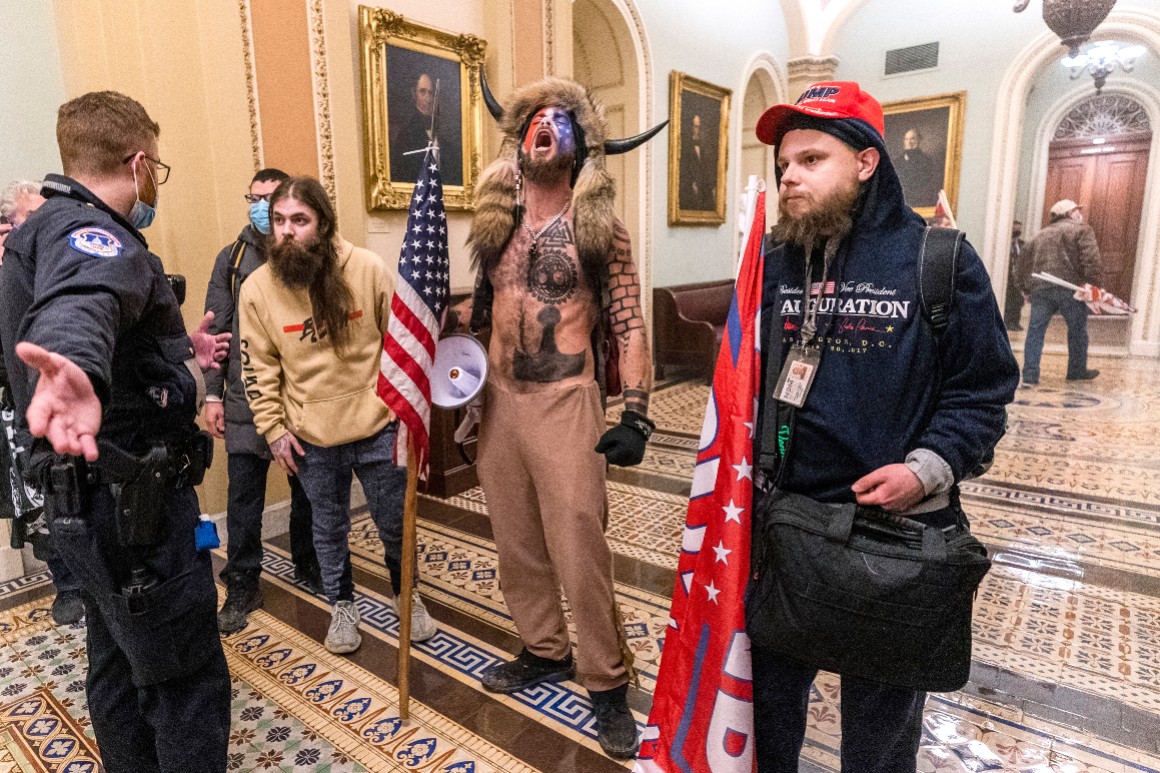
Arizona man who wore horns in riot pleads guilty to felony - POLITICOCapitol Riot of Jan. 6, 2021 | The First Amendment EncyclopediaConspiracy theories paint fraudulent reality of Jan. 6 riot | PBS News  Weekend  Those images are powerful, immediately recognizable to most Americans, and they stay with you.  No words needed.

I hate looking at them and being reminded of that day.(2)  It doesn't require you believe this was an insurrection.  I don't, but I do believe it was a riot and a disgraceful day for America.  And brought to you courtesy of Donald Trump.  Do I believe Trump planned it?  No, Trump doesn't do planning, but his reckless rhetoric fired up his most gullible supporters over what was a ceremonial event, the counting of electoral votes.  And, once it happened, while his aides frantically spent hours trying to persuade him to say something publicly to quell the rioters, he was watching it all on TV.

I envision Trump watching it just like Laurie (Vera Miles) watches her suitors fighting over her in The Searchers. Laurie didn't plan it, but she sure likes that they care enough to fight for her.

Trump and his acolytes loved trolling to "own the libs" but ended up creating the greatest political "self-own" of my lifetime.  January 6 was only the culmination of a series of Trump appearances and Trump influenced events that created indelible images - like his out of control presence at the Covid press conferences.

Unless you are a hard-core "stop the steal" person you find the photos above to be repulsive.  That's why it was another self-own when the full tapes of the riot were released and featured extensively on right-wing media.  Do I think some of those arrested have been charged and sentenced excessively?  Yes, but that's not the issue here.  When the full video is being used to argue that the narrative about January 6 is misleading, all I can say, over and over again, if I'm a Democrat, is "don't throw me in that briar patch".  If you want to argue that a bare-chested painted guy wearing a buffalo head roaming around Congress is the good guy and represents Trump and the GOP you are really bad at politics, and every time you show these images you are pushing away anyone other than your hard-core supporters. 

The very real damage Trump did by his actions leading to the creation of those images is that the real danger to American democracy is today's Democratic Party.  The Biden administration is the most radical in American history, devoted to undermining the foundations of this country, rewriting its history, and the most race-obsessed administration since that of Woodrow Wilson.  Trump's disorganized, impulsive rabble has no institutional foothold, and, like Trump himself, is simply incapable of doing long-term strategic thinking and planning, unlike the progressive New Racist warriors who now dominate American institutions.

But with January 6 and those easily remembered and accessible images, Donald Trump gave the Democrats their Reichstag moment, their great opportunity to effectively cast Republicans as the true threat to democracy, a threat justifying limits on speech, limits on conduct, and denying educational and job opportunities to those who dissent.  Any time those images are seen, and every time someone tries to justify aspects of that riot, it just reinforces the Democratic message.

We've already seen the effects in the actions and Executive Orders of the administration.  That it wasn't worse in terms of Congressional action during the first two years of the administration is only because of Sinema and Manchin in the Senate.  We were left dependent on those two Democrats after Trump, in classic passive-aggressive campaign mode, undermined the two GOP Senate candidates in the special election of January 2021.  After all, if they had won it would have undermined his claims about the alleged steal of the Georgia election in November.

Happy to talk with you about Russia Collusion or you can read the links above, but I think Donald Trump's images are much more influential. 

----------------------------------------------------

(1) Pappy O'Daniel really existed, though he was governor of Texas, not Mississippi as portrayed in O Brother, Where Art Thou?  W. Lee ("Pappy") O'Daniel rose to fame as a singer in a band he put together to promote the flour company he worked for.  Eventually O'Daniel started his own company, Hillbilly Flour, and formed a new and very popular group, Pat O'Daniel and his Hillbilly Boys.  After two terms as governor, in 1941 O'Daniel won a special election for the U.S. Senate.  In a close race, Pappy defeated Lyndon Baines Johnson by using the time-honored Texas Democrat tradition of withholding voting returns from certain Rio Grande districts until LBJ leaning districts had finished their reporting, allowing Pappy supporters to create enough votes to win.  LBJ learned his lesson, employing Pappy's techniques in 1948 to win a very close U.S. Senate race.

(2)  I expressed my views of that day here, here, and here.

Tuesday, January 10, 2023

Right Move

New House Speaker McCarthy announced that Adam Schiff would not be allowed a spot on the House Intelligence Committee which he chaired in the last two sessions of Congress.  The right move.  

In June 2017 the Committee began hearings on Russian interference in the 2016 election, which continued until March 2018.  Though Representative Schiff was only the ranking minority member of the committee at the time, he effectively ran the hearings, as gutless wonder Paul Ryan had given into a bogus Democratic complaint regarding Chairman Devin Nunes which removed him from the hearing. Transcripts were submitted to the Director of National Intelligence for review before being released to the public because officials such as Susan Rice and Samantha Power were among those testifying.  The transcripts were cleared for release at the beginning of 2019 but by that time the Democrats had taken control of Congress and Schiff refused to release them until, finally, DNI Grenell threatened to do so on his own initiative, leading to their release in May 2020.

So, for nearly three years, Schiff was able to leave the hearings and make pronouncements about the dire, indeed criminal activities unearthed in the testimony (the committee also had access to witness emails and telephone records).  He provided a series of juicy stories to his accomplices in the media, all of whom promoted the Trump collusion narrative.  The problem was that everything Schiff said was a lie including, to quote Mary McCarthy's take on Lillian Hellman, "even 'and' and 'the'.

How do I know this?  Once the 5,977 pages of transcripts were released I read them all, unlike the media stenographers reporting Schiff's every word.  It's all there, Alfa Bank, Deutsche Bank, Trump in Moscow, the Trump Tower meeting in NYC, the Ukraine platform at the GOP convention, etc, and there was nothing there.  Schiff knew it all along, and just lied, knowing well his audience and knowing he would never be held accountable.   I wrote up my conclusions in the 53 Transcripts series.

Adam Schiff, along with Hillary Clinton, the Intelligence Community, the New York Times, and the Washington Post could not have done more damage to this country and trust in its institutions if they had been paid agents of the Kremlin.  The same goes for Donald Trump based on his actions since the November 2020 election.

Monday, May 16, 2022

What Remains To Be Known

Today marks the trial of lawyer Michael Sussman began in Federal District Court in DC.  It's alleged he made a false statement to the government, in the form of General Counsel of the FBI, regarding Donald Trump's links to Alfa Bank.  I am not following the trial because my interest is not in whether Sussman made a false statement in the course of raising the issue - he is alleged to have said he was not representing a client when, in fact, he was representing the Clinton campaign.  My interest is in coming to a better understanding of the two threads of the Russia collusion scandal.

The first is the one Sussman was involved with and that originated with the Clinton campaign in 2016.  Built upon scraps of figments of possible scenarios and abetted by Donald Trump's own reckless statements during the campaign, the campaign wove a story believed credulously by the FBI, at least initially (1), and swallowed whole by a media ready to believe anything that would help defeat Trump and then, after his election, anything that would bring him down.

That it was all a mirage is now evident.  Apart from the failure to verify the allegations in the Steele Dossier, a document promoted by FusionGPS, an outfit working at the same time for a Putin connected Russian oligarch to overturn American sanctions, a failure we've known about since 2019, it now turns out that much of the dossier was the product of gossip between a couple of Russians, one in Cyprus, one in America, and of an American lobbyist and Clinton supporter!  And what wasn't the product of gossip was fed by FusionGPS to Christopher Steele who put it into the dossier.  There was no there there.(2)

But there was a second, parallel, thread that has gotten little attention recently; the efforts of the Intelligence Community to derail the Trump candidacy and then his presidency.  This goes all the way back to a character I've written about before, Josef Mifsud, and his mysterious visit to, and conversation with, George Papadopolous in March 2016.  We need to know why Mifsud made his approach - was it on his own initiative, or at the request of one of the Western intelligence agencies he was so entwined with?  And why did the senior Australian diplomat and intelligence official, Alexander Downer, who also had connections with the Clinton Foundation, initiate a meeting with Papadopolous in May 2016 to allegedly extract the information Mifsud had passed on?  For more on Mifsud and Downer, read Footnote 2 of this post.

It was no secret at the time that DNI Clapper, CIA Director Brennan, and FBI Director Comey, along with several Western intelligence agencies were alarmed by Trump.  How far did they take this alarm?(3)  It's also now evident that the taking out of NSA Michael Flynn in late January 2017 was planned because he both understood the intelligence community bureaucracy, wanted to reform it, had Trump's confidence and, if he had remained in the role, would have triggered the legal requirement to be briefed by the intelligence agencies on their Russia collusion investigation, which would have revealed the plot.  Their only interest was in getting Flynn out of the administration, once that was done they had no further agenda with him.  It was only when the Muller gang got going and decided to try to squeeze Flynn that the criminal investigation began.

In January 2017, Senator Chuck Schumer warned President-elect Trump that, “Let me tell you, you take on the intelligence community, they have six ways from Sunday at getting back at you.”(4)  That is a frightening statement about where a senior U.S. senator thinks power resides in the federal government.  The intelligence community thread needs to be thoroughly investigated or Schumer will be proven correct about who our real rulers are.  Is Durham willing to do it?

Let's also not forget the lives and reputations ruined along the way by the reprehensible actions of the Clinton campaign, the intelligence community, and its willing accomplices in the media; Svetlana Lokhova, Serge Millian, Jeffrey Gordon, Michael Caputo, and Carter "The Most Innocent Man in America" Page, among others.  They deserve justice.(5)

------------------------------------------------------------------------------

(1) Filings by Sussman's lawyers in this case indicate that one of his defenses is that the FBI knew all along he was representing the campaign!

(2) The revelations of the past year have also led me to question some assumptions I'd made during 2018 and 2019 about Russia collusion.  For instance, my inclination had been to believe the official conclusion that the Russians carried out the three hacks of Democrat IT systems in 2016 (see 53 Transcripts: The Hacks).  Given that the involvement of the Clinton campaign in creating the Russia collusion hoax was even more complex that I thought then, I simply don't know what to think about the hacks now.

(3) Along with Mifsud and Downer, Stefan Halper was also used in this effort, managing to smear Flynn, destroy the career of Svetlana Lokhova, and serving as a Confidential Human Source for the FBI regarding Carter Page.

(4) Schumer made his pronouncement on the MSNBC show of Rachel Maddow, who went on to spout all kinds of ridiculous nonsense about Russia and Trump for the next three years.

(5) And speaking of justice, every time I go back and reread my 53 Transcripts posts, I grow more outraged about Rep. Adam Schiff.  For three years, Schiff emerged from these hearing room sessions and lied repeatedly about what was being said, and what was being learned.  He always lied, as became evident when Acting DNI Grenell forced his hand and made him release the actual transcripts in the spring of 2020.  Should the GOP regain control of the House, I hope its leadership has the guts to bar Schiff from serving on any House Committee.

Monday, March 29, 2021

53 Transcripts: Real Estate Promoters

In May and June of last year I wrote a series of posts (53 Transcripts) after reading the nearly 6,000 pages of testimony given to the House Intelligence Committee in 2017 and early 2018 regarding alleged Russian interference with the 2016 presidential election.  This testimony had been suppressed for nearly a year and a half by Representative Adam Schiff after the Democrats seized control of the House because it debunked their theories of Trump collusion with the Russians and exposed Rep Schiff as a serial liar.  I recently discovered one last post that mistakenly was left in draft form and wanted to post it to complete the series.

Before doing so a couple of summary comments on what has proven to be the Russian Collusion Hoax and the greatest political scandal in American history; a concerted attempt to remove an elected President by the opposition party, entrenched federal bureaucrats and supported by supposedly non-partisan media.  The post Election Tampering sums up my views and you can read all the Russia Collusion posts here.

I initially thought there might be something to the allegations regarding Trump based on his own statements during the campaign and after the election.  I was wrong.(1)

There were two pillars upon which the investigation rested.  The first was the Steele Dossier, which proved to be a creation of the Clinton campaign and Russian intelligence, a fact so embarrassing to the Mueller investigation that all mention of the dossier was excised from the collusion section of its final report.  The second was the March 2016 conversation between Professor Joseph Mifsud and junior Trump foreign policy wannabe George Papadopolous.  What was said remains in dispute.  Mifsud, interviewed by the FBI in February 2017, denied making any statements regarding Russian possession of damaging information regarding Hillary Clinton and the Mueller team never charged Mifsud with making a false statement.  What appears to be the case as of now is that Mifsud was not a Russian intelligence asset and not working for the FBI.  But what was he?  If, as I suspect he was tasked by a friendly foreign intelligence service to approach Papadopolous it puts an entirely different light on the beginnings of this affair.  I hope that Special Counsel John Durham's investigation will reveal whatever the truth is about Mifsud.  For more background on Mifsud see Footnote 2 of this post.

Looking back it is also revealing the depths to which the Democrats and their allies stooped to conspiracy mongering.  Just as we have QAnon, we also have what some have aptly referred to as BlueAnon, and the Russian Collusion Hoax was the starting point for an unending wave of conspiracy theories from the Left.

Russian Collusion was a conspiracy theory and it had many sub-components.  As a reminder here are some of them (ones I wrote about as part of the 53 Transcript series are in bold):

Carter Page as key link in collusion

Trump Tower Meeting

Trump Tower Moscow

Miss Universe Moscow and the "salacious allegations" (Fake news, but relevant because Russians.)

Russian Financiers of Trump Org (except there weren't any, but relevant because Russians)

Russian Condo Buyers (after Trump Tower was built, which contains condos separate from the office space, some of the original condo purchasers resold their unit to Russian buyers.  The Trump Organization was not involved but somehow this was relevant because Russians.)

Russian Buying Florida Mansion (Trump bought a Florida mansion and sold it a few years later to a Russian and made tens of millions.  Relevant because Russians.)

Deutsche Bank (so stupid even the D's on the Intelligence Committee gave up on this one.)

Alfa Bank  (Russian owned bank with its servers allegedly connected directly with Trump Org.  Fake news, but relevant because Russians)

Ukraine Plank on GOP Platform

Paul Manafort.  (Supposed co-mastermind behind it all.  Not.  Targeted by Ukrainians working with Hillary Campaign in 2016).

Michael Flynn & The Ruskies (this one completely fell apart with revelations later in 2020)

The Hacks (DNC, DCCC, John Podesta)

Wikileaks (Bumbling clowns Roger Stone and Jerome Corsi try to get info from Assange but fail).

Michael Cohen in Prague.  (And, according to Steele Dossier, co-mastermind with Manafort of collusion.  I was surprised and impressed with Cohen's testimony - precise, knows the real estate world, impassioned rebuttal of the Steele Dossier, and refused to be pushed around by Schiff and Swalwell.)

Cambridge Analytica.  (Bad because it used data from Facebook, unlike the Obama people in 2012 who were good because they used data from Facebook.  More recent information indicates this was a phony story from the start).

This doesn't even include the continuing barrage of "fake news" stories from major media outlets.  For three examples just from one week in December 2017 read Footnote 4 from this post.

Real Estate Promoters

The Democrats on the Intelligence Committee were fixated on the attempt to build a Trump Tower in Moscow based on a complete misunderstanding of how the Trump Organization operated and developed and financed its projects.

There were two primary witnesses on this subject, Felix Sater and long-time Trump Organization lawyer Michael Cohen.

By the time he testified Felix Sater was being portrayed in the press as a Russian asset who was loyal to Putin.  He gave a lengthy opening statement refuting these allegations.  Sater, who was a U.S. citizen after emigrating from Russia with his family at the age of seven, started:

"I was born in 1966 in Moscow, Soviet Union, with the word 'Jew" stamped on my passport under nationality, not Russian, as has been reported about me". 

Sater had previously been the promoter for the Trump SoHo project in Manhattan and had known Michael Cohen since they were both teens.  In discussing some of his emails and his claims regarding contacts with the Russian government as he pursued the Trump Tower project he was unabashed about the fact he would say anything to get a deal done.
"Guys, I'm a real estate promoter.  Until the bank writes the check, it's all salesmanship and promotion to try to get many, many parties towards the center to try to get the deal done." 

Reading this in light of the Trump presidency and, in particular, the debacle he created between the 2020 election and the inauguration, it is clear how much of Trump's political strategy derived from his real estate experience.  The Trump projects were transactional and one-time events.  Each stood alone.  Trump never had to think about longer-term strategy and it hampered him as President.  After the election he employed his real estate techniques, making outlandish and insupportable statements about election fraud, specifically the Dominion software allegations.  He simply didn't care if they were true or not as long as he got enough of his supporters to believe they were.  He would say anything, regardless of longer-term consequences, if it could get him the deal.

Sater was an independent contractor.  If he could put together the deal and the parties in an acceptable form the Trump Organization could agree to proceed with his proposal.  There was never any need for he or anyone else to talk with the Trump Org or banks about financing because the Trump Org only did licensing deals, it provided its brand name and management skills if a project proceeded, that was it - there was no need for financing, so all the talk about being dependent on Russian banks for financing was fake news.
 
It was Sater and Michael Cohen working on the Trump Tower Moscow project and it was only if it came together that it would go to Trump for approval.  Cohen confirmed the contingent nature of Sater's efforts, telling the committee that in a real estate deal, "the loyalty is to who brings the check first."  
 
Sater stated he was ambivalent about Trump entering the presidential campaign because its potential effect on the deal was uncertain:
"I had a concern both that if we won and the project couldn't move forward, because maybe he couldn't do it as the President . . . or if he lost and the other side would lose interest in financing it".  
Cohen testified he discounted some of Sater's email claims and never discussed them with Trump.
"What Mr Sater is is a salesman, and he uses very colorful language".
Cohen went on to say the deal failed because partner could never establish control of property and "I had lost confidence in the licensee [Sater]" by January 2016. 
 
In general, Cohen's testimony demonstrated the complete lack of business knowledge by the Democrats on the committee.
 
He also testified the only time Donald Trump spoke with him regarding Putin was to ask, "Did you see that President Putin said some really nice things about me?", underscoring Trump's lack of interest in the details of foreign policy as well as his belief that if you say nice things about him he will say nice things about you.
-----------------------------------------------------------------------------

(1) In this, as in other instances, Trump was his own worst enemy.  His statements about Putin and Russia during the campaign and during his Presidency were often terrible and frequently embarrassing.  I wrote that at his 2018 Helsinki summit with Putin, the president sounded like a starstruck teenage girl.  This contrasted with his actions, including sanctioning additional Russian oligarchs, authorizing the attack that killed 200 Russian mercenaries in Syria, the unprecedented American-Swedish-Finnish military exercises in the Baltic aimed at Russia, sanctions halting the Nordstream 2 gas pipeline from Russia to Germany, and an energy policy damaging to the Russian economy.

It's the exact opposite of the Biden Administration so far.  Biden talks very tough about Russia and Putin but, so far, he's given Putin everything he wants.  Trump had refused to extend the Intermediate Nuclear Missile Treaty with Russia unless Russia improved compliance and unless China, which is now a bigger threat, became a party.  For Putin this was a problem because if the treaty was not extended it would place enormous economic pressure on Russia.  Biden immediately announced a five year extension with no additional conditions and without China joining.  Biden has also effectively withdrawn sanctions on Nordstream 2 and with his domestic energy policy he is driving a reduction in U.S. output and an increase in oil prices which suits Putin just fine.  Little noticed in the January 2017 Intelligence Community Assessment on Russian election interference was a mention in the appendix that the undisputed conclusion was that the Kremlin was supporting American environmental groups trying to block fracking and energy production because it would create favorable conditions for the sale of Russian fossil fuels.
 

Friday, June 12, 2020

53 Transcripts: The Trump Tower Meeting

The Trump Tower meeting took place on June 9, 2016 but did not come to public attention until a report by the New York Times on July 8, 2017, a report that added a lot more fuel to the Russia collusion fire, abetted by the clumsy handling of the news by the Trumps, father and son.

Donald Trump Jr's agreeing to that meeting was the height of stupidity and recklessness.  The way to handle a sensitive offer of dirt regarding your opponent is to use cut-outs as the Clinton campaign did when it used FusionGPS, a firm working for a Putin-associated oligarch, to obtain information from Russian intelligence sources damaging to Donald Trump.

There were eight participants in the meeting, of whom six were interviewed by the House Intelligence Committee.  In addition, everyone associated with the Trump campaign who testified was asked about the Trump Tower meeting (it turned out none of them were aware at the time it had occurred).  It was also fascinating to see how many of the Russian participants had direct or indirect connections with Hillary Clinton or the Obama administration.

The participants (those interviewed in boldface):

Donald Trump Jr
Jared Kushner
Paul Manafort
Natalia Veselnitskaya (Russian lawyer and lobbyist, and hereafter referred to as V)
Ike Kaveladze (US based VP for real estate development company run by Russian Aras Agalarov)
Rinat Akhmetshin (Russian-American lobbyist)
Anatoli Samachornov (interpreter)
Rob Goldstone (music promoter, manager of Russian pop star Emin Agalarov, son of Aras)

My assessment is the basic story as laid out by the six witnesses is generally accurate because (1) the testimony is consistent though not so identical in the details as to raise suspicions, (2) Anatoli Samachornov is very credible (for reasons explained below), and (3) if the slightest discrepancy (real or imagined) had been found in anyone's testimony by the Mueller gang they would have been indicted for false statements as we saw with Roger Stone, Michael Flynn, and George Papadopolous.  My takeaway - the meeting was a clown show from start to finish.

The origins of the meeting are in an early June 2016 phone call from Emin Agalarov to his manager Rob Goldstone, a dual US/UK citizen who Donald Trump Jr described in his testimony as a "flamboyant music promoter" (p.27).  He'd met Donald Sr in 2013 and been involved with negotiations for the Trump-sponsored Miss Universe Moscow later that year.  Goldstone met Donald Jr the following year when he had a client appearing on Celebrity Apprentice (this is all so weird).

Not long before Agalarov called, Rob had worked with him on a music video featuring a song with visuals celebrating Hillary Clinton's success in beating Sanders and becoming the Democratic nominee.  Unfortunately, the blowback from Emin's Russian fans was so bad they had to remove the video from social media.  This time Emin was calling to convey a request from his father, a billionaire Russian real estate developer who built the largest indoor shopping center in Moscow as well as the Trade Expo, hosted the Trump owned Miss Universe 2013 Contest in Moscow, received the Russian Order of Honor from Putin the same year, and is a partner with Robert DeNiro in two Moscow restaurants, to arrange a meeting between V and the Trumps.  In 2017, Agaralov joined the list of sanctioned Russian oligarchs under a Congressional act signed into law by President Trump.  Goldstone summarized the information:

I wonder if you could contact the Trumps.  My father just had a meeting with a Russian attorney in his office, who has some potentially damaging information about Russian funding to the Democrats and Hillary. (p.33)
Based on his testimony and a little research on Goldstone, this is a guy who knows nothing about politics (and cares less) but will do anything to promote his client and since the client asked him to arrange a meeting he was now on a mission. Think of the Matthew McConaughey agent character in Tropic Thunder willing to go to any length to get his client his Tivo, even if it means a dangerous trip into the jungle, and you've captured the essence of Goldstone.

Goldstone told the committee he had only one shot at getting the attention of Don Jr so sent him an email promising "some official documents and information that would incriminate Hillary" (p.37), describing it as "a schmooze tactic" and was very pleased when he got back a response indicating interest and willingness to meet (p.41) so there is no doubt Don Jr agreed to the meeting because of the promise of damaging information regarding Hillary.  Goldstone never met V until he met her and the others in the Trump Tower lobby to take them to the meeting.

Trey Gowdy asked how he could reconcile his putting together a video celebrating Hillary Clinton with the email promising incriminating information on the same person.  Goldstone's response:
I'm not in the slightest bit political . . . my job is to promote Emin the best way I could.  And if I had been able to convince the DNC to use this song, it would have been amazing for him.  And if ultimately my sole client asked me to send an email that's important to him and/or his father . . . well, again, I'll do that. (p.47)

V was a Russian lawyer who spoke no English.  She was a litigator (the question of whether, or to what extent, she was connected to the Russian government remains unclear) who'd been working for Denis Katys, owner of Prevezon Holdings on litigation regarding the U.S. government's actions in seizing his properties, on investigating Bill Browder, proponent of the Magnitsky Act, and to lobby to overturn or modify the Act. The Magnitsky Act is named after a Sergei Magnitsky, a Russian accountant who worked for Bill Browder on his Russian business.  Magnitsky was arrested and allegedly beaten to death in a Russian prison, prompting the U.S. Congress to pass the Act which included sanctions on a number of Kremlin-linked oligarchs, including Katys, who also hired FusionGPS to lobby against the Act.  As a result, V and Glenn Simpson worked closely together.  In fact, V and Simpson had lunch together the day before the Trump Tower meeting and met again the day following the meeting.

Samachornov described V as a one issue person who was driven to meet any person who might help her client.  My guess is that Agaralov's call to Goldstone was prompted by Katys contacting him.  Ironically, the sequence undermines a theory the Democrats on the committee tried to promote, that Agaralov was closely linked to the Trumps.  If that had been true, why would he have needed to go through Rob Goldstone to set up the meeting?

Ike Kaveladze came to the U.S. in 1991 and is a dual U.S./Russia citizen, working for Agalarov who asked him to attend the meeting to translate for Veselnitskaya who spoke no English.  Prior to the meeting, V told him it was to be primarily about the Magnitsky Act but also mentioned she had some information damaging to the Clinton campaign.  It was only when he met Veselnitskaya for lunch before going over to Trump Tower for the meeting that he found out she had hired Samochornov to interpret so although he accompanied V to the meeting he felt pretty useless.

Anatoli Samochornov is considered the best Russian-English interpreter in the New York area, coming to the U.S. in 1991 and is a U.S. (not dual) citizen.  Working as a contract interpreter for the State Department since 1997 he has, among other assignments, interpreted at President Obama's UN summit on refugees.  He was hired in October 2015 as an interpreter by a Foundation funded by Denis Katys, who had also retained V, Akhmetshin, and Glenn Simpson.  His initial meeting with them was at the New York offices of the international law firm of Baker & Hostetler regarding Prevezon's ongoing litigation.  Samochornov has no record of contact with any Russian government officials.  Having spent time with V over the prior months he was asked about her views of U.S. politics and replied, "I would not characterize her as partisan towards U.S. politics in one particular way or another", and had never heard her speak about the Trump family until a few days before the meeting when she asked him to attend and interpret.  He also testified he had no idea what the meeting was about until he was in it.  Of all the participants in the meeting Samochornov comes across as the most grounded, sophisticated, and direct in his testimony.  In fact, we recently learned that four days after the story broke in 2017 he was interviewed by the Mueller gang and when he confirmed Donald Jr's story they lost all further interest in the matter.

The last member of the crew was Rinat Akhmetshin, another U.S./Russia dual citizen who arrived in the early 1990s.  He's actively worked as a lobbyist, primarily for the former Soviet republics of Central Asia and, at the time, was also working with a Russian foundation aiming to restart Russian adoptions by Americans, a foundation funded by Denis Katys of Prevezon, which Putin had terminated in retaliation for passage of the Magnitsky Act.  Rinat was very blunt with the committee, testifying that while he has done no work for Putin or his associates, he will not work for any Russian directly opposing the regime because it is too dangerous (press reports often claim Akhmetshin was part of Russian intelligence, but he explained his only link was military service in the late 1980s as a guard at intelligence facilities and no information contradicting him has surfaced).  He testified the FBI routinely debriefed him after meetings with Russian officials.  Akhmetshin had met V in the course of his work for the foundation.

After learning he was in New York to see a show that evening, V invited Akhmetshin to lunch which is when he learned about the Trump Tower meeting which V invited him to join. (1)  Rinat was unprepared, telling the committee he was wearing a t-shirt and jeans but ended up accompanying them anyway.  Akhmetshin saw the briefing paper V had prepared for the meeting and realized that while it contained a brief reference to the Ziff Brothers hedge fund issue it was primarily about the Magnitsky Act and didn't realize there was any connection with Clinton.  Samachornov described the conversation at lunch as "the Magnitsky law, Mr. Browder, the Prevezon case", and told the committee the subject of U.S. politics, the election, and the Trumps never came up.

Since Goldstone was the only one who'd been to Trump Tower he walked them over to the building, checked them through security in the lobby and went up the elevator with the group.  His intent had been to introduce them to Don Jr and then leave but Don Jr asked him to stay.

On the Trump side, Jared testified he was not told anything about "damaging information", wasn't sure what the meeting was about and attended as a courtesy to Donald Jr.

Once introductions were made, V launched into her presentation, the first part of which was a convoluted story about an American hedge fund, operated by the Ziff Brothers, committing tax fraud in US and Russia with the aid of Browder and funneling contributions to the Democratic National Committee. (2) As she went on, Kaveladze testified that "Mr Kushner was very frustrated.  He looked very frustrated" (p.69), finally interrupting and, according to Goldstone, asking, "Could you just come to a point, or is there a point to this?" (p.87).  Akhmetshin testified that Don Jr also quickly lost interest. [ADDED: In his testimony, FusionGPS head Glenn Simpson testified that some of the information presented by V was based on research his firm had done, though he claimed he had no knowledge of the meeting and it was not a set-up of the Trumps.  I trust Simpson as much as I trust Steve Bannon - not at all.]

At that point, Akhmetshin, sensing disaster, jumped in and gave an impromptu talk about the Magnitsky Act and the prohibition on adoptions from Russia, which tested the patience of Trump Jr and Kushner even more (according to all those who testified, throughout the entire meeting Paul Manafort was doing stuff on his cellphone and never paid the least attention, except for one moment (3))  Kushner testified he texted his admin to call and get him out of the meeting and the other participants agreed he left before it ended.  The meeting finally ground to a halt after 20 minutes.   Akhmetshin told the committee, "I thought the whole meeting was ridiculous" (p.147)  Goldstone stated he was embarrassed and apologized to Don Jr as they were leaving.

Don Jr repeatedly stated he had not told his father about the meeting either before or after it happened, nor had he mentioned its purpose to Manafort or Kushner.  He said his reason for not doing so beforehand was he wanted to vet the information promised by Goldstone before informing Trump Sr.  My take is that Don Jr was trying to stake out a bigger role for himself in the campaign and it would have been quite a big deal for him to have more scandalous Clinton information handed to him.  His explanation for why he didn't tell Dad after the meeting, also helps explain his hesitation before:

"I believe I would remember a conversation like that with my father, and I also would not bring my father something that I believe to be a waste of time.  I've learned that through many years of working with him the hard way." (p.126)
Based on what I already knew about Trump before 2016, having observed him since, and read the  testimony of how he operated his business and campaign by those who know him, Don Jr's explanation rings true with me.  The Trump Tower meeting was a disaster; nothing came of it.  Why would he tell his father and look like a fool?

There is also no documentary evidence to the contrary.  I've haven't noted this before but all of those associated with the Trump Org or Campaign also had their records subpoenaed, including emails, by the committee and were questioned intensively by the members.  And this crowd was too naive to know not to put some things in writing.

Under questioning Ike Kaveladze stated he told his wife and 13-year old daughter about the meeting before it occurred, telling them V had some information damaging to Hillary Clinton, which upset his daughter who supported Clinton.  After he left the meeting he called his daughter to tell her nothing damaging to Hillary happened.

I learned from his testimony that Rinat Akhmetshin also had a Hillary Clinton connection.  His business colleague Edward Lieberman, was married to Evelyn Lieberman, White House assistant to Hillary and later Deputy Chief of Staff to Bill Clinton.  It was Evelyn who spotted what was going on with Monica Lewinsky and moved her to an assignment away from any connection with Bill.  She later became Director of Voice of America.  Akhmetshin had been to the Lieberman's home on several occasions and more than once had met Hillary there.  He also referred to Glenn Simpson of FusionGPS as an "old acquaintance". (p.42)

In questioning of Trump campaign witnesses, Schiff and Swalwell pushed hard to establish that Donald Trump's campaign remark on June 7, two days before the Trump Tower meeting, that the following Monday (June 13) he'd have some new big news about Hillary, showed he knew about the planned meeting in advance.  Both Hope Hicks and Steve Bannon testified the reference was to Clinton Cash, a book published in 2015 by Peter Schweizer, documenting the seedy side of the Clinton Foundation, which had been recently made into a documentary.  The plan was for a event showcasing the film and its first U.S. showing.  However, on the night of June 11-12, Omar Mateen killed 49 people at the Pulse nightclub in Orlando, Florida and the event was postponed while the campaign focused on the candidate's response to the murders.

The existing record shows V's intent was to use the potentially damaging information about Hillary as a hook to get the meeting which was, in reality, about lobbying for repeal of the Magnitsky Act.  The preparation and coordination for the Russians attending the meeting was very poor, with V having little idea how to effectively make her case.

There are alternative explanations as to how and why the approach to the Trumps was made.

(1) As described by Samachornov, V was monomanical about the case and may have come up with the idea herself and gone to Katys.

(2) Katys and Agaralov may have seen the damaging information on Clinton as a way to curry favor with the Trumps, either if Don Sr unexpectedly was elected or, if he lost, as way to enhance relationships.  If so, it shows how little understanding they had of American politics.

(3) This was part of a deep convoluted Kremlin plot to do something, I'm just not sure what, given the damaging information was a nothingburger.

(4)  Could it have been Glenn Simpson who planted the idea with V of a meeting with the Trumps?  He had worked closely with her and was tied to the same oligarch whose interests he was advancing.  What they didn't know was Simpson had been hired by the Clinton campaign to investigate Trump's Russian connections and had recently hired, or was about to hire, Christopher Steele.  Unlike the Russians, Simpson was sophisticated enough to understand the implications of a direct meeting between them and the Trump campaign.  Weighing against this theory is it would have been in Simpson's interests to make the meeting public before the election.

In any event, there is no evidence the damaging information was anything beyond the Ziff Brothers (4) allegation and none of the participants had any followup with anyone associated with the Trump campaign.

We'll leave the last word on this debacle to Corey Lewandowski who testified he spoke with President Trump shortly after news of the meeting became public in 2017.  Lewandowski said he told the President, "I thought it was a politically stupid thing to do to have that meeting."  The President responded, according to Lewandowski:
"He acknowledged it was a short, stupid meeting too and probably shouldn't have taken place". (p.87)
-----------------------------------------------------------------------
 (1) Samachornov tells a different version of how Akmetshin ended up in the meeting.  According to his account, once the meeting with Don Jr was set, V asked him to send a text to Rob Goldstone asking him to pass on her request to Don Jr to:
". . . include our trusted associate and lobbyist, Mr Rinat Akmetshin, who is working to advance these issues with several congressmen." (p.24)
Goldstone texted back:
"I would suggest you bring whoever you need in order to make the meeting successful." (p.28)
The evidence of all those involved would indicate Goldstone never passed on the request to formally add Akmentshin or, for that matter, Kaveladze, to the meeting and it was only Goldstone's presence as someone known to Trump Tower security that got them all up where the Trump crowd seemed surprised at the number of visitors.

Whether Akmetshin really knew in advance about the meeting in part depends on whether his testimony that he showed up at the lunch in t-shirt and jeans is true.  Both sides in this meeting seem to have been rather casual in the lead up to the event.

(2) Samachornov's summary of V's presentation:
". . . she spoke that during the course of her research into the Prevezon case she uncovered financial irregularities by Mr. Browder and also by his client, the Ziff Brothers, who were contributors - and here again, I don't remember - either to the DNC or to Mrs. Clinton's campaign." (p.48) 
(3)  According to Samachornov, when V mentioned contributions from the Ziff Brothers, Manafort looked up from his phone and:
". . . he said something along the lines that the fact that there is a political contribution is not significant, that people contribute to both parties all the time." (p.49)
(4)  Daniel, Dirk and Robert Ziff are the sons of William Ziff a prominent magazine publisher.  They started Ziff Brothers Investments in 1994.  Two of them live in Manhattan and the other in Palm Beach.  My guess is Jared Kushner and Ivanka Trump know them.