Wednesday, March 7, 2018
The System Only Dreams In Total Darkness
Released in 2017 by The National, The System Only Dreams in Total Darkness is a striking song. I liked it. Hope you do also.

Tuesday, March 6, 2018
Finding Lexington
Microsoft co-founder Paul Allen has spent the last few years locating famous sunken warships, most notably the USS Indianapolis, the cruiser which carried parts of the first atomic bomb to Tinian and was sunk on its return, with several hundred sailors being killed by sharks (a story memorably told in the movie Jaws).
Two days ago, Allen's team found the aircraft carrier, USS Lexington, sunk during the Battle of the Coral Sea on May 8, 1942, the first time the Japanese rampage across the Pacific and East Asia had been successfully countered. The wreck is located 10,000 feet below the ocean surface.
Since December 7, 1941, Japanese Imperial Forces had occupied much of the Central Pacific, the Philippines, Hong Kong, Malaya, Singapore, Burma, and the Dutch East Indies. The Imperial Fleet had severely damaged the American flotilla at Pearl Harbor, destroyed the British, Dutch, and Australian fleets in Asia, and had roamed as far as Ceylon, where Japanese naval air wrecked Allied sea and air forces. Air raids had been conducted even on Australia, where Darwin the Northern Territories had been attacked.
Japanese infantry had landed on the northern coast of New Guinea in early 1942. The next stage of advance was over the Owen Stanley Mountains in order to capture Port Moresby on the southern coast. With Moresby in their hands the way would be clear for an advance to Australia, and any Allied counterattack would be easy to thwart.
To provide air cover for the infantry advance, the Japanese sent two fleet carriers, Shokaku and Zuikaku (both part of the Pearl Harbor task force) and Shoho, a light carrier. American intelligence was able to decode Japanese messages, and two carriers, Yorktown and Lexington, were sent to the Coral Sea.
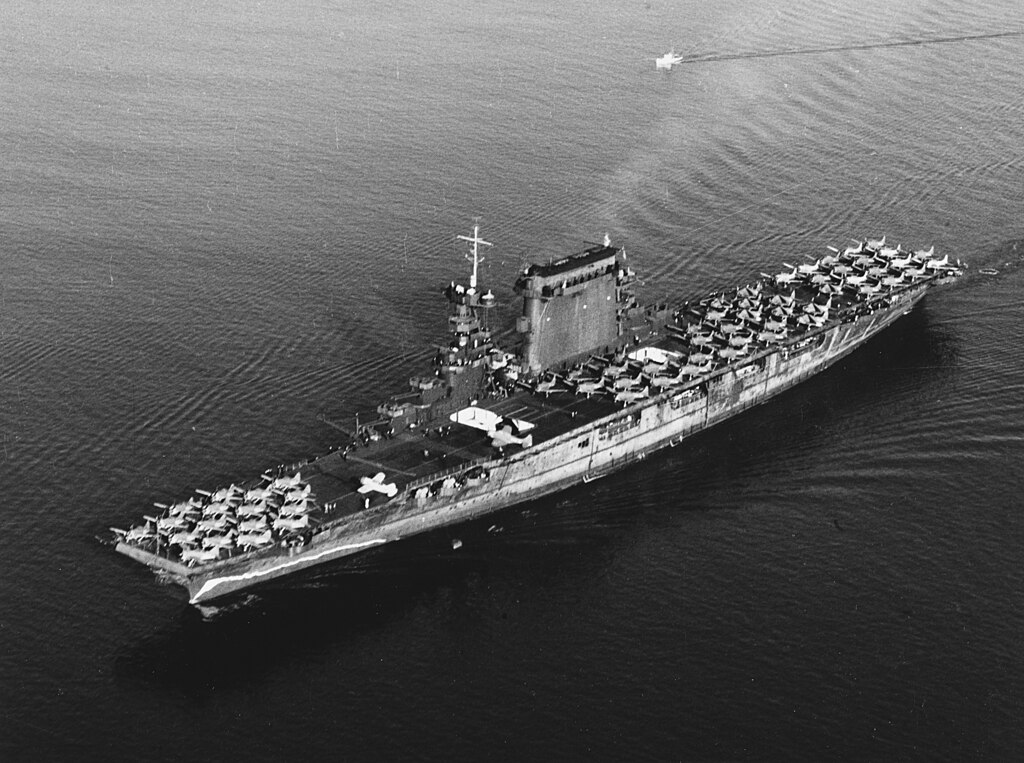
With the American battleship fleet destroyed the four carriers in the Pacific were the only significant resource for our navy. Lexington, commissioned in 1927 and one of the oldest carriers in the American fleet, was needed in the crisis.
(Lexington, October 1941)
 The battle, which took place on May 7 and 8, was the first naval action in history where none of the ships involved saw each other. All of the action consisted of air attacks. While the Americans drew first blood, sinking the Shoho, on May 8 the Japanese were able to badly damage Yorktown, and torpedo bombers hit Lexington several times, causing a series of explosions, and forcing the ship to be abandoned as it sunk. Fortunately 2,735 personnel were rescued while 216 died.
(Explosions on the Lexington, May 8, 1942)

The Battle of the Coral Sea is considered a tactical victory for Japan since it lost one light carrier while the U.S. lost a heavy carrier and had another one badly damaged. At the same time it's considered a strategic American victory, because in the wake of the battle the Japanese Imperial command ordered its naval forces to withdraw and Port Moresby was saved for the Allies.
Yorktown limped back to Pearl Harbor where it was estimated repairs would take three months before it could put to sea again. But the American naval command had just become aware of the Japan's plan to attack Midway Island and force a decisive confrontation with the American carriers. After only three days of repairs Yorktown put out to sea and was part of the overwhelming American victory at Midway in which four Japanese carriers were sunk, permanently crippling the Japanese navy, and ensuring ultimate American victory in the Pacific. The only American carrier loss was Yorktown, hit by torpedoes from a enemy submarine.
Though Lexington was lost at the Coral Sea, the navy decided to give a new carrier under construction the same name. The USS Lexington was commissioned in 1943 and served on active service until 1991.
Two days ago, Allen's team found the aircraft carrier, USS Lexington, sunk during the Battle of the Coral Sea on May 8, 1942, the first time the Japanese rampage across the Pacific and East Asia had been successfully countered. The wreck is located 10,000 feet below the ocean surface.
Since December 7, 1941, Japanese Imperial Forces had occupied much of the Central Pacific, the Philippines, Hong Kong, Malaya, Singapore, Burma, and the Dutch East Indies. The Imperial Fleet had severely damaged the American flotilla at Pearl Harbor, destroyed the British, Dutch, and Australian fleets in Asia, and had roamed as far as Ceylon, where Japanese naval air wrecked Allied sea and air forces. Air raids had been conducted even on Australia, where Darwin the Northern Territories had been attacked.
Japanese infantry had landed on the northern coast of New Guinea in early 1942. The next stage of advance was over the Owen Stanley Mountains in order to capture Port Moresby on the southern coast. With Moresby in their hands the way would be clear for an advance to Australia, and any Allied counterattack would be easy to thwart.
To provide air cover for the infantry advance, the Japanese sent two fleet carriers, Shokaku and Zuikaku (both part of the Pearl Harbor task force) and Shoho, a light carrier. American intelligence was able to decode Japanese messages, and two carriers, Yorktown and Lexington, were sent to the Coral Sea.
With the American battleship fleet destroyed the four carriers in the Pacific were the only significant resource for our navy. Lexington, commissioned in 1927 and one of the oldest carriers in the American fleet, was needed in the crisis.
(Lexington, October 1941)
The battle, which took place on May 7 and 8, was the first naval action in history where none of the ships involved saw each other. All of the action consisted of air attacks. While the Americans drew first blood, sinking the Shoho, on May 8 the Japanese were able to badly damage Yorktown, and torpedo bombers hit Lexington several times, causing a series of explosions, and forcing the ship to be abandoned as it sunk. Fortunately 2,735 personnel were rescued while 216 died.(Explosions on the Lexington, May 8, 1942)
The Battle of the Coral Sea is considered a tactical victory for Japan since it lost one light carrier while the U.S. lost a heavy carrier and had another one badly damaged. At the same time it's considered a strategic American victory, because in the wake of the battle the Japanese Imperial command ordered its naval forces to withdraw and Port Moresby was saved for the Allies.
Yorktown limped back to Pearl Harbor where it was estimated repairs would take three months before it could put to sea again. But the American naval command had just become aware of the Japan's plan to attack Midway Island and force a decisive confrontation with the American carriers. After only three days of repairs Yorktown put out to sea and was part of the overwhelming American victory at Midway in which four Japanese carriers were sunk, permanently crippling the Japanese navy, and ensuring ultimate American victory in the Pacific. The only American carrier loss was Yorktown, hit by torpedoes from a enemy submarine.
Though Lexington was lost at the Coral Sea, the navy decided to give a new carrier under construction the same name. The USS Lexington was commissioned in 1943 and served on active service until 1991.
Monday, March 5, 2018
Urgent Health News!
According to The Guardian, chemicals used in the processing of bacon may cause significant damage to your health. The article goes on to say that . . . . wait, what's that? . . . ah!! . . . what was I saying? . . . while I try to remember let's relax and watch this for a bit:
Sunday, March 4, 2018
Oscar Prep
For those of you planning to watch the Oscars tonight (THC is taking a pass), we present the Honest Trailers take on the ten Best Picture nominees. We saw three of them, all fine films; Lady Bird, Dunkirk, and Darkest Hour (described as "A movie about all the talking that was going on at the same time" as Dunkirk (not the movie).
Saturday, March 3, 2018
How To Talk About What We Can't Talk About
The current atmosphere around discussions, or non-discussions on race, gender, and ethnicity, and the rise of social justice, microagression, intersectionality, and the other nonsense spawned by post-modernists prompted me to track down something I watched on C-Span several years ago. It's a short talk and Q&A by Annette Gordon-Reed in connection with her then-new book The Hemingses of Monticello: An American Family.
I had not planned to read the book as I was sick of the battles over the alleged relationship between Sally Hemings and Thomas Jefferson. It seemed that one group was intent on taking the relationship as 100% proven and then using it to trash Jefferson's reputation, while the other group steadfastly ignored any credible evidence supporting the possibility that such a relationship existed.
However, after watching Gordon-Reed I changed my mind, purchased her book and highly recommend it. The author presents a plausible view of the relationship between Sally, and indeed the entire Hemings family, and Jefferson, and it's told with an understanding of the perspectives of everyone involved; Gordon-Reed treats everyone as a person, not as symbols or caricatures to make a point. Along the way, I learned quite a bit about the history of slavery in Virginia and the evolving (or perhaps devolving) view of whites towards the institution during the late 18th and early 19th centuries.
The entire 33 minutes is worth viewing but it was a question at the end (asked at the 30:20 mark) that caused me to go back and watch it again. The question goes to whether, or how, Jefferson reconciled his worst written racist utterances with his treatment of the Hemings family. From Gordon-Reed's response:
[growing up in the South; Texas to be specific] . . . it is not uncommon for blacks and whites to have generalized racial views but see individual people differently.I'm not sure Gordon-Reed could get away with this thoughtful perspective today. In our brave new world, anyone who carelessly utters what others see as the wrong words can be attacked, humiliated, and driven from public life, regardless of their actual actions. It is a loss for our society and corrosive to our ability to function. Having read and heard her in other contexts, it is clear Gordon-Reed and I tread different political paths but I think her approach to discussing these issues is the right one.
. . . it is not unusual for people to have a set of intellectual beliefs that their emotional lives do not jibe with.
. . . some of the people who have been the most helpful to me in my life, if you were to sit down and talk to them, they would express sentiments that were racist sentiments but [they were not malicious] . . . there are malicious people who are non-racist and there are malicious people who are racist . . . and I don't see Jefferson as malicious.
My own take on Hemings and Jefferson is that I think it highly likely they did have a relationship that lasted for 35+ years and that the author of the Declaration of Independence is the father of Sally's six children though it will never be proved to a certainty. The DNA evidence only indicates that someone in the Jefferson family was the father of her children. Defenders of Thomas have claimed the real father was his younger brother. However, one of the other defenses, that Thomas Jefferson was not present at Monticello nine months prior to the birth of all of Sally's children has now been discredited, and it is accepted that the timing is now consistent with his paternity.
In addition, there is a strong psychological element at play. Jefferson, born in 1743, was only married once, in 1772, to Martha Wayles. By all accounts, the introverted and aloof Jefferson was madly in love with Martha and she reciprocated. When Martha died in 1782 he was distraught, isolating himself for weeks, leaving his family worried he might do harm to himself.
Sally Hemings was the half-sister of Martha Jefferson. They shared the same father. Sallie's mother was half white, so Sally was three quarters white (many of her descendents after being freed and moving to Ohio passed as white). We have no pictures of Sally but according to those who knew her she looked strikingly like her half sister. One can only surmise how Jefferson might have reacted when the teenage Sally showed up in Paris in the late 1780s, as escort to his daughter. We also know that Jefferson treated the entire Hemings family much differently than the rest of the enslaved population of Monticello.
For a more complete and balanced analysis of the Hemings-Jefferson controversy read this piece by Professor Paul Rahe.
Friday, March 2, 2018
Winter In New England
Now that we've been living in Arizona for a year, this is how I remember New England in the winter:

The painting is by George Henry Durrie (1820-1863). Born in Hartford, CT, he moved to New Haven in 1842 and made a name painting scenes of rural New England. Three years before he died he gained wider popularity when Currier and Ives began selling prints of his artwork.
The painting is by George Henry Durrie (1820-1863). Born in Hartford, CT, he moved to New Haven in 1842 and made a name painting scenes of rural New England. Three years before he died he gained wider popularity when Currier and Ives began selling prints of his artwork.
Subscribe to:
Posts (Atom)