Friday, June 28, 2024

The Life And Death Of Colonel Blimp

Released in 1943, THC finally got around to viewing Colonel Blimp this week.  A splendid film!

It's also deceptive as the first, fast-paced, scene leaves one a bit befuddled about what the film is about.  And then it looks like it's going to be a satire about the British military and the last days of imperialism.  But it ends up as something more deep and profound.  It does satirize the military, but also conveys the sense of duty and responsibility of soldiers.  It is about friendship, love, and patriotism and how people respond when under strain.  

The movie was filmed in Britain in 1942 and early 1943, in the midst of the world war.  For various reasons the British military and Winston Churchill preferred it not be made but the filmmakers, director Michael Powell and screenplay writer Emeric Pressburger (who also made The Red Shoes, A Matter of Life and Death, Black Narcissus) forged ahead.  

The movie stars Roger Livesey (as the British soldier Clive Wynn-Candy who eventually rises to Major General), Anton Walbrook as German officer Theo Kretschmar-Schuldorff, and Deborah Kerr in one of her first lead roles playing three different characters.  All are indeed splendid.

The story begins in 1902 when then Lt. Livesey fights a duel in Berlin with Kretschmar-Schuldorff, leaving them both wounded and hospitalized and where they meet Kerr's first character.  We then see both soldiers during World War One and its immediate aftermath.  Finally, they are reunited in wartime England after Theo has fled Germany.

Two scenes from near the end:

Theo, a refuge in England in 1939, is being questioned by British security which needs to decide his status.  This is the latter part of a nine-minute scene.  Walbrook is so good, doing so little, but conveying so much.  You've never heard anyone say "Heil Hitler" like he does.

In this scene, General Candy was to have delivered a talk on the BBC in the aftermath of Dunkirk, but it is cancelled at the last minute.  He arrives home to find he has also been discharged from the military.  Kerr is now playing Candy's driver.  Theo speaks to him of the changed world and the need to fight differently.  Theo's message was one of the aspects of the film that gave the British military and Churchill pause.  It is also a message that resonates today - the eternal question.

The restored version of Colonel Blimp you can know see was made under the direction of Martin Scorsese, a huge fan of the film since he was a teenager.

Thursday, June 27, 2024

Caring For Each Other

File:Lucy Higgs Nichols Original.jpg

In a sea of white male faces in what looks like a late 19th century photo stands, in the center of the second row, a black woman.  What is going on here?  

The woman is Lucy Higgs Nichols, and the photo was taken Indiana in 1898.

Lucy Higgs, along with her very young daughter, escaped slavery in late June of 1862, traveling 30 miles before finding refuge with the 23rd Indiana Infantry Regiment near Bolivar, Tennessee.  She served with the regiment throughout the rest of the war as a nurse, cook, laundress, and forager, marching with the regiment in the Grand Review that took place in Washington DC in late May of 1865.  The 23rd saw hard fighting during the war, seeing action at Shiloh, the Vicksburg campaign, the Atlanta campaign, the March to the Sea, and on Sherman's Carolinas campaign.  Seventy two soldiers died in combat or from wounds, and 145 from disease.

The 1898 photo shows her with veterans of the 23rd, along with some veterans of the recent Spanish-American War.  They are celebrating the award of a $12 a month pension to Lucy, a pension obtained through the petitions of the regimental veterans.  Obtaining the pension became a national news story at the time.

Higgs was born into slavery in 1838.  The year after joining the 23rd, her daughter died during the Vicksburg siege and the regiment conducted her funeral.  At the invitation of the veterans, she returned with the regiment after the war to New Albany, Indiana, across the Ohio River from Louisville, Kentucky.  She worked for several of the officers and continued nursing sick veterans.  When she, in turn, became ill, the soldiers would nurse Lucy.  She was a member of the local Grand Army of the Republic (GAR) post(1), participating in all regimental reunions and marching in the annual Memorial Day parade. Among the former officers Lucy worked for was General Walter Gresham who commanded the 53rd Indiana during the war.  Gresham would go on to serve as Postmaster General in the cabinet of President Chester Arthur and as Secretary of State under President Grover Cleveland.  When Gresham's daughter married, Lucy, who by that time was considered a member of the family, attended the wedding in Chicago.

After the war, Lucy married John Nichols who had lived as a freedman in Tennessee before the war.  John passed in 1910 and Lucy Higgs Nichols died in 1915.

-------------------------------------------------

(1)  Though emancipation had occurred, there was still social segregation in much of the North.  However, recent research has revealed that most GAR posts admitted black veterans of the Civil War.  The shared experience of soldiering overcame the racial prejudice that existed in much of the Northern population.

Tuesday, June 25, 2024

Contrast Agent

I have about 2100 songs in my iTune library,  many of them organized into playlists, but I often like listening via shuffle to see what the algorithm reveals.  Recently these two songs came up in sequence, tunes about as different as can be musically and lyrically.  I enjoy them both, which is why they're in my library, but the only other thing they have in common was both were released in the early 1970s.

First up was James Brown's Down and Out in New York City.  And then came The Fountain of Salmacis from Nursery Cryme, one of the best albums from Genesis.  The former a tale of contemporary New York, the latter the retelling of an ancient Greek myth.

Monday, June 24, 2024

Numidia


The Roman province of Numidia included that portion of modern-day Algeria north of the Sahara.  Incorporated within the Roman state between 46 BC and 40 AD, the province remained Roman until the 430 when conquered by the Vandals.  A century later the Romans of Byzantium expelled the Vandal, ruling for 150 years until the Arabs arrived at the end of the 7th century.

The most recent edition of Antigone, the online magazine of the Classical World, contains an entertaining travelogue by two brothers, recent visitors to Algeria who viewed many of the Roman ruins still extant in the former province.


Their conclusion:

Quite simply, the Algerian people are warm, the infrastructure superb, and after Pompeii and Ostia in Italy, the Roman sites at Djémila and Timgad (“the Pompeii of Africa”) are the best in the world. The seaside remains at Tipasa aren’t far behind.

Best of all, we had these places nearly to ourselves. Walking through the sprawling, preserved Roman cities in Algeria may well be a 21st-century traveler’s single best opportunity to imagine life in the Empire two thousand years ago.

They go on to note:

After Italy and maybe Spain, Algeria – known as Numidia in Classical antiquity – produced more Latin literature than any other region. Latin was spoken there for at least six centuries, and maybe even ten. St Augustine lived in Hippo and Apuleius came from M’Daourouch, while Fronto (who taught Marcus Aurelius), Lactantius, and Minucius Felix resided in Cirta (modern Constantine, a spectacular city of gorges and, yes, named for the Emperor). The Augustan writer Juba II ruled Mauretania from the coastal city of Caesarea (modern Cherchell), where Latin grammarian extraordinaire Priscian later grew up. Martianus Capella, Nonius Marcellus, and maybe even Suetonius were Algerians too. (By contrast, in antiquity France produced only two Latin authors – the historian Pompeius Trogus and, er, Ausonius – while England, Switzerland, Belgium, and Germany produced none at all.)

For all of its ancient wonders, Algeria is not an easy place to visit:

Tourist visas are hard to come by: Mike’s took four months to process and required repeated emails, phone calls, and two in-person visits to the New York consulate to obtain. The economy runs on cash, and mostly small bills: good luck closing your wallet. No credit cards, no ATMs for foreign withdrawals, and the official exchange rate is half what traders on the hardly-concealed black market offer. (Guys with bundles of cash, proficient with their phones’ calculator apps, hang around public squares in downtown Algiers.) Even in five-star hotels, you can’t charge to the room – meals and all else have to be paid in cash each time. There’s virtually nothing in the way of tourist infrastructure, either. There’s excellent travel infrastructure – wonderful highways, good restaurants, WiFi everywhere, and upscale lodging – but for tourists specifically, nada.

I don't think I'll be making it there, so I quite enjoyed the article and photos.


Sunday, June 23, 2024

The Catch

Reading about Willie Mays after his passing, I came across this account of what Vin Scully called Willie's greatest catch, and it is not what is now called The Catch - Willie's catch of Vic Wertz's 400+ foot rocket in Game 1 of the 1954 World Series.  Indeed, it is what Willie also thought was his greatest catch and it happened in Ebbets Field in a game against the Dodgers.

It took place at the Dodger's home opener on April 18, 1952.  Willie was beginning his sophomore season, and a month later he was scheduled to report for military service, missing the rest of that season and all of the '53 campaign.

The Giants jumped on starter Clem Labine, scoring five runs in the top of the 1st inning, but the Dodgers slowly chipped away and entered the bottom of the 7th trailing 6-4.  The first two batters were easy, Roy Campanella popped out and Duke Snider hit a one-hopper back to pitcher Dave Koslo.  Then things fell apart; Andy Pafko homered to deep left field on a 0-2 pitch, Gil Hodges singled, and Koslo issued a 4 pitch walk to Carl Furillo.

Bobby Morgan came to the plate, pinch hitting for Carl Erskine.  On the first pitch, the light hitting Morgan hit a long line drive to left center that looked certain to be at least a double, more likely a triple, giving the Dodgers the lead.  Here's Scully's description:

In those days the Ebbets Field warning track was gravel, and the wall concrete.  It was a sinking liner, and in my mind, it would score two runs.  But Willie runs as fast as he could and dives for it with his body parallel to the ground, fully stretched out.  He catches the ball and literally bounces off the gravel and into the base of the wall, rolling over on his back with both hands on his chest.  I'll never forget Henry Thompson, the left fielder for the Giants, walking over, bending down, and taking the ball out of Willie's glove and showing everyone he made the catch.  It was incredible.

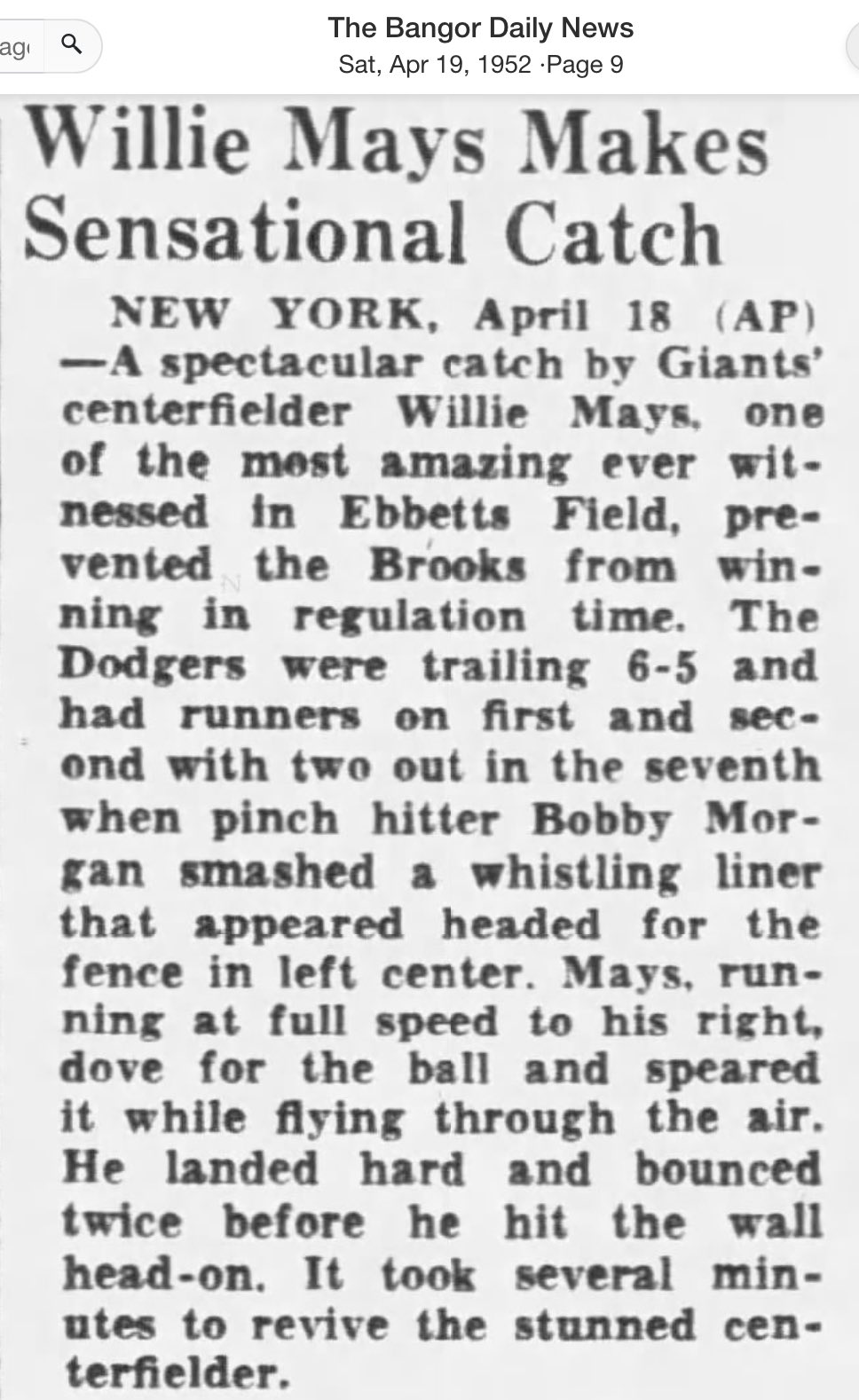
This is the AP account of the catch, saying Mays bounced twice on the gravel.
Image

A Society for American Baseball Research article on the catch describes other contemporaneous reactions:

Morgan ripped a liner into left-center-field and Mays began his sprint toward the wall. According to a reporter from Baltimore’s Afro-American, “[I]t was doubtful that anyone in the park, even the most optimistic of the Giant rooters, entertained a hope that (Mays) would catch it.”5

Mays “grabbed Morgan’s blast with a desperation lunge.”6 Dick Young wrote that Mays made “another one of his description-defying catches.” The second-year player “left his feet. He actually bounced, crashed into the wall on the first hop, and rolled over on his back. But he held the ball.”7 Young’s colleague at the New York Daily News, Dana Mozley, insisted “Willie Mays just had no right” to catch Morgan’s liner.8

After the game, the talk turned more to Mays’ catch than Pafko’s heroics. “The greatest catch I ever saw in my life,” [Dodger Pee Wee] Reese said. “He came with it. I know that. There’s no argument. It was in his glove when he turned over, and Thomson went over and picked it out.”10

Brooklyn Eagle sportwriter Harold Burr, in an article titled "Mays’ Catch Greatest, Dodgers, Giants Agree”, wrote “It looked as if the best Willie could do with the drive was to hold it to the double.”

Unfortunately, we have no film of the catch.  Based on Mays' later recollection and accounts of others it seems like Willie momentarily lost consciousness when he bounced into the wall.  Accounts have players of both sides running out to center field after the catch.  Willie remembered waking up and seeing Jackie Robinson and Leo Durocher (Giants' manager) standing over him, Jackie to see if he really caught the ball and Leo to make sure he was okay.

Mays stayed in the game, but struck out in his next two at bats.  In the bottom of the 8th, Jackie Robinson hit a home run to tie the game, and the Dodgers won in the 12th when Pafko hit his second round tripper.

Late in life, Willie said: “That (the catch off Morgan) was a good catch, better than the World Series catch. I believe my best catch.”

Bobby Morgan died in his hometown, Oklahoma City, on June 1, 2023, a month short of his 97th birthday.  At the time, he was one of only two surviving members of the Boys of Summer, the Dodgers' pennant winning teams of 1952 and 1953.  With his passing, and that of Carl Erskine in April of this year, they are all gone.  

During his time with the Dodgers, Bobby was a utility infielder known for his fielding, not hitting, though he had a good eye at the plate, drawing a lot of walks.  You can read about Bobby and some of the stories of his time in baseball here, here, and here.  

Willie Mays was the last living player from the Giants' pennant winning 1951 squad.

Tuesday, June 18, 2024

Goodbye Willie


He was the first athlete I knew by name because my dad spoke so frequently about him.  His major league debut was when I was three months old, so he's been around my entire life. Willie Mays is gone at 93.

My dad's favorite ballplayer and mine.  Willie was part of our shared lives and conversations over the years.  Dad passed ten years ago, also at the age of 93, and since then, every time I see, read, or think about Willie, I think about my father.  I knew Willie was declining but this is hard news nonetheless.

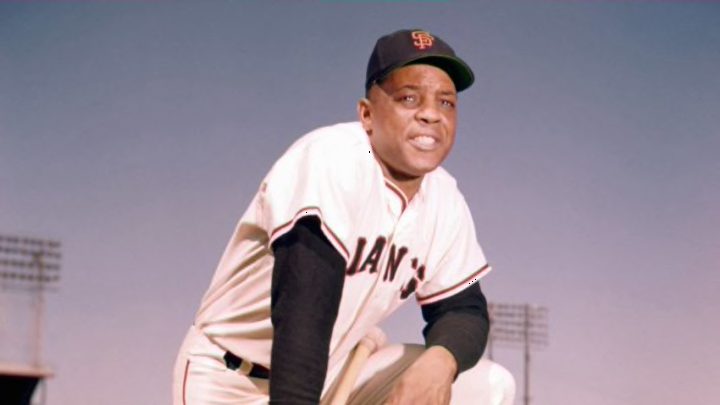
PHOENIX - MARCH, 1962: Outfielder Willie Mays #24, of the San Francisco Giants, poses for a portrait prior to a Spring Training game in March, 1962 in Phoenix, Arizona. (Photo by: Kidwiler Collection/Diamond Images)